Italian shoegazers TIGER! SHIT! TIGER! TIGER! have a name that sounds like if William Blake’s “The Tyger” got locked in a venue bathroom with a broken hand dryer and came out coughing up fuzz pedals. Stephen King also observed that in 2019, he humorously named Satan’s Almighty Penis as ‘today’s best rock group name” and awarded the runner-up to ‘Tiger! Shit! Tiger! Tiger!’. While not a traditional promotional blurb, it still seems to serve as the right kind of literary omen. The trio of Diego Masciotti, Giovanna Vedovati, and Nicola Vedovati has already dragged its analogue racket through SXSW, CMJ, and enough live rooms to make a sensible person ask whether the smoke machine needs a union rep.
With Glue, the new single from the band’s forthcoming albumDISSOLVE HERE, they turn the volume inward without tidying up the mess. Thankfully, no linen is audible here.
Glue crawls rather than charges, built on repetition, low-ceiling tension, and a guitar language that seems to have learned manners from DIIV and then spent the weekend with Sonic Youth’s Sister, coming home with bad posture and interesting stains. “that’s not me” and “spin around” circle the room like phrases someone keeps muttering after leaving a party too early, or too late, or perhaps after realizing the party was inside their skull all along. The performance feels primitive in the best sense: few pieces, no chrome, no studio perfume, just bass, drums, guitar, voice, and that lovely feeling of your identity slipping behind the couch.
The lyrics describe a dissociative spiral where identity loosens, perception blurs, and the body seems to sink through haze, light, and repetition. Desire for closeness collides with alienation, leaving the speaker caught in loops of confusion, fading self-recognition, and a need that feels both intimate and destabilizing.
“Glue functions as a raw, primitive document that transitions straight into the wall-of-sound production of our upcoming record,” says the band. “…We wanted to capture that specific, weightless headspace where identity begins to blur into the background, letting the song slowly dissolve into an extended, atmospheric instrumental outro.”
Recorded at VDSS Studio by Filippo Passamonti, DISSOLVE HERE points toward heavier down-tuned fuzz and larger walls of guitar, but Glue earns its place by pulling the frame closer. You can hear The Jesus and Mary Chain in the scuffed romance, The Veldt in the blurred devotional charge, and even a trace of James in the melodic lift that sneaks through the murk wearing a fake mustache.
By the time the instrumental coda stretches out, Glue feels less like a single than a little spell of disappearance, a band sanding itself down to a nerve before the larger album drops its full weight.
Hailing from the frozen lands of Ontario, Canada, Solarus offers a more complex and progressive variety of power metal. Of Sin and Ruin is their fourth album and they’ve got their sound down to a science. Expect the standard triumphant, soaring melodies and ethereal keyboard arrangements, but tempered with pounding drums, chugging guitar riffs, and even some growled vocals. It’s highly enjoyable if you have a tolerance for this kind of cheese.
For fans of extreme metal, it’s no surprise to see bands seclude themselves, giving us nothing until their next project drops. Sex Prisoner have been completely silent since their 2017 split EP with fellow powerviolence group Harm Done (who have since disbanded), leading fans to believe they were finished. 10 years since their debut album, Tannhäuser Gate, Sex Prisoner is back and just as quiet: no singles, no comments from the band, just a bunch of pre-orders popping up on merch sites. Their previous work brings hope of punishing powerviolence with droning bass and drum blasts like Uzi sprays. Vicious breakdowns that halt the 200-mile-per-hour pace will stomp our ribcages to the tune of disgust in humanity. There’s only the band’s history to set expectations, but their history has given us one of the most exciting discographies in modern powerviolence.
If you like your black metal to be unsettling, dissonant, and just slightly off-kilter, Mourir’s third album, Nous, Le Venin, should satisfy you. Black metal is known for being cold and arboreal, but that’s not what is on display here. Instead, it’s something more urban, though certainly not any less inhuman. The songs have grandiose and theatrical arrangements without being overly technical or obtuse. At times, the guitar riffs are twisted and thorny; elsewhere, they are straightforward and driving. Cloaking it all and bringing it together is a feeling of tension, darkness, and death.
Now this is some old-school black metal! Escumergamënt is an anonymous Swedish black metal group that may contain members of Swedish cult legends Setherial. Only one song is available for listening at time of writing, but it is a dense, icy torrent of second-wave style black metal. Miasma, tremolo-picked guitars? Check. Haunting keyboard pads? Check. Primitive production? Check. Embrace the darkness and let this into your soul.
“Negative Desire” is the sole track available preceding Cosmic Vertigo‘s release, but it shows Black Death Cult slightly demuddying their psychedelic blackened death metal. They’re more direct than they were on Devil’s Paradise, but still atonal. They weren’t going to ditch the latter quality nor their desire to disorient. After all, the record features a Uriah Heep cover and was mastered by Colin Marston. It has to be weird.
Cabinet’s sole member maintains snowmobile trails in a PistenBully as a full-time gig. It’s a lonely, cold, and punishing endeavour, much like Cabinet itself, which transposes death metal into music suitable for long treks in the Californian backcountry during the winter. So, it’s death metal cosplaying as ambient. Texture and mood overtake any riff or groove, with every moving piece being suffocated by fuzz. More interestingly, the song structures are there, they’ve just been overtaken by dust. Deracinated Into Soiled Reliquaries (Sarcophagus Odyssey) is, as such, more complex than its Mortician influence implies.
Not much these days has an organizing principle, but such a thing does not need to be complicated: songs need to sound like some kind of experience, real or imagined, and all their parts need to support that vision.
Horrifier combine early horror grindcore like Repulsion and Impetigo with more recent efforts such as Tenebro or Gwar, coming up with a musical take on the cinematic panic and paranoia of a good horror film.
Expect ripping first-five-fret riffs with bounding rhythms, tied together on a moment of not only suspension of disbelief, but suspension of normal life, colliding through rhythm and brief melodic hook to create a world of terror.
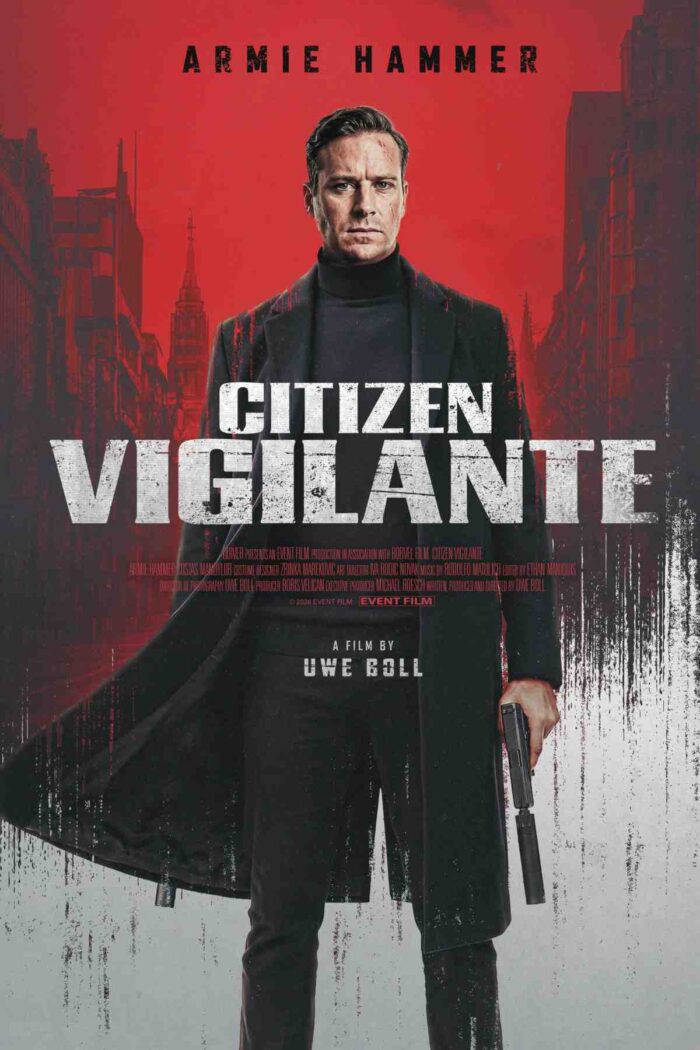
At some point, one is tempted by the hype, and has to check out the latest train-wreck from the movie industry. In this case, it is Citizen Vigilante, a Deathwish-style “delayed justice” flick.
It features MeToo-deplatformed actor Armie Hammer, grandson of Communist industrialist Armand Hammer, who is returning with a bang to his acting career by starring in the most deliberately provocative movie of our time.
The plot — in case you live under a rock and have missed the hype — involves a vigilante who, upon seeing migrants commit rapes and get a slap on the wrist from the justice system, goes on a deliciously bloody rampage.
“First the traitors, then the invaders,” might be the plot summary here, because Hammer’s vigilante makes it clear that his ultimate target is the judges and police who allowed this to happen.
He clears out the migrants as a matter of course, restoring balance to the universe, and that kind of thing. His actual motivation is to purge the weak, in a film that is both incoherent and startlingly on point.
Its peaks, following Gatsby, of course, is a scene of chicken between cars. Hammer points out that most people would rather die while following the rules than turn the steering wheel, breaking a rule, and avoiding death.
It is a powerful metaphor for the West not just in terms of migrants and diversity but how people avoid conflict and follow rules in order to preserve their bourgeois middle class existence.
Evoking High Noon as well as Dirty Harry, the film points out how the desire for comfort and respectability has neutered Europeans to the point where they allow others to become victims and ignore the underlying problem.
Moving past the obviously controversial topic of migrant rape gangs and the political system that ignores them, the core of this movie is about Europeans, UKers and USians regaining a sense of self-preservation.
Much of it makes little sense to me, such as lengthy scenes of armored vehicles driving around, but a great deal aims to explore the psychology of the American of European descent who leaves a military career to restore order.
The scenes feel like a high school production in many cases, but then hit on great insights as characters are forced to choose between ends (justice) over means (civil rights) and find themselves becoming outsider counter-revolutionaries.
There are baffling moments designed to provoke, much as one finds in Houellebecq and Celine, such as the lengthy interaction between Hammer and a prostitute, after which point he gives practical advice regarding mold growth.
But in the end, the movie makes its point. In each of us dwells both the ends-over-means warrior and the means-over-ends suburbanite, and for the sake of our souls more than even practical concerns, now is the time of choosing.
Check Shinedown’s vital signs in 2026, and everything suggests a band in rude health. The Florida alt.rockers have been out there killing it for a quarter of a century. They’re now set to release their eighth album – the cunningly titled EI8HT, loaded with 18 original songs – and surely about to boost their lifetime tally of 22 Billboard chart-topping singles. Contrast that, frontman Brent Smith says with a smile, with the doomy projections and media apathy of the band’s early days.
“Nothing was ever handed to us,” he says. “When we started in 2001, I thought to myself: ‘We’re going to be on MTV and the cover of Rolling Stone.’ That was not the case. Maybe they thought that would make me cower in a corner or give up. It did the opposite. I used it as fuel, man. My job starts when you tell me: ‘No.’”
If you don’t read between the lines (and there’s no pressure to do so; Shinedown have always been a band that are feasible to enjoy through your hair, feet and fists, with your brain as an optional extra), then EI8HT feels like another uncomplicated, escapist, chest-pounding triumph. The long-settled line-up of Smith, guitarist Zach Myers, bassist Eric Bass and drummer Barry Kerch have always been strong on hooks that hit a stadium’s back wall, and that knack is represented on incoming anthems like Dance, Kid, Dance and Burning Down The Disco.
“There’s something about what we do that resonates with people,” the frontman says of Shinedown’s mass appeal Stateside, underlined by record sales of more than 10 million. “I will never, for the life of me, necessarily understand why that is, but I don’t question it. I just hold on tight and ride.”
But the new record’s near-two-year genesis wasn’t necessarily joyous, he counters.
“There is an immense amount of emotional real estate on this album. There’s been a lot of loss in the band. Eric lost his dad and aunt. His wife lost her sister. I lost my granny, my mom. When loved ones pass away, our instinct is to say: ‘I’m so sorry for your loss.’ But a song like Three Six Five is about how they may be physically gone but their spirit will never leave you. It’s not that they’re gone, they’re everywhere. They’ve transcended.”
Meanwhile, the singer adds that it was difficult to stop culture wars, actual wars and big tech dripping into his headspace (while staying discreet on his own political stripes).
“We’re in a situation right now where there’s a lot of people trying to flex their power,” he says. “But you’re never gonna outrun karma. You’re going to pay for it here. Or you’re going to pay for it in the next life. I know some people might look at that and be like: ‘Well what if there’s nothing after this?’ And I just say to them: ‘You’re not gonna get out that easy.’”
All of this context swirled around the band as they set to work in the barn studio on Bass’s South Carolina property.
“Eric is probably a bass player last, more like a Swiss Army knife,” Smith says proudly. “He’s mixed, produced and engineered the last three albums. It’s astonishing to watch this man work. You’re talking eighteen-hour days, no sleep, months at a time. He’s a mad scientist. You don’t know which Eric you’re gonna get on any given day.
“There’s a little bit of One Flew Over The Cuckoo’s Nest. The studio looks all nice and put together, but then you leave for twenty-four hours, come back, and it’s like a tornado hit it. He’s pulling out pedals, keyboards, stuff you didn’t even know he had. He’s searching for something, going down the rabbit hole…”
EI8HT doesn’t sound over-produced, though? Smith shakes his head.
“Everybody had to play through all the songs; we didn’t want cut ’n’ paste or computer surgery. It’s just gonna sound robotic. We might as well be an AI band if we do that. So we doubled down. When you open up the record case, there’s a stamp we created that says: ‘100% human – no AI used in the making of this record’. Y’know, like Rage Against The Machine wrote back in the day: ‘All sounds made by guitar, bass, drums and vocals’.”
It doesn’t take much of a nudge of Smith for him to let rip at Silicon Valley.
“Developers of AI in the music sphere think people are sheep, and they’re finding out they’re not. They’re like: ‘This is the way of the future and everybody’s gonna listen to robots.’ And it’s like: ‘Yeah, man, nobody likes it.’ AI music is a novelty at best. And I may get some hate for this. But I don’t care.
“Because here’s the reality: there is something about when you put human beings in a room and they start pushing air. You’re never gonna replace drums, bass, guitar, badass vocals and a killer song. And by the way, I need to remind people of something about AI: you can always go over to the wall and unplug it.”
Brent Smith (Image credit: Ebru Yildiz)
Rant over, he gets back to EI8HT.
“I guess you could say we were a bit Buddhist, philosophy-wise, on this record. Buddhists believe you should leave imperfection in art. That you’ve lost the humanity if you make it perfect.”
Shinedown are big on humanity. Powered by an eerie, electro-rock pulse with shades of Depeche Mode, Imposter finds Smith questioning why modern teenagers seek to numb themselves (“I’ve met so many young people over our career. You’ll be talking to a fourteen-year-old who’s addicted to drugs, y’know?”).
Machine Gun’s driving pop-punk gives a voice to his and Bass’s grandfathers in WWII. “They both had a similar story. They called out to the universe, like: ‘I’ll do my duty and complete the mission, but if you can get me out of this mess and back to the woman I love, I’ll be a good man.’ We wrote it from the position of what they were going through in the trenches. So that’s where that line ‘Instead of you, I’m holding a machine gun’ comes from. Both of them survived, and when they got home the first thing they did was marry their significant other, our grandmothers.”
Other songs seem to pull 48-year-old Smith himself back to a simpler time. On the edgy, cinematic Deep End, he explains: “I’m transported back to opening night at the movie theatre, Brandon Lee in The Crow [1994]”. The hazy, golden swirl of Young Again reconnects with his childhood as a “handful, a troublemaker, growing up in the eighties, before cell phones, when you could just take off and you were gone, man”
Eric Bass (2009), Barry Kerch (2012) and Zach Myers (2009) onstage (Image credit: Eric Bass, Zach Myers : Barry Brecheisen/WireImage | Barry Kerch: Chelsea Lauren/FilmMagic)
Smith’s Southern roots, meanwhile, are saluted subtly in the music.
“Searchlight is dipping a toe into country. That song reminded me of growing up in East Tennessee. I sang it with a different conviction to songs like Back To The Living, which is more soulful. I’m singing a bit more from my roots – R&B, Otis Redding, Billie Holiday, Al Green, Sam Cooke, Etta James…”
Perhaps. But as if to reaffirm their early alt.metal piss and vinegar, there’s also the seething Safe And Sound.
“Some comments are like: ‘I didn’t know they still had this in them.’ Which I find interesting,” Smith says of the fan response. “Some of them are like: ‘I thought Shinedown were a pop band.’ And then other people are like: ‘I thought they were more of a metal band’ Or: ‘I thought they were an alt. band.’ Here’s the reality of it: Shinedown is everyone’s band.”
Dizzy might prick up your ears too. The singer bills the wistful-slash-euphoric anthem as a salute to a lifelong comrade (“It’s about your best friend, your ride-or-die”). But lines like ‘I swear I didn’t smoke and I’m off the wine’ will remind long-term fans of Smith’s unravelling in the early post-millennium. He has said cocaine, alcohol and opioid painkiller OxyContin were all dark backdrops to 2003’s Leave A Whisper and 2005’s Us And Them.
“Why did it call to me?” he wonders out loud. “Because it felt good. It wasn’t about wanting to be inspired or be creative or anything. I did it because I was curious. And when I did it, I found: ‘Oh, this makes me feel good. I wonder what that will make me feel like.’”
Shinedown are such a tight unit. How did your bandmates deal with your addictions?
“They saved my life. Without question. They never judged me. I’ll never forget Barry looking at me at my lowest and him being like: ‘Dude, I’m not a cop. I’m not here to arrest you or take you in. I just don’t want to watch you die. Please, whatever I got to do, man, I’ll do it. Just don’t leave me. Don’t leave us. We have no idea why you’re torturing yourself like this, but please, you have to stop.’”
Smith credits his then-newborn son (now 18) for the decisive push towards sobriety. “I’d just turned thirty, and that’s when I realised it was no longer about me. Like, I’m no good to this child if I’m dead. We don’t know when it’s our time. I could have a freak accident, act of God, whatever. But I do have control of whether I’m gonna do that line, drink that bottle, smoke that rock. I do have a choice in regards to that. I can stop that.”
Smith piled on the weight when he kicked his habit (in an interview with the LA Times, he recalled his heart “falling on the floor” when, during a 2009 performance on Today, the show’s hosts likened his appearance to Meat Loaf). These days the singer looks sharp and battle-ready.
“I’ll be transparent,’ he says. “I had to change my lifestyle about a decade ago, because I just wasn’t going to be able to keep up with the way I wanted to be on stage. I did a lot of research about diet, nutrition, exercise, supplementation, all these different things where people are like: ‘Oh, it’s all hocus pocus.’ I just recently started doing yoga four days a week. Back in the day, people were like [rolls eyes]. But when you start getting older, the most crucial thing you need to be is flexible. You have to work that shit out, dude. You can’t be stagnant.”
Outwardly, Smith is a machine. But has he buried that troubled individual for good?
“Oh, he’s with me every single day,” he says. “I’m not talking about schizophrenia. But I am, and forever will be, an addict and an alcoholic. He’s in here [taps head]. He’s very, very far in the back of my subconscious. But there are days I wake up that he can get loud, and I have to tell him: ‘Not today, man.’ That’s the only thing in my life that I have to do one day at a time. I have to remember: ‘I didn’t do drugs today, I didn’t drink today. But I have no idea what I’ll do tomorrow.’ So it’s never like: ‘I’m good. I can forget about it.’ Because at any given moment he could pick the lock and get out of the cage.”
Right now, with a killer new album in the can and November’s UK arena dates testament to a band making steady inroads overseas, you’d bet on Smith’s Dr Jekyll winning out over his Mr Hyde.
“I’m not surprised we’ve made it to an eighth album, but I’m very grateful,” he says. “And there’s a statement I keep in the front of my mind. In my worst throes of addiction, I had a friend of mine tell me: ‘Dude, you focus on wanting to be this hardcore individual, on wanting to be punk-rock. But that other guy. He’s not trying to have fun with you, he’s trying to end you. And I’m telling you right now, man, when you’re clean, sober and locked in, that’s when you’re at your most dangerous.’”
In this interview, we chat with Marianelle and Navka of the Ukrainian symphonic metal band Thy Despair to discuss how they combine keyboards and vocals to shape the group’s dark, atmospheric sound. The duo also opens up about the emotional reality of playing live in Kyiv, navigating the metal scene as women, and the unexpected places they find musical inspiration.
Reuel
Hello Marianelle, hello Navka! I’m happy to chat with you. How are you doing?
Marianelle
Hello! Thank you for inviting us. We’re glad to be part of this conversation. These are difficult times for us as Ukrainians because of Russia’s full-scale invasion of Ukraine. Like everyone else in Ukraine, we have difficult days, sleepless nights and moments of exhaustion. But music helps us stay strong and move forward. That’s why we’re always grateful for every opportunity to share our music and connect with people.
Navka
Hello, nice to meet you! My deepest gratitude to the Armed Forces of Ukraine. These brave men and women give us the opportunity to live in our own home, create music, and share our work with the world.
Reuel
Two of the main elements that define symphonic metal and make it unique are the keyboards and the vocals. How do you two work together to combine these parts and shape the band’s sound?
Marianelle
We often discuss arrangements and details together with the band, especially when it comes to harmonies, backing vocals and creating the right atmosphere. I think this interaction helps tell the same story from different angles and contributes to the overall character of the band’s sound.
Navka
I’m always open to arrangement discussions and creative debates, because that’s the only way to craft a truly rich and multifaceted composition – especially when we’re talking about symphonic metal!
Reuel
Your music deals with heavy themes like freedom and resilience. How do you get ready emotionally before a live show?
Marianelle
To be honest, it’s not always easy to feel fully prepared emotionally. There are times when we feel exhausted after difficult nights and constant attacks. But we truly love what we do. Every time we step on stage and connect with the audience, we gain new energy. For a while, we can completely immerse ourselves in that shared atmosphere and that helps us keep going.
Navka
I think back to our previous performances and the wonderful feedback from our beloved audience, and I realize that today we will bring them joy once again, while they will once again reward us with their warmth and enthusiasm. In these difficult times that all of us are living through, every positive emotion feels like a breath of fresh air.
Reuel
As women in the symphonic metal scene, what has your experience been like, and do you feel there’s a strong community among female musicians in the genre?
Marianelle
For me, music has always come first. I’ve never really thought about my place in the scene in terms of gender — I prefer to focus on the music, the performance and the connection with the audience.
Navka
Most of the people in our community do not place much emphasis on gender. What matters more is your skill with your instrument and your ability to work as part of a team.
Reuel
You’ve been playing shows in Kyiv recently. What does it mean to you personally to play live and connect with the audience there right now?
Marianelle
It means a lot to us, especially now. We live in very difficult times, and despite regular attacks, power outages, sleepless nights and even when the subway may not be running normally, people still find a way to come to our shows.
What makes it special is that we’re all going through the same reality. For a few hours, the distance between the stage and the audience disappears and it feels like everyone is sharing the same moment together.
Navka
It is a never-ending source of inspiration that motivates me to keep creating and improving.
Reuel
What new sounds or ideas are you most excited to try out in your future music?
Marianelle
We’ve always been open to experimenting and exploring different sounds, and we never want to limit ourselves creatively. At the same time, what matters most to us is the emotion behind the music. Whatever direction we take, our goal is always to create something honest, meaningful and true to who we are.
Reuel
What are your thoughts on how women are represented in music today, and what do you think can be done to promote more inclusivity and support for female musicians?
Marianelle
I think the most important thing is to focus on musicians for their talent, creativity and dedication rather than their gender. The best way to support female musicians, or any musicians, is to support good music, encourage new artists and create an environment where people are judged by their work and not by stereotypes.
Navka
The best support for a creative person of any gender is validation within their inner circle. And this should come without trying to fit them into a Procrustean bed of behavioral, appearance or creative standards – something that, unfortunately, women face more often. However, over the last 10-15 years I’ve seen a steady trend toward breaking down these standards, and that’s really cool! The support of family and friends can keep you afloat when the whole world is against you; at the same time, even at the peak of success, a person can feel deeply miserable if the people who matter most belittle and ridicule them.
Reuel
What was it like joining a band that already had so much history, and how did you put your own spin on their older songs?
Marianelle
I’m grateful to have joined a band with such a long and rich history. What makes it even more special is that the music truly resonates with me, so being able to perform these songs together with the band means a lot.
As for adding my own touch, I think it happens naturally. I bring my own emotions, experiences and feelings into every performance while staying true to the spirit of the songs. My goal is not to change them, but to express it in the most honest and authentic way I can.
Reuel
How do you handle singing the band’s older songs compared to the new ones you helped create?
Marianelle
For me, the main difference is not between old and new songs, but between representing the different moods and styles. Thy Despair’s earlier and newer material is quite different, and I really love this diversity.
My musical education has given me a strong foundation to work with different kinds of material, so I feel comfortable performing both older and newer songs. What matters most to me is connecting with the music emotionally, and I enjoy performing all the band’s material.
Reuel
What got you into symphonic metal, and which vocalists influence you the most?
Marianelle
Norwegian sympho-gothic metal band Sirenia completely changed my life. They were the band that introduced me to metal and made me realize that I not only loved this music, but also wanted to sing myself. That was the beginning of my journey, and their influence is still very special to me.
As for vocalists, I’m inspired by several incredible singers, especially Emmanuelle Zoldan, Vibeke Stene, and AnnLouise Lögdlund. Each of them has a unique voice and artistic identity that I deeply admire.
Reuel
Navka, how has your approach to the keyboards changed as the band’s overall sound has evolved over the years?
Navka
As time went on, the band grew to sound increasingly heavy, grim and powerful. It became clear to me that symphonic orchestral arrangements were absolutely essential. You could hear our initial foray into this sound on our recent release. Currently, I am crafting the keyboard arrangements for our new release, aiming to forge an intensely dark and epic atmosphere.
Reuel
Where do you get your inspiration when writing the atmospheric keyboard parts?
Navka
I draw inspiration from many things: from the books I read and the stories I hear, to my favorite music – ranging from folk music to symphonic black metal – and long weekend walks in the woods. Yes, sometimes to create music you just need to listen to the silence.
Reuel
How do you balance staying in the background for atmosphere versus taking the lead on melodies?
Navka
A keyboardist isn’t just staying in the background for atmosphere — it’s a full-fledged participant in a musical performance with a solid place in the mix. That’s why I can either drive the main melody or accentuate things like a guitar solo or vocals, depending entirely on how the arrangement is structured in a specific song or its fragment.
Reuel
Thank you for your time, ladies! Is there anything else you’d like to add?
Marianelle
It’s still difficult to make long-term plans while the war in Ukraine continues, but we keep moving forward and creating music.
We’re currently working on something new, and we hope to share more details soon. But it’s still too early for big announcements. Until then, stay with us, support Ukraine, support Ukrainian metal and let us touch your souls with our dark and powerful music.
Navka
Music has always been an anchor and a source of support for me. In the times our country is going through right now, this is especially valuable, and the feedback from our listeners becomes incredibly heartwarming.