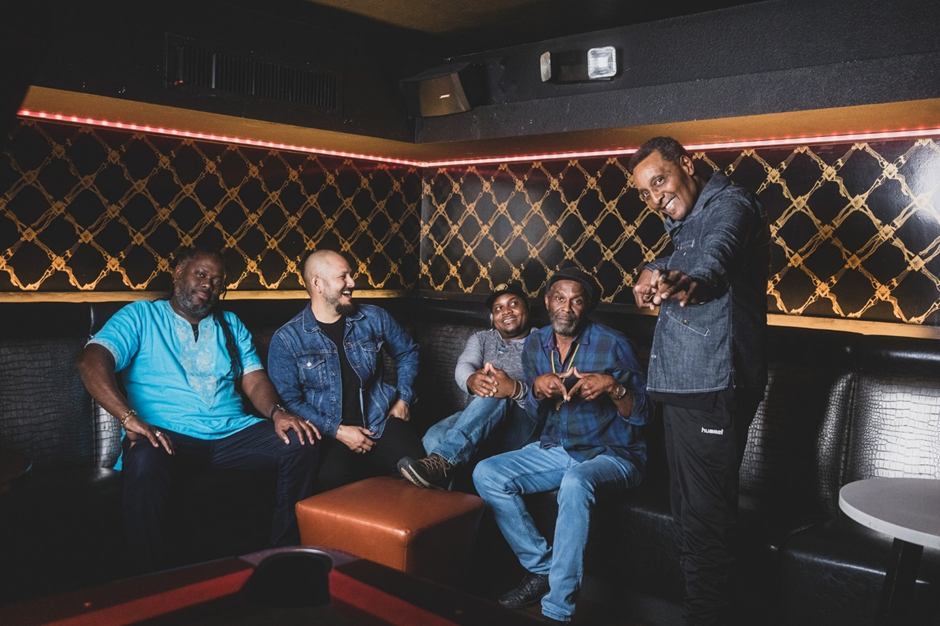
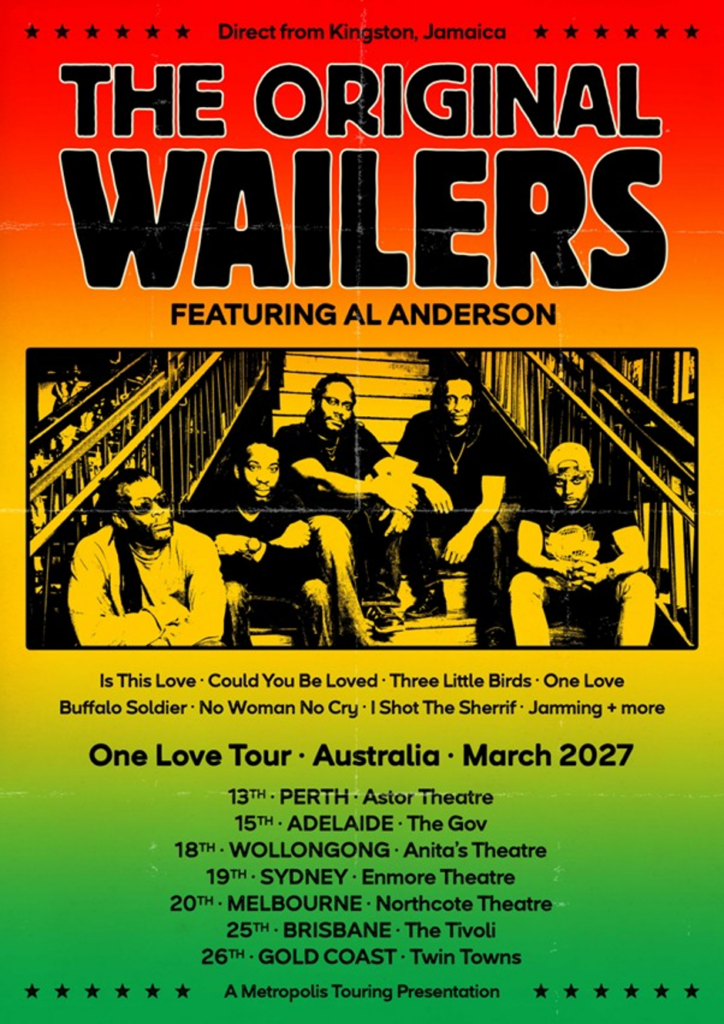
Reggae Royalty, THE ORIGINAL WAILERS, led by legendary guitarist Al Anderson, return to Australia in March 2027 for the One Love Tour.
Al Anderson is the sole surviving member from the mid-1970s Bob Marley & The Wailers classic lineup. Al joined in 1974 for the Natty Dread recording sessions, he also played on Live!, Babylon by Bus, Survival, and Uprising. Al Anderson also has the distinction of backing PETER TOSH on the albums Legalize It and Equal Rights.
In the last few days of his life Bob Marley told Al: “Al, I’m going on my journey. Please honour the music that we made together and make sure the band stays together”. He’s doing just that. They deliver the timeless catalogue with a feel-good setlist that includes Is This Love, Could You Be Loved, Three Little Birds, One Love, Buffalo Soldier, No Woman No Cry, I Shot the Sheriff, Jamming plus More
On the One Love Tour, The Original Wailers will respectfully honour the songs of Bob Marley and The Wailers with a spirit and authenticity that only they can.
Peace. Love. Unity
THE ORIGINAL WAILERS ‘’One Love’’ March 2027 Australian Tour Dates
Tickets:
Presale: Tuesday June 9th, 10am Local time –
General Public On Sale: Friday June 12th, 10am Local time
After some visits to Czechia, Hungary, and a trip planned for Romania, it dawned on me that I have always had a special affection for Eastern Bloc* metal music. From heavy to black to death metal and all in between; these lands behind the Iron Curtain had a unique characteristic to their bands, whichever the style. Over the years, I have been lucky to see Pokolgép in Hungary, Törr in Czechia, and performances of Root, Tormentor, Imperator, and plenty more of the bands I talk about below. Others I will certainly never get the chance to see and will even struggle to get their records (though I have a healthy chunk of those mentioned too, mostly purchased overseas on my travels). Some do not even have officially pressed records or tapes, and the only surviving recordings are from reel-to-reel that people have recovered. This is by no means a complete list of all of these countries’ bands nor an in-depth biography of the bands hailing from them. This is more a place to start for underground maniacs from the West (or anywhere in the world) to start their journey exploring these bands.
*For clarity, my definition of the “Eastern Bloc” is countries which were a part of the Warsaw Pact: Albania, Bulgaria, Czechoslovakia, GDR (East Germany), Hungary, Poland, Romania, the Soviet Union, and Yugoslavia (who were a non-aligned country but for several reasons such as felt appropriate to include). Furthermore, this is definitely not a glorification of the communism these bands existed under; but a celebration of the rebellious spirit of heavy metal and its ability to exist in the harshest of conditions.
Albania
My first contact with Albanian metal was the EP “The Death Spirit” by Wild Feeling. For such a short release, it definitely has a wide range of ideas, some better than others. The real gem from Albania is Thunder Way. Their only release, “The Order Executors”, a full-length from 1993, is a ripping storm of razor-sharp power metal. Not too far from early Helloween or Blind Guardian but with a grittier guitar sound, thinner production but still excellent with a majestic vocal performance that really stands out. Aside from this, you can find a lot of classic rock from Albania, some stronger than others, but these were the only real metal releases I found thus far.
Bulgaria
The land of Bulgaria gave us Trotyl, an interesting hybrid of doom and power metal, whose “Lunatic” single was my first time hearing Bulgarian metal. This 7″ has a distinctly NWOBHM feeling akin to Demon or Cloven Hoof, which felt strangely familiar in a very pleasant manner. One of the oldest Bulgarian bands I found was Славяни, dating back to 1973! Only two songs were recorded and unearthed by “Heavy Metal of Eastern Bloc” (the channel I found several of these releases thanks to), but they showed a promising melodic heavy metal more akin to Iron Maiden and early USPM. From the early to mid-90s, there seemed to be a lot more black, death, and thrash metal coming from Bulgaria – the prime example I could find being Ексхуматор who mix all of the above to some pretty unholy and wild results.
Czechoslovakia
I associate this country more with black metal than anything else. From the otherworldly occultism of Root to the thrashing primitivism of Törr, and of course the unusual avant-garde experimentalism of Master’s Hammer. Czechoslovakia pushed metal into some strange corners that still have a massive impact to this day! Törr‘s demo and first three albums are essential. Master’s Hammer’s “The Ritual” and “Jilemnický Okultista” are definitely their highlights, along with the demo versions. As for Root, I think the first three LPs (“Zjevení”, “Hell Symphony” and “The Temple in the Underworld”) are the perfect trinity of this magnificent band, but they did do some great stuff in their later years too. The natural mystique of this land clearly leaves a mark on the bands who each possess this profound sense of mystery.
As for a more straightforward traditional heavy metal angle; Vitacit‘s 80s recordings are surprisingly well-produced and have more in common with American bands due to their tight musicianship and anthemic songwriting with dynamic structures. I recommend “Noc Satana”! Similarly, Citron take good old heavy metal with a catchy style and give it that classic mid-80s Eastern Bloc feel (best album “Plni Energie”). Another very classic-sounding heavy metal band I suggest is Excalibur with their self-titled demo from 1990 (recorded 1989). One last EP recommendation is the powerhouse 7″ from Morava entitled “Heavy Metal”. With a title like that, what’s not to like? For the thrash metal fans, I suggest Drakar for their blend of thrash and heavy metal in quite a unique way on their debut album “Let Drakar”. As for favourites? Törr‘s “Witchhammer” demo, Root‘s “The Temple in the Underworld” and Master’s Hammer‘s “The Ritual” are the definitive trio of Czech records for me.
East Germany
East Germany may have had fewer bands than its western counterpart, but there were some real gems. Formel 1 may not have had a formal studio album, but their recordings mostly intended for radio play proved them to be a more than worthy force, as the “Auf dem Weg nach oben (1982-1987)” compilation showcases. These bands sort of mirror what was happening in the rest of Germany with an inclination to a more speed metal sound while still bearing an influence from the east. Macbeth from Erfurt was one of the first from the GDR as well, their “Demo 1985” showcasing a powerful and driven heavy metal assault that is gritty and full of energy.
One of Germany’s most famous bands is Warlock. So naturally, the GDR had a sort of mirror to this – a band under the name Plattform. Fierce heavy metal with a powerful female vocal attack certainly resembling that of Doro Pesch. Of course, we cannot talk about German metal without some thrash, so enter Panther to the conversation. These guys rip in the vein of Assassin, Exumer, Kreator, and most of all, Sodom. In fact, their cover of “Bombenhagel” got them banned from playing live in East Germany. “Total Chaos” is a demo that delivers what it promises with such a title; violent and deathly thrashing mania!
Hungary
Hungary has the widest selection of heavy metal that I’m aware of. Pokolgép is probably the most widely known. Their exhilarating melodies and massive dynamics, delivered with powerful musicianship and some of the best songwriting in heavy metal, are simply sublime. Along with Tormentor, one of the best black metal bands of all time! Aside from these two titans, bands worth your time include: Ossian, Stress, Omen, Metal Lady, Rotor, Akela (the 1990 demo), and for the thrashers: Moby Dick!
Suggested listening: both Tormentor demos, the first five Pokolgép LPs (especially “Totális Metál” and “Pokoli Szíjáték”), Ossian‘s “A Rock Katonái” (totally wicked heavy metal which I blind bought in Budapest and it blew me away as soon as the needle dropped), Stress‘ “Kísértet Kastély” (another legendary record of pure heavy metal might), and Rotor‘s “Tépj Szét Minden Láncot” (a more obscure discovery which sounds like a mix of Running Wild and Heavy Load). If you love József Kalapács’ vocals on the first four Pokolgép albums, check out Omen, the band he was in afterwards (I recommend the “Brutális Tangó” album). Another real gem from Hungary, although not an album, is the 1987 demo by Sámán.
Hungary definitely seems to have a command of writing catchy, memorable, and yet intense records that really leave a mark on you. There is a darkness or melancholy present on all of these, even in their most anthemic moments.
Poland
Poland is definitely the country with the strongest death metal out of the bunch. The absolute pinnacle being Imperator, one of my favourite death metal bands of all time. Without a doubt, some of the most brutal material you’ll ever hear. Of course, legendary bands like Vader spawned from here too. Another gem is Magnus, especially the “Scarlet Slaughterer” album – total savagery with a death-thrashing artillery strike you cannot miss!
The other real legends of Poland are the more speed/thrash-oriented Kat (both variants of the debut are perfect in my book) and Turbo (“Kawaleria Szatana” is the best in my opinion). Kat‘s “Metal and Hell” is the defining Polish metal album for me alongside Imperator‘s “The Time Before Time”! Poland seems to be the country to go to for brutality, especially in the drumming department, with all of these bands having a more percussive impact.
Romania
Romania seemed to have less in the way of traditional heavy metal, but two really killer examples I found are Voltaj (who went on to play pop music) and Metalchrist, who had a sharper mix of speed/power metal that is reminiscent of USPM in some parts. Both bands hail from the country’s capital city, Bucharest. A lot of hard rock seemed to come about in the 90s, but as for proper heavy metal, these bands remain the only real stand-outs for me. That said, the debut Voltaj record “Pericol de Moarte” and sole Metalchrist “Nihil Sine Deo” are real gems.
Soviet Union
I think the most common comparison between Eastern and Western Europe is while the west has Iron Maiden, the East has Ария from Moscow. This band nailed the huge sense of melody, theatrics and detailed musicianship coupled with a powerful sound. Having formed in 1985 and releasing some landmark albums in the 80s, they are still around and playing shows today! My favourite album is “Игра с огнём”. Another massive band in Russia is Круиз. Their “Kruiz” album one of the most well-regarded heavy metal records from Russia. If Ария is Russia’s Iron Maiden, then Круиз is their Judas Priest.
Магнит were another prolific Russian band, releasing several albums in the late 80s. Mixing power and speed metal in a really epic and exciting manner. Their album “День гнева” is a masterclass in shredding guitars, soaring vocals, and a simply majestic execution all around. Another real treasure is Хопо‘s 1989 (recorded 1988) debut album “Преданность и предательство” – a surging and electrifying opus of melodic heavy metal with some haunting vocals, killer lead guitars and memorable riffs. Next up we have the more obscure Консул who recorded a ripping demo in 1989 which has a sharp and dry sound with some really cool vocals. Титаник from Kyiv (now Ukraine) mixed things up with some songs which felt a bit more thrash than a lot of other bands in the region and others that were much softer and more brooding.
Yugoslavia
Yugoslavia has since become a plethora of countries (Bosnia and Herzegovina, Croatia, Kosovo, Montenegro, North Macedonia, Serbia, and Slovenia), so this section may contain bands from any of these nations. Forming in Croatia, Divlje Jagode is definitely the band which is by far the most known. Dating back to 1977, they are also one of the oldest on this list. Another older act is Gordi, hailing from Serbia, whose 1982 record “Kraljica Smrti” balanced a mix of more harmonious heavy metal with a more aggressive, street-ready attack reminiscent of 80s Judas Priest, Saxon and sometimes even Motörhead.
Next up from Bosnia and Herzegovina’s capital Sarajevo comes high-octane thrash/speed metal band Bombarder. Whereas Divlje Jagode and Gordi had a more classic heavy metal/hard rock sound, Bombarder up the ante with a raw and in-your-face thrash attack with some rusted barbed wire vocals to grapple with. Check out “Speed Kill” – this is some evil stuff! On a lighter note, the hard-hitting melodic heavy metal of Legija from Croatia will certainly have you rocking out with some excellent lead guitar work and haunting vocal passages on the “Demoni u noći” demo from 1985.
One precursor to all of this that feels like an especially “metal” practice was the art of pressing music onto X-ray films (like a skeletal flexi-disc) as a means to bootleg music under the communist regime. Perhaps this is not directly relevant to the topic of heavy metal, which is set a couple of decades later, but this felt like an element of the people’s creativity when it came to accessing music that was too cool not to mention. Furthermore, this is one of the ways people accessed early rock ‘n’ roll music from the West and thus perhaps a factor in the musical ancestry of these bands.
So there you have it! This serves as some sort of starting point for those of you wanting to discover heavy metal from the Eastern Bloc. As I said in the introduction, it is not a complete history nor detailed biography but more of a cursory glance at some amazing bands from an isolated region of Europe that deserve a spotlight. Some are more known, some are real obscure gems, but I hope everything talked about inspires you to check out some bands, dig for yourselves, and form your own opinions.
Of course, there will be things I have missed and things I won’t “get” as someone from the other side of the continent, but this is the opening of a dialogue I think is worth having because a lot of people ask me about X record I talk about or show from this part of the world. I would also like to give thanks to “Heavy Metal of Eastern Bloc” on YouTube for the huge selection of records uploaded. A second credit goes to The Corroseum, which I found some further gems from. Finally, Metal Archives proved useful for information, as usual. Thanks to everyone who chooses to read this and to all heavy metallers who still seek obscure gems from around the world. If you found this helpful, please share it with your friends who are die-hard metallers!
Ruthie Foster has announced the release of her new studio album, Just Say Yes, arriving August 28 via Sun Records.
The Austin-based GRAMMY Award-winning artist also released the album’s lead single, “Thank You,” a blues, rock and gospel-infused track that explores feelings of imposter syndrome. The song reflects on Foster’s experiences being questioned about her authenticity as a blues artist despite earning widespread acclaim, including a GRAMMY Award for Best Contemporary Blues Album.
“There’s a front door, but there’s also a window and back door. There’s ways to get in,” Foster says. “I never put any kind of constraints on myself. I’m showing up with all of this.”
Produced in Nashville by Tyler Bryant and co-written with Bryant and Rebecca Lovell of Larkin Poe, Just Say Yes features 10 tracks that blend soul, roots and blues influences. The album follows Foster’s GRAMMY-winning album Mileage and arrives during a significant period of personal reflection and transition for the veteran singer-songwriter.
“I’m amazed at how I got to this place,” Foster says.
Foster’s path to success has spanned more than three decades. After serving in the U.S. Navy, she signed with a major label before stepping away from music in 1993 to care for her ill mother. Following her mother’s death, she returned to music as an independent artist and steadily built a career that ultimately led to GRAMMY recognition.
The title of the new album came from a simple reminder Foster wrote to herself.
“I wrote this thing on a sticky note and it just said ‘Just say yes,’” she recalls.
The album also arrives after Foster suffered a torn meniscus while running to catch a flight last year. She underwent knee surgery in December and says the experience forced her to reevaluate both her personal life and her approach to performing.
“It’s not just about age. It’s really about the miles I’ve put on,” she says. “Every step matters.”
Before undergoing surgery, Foster used a break from touring to spend a week recording in Nashville. She reunited with Bryant and Lovell, who also worked on Mileage, and expanded the sessions into a family affair with Megan Lovell and Mike Seal joining the project.
“Every last one of these songs are about some aspect of my life,” Foster explains.
As she worked on the album, Foster was navigating both physical recovery and uncertainty within her personal relationship. Those experiences became central themes throughout the project.
“This was my way of being true to who I am and knowing that I’m in yet another transition in my life, which is how these albums tend to happen,” she continues.
Track Listing
Thank You Come on Up (featuring Larkin Poe) Hold On Yes Take Time Doubling Back Tangled Sitting Still Maybe It Up Reachin’
Tour Dates
June 5 – Burlington, VT – Burlington Jazz Festival June 7 – Chicago, IL – Chicago Blues Festival June 12 – Austin, TX – Paramount Theater June 25 – Eugene, OR – The John G. Shedd Institute For The Arts June 26 – Berkeley, CA – The Freight June 27-28 – San Jose, CA – Fountain Blues & Brews Festival June 28 – Nicasio, CA – Ruthie Foster BBQ On The Lawn June 29 – Grass Valley, CA – The Center For The Arts July 10 – Columbus, OH – Bicentennial Park July 11 – Deadwood, SD – Deadwood Blues Festival July 16-18 – Taos Pueblo, NM – She Rises International Women’s Music Festival July 24 – South Park Township, PA – South Park Amphitheater August 1 – Woodstock, NY – Sun Records Midnight Ramble August 2 – Woodstock, NY – Sun Records Midnight Ramble August 12-13 – Big Indian, NY – Catskills Crossroads Blues Camp August 14 – Brattleboro, VT – Stone Church August 16 – Thornton, NH – White Mountain Boogie N’ Blues August 20 – Brownfield, ME – Stone Mountain Arts Center August 21 – Plymouth, MA – Spire Center for the Performing Arts August 22 – Falmouth, MA – Falmouth Academy August 23 – Albany, NY – The Egg August 25 – Okoboji, IA – Pearson Lakes Art Center September 10-13 – Las Vegas, NV – Big Blues Bender September 13 – Cerritos, CA – Cerritos Center For The Performing Arts September 15-19 – Nashville, TN – AmericanaFest October 31-November 7 – San Diego, CA – The Legendary Rhythm & Blues Cruise February 26-March 5, 2027 – Miami, FL – Cayamo
Tommy Lee shared that he took both tap and ballet dance lessons in his youth, finding an interest in the beat-driven experience of it all. Continue reading…