Category: news

  • “We touch on loss, grief and an octopus”: Mastodon’s transit from triumph to tragedy and back on fifth album The Hunter

    Crack The Skye established US prog metallers Mastodon on many prog fan’s radars. When it came to a follow-up there were bigger riffs and choruses, but it still beat with a prog heart, as the band told Prog when we sat down to talk about The Hunter in 2011.

    Unlike its namesake, Atlanta progressive titans Mastodon have sidestepped extinction through the clever notion of adaption. In an industry and a market that cries out for new ideas and reinvention, they continue to surviv and thrive with The Hunter. “It’s not in our nature to say we’re going to write songs that are different to anything we’ve ever done, because that puts pressure on us.” sasy bassist Troy Sanders. “But thankfully it comes naturally. I love change – we embrace the unknown.” His words resonate not just with his bandmates, but with the swathe of fans they’ve amassed.

    When their previous album, Crack The Skye, came out, people sat up and listened. Here was a band, traditionally regarded as metal, releasing a masterpiece in heavy prog. It became not only a landmark record for metal fans, but an enthralling concept album for proggers with a penchant for metallic elements.

    For their fifth album, they could easily have knocked out Crack The Skye II and no one would have batted an eyelid. But sticking to their ethos, they have surprised again. The Hunter is the most melodic record the Georgia-rooted four-piece have created to date, to the extent that it contains a plethora of – saints above! – sing-a-long choruses. Gone are the heaps of thick, oppressive, acerbic riffs borne out of their mutual admiration for post-punk and sludge metal. Here instead are groovy basslines, acrobatic drumming, sensitive riffs, vast, spatial, shimmery effects and gentle psychedelic vibes.

    “Once we decided to shed the idea of having another concept album, I feel like it breathed fresh energy back into the band,” says Sanders. “And that’s what lent itself to songs coming together rather quickly.”

    Drummer Brann Dailor adds: “We thought how cool would it be to abandon the Mastodon comfort zone and do something completely different.” While very melodic in many points throughout the record, The Hunter is also more urgent and riff-laden than Crack The Skye. “It’s a knee-jerk reaction to spending two years touring Crack The Skye, which was so proggy and layered,” Dailor explains. “We wanted to let loose from that. The songs are probably the most instinctual we’ve ever put together – where we’ve worked the least on fine-tuning and tailoring every little piece.”

    Knowing that they’d be booked up all summer with festival appearances, it was ‘now or never’ to get the songs laid down. “Our music is like milk,” Dailor says. “If we’d let it sit while we go to Europe it would have spoiled a little bit.” They split their time between Los Angeles and Atlanta over six weeks – a remarkably short period in any band’s books, let alone one whose records are crammed with labyrinthine riffs and melodies.

    Continuing their trend of doing things differently, they roped in producer Mike Elizondo, known for his work with hip hop artists such as Eminem. Their choice of cover art saw another departure. Instead of Paul Romano – responsible for their first four covers – they went with AJ Fosik, who created of the vibrant yet terrifying mythical beast sculpture that defines The Hunter. “We don’t know him, but I saw his work years ago and always had him in the back of my mind in case we used a different artist,” says Dailor. “And, yeah, Romano was disappointed, but I think he understands.”

    Sanders summarises the hiring of Fosik in the context of this project as a whole: “Every aspect of the album changed – new producer, new artist. We want the artwork to come from someone who is incredibly passionate and talented and we want people to realise it isn’t just a picture of a mythological creature – this is an epic wood sculpture that took complete dedication.”

    It‘s been mentioned that album title refers to guitarist Brent Hinds’ brother, who died last year while on a hunting trip. But Dailor and Sanders stress that The Hunter is in no way a concept piece, nor is the lyrical content directly connected to their bandmate’s sibling. “Ultimately it’s a collection; each song has a story of its own,” says Sanders.
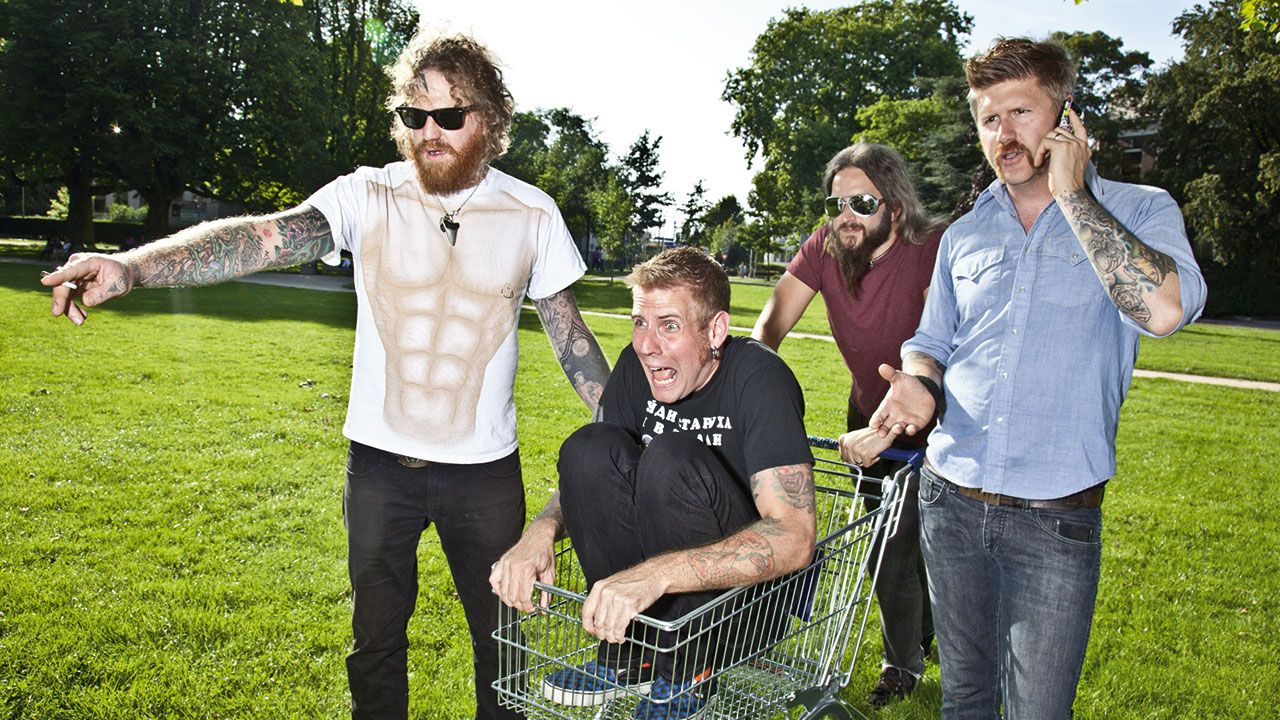
    Mastodon

    (Image credit: Cindy Fey)

    It becomes apparent that Hinds’ loss is not the only traumatic experience to affect the band. Behind every rock’n’roll lifestyle there are loved ones who get left by the wayside; and while Dailor won’t discuess his own personal life, you sense there’s a family that deeply misses him. “We are constantly disappointing the people that we care about the most with being gone so often,” he says. “So a lot of the themes on the record kind of have to deal with the people we’re closest to. Some of it’s almost like an apology to those people.”

    Sanders confirms: “We touch on loss, we touch on grief, we touch on triumphant moments – it’s all over the place. And then we’ll think about how an octopus feels. We’ll go from very deep, sorrowful subjects to talking about the Swamp Thing’s baby.”

    When I was introduced to Pink Floyd they frightened me. King Crimson irritate me to this day because they’re so good

    Troy Sanders

    “Or being a baby!” Dailor adds. “The Thickening is about being in a crib and wanting to be picked up and nursed. Then there’s Stargasm, which isn’t exactly about having sex in space, but it’s about having the best sex you’ve ever had with someone you really connect with and you go up into space. Blasteroid is like a playground song where you’re bouncing off the walls and the lyrics are: ‘If you’re sad and need to cry then turn around and go outside.’ It’s like a little kid wrote it.”

    Although the title Bedazzled Fingernails is a cheeky nod to Hinds’ playful fretwork, the lyrical content is a reference to the fact that his entire family are born under the Chinese sign of the Ox. Dailor explores a further emotional topic in All The Heavy Lifting: “I had a movie playing in my head, of my wife and I in the woods running around and me saving her, and then some of the lyrics are about a bad situation I had back home. I was sitting behind my drums feeling numb and stressed out at not knowing what to do, and I heard in my head: ‘Just close your eyes and pretend everything’s fine’.”

    This lyrical refrain is one of the catchiest moments on The Hunter, and also the first of its songs they recorded. Asked whether they can see their fans joining in, Sanders seem eager: “That, we hope, is the song that all our friends will be able to sing along with. I’m excited about that!”

    Like their previous albums, The Hunter touches on both old and recent influences. There are moments that echo Radiohead’s OK Computer, Pink Floyd’s spatial awareness or the atmospheric grandeur of Muse, while heavier songs hark back to their sludge roots. Had Mastodon stuck with the style exemplified in early albums like Remission they could have ended up playing the type of music we traditionally class as stoner or desert rock, with a weighty Sabbath influence. Yet the band’s love for prog has spurred them on to create something far more complex.

    “The old Genesis stuff is probably some of my favourite music ever created,” Dailor says. “Gabriel-era Genesis, too. But even when he left there were records that still embraced their proggier side.”

    Sanders explains: “I remember very well when I was introduced to Pink Floyd – they frightened me! And King Crimson irritate me to this day because they’re so damn good. Recently touring with Mars Volta and Tool, I love that specialness they embrace with this thinking man’s music.”

    On top of their genre-defining sound, iconic artwork and incendiary live shows, it’s sometimes forgotten that here’s a band who have stuck together since their inception more in 1999, overcoming deaths of loved ones (Dailor’s sister took her own life aged 14), drug abuse and a near-fatal altercation involving Hinds. That’s a vast achievement in itself.

    Sanders admits: “I never thought it would last. It’s rare that any relationship can last this long – much less with three grown men that I’m ‘married’ to.”

  • Poe’s Influence on Modern Horror Cinema

    Poe’s Influence on Modern Horror Cinema

    Long before horror cinema existed, Edgar Allan Poe was already exploring many of the fears that would later define the genre. His stories rarely relied on monsters, elaborate mythology, or graphic violence. Instead, Poe turned inward, examining guilt, obsession, paranoia, grief, and psychological collapse. The greatest horrors in his fiction often emerged from the human mind itself.

    This approach transformed Gothic literature and helped create a blueprint that filmmakers continue using today. From psychological thrillers to supernatural horror, traces of Poe’s imagination appear throughout modern cinema, shaping how fear is visualized and experienced on screen.

    Although few contemporary films directly adapt his stories, countless directors continue drawing upon his themes, narrative techniques, and understanding of psychological terror.


    Poe's Influence on Modern Horror Cinema
    Poe’s Influence on Modern Horror Cinema

    Poe and the Birth of Psychological Horror

    One of Poe’s most significant contributions to horror was his decision to shift fear away from external threats and toward the inner world of the mind.

    Earlier Gothic fiction frequently focused on haunted castles, villains, supernatural events, and dramatic confrontations. Poe certainly employed Gothic settings, but his deepest interest lay elsewhere. He wanted to understand what happened when fear, guilt, obsession, or grief took control of human consciousness.

    Stories such as The Tell-Tale Heart, The Black Cat, and The Fall of the House of Usher present characters whose greatest enemies are often themselves. Their terror emerges not from physical danger alone but from psychological instability.

    This innovation would become one of the defining characteristics of modern horror cinema. Many of today’s most unsettling films focus less on monsters and more on fractured identities, unreliable perceptions, and emotional collapse.

    In this sense, Poe helped establish the foundations of psychological horror more than a century before the genre fully developed on screen.


    Visualizing Madness on Screen

    Cinema introduced a challenge that literature did not face. Filmmakers needed to transform internal psychological experiences into visual form.

    Poe’s stories provided a valuable model because they frequently blur the line between objective reality and subjective perception. Readers experience events through narrators whose sanity is often questionable, creating uncertainty about what is actually occurring.

    Modern horror films frequently employ similar strategies.

    Robert Eggers’ The Lighthouse traps its characters inside an increasingly unstable reality where hallucination, obsession, and isolation become impossible to separate. Darren Aronofsky’s Black Swan follows a protagonist whose pursuit of perfection gradually destroys her sense of self.

    Neither film directly adapts Poe, yet both rely upon a technique that he helped popularize: allowing audiences to experience psychological disintegration from the inside.

    The horror emerges because viewers can no longer trust what they see, much like readers navigating Poe’s most famous narrators.


    The Uncanny and the Fear of Uncertainty

    Another reason Poe remains influential is his ability to create uncertainty.

    Many horror stories present clear threats. Poe often preferred ambiguity. His narratives frequently leave readers questioning whether supernatural events are real or whether they originate within disturbed minds.

    This uncertainty closely resembles what Sigmund Freud later described as the uncanny: the unsettling feeling that emerges when something familiar suddenly becomes strange.

    “The uncanny is that class of the terrifying which leads back to something long known to us, once very familiar.”
    — Sigmund Freud, The Uncanny

    Poe repeatedly explored this territory. Familiar homes become threatening. Ordinary sounds become sources of terror. Everyday reality begins to feel unstable.

    Modern horror cinema continues relying upon this technique. Films often generate fear not by revealing monsters immediately but by disrupting the audience’s sense of certainty. The unknown becomes more frightening than anything fully explained.

    This psychological strategy remains one of Poe’s most important gifts to the genre.


    From Poe to Hitchcock

    The influence of Poe can be traced through many of cinema’s most important directors, including Alfred Hitchcock.

    Hitchcock openly acknowledged Poe’s importance, once describing him as a major influence on the development of suspense and psychological storytelling. Both artists shared a fascination with obsession, guilt, identity, and unreliable perception.

    This connection is particularly visible in Vertigo. Like many Poe protagonists, Scottie Ferguson becomes consumed by an obsession he cannot control. His fixation gradually distorts reality, transforming love into psychological imprisonment.

    The film’s dreamlike atmosphere, emotional instability, and exploration of fractured identity closely resemble the psychological landscapes Poe created in stories such as The Tell-Tale Heart and The Fall of the House of Usher.

    Hitchcock also understood a lesson Poe had mastered decades earlier: suspense becomes most effective when audiences fear what might happen rather than what is already visible. By emphasizing anticipation, uncertainty, and psychological vulnerability, both artists transformed fear into an intensely personal experience.


    Poe’s Shadow in Contemporary Horror

    The influence of Edgar Allan Poe extends far beyond direct adaptations of his stories.

    Many contemporary horror films continue exploring themes that Poe helped establish nearly two centuries ago. Psychological instability, grief, obsession, guilt, and the gradual collapse of reality remain central elements within modern horror.

    Films such as The Babadook and Hereditary demonstrate this connection particularly well. Both focus on emotional trauma and psychological suffering rather than conventional monsters. Their horror emerges from the inability of characters to escape grief, memory, and emotional wounds.

    This approach closely resembles Poe’s fiction. In stories such as The Raven and The Fall of the House of Usher, emotional pain becomes inseparable from the horror itself. Fear does not arrive from outside. It grows from within.

    Modern filmmakers continue returning to this model because it creates a more intimate and lasting form of terror. Audiences may never encounter ghosts or supernatural entities, but they understand grief, anxiety, obsession, and loss.


    Poe and Lovecraft: Two Visions of Fear

    Among horror writers, few comparisons are more revealing than Edgar Allan Poe and H. P. Lovecraft.

    Both shaped the evolution of horror, yet they approached fear from fundamentally different directions.

    Poe focused on the mind. His stories examine psychological collapse, guilt, obsession, and emotional instability. Horror emerges from the internal world of the individual.

    Lovecraft shifted attention outward. His fiction presents an indifferent universe filled with incomprehensible forces that dwarf humanity. The terror comes not from personal guilt but from cosmic insignificance.

    Modern horror cinema continues drawing from both traditions. Films such as Hereditary, Black Swan, and The Lighthouse reflect Poe’s psychological approach, while productions such as Color Out of Space and Annihilation explore themes more closely aligned with Lovecraftian cosmic horror.

    Together, these two writers helped establish the dominant forms of fear that continue defining the genre today.


    Roger Corman and the Poe Film Cycle

    While many filmmakers have absorbed Poe’s influence indirectly, Roger Corman brought his stories directly to the screen.

    During the 1960s, Corman produced a series of films inspired by Poe’s work, many starring Vincent Price. These adaptations introduced new generations of audiences to Poe’s Gothic imagination while helping establish the visual language of modern horror cinema.

    Films such as House of Usher (1960), The Pit and the Pendulum (1961), and The Masque of the Red Death (1964) emphasized decaying architecture, vivid color palettes, psychological tension, and atmospheric dread.

    Although Corman often expanded or altered Poe’s original narratives, he preserved their essential spirit. His films understood that Poe’s true subject was not simply death or the supernatural, but the emotional and psychological forces hidden beneath the surface of human behavior.

    The success of these productions helped cement Poe’s place within cinematic horror history.


    Poe’s Influence on Horror Aesthetics

    Poe’s impact extends beyond narrative themes. He also helped shape the visual and emotional atmosphere associated with horror.

    His stories are filled with crumbling mansions, dark corridors, oppressive interiors, storms, shadows, mirrors, and decaying landscapes. These images became central components of Gothic visual culture.

    Filmmakers repeatedly draw upon this aesthetic tradition because it provides an immediate sense of mystery and unease. The visual worlds of Gothic cinema often feel like direct descendants of Poe’s imagination.

    The influence can be seen in everything from classic horror films to contemporary productions. Atmospheric lighting, architectural symbolism, and isolated settings continue serving as powerful tools for creating psychological tension.

    Poe understood that environments could reflect emotional states. Modern horror cinema continues applying that lesson, turning houses, rooms, and landscapes into extensions of the characters who inhabit them.


    Why Poe Still Shapes Horror Cinema

    Few writers have influenced horror cinema as profoundly as Edgar Allan Poe.

    Long before filmmakers explored psychological terror on screen, Poe was examining obsession, guilt, grief, paranoia, and the fragile boundary between reality and imagination. His stories demonstrated that the most disturbing horrors often emerge not from monsters but from the human mind itself.

    This insight continues shaping modern horror. From Hitchcock’s suspense films to contemporary works such as Hereditary, The Lighthouse, and The Babadook, filmmakers repeatedly return to themes that Poe helped establish: unreliable perception, emotional collapse, psychological isolation, and the fear of losing control.

    Technologies change and cinematic styles evolve, yet the anxieties that fascinated Poe remain remarkably familiar. People still struggle with grief, guilt, obsession, loneliness, and uncertainty. These universal experiences allow his work to transcend both time and medium.

    Poe’s lasting influence comes from his understanding that horror is ultimately psychological. By transforming inner fears into compelling narratives, he created a blueprint that continues guiding horror cinema nearly two centuries later.


    Wear the Darkness

    If Poe’s Influence on Modern Horror Cinema speaks to your fascination with Gothic literature, psychological horror, and the darker side of imagination, explore the Edgar Allan Poets store. Our designs celebrate Poe, noir culture, classic horror, and the timeless beauty of the Gothic tradition.


    Edgar Allan Poe Gothic apparel and noir-inspired fashion from the Edgar Allan Poets store


    Join the Noir Newsletter

    Receive more essays exploring Edgar Allan Poe, Gothic literature, horror cinema, noir psychology, dark aesthetics, and the artistic legacies that continue shaping modern culture.


    Frequently Asked Questions

    How did Edgar Allan Poe influence horror cinema?

    Poe helped establish many of the themes and techniques that define modern horror, including psychological terror, unreliable narration, obsession, guilt, and the exploration of madness.

    What horror films show Poe’s influence?

    Films such as The Lighthouse, Black Swan, Hereditary, and The Babadook reflect Poe’s fascination with psychological instability, grief, obsession, and emotional collapse.

    Did Alfred Hitchcock draw inspiration from Poe?

    While Hitchcock rarely adapted Poe directly, both artists explored similar themes, including obsession, unreliable perception, psychological tension, and suspense built through uncertainty.

    What role did Roger Corman play in Poe’s cinematic legacy?

    Roger Corman directed a series of influential Poe-inspired films during the 1960s, helping introduce Poe’s Gothic imagination to modern movie audiences through visually rich adaptations starring Vincent Price.

    Why does Poe remain relevant to horror filmmakers?

    Poe explored universal fears such as grief, guilt, madness, isolation, and uncertainty. These themes remain central to horror storytelling, allowing filmmakers to reinterpret his ideas for new generations.


    The post Poe’s Influence on Modern Horror Cinema appeared first on Edgar Allan Poets – Noir Rock Band.

  • Narcotic Wasteland announces 2026 Morbidfest European tour dates as Fentanyl Zombie Apocalypse arrives worldwide. Death Metal Force joins I Am Morbid, Atheist, and Cancer for major European run. – @thebeast

    FOR IMMEDIATE RELEASE


    Narcotic Wasteland announces 2026 Morbidfest European tour dates as Fentanyl Zombie Apocalypse arrives worldwide. Death Metal Force joins I Am Morbid , Atheist , and Cancer for major European run.

    Narcotic Wasteland is heading back across the Atlantic.


    The uncompromising death metal project led by former Nile guitarist and vocalist Dallas Toler-Wade has officially been announced as part of the 2026 Morbidfest European tour , joining a powerhouse lineup featuring I Am Morbid , Atheist , and Cancer .


    Narcotic Wasteland will appear on eight dates spanning the Netherlands, Belgium, Germany, Denmark, Slovakia, the Czech Republic, and Switzerland, bringing their brand of brutal, technically precise death metal to European audiences this November and December.

    The tour dates with Narcotic Wasteland include:
    November 21 | Iduna | Drachten, Netherlands
    November 22 | Bibelot | Dordrecht, Netherlands
    November 23 | DVG | Kortrijk, Belgium
    November 24 | Musikbrauerei | Berlin, Germany
    November 25 | Pumpehuset | Copenhagen, Denmark
    November 28 | Collosseum | Kosice, Slovakia
    November 29 | Barrák | Ostrava, Czech Republic
    December 1 | Dynamo | Zürich, Switzerland


    The Morbidfest announcement arrives as Narcotic Wasteland continues promoting its latest single, “Fentanyl Zombie Apocalypse,” which is out now worldwide .
    Driven by punishing riffs, razor-sharp musicianship, and unflinching social commentary, “Fentanyl Zombie Apocalypse” confronts the devastating impact of the synthetic opioid crisis. The track continues Narcotic Wasteland ‘s tradition of tackling addiction, corruption, and societal decay through uncompromising death metal.

    The single was released alongside the band’s Fentanyl Zombie Apocalypse Tour , which brought Narcotic Wasteland to stages across the United States throughout August, with support from acts including Visitant , Monochromatic Black , Yotuma , and IATT on select dates.
    Now, with the new single out and the Morbidfest European dates officially announced, Narcotic Wasteland is carrying its attack overseas.

    “Fentanyl Zombie Apocalypse” is available now.
    Listen / Download:
    https://orcd.co/fentanylzombieapocalypse

    Artist: Narcotic Wasteland
    Genre: Death Metal
    Featuring: Dallas Toler-Wade

    For press inquiries, interviews, coverage, or promotional opportunities, contact: zach@metaldevastationradio.com


    Connect with Narcotic Wasteland:
    https://linktr.ee/narcoticwasteland
  • Beyond Frequencies Release New Single “More Than a Feeling”

    Independent rock band Beyond Frequencies have released their brand new single and accompanying music video for “More Than a Feeling.” The track marks the beginning of a fresh chapter for the group and serves as the lead single for their upcoming fourth studio album.

    Thematically, “More Than a Feeling” explores the experience of leaving familiar situations behind and stepping into the unknown. The song focuses on the exact moment a person realizes it is time to make a major life change, even when that decision seems to make no sense on paper. Beyond Frequencies plan to drop several more singles in the coming months leading up to the release of their next full length record, which is currently scheduled to arrive in the spring of 2027.

    The post Beyond Frequencies Release New Single “More Than a Feeling” first appeared on FemMetal – Goddesses of Metal.

  • Interview | “All we can do is keep creating and support others who do the same, so we can keep the art alive.” – Alice Gawlinski (Mothertomb)

    Doom metal band Mothertomb released their debut album, “Dying To Live,” in mid-July. The album revealed a talented band capable of creating music at this early stage of their career that sounds like the work of a seasoned band. We had the chance to talk with Alice Gawlinski, vocalist of Mothertomb, and ask her about the feelings she’s having after releasing this debut, the independent approach Mothertomb followed throughout the process, and other interesting things.

    Read the review of Mothertomb – “Dying To Live”

    Reuel

    Hello Alice! I’m very happy to chat with you. How are you doing?

    Alice Gawlinski

    Hello! Thank you so much for the opportunity to do this interview! I’m doing very well, thank you.

    Reuel

    It’s been a couple of months since Dying to Live was released. Given how personal the album’s themes are, how has it felt seeing fans connect with your debut album?

    Alice Gawlinski

    I definitely felt a sense of vulnerability and a feeling of being exposed when it was first released. It was both exciting and nerve-wracking. Although the themes aren’t terribly literal for the most part, many parts of our songs feel quite intimate to me. It really moves me to see people truly enjoying and connecting with our music. It still feels surreal that people really do. It means a lot to each of us.

    Reuel

    They say ‘don’t judge a book by its cover’, but Dying to Live’s cover art, also done by you, captures the album’s spirit perfectly. At what point in the songwriting process did that visual image start taking shape for you?

    Alice Gawlinski

    Thank you so much! I conjured up this image at the very end of our recording process. I had some ideas floating around in my head, but nothing concrete. When it came time to craft the cover, I allowed an innate intuition to guide what imagery felt right. Ultimately, all I knew was that I wanted it to depict a woman who is on a journey. I wanted the imagery to reflect different elements of that journey, while also being surreal and even beautiful. Hopefully, I have achieved that!

    Reuel

    Releasing your debut album is no doubt a huge milestone for any musician, but it’s also challenging. What was your favorite and least favorite part of working with your bandmates on Dying to Live?

    Alice Gawlinski

    My favorite part of this whole process was truly the experience of the shared excitement we each had throughout various stages of creating the album. That feeling, when something really starts to come together, and you all know it and feel this collective magic… it’s amazing! I think we each grew as individuals and musicians throughout the process, too. Our friendships certainly deepened.

    As with all endeavors like this, the process also comes with challenges. The most difficult part for me was facing my lack of confidence in some areas and battling perfectionism. I have come a long way since completing the album, but the process really exposed some challenges I had with negative self-perception and fear of being ‘seen’. Ultimately, though, those difficulties have resulted in much emotional growth, and so I am thankful for that.

    Reuel

    If all the tracks on Dying to Live came to life and became real people, which one of these songs would be your best friend?

    Alice Gawlinski

    I love this question! Definitely the title track, Dying to Live. Although it explores themes of suicidality (and the ending is ultimately ambiguous…), there are many themes of empowerment in there too – about choosing to live in spite of suicidal feelings. To me, it embodies psychological strength and resilience. I think I’d enjoy those qualities in a best pal!

    Reuel

    Brilliant! If someone has never heard Mothertomb before, which single track from Dying to Live do you tell them to play first?

    Alice Gawlinski

    Well, my personal favorite is Cythraul… so, that one! I think it combines our varying styles well in one track.

    Reuel

    What musicians can you credit as the ones who inspired you, personally, in your life or career as a musician?

    Alice Gawlinski

    Ahh there are so many! I am inspired by musicians of varying genres for various reasons. In terms of helping inspire me to put myself out there as a vocalist specifically, listening to other female vocalists of doom/heavier bands was critical to squashing the ‘I can’t do that’ mentality I had before. Special mentions include Dorthia Cottrell of Windhand, Sara Bianchin of Messa, and Pardis Latifi of Daevar.

    Reuel

    Mothertomb handled everything on Dying to Live entirely in-house. Meanwhile, people are using AI to say hello to each other. What dangers does AI pose to musicians in particular, and what do you think needs to be done to counter it?

    Alice Gawlinski

    In all honesty, it’s quite terrifying to me. I try to have faith and hope that the creativity of the human spirit will persevere, and I know that the organic nature of humanity can never be truly replicated… but it’s scary as hell! All we can do is keep creating and support others who do the same, so we can keep the art alive.

    Reuel

    Thank you for your time, Alice! Is there anything else you’d like to add?

    Alice Gawlinski

    Nothing besides thank you! 🙂

    The post Interview | “All we can do is keep creating and support others who do the same, so we can keep the art alive.” – Alice Gawlinski (Mothertomb) first appeared on FemMetal – Goddesses of Metal.

  • NARCOTIC WASTELAND’S 2026 MORBIDFEST TOUR ANNOUNCEMENT GARNERS MAJOR METAL MEDIA COVERAGE – @thebeast

    FOR IMMEDIATE RELEASE
    NARCOTIC WASTELAND’S 2026 MORBIDFEST TOUR ANNOUNCEMENT GARNERS MAJOR METAL MEDIA COVERAGE

    Coverage Lands Across BraveWords , Metal Anarchy , Metal Rules , Lambgoat , The PRP , Metal Addicts , and More

    Narcotic Wasteland is hitting the road across Europe this November and December as part of the massive 2026 Morbidfest European Tour , and the announcement is already making serious waves throughout the international metal press.
    Led by former Nile guitarist and vocalist Dallas Toler-Wade , Narcotic Wasteland will join a powerhouse lineup featuring I Am Morbid, Atheist, and Cancer for eight European dates spanning the Netherlands, Belgium, Germany, Denmark, Slovakia, the Czech Republic, and Switzerland.
    The tour announcement, along with news of Narcotic Wasteland’s new single “Fentanyl Zombie Apocalypse,” has now been featured by major metal media outlets including BraveWords, Metal Anarchy, Metal Rules, Lambgoat, The PRP, Metal Addicts , and more.
    Among the latest coverage, BraveWords reports that Narcotic Wasteland will bring their “brutal, technically precise death metal” to European audiences across the upcoming tour.
    The confirmed Narcotic Wasteland dates include:
    NOVEMBER 2026
    November 21 – Iduna – Drachten, Netherlands
    November 22 – Bibelot – Dordrecht, Netherlands
    November 23 – DVG – Kortrijk, Belgium
    November 24 – Musikbrauerei – Berlin, Germany
    November 25 – Pumpehuset – Copenhagen, Denmark
    November 28 – Collosseum – Kosice, Slovakia
    November 29 – Barrák – Ostrava, Czech Republic
    DECEMBER 2026
    December 1 – Dynamo – Zürich, Switzerland
    The European run comes as Narcotic Wasteland continues promoting “Fentanyl Zombie Apocalypse,” the latest single from the project, adding another dose of uncompromising death metal to an already highly anticipated tour campaign.
    With coverage continuing to spread across the international metal media landscape, the Morbidfest announcement is putting Narcotic Wasteland directly in front of fans of death metal throughout Europe and beyond.
    NARCOTIC WASTELAND
    2026 MORBIDFEST EUROPEAN TOUR
    I AM MORBID • ATHEIST • CANCER • NARCOTIC WASTELAND
    More coverage and additional tour information will continue to be shared as the campaign rolls forward.

    Check out Narcotic Wastelands latest single: 
  • DREAM UNENDING – Ανακοινώνουν νέο άλμπουμ και παρουσιάζουν το “Strained Sincerity”

    https://www.metalourgio.com/wp-content/uploads/2026/09/Dream-Unending-band-photo-768×509.jpg
  • How Duff McKagan became on honorary member of Motorhead

    You did a ‘Lemmy Forever’ dedication ceremony at Download, where some of his ashes were enshrined in a fruit machine. How did you meet Lemmy?

    “Guns N’ Roses were playing our first gigs ever in London, like four or five nights at the Marquee. We had this flat on Kensington High Street and everything seemed to be going our way. Especially so when we got this invite to go hang out with Motörhead at their studio. We walk in and there’s a pool table – at least that’s how I remember it – and Lemmy looked at me first and goes, ‘You’re the bass player, aren’t you? I’m Lemmy. Nice to meet you.’ So very nice! We had no idea what to expect, whether they were going to fuck with us or whatever. Lemmy took us under his wing and we played Donington a year later. He came up just to hang out with us.”

    It’s hard to imagine you guys being starstruck – even then.

    “Oh, man. Ace Of Spades to me – and to everybody else my age – was one of those place-setter records that changed the scope of what you could do in rock’n’roll. It was truthful, badass and, look at me – I play bass! When Ace Of Spades came out I was playing drums, guitar, a bit of bass in different bands, but I started to lean more towards bass because of Lemmy.”

    It seems everyone who met Lemmy has a wild story about him. What’s the story you’d tell people at parties?

    “I mean, look, man, the party story I’d have with Lemmy… I wouldn’t remember! Ha ha ha!”

    Away from drinking, what memory with Lemmy means most to you?

    “I got to get up and play with Motörhead and that was incredible. Loaded [one of Duff’s former bands] did a tour with them up in Germany – they’re huge over there. I’d get up and play Overkill with them, every night. They made me an honorary Motörhead member – I’ve got a plaque. I’d like to think I’m the only one, but I bet there’s others.”

    You’re the first we’ve heard of, at least.

    “Well, there we go!”

    Speaking of legends, last year you played the final Black Sabbath gig at Villa Park. GN’R had played the venue
    the week before, so was it weird returning to do a quick set?

    “That gig was just ultra-special. Those guys have been my family since the 80s, you know? There were roadies there I’ve known since the start. This one guy comes up, he’s like, ‘You won’t remember me, but I was on the crew for Mötley Crüe during Girls, Girls, Girls.’ Everybody was there, man. Trying to get side-stage to watch a band, it’d take you 45-minutes because you’d run into everybody on the way. The mood was killer. Everybody was in it for Ozzy and Sabbath. It was cool – more than cool, it was epic.”

    You mentioned playing Donington earlier – what are your strongest memories of playing?

    “Man, I have played so many times. That first time [in 1988] was so special. We were playing at 1pm but we’d blown up by that point, so in between us being booked and playing, everybody had heard about us. It felt incredible at the time, but the crowd started pushing forward and I remember it was the first time Axl had to do crowd control, getting everyone to take a step back. Unfortunately, a couple of guys didn’t make it and that was such a wake-up call. We took a step into the big leagues, but we had to be careful. Now it was like, ‘We need to take care of people.’”

    Are there any up-and-coming bands who you think who could become legends?

    “I really like James And The Cold Gun. They’re great songwriters and I’ve seen them play a bunch. They have got everything you need. But in this day and age, it’s just so hard to break through so I don’t know how you could.”

    A lot of people keep Lemmy’s ashes in special places. Do you have some and, if so, where are they?

    “Of course! I’ve got them in a little Lemmy hat thing. It’s on my mantelpiece at home. He lives with my family, he’s safe with us.”

  • REPENTANCE Release Tribute Video to SHAUN GLASS “Fade Into Silence”

    Chicago -based metal act Repentance has released a deeply personal tribute to the band’s founding member Shaun Glass with a brand-new video for “Fade Into Silence”. The track, which is featured on the band’s upcoming third studio album Retaliate, is out now.

    Shaun Glass, the founding member and driving force behind Repentance, passed away unexpectedly on July 1, 2026. Following his tragic death, the band decided to postpone the release of Retaliate from its originally scheduled summer release to November 27, out of respect for their brother, friend, and bandmate.

    Vocalist Adam Gilley comments: “We decided that ‘Fade Into Silence’ would be the next single from the record because we wanted to dedicate this release to Shaun Glass. Of all the songs on the record, ‘Fade Into Silence’ just felt like the perfect song to honor him – especially because it was a song that Shaun himself wrote.

    His unexpected passing has left a major hole in our hearts and in this band. Shaun wasn’t just a bandmate or a friend; he was our brother. He was the one who created this band and helped give it its identity, and he was deeply loved by everyone of us. It’s difficult to put into words what his loss means to us, and things will never quite be the same without him.

    This song now carries a meaning we never expected it to have. Every note is a reminder of Shaun, his creativity, his passion, and everything he gave to this band. We’re proud to dedicate ‘Fade Into Silence’ to our brother and friend, Shaun Glass. His music, his influence, and his memory will always be a part of us. Rest easy, Shaun. This one is for you.”

    Shaun Glass spent more than four decades shaping the Chicago metal scene and was a driving force behind influential bands including Terminal Death, Sindrome, Broken Hope, SOiL, Dirge Within, The Bloodline, and, most recently, Repentance. Throughout his career, he shared stages with some of the biggest names in metal and left behind a lasting musical legacy that continues to resonate with fans around the world.

    Formed in 2018, Repentance have built their sound around crushing groove metal, technical precision and uncompromising intensity. Following their debut album God For A Day (2020), the band signed with Noble Demon and released the EP Volume I – Reborn (2021), introducing vocalist Adam Gilley to the fold. Their sophomore album The Process of Human Demise (2023) further established their modern take on groove metal and thrash.

    Now, Retaliate will arrive on November 27, 2026, via Noble Demon. Produced by Alex Lackner at Accelerated Sound and mixed by Ari Mihalopoulos at Inner Light Studio, the album marks another chapter in the band’s story – one that will now forever be connected to the legacy of its founder.

    “Fade Into Silence” is more than just a new single. It is a final musical tribute to Shaun Glass, carrying his creativity and spirit forward through the band he created.

    If you want to support Shaun‘s family, in order to cover hospital bills for his last weeks on life support and to give stability to his son Maddux’s future, a Crowdfunding campaign has been launched here.

    Retaliate is available for pre-save here.

    The post REPENTANCE Release Tribute Video to SHAUN GLASS “Fade Into Silence” appeared first on Sonic Perspectives.

  • THE CALLING Returns With First New Album In 22 Years, “Before The World Turns To Dust”

    Multi-platinum rock band The Calling release their long-awaited third album, Before The World Turns To Dust, via TLG | Virgin Music Group. Their first full-length record since 2004’s Two, the 15-track album brings founding singer and songwriter Alex Band together with guitarist and keyboardist Daniel Damico and bassist Dom Liberati.

    “After nearly 20 years of writing and creating new music, and hitting roadblock after roadblock along the way, I finally have the right band with Daniel and Dom, the right album, and the right team behind us to put it out. We aren’t trying to chase trends, we’re making the music we want to make and bringing back The Calling sound that our amazing fans around the world have been waiting for. I honestly didn’t know if this day would ever come!” says Band.

    The release arrives as lead single “Dust” continues its climb at radio, reaching No. 32 with a bullet in its second week on the Mediabase Hot AC chart. The song marks The Calling’s first radio campaign at the format in more than 20 years. The band has also recently surpassed 10 million monthly listeners on Spotify.

    Produced by John Fields and recorded in Nashville and Minneapolis, Before The World Turns To Dust pairs the soaring melodies and emotional directness that first connected The Calling with listeners worldwide with songs shaped by everything the band has lived through since its last album. “Dust,” a song about love and connection in a world that can feel as though it is coming apart, sets the tone for the record. The band has shared both an official video and a stripped-down acoustic performance of the single.

    The Calling will celebrate the album’s arrival with a record release show tonight, Friday, September 25, at Dreamland in Malibu, California. Doors open at 7 p.m. The show is 21 and over, with general admission standing room and VIP tables available.

    The Calling broke through with their 2001 debut, Camino Palmero, and “Wherever You Will Go,” a worldwide hit that reached the Top 5 of the Billboard Hot 100 and spent 23 consecutive weeks at No. 1 on the Adult Pop Airplay chart. The song has since surpassed one billion streams on Spotify, while the band has sold more than 10 million albums worldwide and generated billions of streams across its catalog.

    The post THE CALLING Returns With First New Album In 22 Years, “Before The World Turns To Dust” appeared first on Sonic Perspectives.