When 2026 started, I had no history with indie rock group Tokyo Police Club’s frontman David Monk or his viral TikTok peasant-sona Worm Chewer. But when the lead single of Monk’s avant-garde “peasant metal” side project Netherwilds dropped—”Return the Goat”—Peasant Rising immediately shot to my most anticipated release of the year. That snapshot of blackened hardcore folk was wild in a way I couldn’t have anticipated. The promise of a concept album following Worm Chewer’s peasant revolution involving mud mages, witch hunters, and Druidic battlemechs only sweetened the deal.1 But I’m also seeing high expectations for an untested band’s debut in Peasant Rising, something that could easily smite Netherwilds’ fairytale ending. Is Peasant Rising a kingmaker, or are Netherwilds’ ambitions…feudal?
To my knowledge, nothing else sounds like Peasant Rising. Netherwilds pushes thrash, industrial, hard rock, black metal, and doom through a sieve of eclectic Refusedesque hardcore and romanticized medieval folk. Between EDM drums meeting crossover thrash on “Helm Yeah,” “Dungeon Song” trading hypnotic folk with blackened blasts, and theater choir setting the stage for double-f’d-up tuff groove on “The Fall,” there’s always something novel happening with Peasant Rising. Like a ye olde Systemme of a Downe, every disparate genre thrives symbiotically in Netherwilds’ sound, stacking strength upon strength into a distinct, singular identity. Two ubiquitous factors tie Peasant Rising together sonically: folk aesthetics and insanely catchy hooks. Led by Monk’s bouzouki, folk instrumentation offers continuity whenever Netherwilds jumps from hardcore riffing (“Farmer’s Armoury”) to Slayer-informed thrash (“Return the Goat”) to acoustic industrial groove (“Blight!”) and back. With this creativity come well-earned earworms. Hear the radio-ready “The Ballad of Sir Gregory” or the atmospheric “Cry in the Hay,” or any one of the bombastic choirs across Peasant Rising and you’ll be humming them before you know it. It’s one thing to sound one-of-a-kind; it’s another to also sound as sharp, vital, and catchy as Peasant Rising.
What makes Netherwilds’ genre witchcraft so compelling is how it forwards the narrative told on Peasant Rising. Aided by many short narrative interludes,2Peasant Rising tells a story of desperation, oppression, and revolution. Each beat is met with an appropriate musical identity. Worm Chewer’s belligerently drunk early ideations of rebellion are captured in the raucous ragers of “Peasant Pit” and “Helm Yeah,” while his tighter, more focused calls to revolution in “The Fall” and “Return the Goat” come later. SepticFlesh-like symphonic death riffs and choirs on “Heretic” characterize the seething sanctimoniousness of the king’s Inquisition, while the grimy Sabbathian doom riffs on “Wickermech” sell the monstrosity of its titular war machine. Guitar solos are few on Peasant Rising, but when Worm Chewer feels badass on “The Ballad of Sir Gregory” or unspeakably livid on “Return the Goat,” you’d best believe they come out ripping. Netherwilds play with an ear for hooks and a mind for narrative, portraying Peasant Rising’s tale in convincing earnestness.
That earnestness is what most surprised me about Peasant Rising; I never expected to be as moved by Netherwilds as I was amused by them. Eager to hype up Worm Chewer’s “Siege Proof Hovel” or “show these nobles who’s King of the Crops” (“Peasant Pit”), Netherwilds are just as equipped to bear the cruelty of the ruling class and show Worm Chewer at his lowest: “cry in the hay and call it a prayer” (“Cry in the Hay”). Encapsulating Peasant Rising’s narrative identity is one brilliant metaphor: the goat. The object of jilted remorse on “Peasant Rising,” the goat transforms as Worm Chewer radicalizes (“Siege Proof Hovel”), suffers oppression and degradation (“Dungeon Song”), and galvanizes the Humble Horde (“Farmer’s Armoury”). By the time we reach “Return the Goat” in Peasant Rising’s climax, the goat isn’t just a metaphor for the peasants’ labor being exploited by the parasitic nobility but also Worm Chewer’s self-respect and dignity. “Take me for no fool,” he implores. Despite the farce of Peasant Rising, I must oblige.
Merging grand storytelling, dark humor, a keen social consciousness, and some of the wildest compositions out there, Netherwilds swing Peasant Rising like a battering ram against the gates of Metaldom. Rarely has a record been so affecting as it is fun as Peasant Rising. Inventive and approachable, high-minded and down-to-earth, Netherwilds lived up to the hype and then some. The boon of hard labor and relentless creativity, Peasant Rising is a debut Netherwilds can hang their helmet on. Don’t be the village idiot; take up your pitchfork and get with Peasant Rising.
Houston Doom, Stoner, and Sludge Quartet Continues the Road to Altars With Another Dose of Riff-Driven Destruction
Houston, Texas heavy quartet Direlands have officially unleashed their crushing new single “Leviathan,” the latest chapter in the band’s ongoing campaign toward their forthcoming full-length album, Altars , due January 20, 2027.
Built from the weight and atmosphere of doom, the grit of Gulf Coast sludge, and the muscular attack of stoner metal, “Leviathan” further establishes the sound Direlands have been developing throughout their recent releases. Massive riffs, dynamic songwriting, and a sense of scale give the track the feeling of a soundtrack to a world already collapsing around it.
“Lay waste to the damned!”
“Leviathan” follows the release of “The Wizard” on August 26 and marks the second scheduled chapter in Direlands’ carefully planned rollout for Altars . With the latest single now available, the band will continue unleashing new material throughout the coming months, including “Blood Moon” on October 22, “Ancients” on November 19, and “Doombringer” on December 16.
The campaign will culminate with the release of Altars on January 20, 2027 , followed by additional promotional activity surrounding tracks including “Darkest Light,” “Iron God,” “Irony God,” “Mourning Bell,” and “In My Eyes.”
Direlands features Troy Binegar on guitar, Jarett Dureell on vocals, Austin Clark on bass, and Tom Heyman on drums. The Houston quartet has carved out its own place within the American heavy underground, sharing stages with acts including The Obsessed, Duel, Warlung, and Stone Nomads .
The band’s sound draws from heavy metal, atmospheric doom, and Gulf Coast sludge, combining technically sharp musicianship with precise, riff-driven arrangements and volatile vocal dynamics. For listeners drawn to the crushing heaviness of Mastodon, High On Fire, and Down , Direlands delivers a similarly weighty experience while maintaining its own distinct identity.
The band’s foundation was established through the releases The Cave You Fear and Ascension , before Direlands began building toward Altars with the anthemic “Iron God.” The forthcoming album represents the next stage in that progression, bringing together the band’s heavy, atmospheric approach with a deliberate visual identity and uncompromising live presence.
With “Leviathan” now available, Direlands continue laying the groundwork for Altars one crushing riff at a time.
“Leviathan” is out now.
DIRELANDS
Crushing Riffs Echoed in a Lost World
“Leviathan” Out Now Independent Release
For Fans Of: Mastodon, High On Fire, Down
Leviathan by Direlands
Swedish black metal entity ARCKANUM have unveiled “Mz Fianda Raþi (Mz Fianda Rathi)”, the first track from forthcoming tenth album Beswærilsin. The record will be released internationally on 31 October through DARKNESS SHALL RISE PRODUCTIONS. A video for the song is available now via the label’s official YouTube channel. Translated in the accompanying material as […]
Hard rock juggernaut The Dead Daisies have officially charted a bold course for 2027, ushering in a thrilling new chapter with the addition of legendary former Foreigner frontman Kelly Hansen on lead vocals. Signalling a restart for the band, the rock collective has confirmed the upcoming release of a brand- new single alongside extensive global touring plans. Fronted by exceptional lead vocalist Kelly […]
There is a lot to say when it comes to our beloved heavy metal singers – after all, they have a lot to say too as they speak to, and on behalf of, generations. They inspire us, they share their ideals and wisdom, and make us think.
Now, iconic vocalist Chuck Billy of Testament, 40 years plus of touring the globe, practicing what he does preach, being heavy…staying heavy, whilst also pushing boundaries to elevate fans with thought-provoking songs that bring socially conscious subjects, like 1987’s “The Greenhouse Effect”, or ballads like 1992’s “Return to Serenity” to taking the crown in 2025 with Loudwire naming Testament‘s 2025 release as Album of the Year. That is tried and true relevance right there!
Multifaceted, to say the least, Chuck Billy is a brother, a family man, an iconic heavy metal bar raising vocalist, a Native American, a friend, a cancer survivor. He has encountered spirit guides, saved the day at his friend’s trucking business, one of many of Chuck Billy‘s day jobs. This book release tells it all, and so much more.
Appearing:
October 29 In-Store Appearance in Phoenix, AZ at Changing Hands Bookstore/Bar 300 West Camelback Road More Details TBA
November 10 Party in Seal Beach, California with Jose Mangin SiriusXM Metal Ambassador and co-host, comedian, and Metal fanatic Brian Posehn 4 to 8 PM More Details TBA
November 14 Party in Dublin, CA at Metal Community Bar – The Back Lounge with Phil and Marta Demmel + Brian Posehn to host 7138 Village Parkway 2 to 6 PM More Details TBA
He screamed his way into metal history. Then cancer tried to silence him for good. Now, for the first time, Chuck Billy, the iconic frontman of Bay Area thrash legends Testament, tells the whole truth in his unflinching memoir, Holding My Breath: The Two Testaments of Chuck Billy, publishing November 10, 2026, from Permuted Press.
This is not your typical rock memoir. Structured as two interlocking testaments, the book traces the full arc of a life lived at maximum volume—and then something louder than any riff: the fight to stay alive. The Old Testament plunges readers into the explosive birth of Bay Area thrash metal, the formation of Testament, the rivalries, the brotherhood, and the reckless, glorious chaos of becoming one of the genre’s most powerful voices.
The New Testament is something rarer and more raw—a frontman at 38, blindsided by a devastating cancer diagnosis, drawing on his Native American and Mexican-American heritage, spiritual healers, visions, and the fierce love of a metal community.
At the center of that community: the legendary Thrash of the Titans benefit concert—one of the most galvanizing moments in heavy metal history—which rallied old rivals into brothers and helped ignite a genre revival while keeping Chuck Billy in the fight.
“This book is about two versions of me that are really just one story,” says Billy. “The guy who thought he was invincible, and the guy who learned how fragile life really is.”
Co-written with Dave Erickson, Holding My Breath delivers the unfiltered insider story of thrash metal’s rise alongside a deeply human account of mortality, miraculous recovery, cultural identity, and chosen family. It is, equally, a gift to lifelong Testament fans and to anyone who has ever faced the unthinkable, and refused to let go.
“Chuck Billy is a major influential voice in the thrash metal scene. Permuted Press is thrilled to be publishing his remarkable personal journey.” —Anthony Ziccardi, Publisher of Permuted Press
The book features a foreword by Rob Halford (Judas Priest) and an afterword by Randy Blythe (Lamb of God)—two of metal’s most revered voices bearing witness to Chuck Billy‘s enduring legacy.
Chuck Billy is the powerhouse lead singer of Testament, one of thrash-metal’s original Bay Area legends since the ’80s. He beat cancer in 2001 and came back stronger, weaving his Native American (Pomo) roots into his life and lyrics. Fourteen studio albums in, he has been honored with a California State Assembly recognition for his positive influence on Native communities, was part of The Smithsonian National Museum of The American Indian’s exhibition ” Up Where We Belong: Native Musicians In Popular Culture,” and won “Best Music Video” at the American Indian Film Festival for “Native Blood.”
Holding My Breath: The Two Testaments of Chuck Billy is available to pre-order here.
Jennifer Finch, longtime bassist of the great veteran grunge-punk band L7, passed away in July at the age of 59, just a few days after she revealed her brain cancer diagnosis. Just a couple of months before Finch’s death, L7 announced plans for their final tour. At Finch’s request, the band is going ahead with that tour, which starts on Tuesday in San Diego. Today, L7 have shared a new song in advance of that tour kickoff.
One-man funeral doom band Comploratio first emerged last month, releasing a nine-minute single simply called “Untitled.” They’re back today with “I,” the lead track on their self-titled album.
Once again clocking in at nearly nine minutes, Comploratio have a strong grasp on atmosphere, conjuring a feeling of death and darkness as the opening notes play out. The song unfolds slowly, with reverberating guitars eventually giving way to a full-band outing but the space never feels wasted or stretched out unnecessarily.
Fittingly, Comploratio will be released on Halloween and is available for pre-order via Bandcamp.
UK synth-metallers Fail The Enemy are gearing up for a major release with their brand-new EP, Sandcastles, dropping on Friday, 9th October. Fresh off the back of recent singles like the crushing “Drowning Deep” – which has just picked up airplay on Kerrang! Radio – the trio are stepping into a heavier, darker, synth-driven sound … Continue reading Exclusive Track by Track: Fail The Enemy – Sandcastles
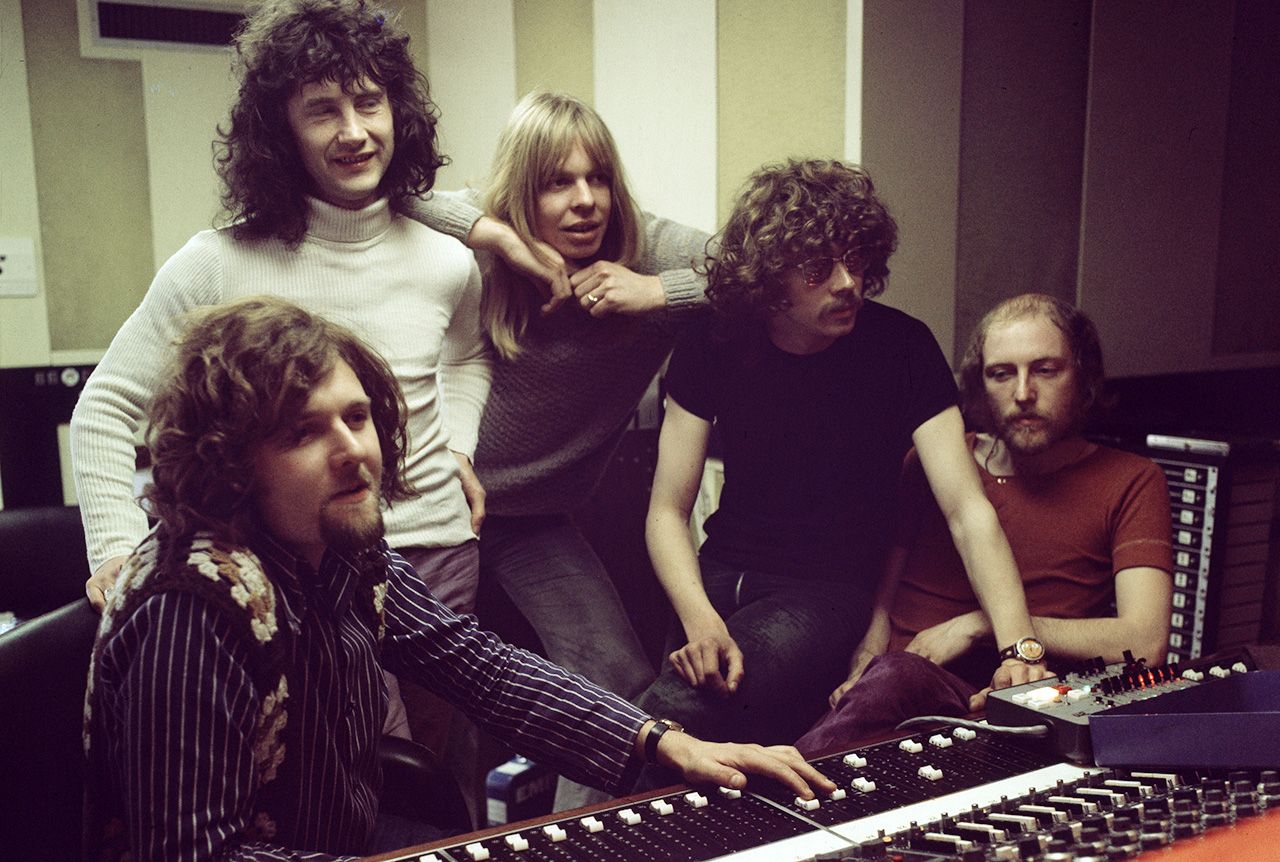
As a founder member of the Strawberry Hill Boys, Dave Cousins helped move the band through bluegrass and folk until they finally became international prog icons Strawbs, who could count Led Zeppelin among their fans. In 2019 – six years before his death at the age of 80 – Cousins told Prog about his journey from underground band to the household name that helped give Sandy Denny and Rick Wakeman their breaks.
Having notched up 19 studio albums since Strawbs’ 1969 self-titled debut, Dave Cousins has remained the one constant at the centre of the band, amid various shifts in musical directions and sometimes turbulent personnel changes. And the prolific songwriter and vocalist intends to stay busy. “While I still enjoy it, I’ll keep on doing it,” he says.
In 2019 Strawbs celebrated their golden jubilee at a gala event in Lakewood, New Jersey. Backed by a 30-piece orchestra and a choir of staff members from New York’s United Nations building, the gig covered their lengthy career from start to present day. Cousins recalls: “Tony Visconti, who’d worked with us on our very first records, agreed to come and conduct.
“It was unbelievable to have Tony there. We did our very first single, Oh, How She Changed, with Dave Lambert singing, backed by the orchestra. We also had the choir sing an amazing rendition of Lay Down and they accompanied us on We Have The Power from our 2017 album, The Ferryman’s Curse. That was extraordinary.”
The three-day celebration featured many musicians who’ve played live or recorded with the band. “Strawbs are a family. You can never overlook that. And we all get on very well together. Even though people left the band there was never really any hard feeling. Yes, there might have been aggravation at the time – but by and large, we’ve all stuck together and looked after one another.”
Whether it’s touring on his own or with The Acoustic Strawbs alongside longtime members bassist Chas Cronk and guitarist Lambert, 2020 looks like another busy year. When Prog caught up with Cousins at his home in Kent, he was still at the early stages of working on Strawbs’ 20th studio album.
“At the moment I’ve got ideas and a few scraps of paper with titles on them. I’m going down to my local pub, who’ve agreed to let me have the back room on an afternoon, where I can sit on my own and get on with the writing.”
You started out playing the folk circuit in the early 1960s.
Yes – though we were never a folk group as such. I was the fastest banjo player around, Tony Hooper was the lead singer and we had a double bass player. Before that we’d done a BBC audition which we passed, and I started ringing up BBC producers trying to get us work. One of them returned our call and told us we were recording the next week. The show was broadcast in 1963 and we shared billing on Saturday Club with Chris Barber’s Jazz Band and The Beatles.
Captain Beefheart said, ‘I can’t do this interview without running water.’ He put the tap on. It sounded as if he was having a pee!
At the time, I was the cloakroom attendant at Eel Pie Island Jazz Club in Twickenham; Arthur Chisnall, who ran the club, heard us on the radio and asked if we’d like to do the intervals for a group he had coming in. They were booked for the next six weeks and they were called The Rolling Stones. No idea what happened to them!
A bit later you were a producer on a pop show for Danish radio. How did that happen?
Tom Browne, who was later a Radio 1 DJ, did an interview with me about the Strawberry Hill Boys and he helped set up a tour of Denmark. I got booked for a Danish TV show. Also on there was The Who, promoting I Can’t Explain, and I got chatting to them afterwards. Pete Townshend gave me his phone number and told me to give him a ring sometime.
Anyway, Tom Browne had been asked by Danish radio to do a pop show from London called The London News. He said to me, ‘I know nothing about pop music – will you produce it?’ He and I interviewed all sorts of people: David Bowie, Sandy Shaw, Marc Bolan, Mary Hopkin, Keith Emerson.
We even interviewed Captain Beefheart on his first visit to England. We went up to his hotel off Oxford Street and he said, ‘I can’t do this interview without running water.’ So he went into the toilet, put the tap on, came back in and then we talked. Of course, when we came to edit, it sounded as if he was having a pee throughout the interview!
How did you meet Sandy Denny?
I’d gone to The Troubadour in Earl’s Court, and there’s Sandy down there wearing a long white dress and a straw hat playing a Gibson Hummingbird, singing the Gaelic song Fear a’ Bhàta. I introduced myself after she came offstage and asked if she wanted to join my group. ‘What’s the name?’ she asked. ‘Strawbs,’ I told her, and she said, ‘Yeah, okay.’ It was as simple as that!
“It was in 1967. She was 20 at the time and living at home with her mum and dad. She joined us and we were booked to play in Denmark. We really got to know Sandy on the ferry from Newcastle to Aarhus where we sat up all night, rehearsing and drinking every bottle of beer that was on the ship.
Sandy joined Fairport Convention – which I didn’t mind. We were still the best of friends. She was an absolute icon
We got signed to Sonet Records, run by Karl-Emil Knudsen, and made a record in Copenhagen in an old cinema. We could only record during the day because people had to be let into see the film in the evening. So we’d go off and play in Tivoli Gardens with Sandy singing.
It was the only time we performed on stage with her, really. She came back to England and, after three months, I hadn’t been able to get anybody in England interested in releasing it. By then Sandy had joined Fairport Convention – which I didn’t mind. We were still the best of friends. She was an absolute icon.
And you were the first British act to sign to A&M Records, weren’t you?
Yes. That was through Knudsen, who distributed A&M in Denmark. He played them the recordings with Sandy; and although they were disappointed she wasn’t with us anymore, Jerry Moss – the M of A&M – phoned to tell me they were excited to have us and wanted a single. We were in the studio with Gus Dudgeon as producer, who shared his office with Tony Visconti.
A&M had sent $15,000, which at that time was a colossal amount of money, and it was all spent on that first record because Gus Dugeon wanted to prove himself with orchestras and Christ knows what. So when they said they wanted another album we asked for more money. They told us the cash they’d originally sent was to be spread across three albums!
So we went from London back to Denmark, but we took Tony Visconti with us because Gus had buried my voice on the first album. So Tony produced Dragonfly [1970].
How did you hook up with Rick Wakeman?
We’d been asked to do a session for the John Peel show and we wanted to do a piece called The Battle, but we didn’t have a keyboard player. Tony suggested he bring Rick along, and it was great – we got on famously. When it came to Dragonfly we had him play on The Vision Of The Lady Of The Lake.
I asked Rick where he was going for the honeymoon. He said, ‘We can’t afford one’ … So he came to Paris with us and had his honeymoon there
I put his name on the sleeve notes, and when it came out sent him a copy. He said he was thrilled – that was the first time he’d had his name on the back of an album.
We met up and had a beer and I asked him to join the group. Our first gig with him was to be in Paris a fortnight later, but he said, ‘I can’t do that; I’m getting married.’ I asked him where he was going for the honeymoon. He said, ‘We’re not; we can’t afford one.’ So I said, ‘Well, I’ve got an idea…’ He came to Paris with us and had his honeymoon there!
After Dragonfly your music shifted towards a more electric sound. Was that deliberate?
We’d been using acoustic bass but it just wasn’t working for what we needed. At the time I had a folk club and then an arts lab in Hounslow and I’d booked Elmer Gantry’s Velvet Opera. It had guitarist Paul Brett, who’d guested with us on Dragonfly; and Richard Hudson and John Ford on drums and bass respectively. I thought they were great and invited them to join.
(Image credit: Getty Images)
I still viewed us as a folk group, so the fact that Richard played percussion rather than a regular drum kit is what attracted me. It was only when we made From The Witchwood [1971] that we brought drums in for the first time, but they were very much mixed down because I didn’t want them to overwhelm the songs.
From The Witchwood has quite an eclectic mix of sounds and instruments, doesn’t it?
Yes, it does. On A Glimpse Of Heaven you’ve got multi-tracked voices to create a choir, Rick steaming in with a ferocious Hammond organ solo, and me playing bluegrass banjo behind him. Witchwood has me playing dulcimer and Rick playing clarinet – his second instrument at college. The Shepherd’s Song has that great Mellotron part as well as Rick’s great synth solo.
That was the first time we used a Mellotron. Also in the studio was a Moog synthesiser, the really big one. Rick sat with Tony and they got a sort of piccolo trumpet sound which Rick overdubbed. I’d been influenced on that song by Alone Again Or by Love. I adored that song and still do. So Rick dubbed that Moog on top of the strings.
We recorded a version of Part Of The Union that was far more left-wing, but that wasn’t released
You must have been really sorry to lose Rick to Yes.
Well, of course – but we’d been paying Rick £25 a week and Yes offered him £100, so it was understandable really. Funnily enough history repeated itself, because we had Oliver, Rick’s son, playing with us for a while, and he left us to join Yes as well!
1972’s Grave New World had a grander, more dramatic feel to it, and of course it had that fantastic triple fold-out sleeve which must have been very expensive to produce at the time.
The sleeve was immensely powerful. We’d become quite a significant band so A&M didn’t mind spending the money. We went from selling 5,000 copies of From The Witchwood to selling 98,000 in the UK with Grave New World.
A&M did the artwork and we had no involvement, other than me writing the sleeve notes and choosing the bits of text from the Egyptian Book Of The Dead and the Tibetan book of the dead [Bardo Thodol].
I had no idea what was going to go into the artwork until I saw the finished thing. I was staggered. The William Blake painting The Dance Of Albion [also known as Glad Day] is an immensely powerful picture as well. As for the middle picture, I’ve got that hanging on my wall at home.
You had an unexpected hit single in the UK with Part Of The Union, which got to No. 2 in 1973. Was that a blessing or a curse?
This article first appeared in Prog 109 (Image credit: Future)
That song has been an albatross round our necks since it came out – in this country anyway. It was No. 1 in Germany because it’s an oom-pah song. In America nobody heard it. The first song we recorded for what became Bursting At The Seams was Lay Down and that was very much in my style.
At the same time, Hud and John had recorded a demo of Part Of The Union, and were going to put it out under the name of The Brothers. The publicity we got from the song at the time of the miners’ strikes and the three-day week and so on, was colossal.
But the problem was we didn’t come out and say whether we were left-wing or right-wing; we kind of sat on the fence. I think, unfortunately, that clouded the judgment of us for a few people. We recorded a version that was far more left-wing, but that wasn’t released. I have that on a cassette still.
The album title Bursting At The Seams was very apt. Things in the band had become quite acrimonious, hadn’t they?
Yeah. I was taken to one side by our manager, who said, ‘The band have decided to fire you. ‘We’re going to keep you on as a solo artist and they’re going to carry on as Strawbs.’ I said, ‘Over my dead body.’ There was a bloodbath in Hollywood, where we were at the time, and so John and Richard went their separate way and had some success as Hudson Ford.
Your next album, 1973’s Hero And Heroine, is regarded as a classic, featuring John Hawken from the original Renaissance on keyboards.
When John came in he’d never touched a Mellotron or a synthesiser. ‘What do I do with this?’ he said. But he was such a useful piano player with such a wonderful touch. I’d first heard him on that first Renaissance album [1969] when I was producing my Danish radio show. Hero And Heroine was when we became a proper progressive rock band. It was probably our biggest album worldwide, especially in America.
The most satisfying shows we did at the time were the double-header shows with King Crimson. Both bands liked one another’s company. There was a sympathy between Hero And Heroine – tracks like The River and Down By The Sea – and King Crimson, who were doing a lot of Larks’ Tongues In Aspic at the time.
Led Zeppelin would fly out to wherever they were playing, come back on their private jet and watch our last set
Life on the road can take its toll in terms of relationships and personal health. How did you cope with it?
We weren’t into drugs. We loved a good old drink, you know? Yes, we occasionally smoked a few joints, but not coke or anything like that. It’s only when we met up with Led Zeppelin in Hollywood that I had coke with John Bonham, which was an extraordinary experience. He kept pushing my head down to the table, saying, ‘More, more, more!’
Our first gig in the States was a week-long residency at the Whiskey A Go Go. Zeppelin would go flying out to wherever they were playing that day, come back on their private jet to the Go Go and watch our last set. They did that two or three nights running. Our audience were astonished that Led Zeppelin were there watching us.
Your 1976 album, Deep Cuts, was given the deluxe reissue treatment last year. How you think it stands up?
It’s probably the best-sounding Strawbs album of the lot – but we were rushed into doing it. I didn’t have any songs. I’d just sold a cottage in Devon that I was about to move out of, so it had no furniture in it. I invited Chas Cronk to come down.
We went down the pub first and then went back, sat on the floor with two guitars, and in less than five days we’d written six or seven songs. It turned out to be more of a pop album due to the pressure of management saying we really needed a hit single.
Were you pleased by the reception for your 2017 album The Ferryman’s Curse?
Yes! It went into the prog rock album charts and I was thrilled. It wasn’t easy to make that album. I had a terrible hernia and it made singing a lot of the songs incredibly painful. I was also suffering from kidney problems; I was in and out of the hospital a lot of the time.
It was well-received by fans and critics so that was great. Some of the joy was taken from it, however, because our producer, Chris Tsangarides [Colosseum II, Brand X] sadly died a month later, which really broke my heart.
I asked Universal if they could get Steven Wilson to remix Hero And Heroine, but they weren’t keen
What’s the Strawbs album you would point to and say, ‘This is what you need to listen to?’
Grave New World. There’s one thing wrong with the studio version – we put it right in the live recording from our 50th anniversary show, which we’re going to release soon. We reprise Grave New World in a different key and suddenly the whole thing goes circular, comes to a resolution and makes sense.
Rolling Stone magazine listed Hero And Heroine as one of the 50 greatest prog rock albums of all time. Universal owns the masters of the biggest albums on A&M. When Steven Wilson started remixing all the classic albums by King Crimson, Yes and others, I wrote to Universal and asked them if they could get Steven to remix it to 5.1, but they weren’t keen on the idea.
Yet 50 years on our albums are still selling. We repaid our advance from A&M 20 years ago and we’ve been receiving royalties ever since. They’ve totally recouped. Now, for argument’s sake, say the royalty is 10 per cent and we’ve been paid over £100,000 – that means Universal has grossed a million pounds over the last 20 years. There aren’t many bands from that era still selling those kinds of quantities.
(written by Islander) Untu is an experimental death/thrash band from Yogyakarta, Indonesia, whose music fuses old-school extreme metal with Javanese gamelan — a traditional Javanese instrumental ensemble that includes such percussive instruments as gongs and the bronze saron demung. The group was originally formed in Los Angeles in 2015 as a large ensemble by composer […]
 When 2026 started, I had no history with indie rock group Tokyo Police Club’s frontman David Monk or his viral TikTok peasant-sona Worm Chewer. But when the lead single of Monk’s avant-garde “peasant metal” side project Netherwilds dropped—”Return the Goat”—Peasant Rising immediately shot to my most anticipated release of the year. That snapshot of blackened hardcore folk was wild in a way I couldn’t have anticipated. The promise of a concept album following Worm Chewer’s peasant revolution involving mud mages, witch hunters, and Druidic battlemechs only sweetened the deal.1 But I’m also seeing high expectations for an untested band’s debut in Peasant Rising, something that could easily smite Netherwilds’ fairytale ending. Is Peasant Rising a kingmaker, or are Netherwilds’ ambitions…feudal?