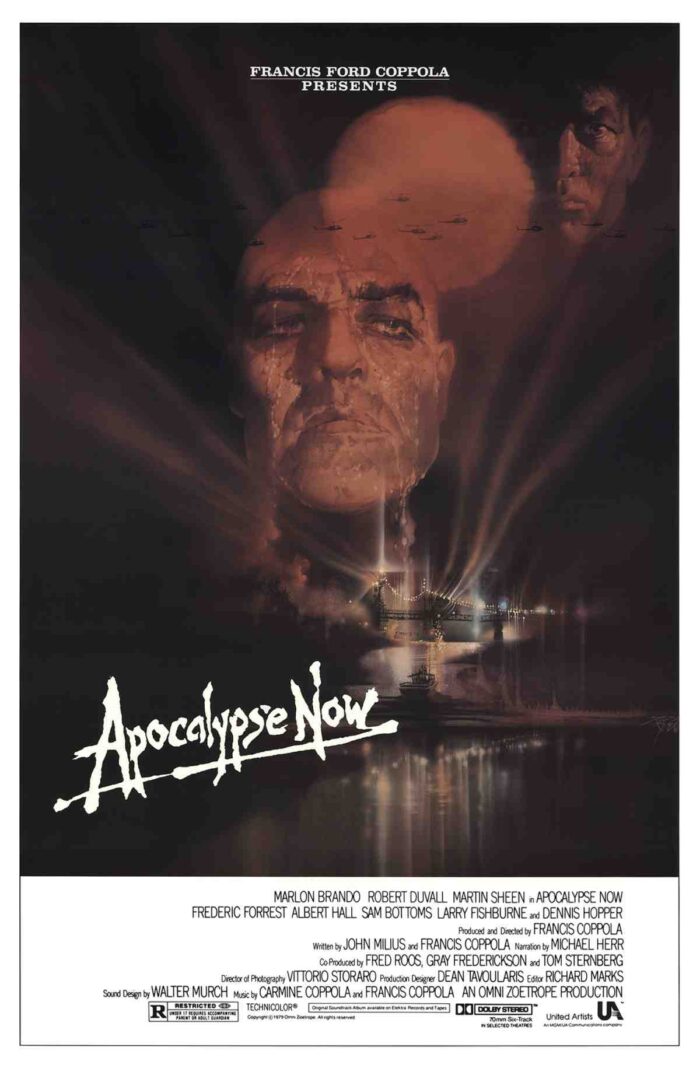
Very few movies manage to be relevant, or to show us something about life that makes us want to re-engage from our comfortable armchair debt servitude, and very few do it so insightfully and elegantly that they might be “classics,” but this film surely qualifies.
Ostensibly a war film, it re-tells Joseph Conrad’s Heart of Darkness in a Nietzschean take informed by the civilization collapse riffs of T.S. Eliot, set in the Vietnam war to symbolize the ongoing interaction of the West with the third world.
Instead of the usual hoorah nonsense we receive instead a meditation of the deepening of descent into both crisis and an escape from the mental poison of civilization, hitting on many of the themes of black metal which Conrad carries on from Plato.
Its peak may be the infamous sampan scene where means-over-ends reasoning collides with ends-over-means, a moral critique echoed in the final scenes, where an escape from social morality provides the characters a means of going forward, even if scarred by the past.
While it is criticized for its intense nihilism and seemingly depressing theme of the ongoing failure of civilization in the West, its message to a metal fan offers the usual hope: if we can escape the mental pathology of civilization, we can rediscover the wisdom of nature and become participants in our own lives again.
Kanonenfieber’s third studio album, titled Soldatenschicksale, is essentially not a new album in the traditional sense, but rather a compilation of their three previous EPs. In addition, there are two new tracks:“Z-Vor!”, which was released in August last year, and “Heizer Tenner”, a new song.
That being said, the three EPs were not simply thrown together. All of the material was reworked and re-recorded. This becomes especially obvious when listening to the old and new versions back to back: the recordings and overall sound are clearer, the mixing is different, and the drums and riffs are much more prominent. Some passages were also slightly altered; the two “Füsilier” tracks in particular clearly show an adaptation to the band’s own 2025 sound, which had not yet been present on their debut album.
However, even after listening to it several times, two questions still remain for me: did this album really need to exist in this form, and is it actually worth it? Do the new versions justify a full album, and was this necessary after only five years as a band? Personally, I would say no. Even the excellent “Z-Vor!” and the solid “Heizer Tenner” cannot fully save the album’s overall concept for me. I can also imagine that especially death/black metal fans who prefer a rawer sound might not be particularly fond of the cleaner sound design, despite the supposed “improvements”. That said, the steadily growing number of Kanonenfieber fans will surely appreciate the album just as much as its predecessors. One thing still holds true: the band continues to deliver consistently strong songs that simply work.
Since the release of Die Urkatastrophe (Review) in 2024, it has become quite clear where the band is heading: top spots on upcoming festival line-ups are already in their sights, and this summer they will once again appear on several line-ups that have already been announced. In more and more countries around the world, sandbags are being set up on stages. Whether an in-between album like this is really needed to support the new tour is something the band’s fans will ultimately have to decide for themselves.
Listening to EVA UNDER FIRE (@evaunderfire) is like hard rock therapy, turning scars and demons into anthems of inner strength. Nowhere is that clearer than on the Detroit band’s latest single, the sonically fierce and lyrically razor-sharp Murder Scene, released today (February 6) via Better Noise Music. “‘Murder Scene’ explores eating disorders, body dysmorphia, self-doubt, […]
Lost in Hollywood push things forward with their brand new single Pieces, taken from their upcoming sophomore self-titled album, out on March 20. After the strong impact of their previous singles, Pieces hits with a darker, more direct edge—channeling frustration, pressure, and the slow collapse that happens when everything you’ve built starts slipping through your […]
LONG DISTANCE CALLING return with new music and open an entirely new chapter in their career. Today, the German instrumental rock pioneers release A Secret Place, the first single and video taken from their upcoming studio album The Phantom Void, set for release on April 10, 2026. Described as “the shortest, hardest and strongest album […]
Tunisian French metal innovators Myrath shine a new light on their recent single Soul of My Soul with the release of its official music video, adding a powerful new emotional layer to a song that has already deeply resonated with fans. Released two weeks ago, the track now gains renewed attention through visuals that expand […]
Listen to the best in new, heavy music every week with HEAVY‘s new weekly HEAVY AUDIO MAG, featuring music from our weekly cover artist plus new premieres, hit predictions, and killer tracks we just know you want to listen to from bands featured over both digimags and some just because we want to put them […]
In this interview, Kitty A. Austen, Jon James Tufnell, and Andy Head of the band Saint Agnes discuss their musical evolution and upcoming album. They describe their sound as a blend of industrial rock, punk, and metal, focusing on emotional honesty and intense live performances. The conversation covers their DIY approach to music videos, their songwriting process, and how personal experiences with grief and world events influenced their new music.
The Revölution by Night (1983) is where it all fell apart for Blue Öyster Cult.
Or is it? The errant historical position of The Revölution by Night in the band’s catalog reflects its debated quality. The narrative around the Cult’s first post-Albert Bouchard album has never stabilized. Structural changes in the band’s lineup and exhaustion from the one-two blow that was the prior Fire of Unknown Origin (1981), as well as a well-received live companion Extraterrestrial Live (1982), put pressure on The Revölution by Night to define the inflection point in the superstructure of Blue Öyster Cult’s weltanschauung. There is a sundering here which left one half of fans pleased and the other half wanting. The album had something in it of both the whip and the dope. A true consensus has never cohered on The Revölution by Night even several decades on from the 1980s, but one gets the same ageless impression: “It feels different.”
Does it though? Upon analysis, The Revölution by Night is not too different from the prior Fire of Unknown Origin, the aesthetic pinnacle of Blue Öyster Cult in the radio mainstream. The Revölution by Night and Fire of Unknown Origin share the same skin and bones of the Cult’s transitory period, which weighed heavily on the band throughout the early 1980s. One need look at the writing credits on the album to scan familiar names: Richard Meltzer, Helen Wheels, Sandy Pearlman, and queen of the New York scene Patti Smith. Smith’s poetry was once again key for the album by contributing the lyrics for the album’s mystical centerpiece: the sensually illusive ballad “Shooting Shark.” The album’s overall subject matter is all well-trod at this point too with (if anything) a more pronounced interest in extraterrestrials, motorcycles, and psycho-murderers. The skin of the album is familiar as well. Artist Gregg Scott returns after his work on the legendarily eerie Offering cover for Fire of Unknown Origin with a mythic highway exchange of speed, lightning, and hieroglyphics for The Revölution by Night. All this is the Cult’s established philosophy and aesthetics.
…
…
So, what was the difference? The most immediate and tangible was Albert Bouchard’s absence on drums after the blowout in England in August 1981. Bouchard had, ultimately, been voted out of the band in a unanimous group decision (including his own brother Joe Bouchard) as, after a tense confrontation backstage at the Monsters of Rock music festival, Bouchard’s intense creativity could no longer justify increasing unreliability. The rift with Albert was much more consequential than originally intended. Months of separation turned into years. The Cult’s handy fixit Rick Downey was then gang-pressed into filling the open seat. Downey was not intended to stay in the drummer’s seat for long, but necessity, alongside the band’s general dissatisfaction in the search for a long-term replacement, turned into Downey featuring fully on The Revölution by Night—it would be his only feature on a Cult studio album. This change in the lineup was exacerbated by the departure of producer Martin Birch, who had provided a needed steady hand on Cultösaurus Erectus (1980) and helped the band secure an undeniable second wind with Fire of Unknown Origin. Birch had to heed the call of the Commonwealth when he returned to merry old England (technically the Bahamas) to help a little-known band produce an album titled Powerslave (1984). His transition to Iron Maiden’s technical man necessitated his replacement by Kasim Sulton, and later Bon Jovi-producer Bruce Fairbairn. Most of the pre-production with Fairbairn, according to Eric Bloom, ended up being done in an apartment loft in Brooklyn, next to the Brooklyn Bridge, where the Cult had to pay off the rest of the apartment lodgers so as to not be inundated with noise complaints. None of these changes were concessions, perhaps the all-consuming terror of disco did place certain necessities on the band, but it was undeniably different.
There was doubtless a decay in the monolithic autarchy of the concept of Blue Öyster Cult, but The Revölution by Night’s opening track shows the band did not feel themselves in alien territory: “Take Me Away.” This surprise collaboration between Eric Bloom and guitarist Aldo Nova shows no awkwardness. Though technically not a Blue Öyster Cult song by inception, “Take Me Away” was originally a psychotic tune by Nova titled “Psycho Ward” which Bloom re-conceived with an appropriate Cult-ish fantasy: his legitimate desire to be abducted by aliens. The result was a strange twist on the “I wanna be a rockstar” power ballad that is instead dedicated to the Men in Black, close encounters of the third kind, and a lust for the foreign rather than flesh. A majority of the work on the song was apparently laid out by Nova, who slipped into the studio with Bloom’s help to cut the track with the band’s consent. The insane origins of the tune remain in the breakdown in the latter half, which heavily features Nova’s guitar prowess. The entire piece is celestial, rather bright for a Blue Öyster Cult song, which makes ample use of sci-fi synthesizers (also played by Nova) and hooks. There’s a different edge here that is refreshing for being a little less cynical than Fire of Unknown Origin. “Take Me Away” is an incredibly strong opening, so why not go along for the ride?
…
…
“Eyes on Fire” is the first odd note on The Revölution by Night. The subject matter is perfectly Blue Öyster Cult, a ballad of obsession from the perspective of a man who finds himself always second-best in the eyes of the woman he desires, but the demo was by outsider Gregg Winter (no connection to artist Gregg Scott). The Cult ended up buying the song outright from Winter because Bloom enjoyed it. There are a couple turns of phrase that make “Eyes on Fire” a fun little tune: “Eyes on fire / glowing like coals in the night,” and “I’m the wildcard / She’s got up her sleeve / But she doesn’t look at me.” The issue is the song never goes beyond implications and inferences, so there is not a bloody (or outlandish) twist that pulls it together at the conclusion. Catharsis is absent. One gets the sense this was another attempt by the Cult at swinging for a hit, but the song lacks “frisson” (as Sandy Pearlman would put it). Bloom’s bellowing vocals are also unable to cover up the main issue most point to with the album: the very 1980s electronic drums. They were the Simmons drums Downey used for the majority of the material, which always sounded slightly muted. Is Downey at fault here? Not at all, but “Eyes on Fire” does make it obvious that Blue Öyster Cult were falling victim to the technological attrition of the era.
Patti Smith’s “Shooting Shark” luckily swoops in and puts the album back on a proper footing equal to Fire of Unknown Origin, though it was not originally for The Revölution by Night. While not an active face-to-face collaboration, Smith had unofficially pseudo-retired from the music industry by 1979. Buck Dharma was able to take a cut of Smith’s leftover words and turn them into a lush ballad of mystical frustration. In untruncated form, “Shooting Shark” is one of the longer Cult songs (around seven minutes), but not exactly a conceptual epic like “Nosferatu” or “Black Blade.” What exactly the song represents is forever hotly debated, but the star-crossed narrative is a fever fugue which slides between billiards metaphors, the harsh obligations of love, and infinite distance that not even intimate closeness can overcome. The actual composition is rather romantic in soft rock fashion, synthesizer-heavy, where Buck on guitar and American Idol’s Randy Jackson, of all people, on bass lay down sweet licks and sweeping sequences. Joe Bouchard stated he lacked the slap bass skills Buck wanted for the song, so Jackson was brought in like a mercenary for the session. The saxophone solo was then provided by Marc Baum! Ultimately, the song is smooth as hell but feels rather isolated being based so heavily on outside musicians, drum machines, and adult contemporary-oriented mutations to the BÖCDNA. Any hope for the song to be the album’s shooting star ended up beached as the rise in rigid hit-fishing on AM and FM terrestrial radio meant the era of experimentation with longer rock and metal tracks on air was done. The high quality of “Shooting Shark” did little to prop it up in mainstream culture besides some minor airtime in rotation after release.
…
…
“Veins” is a patented Cult pseudo-murder ballad with lyricist Richard Meltzer’s only credit on the album. The song puts ice in the veins. It also puts the 1980s in the veins with a lot of synthesizer and radio-friendly energy, a reoccurring theme. Another Buck song, “Veins” is a hard shift from the sleek “Shooting Shark” towards the album’s core section of teeth-clenched rock and metal. “Veins” bridges this gap to a satisfactory degree. Dharma’s vocals here are unique enough to make the listener wonder if there has been a verifiable murder. The word “overproduced” is thrown around about “Veins,” but that sensation could be the result of the Prophet 5 synthesizer used on the track. This is another Cult offering bogged down by the mechanical traits of the 1980s, though Downey and Lanier provide subtler accompaniment in the background which give the song a fullness rather than totally ringing hollow. “Veins” slots in as another example of fever dream bloodshed in the Cult’s catalog, but few will directly name “Veins” as their favorite case of blue bloodshed.
Victims of circumstance “Shadow of California” and “Feel the Thunder” compose the cyclical core of The Revölution by Night. The album’s greatest failure is in placing these much too similar tracks back-to-back. “Shadow of California” is a bombastic biker metal track, penned by Sandy Pearlman, that puts the sterling studs in the leather of The Revölution by Night. An intentional pseudo-sequel to the earlier “Golden Age of Leather,” Pearlman’s lyrics of motorcycle madness provide ample space for electronic booms and studio choruses. The issue becomes that the unapologetic loudness of “Shadow of California” is followed up by the spooky, also unapologetically loud, biker rock of Bloom’s “Feel the Thunder.” Originally a Michael Moorcock-penned song by the name of “Sleep of a Thousand Tears,” Bloom shifted the track towards a more urban legend style story in the folkloric lineage of the country-western classic “(Ghost) Riders in the Sky,” about a group of Gothic ghost-riders on motorcycles. “Feel the Thunder” is another instance of the Cult penning a modernized Hammer Horror soundtrack. Both songs ultimately step on the other’s toes thus causing the whole middle of the album to awkwardly misfire. The Cult’s modern American folklore unfortunately withers all the same at the cold in-creep of the 1980s. Summer of love, winters of discontent, all were giving way to the spring of unabashed Reaganomics.
…
…
“Let Go” is another go at a band anthem for Blue Öyster Cult, though different from the first attempt off Spectres with “R U Ready 2 Rock.” It’s also another Bloom and Ian Hunter (of Mott the Hoople fame) collaboration with some additional input from Dharma. It is not too dissimilar in style from Bloom and Hunter’s earlier collaboration off Spectres: “Goin’ Through the Motions.” “Let Go” resembles a salon-style riff redux on those earlier collaborative attempts to distill the band identity down to one track. The song, in all, was the self-reflection of the band who were, perhaps, becoming too self-aware about the whole situation: more successful, more self-referential, but more cheesy. It, of course, included a vibrant chorus to encourage audience participation in live performances, but the function here is much more rock ‘n roll stagecraft rather than the Cult’s earlier interest in mass psychology. The composition is reflective of the early 1980s period which the Cult spent touring with groups like Triumph and Journey. The result is a wild rock anthem that functions better in concert rather than sealed away, hypostatic, on an album. Additionally, the song opened the band to the accusation that all their new material was too much fat and too little muscle.
A lean collaboration between Dharma and Broadway Blotto (real name: Bill Polchinski) then bursts out in flames with “Dragon Lady,” one of those rock-metal songs that should be painted across the side of a van in a full-on fantasy mural. Fighting, cavorting, and almost parodic, “Dragon Lady” is a blazing guitar-centric track about an unattainable warrior lady in-command of a mythical beast and the attention of all men. The fun here is all in the testosterone, leather, and ozone destruction from the fire and hairspray. Structurally, the song is brash due to the influence of Polchinski, a mainstay member of the upstate New York oddball band Blotto. They legitimately originated as a comedy jug band and were friends with Dharma, who occasionally cameo’d in their satirical music videos. Polchinski’s and Blotto’s general blunt ethos can be felt throughout “Dragon Lady,” which put even some Cult diehards off. The rest of the Cult unfortunately get pushed into the background here as Dharma’s guitar chops cut it up. Nothing feels ignored, but still, something smells off. “Dragon Lady” was never going to be a hit, but it is an unappreciated scorcher of a song that makes no apologies for being so indulgent.
…
…
“Light Years of Love” is a somber crooner ballad that closes off The Revölution by Night. Written by Joe Bouchard and hardcore rocker Helen Wheels, it reflects both the great strengths and great weaknesses of the whole album. Bouchard often names “Light Years of Love” as having some of his favorite original lyrics, and he is not misguided in his affection. The song presents sincere love lyrics and carries them well for a band that, on the surface, seemed to be so cutting with every topic. Bouchard went from the anonymous metropolitan torture of “Screams” off Blue Öyster Cult (1972) to, in 1983, crooning, “Our love is like the shining sea / In salty foam we can feel so free.” Living or dead, mustachioed men in leather can love too. The entire affair is an electric pastoral in the unabashed sci-fi language of 1980s neon. “Light Years of Love,” though, confirms the serious breach that the succeeding album Club Ninja would go on to consummate: Blue Öyster Cult’s dis-frequency (though not exactly break) with the wider American rock-metal tradition. “Light Years of Love” straggles into the no man’s land of surplus studio production and is shot down with little flourish. Outside Bouchard’s voice, “Light Years of Love” is so flattened that all personality has been squeezed and salted out of it. There’s nothing loud, nothing experimental, nothing so alien here that any audience will return to this track with addicted ears and fresh eyes. The shadow that has been haunting the Cult since Cultösaurus Erectus is coalescing in light as The Revölution by Night disperses.
The Revölution by Night failed to stabilize the centrifugal forces that had delivered the band their second wind with Cultösaurus Erectus. These forces were self-negating as the band’s identity continued to disperse and dissolve with only a vague thrust of commercialism as a guiding light through the late 1980s. The title, then, as with every unplanned revolution, failed to establish a solid alternative for what Blue Öyster Cult could be for the next decade. The miss came at an unfortunately critical time when such a vanguard failure for Blue Öyster Cult created a self-reinforcing collapse of the band’s identity and, essentially, exile from mass culture until the 2000s. The exact causes for error, as with any historical collapse, varied depending on the source. Bloom blamed the prolonged period on how out-of-step the Cult had become with the zeitgeist after punk, which the Cult were friendly to, lost the grand market campaign to disco. Bouchard’s answer is similar: the culture hegemony of 1980s studio production, derived from disco philosophy, created a cascade effect that caused the band to always be playing catch-up. The most incisive anecdote about the album, though perhaps an apocryphal rumor, is that both Sandy Pearlman and Dharma went behind producer Bruce Fairbairn’s back to remix multiple tracks on the album. No one knew what to make out of The Revölution by Night, which, to this day, still sounds out of place yet oddly listenable.
The ultimate result of The Revölution by Night is a lot of bitter and a lot of sweet. It was Blue Öyster Cult’s rearguard action against inevitable market forces banging at the door. The band had been buoyed for a decade on connections and hot luck: a sweetheart deal with Columbia, a love affair with the New York milieu, and an immortal mega hit that still lives on after fifty years. The Revölution by Night proved the band was still a functioning unit with comprehensive talent, maintained a voice, but also that the functional braintrust behind the music was under strain. The inevitable chips of bad fortune were being delivered to the band as they trudged on with the knowledge that those stable givens could soon collapse, economic concerns were replacing philosophical unity, and that there were only two more studio albums until the decade-long deal with Columbia was up. It all foreboded the long, axial crisis of Blue Öyster Cult throughout the unstable 1980s, culminating with a long 1990s in the wilderness. They were now at the threshold, but the man bound for the wilderness becomes either a beast, a philosopher, or a prophet with each step.
What would Blue Öyster Cult become? A shadow warrior, of course.
–William Pauper
…
Special thanks on this retrospective to Martin Popoff for his Agents of Fortune: The Blue Oyster Cult Story, the administrators at Hot Rails, and the disparate BÖC archivists across the Internet keeping alive more than fifty years of band history.
 Listening to EVA UNDER FIRE (@evaunderfire) is like hard rock therapy, turning scars and demons into anthems of inner strength. Nowhere is that clearer than on the Detroit band’s latest single, the sonically fierce and lyrically razor-sharp Murder Scene, released today (February 6) via Better Noise Music. “‘Murder Scene’ explores eating disorders, body dysmorphia, self-doubt, […]
 Lost in Hollywood push things forward with their brand new single Pieces, taken from their upcoming sophomore self-titled album, out on March 20. After the strong impact of their previous singles, Pieces hits with a darker, more direct edge—channeling frustration, pressure, and the slow collapse that happens when everything you’ve built starts slipping through your […]
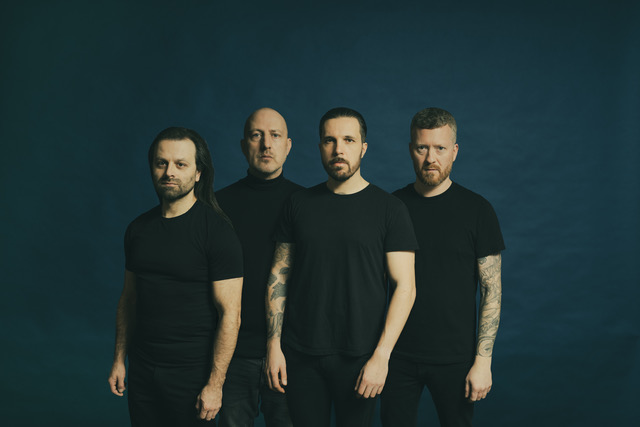 LONG DISTANCE CALLING return with new music and open an entirely new chapter in their career. Today, the German instrumental rock pioneers release A Secret Place, the first single and video taken from their upcoming studio album The Phantom Void, set for release on April 10, 2026. Described as “the shortest, hardest and strongest album […]
 Tunisian French metal innovators Myrath shine a new light on their recent single Soul of My Soul with the release of its official music video, adding a powerful new emotional layer to a song that has already deeply resonated with fans. Released two weeks ago, the track now gains renewed attention through visuals that expand […]
 Listen to the best in new, heavy music every week with HEAVY‘s new weekly HEAVY AUDIO MAG, featuring music from our weekly cover artist plus new premieres, hit predictions, and killer tracks we just know you want to listen to from bands featured over both digimags and some just because we want to put them […]