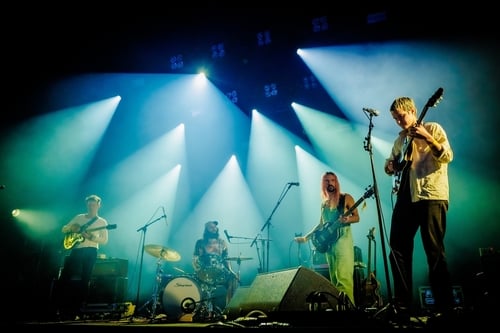
Gozu – Gozu VI (Metal Blade Records / Blacklight Media Record) [Rich Piva]
Yes, Gozu gets thrown into stoner rock band categorization, and for good reason. But no band swings like Gozu swings, and no band sounds like Gozu does, even with the seemingly thousands of stoner bands out there today.
This is very evident on their new record, Gozu VI, which shows some of their metal side too, but keeps their trademarked Gozu sound that you know and love and ratchets up the harmonies and catchiness that help make this band so special.
Marc Gaffney’s unique vocals are at the top of his game while Doug Sherman brings out his shredder for the eight tracks on VI. Banacek kicks all sorts of ass, with Sherman doing his best early 80s metal impression on the solo, simply ripping it up. Killer Khan is another favourite, and the band really layers in the background vocals and the harmonies to really make this group of songs stand out.
Of course you get the great titles that have no meaning to the lyrics, but with those lyrics you get some of the deepest, personal, and best songs in the band’s career. That is really saying something, given how much I love Gozu. Plus they have a song called Corinthian Leatherface which is great on multiple levels.
Gozu never disappoints, and they don’t here either with VI. They may have even exceeded expectations with these songs. Don’t let the 80s wrestling and old TV titles fool you. Gozu is not screwing around on Gozu VI, an album of the year contender. 9/10
Requiem In White – The Visible Heaven (The Circle Music) [Spike]
Back in 1985, if you wanted to play dark, romantic music in Boston, you were fending for yourself. There was no organized gothic scene to coddle you. Requiem In White built their own fortress out of classical operatic drama and jagged, raw post-punk friction.
By the time they took over New York in the late 80s, headlining over the likes of Christian Death and Type O Negative, they had become a myth, partly because their music was exceptional, and partly because they flat-out refused to play the media game.
After 32 years of silence following their painful 1994 split, The Visible Heaven is a resurrection that shouldn’t work on paper, yet it stands as one of the most vital, majestic things I’ve heard in a very long time.
This isn’t a band trying to copy modern “darkwave” trends or hide behind cheap drum machines. The record opens with the title track, The Visible Heaven, and the hair on your arms immediately stands up.
Lisa Stockton’s vocal range remains an absolute force of nature; she doesn’t just sing, she commands the frequency with a classical, theatrical gravity that most of the modern goth circuit can only dream of. Doc Hammer’s guitar work is right where it needs to be, thick, ominous, and shifting seamlessly from jagged metallic riffs to sprawling, gothic soundscapes.
The rhythmic spine of the record is incredibly bitter-sweet. While we deeply feel the absence of the late Chris Walsh on bass, the foundation provided on tracks like Ursuline Sister and True Lovers and Whores is remarkably heavy and physical. Javier Madariaga’s drumming retains that urgent, street-level pulse, a reminder of his roots in Reagan Youth which keeps the “gothic opera” tag firmly anchored in a raw, unvarnished punk reality.
Missa Brevis for the despised king in D minor is the absolute centrepiece of the record. It’s a track that highlights their unique ability to weave classical mass structures into a rock framework without ever feeling pretentious or silly. It’s dense, atmospheric, and has a cold-blooded elegance that reminds me of early Paul Chain or Sex Gang Children at their most creative. The guitars don’t just play riffs; they build a grey, towering cathedral in your living room.
The back half Solus Sum, Suffer And Sleep, and Reckless In Misery doubles down on the melancholy. I’ve been listening to Cold Or Divine in the car, and the way the vocals layer over that crawling, feedback-laden groove is pure, late-night catharsis and could be the reason for the odd speeding ticket late at night too. It’s honest, pained, and entirely unmasked music for people who understand that goth isn’t about the hair dye; it’s about the soul of the noise.
The Visible Heaven is a heavy, shimmering triumph of composition and intent, proving that some myths are entirely real. For those of us who still remember goth from the 80s, this isn’t just a record, it’s a home. 9/10
Iron Kingdom – Shadows And Dust (Steel Shark Records) [Adz Redpath]
Forming in 2011 in Vancouver, Canada This is Iron Kingdom’s 6th full length studio album and coincides with their 15th anniversary as a band, having had quite the illustrious career to date with support slots with everyone from Anvil, HammerFall, Angra, Metal Church and Jag Panzer to the mighty Flotsam and Jetsam, and with many festival and tour shows under their belt this group have a definite calibre and track record to be respected.
A self proclaimed self produced and mainly DIY group in most every aspect of what they do is not so common at this level and especially within the traditional, classic and prog metal genres. At this stage a band would usually hit big studios and big production to give the huge sound that is so iconic within these styles but to their credit they as a band have taken a different route.
Unfortunately this does show in the overall sound, whilst this is their first release in their own self constructed studio I feel it is underwhelming on the production front, lacking both definition and separation overall and in particular with the drums which are lacking a punch that is sorely missed, both the cymbals and guitars feel washed out and almost hark back to the mp3 era, the bass guitar is almost non existent sonically and missing the frequencies that fill the low end of the mix which even falls flat when the bass is alone such as on the intro of the track Blood And Steel and for majority of the record.
There is a sound here that speaks to everything being mastered at too low a hz level with samples sounding like they were low rez ripped from Youtube and a lack of space within the mix that even programmed music ad’s these days, this is missed greatly given the scope of the songs on display here and has more of a production sound that is reminiscent of the first Iron Maiden album before the remasters, not bad but not up to modern standards.
The musicianship here is very strong and undeniably adept as the band puts a strong foot forward in these areas most of all, and whilst being masterful in every instrumental aspect of their craft this release however simply lacks the songs to carry it to any massive heights in what is a very strong scene.
Mashing the more classic thrash metal and NWOBHM with soaring vocals and shredding solo’s mixed with the anthemic gang vocal sections and almost symphonic parts there is a clear calibre here but lacks its own distinct voice. Hopefully the next album will find them more at ease with their new studio and more able to elevate what they have as despite my criticisms this is clearly a band that knows what they want.
Worth a listen but not a head turner. 6/10
Your Spirit Dies – It Is Well (MNRK Heavy) [GC]
Lots to like about EP’s, if you like it you can dive into the rest o the bands catalogue or look forward to what is coming in the future, if its god awful you can be pleased that its short and you have wasted much time on it and move on quickly! So, with all that in mind, I have the new EP from Your Spirit Dies, It Is Well is it bin or get in???
They literally blast out of the blocks on Starless and it is full of the anger and brutality you want but the drums kind of drown everything out at first, when anything else does come through you get a familiar modern sounding metalcore sound that is overtly electronic and this takes something away from the overall sound, like it decent but it sounds to clean and produced, I know that sounds mental but you need a bit of dirtiness to really do this justice, I honestly have no idea why they have decided to put When Peace, Like A River on this as its just 56 seconds of ambient background filler?
This is really not needed and almost slightly insulting to include on this release, put it on an album to break up the flow of as an intro/outro on this? 100% pointless and annoying! So, Whispers In Omen is the next and final track, once again it has all the huff and puff but is just so overproduced that you miss certain things and have to go back to really pick them up and when you’re not actually that bothered about the sound it grates massively, the breakdown in this song saves it from falling into total mediocrity but only just the rest has all been done before and much better.
So, for me this falls directly into the move on quickly category, 2 songs are not enough for me to really form a strong opinion on a band and what I heard made me just think they are ok but I won’t be going out of my way to listen to anything in the future and that’s a shame. 4/10
Melodic classic rock outfit White Skies have announced an exclusive acoustic record store tour across England this July. The intimate run of independent shop appearances is scheduled to coincide with the highly anticipated vinyl arrival of their sophomore studio album, Shouting at the Hurricane, which lands on physical shelves on 3rd July 2026 via Conquest … Continue reading White Skies announce exclusive UK acoustic record store tour ahead of vinyl release
Mallavora vocalist Jessica Douek might’ve lent her impressive talents to Celebrity Traitors, but she’s using her platform to highlight the difficulties she faces as a person with a disability
Austrian black death metal titans Belphegor have officially announced they will unleash their magickal processions across Europe and the UK this autumn with the “Praise The Beast” European Tour 2026. The extensive trek will storm through Germany, Belgium, the Netherlands, Scandinavia, Central Europe, and Poland before culminating in a run of exclusive UK live rituals. … Continue reading Belphegor announce autumn 2026 England tour with Krisiun and Asagraum
Twenty years ago, Slam Dunk was a single-stage festival in Leeds, headlined by Fall Out Boy. In the years since, it has grown into one of the UK’s biggest celebrations of alternative music, welcoming everyone from pop-punk icons and emo veterans to the next generation of hardcore, metalcore, ska bands, and punk bands.
A lot has changed since Slam Dunk’s first edition in 2006, at Leeds Millennium Square. The stages are bigger, the crowds are bigger, and the lineup now stretches across almost every corner of alternative music. What hasn’t changed is the feeling of arriving and immediately seeing thousands of people who clearly wouldn’t want to spend their Saturday anywhere else.
The first thing I noticed after arriving by train wasn’t the stages or which band was about to play. It was the people. Friends reuniting with one another outside the gates, groups comparing schedules and talking about where they should meet up since our telephone signal was lost upon entrance, I hope they fix that next year, and despite the heatwave and the sizes of the different crowd sizes, the atmosphere felt warm, welcoming, and excited. For all the growth Slam Dunk has experienced over the past two decades, it still feels like a festival built by and for the community that helped it survive.
OF COURSE, some parts of the experience were impossible to ignore. The heat was relentless. Bar queues became a running joke throughout the day. Every patch of shade was occupied by somebody trying to recover before the next set, by chugging water like there was no tomorrow. And as someone bouncing between stages, interviews, and the press area, I quickly learned that seeing everything on my schedule was never going to happen. Somewhere between standing in a queue for a drink and racing across the site, I even managed to miss half of State Champs’ set. Sorry!!!
Twenty years on, Slam Dunk still feels like a festival where everyone is trying to do the same thing: fit an entire weekend’s worth of bands into a single day.
Angel Du$t – Main Stage East Left
While there were a few anniversary shows, the focus wasn’t quite there. Angel Du$t felt like a reminder that the festival wasn’t built on nostalgia. But on new innovations.
By the time the band took the stage, the crowd was more than ready to jump into a pit. The heat wasn’t exactly merciful, but the crowd worked with what they got as the band went through their set.
But what made Angel Du$t interesting is that they don’t just fit into the hardcore genre. There’s so much more to them, soundwise, something weirder and more fun happening underneath it all. And everyone was there for it!
Boston Manor – Monster Energy Stage Right
Boston Manor could have easily spent their Slam Dunk set leaning into nostalgia. A lot of bands were doing that, and rightfully so. But instead, the Blackpool band used their time on stage to showcase just how they’ve evolved over the last decade.
Boston Manor’s set felt a bit like a tour through their entire career. One minute they were playing newer songs like “Floodlights on the Square” and “Passenger,” the next they were throwing the crowd back to tracks like “Laika” and “Stop Trying, Be Nothing.”
That balance paid off throughout the set. Older songs sparked memories that flooded back, while the newer material drew some of the loudest sing-alongs. Rather than looking backward, the band used their set as a celebration of everything they have become since they first started appearing.
Dashboard Confessional – Main Stage West
I only caught part of Dashboard Confessional’s set. Like most people at Slam Dunk, I was already checking the time and trying to figure out how long I could stay before needing to head somewhere else.
Even so, it didn’t take long to understand why so many people had made them a priority. Within minutes, the crowd had largely taken over singing duties. Chris Carrabba would start a line, and thousands of people would happily finish it for him.
Sadly, like many people at Slam Dunk, I found myself watching one band while keeping an eye on the time for the next, with The Menzingers waiting across the site. I eventually had to make a run for it before Dashboard’s set was over.
But from what I did catch, it was enough to understand why so many people had made them a priority. Even after all these years, the songs still connect in a way that few bands can catch.
Twenty minutes before The Menzingers took the stage, I was sitting with Greg Barnett and Eric Keen talking about growing older.
Not in the dramatic, rock-and-roll sense. Just life. Families. Kids. The strange reality of somehow being twenty years into a career that started because a group of friends wanted to play punk rock.
Twenty years in, The Menzingers still don’t seem entirely convinced they’re supposed to be here. When I asked what had kept the band together for so long, Greg’s first response was a joke about fame and fortune before both he and Eric settled on a much simpler answer: people kept showing up.
An hour later, standing in front of the stage, it was hard not to see exactly what they meant.
Opening with “I Don’t Wanna Be an Asshole Anymore,” The Menzingers were greeted by a crowd that barely needed warming up. If anything, it felt like people had been waiting for this set all day. Everywhere you looked, someone was singing. Not just the big choruses either. Entire verses disappeared beneath the audience as songs like “The Obituaries,” “Good Things,” and “After the Party” rolled through the set.
Earlier in the day, Barnett had told me that one of the best parts about The Menzingers is that their fans have grown alongside the band. “They’re seeing their stories in the same way that we are existing,” he explained.
Looking around the crowd, it felt less like an interview answer and more like a statement of fact.
The people who first connected with these songs aren’t the same people anymore. Some have children. Some have gone through divorces. Some have moved countries, changed careers, lost people, found people, and somehow ended up here on a Saturday afternoon in Hatfield singing along to a band that has soundtracked a large part of their lives.
That’s what made The Menzingers’ set feel different from many of the anniversary celebrations happening elsewhere across the festival. There was no need to revisit a classic album or recreate a specific moment in time. The connection was already there.
That same mindset has shaped the band’s upcoming album. Rather than looking backward, Barnett described the new record as an attempt to document the present. “It felt like we don’t really need to be looking towards the future or the past,” he told me. “It just feels like we need to kind of document what’s happening right now.”
In many ways, that idea also explains why The Menzingers continue to matter.
While plenty of bands spend years chasing the version of themselves that people fell in love with, The Menzingers have allowed themselves to grow up in public. The songs have changed. The people listening have changed. Yet somehow the connection remains exactly the same.
Earlier in the day, Greg had told me that The Menzingers’ fans had grown alongside the band. By the time “After the Party” rolled around, I didn’t really need the explanation anymore.
Taking Back Sunday – Main Stage West
Taking Back Sunday should have been one of the highlights of the day.
Celebrating twenty years of Louder Now at Slam Dunk feels like a perfect match on paper. Few records are as closely tied to the festival’s audience, and judging by the number of people packed in front of the stage, plenty of fans agreed.
Unfortunately, the sound had other ideas.
Whether it was where I was standing, issues with the mix, or just Adam himself, I spent more time trying to figure out what was happening than actually enjoying the set. Vocals regularly felt buried, and instead of being pulled into the performance, I found myself growing increasingly distracted by the technical side.
Maybe that’s unfair. Maybe somebody standing fifty meters away had an entirely different experience. That’s the reality of festival sets.
What I can say is that after spending most of the day running between stages, sitting through interviews, and standing in queues, Taking Back Sunday became one of the few bands I chose to walk away from.
Judging by the crowd that stayed behind, plenty of people were still having a great time. I just wasn’t one of them.
Slam Dunk’s twentieth anniversary wasn’t the only anniversary I was celebrating that day.
Slam Dunk’s twentieth anniversary happened to coincide with my twentieth as a Motion City Soundtrack fan.
I wish I could tell you I handled that fact normally.
Earlier in the day, I had been standing with Jesse Johnson and Tony Thaxton. A few hours later, I was standing in a crowd watching Motion City Soundtrack tear through a setlist that felt suspiciously designed to target my teenage years.
Fortunately, they made it very easy to remember why.
From the opening notes of “Some Wear a Dark Heart,” the crowd was locked in. What followed felt less like a festival set and more like a greatest hits collection for everyone who had ever found comfort in Motion City Soundtrack’s particular brand of anxiety, self-deprecation, and perfectly written hooks.
“Capital H,” “L.G. FUAD,” “My Favorite Accident,” and “Her Words Destroyed My Planet” arrived one after another, and judging by the reaction around me, I wasn’t the only person having a moment.
What I noticed most wasn’t even the songs. It was the people. Everywhere I looked, somebody was dancing, screaming lyrics at their friends, or throwing an arm around the person next to them. For forty-five minutes, it felt like everyone had collectively decided to stop worrying about being cool.
At the center of it all was Justin Pierre, who somehow remains one of the most relatable frontmen in alternative music. Twenty years on, he still performs with the same nervous energy and sincerity that made so many people connect with these songs in the first place. Nothing about it felt forced. Nothing felt like a band trying to recreate a moment from the past.
That’s what surprised me most.
For a set built around songs that have been with many of us for decades, Motion City Soundtrack never felt stuck there. “Attractive Today,” “Everything Is Alright,” and “The Future Freaks Me Out” got some of the biggest reactions of the afternoon, but they didn’t feel like museum pieces being wheeled out for applause. They still felt alive.
Maybe that’s because the songs have aged alongside the people listening to them.
Or maybe it’s because Motion City Soundtrack has always understood something that many bands don’t: growing older doesn’t mean leaving those feelings behind. It just means understanding them a little better.
Whatever the reason, twenty years after discovering Motion City Soundtrack, I finally got to interview them and then watch them play one of the highlights of Slam Dunk.
Some bands remind you of where you’ve been. Good Charlotte reminds me of where I wanted to go.
Growing up, I always liked how open the Madden brothers were about their background. They never pretended they’d had an easy ride. As another poverty kid, that meant something. Maybe that’s why Good Charlotte always felt a little more personal than some of the other bands I grew up listening to.
Their first UK appearance since 2019 was always going to be one of the biggest moments of the weekend, and the crowd in front of the stage reflected that long before the band even appeared. People weren’t casually wandering over to see what was happening. They were already there, waiting.
And once the set started, they didn’t stop moving.
What I noticed most wasn’t necessarily the songs. It was the people. Friends with their arms around each other. Grown adults screaming lyrics they probably first heard as teenagers. People are climbing onto shoulders to get a better view. For an hour, it felt like everyone in front of that stage had somewhere else they’d rather be than adulthood.
Maybe that’s the real reason Good Charlotte still works.
The songs came from a very specific place, but they never stayed there. Twenty years later, people continue finding pieces of themselves in them. Some came because they grew up with the band. Others came later because they discovered them. Standing in that crowd, the difference didn’t really matter.
For a band that once sang about wanting more from life, it was hard not to smile watching thousands of people sing those songs back at them all these years later.
And that was how Slam Dunk 2026 ended. Did I get to see all the bands I wanted to? NO. But does that give me an excuse to do two days next year?
Many bands don’t make it past the first album (many more don’t make it there at all). Maybe that’s why we’re so big on sophomore releases here? It takes a lot to release your debut, to go through that harrowing process, to inevitably be told by some guy on the Internet that your music sucks, and then go off and do it again. So, before we even get to the review, kudos to Artificial Silence, a progressive metal band and the subject of today’s article. Having released their debut, Negative Space, way back in 2018, the U.S. trio is back with an album that promises to be both proggier and newer than the last. But kudos do not translate into rating ’round these parts. How does the actual music sound?
Artificial Silence are a progressive metal band. I know I said that already, but I need to emphasize that Hollow Drift is all kinds of proggy—it’s got a reasonable level of heaviness, but it also features moments of cappella singing (“The Shadow”), a sudden violin solo (“Paradise”), and one song that inexplicably makes up half the runtime of the album (“Hollow Drift”). It also makes excellent use of a piano, which happens to be one of my favorite things in metal. Yes, there is a whole lot of prog happening on Hollow Drift, reminding me at times of Ayreon and Southern Empire—an album that succeeds or fails by its ideas and the grace with which it executes them. A headbanger this is not, but the scope of what Artificial Silence have made here is impressive. It helps that it sounds great; I really can’t remember the last time I’ve heard bass sound so good in a new release.
Unsurprisingly, then, there is more than enough variety across Hollow Drift for it to be engaging and enjoyable. “Tidal Lock” is unquestionably the heart of the album, a gorgeous, melancholy epic with a supremely emotional core that makes great use of the singers, piano, and keys. It swells to a simple yet lovely tremolo riff towards the end that encapsulates what Artificial Silence do best: simple, straightforward ideas executed with conviction and layered on top of each other to make great music. “Paradise” also does this well; for the most part, it’s a straightforward number that really comes alive in its final third—the piano and bass go wild, competing for speed and space, a violin joins the fray, and the Karevik-esque singing (Kamelot) becomes grander, more sweeping—it suddenly feels like an epic that ends too soon.
Of course, I have to mention the title track; in the forty-eight-minute album, “Hollow Drift” is twenty-four of them, and it contains some of Hollow Drift’s best moments and its one weakness. First, the good: over the first ten minutes or so, “Hollow Drift” establishes a serious, brooding atmosphere that feels great after the lighter and melancholic tracks that precede it. It blends expertly in and out of a cabaret-esque routine, the kind of silly-but-also-serious move I would expect from Diablo Swing Orchestra. It also features some of the heaviest moments on Hollow Drift. Unfortunately, it is simply too long. The last ten minutes grasp at ideas but never really take hold of one long enough to build the thread. There are two false stops that both feel like they “should” be the end, and despite many listens, I can’t quite remember exactly how this strong album closes. It feels like Artificial Silence were going for a grand finish from a story perspective, but I just don’t find the music holds up. This is a shame, especially because when it holds up, it really holds up! “Hollow Drift” features grandiose, epic, and fun music that recommends it highly anyway.
I could—and would really like to—go on. There’s so much to say about Hollow Drift and Artificial Silence that just doesn’t fit into the word count. For example, the vocal lines in “Fear and Retribution” are upbeat enough to evoke early aughts US pop rock—I can’t help but think Panic! At the Disco when I hear it. There’s so much going on here, and while I wish the title track had just a bit less in it, I love the myriad other ideas that make up Hollow Drift. It is a very enjoyable listen, one I plan to return to many more times.
Interestingly enough, this is my third all-day in as many Saturdays, and it’s refreshing to see so many familiar faces, who I saw at either Uprising or Grind After Death. What is undeniable is the feeling of camaraderie that exists in the community, and of how important these events are to many of the people in attendance. Organisers and staffers give their time and energies for little reward, because it means something special to them – not just here in Manchester, but across the country, across the whole globe, wherever a small rock show is staged, someone has had to sweat blood to get it on.
There’s also the effect it has on attendees: being part of something, even in a small way, meeting new people, sharing an experience, could be the saving grace that person needs.
So, here’s to you – all the people – wherever you might be – who give of yourselves to make events like this happen. Thank you!
Onto the Metal 2 the Masses final in Manchester’s Rebellion Music Bar. A whole day of an event, nine non-competing bands and four who have fought their way to this stage today, and everyone is a real treat.
Opening things up is Chrysalid Homo, local lads in as far as they’ve travelled to be here, but I’d be remiss not to differentiate between Manchester and the city of Salford. For this trio of brothers are Salfordians and have brought electro-synth laden punk to the Rebellion after a comment from one of M2tM’s Manchester promoters that he’d love to see the band in front of a metal crowd. And here they are. Banks of synthesizers and a bass guitar are all that’s needed to get this party started. Monkey Boot Boy comes over as a nod to the Eighties European electronic scene, widescreen and cinematic and just the sort of introduction to the day that most of us didn’t know we needed. Brotherly love is shown when it’s announced the bassist has recently had anal surgery, and a handy intro to I Feel Shit. Singer moves in the edgy manner of Ian Curtis, dominating the stage as the musical element explore dark and dangerous areas. Their inclusion shows even a small-c conservative metal crowd can be won over by an honest performance. Well worth checking out.
Photo Credit: Rich Price Photography
Dual vocals and inflatables suggest Kringer and the Battle Katz, formerly only The Battle Katz, is the mob to bring the levity to the early part of M2tM, with their irreverent approach to everything from punk, thrash, groove and nu, as well of ska and funky, this Manchester mob is a party ready to happen. Infectious grooves abound as a third vocalist is added for Space T-Rex, though in fairness it is only a glove puppet, but if Sooty, Sweep and Gordon the Gopher can find fame, why not… With a setlist scrawled on a paper plate, K&tBK show their commitment to their craft with a tribute to the art of wrestling: Stone Cold Stunner and confirm their suitability for children’s parties with Drink Fight Fuck, taken from the band’s debut EP. Suitable madness before the serious business begins.
Photo Credit: Rich Price Photography
The Vikings are back. Local heroes VLKA, formerly Vlka Fenryka, make a welcome return to a stage in their hometown after a couple of years away, and the crowd at M2tM couldn’t be more pleased to see them. Even the band themselves aren’t fully sure whether this is a one-off show or the beginning of something bigger. For the moment, at least, the Rebellion Bar is just happy to see them back on stage. Playing into the pagan vibes that Bloodstock itself loves so much, a more melodic version of Amon Amarth could be one way to describe the band, especially as they have their name spelled out on shields across the monitors. The combination of male and female vocals, the inclusion of a violin, all contribute to the ancient sound, but this is pure heavy metal: furry codpieces, drinking horns and tribal face paint, which turn this corner of M1 into the halls of Valhalla.
Photo Credit: Rich Price Photography
2018 Metal 2 the Masses winners from over in Newcastle-Upon-Tyne, Kilonova, were barely over a year old when they won their right to play at Bloodstock, on a bill that included Nightwish, Gojira, Suicidal Tendencies and Emperor – oh, and Judas Priest and, if drunk me can be trusted, the Geordie thrashers put on a cracking show at Catton Park. Making a rare foray down into Manchester, Kilonova have lost none of the firepower they displayed that Saturday morning. Simultaneously aggressive and melodic in equal measure, crash the stage with a raw metal energy, showing how all six of the opening bands of today’s show have something a little different to offer the early punters.
Vocalist Ellen is a raging banshee, driving pit-forming screams with a power that never lets up. Grieve for the Living is the newest material the band have recorded and it brings with it a wall of death; Burned at the Stake gets all the two-steppers going, and Kilonova lay down the heavy marker for the rest to follow.
Photo Credit: Rich Price Photography
Straddling the England/ Wales border come deathcore machine DystopianSun who formed in 2018 and kicked, screamed and raged themselves to blag a spot on the New Blood Stage at Bloodstock Open Air 2023. Punchy riffs and chunky breakdowns are the order of the day, as the pit at Rebellion swirls like a whirlpool. A bridge has distinctly Cattle Decapitation sound, with vocalist borrowing liberally from Travis Ryan’s high-pitched yawl. There are stage histrionics from the guitarist and bassist, adding to the performance aspect of the show, a sojourn into the front of the crowd for a ripping solo, as Manchester uses him as the fulcrum to their spin. The show ends with a previously unreleased tune and, if my eyes are not deceiving me, VLKA’s guitarist, still in her Viking warrior garb, is fully committed to every circle pit and every wall of death that comes along.
Photo Credit: Rich Price Photography
Manchester UKHC band, Dekaytah, are as underground as they come, hitting the stage at the Rebellion with a raw, hard-hitting metallic hardcore energy. It’s a performance that comes out of leftfield as the fist-in-yer-face aggression comes with sharp electronics. Feel This’ deep bass sound attracts the two-steppers, In Your Place is a new one and it shows the band maturing as songwriters, Move ignites the pit once more as though a Molotov cocktail had been launched into a firework factory.
I’ve seen the likes of Terror, Madball, Cro-Mags and Sick of It All lay waste to this stage and Dekaytah can hold their heads up high sure in the knowledge they can shoulder-to-shoulder with those hardcore legends when it comes to tearing Rebellion a new one. What was not expected was for the band to finish off with a Drum & Bass session, which had Metal 2 the Masses, bopping and boogying like we wuz down the club. Just as Chrysolid Homo had a few hours earlier, so Dekaytah again demonstrated there are many ways for music to be heavy.
Photo Credit: Rich Price Photography
Six bands in and it comes to the business part of the day: the competition to see who gets to play the New Blood Stage at Bloodstock 2026. Some notable graduates of that stage include tonight’s headliners, Ward XVI who played one of the best New Blood opening sets ever in 2017 and went on to play the S.O.P.H.I.E. Stage in 2021 with Raised By Owls and Onslaught; Raised By Owls themselves follow a similar trajectory, leading them to a Ronnie James Dio set in 2024; Deitus were a New Blood act in 2021 and made it to the main stage, also in 2024. South of Salem graduated to Stonedead and as support on the Kris Barras tour; so, I guess what I’m saying it, this is serious; shit just got real…
Lads from Macc(lesfield), post-metal cerebralists, Sigils are the first to face scrutiny, but the gremlins from Grind After Death seem to have found their way to Manchester this week and the beginning is delayed while things get sorted. Can’t be good for the band themselves, as adrenaline levels must be sky-high at this point.
Formed in 2022, Sigils’ alternative post rock styling goes straight for the cerebellum with their intricate blend of heaviness and fragility. Inertia is slow and doomy, evoking the likes of Opeth and Katatonia; crushing weight mixes comfortably with old school prog and post metal, which makes me think they’d be better suited to a slot at Radar, or in Damnation’s dark halls than a sun-drenched tent at Catton Park. They have a huge sound and a vast canvass upon which to express their expansive musical palette.
Photo Credit: Rich Price Photography
Even before a note has been struck of Technologist’s set you get the feeling that there is technicality abound as a six-string bass is brought out, alongside seven and eight string guitars. And, sure enough, the progressive sound of Sigils is carried into the next act, moving away from the post-metal model into a more Deathy vibe. An inventive use of the rear screen casts the band in silhouette, adding an otherworldly feel to the show; it’s the biggest pit Technologist have yet seen, and their blend of technicality and gut-punch heaviness lends itself to such audience shenanigans. Original bassist joins to add backing vocals as surfers go over the top and the pit whirls in constant motion. Technologist will take some beating.
Photo Credit: Rich Price Photography
I last saw Preston’s AphoticSky at Ward XVI’s Halloween Homecoming show – unsurprisingly – last October, and their blend of boundless energy has them literally bouncing onto the stage. Fast and furious modern hardcore is just a starting point for the band who don’t allow mere categorisation to define their sound. Manic energy and unconventional songs are the order of the set for another band playing to their biggest crowd so far. A song about mental health and opening up, Darkside, brings the early Nineties alt scene into focus, as though put through a twenty-first century filter. Spending time in the crowd and utilising a bullhorn seem to come with the Aprotic Sky territory, as does mandatory audience participation. The Day He Died brings something of a sombre note to the show, adding some gravity to the madness that is the band’s set.
Photo Credit: Rich Price Photography
Not wanting to repeat myself, but I last saw local lads, Bloodsaw opening the most Metal of shows with Devistator and Bewitcher over at the Star & Garter, and the young fellas more than held their own in the sheer and unadulterated metal stakes. Time has sharpened their cutting edge even more and the Bloodsaw that hits the stage at Rebellion tonight is hungry and set to Killing mode. Clad in classic band tees – Maiden, Metallica and Thin Lizzy let you know this is old school as f… Spikes and studs and timeless riffs, this could almost be 1986 all over again, if only I didn’t ache all over from standing up for too long. Heavy metal gets combined with Speed Metal and some Thrash, they have the air of Venom for a brief moment; a cut-price Eddie the ‘Ed enters stage left – just a bloke with an inflatable axe – but everyone has to start somewhere. Beach balls fly about bouncing off heads and faces at will, the bass player is in the pit, so’s the guitarist – it’s controlled chaos in the best possible way. In all honestly, you could put Bloodsaw on anywhere and it’d be pure, blissful carnage. Deep down, my inner sixteen-year-old is cursing that I’ve let him become me – he might have a point.
Photo Credit: Rich Price Photography
I would not like to have the responsibility of choosing just one band to play Bloodstock this year, so I’m glad it’s someone else’s responsibility. In the end, it was decided Technologist we the victors, but it’s a huge milestone to get to this stage and all three other bands should be proud of their achievement.
Time is running away with the show and we’re currently about three-quarters of an hour behind schedule, but the best laid plans, and all that, and with the serious part of the evening over and only the result to come in, it’s back to the music with London ladies, JOANovARC. Early sound gremlins rob the power from the vocal, but they’re back and firing before too long. Carved from the same stone as Girlschool and Rock Goddess, JoanovArc are as NWoBHM as they come, showing that the ladies can shred and scream as well as the lads. Mister Mister comes with classic Eighties vibes, and the band seem to be settling nicely into their Manchester debut; Escape the Fire’s title track is full of catchy hooks and recent single, Mechanical Overlords comes with a sawing riff. The set has slipped by in an instant and it’s left to Invisible Enemy’s Isolation to bring it to a climax.
Photo Credit: Rich Price Photography
There’s a huge amount of buzz around VMBRA tonight; not least as they are the band who won this competition last year, securing a spot on the New Blood Stage after having already been a late booking at Radar Festival a month earlier and wowing the crowd there too; but also there’s a sense of ownership from Manchester tonight, that Vmbra is their band and they’re proud as hell of this fact.
And so they should be; the band have an emotional range that far exceeds most others, and they embrace the progressive with open arms, turning every song into a passionate expression of art. I’m lucky enough to have a review copy of the upcoming Polylith album, out in a couple of weeks and was looking forward to seeing which tracks Vmbra might play. Vocalist, Ai Sánchez admitted the Rebellion Bar feels like home in her introduction to latest single, Wryrm. The complex vocal arrangements and cycling between harsh and mellow passages take the listener on a sonic journey. Combinations between all factions of the band interlink beautifully, providing us with a lush, heart-warming sound. A Man Walks In is the first song on Polylith and comes with synaptic visuals plastered across the rear screen; and Money Tree brings it to a close. I know it’s running way behind schedule, but we could have done with a little bit more Vmbra tonight.
Photo Credit: Rich Price Photography
But that might have impacted on the headliners, Preston’s gloriously theatrical troupe of shock-rockers, Ward XVI. I caught the inmates a couple of weeks ago down at Uprising Festival in Leicester and I’m recognising many of the devotees from that show here tonight.
It’s all hands to the pumps to set up the stage, with all members of the band working like a well-oiled machine to set the barred frame and lights ready for the show. As winners of the 2017 competition, Ward XVI went on to opening the New Blood stage on the Saturday with one of the greatest live sets that stage has seen. A return to Bloodstock came in 2021, this time to the S.O.P.H.I.E. stage, where they entertained alongside fellow 2017 New Blood alumni, Raised by Owls.
Photo Credit: Rich Price Photography
It’s late and my feet and back are screaming, but Ward XVI’s over-blown production and camp aesthetics are the perfect remedy to such things. Again, as with the Uprising show, it’s a truncated version of the climax to the story that began back on The Art of Manipulation. It’s three-quarters of an hour of Alice-like Grand Guignol and Kiss bombast all with a Maiden-esque soundtrack. Aches and pains be damned as Ward XVI again prove themselves to be consummate entertainers. I’m going to suggests the band follow the arc of Raised by Owls and should get a main stage slot, an early Sunday sermon from the inmates would go down a treat, me thinks.
Thus ends a full day of thirteen bands, many who might not yet be on your radar yet but, after attending an event like this Metal 2 the Masses final in Manchester, it’d be rude not to check them out.
As said in the introduction, the time and effort given freely by all involved is just begging for your support, so find a local show and get yourself along. You’ll meet loads of interesting new folk – and some idiots, it must be said – but it’s all part of life’s rich tapestry. Plus, even the biggest bands in the world had to start somewhere.
I wasn’t familiar with Deus Sabaoth before this album, which is probably why Distortion of Lies ended up being a pleasant surprise.
The Ukrainian project released its second full-length at the end of May, and while plenty of melodic black metal records pass through my headphones every year, this one managed to stick around longer than most.
What kept bringing me back wasn’t the aggression. In fact, the album isn’t particularly aggressive by black metal standards. The stronger moments come from the atmosphere and the melodies. A lot of riffs here have that slightly melancholic feeling where they’re heavy enough to carry the song but melodic enough to stay in your head afterwards.
I noticed that especially on “Tree of Knowledge”. That track probably sums up the album better than any other. There’s a sadness running through it, but it never turns completely hopeless. The same thing happens later on with “For There Will Be Dawn”, which ended up being one of my favourites after a couple of listens.
The violin works surprisingly well too (“For There Will Be Dawn”). Normally that’s the sort of thing that can go wrong very quickly in black metal, but here it feels natural. Nothing sounds forced.
Another thing I appreciated was the pacing. The band don’t rush from one idea to another. The songs are allowed to sit for a while and develop naturally, which helps the atmosphere a lot.
I’m sure people will mention bands like Mgła, Groza or Ellende when talking about Deus Sabaoth, and I can understand why. Still, I never had the feeling I was listening to a clone of something else. The album feels sincere, which is harder to achieve than most people think.
The funny thing is that I wasn’t completely sold on Distortion of Lies after the first listen. The second one changed my mind. By the third spin I was already saving a couple of tracks for later.