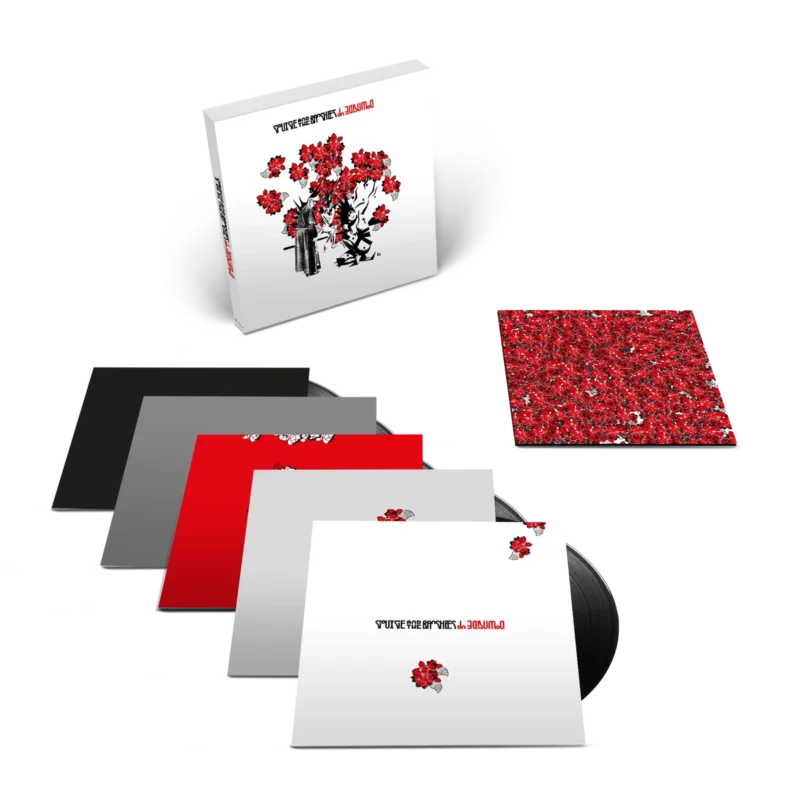
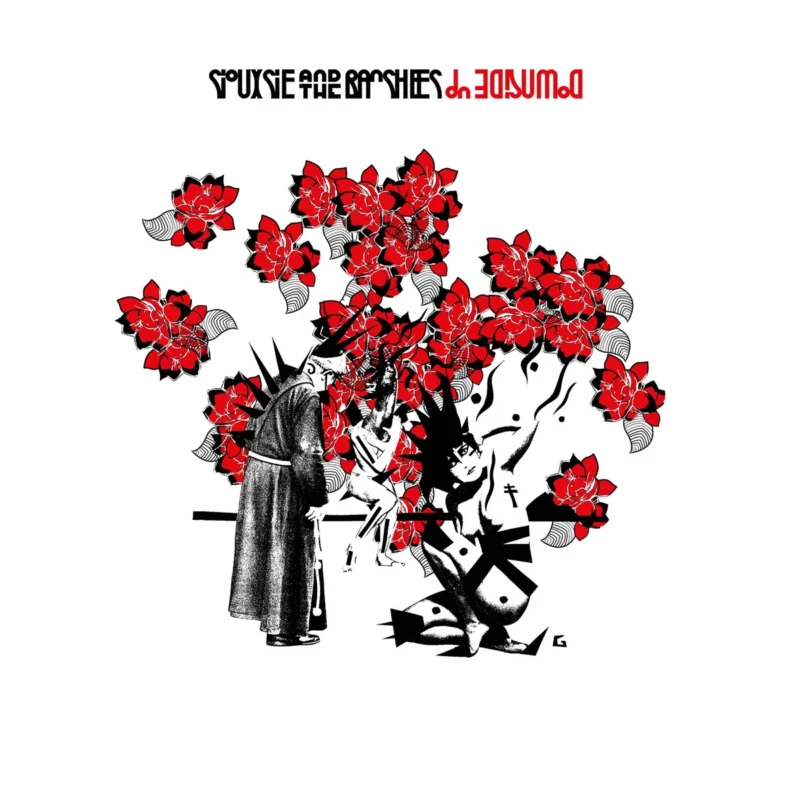
Siouxsie and the Banshees’ long-out-of-print Downside Up, the expansive collection of B-sides and other non-album recordings first released in 2004, will return this fall in newly remastered five-LP and three-CD editions.
Due Nov. 20, the revised box set brings together 51 tracks — 49 studio recordings and two live performances — covering material originally issued between 1978 and 1995, from “Voices (On the Air),” the flip side of the band’s debut single “Hong Kong Garden,” through late-period cuts “B Side Ourselves,” “Hang Me High” and “Black Sun.”
Along the way, Downside Up collects some of the Banshees’ finest work outside their studio albums, including “Pulled to Bits,” “Drop Dead/Celebration,” “Eve White/Eve Black,” “Red Over White,” “Tattoo,” “Umbrella,” “Something Blue,” “El Día de los Muertos,” “Return” and “Sea of Light.” The set also features the band’s versions of T. Rex’s “20th Century Boy,” Ben E. King’s “Supernatural Thing” and the Modern Lovers’ “She Cracked.”
Both configurations have been remastered from the original tapes. The five-LP edition, which marks the collection’s vinyl debut, was cut to lacquer by Miles Showell at Abbey Road Studios and comes with a 32-page booklet featuring new imagery drawn from the Banshees’ original single sleeves. The three-CD clamshell box includes a 68-page booklet.
The original four-CD edition contained 55 tracks. The new reissue carries over its first three discs in full: 49 studio recordings plus two performances taped at KROQ’s 1991 Acoustic Christmas, “Swimming Horses” and the Velvet Underground’s “All Tomorrow’s Parties.”
The only material omitted is the original box’s fourth disc, which contained the four orchestral rerecordings from the Banshees’ 1984 The Thorn EP: “Overground,” “Voices (On the Air),” “Placebo Effect” and “Red Over White.” The earlier B-side versions of “Voices (On the Air)” and “Red Over White” remain in the new collection.
Box-set preorders placed through the official Siouxsie and the Banshees webshop will include an exclusive print hand-signed by Siouxsie while supplies last. The print will accompany the first 500 five-LP box-set orders and the first 300 three-CD box-set orders.
For U.S. fans, a new Siouxsie and the Banshees shop will launch Friday, Sept. 11, at 11 a.m. EDT, allowing customers to order with domestic postage. A separate allocation of box sets accompanied by the signed print has been reserved for the U.S. store. The shop link will be available through the band’s official Linktree.
Things used to be so simple. The band Muse did not invent the word “muse,” but they got to be the main “Muse” on the social media landscape. On both Facebook and Instagram, Muse were simply @Muse. But then yesterday Meta, the company formerly known as Facebook, announced the launch of its new personal AI agent, which is also called Muse.
Today, legendary Christian metal pioneers Stryper return with a commanding new chapter in their storied career, their 18th studio album, Throne of Thorns, set for release on September 25th via Frontiers Music Srl. Decades into their journey, Stryper continue to reaffirm their status as one of the most influential and enduring bands in classic metal, seamlessly blending their signature message with a sound that remains as powerful and relevant as ever.
About Throne of Thorns, drummer Robert Sweet says: “Soon our new Stryper record will be out, and can you believe it? It’s album number 18! I really believe you’re all going to love it. Michael worked incredibly hard writing these songs and bringing everything together. Oz, Perry, and I also worked hard to make this, which I feel is our best record yet. I’m confident that once you hear it, you’ll agree. Thank you all for your incredible loyalty and for continuing to support what we do.”
To celebrate the announcement, the band shares the title track from the upcoming album, alongside an official music video, available below.
On the title track, Michael Sweet comments: “Throne of Thorns is a powerful message. Christ is on the throne, and we are redeemed because of the crown of thorns that He endured. This song is a perfect representation of our 43 years and who we were and who we are. Heavy yet melodic, classic yet modern, and 100% Stryper!”
Throne of Thorns showcases the band at the height of their creative powers, delivering a masterclass in songwriting and musicianship. The album is packed with grand, meticulously crafted arrangements, where thunderous rhythms, soaring guitar harmonies, and anthemic choruses come together in a style that is unmistakably Stryper. Each track is infused with both intensity and melody, capturing the essence of classic metal while pushing their sound forward with renewed energy and purpose.
At the forefront stands the unmistakable voice of Michael Sweet, whose passionate, powerful, and instantly recognizable delivery continues to define the band’s identity. His vocal performance on Throne of Thorns is nothing short of extraordinary, effortlessly moving between soaring highs and emotive depth, adding a timeless quality to every song.
Perry Richardson says: “The best music doesn’t come from comfort. It comes from living, struggling, growing, and refusing to quit. I hope these songs find you exactly when you need them.”
With Throne of Thorns, Stryper not only honors their legacy but expands upon it, offering an album that will resonate with longtime fans and newcomers alike. It’s a bold, inspired statement from a band that refuses to stand still—proof that true metal greatness only grows stronger with time.
Guitarist Oz Fox concludes: “I’m really happy with the final outcome of this record and the heart that went into it. Michael continues to pour everything he has into the music and the message; Robert brings the power and energy that has always been the pulse of Stryper; Perry’s musicianship, vocal talents, and dedication are second to none, and I’m grateful to be on this journey with all of them.”
Four decades and counting, Stryper shows no signs of slowing down. The band will be back on the road this summer with a full U.S. tour beginning July 17 in Arlington, TX.
A celebration of life for Andy Williams, who passed away earlier this week, will be taking place in Buffalo later this month.
Andy was a founding member of Every Time I Die, playing on each of the group’s nine studio albums, from 2001’s ‘Last Night In Town’ through to 2021’s ‘Radical’, until their disbanding in 2022.
Most recently, he played in metalcore group Atomic Rule, releasing two 3-track EPs in 2025, alongside a career in wrestling, appearing in AEW as ‘The Butcher’ in a tag-team duo alongside Jesse ‘The Blade’ Guilmette.
He experienced a medical emergency during an ‘Enjoy Wrestling’ match in Millvale, Pennsylvania on Saturday night (September 05) and was rushed to hospital. It was then reported that Williams had passed away.
The celebration of life will take place at Buffalo River Works on September 27, with attendance being free of charge. A ticket can be reserved here.
There will be acoustic tributes throughout the occasion, with the first names to be announced being Stephen Brodsky & Adam McGrath of Cave In, Dan O’Connor & Alan Day of Four Year Strong and Anthony Green, with more to be confirmed.
There will a special video tribute played at the event too, full of pictures and videos submitted which, if you have one, can be sent to andywilliamsforever@gmail.com
FOR IMMEDIATE RELEASE
MURDERY Unleash New Death Metal Assault With “Killing Grandma” Spanish-Polish Death Metal Force Return With the First Taste of Their Upcoming Full-Length
Release Date: October 2026
MURDERY are back to deliver another dose of crushing, groove-driven death metal with their upcoming new single “Killing Grandma,” arriving worldwide in October 2026. The track serves as the first official preview of the band’s forthcoming studio project, with the first four songs from the upcoming album being unveiled as part of this next chapter.
Formed in Murcia, Spain, in 2018 and now operating between Spain and Poland, MURDERY have carved out a sound that combines the brutality and authenticity of old-school death metal with a powerful groove-oriented attack. Their music is raw, aggressive, tightly played, and built around the kind of crushing riffs that demand to be experienced at full volume.
Following the band’s 2023 release Bloodshed , “Killing Grandma” signals an even heavier and more uncompromising direction. The song captures the experience MURDERY have accumulated throughout their career while refusing to bury the music under unnecessary production or studio gloss.
“This next work sums up the production, technique, rawness and aggression learned and forged in all of our career.”
Produced by JFT Studio , “Killing Grandma” represents the first taste of a larger body of material that will soon reveal more about MURDERY’s next era. The band is also preparing to unveil the full album details, with additional announcements and the accompanying music video expected soon.
The track has already proven itself in the live environment, becoming a centerpiece of MURDERY’s performances during their Spring Annihilation Tour across Poland. That live-tested intensity is at the heart of the band’s approach: aggressive, tight, direct, and designed to hit with maximum impact.
MURDERY bring considerable experience to their attack, featuring former and current members of respected Spanish acts including Vendetta FM, 91Suite, and Siberia . Over the years, the band has also shared stages with international heavyweights including Napalm Death, Brujeria, Hatebreed, Crisix, and Dust Bolt , further establishing their reputation as a formidable live act within Europe’s underground metal scene.
Rather than chasing trends, MURDERY remain focused on what makes death metal hit hardest: massive riffs, crushing grooves, raw aggression, dynamics, and authenticity.
“Killing Grandma” is the beginning of the next chapter.
And if the first taste is any indication, MURDERY are preparing to make one hell of a racket.
“Killing Grandma”
MURDERY Release Date: October 2026 Genre: Groove / Old School Death Metal
For Fans Of: Cannibal Corpse, Bloodbath, Obituary, Dismember, Deicide, Napalm Death
About MURDERY
Formed in Murcia, Spain, in 2018, MURDERY are a death metal band currently operating between Spain and Poland. Built on old-school death metal foundations, the band combines crushing groove, dynamic songwriting, modern aggression, and a deliberately raw production philosophy.
With members bringing years of experience from across the Spanish metal scene, MURDERY have developed an uncompromising sound designed equally for the record player and the live stage. Their mission is simple: death metal driven by groove, power, and authenticity.
Check out the video:
Connect:
https://linktr.ee/murdery_europe
Contact: Juan Robles aka Tito Crowlord robjua4@gmail.com murderyeurope@gmail.com
The surviving members of Supertramp, along with the Estate of Rick Davies, have launched a brand new website under the collective banner of ‘Supertramp Partnership: The Classic LineUp’.
In a message to fans, former bassist Dougie Thomson, saxophonist and vocalist John Helliwell, and drummer Bob Siebenberg said, “As surviving members of the classic lineup, we reflect on the year since Rick Davies’ death, more grateful than ever to have brought Rick’s dreams for Supertramp to life. Two iconic writers with indelible voices led to a body of work that is revered by millions. We are proud of what this music represents as much today as we were when it was created.
“Dougie, John and Bob are happy to mark this milestone with this new path to connect with Supertramp fans around the world for whom this music has been formative and who have kept Rick’s legacy burning brightly. The polarity of Rick Davis and Roger Hodgson within Supertramp was a source of fruitful creative tension, and relations between the players have been challenging over the years. Nevertheless, the music is a common thread that binds us all. The classic era of Supertramp endures…”
The band’s social media presence has never been particularly strong, even when they were a going concern, but the new Supertramp Partnership website also boasts links to a new Facebook and Instagram page.
How Poe Transformed Gothic Horror into Atmospheric Horror
Long before horror films filled screens with monsters and jump scares, Edgar Allan Poe discovered a different path to fear. His stories rarely depend on supernatural creatures, elaborate action, or graphic violence. Instead, they create a feeling. A growing sense of unease. A pressure that slowly tightens around the reader.
The horror emerges from atmosphere itself. Today this approach feels familiar, but during Poe’s lifetime it was revolutionary. Earlier Gothic fiction often relied on ruined castles, family curses, mysterious villains, and supernatural events. Poe inherited those traditions but transformed them into something more psychological.
The most frightening place in a Poe story is usually not a haunted building. It is the human mind. By shifting horror inward, Poe helped create a new model for the genre—one where mood, perception, obsession, and emotional tension became more important than external threats. This transformation helped establish what we now recognize as atmospheric horror.
How Poe Transformed Gothic Horror into Atmospheric Horror
The Gothic Tradition Before Poe
Poe did not invent Gothic fiction.
Writers such as Horace Walpole, Ann Radcliffe, Matthew Lewis, and Mary Shelley had already established many of the genre’s defining elements. Crumbling architecture, isolated landscapes, family secrets, supernatural possibilities, and emotional intensity all appeared before Poe began writing.
Walpole’s The Castle of Otranto helped create the Gothic template. Radcliffe refined the atmosphere of mystery and suspense. Shelley’s Frankenstein introduced psychological and philosophical depth.
These writers built the foundation.
Poe changed the emphasis.
Rather than focusing primarily on external settings and events, he became fascinated by perception itself. His stories ask what happens when fear grows inside the mind and begins altering reality.
The result was a form of horror that felt far more intimate than traditional Gothic fiction.
The castle remained.
The real terror moved inside.
Poe’s Theory of Emotional Effect
One reason Poe’s stories feel so distinctive is that he approached writing with unusual precision.
In essays such as The Philosophy of Composition, Poe argued that every element of a work should contribute to a single emotional effect. Nothing should be accidental. Every image, sound, rhythm, and narrative choice should guide readers toward a specific psychological experience.
This idea became known as the principle of unity of effect.
For Poe, atmosphere was not decoration.
It was the purpose.
A successful story did not merely describe fear. It created fear. Every sentence served that objective.
This philosophy helps explain why so many of Poe’s works feel immersive. Readers do not simply observe the characters’ emotions. They experience them.
The growing panic of the narrator in The Tell-Tale Heart, the oppressive melancholy of The Fall of the House of Usher, and the despair of The Raven all emerge from carefully controlled emotional design.
Poe understood that horror becomes most effective when atmosphere and psychology work together.
The House of Usher and the Architecture of Dread
Perhaps no story demonstrates Poe’s atmospheric method more clearly than The Fall of the House of Usher.
The story begins before anything frightening occurs.
A visitor approaches an isolated mansion beneath a gloomy sky. The landscape appears lifeless. The building itself seems infected by decay. Readers immediately experience a sense of unease long before the plot reveals its secrets.
This is atmospheric horror in its purest form.
The setting does not merely contain the horror.
The setting becomes the horror.
As the story progresses, the psychological deterioration of Roderick Usher begins reflecting the physical deterioration of the house itself. Architecture and emotion become inseparable.
Poe creates fear not through sudden shocks but through accumulation. Every detail contributes to a growing sense that something is profoundly wrong.
By the time the story reaches its climax, the atmosphere has already done much of the work.
The reader feels trapped inside the same nightmare as the characters.
The Language of Dread
Atmosphere in Poe’s fiction is not created by setting alone.
Language itself becomes a source of horror.
Poe understood that words possess emotional weight independent of their literal meaning. Rhythm, repetition, sound, and sentence structure all influence how readers experience a story.
This sensitivity to language appears throughout his work.
In The Raven, the repeated word “Nevermore” becomes more than a refrain. Each repetition deepens the narrator’s despair until the sound itself feels oppressive. Meaning and atmosphere merge into a single effect.
The same principle appears in his prose.
Poe often uses repetition to create psychological pressure. Certain words, images, and ideas return again and again, mirroring the obsessive thoughts of his narrators.
The reader becomes trapped inside the rhythm of the character’s mind.
This technique helped distinguish Poe from many earlier Gothic writers. The horror no longer depended solely on what happened.
It depended on how the experience felt.
The Tell-Tale Heart and Psychological Horror
If The Fall of the House of Usher demonstrates Poe’s mastery of atmosphere through setting, The Tell-Tale Heart demonstrates his mastery of atmosphere through psychology.
The story contains very little physical action.
A narrator becomes obsessed with an old man’s eye, commits murder, and eventually confesses.
The plot itself is relatively simple.
What makes the story unforgettable is the narrator’s state of mind.
Readers experience events through a voice consumed by paranoia and obsession. Every detail becomes magnified. Every sound acquires terrifying significance.
The famous heartbeat illustrates Poe’s genius.
Whether the sound is real or imagined ultimately matters less than its psychological effect. The heartbeat becomes a manifestation of guilt, transforming an ordinary sound into a source of unbearable tension.
Poe understood that fear often originates within the mind itself.
The most terrifying monsters are not always external.
Sometimes they are our own thoughts.
Madness, Guilt, and the Human Psyche
Many Gothic writers explored supernatural threats.
Poe frequently explored psychological ones.
Stories such as The Black Cat, The Tell-Tale Heart, and The Imp of the Perverse focus on narrators whose minds become their own worst enemies.
These characters are not haunted by ghosts in the traditional sense.
They are haunted by guilt, obsession, self-destruction, and irrational impulses.
This shift was crucial to the development of atmospheric horror.
Fear becomes internalized.
The reader is invited into psychological spaces where reality itself feels unstable.
Modern horror often relies on the same principle.
Films and novels that focus on psychological breakdown, unreliable perception, and emotional disintegration owe a significant debt to Poe’s innovations.
He demonstrated that horror could emerge from ordinary human emotions pushed to their limits.
Poe and His Contemporaries
Comparing Poe to his contemporaries reveals how unusual his approach truly was.
Nathaniel Hawthorne frequently used dark themes to explore morality and religious guilt. Charles Dickens occasionally incorporated Gothic elements while maintaining a strong interest in social commentary.
Poe pursued a different objective.
His primary concern was emotional experience.
Rather than teaching moral lessons or examining social problems, he focused on creating specific psychological states within the reader.
This emphasis on atmosphere over message helped distinguish his fiction from much nineteenth-century literature.
The stories feel intensely personal.
Readers are not asked to judge the characters.
They are asked to inhabit them.
That immersive quality remains one of Poe’s most important contributions to horror.
Why Poe Changed Horror Forever
Before Poe, Gothic horror often depended upon external threats and dramatic events.
After Poe, horror increasingly became psychological.
Writers discovered that atmosphere could be more frightening than action. Suggestion could be more powerful than revelation. Internal fears could be more disturbing than external monsters.
Poe did not abandon the Gothic tradition.
He transformed it.
By combining atmosphere, psychology, and carefully controlled emotional effects, he created a model that continues influencing horror literature, cinema, and popular culture.
His stories remind us that fear is not always something we encounter.
Often, it is something we carry within ourselves.
The Legacy of Atmospheric Horror
The influence of Edgar Allan Poe extends far beyond the nineteenth century.
Many of the techniques that define modern horror can be traced directly to his work. Psychological instability, unreliable narrators, oppressive atmosphere, and carefully controlled emotional tension have become central elements of the genre.
Writers such as H. P. Lovecraft, Shirley Jackson, Robert Bloch, and Stephen King all inherited aspects of Poe’s approach.
Although their styles differ dramatically, each understood that fear often becomes more powerful when it grows gradually within the imagination.
Poe’s influence extends beyond literature.
Modern horror cinema frequently relies on atmosphere rather than constant action. Films such as The Shining, The Witch, and Hereditary demonstrate how mood, isolation, and psychological tension can create terror more effectively than conventional shocks.
The principle remains remarkably similar to Poe’s own artistic philosophy.
The audience must feel the horror before it fully understands it.
Atmosphere as the True Monster
One reason Poe’s stories continue to feel modern is that they rarely depend on specific monsters.
Many classic horror tales lose some of their power once the threat is revealed. The unknown becomes known. Mystery becomes explanation.
Poe often avoids this problem.
His greatest stories do not rely on creatures lurking in the shadows.
The shadows themselves become the source of fear.
In The Fall of the House of Usher, readers remember the atmosphere long after they forget individual plot details. In The Tell-Tale Heart, the narrator’s unraveling mind becomes more terrifying than the murder itself.
This approach allows the stories to remain effective across generations.
Human psychology changes far less than cultural fears.
Poe understood that atmosphere could reach emotional truths that monsters alone could never fully capture.
Why Poe Still Feels Contemporary
Modern audiences live in a world saturated with horror.
Films, television series, novels, video games, and online media constantly compete for attention through increasingly elaborate spectacles.
Yet Poe’s stories continue finding new readers.
Part of the reason lies in their psychological focus.
Anxiety, obsession, guilt, grief, loneliness, and uncertainty remain universal human experiences. Poe explored these emotions with unusual precision, creating stories that feel surprisingly relevant despite their age.
His narrators struggle with problems that still resonate today.
They fear losing control of their minds, and they wrestle with guilt.
They confront grief and isolation.
The details may belong to the nineteenth century, but the emotions remain timeless.
The Master of Atmospheric Horror
Edgar Allan Poe did not invent Gothic horror.
Writers before him had already established many of the genre’s defining themes and images.
What Poe accomplished was something equally important.
He transformed horror into an emotional experience governed by atmosphere, psychology, and carefully controlled artistic effect.
Through his principle of unity of effect, he demonstrated that every element of a story could work together to produce a specific emotional response. Settings became extensions of psychological states. Language became a tool of dread. Narrators became prisons for their own fears.
The result was a new kind of horror.
A horror built not upon monsters alone, but upon perception, emotion, and the hidden landscapes of the human mind.
More than a century and a half later, that achievement continues shaping the genre.
Whenever a writer uses mood to create tension, whenever a filmmaker relies on atmosphere rather than spectacle, and whenever horror emerges from psychological uncertainty rather than physical danger, Poe’s influence can still be felt.
That is why he remains not merely an important Gothic writer.
He remains the master of atmospheric horror.
Wear the Darkness
If How Poe Transformed Gothic Horror into Atmospheric Horror resonates with your love of Gothic literature, psychological horror, and dark culture, explore the Edgar Allan Poets store. Our designs celebrate the writers, symbols, and ideas that continue haunting the imagination.
Join the Noir Newsletter
Receive more essays on Edgar Allan Poe, Gothic literature, noir psychology, symbolism, horror history, and the creative forces that shaped dark culture.
Frequently Asked Questions
Did Edgar Allan Poe invent Gothic horror?
No. Gothic horror existed before Poe through writers such as Horace Walpole, Ann Radcliffe, Matthew Lewis, and Mary Shelley. Poe transformed the genre by emphasizing atmosphere and psychology.
What is Poe’s theory of unity of effect?
Unity of effect is Poe’s idea that every element of a story should contribute to a single emotional response, creating a focused and immersive experience for the reader.
Why is The Fall of the House of Usher considered atmospheric horror?
The story uses setting, mood, symbolism, and psychological tension to create fear long before any dramatic events occur.
How did Poe influence modern horror?
Poe helped establish psychological horror by focusing on guilt, obsession, madness, and emotional tension rather than relying solely on supernatural threats.
Why is Edgar Allan Poe still important today?
His exploration of fear, grief, guilt, and psychological instability remains relevant, and his techniques continue influencing literature, film, and popular culture.
WALL OF SLEEP are celebrating their 25th anniversary this year, and activity around the band has intensified considerably since the release of The Kingdom in 2025. The album won a Fonogram Award, the band’s earliest recordings have been reissued, and the seven-track Monolith EP, with a running time of more than 40 minutes, is due […]