It’s been a huge year for Madonna. Confessions II, her long-awaited, much-hyped sequel to 2005’s Confessions On A Dance Floor, was rapturously received — including by Stereogum readers, who voted “Danceteria” to the top of our Song Of The Summer poll. Any perceived beef with her artistic descendant Charli XCX was squashed with a remix and a pack of smokes, and Charli’s pal Troye Sivan paid homage with a “Music” sample on his new single “Party.” Madge has been everywhere from Coachella to the World Cup final to Times Square. Now, that list includes the 2026 MTV Video Music Awards.
Oasis have sold out all of the shows on their Live ’27 stadium tour.
Eager fans snapped up the tickets for the 42 shows – which include a run of 11 shows at Manchester’s Etihad Stadium and conclude with a six-night stretch at Knebworth Park in Hertfordshire – during three sales windows over the weekend.
The tour will also visit Ireland, Spain, Germany, the Netherlands, France, Italy and the US, but no further dates will be added.
The dynamic pricing model that caused much anger when it was used to sell tickets for the band’s 2025 reunion tour was abandoned for the new sale, in favour of a pre-registration system where fans were randomly selected to receive a unique code to access tickets. However, some have complained that the only available seats were for expensive VIP or travel packages.
“Just got to the front of the queue in half an hour for Oasis tickets,” posted one prospective purchaser. “Loads of seats left to choose from, but all gettin’ sold as ViP packages for £500.”
Oasis frontman Liam Gallagher responded by asking the punter to “PROVE IT”, which prompted the original poster and multiple others to share screenshots showing seats priced around the £500 mark. Resale tickets will only be available via Ticketmaster and Twickets, sold at the original price paid.
May 21: Glasgow Celtic Park, UK May 23: Glasgow Celtic Park, UK May 25: Glasgow Celtic Park, UK May 28: Glasgow Celtic Park, UK May 29: Glasgow Celtic Park, UK Jun 04: Manchester Etihad Stadium, UK Jun 06: Manchester Etihad Stadium, UK Jun 08: Manchester Etihad Stadium, UK Jun 11: Manchester Etihad Stadium, UK Jun 12: Manchester Etihad Stadium, UK Jun 15: Manchester Etihad Stadium, UK Jun 18: Manchester Etihad Stadium, UK Jun 19: Manchester Etihad Stadium, UK Jun 22: Manchester Etihad Stadium, UK Jun 25: Manchester Etihad Stadium, UK Jun 26: Manchester Etihad Stadium, UK Jul 02: Munich Allianz Arena, Germany Jul 03: Munich Allianz Arena, Germany Jul 06: Munich Allianz Arena, Germany Jul 10: Barcelona Estadi Olímpic Lluís Companys, Spain Jul 11: Barcelona Estadi Olímpic Lluís Companys, Spain Jul 16: Amsterdam Johan Cruijff ArenA, Netherlands Jul 17: Amsterdam Johan Cruijff ArenA, Netherlands Jul 20: Paris Stade de France, France Jul 24: Paris Stade de France, France Jul 26: Rome Stadio Olimpico, Italy Jul 29: Rome Stadio Olimpico, Italy Jul 30: Rome Stadio Olimpico, Italy
Aug 10: Boston Gillette Stadium, MA Aug 13: Boston Gillette Stadium, MA Aug 14: Boston Gillette Stadium, MA Aug 20: Las Vega Allegiant Stadium, CA Aug 21: Las Vegas Allegiant Stadium, US Aug 24: Las Vegas Allegiant Stadium, CA
Sep 04: Slane Castle, Ireland Sep 05: Slane Castle, Ireland Sep 11: Knebworth Park, UK Sep 12: Knebworth Park, UK Sep 18: Knebworth Park, UK Sep 19: Knebworth Park, UK Sep 25: Knebworth Park, UK Sep 26: Knebworth Park, UK
REVIEW BY DAVID TAYLOR AND PHOTOS BY ROBERT A CHADWICK | Go Venue Magazine
On Saturday, September 26, Black Label Society made their return to the Omaha metro area to play Harrah’s Stir Cove in Council Bluffs, Iowa for the first time ever. Every member of Black Label Society was pulling double duty. The Iowa Chapter showed up in full force as they always do.
Dark Chapel was up first. This was Black Label Society’s Dario Lorina’s band. They were fast and heavy. It was really a showcase for Dario’s great vocals and piano playing. The whole band are great players. It was awesome seeing Dario and the other guitarist in the band, Dylan Dyce, trade solos. I love it when bands have two lead guitarists trade solos, it is so cool. They even did a pretty heavy cover of Bill Withers’s “Ain’t No Sunshine”. I’d be down to see them again if they play a headline show somewhere nearby. Be sure to check out their debut album, Spirit in The Glass.
Zakk Sabbath was up next. Dario got to take a break, but it was time for Zakk, JD, and Jeff to take the stage. I’ve seen Zakk Sabbath before, but this felt more important because Ozzy Osbourne is no longer with us. I can’t help but think Ozzy was watching down on us, making sure no rain was going to happen on Zakk’s watch. And they crushed it. I did found it interesting that Jeff Fabb used a much smaller drum kit for Zakk Sabbath, but I guess it’s better to not wear out just one drum kit. The crew threw beach balls during “NIB”. And Zakk went in the crowd during “War Pigs”, even though I think he could’ve went farther, like up the hill by the entrance. Nevertheless, it was a perfect tribute to the greatest heavy metal band of all time, Black Sabbath.
Finally, the crowd was ready for Black Label Society. This was my fourth time seeing these guys and they never disappoint. The whole band lays it down thick and heavy and they are always constantly putting out incredible music. John DeServio doesn’t get enough credit for how good his bass playing is. He slaps his bass with incredible precision. It’s amazing to see live. Zakk Wylde just continues to deliver an incredible performance, both with his guitar playing and singing. It was emotional hearing him sing “Ozzy’s Song” with the Ozzy backdrop behind him. And hearing him play some of “No More Tears” including the guitar solo was so cool. He and Dario playing their guitars behind their backs is still so incredible to watch. I was happy to see Stir Cove filled with the Black Label faithful since I’m usually seeing them play the Admiral. I don’t know how Zakk Wylde manages to balance BLS, Zakk Sabbath, and Pantera, but the man, as he approaches 60, seems like he is never slowing down. He is still that guy that I was first introduced to in 2008 in Guitar Hero World Tour. Their new album is Engines of Demolition.
Mystic is one of those acts that can’t really be put into a box, consistently putting out one good song after another. They recently announced that they’re bringing a bunch of those songs together for their debut album, Slipstream! We had a chat with Blume from the duo about her inspirations, the concepts behind Slipstream, the artists who inspire her, and how Mystic Tea Party approach their creative process.
Reuel
Hello Blume! I’m very happy to chat with you. How are you doing?
Blume
I am fantastic. I am currently here in Corfu on vacation, soaking up the sun and petting lots of cute cats. Having a nice break before the chaos starts for the album release!!
Reuel
Sounds great and exciting! It is really hard to describe Mystic Tea Party’s music in one or two words. So let’s put it this way: If Mystic Tea Party’s music were a tea flavor, what would it be?
Blume
Interdimensional Earl Grey
Reuel
Brilliant! You’ll be releasing your debut album, Slipstream, in October. You’ve been releasing standalone singles since 2023. What made you decide that this was the right time to finally commit to a full-length debut album?
Blume
It’s interesting because I feel like making an album was, in a way, something we decided to do almost in rebellion against the current music industry. Nearly every piece of advice we were hearing followed the same formula: “Only release singles! Do the waterfall technique! Wait until you blow up on socials and then maybe think about an album.” But that game just felt so uninspiring to us. We ended up getting a few different pieces of advice from touring musicians that resonated much more. We were fortunate enough to hang out with Andrew from Drab Majesty last year when we saw them play in Wrocław, and he echoed the sentiment: “If you want to play a lot of European festivals, you’ll need an album.” Hearing that from him was kind of the nail in the coffin for all the other strategies. Writing and releasing an album, our own little world, and then touring that album, simply sounded way more exciting to us.
Reuel
When you write, record, and mix everything yourselves, there’s no outside producer to tell you an idea is too weird. What was the most unconventional choice you committed to on this record that might have been vetoed in a traditional studio?
Blume
I think our decision for the second verse of The Looking Glass was pretty weird. We actually had this beautiful, heart-wrenching second verse written, but in the end we decided to make the second verse the first verse… just in reverse.
Conceptually, it made perfect sense. The song is about looking in the mirror and not recognising the person you’re becoming, so having the song literally reflect back on itself felt right. And even though it sounded odd – it was cool! It definitely isn’t the kind of decision you make if commercial success is your main priority, but it just FITS the song and us.
Either that, or Palmtree Views. That one started as a bossa nova song that we were honestly going to scrap because we thought, “This is just TOO random, even for us!” Instead, we ended up making it a bossa nova track that suddenly transforms into this dark, alternative electronic soundscape. It turned out so good. I’m not even sure if the whole mashing that many genres together is something conventional to do in record-making, but that’s kind of our whole thing!!
Reuel
Both of these are great ideas! I’m so excited to listen to these songs now! You really play with extremes on “ANGELITE,” starting out very quiet and intimate before building to a huge, heavy finish. Looking at the full album, does it lean more toward the heavier side or the calmer side?
Blume
The album is honestly just a full journey. We have a little bit of everything from the MTP universe… and it’s a pretty expansive and diverse universe, let’s just say, lol. We kind of take you on a full ride through that whole spectrum. You’ll get to experience the full range of Mystic Tea Party, which I think is really fun.
Reuel
What themes, situations, or emotions inspired the songs on Slipstream?
Blume
Slipstream is really about being pulled through life and all the weird, intense emotions that come with that. A lot of the songs came from love, obsession, desire, identity, change, nostalgia, uncertainty … to name a few.
Some songs are super personal and emotional, some are more playful or surreal, and some are just us following a feeling or a world we wanted to create. I think that’s why Slipstream felt like the right name for the album. It kind of captures that feeling of being caught in the current of your own life and getting pulled forward whether you’re fully ready for it or not.
Reuel
What musicians can you credit as the ones who inspired you, personally, in your life or career as a musician?
Blume
My parents were both musicians/wrote music my whole life and were in multiple different bands. They definitely put it into me that this is something I wanted as a way to express myself. Growing up, I was really into Avril Lavigne. I used to play the Let Go album on repeat on my Hello Kitty CD player, and that shit was so deep for me. I remember whenever I’m With You came on, I would have a physical, psychological, and spiritual uproar within my body and soul every time. As I got into my teens, I was really into Miley, and I idolised her throughout my teens and still to this day as a powerhouse of a woman and artist. But none of the musicians who I idolised (as a person more so than their music) have ever come out in my music. Sound-wise, I always resonated more to a different palette, and as I became a late teen/early adult, I was really into Deep Forest, Sade, Enya, Enigma and Grimes… and those influences have definitely come out in MTP.
Reuel
Great names you mentioned! We have readers from all around the world, including women who still face barriers, and even persecution, in the music industry. What message would you like to share with those who dream of pursuing a music career?
Blume
Find your own way of doing things – and do that. Take every bit of advice into consideration, but don’t feel like anything is gospel. You have your own way of making your art and succeeding in it. There’s a lot of work that goes into trying to make it in music, and unfortunately most of it has nothing to do with music. Just focus on making your music and making it because you love it and it feels good, and for all the other BS that you need to do, just try to gamify it, and try to make everything FUN. If it’s not fun and feeling easy, then be like, HOW CAN I MAKE THIS MORE FUN AND EASY? I think it’s expected to be overlooked and ignored in this industry ESPECIALLY as a woman. But just know you have your own incredible, unique avenue to making it in music, and that’s the path that’s destined for you!
Reuel
Brilliant! Thank you for your time, Blume! Is there anything else you’d like to add?
Blume
Our debut album is coming out this October! I hope you enjoy the journey it takes you on. Also, a massive shoutout to my other half, Sebastian, who, without him, MTP would not be possible. I’d also like to thank my dog Frodo, who fell asleep to me writing a lot of songs for this album on the acoustic guitar in my bedroom, for always being there to support me emotionally. And I would like to send out positive light, catchy melody ideas, and great sex for the rest of your life to anyone who reads this!
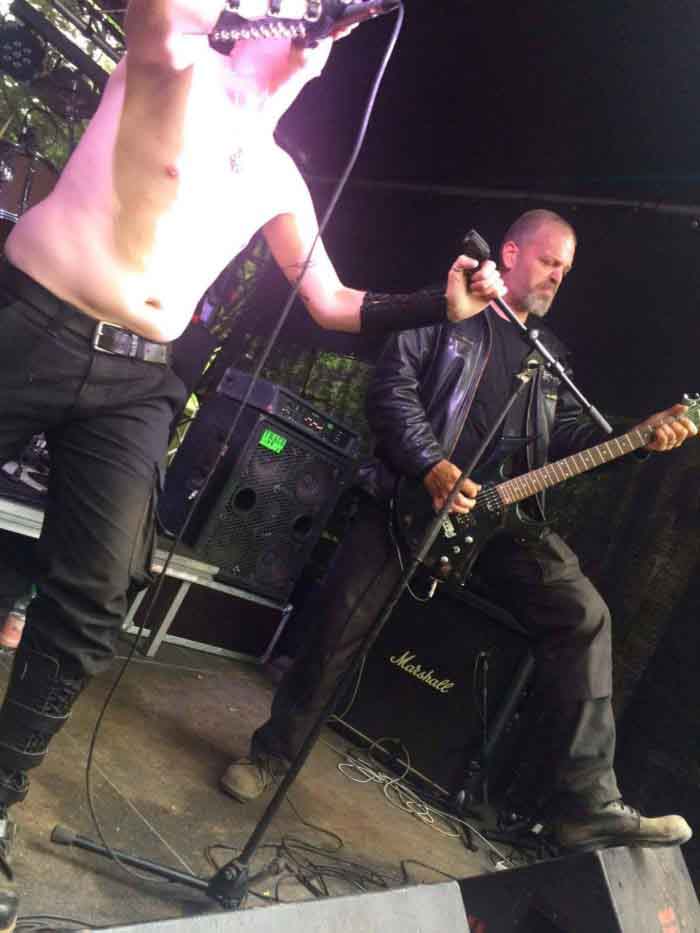
Storming unruly black/death squad Kaeck reprised their 2016 appearance at the Under The Black Sun festival (pictured above) with a new live recording that shows the immense disturbance among the forces of good that this band creates.
In recent months, Queen guitarist Brian May has turned into something of a serial collaborator, working on projects with Steve Cropper, Billy Gibbons, William Shatner, Daniel May (his grandson), TV “Supervet” Noel Fitzpatrick and Graham Bonnet, and he’s not done yet.
May’s latest collab is with London’s Portobello Road Distillery, with whom he’s created The Red Special Gin, named in tribute to his iconic Red Special guitar.
“I’ll be proud to see this new collaboration out there,” says May. “I completely relate to the very British homespun ethos of Portobello, and their attention to detail, making this a very high-quality product. Like the electric guitar, this Red Special has to be enjoyed responsibly!”
“Working with Sir Brian May on Red Special Gin has been a real joy,” enthuses Gemma Monaghan Gilbert, Marketing Director at Portobello Road Distillery. “What makes this collaboration so special is that it’s rooted in a shared passion for craftsmanship, creativity and doing things differently.
“Brian has poured so much of his own story, his character and creativity into the project, and we’ve loved bringing that together with our own London distilling heritage. Red Special is the result of two British icons coming together to create something genuinely unique.”
The limited-edition Red Special Gin is a premium London Dry Gin, flavoured with a variety of botanicals, including juniper, liquorice root, sage and calamansi orange, the latter grown in May’s own greenhouse. The distillery describe the result as “distinctive and elegant, with subtle complexity and a vibrant citrus finish. It is a gin with character, just like the man behind it.”
The bottle also tips its hat to May’s guitar, with a sixpence embedded in the lid in tribute to the coin May has used as a plectrum since building the Red Special guitar with his father Harold over 18 months between early 1963 and late 1964.
King Crimson leader Fripp and Willcox chose the 58-year-old classic to celebrate punk music’s 50th anniversary, and while the dates might not line up exactly, they do attempt to match the rabble-rousing intensity of the original. Although, sadly, the song’s iconic “Kick out the jams, motherfuckers!” introduction is omitted.
It’s one of the fiercest performances to have graced the duo’s Worcestershire kitchen, and a fitting tribute to a song that was originally written in the kitchen of the MC5’s 20-room revolutionary commune in Ann Arbor, Michigan.
“We were commune-ists,” guitarist Wayne Kramer told Classic Rock in 2019. “We had this all-for-one, one-for-all… I hesitate to call it a business structure. We just saw ourselves as one unit, but it was [vocalist and lyricist] Rob Tyner and I that wrote Kick Out The Jams in the kitchen, smoking a joint.”
In more sensible news, live recordings of all 21 shows from the first leg of King Crimson’s 2016 European tour have been made available via the band’s partnership with streaming service Nugs.
The shows featured Crimson’s celebrated “Seven Headed Beast” line-up of Fripp, guitarist and singer Jakko Jakszyk, saxophonist and flautist Mel Collins and bassist Tony Levin, plus drummers Pat Mastelotto and Gavin Harrison, with Jeremy Stacey stepping in for Bill Rieflinas the third drummer and keyboard player.
Meanwhile, Toyah will release a 24-CD box set on December 4. Twenty-Four From Toyah includes every single and EP she released between 1979 and 1987, plus a selection of mixes, rarities, outtakes and live recordings. It’s available to pre-order now.
In 2018 musician and producer Moby – whose career extends across multiple genres from electronica and ambient to rock and punk – told Prog why Yes had mattered to him since his childhood, and particularly guitarist Steve Howe.
“I grew up in Connecticut and my mom was a hippie. We listened to a lot of college radio and AOR together. I first heard Yes when Roundabout was their big single. In 1978, aged 13, I went to my first ever concert – Yes in Madison Square Garden.
It was a school night and everything about it was so exciting; it made an indelible impression. I was thrilled to see Rick Wakeman, but I was most impressed with Steve Howe, a player so unique but always in service to the song.
From the age of 10 I’d played guitar and my teacher only liked complicated music. We had a schism because I liked a lot of punk rock and he hated that – but we agreed on Steve Howe, and I learned to play Roundabout note-perfect.
Later, I got really lucky: one of my friend’s fathers worked at CBS. He had access to the Yes catalogue for free, which he gave to me.
What I like about them is their approach to atmosphere and melody. Neil Young records are great, but they’re a document of a band in a room. Yes use the studio as an instrument to craft something bigger, to create a transcendent atmosphere. Aged 13, I could be in a suburban bedroom but transported somewhere else – and Roger Dean’s artwork certainly helped.
In the 80s and 90s they dropped off the cultural radar. Then Vincent Gallo used Heart Of The Sunrise in his [1998] film Buffalo ’66. I knew him, and talked to him about Yes – it made it okay for us closet fans to admit how much we loved them.
At their best, Yes created entire landscapes and worlds like no other. They’ve inspired me in that a lot of the music I’ve made has had the goal of achieving something similar.
Close To The Edge is my favourite album. I go back to it at least once a month. It has such flawless songs and recordings. Even if And You And I and Close To The Edge were the only tracks on the album, it would still be in my top 10.”
Hope I find you
Awake tonight
When I’m dreaming
I can’t hold onto you
Sleep offers a peculiar bargain to anyone missing someone they cannot reach. For a few hours, a face returns, a voice becomes clear, and the distance seems negotiable. Morning collects its debt. Louisville synth-pop trio MODISTE understands the terrible tenderness of that exchange, bringing a spellbinding ache to their cover of The Black Queen’s “Distanced.” Beautiful and uneasy in equal measure, their interpretation holds close to the original while allowing vocalist Sydney Sleadd to lead it somewhere distinctly her own.
The cover’s release precedes MODISTE’s two upcoming appearances alongside The Black Queen and Trace Amount on the Fever Daydream tenth-anniversary tour. “Distanced” originally appeared on that album, and MODISTE have been performing it in their own sets since March. With the shared bills approaching, the trio moved quickly to have their recording mixed and mastered, turning a live favorite into a recorded salute before meeting its makers on the road.
A tight, compressed snare rhythm and rippling bass synth establish the song’s measured movement. Sustained guitar accents stretch above them with a dreamy, Cure-like delicacy, leaving space for a voice that seems to glow in the dark. Sleadd’s singing carries warmth through an icy wash of reverb, her delivery intimate even as the room around it seems to expand. It is among MODISTE’s most Lynchian vocal turns yet: poised, emotionally exposed, and suggestive of a familiar room made strange by the person missing from it.
As Sleadd begins to glide through the melody with greater force, the percussion gathers speed and the arrangement opens around her. Iridescent synth tones chime like fireflies in the dark; further layers rise beneath the chorus, lending weight to its plea for another encounter beyond waking life. Harmonies deepen that sense of yearning without crowding the lead. The guitar’s angular edges and the precision of the programmed drums keep the performance moving while the voice stretches toward something it cannot quite touch.
The lyrics gradually reveal the severity of that separation. Songs, whispers, and the smallest intervals of consciousness become reminders of an absent person, until the reference to a grave makes the loss explicit. Sleep becomes both a means of reunion and another occasion for parting. Sleadd gives that contradiction room to hurt, building the chorus from a private wish into an appeal whose strength cannot guarantee an answer.
The recording was mixed by Dave Chale at Louisville’s Deadbird Studios, becoming the first release mixed on the studio’s newly acquired Neve console. Chris Gehringer handled mastering at Sterling Sound.
Listen to “Distanced” below:
MODISTE brings together Sleadd, synthesist Dennis Stein, and guitarist Kyle Stallings. Sleadd’s background in Louisville’s folk songwriting community meets Stein’s more than 25 years of synth and production experience, including his solo work as Introvert, and Stallings’ grounding in punk, experimental rock, and electronic music. Working primarily with vintage analog synthesizers, drum machines, and digital instruments from the 1980s and 1990s, the trio draws connections between synth-pop, post-punk, new wave, and darker electronic music.
Their debut album followed on August 7, 2026, and work on a second is already underway. Onstage, synchronized lighting, CRT televisions, glitch visuals, and avant-garde fashion extend the music’s peculiar atmosphere. Local photographers, seamstresses, designers, dancers, and videographers contribute to that wider creative world, giving the project a community beyond its three members.
MODISTE Live dates with The Black Queen and Trace Amount:
September 29 — Asheville, NC — Eulogy
October 1 — Nashville, TN — Eastside Bowl
More MODISTE live dates:
October 2 — Adams, TN — Kinda Spoopy Fest at Red River Canoe Rental
October 10 — Louisville, KY — Fall Schnitzelburg Walk at The Merryweather
October 24 — Louisville, KY — “Night Service” at PORTAL (with MODELE, Black Signal, and Virgin Birth; Substance Subculture dance afterparty)