Following the acclaimed success of their 2024 debut No Hill For A Climber, Neal Morse & The Resonance return with their highly anticipated second studio album, River of Light, a powerful and deeply personal progressive rock journey, set for release on November 27th, 2026. To mark the announcement, the band are launching the video for the first single “Walk On Water”.
When Neal Morse first announced Neal Morse & The Resonance in 2024, fans and critics were surprised to see the celebrated prog rock visionary collaborating with a group of exceptionally talented yet relatively unknown musicians. The resulting album, No Hill For A Climber, was met with overwhelming praise, showcasing a fresh creative chemistry that resonated strongly with audiences worldwide.
Now, just two years later, the band continues that journey with River of Light, an album that expands upon the musical and spiritual foundations established by its predecessor.
Reflecting on the project, Morse explains: “Following the success of No Hill For A Climber and some really great live shows in the summer of 2025, we knew that we wanted to make more music together. We started kicking around ideas in October 2025 and ended up spending much more time on this record. At one point it looked like it might become a double album because we had so many ideas. Eventually, we trimmed it down to a single album, and I think it works great.”
At its core, River of Light is a concept album centered on a spiritual journey, a theme familiar to Morse’s longtime fans. This time, however, the inspiration comes from the often-overlooked biblical figure Terah, the father of Abraham.
“Terah signifies someone who begins a journey with God but gets tired and allows sadness and resignation to keep them from going all the way,” says Morse. “However, his son completes the journey.”
Musically, River of Light represents a true collaborative effort. While Morse remains the band’s creative anchor, the album highlights the significant contributions of guitarist Andre Madatian and vocalist Jonny Bisaha, whose influences bring a fresh energy and perspective to the material.
“On this album, you can really hear what these guys have brought to the table,” Morse says. “Partly because of their ages, they’re influenced by bands like Rush and 90s rock, which I think is really cool. We had so many ideas that simply fitting everything together and creating the right flow became a challenge in itself.”
River of Light will be available as a Limited 2CD Digipak (featuring a second disc of instrumentals), Standard CD Jewelcase & Digital Album, and is available to pre-order now here.
Really excited to present the five albums below. If you’re looking for great black metal, high-quality speed metal, industrial metal royalty, or something to just vibe to in a dark cavern (the first one on the list), we’ve got your weekend covered.
—
Death.Void.Terror – To the Great Monolith III: Rifts
Ominous, foreboding, and cinematic all at once — Death.Void.Terror embody everything we mean when talking about “atmosphere” in extreme metal. Their presence in the Swiss Jünger Tumilon provides a contrast to more immediate work of bands like Ungfell, Ateiggär and Kvelgeyst, one that makes them an essential, expansive and exploratory voice in modern black metal.
And thus the long story of one of industrial metal’s titans comes to a close. Although Justin Broderick has plans to “move on creatively with heavy/ugly music to new ground,” it will be a loss to no longer look forward to new noise under the Godflesh banner. On the other hand, there’s a definite dignity in Broderick closing the book: “it has to reach a point where enough is enough. Creatively, there has to be self-discipline. One has to end it.”
Straightforward Norwegian black metal in the modern, well-produced 2000s style. Definitely check out Iskald if you’re in the mood for something that blends Kampfar, Blodhemn-era Enslaved, and Windir with the folk elements dialed back.
We at Decibelhave been hot on the trail of Slovakia’s Krolok for a long time now, and so it’s gratifying to witness their path leading to still greater heights! The band’s mastery comes in how they put songs together, creating a story with every riff, every groove, and every beat. Oh, speaking of beats, they remember to use two-step beats, like on the excellent Súľov, mixing it up with single- and double-kick techniques. It’s easy to win me over with that.
The past is alive, specifically the mid-1980s. Skumstrike first struck their deadly blade into the scene in 2022 with Deadly Intrusions, and this new album sharpens the blade ever more into a finely-honed instrument of deathy speed-metal extremity. When it comes to this style, we don’t need innovation or ground-breaking exploration — we need to keep the eternal fires burning!
British post-hardcore crew Ruled By Raptors are ramping up towards the release of their brand-new mini-album, A Shadow That Never Moves, out on Friday, 2nd October. Following hot on the heels of lead single “Algebra (I’m On A Rage)” picking up Single of the Week on BBC Radio 1’s Introducing Rock and gaining heavy rotation … Continue reading Exclusive Track-by-Track: Ruled By Raptors – A Shadow That Never Moves
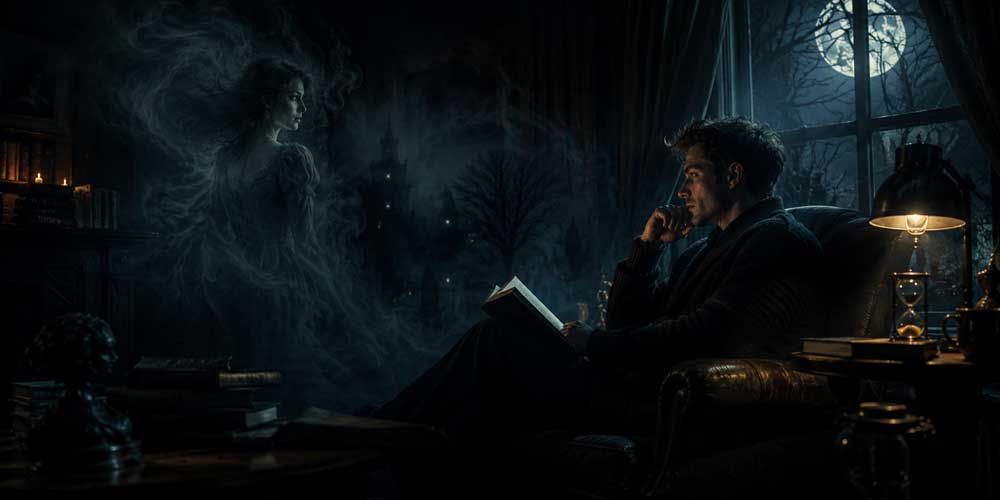
A shadow flickers across a wall. Footsteps echo through an empty corridor. A voice seems to emerge from a place where no one stands. Ghost stories have haunted human imagination for centuries, yet their enduring appeal raises an intriguing question. Why are people so fascinated by tales designed to frighten them?
The answer lies deeper than simple entertainment. Ghost stories transform invisible anxieties into visible forms, allowing audiences to confront fear, loss, memory, and uncertainty through narrative. Whether encountered around a campfire, inside a Gothic novel, or on a cinema screen, they continue revealing something important about the human mind.
The Psychology of Ghost Stories
Gothic Literature and the Rise of the Psychological Ghost Story
Stories about spirits existed long before Gothic literature emerged. Ancient cultures throughout the world developed legends involving restless dead, supernatural visitations, and encounters with the unknown.
The Gothic tradition transformed these tales into something more psychologically complex. Beginning in the late eighteenth century, writers such as Horace Walpole, Ann Radcliffe, and later Mary Shelley created fictional worlds filled with hidden secrets, mysterious settings, and emotional tension. Supernatural possibilities became tools for exploring fears that could not easily be discussed directly.
This literary shift occurred during a period when traditional beliefs increasingly collided with scientific progress and rational thinking. As society changed, ghost stories evolved as well. Rather than functioning solely as supernatural warnings, they became vehicles for exploring guilt, memory, repression, and uncertainty.
In many Gothic works, the haunting itself matters less than what it represents. Ghosts frequently appear where secrets have been buried, crimes concealed, or emotional wounds left unresolved. The supernatural becomes a visible expression of something hidden beneath the surface of ordinary life.
This psychological dimension would become one of the defining characteristics of the modern ghost story.
The Uncanny and the Human Psyche
One of the most influential explanations for the appeal of ghost stories comes from Sigmund Freud’s concept of the uncanny.
Freud described the uncanny as the unsettling sensation that occurs when something familiar suddenly becomes strange. A house appears ordinary until an unexplained sound echoes from an empty room. A reflection seems slightly wrong. A familiar face appears where it should not exist.
“The uncanny is that class of the terrifying which leads back to something long known to us, once very familiar.”
— Sigmund Freud, The Uncanny
Ghost stories thrive within this psychological territory. They rarely transport audiences to completely alien worlds. Instead, they introduce disturbances into familiar environments, making the impossible feel disturbingly plausible.
Carl Jung approached the subject from a different perspective. He believed stories often express hidden aspects of the psyche through symbolic figures and archetypes. Ghosts can function as manifestations of the Shadow, representing emotions, regrets, fears, and desires that individuals struggle to acknowledge consciously.
Viewed through this lens, ghost stories become more than supernatural entertainment. They become explorations of the hidden self, revealing psychological tensions that continue influencing behavior long after they have been suppressed.
Ghost Stories Across Cultures
Although ghost stories appear throughout the world, different cultures shape them according to their own values, fears, and beliefs.
In Japanese folklore, spirits often remain connected to unfinished emotional obligations. Traditional ghost stories frequently emphasize memory, duty, and the consequences of unresolved actions. The supernatural becomes closely tied to social responsibility and emotional balance.
Mexican folklore offers the enduring legend of La Llorona, the Weeping Woman. Her endless search for lost children transforms grief and regret into a haunting presence that continues across generations.
Irish traditions include stories of the Banshee, whose mournful cry announces approaching death. Rather than focusing solely on fear, these tales often reflect cultural attitudes toward mortality and loss.
Despite their differences, these stories perform a remarkably similar function. They transform difficult emotions and unanswered questions into narratives that communities can understand, share, and preserve.
The universality of ghost stories suggests that the fascination with haunting may be rooted in fundamental aspects of human psychology rather than any single cultural tradition.
The Turn of the Screw and the Fear of Uncertainty
Few ghost stories demonstrate the psychological power of ambiguity more effectively than Henry James’s The Turn of the Screw.
The novella follows a governess who becomes convinced that malevolent spirits are influencing the children in her care. Yet James never provides definitive proof that the ghosts actually exist.
This uncertainty is precisely what makes the story so unsettling.
Readers are forced to confront two equally disturbing possibilities. Either supernatural forces are genuinely present, or the narrator’s perceptions cannot be trusted. Neither explanation provides complete certainty.
James understood that fear often emerges not from what is known but from what remains unresolved. By refusing to answer the story’s central question, he forces readers to participate in the haunting themselves.
The novella remains one of the most influential ghost stories ever written because it reveals a psychological truth that continues shaping supernatural fiction today: uncertainty is often more frightening than certainty.
Why We Love to Be Haunted
If ghost stories are designed to frighten us, why do so many people actively seek them out?
Part of the answer lies in the way fiction allows audiences to experience fear safely. Readers and viewers can confront unsettling situations without facing real danger. This creates a unique emotional experience in which anxiety becomes engaging rather than overwhelming.
Ghost stories are particularly effective because they focus on psychological fear rather than physical threat alone. A ghost may never attack anyone directly, yet its presence can transform an ordinary environment into something deeply unsettling.
A dark hallway, an empty room, or an abandoned house suddenly acquires new meaning. The familiar becomes uncertain. The mind begins searching for explanations, often creating fears more powerful than anything explicitly shown.
This process helps explain why ghost stories remain effective even when very little actually happens. Their power often comes from anticipation rather than action, from suggestion rather than revelation.
The audience becomes an active participant in the haunting, filling empty spaces with personal anxieties and imagined possibilities.
Ghost Stories in Literature and Film
The transition from literature to cinema expanded the reach of ghost stories while preserving many of their psychological foundations.
Classic literary works such as Charles Dickens’s A Christmas Carol, M. R. James’s supernatural tales, and Shirley Jackson’s The Haunting of Hill House demonstrated that ghosts could serve purposes far beyond simple scares. They became vehicles for exploring guilt, memory, isolation, and emotional conflict.
Film introduced new methods for creating similar effects. Directors could use shadows, silence, framing, and sound design to generate uncertainty in ways unique to the visual medium.
Jack Clayton’s The Innocents, adapted from The Turn of the Screw, remains one of the finest examples. Much like James’s novella, the film refuses to provide clear answers. Viewers are left questioning whether supernatural forces truly exist or whether the horror originates within the characters themselves.
Alejandro Amenábar’s The Others uses isolation, darkness, and restricted perspective to create a similar effect. The film’s power comes not from constant apparitions but from uncertainty and emotional tension, allowing the audience to experience the same confusion as its protagonists.
M. Night Shyamalan’s The Sixth Sense transformed ghost stories for modern audiences by shifting attention away from spectacle and toward emotional resolution. Its spirits are frightening, but they are also deeply connected to grief, regret, and unfinished relationships.
These works demonstrate that the most effective ghost stories often use the supernatural as a framework for exploring human psychology rather than as an end in itself.
The Revival of Ghost Stories in Contemporary Media
Far from disappearing, ghost stories have experienced a remarkable revival in recent decades.
Contemporary creators continue adapting traditional supernatural themes to address modern anxieties. Isolation, grief, trauma, fractured identities, and the lingering effects of the past frequently appear within today’s ghost narratives.
Series such as The Haunting of Hill House and The Haunting of Bly Manor demonstrate how supernatural stories can function simultaneously as ghost tales and psychological dramas. The apparitions remain important, but the emotional experiences of the characters often prove even more significant.
This evolution reflects a broader shift within modern horror. Rather than focusing exclusively on external threats, many contemporary ghost stories explore internal struggles and emotional wounds.
The ghost becomes a symbol of something unresolved, transforming supernatural fiction into a powerful vehicle for exploring memory, trauma, and loss.
In this sense, modern ghost stories remain surprisingly close to their Gothic ancestors. Both use haunting as a way of revealing truths that characters would prefer to keep hidden.
Why Ghost Stories Endure
Ghost stories have survived for centuries because they speak to fears and questions that never fully disappear.
They explore mortality, memory, guilt, grief, and the unknown. They transform abstract anxieties into narratives that audiences can experience, examine, and understand.
Unlike many forms of horror, ghost stories rarely depend on violence alone. Their power comes from uncertainty. A ghost is unsettling because it exists between categories: life and death, presence and absence, memory and reality.
This ambiguity allows ghost stories to adapt across generations. Victorian readers found reflections of their fears within haunted houses and mysterious apparitions. Modern audiences encounter ghosts connected to trauma, isolation, and unresolved emotional experiences.
The settings may change, but the psychological foundations remain remarkably similar. Ghost stories continue haunting the imagination because they confront mysteries that resist easy answers while revealing truths about the human condition.
As long as people continue wondering about death, memory, loss, and the unknown, ghost stories will always find new audiences.
Wear the Darkness
If you are fascinated by Gothic literature, haunted histories, supernatural folklore, and the psychology behind ghost stories, explore the Edgar Allan Poets store for apparel inspired by mystery, darkness, and classic Gothic culture.
Join the Noir Newsletter
Receive more essays exploring Gothic literature, supernatural folklore, noir psychology, classic horror, haunted places, and the darker side of human imagination.
Frequently Asked Questions
Why are people fascinated by ghost stories?
Ghost stories allow people to explore fear, mortality, memory, and the unknown in a safe environment while confronting emotions that often remain difficult to discuss directly.
What is the psychological purpose of ghost stories?
Many psychologists believe ghost stories help people process uncertainty, grief, guilt, and hidden fears by transforming them into symbolic narratives.
What did Freud say about ghost stories?
Freud’s concept of the uncanny explains how ghost stories create fear by making familiar environments suddenly feel strange, unsettling, and psychologically uncertain.
Why are ghost stories common in every culture?
Although details differ, ghost stories often address universal concerns such as death, memory, loss, morality, and the fear of the unknown.
Why do ghost stories remain popular today?
Modern ghost stories continue adapting to contemporary fears while preserving the psychological themes that have fascinated audiences for centuries.
In 1976, four kids at Dublin’s Mount Temple Comprehensive School got together to start a band. The 14-year-old Larry Mullen., Jr. posted that he was looking for musicians on the school’s notice board, and he and some of his classmates had their first practice in his kitchen on Sep. 25. The young band called themselves Feedback and then the Hype before changing their name to U2. Within about a decade, they became one of the biggest acts on the planet. Yesterday, U2 marked their 50th anniversary as a band by announcing their new album Carnaval de Luz. Today, they played a secret gig at the school where it all started.
Today, legendary Christian metal pioneers Stryper proudly release their 18th studio album, Throne Of Thorns, out now via Frontiers Music Srl. Decades into their journey, Stryper continues to reaffirm their status as one of the most influential and enduring bands in classic metal, seamlessly blending their signature message with a sound that remains as powerful and relevant as ever. To celebrate the release, the band also unveil an official visualizer for their new single, “Shadowbreaker”.
On the new track, Michael Sweet comments: “’Shadowbreaker’ is a full throttle banger and a great way to end the album. It represents our heavier side perfectly, and where we’re at as a band in 2026.”
Throne of Thorns showcases the band at the height of their creative powers, delivering a masterclass in songwriting and musicianship. The album is packed with grand, meticulously crafted arrangements, where thunderous rhythms, soaring guitar harmonies, and anthemic choruses come together in a style that is unmistakably Stryper. Each track is infused with both intensity and melody, capturing the essence of classic metal while pushing their sound forward with renewed energy and purpose.
At the forefront stands the unmistakable voice of Michael Sweet, whose passionate, powerful, and instantly recognizable delivery continues to define the band’s identity. His vocal performance on Throne of Thorns is nothing short of extraordinary, effortlessly moving between soaring highs and emotive depth, adding a timeless quality to every song.
Perry Richardson says: “The best music doesn’t come from comfort. It comes from living, struggling, growing, and refusing to quit. I hope these songs find you exactly when you need them.”
With Throne Of Thorns, Stryper not only honors their legacy but expands upon it, offering an album that will resonate with longtime fans and newcomers alike. It’s a bold, inspired statement from a band that refuses to stand still—proof that true metal greatness only grows stronger with time.
Guitarist Oz Fox concludes: “I’m really happy with the final outcome of this record and of the heart that went into it. Michael continues to pour everything he has into the music and the message; Robert brings the power and energy that has always been the pulse of Stryper; Perry’s musicianship, vocal talents, and dedication are second to none, and I’m grateful to be on this journey with all of them.”
Tonight, the road takes me to Hamburg’s Barclays Arena, where Amy Lee and Evanescence are set to take the stage. The band is currently touring across Europe and the UK, with a stop in the autumn city on the Elbe. Poppy is along for the ride as an additional special guest, while Nova Twins have… Continue Reading →