A Perfect Circle’s “Thirteenth Step” returns in the Definitive Sound Series vinyl reissue, using One Step mastering for enhanced clarity, depth, and dynamic range, arriving Aug. 28.
The song opens with an immediate emotional impact, characterized by a heavily reverberated voice. This vocal quality touches the heart, and the melody along with the keys, creates a pop anthem feel. The sound gradually builds with an increasingly engaging groove that evokes epic vibes. It’s a celebration of everlasting love, one of those fortunate experiences where you find your soulmate, someone who supports you through tough times.
With a partner by your side, life’s battles become more thrilling and emotionally rich. You can share the ups and downs, transforming challenges into shared victories. The track embodies a very pop-centric sound, making it likely to reach the top of the charts due to its infectious qualities. This gives listeners a sense of hope and excitement infused throughout the song.
Around the two-and-a-half-minute mark, a guitar solo adds a surprising rock element to the piece. This unexpected twist provides a refreshing variation that guides the listener toward the conclusion. It’s a delightful addition that enhances the overall experience of the song. The solo stands out yet complements the earlier sections well, adding depth to the emotional journey.
BattleField Of Love – Sound and Atmosphere
The song is well-constructed, featuring effective harmonic and dynamic variations. The transitions between the sections are perfect.
The layers of music meld together flawlessly, enriching the overarching theme of love and resilience. The instrumental components work harmoniously to set the mood, with the piano and drums driving the pace forward. This creates a backdrop fitting for the song’s overriding message of unity in love.
Vocals soar above the instrumentation, offering a heartfelt performance that resonates with the audience. The singer delivers each line with sincerity, drawing listeners deeper into the narrative of the song. The feeling of warmth and togetherness permeates every note, creating a sense of belonging.
BattleField Of Love – Performance and Production
As the song progresses, it reveals various emotional shades. Listeners can experience joy, nostalgia, and even moments of introspection. This emotional journey is significant, allowing everyone to relate to their own experiences of love and partnership. The uplifting nature of the music fosters a sense of community—listeners feel part of something greater.
The rhythm never falters, encapsulating the essence of persistence in love. Each beat celebrates the strength that comes from being in a supportive relationship. This empowering message can inspire individuals to appreciate their relationships more deeply.
This single is a well-executed venture into the realm of modern pop. It combines emotional resonance with musical innovation. Matthew Phillips delivers a solid piece with “BattleField Of Love.” The track is rich, vibrant, and filled with dynamic contrasts. It is a worthy addition to any pop lover’s playlist and a track that should resonate with many.
The single “Sunburn” by FREQUENCY OVERLOAD begins with powerful chords and a drumline that seems poised to explode. The atmosphere quickly becomes profound and intense. As the vocals enter, enhanced by effects reminiscent of Ozzy, the track immerses listeners in its dark and hard rock essence. This song is not merely an auditory experience; it unfolds like an adventure. It tells an incredible story that feels deeply personal and transcends mere entertainment.
“Sunburn” serves as a rock anthem that delves into themes of pain, addiction, and a promise kept for thirty-seven years. The lyrics recount the tragic loss of the band’s frontman’s brother, Robert, who died in a car accident in 1987. This personal tragedy plunged him into darkness, yet he never forgot about Robert’s unborn son, a familial connection that had faded with time. Decades later, in 2024, a reunion occurs, bringing relief and closure.
The essence of the song transforms pain into redemption. It illustrates how certain wounds may never completely heal, yet they can guide love back to its origins. “Sunburn” paints a vivid picture of a life that has been lost but is reborn from the seed planted by the brother. The lyrics metaphorically close an infinite circle of life, resonating with listeners on multiple levels.
Sunburn – Sound and Atmosphere
This introspective approach renders the song a rarity in today’s musical landscape, where disingenuous emotions run rampant. The composition of “Sunburn” feels authentic and relatable, drawing listeners into a twilight space where the realities of life and death are rendered strikingly close.
The emotional intensity of the piece ensures it resonates profoundly within the listener’s soul. “Sunburn” is genuine music that encourages listeners from all walks of life to engage with its themes. Its blend of hard rock anthem is enriching, especially in a time when so much music feels superficial. The band’s commitment to creating something real is evident in every aspect of this song.
Sunburn – Performance and Production
FREQUENCY OVERLOAD successfully harnesses its raw emotional energy and channels it into a structured composition. The combination of dark storytelling intertwined with rock’s heavier elements makes “Sunburn” an impactful piece.
Listening to “Sunburn” is an experience that encourages self-reflection and acknowledgment of one’s past. The weight of the message coupled with the dynamic instrumentation makes for a powerful combination. This single will likely resonate with anyone who has faced loss or is seeking to heal from the past.
FREQUENCY OVERLOAD has crafted a narrative that is not only personal but universally relatable, showcasing that true art can help the creator and the listener confront deep-seated feelings.
This is more than just a song; it is an invitation to embrace life’s complexities and seek redemption in the midst of pain and sorrow.
On November 8, 1975, NME magazine ran a live review of a Ramones and Blondie show at the Performance Studio on New York’s Lower East Side. Though the Ramones would not release their debut album until the following April, there was already a buzz around the Forest Hills, Queens quartet, who were racking up rave reviews in the New York-area rock press. Understandably then, NME writer Charles Shaar Murray was somewhat bemused to find that the group were playing to “a total audience of – at final count – 27 people, nine of whom were photographers.” Clearly, the hotly-tipped New Yorkers had a way to go before becoming the city’s Next Big Thing.
“The Ramones, though, are a band that the London rock scene could really use,” the man from NME told readers. “Jeez, I’d give a week’s pay just to see them explode over an unprepared audience at, say, Dingwalls. They’re simultaneously so funny, such a cartoon vision of rock and roll, and so genuinely tight and powerful that they’re just bound to enchant anyone who fell in love with rock and roll for the right reasons.”
Charles Shaar Murray’s words did not go unnoticed by Ramones’ canny manager Danny Fields. The New York Dolls’ profile in their hometown was boosted after the group undertook a UK tour in 1973, landing a slot on BBC TV’s The Old Grey Whistle Test while in London, and Fields realised that if he could generate a buzz around Ramones in the UK, it would make Anglophile music fans in the US pay more attention to his band. And so a whistle-stop visit was planned for July 1976, with two shows booked: a gig supporting The Flamin’ Groovies at London’s 3,000-capacity Roundhouse venue in Camden on July 4 (with The Stranglers opening up), and a headline show at the 500-capacity Dingwalls club, also in Camden, the following evening.
Contrary to a popular myth constantly repeated to this day, no members of the Sex Pixtols or The Clash were present at The Roundhouse on July 4: the two bands were playing Sheffield’s Black Swan pub that very night, The Clash’s support slot being their first ever gig. But among the Roundhouse audience were members of The Damned, Gaye Advert, Adam Ant and future Pogues frontman Shane McGowan.
“It’s now seen as this big iconic, historical thing – the visit that lit the torch-paper for UK punk – but it didn’t feel legendary at the time,” Danny Fields once told me. “But it was astonishing in that there were more people there than they had ever cumulatively played to in their career at that point. I mean, most of my work before that with them was getting them ‘jobs’ – Johnny [Ramone] always called them ‘jobs’, not gigs – and here we were in one of the world’s most important cities and there were thousands of people there, and people being turned away.”
“There were people waiting at the hotel to sleep with us all,” Fields noted in Ramones documentary End Of The Century. “You can tell it’s pretty good if people are lined up to fuck the roadies and the managers.”
On July 5, the turn-out for Ramones’ first UK headline show was impressive. Among those in attendance were Brian James, Rat Scabies and Captain Sensible from The Damned, Joe Strummer and Paul Simenon from The Clash, JJ Brunel from The Stranglers, John Lydon and Glen Mattlock from Sex Pistols, future Sex Pistol Sid Vicious, and future Pretenders leader Chrissie Hynde.
“I remember Johnny Ramone and Paul Simenon talking beforehand,” Dany Fields told me. “Paul said, ‘We played our first show last night: no-one wants us because we don’t know what we’re doing, and we’re not good enough.’ And Johnny said, ‘Wait, you haven’t seen play. We stink! We can’t play! Just do what we do… just play!’ But I also remember Joe Strummer later saying, ‘You couldn’t slide a cigarette paper between any two of their songs’ so I guess people were impressed. Plus, those gigs showed promoters that there was an audience for punk, and that was important too.”
“They kickstarted the whole thing in a big way,” Captain Sensible insisted.
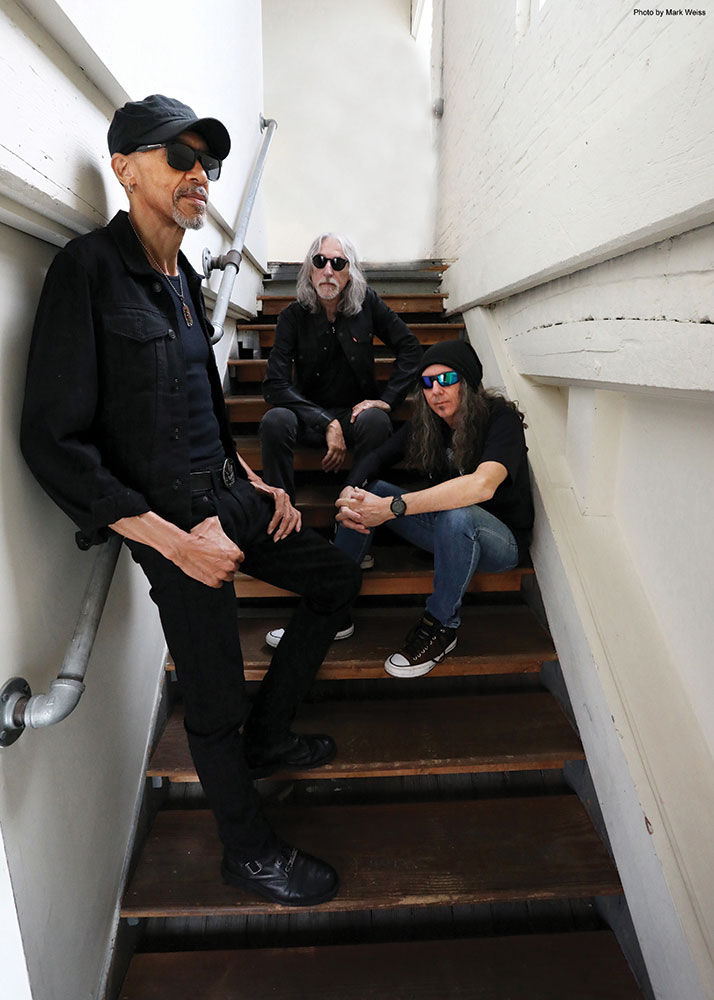
In 2022 King’s X ended a 15-year silence with the release of most recent album Three Sides Of One. Ahead of its launch they told Prog how they’d got there.
With drummer Jerry Gaskill suffering a pair of near-fatal heart attacks and guitarist Ty Tabor developing an unspecified illness that required “vigilant monitoring”, causing the second axing of a visit to Europe and the UK, the past few years represented a tumultuous era in the history of King’s X. Bassist and frontman Dug Pinnick, too, was twice hospitalised. On top of everything else, the idiosyncratic Texas-based trio were forced to delay entering the studio after a big fall-out with a record label. Don’t forget to throw in a pandemic that devastated the world of music. However, despite their previous album, XV, being released as long ago as 2008, Dug Pinnick insists that there was never any possibility of King’s X dropping quietly off the map.
“No,” he scoffs affably. “My issue was just a hernia. Jerry had two heart attacks but they didn’t cause him to be disabled. He’s probably healthier than any of us right now. Ty has an immune problem that the doctors are trying to deal with. So we didn’t think about throwing in the towel just yet, but it’s going to happen sooner or later. At almost 72, I’m realising that there are things I won’t be able to do forever, such as singing Over My Head, or something.”
Since settling upon the name back in 1985 (though the trio had worked together for longer), King’s X have carved a defiant though less than meteoric path, despite the magazine covers and ticker tape welcome that greeted their fabulous debut, Out Of The Silent Planet, in ’88. Their 13th album, Three Sides Of One is a statement of solidarity from a group that continues to wield a massive influence without reaping the financial rewards. This is something King’s X have had to learn to live with.
(Image credit: InsideOut Music)
A lifelong fan of the genre, Pinnick – who cites Close To The Edgeby Yes as a record that changed his life – is very pleased to be talking to Prog once again.
“As a musician I love the time changes and the space for ideas that progressive rock opens up,” he grins. “There was something about Yes: the way that Jon Anderson and Chris Squire came up with those amazing, beautiful harmonies and beneath all of that they would be playing such complicated music. Those key elements never detracted from the other. For some bands that was too much of a battle, but Yes had a knack of making it work. Close To The Edge… what an amazing 18 minutes of music that was; and you never got bored. I would play it to my friends and they would say, ‘Oh my God, that is so great.’ And these were people that didn’t listen to music a lot. to me, Roundabout is still one of my all-time favourite pieces of music. It’s a template for the way I write my own songs.”
Does Pinnick consider King’s X a prog band?
“No,” he fires back, smiling. “King’s X is a rock band. We dabble in all sorts of avenues, from gospel to blues, rock and prog. From show tunes to classical. We’ve never been able to add a label to our name and I don’t think we ever will. One of our songs could be based on two chords and the next is a magnum opus. It all depends upon how we are feeling.”
Some might suggest that the very uniqueness of King’s X renders them progressive? Pinnock considers the question for a moment before replying: “Yeaaaah. It’s really nice to be in a band that doesn’t just sound like another band. It has its drawbacks, of course, but overall we’ve been pretty lucky.”
All the same, the bass player is proud of his belief that nobody successfully cloned King’s X.
“I’ve heard similarities – but subtle ones,” he laughs. “When we began drop D tuning back in ’88, nobody else was doing that,” he explains. “Van Halen and Killing Joke did songs in that tuning but their bass players never did. Eighty per cent of our first album, Out Of The Silent Planet, was drop D and it led to a whole different approach on the guitar. After we did that, the grunge generation followed suit – in fact, the whole world did. Alice In Chains were doing the same thing as us, but in a more primitive way that really appealed to the masses.
“You know, somebody from another band once told me: ‘You can take one chorus from a King’s X song and make it into a whole new genre’,” he adds with a chuckle. “I thought that was very cool.
“But answering your question, even when others try [to sound like us], they don’t [manage it],” Pinnick adds. “There’s something about the three of us. We play on each other’s nuances. It’s not just notes; it’s about how we blend our emotions. When people hear that, it’s special.”
Despite the inclusion of lyrics such as, ‘Is this the end of the world/Or a new beginning’ (from its opening track Let It Rain), Three Sides Of One was written and recorded though not mixed before the pandemic. The band used the Emmy Award-winning Michael Parnin, who had previously worked with Pinnick on his 2007 solo set Strum Sum Up and also on a Jimi Hendrix tribute album, as producer.
“I’ve known Michael for more than 20 years and asking him to do the record was a great marriage from the very start,” Pinnick enthuses. “He got us, and we liked him.”
(Image credit: Mark Weiss)
Pinnick alone brought 27 songs to the session, with Tabor and Gaskill submitting their own compositions, before whittling them down to the final dozen. “Our prognosis was that every song had to be recorded to make it sound like a single,” the bassist explains. “People don’t listen to albums like they once did, so some songs have a lot of bass, others drums, and Take The Time was mixed for Top 40 radio.”
Pinnick’s Give It Up, in which mentions the making of a will, is highly autobiographical. “I had just turned 70 when we started to make this record and those lyrics were an awakening for me,” he explains. “That realisation now causes me to live in the moment.”
Destined to become a stage favourite, All God’s Children is a quintessentially King’s X-stylised song written by Tabor about the puzzling duality of Christians with less than evangelical beliefs. As a gay man and an individual of faith, that hypocrisy is something Pinnick knows all about.
“Here in the US we’ve got the Christian nationalists, everything has split apart and it’s become political,” he sighs. “It’s getting scary. It’s all a big mess and I don’t want anything to do with it other than to tell folks to wake up.”
Elsewhere, Gaskill addresses his own advancing years with She Called Me Home, inspired by the drummer’s multiple heart attacks. “For a while, Jerry thought that maybe he couldn’t do this anymore,” Pinnick confides. “And then his brother came along and told him, ‘Get your shit together, go and make music’ – and he did. We’re a band that sometimes needs a kick in the ass.”
Which brings us to the subject of taking 14 years between albums. If Pinnick and company are counting out time, do they feel bad about wasting so many precious moments?
“Not at all,” he fires right back. “In that time, I did Tres Mts with Jeff Ament and Mike McCready of Pearl Jam, three KXM albums with [ex-Dokken guitarist] George Lynch and Ray Luzier of Korn, two albums with Grinder Blues, my Hendrix tribute album [Tribute To Jimi: Often Imitated But Never Duplicated] and two solo albums. I’ve been busy, busy, busy. It’s not my fault the other guys didn’t want to make music.”
So what has changed?
“The guys felt it was time. After making Gretchen Goes to Nebraska[1989], Dogman [1994] and all the rest, they were reluctant to make a record just for the sake of making a record. The last thing we wanted was to shit out crappy music for people to be disappointed.”
Despite the announcement of a deal with the Australian label Golden Robot back in 2018, King’s X have returned to their old home of InsideOut for Three Sides Of One. Pinnick isn’t keen on raking over the details, commenting: “Some things happened, and they broke the contract in a way that made us say: ‘This is not cool. We’ve got to go.’ And we left.” He adds: “We’ve known Thomas [Waber] at InsideOut for so long, they had signed us for two previous records, so it’s like going back to family again.”
A social media post from July 26 showed King’s X rehearsing for the first time in two and a half years ahead of a trio of US shows. In it, Pinnick admitted to having a “panic attack”, but the group’s shared joy was obvious.
“Each of us was having panic attacks,” he laughs. “The type where your stomach knots up and you wake up in the middle of the night afraid of not remembering the songs.”
Getting back onstage was “horrifying”, he laughs. “After all that had gone on we had no idea of whether we could do this individually, let alone as a band. I had had Covid, which forced me to rehearse at home alone. All of us were thinking about our age. It was like running a marathon after 15 years… without training. As a band, we have always played inside each other’s heads and suddenly I was having to think about things like notes and timing, but it was like riding a bike and I’m happy to say that those days are over. We did three shows and after the second we said, ‘Okay, we are starting to get warmed up. We can do this again. Now we’re excited.’”
However, when asked how soon King’s X might return to Europe, Pinnick can’t be sure.
“I don’t want to even make a prediction because we’ve let people down twice now,” he replies. “When Ty’s doctor gives the all-clear, that’s when everything gets re-booked and not before. Individual gigs are okay, but going on tour is the problem. After flying, Ty needs a couple of days to recuperate. A tour of Europe is night after night and his immune system wouldn’t hold up to that. Right now, we don’t know when that situation might change. It’s possible that he could have immune problems for the rest of his life, which would mean that we could only play at weekends every month.”
With a shrug of the shoulders he concludes: “But you never know.”
Alkaline Trio have cancelled their UK tour on the day of the first scheduled date as frontman Matt Skiba is dealing with worsening medical issues that have left him unable to “walk, talk, play or sing” properly.
The band were due to perform at the O2 Institute in Birmingham last night (Friday), but that show did not go ahead and neither will scheduled shows in London, Newcastle, Leeds, Manchester and at the 2000Trees festival in Gloucestershire on July 9.
In a statement, Alkaline Trio say: “We are immensely sorry, but we must cancel our dates in England, including tonight’s show in Birmingham, due to medical issues Matt has been suffering from that have worsened.
“He’s gonna be okay but needs to be treated stateside as soon as possible. We will be back healthier and stronger.”
Skiba later released a video giving further details on his illness. He says: “Thank you for all the love and support. It means the world to me.
“You guys deserve a better show than I can throw right now. I’ve got numbness in my feet, numbness in my hands, and as you can tell I’m losing my voice. I can’t really talk, walk, play or sing.
“I’m gonna go home and get looked at. I love all of you so much and we’ll be back asap to make these shows up to you.”
July 03: Birmingham O2 Institute July 04: London O2 Forum Kentish Town July 05: Newcastle O2 City Hall July 07: Leeds O2 Academy July 08: Manchester O2 Ritz July 09: 2000Tress Festival, Cheltenham, Gloucestershire
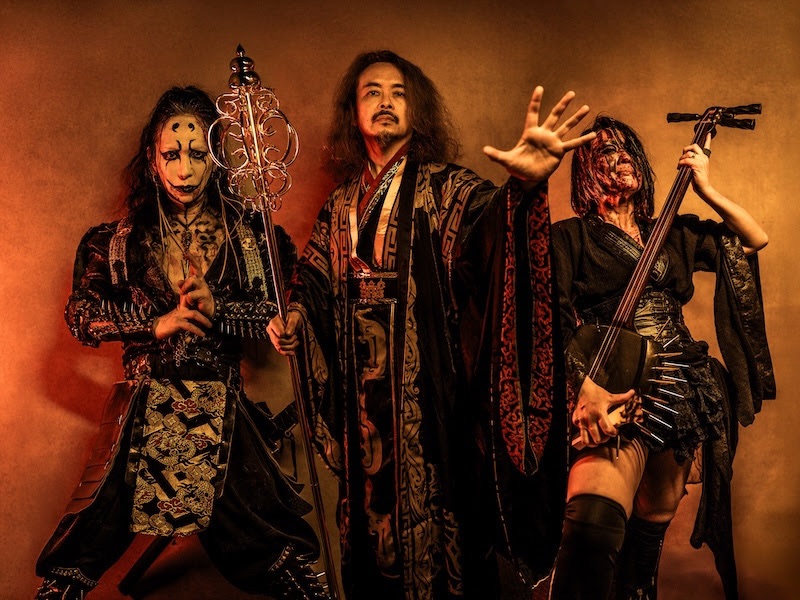
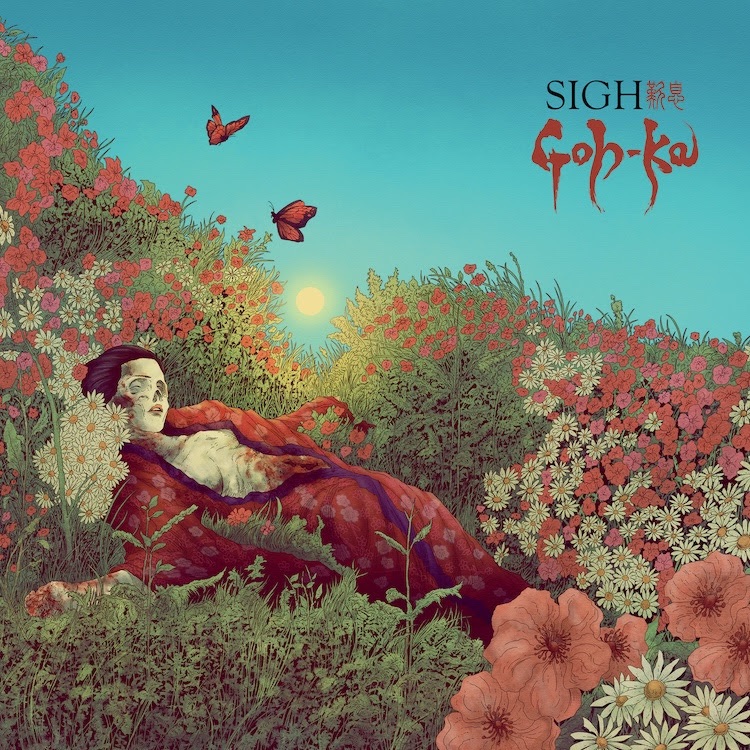
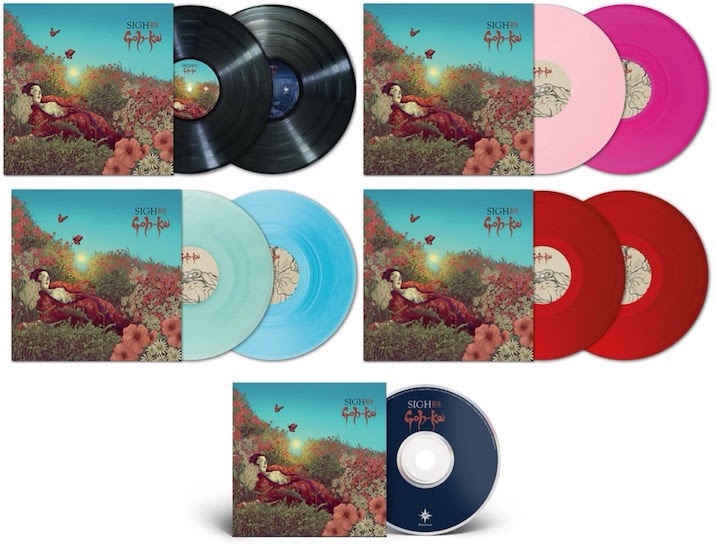
Japanese metal pioneers Sigh are back today with news of their new album ‘Goh-ka’; a new highlight of atmosphere, technical mastery, and meticulously arranged epics of metallic grandeur. Main-man Mirai Kawashima notes this as being as equally personal an album as ‘Shiki’, both musically and lyrically.
From a musical perspective, if you were to place the main ingredients of Celtic Frost, Voivod, Black Sabbath, horror movies and Japan into a cauldron and stir it, you will get ‘Goh-ka’. Numerous additional spices such as psychedelic rock, prog rock and classical music are also evident over the album’s close to one-hour duration.
The album title ‘Goh-ka’ has a triple meaning, being: 業火 infernal fire scorching sinners, 劫火 a huge fire that burns down the world at the end of time, and 業果 karma. The primary theme permeating the album is Kuso-zu; a series of Buddhist paintings or illustrations depicting the nine stages of a human body’s decomposition after death, created to encourage meditation on the impermanence of life, the inevitability of death, and the detachment from physical beauty and worldly attachment.
It openly shows the harsh reality that no matter how beautiful you are, you’ll be dead and rot sooner or later. And Kuso-shi is a poem based on these paintings. The artworks on the cover and in the booklet of ‘Goh-ka’ are therefore Kuso-zu themselves.
Joining Mirai Kawashima and Dr Mikannibal along with guitarist Nozomu Wakai, are Frédéric Leclercq (Kreator) on bass, plus renowned US drummer Mike Heller.
Among the additional contributors to the album, Mikael Åkerfeldt of Opeth notably delivers a special guest guitar solo on the track, ‘Unputenpu’.
‘Goh-ka’ was recorded across multiple studios, and once again mixed and mastered by Lasse Lammert at LSD studios in Germany.
PRE-ORDERS OF THE ALBUM FROM THE PEACEVILLE STORE AND BAND STORE WILL COME WITH THE FREE ‘LEGACY OF HORRORS’ 10-TRACK SIGH SAMPLER.
Japanese metal pioneers Sigh formed in 1989/1990. Their genre-classic Black Metal debut ‘Scorn Defeat’ arrived in 1993, and with a subsequent journey through the strange and the psychedelic, incorporating a whole eclectic mix of genre styles & ideas throughout their career, Sigh has remained a vital creative force in the avantgarde field whilst maintaining their old school roots, as witnessed on the 2022 album (and first for Peaceville Records), ‘Shiki’.
This was followed by the remaking of their ‘Hangman’s Hymn’ album as part of the band’s 35th anniversary celebrations, in the shape of ‘I Saw the World’s End: Hangman’s Hymn MMXXV’ (2025).
SIGH TOUR DATES:
EUROPE OLD-SCHOOL SET (AS A TRIO) 07/09 DE Torgau In Flammen Open Air (Scorn Defeat Set) 07/10 DK Fredericia Metal Magic (Special Old School Set) 07/11 UK London Downstairs at the Dome (Special Old School Set)
US 07/26 Fire In The Mountains 07/28 Seattle WA El Corazon 07/29 Portland OR Star Theater 07/30 Sacramento CA Cafe Colonial 07/31 Berkeley CA Cornerstone 08/01 Los Angeles CA 1720
EUROPE 09/03 PL Aleksandrow Lodzki Summer Dying Loud 09/04 PL Cracow Zaścianek 09/05 CZ Ostrava Metal III 09/07 DE Munich Hansa 39 @ Feierwerk 09/08 DE Leipzig Moritzbastei 09/09 DE Berlin Badehaus 09/10 DK Copenhagen Beta @ Amager Bio 09/11 DE Hamburg Betty 09/12 DE Oberhausen Death & Damnation Fest 09/13 NL Leeuwarden Neushoorn 09/14 NL Utrecht DB’s 09/15 FR Paris Backstage By The Mill

 If you love this music: