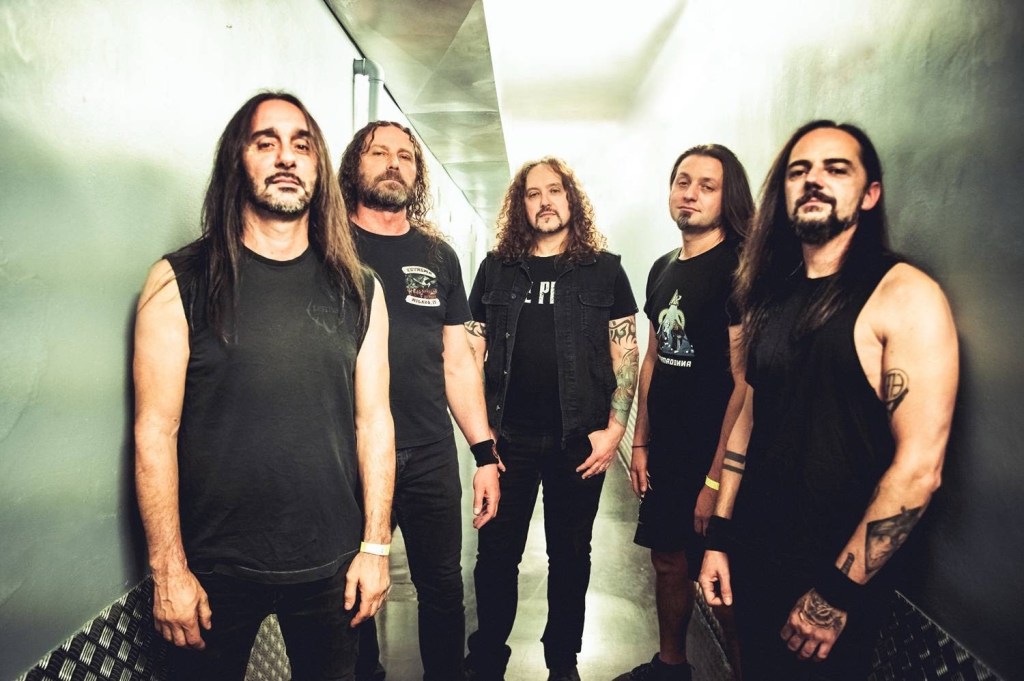
Baltimore (MD) – Street Metal gang, Total Maniac, are set to release sophomore album, Love Overdrive, on March 27!
The album’s first single, “Drinkin’ Our Way To Hell,” is streaming now at: youtu.be/Ylq6yZNyOdg. The song is also available on Bandcamp.
With Love Overdrive, Total Maniac has upped the ante! The quintet’s music can veer from ripping thrash to sleazy hard rock, from d-beat menace to anthemic choruses. Capturing the wild energy and irreverent humor of their live shows and packed with their strongest, most memorable material yet, the album is sure to catch the attention of heshers and open even more doors for the band!
FFO: Inepsy, Motorhead, Judas Priest, BAT
Love Overdrive will be available on 12″ vinyl LP and digital formats.
Diamond Dustin – Vocals Mike Brown – Guitar Nick Etson – Guitar Ben Martin – Bass Vaughn Volkman – Drums
Album engineer: Kevin Bernsten at Developing Nations Studio.
Mastered by: Brad Boatright at Audiosiege.
Catch Total Maniac at these upcoming shows:
March 27 at Metro in Baltimore, MD – LP Release Show – with Hirax, Savage Master, Desolus, and Devil Lust
April 18 at Ottobar in Baltimore, MD – Grim Reefer Fest
BAND BIO:
Gutter dwellin’ rock n roll from Baltimore, MD!
Formed in 2018 by members of Nux Vomica, Deathammer, and Raw Filth who wanted to strike a sound somewhere between their love of 80’s metal and rock n roll swagger with punk grit. Months of gigging and developing their style led them to comparisons with classic bands straddling those same lines such as Motörhead and Venom, with their self released demo in 2019.
After some lineup changes and higher profile gigs opening for BAT, Poison Ruin, and a spot on Maryland Deathfest, they released their self-titled full length in 2022. Total Maniac sets apart from their contemporaries by authentically not giving a fuck about fitting into a narrow box.
Several more high profile gigs, festivals, and DIY tours followed. It’s not uncommon to find them on a bigger stage opening for major metal acts such as Midnight or Sodom one night, and then a sweaty packed dive bar playing alongside crust punk bands the next month.
Opeth’s February 7th stop at The Fillmore Philadelphia felt less like a tour date and more like a gathering of longtime friends trading in dynamic, soul-crushing prog metal. The room was jammed wall-to-wall—pushing nearly 2,800—with anticipation thick before the lights dropped.
Katatonia opened masterfully, delivering a tension-and-release masterclass with melancholic melodies and thick modern production that cut through the dense crowd. For longtime fans, Anders Nyström’s absence added quiet emotion, but the lineup stayed tight and committed, blending older staples like “Soil’s Song” and “July” with moodier newer tracks. The crowd treated them like co-headliners, singing along from the first chorus.
Opeth frontman Mikael Åkerfeldt strode out with his signature understated swagger, dissolving formality with dry humor. Glancing at his tourmates, he said touring with Katatonia felt like traveling with best friends—then grinned: “…they’re also a pretty decent band.” It drew a huge laugh and set the tone for his deadpan, self-aware banter: the perfect foil to the music’s intensity. Anecdotes about run-ins with James Hetfield and ex-bandmate Martin Lopez (soon heading our way with Soen!) further cemented him as one of prog’s most engaging frontmen—even if he still won’t cave to endless crowd requests! Just kidding; they’d play till morning if he did.
This was the The Last Will and Testament tour, so the new album got solid representation, but older-material fans weren’t shortchanged. Covering eight albums over nearly two hours, the band wove a perfect story: growls from “Demon of the Fall,” the quiet pastoral beauty of “To Rid the Disease,” prog-paced gems like “The Devil’s Orchard,” and classics like “Master’s Apprentices” into “Godhead’s Lament.” The band was terrifyingly tight—articulate guitars, locked-in rhythm, keys in perfect balance, and Mikael’s roars-to-cleans cutting through flawlessly.
The emotional high point of the set was the closer. Ending with “Deliverance” was a logical choice, and the crowd clearly recognized it as soon as the chromatic, palm-muted intro started. After a varied set, finishing on one of their heaviest and most familiar songs gave the show a clear sense of conclusion. The mid-section’s slower, groove-oriented riff kept the audience moving, and the well-known stuttering ending had most of the room following along until the final abrupt cutoff.
In the end, the night felt like a complete portrait of Opeth, masterfully ferocious and technically dazzling. The balance between crushing heaviness, intricate progressive passages, and Mikael Åkerfeldt’s sharp-witted charm made the performance more than just a tour stop; it was a reminder of why the band continues to stand at the forefront of modern progressive metal. Now, stepping into the 5°F windy slap was another story and a reminder of how far from my Florida home I was. But even though I’d brave that Arctic blast again in a heartbeat in order to see Opeth, perhaps consider stopping by us next time, guys?
Does A New Forensic Paper Actually Undermine The Kurt Cobain Suicide Ruling?
Short Answer: The researchers argue their findings raise inconsistencies, but Seattle authorities say nothing presented qualifies as new evidence.
TL;DR:
A peer-reviewed forensic paper tied to an independent private-sector research team is drawing attention after suggesting elements of Kurt Cobain’s 1994 death may not align with an “instantaneous gunshot” interpretation. The Seattle Police Department and King County Medical Examiner have responded firmly: their original conclusion — suicide — stands, and the case will not be reopened.
A Case That Refuses To Stay In The Past
Kurt Cobain’s death is one of those cultural fault lines that never fully seals. Decades pass. Generations change. Yet every few years, something pulls the story back into the headlines — and back into public argument.
This time, it’s a forensic analysis authored by an unofficial team of researchers and scientists who revisited autopsy and crime scene materials. Their conclusion doesn’t accuse. It doesn’t name suspects. But it does something almost guaranteed to ignite controversy:
It questions whether the long-accepted narrative tells the complete story.
Why this matters now isn’t complicated. Cobain wasn’t just a musician. He became a symbol — of a generation, of fragility, of brilliance colliding with self-destruction. When new claims surface, they don’t land in a vacuum. They collide with memory, mythology, and emotion.
The King County Medical Examiner’s Office responded to media inquiries by reaffirming that the original investigation followed established forensic procedures, including a full autopsy conducted in cooperation with law enforcement. Their position remains unchanged: no new evidence has emerged that would justify reopening the case.
Similarly, the Seattle Police Department stated detectives concluded Cobain died by suicide — and that conclusion continues to represent the department’s official stance.
In other words: debate may rage publicly, but institutionally, nothing has moved.
What The New Paper Claims
According to reports, independent researcher Michelle Wilkins — identified as part of the investigative team — told the Daily Mail that their exhaustive review raised concerns they believe are inconsistent with an instantaneous gunshot death.
The peer-reviewed paper reportedly outlines multiple points the researchers characterize as “unusual,” suggesting an alternative interpretation of the events surrounding Cobain’s death.
The authors’ stated objective is not prosecution, but transparency. Their message is essentially this:
If the conclusions are wrong, demonstrate why.
Peer Review Is Not A Verdict
Here’s where nuance gets lost in the noise.
Publication in an academic journal means a paper met editorial and methodological standards. It does not mean its conclusions are legally validated or universally accepted as fact.
That distinction is critical — yet often blurred once headlines and social media enter the picture.
A forensic interpretation can challenge discussion. It can provoke scrutiny. But reopening a closed legal case typically requires something more concrete than reinterpretation:
New, verifiable evidence.
Authorities argue that threshold hasn’t been crossed.
Why This Debate Never Dies
Because Kurt Cobain’s story was never just forensic.
There’s a deeper layer here that rarely makes headlines.
At what point does revisiting a decades-old death serve truth — and at what point does it risk reopening wounds for surviving family, friends, and fans?
Scrutiny is healthy in a democracy. But so is responsibility.
Cobain’s death was not entertainment. It was a human catastrophe that rippled through countless lives.
Yet the public appetite for re-examination remains insatiable.
The Reality Check
No arrests are being pursued. No case is being reopened. No official ruling has changed.
What has changed is the conversation — again.
And maybe that’s the real story.
Not whether minds will change… …but whether they ever could.
FAQ
Was Kurt Cobain’s death officially ruled a suicide? Yes. The King County Medical Examiner ruled Cobain’s death a suicide in 1994.
Are Seattle authorities reopening the case? No. Both the Medical Examiner’s Office and Seattle Police Department have stated their conclusions remain unchanged.
What does the new forensic paper suggest? The researchers argue their review identified elements they believe warrant further scrutiny.
Does peer review validate the homicide theory? No. Peer review evaluates academic rigor, not legal truth.
Are the researchers seeking criminal charges? No. Public statements indicate their focus is transparency and re-examination.
Kurt Cobain Bio
Kurt Cobain was the singer, guitarist, and primary songwriter of Nirvana, the Seattle band that helped push grunge and alternative rock into the mainstream in the early 1990s. Born in Aberdeen, Washington, Cobain rose to global fame through landmark releases like Nevermind and In Utero, becoming one of the most influential — and scrutinized — figures in modern music. He died in April 1994 at age 27, and his legacy continues to shape rock culture, songwriting, fashion, and the way artists talk about fame, pain, and authenticity.
I have, this very day, received an email about the upcoming release of a mighty box set of vintage Michael Schenker Group live stuff from the glory years in the 1980s. Schenker and MSG were untouchable back then. That legendary debut album was just the start of it. And the first CD in this box […]
Real extreme music thrives on confrontation, and Master’s Ashes arrive with plenty of it on their debut single, “Defiance Disorder,” which we’re premiering today along with an accompanying lyric video. Featuring current and ex-members of Crisis, Voivod, Dystopia, Crowbar and The Convalescence, the band pulls from the bleak, dystopian heaviness of the early ’90s while sharpening it into something unmistakably current. “Defiance Disorder” is the opening salvo from their forthcoming debut album, How The Mighty Have Fallen, due out April 17, 2026 via Time To Kill Records.
Musically, the track is relentless and suffocating, balancing oppressive atmosphere with blunt-force aggression. Lyrically, it cuts even deeper. “Defiance Disorder” confronts the cycle of violence inflicted on children and teens in America and the psychological fallout that follows – trauma that often manifests later as vengeance, retaliation, and, in its most horrific form, mass murder. It’s an uncomfortable subject, delivered without metaphor or distance, and it sets the tone for an album that, adequately to the times we’re living in, functions as a full-scale protest rather than passive commentary.
About the track, Master’s Ashes tell Decibel:
“’Defiance Disorder’ speaks to the deadly combination of mental illness in teens and the culture of gun violence in America. This nexus creates monsters fed on 24-7-365 violence all around them. It’s a suffocating reality we all have to live with and it’s spreading to all corners of the globe.”
With How The Mighty Have Fallen, Master’s Ashes present a scorched-earth debut, dark, aggressive, and openly hostile toward political complacency and false authority. No gods, no masters – only resistance, firm and strong.
Check it out below. The album is out on April 17th and you can pre-order here straight away.
As a member of Billy Joel’s band between 1976 and 1989, Russell Javors provided rhythm, feel, and vibes. Albums like 52nd Street, Glass Houses, and The Nylon Curtain tell the story of an era of great music, huge success, and tours that saw Joel and his band land behind the Iron Curtain. Of his role within Joel’s music, Javors tells ClassicRockHistory.com, “When I was with Billy, I had guitar picks that said, ‘Sultan of Subtle.’ Playing rhythm guitar with Billy is an understated gig. But I honestly believe that I was a part of Billy’s best-sounding bands.” He explains, “I
I have no doubt the first secular song ever written was a love ballad. I’m equally certain the second tune was about being away from home and longing to return. Denver’s Clay Street Unit just released their debut full length album, and while they don’t call that out as any kind of unifying theme, a […]