Blog
-
The soundtrack to mega-metal videogame Doom has been added to the Library Of Congress, alongside Weezer’s debut album and music by Beyoncé and Taylor Swift
The library contains sound recordings which are “culturally, historically or aesthetically important, and/or informs or reflects life in the United States” -
See the New Paul McCartney and Wings Rock Hall Exhibit
Check out photos of the new tribute and read UCR's interview about how it came together. Continue reading… -
John 5 Has Not Spoken to Rob Zombie in 4 Years
The guitarist's decision to join Motley Crue seems to have severed his relationship with his former boss. Continue reading… -
John 5 Has Not Spoken to Rob Zombie in Four Years
The guitarist's decision to join Motley Crue seems to have severed his relationship with his former boss. Continue reading… -
Lorn – Searing Blood Review
 Nearly a decade has passed since Italian black metal project Lorn last graced these halls. Arrayed Claws greatly impressed the sage Eldritch Elitist back in 2017, who praised its “caustic edge and sheer strangeness.” The man behind the project, Radok, seems to have been relatively quiet in the last nine years, but I don’t think he was idle. In the intervening years, I think Radok has been watching and listening, and he’s found the present lacking. In an endless ocean of new content, Radok sees naught but an arid desert, devoid of depth. On Lorn’s fourth full-length, Searing Blood, Radok promises to reject modernity’s vapid content singularity and conceptually return to black metal’s roots. Is Searing Blood an oasis in the desert, or is it just a mirage?
Those returning to Lorn will immediately notice some differences between Arrayed Claws and Searing Blood. First and foremost, Radok’s newest effort actually has a low end. Where Arrayed Claws was almost grating in its shrill and disquieting tone, Searing Blood rumbles and shakes the ground upon which it stands. This makes for a more physically enjoyable experience, avoiding the listener fatigue that threatened Arrayed Claws. Fans will also clock the shift from fairly distilled black metal toward the atmospheric variety. Radok’s 8-string guitar is still a deeply unsettling force to reckon with (“Haderburg”), but there’s an unexpected tenderness to Searing Blood. While it’s not uncommon for atmoblack bands to focus on the majesty of nature, Radok approaches it through a lens of disillusionment with contemporary life, weaving a sense of loss, betrayal, and impotent outrage into Searing Blood.
Change isn’t always a good thing, but it is on Searing Blood. While Lorn does pay homage to the past with brilliantly discordant melodicism (“Searing Blood,” “Leuchtenburg”), an increased prevalence of synths and the introduction of new elements well-suited to atmospheric spaces allow Lorn greater breadth of expression. “Leuchtenburg” channels Panopticon with metal-stringed chords that hint at a synth-backed, acoustic interlude. Draped in the gothic tones of Unto Others, picked leads on “Gallows” float in and out, evoking a beautiful sense of tension and anxiety. Airy, choral synths and ringing melodies bestow instrumental “Ordo Draconis” with a magical, otherworldly quality. Through it all, Searing Blood’s heart of aching tremolos and agonizing screams adeptly evokes the Romantic’s view of Modernity, an indictment of what is and a yearning for what was.
 Lorn’s exploration of a new form isn’t without its stumbles, though. The acoustic interlude in “Leuchtenburg” is a little long, and the synths can distract from the strings. At over nine minutes, “Gallows” similarly sags under its own weight, and “Ordo Draconis” features a jarring transition that only leads to a mismatched back half. Sample usage is a bit heavy-handed,1 and Searing Blood wouldn’t suffer for their omission. Lorn also relies heavily on certain compositional decisions, robbing them of their impact. Short lulls that explode into a furious bridge appear far more often than they should, even multiple times in a single track (“Gallows,” “Threshold’s Tragedy”). And while I appreciate a good fade out, ending every song that way grows stale quickly.
Searing Blood isn’t what I expected. I had prepared to be unsettled and challenged, but I was instead guided through a poignant and emotive journey. Both novel and familiar, Searing Blood presents a surprisingly singular vision. Rather than simply refining Lorn’s particular flavor of dissonant black metal, Radok tills new soil with well-worn tools. Lorn’s new direction is compelling, missteps aren’t fatal, and there’s ample room for Radok to both improve and continue exploring this space. A tighter and more varied composition would aid any future efforts. Searing Blood won’t necessarily drop any jaws, but for those on the fence, it should convince you to keep an eye on Lorn.
Rating: 3.0/5.0
DR: 6 | Format Reviewed: 256 kbps
Label: I, Voidhanger Records
Websites: Bandcamp | Facebook
Releases Worldwide: May 15th, 2026The post Lorn – Searing Blood Review appeared first on Angry Metal Guy.
-
A – ‘PRANG’
If there was a competition for the least Google-friendly name in history, A would score pretty highly. Back in 1993, it wouldn’t have been a problem but subsequently searching for ‘A Band’ proved futile. So what happened? It went like this; Back in 2002 there was a rock band called A and they hit big with their third album ‘Hi-Fi Serious’, propelled by the incredible single ‘Nothing’. They were invited onto the main stages at festivals, then they released the awesome standalone single ‘Good Time’. In 2005 they released their strongest record to date ‘Teen Dance Ordnance’. And no one bought it. Ironically their final song ‘Wisdom’ left off with the line “waiting for you…”
After sporadically touring as a ‘hobby’, that wait is over. They have finally followed it up with ‘Prang’. After such a long time, it’s hard to know what to expect. Listen back to those big singles, and they show the band at their most straightforward. Most of their discography is weirder. Some consider them a pop punk band, but their music has little in common with Green Day or Blink-182. It’s a distinctive sound that leans more toward rock, but their songs don’t follow a template. Each feels different yet is clearly the work of the same band. ‘Prang’ shares these features, in effect it sounds exactly like a record made by A after a 20-odd year break, which is both its strength and weakness.
Broadly, the difference between this record and those from their heyday is it is being released by Cooking Vinyl and not a subsidiary of Warner Brothers. There is no pressure to write a huge chart-topping banger, so they haven’t. Instead, the songs lean in different, more interesting directions. It means the album is stranger than you might expect, taking longer to settle into, but it’s also comfortably the band’s most consistent record. In essence, it’s confident, unfiltered and delightfully weird.
Way back in the ‘Hi-fi Serious’ days, the band’s guitarist Marc Chapman appeared in Total Guitar Magazine. The article discussed his left-handed playing style and love for guitar solos. Here you can hear those skills being put to good use. While there is plenty of showing off, like the louche guitar solo on ‘Shit Summer’ or the wicked fretwork on ‘Kings Of Lowestoft’, mostly he’s writing interesting, thoughtful parts. Notably there’s a great interpretation of the classic ‘I Love Rock ‘N’ Roll’ on ‘All In’ which deploys the lick like an offensive weapon. Similarly, the hard sound that opens ‘Hello Sunshine’ has teeth but it chews rather than bites. The whole record is like this, in effect, tasteful.
That said the sound is surprisingly punk, featuring a rough, anything-goes edge that a lot of pop punk doesn’t. It’s most obvious on the delightfully rowdy ‘Techno Viking’ but even the more rocky ‘Back To The Shop’ feels nicely dangerous. Similarly ‘Walkover’ has a fast sway, driven by the snapping drumbeat.
The most notable thing, and perhaps shines a light on what it is that makes A so distinctive, is that the songs refuse to stay in one shape. This is a double edged sword. The band’s biggest hits are relatively straightforward and delight in repetition. Here they avoid that. Giles Perry’s keyboards are quite often used to give the songs a strange vibe or transition the song to a different space. In the case of ‘Bring On The Likes‘ it’s an awe-inspiring shift.
Jason Perry remains an ideal frontman. He’s armed with a distinctive voice that sounds unique, no matter how he expresses himself, along with a wicked sense of humour, a distaste for simple song structures and a restless creative energy. Throughout the record he favours a slacker vocal that is a mixture of singing, spoken word and melody. It’s tamed by age, but also bubbling with enthusiasm there is a cheekiness and a defined sense of humour. After the band’s initial run he worked as a professional songwriter, producing Grammy winning records, which might explain why this record sound so good. It’s biting and bassy but with a pleasing depth so that through decent headphones you can feel its rich tone.
Where once Jason Perry mocked old people as “losers” for not being able to use computers, here he’s cast as an old person himself struggling with the online world. It’s a canny choice and tells you a lot about his state of mind, although not quite as much as the discussion of mental health and struggling with cancer on the aptly named ‘Shit Summer’.
‘Bring On The Likes’ feels very much like a companion piece to their 1999 single ‘Old Folks’. It’s a stunning, spoken word, almost stream of conscious song. Indeed, Perry uses this approach on numerous tracks, it’s curious approach and defines the record’s entire feel. Often, he makes strange choices work counter to you’d expect, given the music. Take songs like ‘Back To The Shop’ which have a real “why would you use that as a chorus” vibe. It’s a common theme, a mismatch between what Jason Perry is doing and what you might expect. This is unusual and ultimately robs the album of a couple of straight-up classics, and yet, it gives the songs a strong character. This simply couldn’t be another record by another band.
‘Comment Leaver’ is sung from the perspective of a Daily Mail reader and is a barbed disassembly of that type of person. It also requires him to sing “I’m a little racist” which is a choice. Indeed this is a record full of interesting creative decisions, strong song writing and a talent that has aged like a fine wine.
‘Prang’ lacks a big, simple single to really grab you by both ears but it’s easily A’s most consistent album. It’s a record about finding humour in the passage of time, about having fun and keeping the spark alive. It’s about joy, it’s about love and if we ain’t got that then we ain’t got much and we ain’t got nothing, nothing.
IAN KENWORTHY
-
Interview: laCasta
Italy’s laCasta continue to push their sound deeper into hostile and ritualistic territory with OLIBANVM, a record where black metal atmosphere, crust urgency, and symbolic violence merge into something both oppressive and strangely hypnotic. Built around themes of transformation through suffering, the album treats ritual not as comfort, but as pressure, rupture, and collapse. I spoke with guitarist and composer Mario Morgante about the album’s conceptual foundations, the balance between aggression and restraint, and why laCasta increasingly see themselves operating in the space between black metal and crust rather than fully belonging to either.
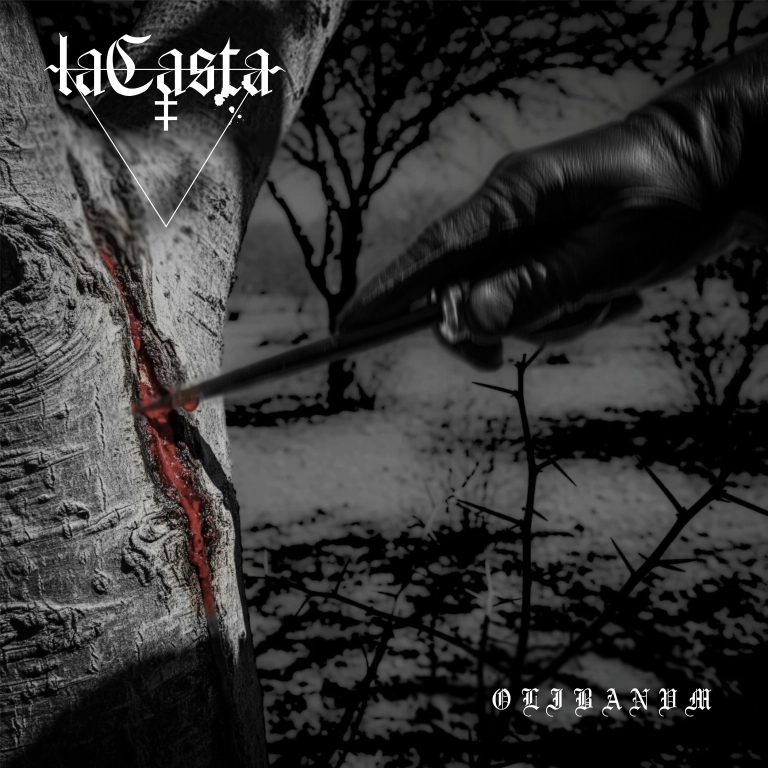
The concept of ‘Olibanvm’ revolves around incense extracted through deliberate wounds. At what point did that image become the emotional core of the album rather than just a lyrical motif?
It became the core when we realised it wasn’t simply describing the concept, but reflecting the way the music itself was forming. The idea of something precious emerging through violence began to mirror the compositional process: tension, rupture and the extraction of something essential from that fracture. At that point, it stopped being an illustration and became a structure.There’s a ritualistic quality running through the album, but it never feels mystical in a comforting sense. What attracts you to ritual as something violent or transformative rather than spiritual refuge?
Because ritual, in its origin, is never comfortable. It is a transition and transition is never neutral. It implies loss, force and change. We are drawn to ritual as a mechanism that transforms through pressure rather than offering protection from it.Black metal and crust both carry rawness, but very different emotional energies. What do those two genres allow each other to express inside laCasta that they couldn’t alone?
Black metal allows space, atmosphere and a sense of collapse that is not immediate. Crust brings urgency and direct physical impact. Together, they create a tension in which neither stasis nor pure aggression dominates. One expands time, the other compresses it.The symbolism of blood, gold, and incense runs throughout the album. Did you approach those images more historically, spiritually, or psychologically?
We never treated them as separate categories. Historically, they carry power, ritual and extraction. Spiritually, they relate to transcendence and control over death. Psychologically, they represent value produced through violence. All these layers coexist without hierarchy.There’s a relentless forward momentum to the material, but the album also knows when to slow into something almost oppressive. How important is restraint in music this aggressive?
Restraint is what gives aggression weight. Without it, intensity becomes flat. The slower or more suffocating sections are not decorative contrasts, but structural pressure points that make the faster moments necessary.Was there a moment during writing where the album became darker than you originally intended?
Not darker in a deliberate sense, but more uncompromising than expected. At a certain point, the material stops following intention and begins to reveal its own direction. We did not try to correct it.Compared to ‘In Æternvm’, what part of laCasta’s identity became sharper or more exposed on this record?
Physicality. This album is less atmospheric as distance and more direct in impact. The identity is less veiled and more exposed in its structural violence.How do you prevent extremity from becoming numbness when writing music built on intensity and abrasion?
By avoiding uniform intensity. If everything is extreme, nothing is. We aim to work through contrast, erosion and dynamics rather than constant escalation. The goal is impact, not saturation.There’s a strong sense of inevitability across the album, almost as if the songs are collapsing under their own weight. Was that atmosphere intentional from the start?
Yes, but not as a narrative concept. More as a structural instinct. The music was built to feel like it is moving toward collapse rather than resolution.The phrase “No compromise. No redemption.” feels less like a slogan and more like a worldview. Does that mentality shape the band creatively beyond the music itself?
It functions more as a filter than a statement. It shapes decisions in terms of coherence and direction, not ideology. It defines what is excluded as much as what is included.At this point, do you see laCasta more as an evolution of black metal, an evolution of hardcore, or something that no longer fully belongs to either world?
Neither exclusively. Both genres are part of the language, but the intention is not to evolve them. It is to operate within the intersection they create, without needing to resolve into a single identity. In this latest work, however, black metal is more dominant than hardcore: we like to define ourselves these days as crust black metal, a definition that feels more accurate to what we have become.Thank you for the space and for the questions; it has been a pleasure to go into detail on ‘OLIBANVM’. A greeting to everyone reading and to those who continue to follow our path.
-
“Of course it was a drug song. We were stoned when we wrote it!” The story of the psychedelic masterpiece inspired by John Coltrane, Ravi Shankar and a trans-Atlantic aeroplane flight
Eight Miles High was the single that should have launched The Byrds into the stratosphere. So why did it instead mark the precise moment when it all came crashing down? -
From Cream and Velvet Revolver to Them Crooked Vultures and Temple Of The Dog, these are the best supergroups in rock history
Some supergroups just aren’t worth the sum of their parts. These are the exceptions -
Muse Share Stratospheric New Track ‘Hexagons’
Muse have shared another song from their upcoming album ‘The Wow! Signal’, and it is space-age prog-rock at its most exploratory.

Titled ‘Hexagons’, it’s a vibrant, stratospheric expedition into the most technically bold and audaciously beautiful components of the band’s sound. From the noddling synths and bodacious guitars of the grand introduction, to Matt Bellamy’s wonderfully soaring vocal display, it’s the sort of creation that feels out of this world in more ways than one. Like staring into the great beyond, the vast openness of the unknown, with a sense of awe and wonder, it’s the perfect track to accompany the band on their current voyage across the universe.
Unapologetically Muse.
Have a listen below, and check out the stunning visuals that accompany it.
‘The Wow! Signal’ is set for release on June 26. It will also include the huge ‘Cryogen’ which sounds a lot like this:
The band are set to make their way across the US on a huge headline tour, with support coming Bloc Party, Portugal. The Man and The Temper Trap.
So it’s going to be very special, basically.
Here are all the dates that you need to know:
JULY
05 – ST. LOUIS Hollywood Casino Amphitheater * ~
07 – NOBLESVILLE Ruoff Music Center * ~
10 – TINLEY PARK Credit Union 1 Amphitheatre * ~
11 – CINCINATTI Riverbend Music Center * ~
13 – CLARKSTON Pine Knob Music Theatre * ~
15 – TORONTO RBC Amphitheatre * ~
18 – MANSFIELD Xfinity Center * ~
22 – HOLMDEL PNC Bank Arts Center * ~
24 – SARATOGA SPRINGS Albany Med Health System at SPAC * ~
25 – WANTAGH Northwell at Jones Beach Theater * ~
28 – COLUMBIA Merriweather Post Pavilion * ~
29 – CAMDEN Freedom Mortgage Pavilion * ~
AUGUST
10 – CHARLOTTE Truliant Amphitheater – ~
12 – ATLANTA Lakewood Amphitheatre – ~
14 – DALLAS Dos Equis Pavilion – ~
15 – AUSTIN Germania Insurance Amphitheater – ~
18 – GREENWOOD Fiddler’s Green Amphitheater – ~ +
20 – WEST VALLEY CITY Utah First Credit Union Amphitheatre – ~
22 – RIDGEFIELD Cascades Amphitheater – ~
23 – AUBURN White River Amphitheatre – ~
26 – WHEATLAND Toyota Amphitheatre – ~
27 – MOUNTAIN VIEW Shoreline Amphitheatre – ~
29 – CHULA VISTA North Island Credit Union Amphitheatre – ~
31 – LOS ANGELES Hollywood Bowl – ~
* support from Bloc Party
– support from Portugal. The Man
~ support from The Temper TrapThe post Muse Share Stratospheric New Track ‘Hexagons’ appeared first on Rock Sound.