Chopped Up come out of the gate swinging. If you like horror movie intros/outros, old school death and blood-spattered grindcore, you’ll dig deep into these dudes. Chopped The Fuck Up, is a really fun and gorey ride. I love the pace of the four track EP. It’s never self-indulgent or overly technical. Tracks all come in under 3:00 minutes which makes this one a great relisten. I’m a big fan of the combo pig squeals(used just the right amount) and the gag reflex triggering, gutteral vocals. My favorite track off this EP is Meat The Cleaver, which begins with a spasdic Ratamahatta-Max Cavalera style scat. I really respect the band’s take on the genre. This is one you can throw on and rock out to. No pretense and it doesn’t leave you feeling queasy.
****And before anyone says, “but you didn’t make mention of the band members who are well known Pro Wrestling veterans who’ve toured the world spilling their opponents (and their own) blood on mats around the world“. Yes Shlak(CZW, etc) and Dirty Daddy(ROH/NJPW) are prominent members of this band (and several others over the years). I give this a Dave “what’s his face” FIVE STARS. Happy? Now throw this on and frogsplash ya mother.
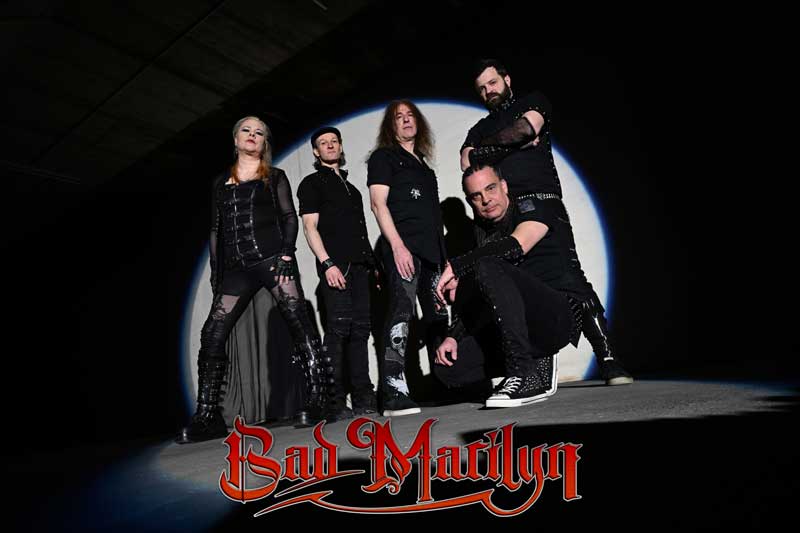
Swiss metallers BAD MARILYN have unveiled NITTE VALO (ex Battle Beast, Dreamtale) as their new lead singer. BAD MARILYN states: “We’re excited to announce to you our new singer for Bad Marilyn: Nitte Valo. You may know Nitte from her work with Battle Beast, Burning Point, After Infinity and Dreamtale where she is also currently singing. Now she is joining Bad Marilyn to delve into a new adventure of Metal Music.” NITTE VALO comments: “I am truly honored and excited to be joining BAD MARILYN. I […]
Here’s another album from 2025 that should have been high in my rankings:
OTU: YOU’LL GET THROUGH THIS
Now here’s one that I didn’t really miss; I bought it back in May, but didn’t really recognize how great it is until the new year. I liked it, but for whatever reason didn’t play it much. Recently I decided to revisit it, and realized what an absolute guitar legend Otu is on this album. All twelve tunes have their own distinct feel, but each of them is sneakily completely bad-ass. Here are two that might help get your attention, but all of them are worth your while if you like your music heavy.
Otu is a musical phenom, singlehandedly writing, playing and producing everything he puts out. Perhaps you’ve seen some of his “If _________ Wrote ________” tunes on YouTube; they are phenomenal. To say that he nails every artist he attempts to sound like is an understatement, and now I am just starting to appreciate his own original songwriting.
Here’s another album from 2025 that probably deserved top ten status:
SEEDY JEEZUS: DAMNED TO THE DEPTHS
This is another one I learned about by perusing The Obelisk’s top albums lists. I’ve become such a Tony Reed fan and was a bit embarrassed that I had not heard of this project, but so grateful to have found it now. This is an Australian band which had worked with Tony before, and he has now become an official member of the band. I frequently think of Pink Floyd when listening to this album, and I think it’s because of the clarity of the sound and the quality of the songwriting. Here are two of my favorites; see what you think:
The whole album is great, and rates a ten out of ten in my book.
A million thanks to my acquisition editor, Norm Hirschy, who guided me through the book proposal process back in 2023, and then offered to include my book in an open-access initiative.
Long-time readers of my work will recognize parts of Chapters 5, 8, 9, and 10, but they have all been updated and expanded with new material and ideas to match this book’s broader context and arguments about heaviness as a participatory experience, its origins within the blues, and how it shaped the emergence and evolution of metal.
Here’s a brief preview of what’s in the book:
Heaviness in Metal Music
Heaviness in metal music is not just a timbre or quality of sound—it’s an experience of impact that listeners help create. This book combines methodologies from musicology, music theory, cognitive science, and performance studies to define heaviness as a cross-sensory experience and aesthetic practice. Heaviness is shaped by what we do when we listen, how we think about metal music, and how we relate to the people who make and listen to it.
By studying the origins of heaviness, this book overturns common myths about metal’s history. Heaviness and the musical practices associated with it emerged from 1960s White audiences’ encounters with Black American music styles, especially the blues. Despite metal’s historical narrative of “leaving the blues behind,” many aspects of the genre perpetuate legacies of blues’s musical style and highly racialized reception—including headbanging, and metal’s ideologies and aesthetics of oppositional authenticity, loudness, heaviness, and extremity.
Musicians and listeners navigate their own way through this landscape of legacies, re-enacting the genre’s ideologies and musical structures through their own headbanging and moshing. When musicians use the most common drum patterns and song forms in metal, they perpetuate the genre’s norms and practices, but they also provide a framework for the creation and distinction of new metal styles and experiences. This book concludes with the argument that longstanding restrictions about who and what count as metal have recently begun to loosen, expanding the scope of what heaviness can mean, and to whom.
Table of Contents
PART I. WHAT IS HEAVINESS?
Introduction
1. Experiencing Heavy Timbres Through Metaphors: Buzzsaw Tone
2. Power Chords and the Basic Illusion of Heaviness: Hearing Something More Powerful Than Reality
3. Rock Is Dead, But Metal Will Live Forever: The Paradoxes of Metal’s Progressionism
PART II. WHERE DID HEAVINESS COME FROM?
4. Leaving the Blues Behind: The Racialized Origins of Metal and Its Progression Toward Heaviness
5. Headbanging as a Legacy of Black Dance
6. Angels and Demons: Hearing Gender and Heaviness in Metal’s Fantastical Vocals
PART III. HOW IS HEAVINESS CREATED AND WHAT DOES IT FEEL LIKE?
7. How Metallica Created Extreme Metal: Active Listening, Connoisseurship, and Cover Songs
8. Headbanging to Drum Patterns to Create Heaviness
9. How Song Forms Create Ritual Spaces for Experiencing Heaviness
10. Feeling Different Heavinesses in Different Song Forms and Subgenres
On February 6, 2026, I was honored to give a talk at the University of Iowa as part of their Musicology/Music Theory Colloquium series, hosted by Prof. Joshua Albrecht. I gave an hour-long lecture about the Swedish extreme metal band Meshuggah, consisting of material from my second book project, which I’m currently drafting.
My work on Meshuggah is building very directly on my first book, which is now available open-access through Oxford University Press!
Please feel free to reach out if you’d like to know more about this project! You can always find my contact information at my faculty bio page for my job at Occidental College.
Here’s a short description of my talk:
The Swedish extreme metal band Meshuggah has already been the subject of extensive music analysis research. My first intervention is to retheorize Meshuggah’s distinctive complex rhythms as “overlays,” a groove-based construction which repeats a short unit of odd length to create a rival accent pattern over 4/4—which has been previously studied in jazz, soul, and EDM by Pressing (2002), Cohn (2016), and Butler (2006). This retheorization connects existing Meshuggah research with numerous concepts to better explain the physical experiences that their rhythms create (groove and perceptual rivalry, cycles of release and relock, metrical displacement, etc.). My second intervention is to highlight Meshuggah’s connection to previous thrash/groove metal (which also frequently used overlay riffs), helping to explain their music’s brutal physicality in terms of new research on previous metal practices of heaviness, headbanging, etc. This reverses a trend in existing research which mostly highlights Meshuggah’s “deviance” from mainstream metal (Capuzzo 2018). Overlay analysis shows how even Meshuggah’s most complex, “mathematical” riffs emerge from recursive recombination of physical, groove-oriented riff techniques from previous metal. These two interventions connect analysis of Meshuggah’s music directly to ideas about groove and physicality from studies of African diaspora popular music traditions, troubling common assumptions about complexity, detachment, and race in popular music—and especially in the context of thrash metal, a genre which is often described as “leaving the blues behind” through increased complexity, detachment, and control (Pillsbury 2006). I end with broader thoughts about musical complexity: problematizing the association of certain kinds of complexity with whiteness or embodied detachment, questioning the status of complexity in music theory, and riffing on old questions about mind-body dualism.
If you’re interested, I’d be happy to share my slides and script! Feel free to email me to ask. You can always find my contact information at my faculty bio page for my job at Occidental College.
Here’s the official title and 350-word abstract for my talk, which I’m planning to write up as a chapter in my second book.
“Corpus of Chaos: Headbanging to Conventional Form Cues in Meshuggah’s Unconventional Songs”
Meshuggah’s extreme metal songs often have disorienting forms, which eschew conventional verse-chorus teleology (Nobile 2022), instead staging a progression of static sections, creating seemingly intractable expanses of time. And yet, their audiences all seem to know when to start moshing, and when their song forms are written down, their proportions often strongly resemble metal’s normative song form, compound AABA (Hudson 2021). How is it that song form which look so conventional on paper can feel so disorienting in listening?
To answer this question, I build on theories of metal drumming and song form—which often foreground affordances for physical participation. Traditional theories of pop song form focus on section types determined by lyrics (“verse,” “chorus,” etc.) but metal fans experience also experience form implicitly through embodied feeling and active motion, such as headbanging and moshing. Metal’s riff-based version of compound AABA structures this participatory listening by offering fans both specific formal cues, especially drum patterns (Kozak 2021; Garza 2021; Hudson 2022), and familiar patterns of song form that organize physical engagement, especially buildup intros, verse-chorus “energy cycles” (Pillsbury 2006), transforming or transporting bridges (Hudson 2023), half-time breakdowns (Gamble 2019), and vamps. In this way metal song forms create ritual spaces for heaviness, by implicitly choreographing participatory dance to create shared moments of physical impact (Hudson 2026, Chapter 9).
I use this conventional framework to analyze Meshuggah’s unconventional song forms, showing how they retain some familiar cues and patterns while also departing from these norms. Several of Meshuggah’s most well-known songs follow a pattern of two verse cycles followed by a bridge, with a guitar solo occurring roughly two-thirds of the way through the song’s duration—just like compound AABA (Example 1). However, most of Meshuggah’s songs do not have the conventional teleology of a quieter verse leading up to a louder chorus; instead they alternate, without a sense of directionality or hierarchy, between verses and what I call “pseudo-choruses.” I show how even Meshuggah’s most experimental songs often retain some conventional formal cues (especially drum pattern shifts and guitar solos) which guide listeners’ participatory movement, shaping shared experiences of heaviness.
Same old question: should we like bands like Unifaun that explicitly revive classic prog bands’ style? Well, the answer is simple to me: yes, if they know how to write good songs and to play them. This is the case with Swedish duo Unifaun, whose only album to date include some very good and very Genesis oriented songs. This Swedish duo includes singer and multi-instrumentalist Nad Sylvan of Steve Hackett live band fame and keyboardist Christian Thordin, AKA Bonamici.
Above: the dark original 2008 cover art. Below: the Genesis-oriented 2023 reissue painting.
Their self-titled album features many musical solutions related to the ex Charterhouse pupils, but with a distinctive nordic and slightly folk taste I appreciate. The track I choose here is a prog ballad full of dreamy passages and based on really good melodies. The overall effect is mostly similar to Genesis’ “Selling England by The Pound” era. Is this a good reason to despise such a song? I don’t think so, but let me know your opinions.
There’s something about music and cars – a match made in Heaven. As a teen cruising in my ride, a ’72 VW Beetle, back before digital media and streaming, I’d be listen to tunes mostly on the radio, beholden to the DJs and what they’d play. Rotating through my preset stations, usually WCCC, “The Rock”, WHCN, “The River” famous for album oriented rock, rock blocks, and double shots, and WPLR out of New Haven, I’d search for the best song in the moment. And now and then, I’d stumble upon a song that would instantly inspire a spontaneous right hand to the volume knob, spinning it clockwise to crank up the volume. So what better inspiration for a playlist than songs that made me, over the years, as Autograph wails in the refrain of their song, “turn up the radio.”
Obviously some band and albums inspire cranking up the volume, like Led Zeppelin, AC/DC, Guns N Roses, hair metal, etc. But I’m talking about individual songs that back before streaming, in the car or at home, would make you turn the radio up. They were songs you couldn’t get loud enough. Many were hard driving songs, but some were just amazing acoustically with the fullness of their sound, and others were songs you loved so much you wanted to just hear every little detail.
So here’s my list. I may have left a few off, and I included a few that weren’t ones I turned up back in the day, but are definitely now songs I want to turn up. For the most part I left out music since streaming began. These are mostly 70s and 80s, and some 90s songs. They aren’t necessarily my favorite songs by these artists, and many aren’t even my favorite artists. But they for whatever reason made me reach for that volume knob and turn up the radio.
For the most part I’ve only included one song per artist, with a few exceptions. Led Zeppelin blasts through the intro with “Immigrant Song”, as it did in the movie Thor – Ragnarok, such a great place to start.
But I had to also include one of my Zep faves “Good Times, Bad Times.” Van Halen’s Hot For Teacher” drums and guitar need that full volume sounds, as does “Ain’t Talkin’ ‘Bout Love.” And the haunting Sting “I want my MTV” intro then kicking into the Mark Knopfler guitar riff on his Les Paul in “Money For Nothing” needs to test the limits your amplifier and speakers. But the beauty of Knopfler’s acoustic guitar and vocals on “Romeo & Juliet” also need to be felt as well as heard. And Rush’s “Tom Sawyer” is perhaps my all time favorite song to crank up (check out how young the band looked back in the day).
The songs that truly reminisce about those rides in my kelly green bug, windows down (partly for comfort – no AC back then), in addition to the songs listed above are Boston’s “Long Time,” The Kinks’ “Do It Again,” Yes’ “Leave It,” Scorpions “Rock You Like A Hurricane,” Blue Oyster Cult’s “Don’t Fear The Reaper,” ZZ Top’s “La Grange,” Spencer Davis Group’s “Gimme Some Lovin’,” Steve Miller Band’s “Jungle Love,” Steely Dan’s “Hey Nineteen,” Human League’s “Fascination,” Eagles “Seven Bridges Road,” Spandau Ballet’s “True.” Instant turn the volume to “11” while riding in my car.
Eric Carmen’s “Make Me Lose Control” made the list not out of any desire to turn it up, but by virtue of its lyrics “turn the radio up”!
Jimmy Page (Yardbirds, Led Zeppelin, The Firm), The Edge (U2), and Jack White (The White Stripes) got together to turn up the volume in It Might Get Loud – definitely worth a watch.
While not making my playlist, songs like Elton John’s “Sixty Years On” live with the Melbourne Symphony Orchestra inspire turning up the volume to hear the beauty of every nuanced note:
While I think you’ll enjoy listening to my playlist, as I think it’s pretty great, remember they’re songs that made ME turn up the radio. My further intent and hope with this blog is to inspire you to make your own list of songs that make you want to immediately reach for that volume control (likely no longer a knob). Then, when listening, you can set the volume to “11” and listen to your whole list.
I had lots of fun doing this one, and love cranking it up in my car, though I do get a little embarrassed in parking lots or in my neighborhood, and feel obligated to turn it down a bit…
I hope that this music and my blog truly serve as a “revival: a new presentation of something old,” a springboard to return to the music of your youth, or perhaps to find artists you want to discover anew. Rediscover the passion of music in your life.
Live in the moment. Enjoy the moment. Love the moment. TURN UP THE MUSIC! Listen to the MUSIC!
New Orleans thrash metal veterans EXHORDER have announced a U.S. headlining run set to kick off later this month. The “Unforeseen Circumstances Tour 2026” winter trek launches January 29 in Lafayette, Louisiana and runs through February 22 in Hobart, Indiana. Support on select dates will come from LUICIDAL, RINGWORM, PHOBIA, and SLOWHOLE.
Commenting on the upcoming tour, vocalist Kyle Thomas said: “It’s about that time, y’all! 2026 is here, and we are back to work. Joining us will be the legends that are Luicidal, Ringworm, and Phobia! Up and comers Slowhole will also be on this tour for the entire run, and you do not want to miss them. Luicidal and Ringworm will be on select dates, so consider accordingly when you obtain your tickets. As always, we will be performing a little something from all four albums, so come on out and say hello!”
EXHORDER have also shared a live video of “The Tale Of Unsound Minds,” captured by Mike Holderbeast at the Fillmore in New Orleans last April, showcasing the band’s still-ferocious live attack in support of their latest album, Defectum Omnium.
Forged in 1986, EXHORDER’s career has been as influential as it has been turbulent. After a 27-year hiatus following their final Roadrunner Records release in 1992, the band returned in 2019 with Mourn The Southern Skies, widely hailed as one of metal’s strongest comeback albums. Despite lineup changes and setbacks caused by the pandemic, EXHORDER pushed forward and released Defectum Omnium in 2024. Produced by the band and mixed by Jens Bogren, the album marked a renewed focus on the savage roots that first defined EXHORDER’s sound.
At the time of the album’s release, BLABBERMOUTH.NET praised the record, writing that EXHORDER “still have the power to make metal folk disregard their own safety,” adding that Defectum Omnium “spits, it snarls, it has more killer riffs than seems strictly necessary.” Other outlets echoed the sentiment, cementing the album as one of the band’s strongest statements to date.
EXHORDER “Unforeseen Circumstances” Tour 2026:
Jan. 29 – Lafayette, LA – Freetown Boom Boom Room * Jan. 30 – McAllen, TX – Cine El Rey ** Jan. 31 – Austin, TX – The Lost Well ** Feb. 1 – Dallas, TX – Trees ** Feb. 2 – El Paso, TX – RockHouse ** Feb. 3 – Tucson, AZ – The Rock Feb. 4 – Santa Ana, CA – The Observatory Feb. 5 – Las Vegas, NV – The Dive Bar Feb. 6 – Ventura, CA – VMH Feb. 7 – San Diego, CA – Soda Bar Feb. 9 – Hollywood, CA – Whisky A Go Go Feb. 10 – San Francisco, CA – DNA Lounge Feb. 11 – Portland, OR – Dante’s Feb. 12 – Everett, WA – Tony V’s Feb. 13 – Tacoma, WA – Airport Tavern Feb. 14 – Boise, ID – The Shredder Feb. 15 – Salt Lake City, UT – Aces High Feb. 16 – Denver, CO – HQ Feb. 18 – Springfield, MO – The Regency ** Feb. 19 – Lombard, IL – WCSC *** Feb. 20 – Madison, WI – Annex *** Feb. 21 – Covington, KY – Madison Live *** Feb. 22 – Hobart, IN – Hobart Art Theater ***
* No LUICIDAL or PHOBIA ** No LUICIDAL *** RINGWORM, PHOBIA, SLOWHOLE

 The post


