Blog
-
MT. JOY
Mt. Joy, a new band from Los Angeles by way of Philly, is firmly based in rock but infuses their riffs with some seriously groovy soul. -
Spirit Adrift – Enlightened in Eternity
By Calen Henry.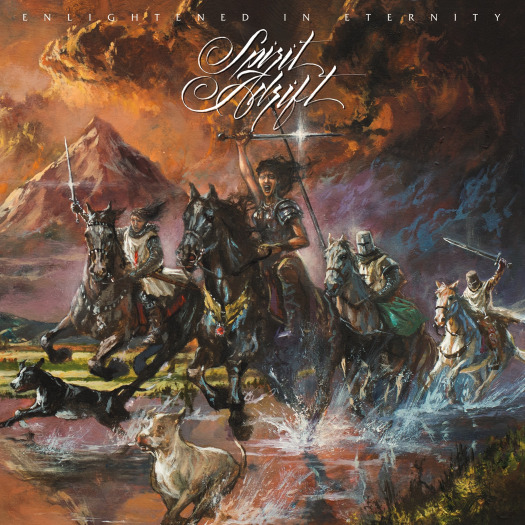 Artwork by Adam Burke.Despite being written in 2019 Spirit Adrift’s fourth album, Enlightened in Eternity, sounds inexorably linked to 2020. By splitting the difference between the somber doom metal of Chained to Oblivion and the righteous classic metal vibe of Divided by Darkness it comes off as hope battling through existential dread, exactly how 2020 has felt for many of us. It also sounds like Nate Garrett and Marcus Bryant simply had a blast recording it. Garrett has a gift for taking a collection of metal riffs and melding them into catchy, anthemic songs that straddle the line perfectly between classic metal and arena rock anthems.These new songs are more diverse than any single prior album. From the punky intro to “Cosmic Conquest” through the full speed metal banger “Harmony of the Spheres” to the dramatic trudging doom metal of closer “Reunited in the Void”. They lay the foundation for some genre hopping classic-metal worship that comes off as reverential, rather than hackneyed. Like with the songs themselves Garrett cherry picks whatever metal bit or piece he pleases and adds some delightfully out there touches from a late track key-change to spooky chains clanking. The lead work fits the feel of every song and twin guitar leads abound. Many of the parts have the air of familiarity from classic metal albums, but nothing (apart from that one riff in “Stronger than your Pain”) calls back to a specific band or album. It just feels right, like “comfort metal”.The choruses are as catchy as the riffs, but the lyrics dive a bit deeper than simply arena rock pizazz. A vein of hope runs through the album, but so does death and pain. The same dichotomy of downcast doom metal and triumphant classic metal that runs through the riffs permeates the lyrics. Many of the songs are about hope and triumph, but they’re often about hope through pain and darkness and death, and the strength to face them head on. So still pretty metal, but 2020 metal, not 1980 metal.2020 has been a crazy year and much of my music consumption has been revisiting favourites and discovering classics I’d missed in the metal pantheon so some new music completely fell off my radar Enlightened in Eternity almost did until Max asked me to cover it, and I’m glad he did. It’s exactly the metal album my 2020 needed.
-
Vigor Reconstruct: A Benefit For The Soroka Family
 Artwork by Calvin CushmanHere at Metal Bandcamp we have been fans of Markov Soroka’s many projects for years. Like Drown, Aureole, Krukh, and of course the mighty Tchornobog. This, though, is not a celebration of another new release from Markov, it’s a benefit compilation with a sad background:
Markov Soroka’s father suffered a severe heart attack earlier this summer and, though he survived, was left without a job nor insurance in the wake of such tumult. Now the Soroka family faces at least $66,000 in medical bills. It is our hope that this compilation, featuring some of the very best of the metal (and beyond) underground, will help ameliorate some of the financial woes which they face.
Musically there’s much to enjoy here (Mare Cognitum tearing through “Cosmic Keys to My Creations & Times”? Yes, please). The fantastic King’s X cover by Panopticon led me to rediscover a band I had forgotten all about (I’m currently deep down a King’s X Youtube rabbit hole). For another look back at good times, here’s a couple of candid Tchernobog merch actions shots from when they played (remember live music?) Kill-Town Death Fest last year:
 Tchornobog merch action at Kill-Town Death Fest 2019.Oh, one last thing. An important message from the compilation organizers:
We will also concurrently be running a raffle for the original hand-painted artwork by Calvin Cushman, as well as original artwork by Karmazid (Tchornobog logo et al). At $5 per ticket, you are welcome to purchase as many “tickets” as possible (Paypal the total amount as Friends and Family to sorokafamilybenefit@gmail.com) between 10/2 and 10/4 (at midnight PST), with the winners being announced 10/5. Global shipping will be covered by the artists.
-
Toadeater – Bit to ewigen daogen
By Justin C. Artwork by Drowned Orange.While discussing this album with a friend, an obvious question came up: What the hell is a toadeater? The interwebs provided the answer: “Originally, a charlatan’s helper who ate (or pretended to eat) poisonous toads so that his employer could display his prowess in expelling the poison.” So, an appropriately bleak moniker for a black metal band, with bonus points because they avoided using phrases like “necro” and “goat.”The band’s second full length, Bit to ewigen daogen, starts off with the standard mood-setting, instrumental opener. To be honest, I’ve gotten a bit tired of this widespread pattern, but I have to give kudos to the band here for melodically tying the intro into the first track, which is much better than the usual, formless fare found in these. From there, we’re off to the races with “Conquering the Throne,” which immediately sets the band apart from a sea of melodic black metal. The song somehow manages to straddle the line between thin and frosty and a meatier, fuller sound. The driving energy reminds me of late-period Woe, with a punk-like aggression. The lyrics come barked out, syllable by syllable, directly on the beat while a guitar plays a chiming line above. It’s not long before the band breaks to a different direction, opening up to an airier sound while the drums and (audible) bass plow on. It’s a barn-burner of a track that maintains the momentum while giving space to compelling melodic lines.“Crows and Sparrows” covers similar territory, but adding in some far-off, clean sing-chanting that actually manages to not sound trite or cheesy. “Returning the Crown” does a similar trick–it keeps the band’s core sound and energy, but also mixes in some influences that remind me of The Cure or Depeche Mode. That gothic/new wave-y sound wouldn’t necessarily be up my alley, but the band absorbs and incorporates it in an organic way that somehow makes those sounds seem like a natural fit in with the maelstrom.The album comes in a little on the short side for this genre–just 36 minutes and change–but the upside is that the band doesn’t wear out their welcome. Without the lyrics, I can’t say if the band is pro- or anti-toad eating, but regardless of your own predilections, you should give this album a spin with whatever snack you prefer.
-
Lares – Towards Nothingness
By Ulla Roschat. Artwork by Mariusz Lewandowski.Towards Nothingness is the sophomore album of the four piece German Berlin based band Lares. The band founded in 2015 and this album follows up their first EP Mask of Discomfort from 2017. Towards Nothingness is 8 songs and about 36 minutes of Blackened Psychedelic Sludge/Doom, and it’s also an apocalyptic space trip.The album starts with the track “It Burns” and yes it burns like the rocket that shoots you into space and into unknown realms, fueled by driving, hypnotic rhythms. A distorted, psychic buzz that keeps you trippin, and soaring harsh vocals with blackened ferocity. There are also a few moments on the album that create a sense of contemplative floating, like in the second track “Theiaphobic Ansia”, but they never feel like a soothing weightlessness or moments of serenity. With a sound damp and blurred with distortion and electronic effects they rather create an atmosphere of depressive bleakness and disorientation.And these first two tracks are a perfect introduction to the album. They showcase the album’s basic and omnipresent atmospheres.Yet each song has its own moods and defining elements that make them memorable. There’s the urgency of the ferocious vocals in “Cursed With Embodiment”, the somber, gloomy doom riffs and huge build up of “SN1987A Space Alteration Machine”, the loud-quiet dynamics and glorious propelling drumming in “Grey Haze” that keep spiraling deeper and deeper into the unknown. The dark and brooding ambience of “Oumuamua”, the gooey, bluesy riffs and the spacious sound of “Catacomb Eyes”, and, eventually, the droney, almost formless waves of noise of “Towards Nothingness”, that let you know you’ve reached your destination.This variety of nuances weaves a thick, expanding texture into the entire album and adds to its dramatic structure with waves of tension building the all encompassing structure. The highest peak of these waves is no doubt “SN1987A Space Alteration Machine”. This is the longest track of the album (9:21) and Lares don’t waste one second of it. Here they set space truly ablaze like a supernova with a sweeping, carefully layered build up creating a sublime, intense and monolithic atmosphere.It’s Lares’ ability to combine the fierceness of Black Metal, the abrasive filth of Sludge, the entrancing grip of Psychedelia, the gloomy heaviness of Doom and the thrilling dynamics of Post Metal in an exciting way, that makes Towards Nothingness an organic, cohesive unity and an extremely rewarding listening experience. And to make the sense of completeness even “completer”, once again, Mariusz Lewandowski perfectly captures the soul of the music with his cover artwork (like so many times before for Abigail Williams, Astral Altar, Bell Witch, Elder Druid, Eremit, Jupiterian… just to name a few). So I am hoping for a vinyl edition of Towards Nothingness, not only, but also, because of this great artwork.
-
Ars Magna Umbrae – Apotheosis
By Bryan Camphire. Artwork by DhomthThe Great Art of Shadows. This is one possible translation of Ars Magna Umbrae. This Latin name may not easily roll off the tongue, but no matter. Listening to this music, it’s clear that the artist who created it is not interested in easy pleasures. The Great Art of Shadows could hardly be a more evocative and mysterious moniker. Apotheosis, the band’s third release, is also a fitting title as it is indeed a high point in the development of this compelling and carefully crafted body of work.
Ars Magna Umbrae is a one person black metal entity hailing from Poland. The band’s previous release, Lunar Ascension, caught my attention as it was released by the venerable I, Voidhanger Records, an unmatched tastemaker dealing in present-day outer reaches of music. What shocked me about this artist then–and continues to do so now–is the uniqueness of the voice. There is a sophistication in the sense of melody and composition that becomes instantly recognizable and sounds like no other.The high level of talent on display in the music of Ars Magna Umbrae is unmistakable. I’m of the opinion that heavy metal music is a realm toward which musical savants gravitate who would have, in former times, gravitated toward classical composition. Nowadays, composing classical music is no more likely to pay the bills than metal. Metal music affords unique opportunities for emotional expression. Black metal can be seen as an especially emotive sub-genre, one that venerates individuality and poise. Describing how imperative it was for black metal bands to be unique in the genre’s early formative years, Garm, aka Kristoffer Rygg, of Ulver put it thusly,“I think in those days that was a major criterion; to be a force to be counted on in the scene, you had to create your own thing. This latter-day perception that true black metal only sounds like Darkthrone is just fucking silly, it’s a lot of distortion on the original idea, which included stuff like Mercyful Fate, for crying out loud. The charisma of the music was really paramount.”
Going into detail about the singularity of the music on Apotheosis, there are passages to be found within this release that are nothing short of jaw-dropping. One such moment arrives as the second riff on the second song, “She Who Splits The Earth”. A woozy 4/4 rhythm is stomped out as the guitars glissando up and down the fretboard with uncanny precision. The off-kilter feel is accomplished by the guitar cramming more notes into the phrase than seem to want to fit, almost as though it’s transposing some odd-metered tabla phrase into an otherwise aggressively head-banging riff. I feel like I’d have to hear it slowed down to even begin to make sense of it, yet it’s this smearing of my perception that makes the riff so intoxicating.Other Apotheosis highlights include: The wet gurgling vocals in the lumbering end section of “Mare Tenebrarum” (The Dark Sea), evocative of a pyroclastic flow belching skyward and scorching everything on which it lands. The asymmetrical opening section in “Of Divine Divergence” giving way to a sharp-taloned riff that shreds the listener to ribbons, ending in yet another inter-dimensional guitar glissando. The dueling guitars in the mid section of “Oracle of Luminous Dark”–one of which is played by G.G. of Cosmic Putrefaction–sounding like they’re acting out the scene depicted on the cover art for Dawn of Possession.Apotheosis ends with a number called, “Ignis in Tenebris” (Fire in the Dark). It starts off sounding like the amp was just turned on mid-phrase, as though the song was already unfolding before we arrived to witness it. It builds steadily ablaze with the energy of an all-encompassing darkness. Some time later, as the spell and the album is extinguished, the guitar mimics the dying sounds of smoldering flickering tongues.Ars Magna Umbrae is a force to be counted on. Apotheosis is their grand gesture. It’s a record of sweeping vision and charisma. -
Bull Elephant – Created From Death
By Calen Henry. Anonymous UK collective Bull Elephant’s sophomore album picks up where the debut left off and this time the band are less cagey about the subject matter, giving a pretty clear overview of Created From Death‘s narrative.The album’s eight songs switch between the story of the eponymous Bull Elephant, now in human form, and the build up of tensions during World War II, both on conventional and unconventional fronts. The Cult of the Black Sun, self-professed descendants of a corrupted god, seek to re-enlist the bodies buried in mass graves as an unending undead army. To combat such unholy creations the creature goes “from beast to human to beast again“. From reborn human flesh, the essence of the creature known as Bull Elephant is transferred into the form of a great whale, and on that note the album ominously ends. They’ll have to go far to top Mastodon’s Leviathan for “battle whale concept album” but I’ll definitely be along for the ride.Just as the the story for Created from Death is a bit more succinct than Bull Elephant so is the music. This time around the band digs deeper into groovy doom-sludge, leaning more on the melodic “almost-a-scream” style of vocals and keeping the really heavy and really atmospheric sections for key story moments. The change makes for a more cohesive album than Bull Elephant. Created From Death flows better, has deeper grooves, and more memorable riffs but owes a great deal to the debut. The sequel wouldn’t work without the set up from the first album. Bull Elephant introduced the whole mythos, where Created From Death gets to dive right into the next chapter.The ridiculous multi-album concept (there’s clearly going to be at least one more part) may not be for everyone, but Bull Elephant deliver the goods, both in riffs and concept. Sign me up for album no. 3.
-
Mesarthim – The Degenerate Era
By Calen Henry.

The meta is extremely consistent for Mesarthim albums. A new one drops with no warning, giving no information, with a title referencing an esoteric cosmic concept. It always musically iterates on the last album but remains extremely divisive in the metal community and it always gets a nice dynamic master. The Degenerate Era is no different. It’s the band’s space trance metal at its finest and this time the cosmic concept refers to the cosmic era after the current one, when protons will decay leaving nothing but black holes, presumably what is shown in the album art.
Despite being the opener, the three part “Laniakea” is the album’s centerpiece. The title refers to the Laniakea supercluster of galaxies, of which the Milky Way is part. The movements refer to the Great Attractor, the central gravitational point in the supercluster, the Zone of Avoidance, the portion of the cluster that is obscured from view from earth, and Dark Energy that is hypothesized to ultimately tear apart the Laniakea supercluster.
Underneath these cosmic trappings The Degenerate Era continues the shift towards more epic lead-guitar driven songs that started on Ghost Condensate while also harkening back to the more symphonic sound of .- -... ... . -. -.-. .(Absence). Track length also splits the difference between those two albums with one 14 minute suite and four tracks ranging in length from four to almost nine minutes. Though the shift and references back through the band’s catalog are almost seamless, there are a few transitions on The Degenerate Era that seem to lean to far on stop time, with just a fraction of a second too much space before the next passage begins, something I didn’t hear on any prior releases. It can’t hold back the album’s epic heights, though, with great riffs and leads and the return of pick slides giving it a weird, but great, space punk edge.
Though it’s impossible to discern the actual lyrics for a Mesarthim album, there’s clearly a cohesive concept. From the album title through the “Laniakea” suite to the album closer “618” (a reference to one of the largest known supermassive black holes) complete with a Morse code message spelling out “Planet Nine Located”, there are mysteries yet to discover in The Degenerate Era and the dynamic master (DR 12) makes repeated listens a joy.
-
Vassafor – To The Death
By Bryan Camphire.

To the Death is Vassafor’s grand statement to glorify Satan and all that is evil through music. The album – the band’s third studio recording – is a high watermark in uncompromising black metal being released today. You’d be hard pressed to find music that sounds this aggressively malignant produced by guitar, bass, drums and voice.
Vassafor achieves this apex of malevolence by a raw, loose-limbed performance that is sharp, forceful and urgent. The live sound they have captured spews forth at a rolling boil, yet still contains ample nuance beneath the surface. The riffs knock the listener into a trance-like stupor and then they just keep coming. More than half the tracks clock in at close to or well past ten minutes, altogether amounting to over an hour of extreme relentlessness.
By some sleight of hand and a lot of attention to detail, every time the listener is lulled into thinking they know what to expect, Vassafor break out with some strange secret ingredient that keeps each song in a perpetual state of transformation. To the Death unfurls itself like a powerful explosion belching flames aimed the heavens: a colossal spectacle of blasphemy.
The title track comes first, and it’s a definite highlight. Three minutes of dirge at the beginning make way for some truly bizarre guitar harmonics that bludgeon the listener into submission just as the blasting begins and the tempo takes off. It’s a raucous gallop from there, chock full of wild twists and turns along the way. Here’s a demonic fast-picked arpeggio, there a stomach churning dive bomb, next without warning come some witchy cackling chants. Hard panned wraith-like whispers whirl across the sound field to dizzying effect. Finally, at eleven of its twelve minutes, the track climaxes in seemingly the weirdest way possible: with a bass solo. This writhing busy twisted bass passage somehow sounds like the song’s very entrails are unspooling into your lap, all noxious and inky black.
Raise the volume and you begin to notice all sorts of hidden strangeness. Track three, “Eyrie” – the title of which may refer to the nest of a bird of prey – features a melting solo thirty seconds in that smears two sections together like a space-time rip. This dimensional bleed-through motif returns six and a half minutes into the song, once again smudging your perception yet sticking with you like so much shrapnel after a blast. At eight and a half minutes, monastic chants creep in low and slow in the mix and last less than ten seconds, like phantoms stealing their way through your subconsciousness. Did they ever really exit anywhere, or have they been sneaking in and out all along? Turn it up and try to find them again.
Vassafor’s lead songwriter, VK, is a noteworthy sound engineer, who’s worked with heaps of underground bands of the darkest caliber. This skill set and experience imbues Vassafor’s sound world with its own distinct atmosphere, enveloping the listener in a bewildering shroud of hate. To the Death charts a course deep into the darkest realms of black metal, one with plenty of left turns in its gnarled twisted paths.
-
J.S. ONDARA
The influence of Dylan on Ondara is readily apparent, what with his pointed acoustic stylings, harmonica rack and resplendent fedoras.