“Blackened Mold Marrow”, the second glimpse into Aversio Humanitatis‘ upcoming long player To Become The Endless Static, has surfaced online in the form of a video clip made by Alex Moréan.
Read more…
Blog
-
Heart – a Premiere from Charlie Marie
Photo credit Courtney Denelle Rhode Island doesn’t typically come to mind as country music country, but Charlie Marie has never needed geography on her side. Her voice does the work — warm, commanding, and woven from the same thread as Kitty Wells, Tammy Wynette, and Emmylou Harris. After her last album in 2021, she did […] -
Grabunhold – Releasing Second Full Length In June
German black metallers Frostheim have set June 5th, 2026 as the official international release date of their sophomore record, Grabunhold. To taste a first piece of the new music, give a spin to the track “Grambergs Fluch”.
Read more… -
THINGS YOU MAY HAVE MISSED (BUT SHOULDN’T)
(Andy Synn presents another round-up of cool stuff you may have missed last month) A couple of days ago I promised you a second one of these “Things You May Have Missed” articles… and here it is. Of course, even with double the usual number of bands to cover I’ve still barely scratched the surface […]
The post THINGS YOU MAY HAVE MISSED (BUT SHOULDN’T) appeared first on NO CLEAN SINGING.
-
Ghost Discography: Every Album Ranked

Six studio albums. Five Papas. Fifteen years between a Swedish basement project and a No. 1 record on the Billboard 200. Ghost’s discography is one of the strangest success stories in modern heavy music — a band that has never made the same album twice, fronted by a rotating cast of anti-popes who are all the same guy. We’ve ranked every Ghost album from worst to best, and fair warning: the record that gave them their biggest chart week isn’t the one at the top.
The whole thing is one long con, and it’s magnificent
Here’s what makes ranking Ghost different from ranking anyone else.
Tobias Forge doesn’t write albums. He writes chapters. Each record gets a new Papa, a new visual language, a new set of themes, and a wholesale sonic reinvention — and the audience is expected to follow him from occult doom to disco-metal to Def Leppard worship without complaint.
The mad part is that it works. Every single time.
So this isn’t a ranking of six records by one band. It’s a ranking of six completely different bands who happen to share a songwriter, a set of robes, and a group of instrumentalists nobody has ever officially identified.
Let’s get into it.
6. Infestissumam (2013)

Somebody has to be last, and the sophomore record draws the short straw.
Coming off an underground explosion, Ghost signed to a major, got a real budget, and immediately made their weirdest album. Infestissumam is psychedelic, theatrical, and genuinely ambitious — a carnival record with Gregorian chants and a title nobody could pronounce.
It also sounds thin. That’s the problem. “Year Zero” and “Monstrance Clock” are stone-cold Ghost classics, and “Ghuleh / Zombie Queen” is a seven-minute swing for the fences. But the production never quite matches the size of the ideas, and the album sits awkwardly between the basement and the arena — too polished to be a doom record, not big enough to be a rock one.
It’s the sound of a band figuring out how to scale. Essential to the story, last on the list.
Key tracks: “Year Zero,” “Secular Haze,” “Per Aspera ad Inferi” Papa at the helm: Papa Emeritus II The vibe: Carnival of souls / 60s psych-rock
5. Opus Eponymous (2010)

The Big Bang, and it holds up better than most debuts have any right to.
Opus Eponymous is lean, mean and mysterious — a 34-minute slab of 70s occult rock that sounded like a vinyl someone dug out of a haunted attic. “Ritual” is still one of the catchiest things Forge has ever written. “Elizabeth” pummels. “Stand By Him” was reportedly the first Ghost song ever written, and it already had the whole formula in it: Satanic lyrics, impossible hooks, played completely straight.
Why it’s at five: the songwriting scope expanded so far on later records that the debut can’t compete on sheer craft. The back third drags. The production is deliberately primitive.
None of which stops it being the purest distillation of what this band was before anyone knew what it would become.
Key tracks: “Ritual,” “Elizabeth,” “Stand By Him” Papa at the helm: Papa Emeritus I The vibe: Blue Öyster Cult / Black Sabbath / analog warmth
4. Prequelle (2018)

This is the one that broke them, and it’s the most divisive record they’ve made.
Prequelle is a plague album — Black Death themes, medieval imagery, a whole meditation on mortality — and it arrived fronted by Cardinal Copia, the charismatic rodent who wasn’t technically a Papa at all. It’s also the record where Forge went all-in on 80s arena rock and synth-pop, and lost a chunk of the Opus Eponymous faithful in the process.
Their loss. “Rats” is a monster. “Dance Macabre” is disco-metal that has no business being as good as it is. “Faith” is the heaviest thing on the album by a mile, and “Helvetesfönster” is a genuinely progressive instrumental that most bands wouldn’t dare put on a commercial record.
Two years after it came out, the world got an actual plague. Nobody’s ever fully explained that.
Key tracks: “Rats,” “Dance Macabre,” “Faith” Papa at the helm: Cardinal Copia The vibe: 80s arena rock / synth-pop / medieval plague
3. Impera (2022)

Maximalism, executed perfectly.
If Prequelle opened the arena door, Impera kicked it off the hinges. This is Ghost at their most enormous — immaculate production, stadium-sized choruses, and guitar work more intricate than anything else in the catalogue. Thematically it’s about the rise and fall of empires, which gave Forge licence to write about hubris, cults and collapse without ever getting preachy.
“Kaisarion” opens the record like a cannon. “Spillways” is a perfect pop-rock song wearing a Satanic hat. “Call Me Little Sunshine” is the best single they’ve released this decade, and “Hunter’s Moon” still detonates live.
It only misses the podium’s top two because it’s slightly too clean. There’s a sense of a band operating at total technical command without much left to prove — which is impressive, and a fraction less thrilling than a band still reaching.
This was also the end of an era. Papa Emeritus IV played his final show not long after.
Key tracks: “Spillways,” “Call Me Little Sunshine,” “Hunter’s Moon” Papa at the helm: Papa Emeritus IV The vibe: Stadium rock glory / neo-classical / industrial
2. Skeletá (2025)

The biggest commercial moment of their career, and the most emotionally exposed record they’ve made.
Skeletá debuted at No. 1 on the Billboard 200 — a Swedish occult rock band with an anonymous lineup, outselling everything else in America that week. And the album that did it is inward-looking, melancholy, and largely about guilt, faith and identity rather than empires or plagues.
Papa V Perpetua took over for this cycle, with a half-face mask instead of the full prosthetic, which tells you something about how much closer Forge was willing to get to the surface here.
“Satanized” is an absolute rocket — 80s hard rock, enormous chorus, the most fun single they’ve cut in years. “Lachryma” reaches an emotional depth nothing since “He Is” has touched. And “Peacefield” opens the record with a deliberate note of hope before everything goes sideways, which Forge has said was entirely intentional.
The Skeletour era got its own IMAX concert film, because of course it did.
It’s a bold, mature record and the second-best thing they’ve ever done. One album still beats it.
Key tracks: “Satanized,” “Lachryma,” “Peacefield” Papa at the helm: Papa V Perpetua The vibe: Melancholic arena rock / introspective doom
1. Meliora (2015)

The magnum opus. It isn’t close.
Meliora is the moment every piece of the Ghost machine locked together at once — heavy enough for the metal crowd, catchy enough for radio, theatrical enough to justify the robes, and produced with a clarity the first two records never got near. Papa Emeritus III was the most charismatic version of the character. The art-deco, futurist visual world was the most fully realised. And the songs are simply the best set Forge has ever assembled.
“Cirice” won the Grammy and deserved it — that slow-burn build into the chorus is the single most effective thing in the catalogue. “From The Pinnacle To The Pit” grooves on a bassline that sounds genuinely dangerous. “He Is” is the most beautiful song this band has written, and it’s about the devil.
There is no filler. Not a second of it. Every other Ghost record has at least one track you skip; Meliora doesn’t.
Ten years on, it’s not just their best album. It’s one of the best metal albums of the century.
Key tracks: “Cirice,” “He Is,” “From The Pinnacle To The Pit” Papa at the helm: Papa Emeritus III The vibe: Art deco / futurist / progressive metal
The full Ghost discography, ranked
6. Infestissumam (2013)
5. Opus Eponymous (2010)
4. Prequelle (2018)
3. Impera (2022)
2. Skeletá (2025)
1. Meliora (2015)Ghost albums in release order
Opus Eponymous — October 2010
Infestissumam — April 2013
Meliora — August 2015
Prequelle — June 2018
Impera — March 2022
Skeletá — April 2025
TL;DR
- Six studio albums across fifteen years, all masterminded by Tobias Forge, the band’s only continuous member.
- Best: Meliora (2015) — Grammy-winning, zero filler, the moment everything clicked.
- Worst: Infestissumam (2013) — great songs, thin production, a band caught between the basement and the arena.
- Biggest commercially: Skeletá (2025) debuted at No. 1 on the Billboard 200, but lands at No. 2 here.
- Five Papas: Emeritus I, II, III, Cardinal Copia (later Emeritus IV), and Papa V Perpetua — all played by Forge, whose identity wasn’t publicly confirmed until a 2017 royalty lawsuit.
- The pattern: every album is a full reinvention — occult doom, psychedelia, progressive metal, synth-pop, stadium rock, introspective arena rock.
FAQ
What is the best Ghost album?
Meliora (2015). It’s the record where Ghost’s heavy metal roots, pop instincts and theatrical ambition finally locked together with no compromise, and it produced the Grammy-winning “Cirice.” Fronted by Papa Emeritus III, it contains no filler and remains the benchmark every subsequent Ghost album has been measured against.
How many albums does Ghost have?
Six studio albums: Opus Eponymous (2010), Infestissumam (2013), Meliora (2015), Prequelle (2018), Impera (2022) and Skeletá (2025). The band has also released several EPs, including If You Have Ghost (2013), Popestar (2016) and Phantomime (2023), plus live albums and the concert film material from the Skeletour era.
What is the newest Ghost album?
Skeletá, released on April 25, 2025. It debuted at No. 1 on the Billboard 200 — the band’s highest-charting album to date — and marked the arrival of Papa V Perpetua as frontman.
Who is the singer of Ghost?
Tobias Forge, a Swedish musician who has fronted the band since forming it in 2006. He performs under a succession of characters — Papa Emeritus I, II and III, Cardinal Copia (later Papa Emeritus IV), and currently Papa V Perpetua. His identity was only publicly confirmed in 2017 following a royalty lawsuit brought by former members. The instrumentalists, the Nameless Ghouls, remain anonymous.
What order should I listen to Ghost albums in?
Chronologically, if you want the story — the lore runs continuously across all six records and the Papa transitions only make sense in sequence. If you’re starting cold and want the best entry point, begin with Meliora, then Impera, then work outward in both directions.
Six albums, five Papas, and one Grammy-winning masterpiece that still hasn’t been topped. Think we got Skeletá wrong, or is Meliora untouchable? Settle it in the comments. And keep it locked on the Loaded Radio stream — follow Loaded Radio for daily rock and metal news.
The post Ghost Discography: Every Album Ranked appeared first on Loaded Radio.
-
Finnish extreme metal band SAASTA’s final single from the upcoming album – Not just a song but self-destruction on the altar of ambition
Finnish extreme metal band Saasta has released the final single from their upcoming album “Cesspool” to be released on May 8th. “The Coffin” dives into the rotten core of burning out: self-loathing, feelings of inadequacy, and those deep, unspoken roots that force us to sacrifice everything to achieve nothing. This is not just a song but self-destruction on the altar of […] -
Turnstile’s Statement After Ex-Member Hits Singer’s Dad With Car
Ebert has been charged with attempted second degree murder and first degree assault. Continue reading… -
Portuguese symphonic death metal band GODIVA present “Black Mirror (Live with Orchestra at Vagos Metal Fest)”, the final video of the Hubris era. Out now!
Filmed during their monumental performance at Vagos Metal Fest alongside The Purgatory Orchestra, this special performance captures one of the most ambitious moments in the band’s history, merging crushing metal with powerful orchestral arrangements in a dark and cinematic live experience. The concert served as a special preview of the Hubris album before the pandemic, […] -
FakeYou – “Promise to Disappear”
Montreal punk four-piece FakeYou are set to release their debut full-length album Promise to Disappear Friday, April 3, on Atlanta-based 59 X Records. Playing on the concept of a “promise to appear”, that formal obligation to show up when summoned, Promise to Disappear explores various forms of disappearance as a means of survival in a world of increasing conformity and homogeneity, whether manifesting as fractured identity, negation of self, or a slow descent into less-than-ideal coping mechanisms. Melding the fuzzy grit of grunge and emo with the zeal of pop-punk and the clever sophistications of alt rock, the punk quartet has created an album that, layered under vocalist Guillaume Menard’s throaty vocals, emerges as a heavy, sincere and ultimately, deeply recognizable treatise on who we are and who we are allowed to be. Powerful, organic and encompassing as any instant classic, Promise to Disappear is one of this year’s standout releases from a band that are quickly becoming ones to watch.
The record settles comfortably into itself with gauzy, mellow opener “Wanderlost”, under hazy layers of guitar propelled by a rolling beat. Caught between disillusionment and alienation, the journeys we embark on as we begin to wander off the path of convention will force us to consider how– and if – we want to be seen.
From there, we are led across the album’s ten tracks through a labyrinthine funhouse of feelings as the band sorts through the myriad manifestations of confusion and pain. Time slows on lead single “Tieluck”, an amber-trapped study of the only holdover in a small town quietly slipping into obsolescence, and spins twilight into an endless day on the breathless, lurching “100 Million Sheep”, rhythmic switches mirroring the uneasy cadence of being tugged in and out of a half-sleep. When it all becomes too much to bear, vanishing acts take the form of refuge in addiction on the beautifully harmonious and deceptively upbeat “Solace”, quick comforts for the desperate and lonely that take a dark and poisonous turn. Our emotional wreckage eventually washes up on the shoes of the jeering, semitonal “Like Helium Balloons”, stripped down to a shouting chorus taunting the listener for having been abandoned by their better angels in a pointless quest for the truth.

We are not always the sole architects of our own misery, however, as Promise to Disappear evokes in equal measure the ways in which love and loss reshape us, leaning into percussive elements that invoke a somatic response. Steeped in the sticky syrup of wistful reminiscence, “Faded Scarf” recalls once-cherished memories now wallowed in, a thumping bassline pulsing like a heartbeat under a heavy wall of slow, driving sound. Every drumbeat is like a blow to the chest on “All About You’s” vast and anthemic bridge, echoing the singular enormity of losing someone who came to define your existence. Who we are when these things fade away is a conversation we never quite seem ready to have.
Even the record’s more uplifting songs are tinged with melancholy, though no less with meaning. For those suffering the acute pains of heartbreak or burdened by the heavy impress of despair, there is the soft, emo-infused “Midnight Sun”, a gentle reminder that those less-than-ideal moments that make the nights feel endless are not everlasting. Disappearance can be graceful, it seems, when we are allowed to drop the exhausting pretense of perfection and settle a little bit more into who we really are.
Extensive meditations on love, loss and life tend to serve as fertile ground for existentialism, and it all finally comes to a head on the rollicking pop-punk “Spitshine”, from its jaunty opening bass lick through to the throat-ripping chorus outro: the song’s final moments find Menard’s control wrested away from him by his howling alter ego, whatever sensible opinion that might have been had on the meaning of life ultimately giving way to the sweet release of no longer caring at all. It certainly is no antidote, but as we have learned, we tend to take our comforts in whatever form they come.
On an album whose relentless pursuit of authenticity leaves us with more questions than answers, closing track “Following Protocol” serves as something of its thesis, a bitter final reflection on the lonely realization that a life spent doing as you’re told has yielded little reward. The slow-simmering track steadily builds to a colossally powerful outro, a cathartic tidal wave of feeling that crashes furiously down before receding quietly back into the sea. We are, ultimately, no less lost than when we started. But we might be more equipped to weather what comes.
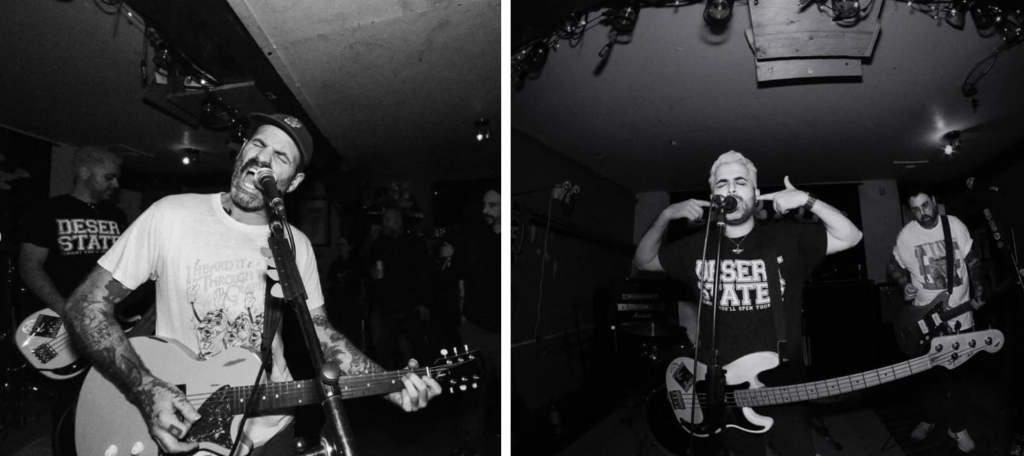
Each song on Promise to Disappear pulls in a different way at the fabric of what it means to be human, unravelling the threads of personal experience and spinning them into familiar shapes. Love and loss, anger and confusion, the cruel distortions of time, the pains of separation: Promise to Disappear takes the intemporal, intangible, constantly shifting agitation of being alive and weaves it into a common and shareable language that permeates the boundaries of our individual selves, recounting the exhaustion of our endless negotiation with life in a vocabulary common to us all. Menard’s rhythm and LeBrun’s lead guitars twist and wind around each other in an intricate lattice of harmonies and countermelodies that layer over bassist Jay Changizi’s deft and melodious basslines to create a sound that is stunningly lush and deep, the perfect backdrop for Menard’s keen and incisive lyrics. The alternation of heavy riffs with sparse, porous bridges creates a pulse that radiates through the album like a living organism. What results is an record whose bracing depth and vulnerability are its most enduring assets.
From scene veterans with an uncompromising dedication to their craft comes a meticulously crafted and dazzlingly executed debut record. Be sure to head over to the group’s Bandcamp to stream Promise to Disappear or snag a copy of it on gorgeous butter-yellow vinyl. If you’re lucky enough to have a foot in the door of Montreal’s thriving underground, you can catch one of their electric live performances here and in the surrounding neighbourhoods throughout the spring and summer.
-
Deathbird Earth Explores Galaxies Like Ghosts on “Objective Consciousness” (Album Premiere)
The Philadelphia duo Deathbird Earth have drawn descriptions of being a modernized Hawkwind, but they’re more the torrential Hawkwind of a dying planet. Though this central duo was always orbiting around each other in prior bands such as Hulk Smash, Dialer, Psychic Teens, and Ghloas, Deathbird Earth is their first expression of a hellish resource rapture in métallique. They take their first steps into it on their debut album, Objective Consciousness, on April 3, but we’re premiering it a day early. Check it out below.
…
…
Objective Consciousness is a sci-fi soundscape for those who want more gravitas and can tolerate a little anxiety. “Take My Blood” and “Christchurch 281” open with the orbital sonic vertigo and the record’s doomed lyrical concerns. There is no way up, no way down, and the pressure of the bass and drums tells there is no reason to turn back. “Mission – Planet Y” then builds upon this with a glib but relentless embrace of pulp sci-fi frills and prog structure featuring Yanni Papadopoulous, Philadelphia local of Stinking Lizaveta fame. The long, restless sessions that produced Objective Consciousness have no lack of collaborators as guitar savant Nick Millevoi also features on the eponymous track “Mission: Nick Millevoi.”
“I’d rather die than never try,” are Objective Consciousness’s watchwords, emerging on “Dead Hands” with a nihilistic response. That doom and noise soundscape, phosphorescent with black-body radiation sci-fi sound cues, is at its best here. Yet, the uncaring cannibalism of “Resources 2.0” makes it the standout track as it shows the machine becoming necessary to navigate the greater interior and greater exterior. Nothing overstays its welcome as the “Time” sequence, which concludes the album, graphs out. These final three tracks, “Time I” to “Time III”, are a lyrical and conceptual statement. Objectuve Consciousness’s abyss-burnt heart, screaming out through a compression-shell, resolves here. Human concerns terminate against an alien philosophy in production.
The sense of Objective Consciousness, partially glimpsed through the looming cover illustration by Jess Feld, is a Gothic astronaut of twisted form lost in an exhausted urbanscape-overlaid-hellscape. There is a familiarity to the fantasy, but the screams tell this is not Major Tom. Meaningless in the end! But against what meaning? Deathbird Earth’s Objective Consciousness invites the listeners out there (out anywhere!) to explore their own uncanny ruin. Are you receiving this transmission?
–William Pauper
…
Objective Consciousness is available April 3rd via SRA Records.