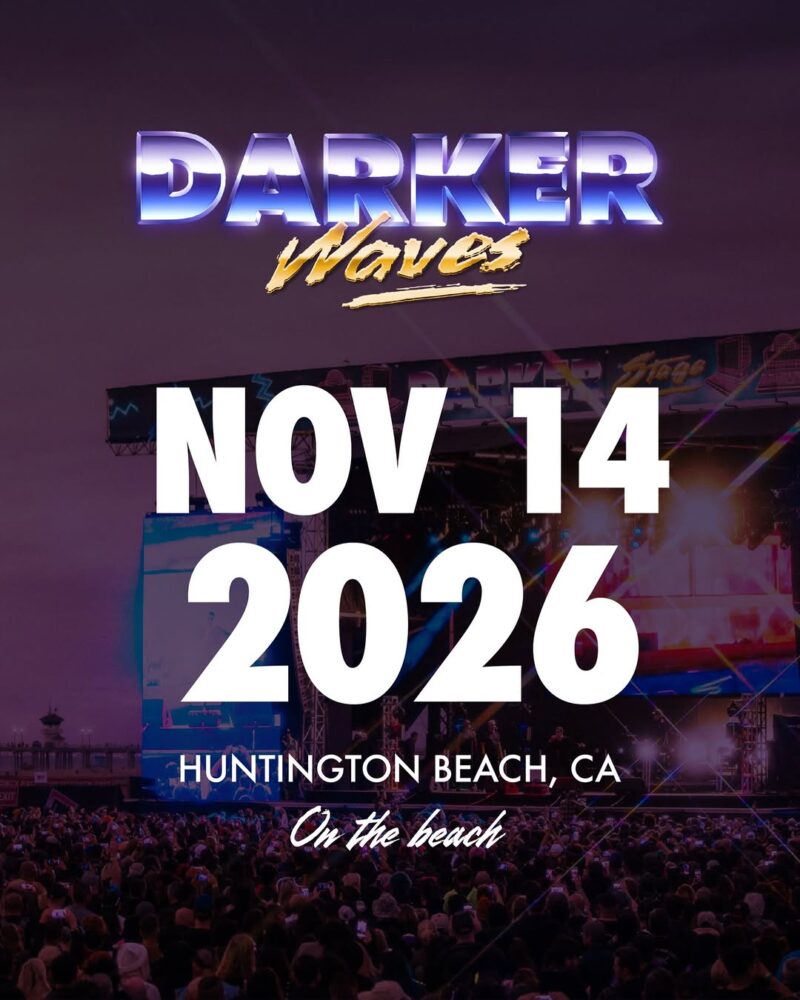
Darker Waves Festival is scheduled to return to Huntington Beach, California, on November 14, 2026. No lineup has been announced yet. The festival is currently directing fans to sign up for updates through its official website.
The newly released promotional image confirms the date and location, billing the event simply as taking place “on the beach” in Huntington Beach. At the moment, no artists, ticketing details, or additional event information have been made public.
The previous edition of Darker Waves took place on November 18, 2023. That inaugural festival featured a lineup led by New Order and Tears for Fears, with additional performances by Echo & The Bunnymen, Devo, Soft Cell, The Psychedelic Furs, OMD, The Human League, and Violent Femmes.
The 2023 bill also included a substantial number of acts from across the post-punk, darkwave, goth, synthpop, and alternative spectrum, among them Molchat Doma, Drab Majesty, Twin Tribes, Cold Cave, Mareux, London After Midnight, Clan of Xymox, The Chameleons, Christian Death, 45 Grave, Skeletal Family, Glass Spells, and Urban Heat.
As previously reported by Post-Punk.com, the first festival was positioned as a large-scale beach event centered on legacy new wave and post-punk acts alongside newer artists working in related styles. The 2023 edition’s festival site utilized three rotating stages on the sand and included shuttle and rideshare access for attendees.
No logistical details have been published for the 2026 event yet. It also remains unclear when the lineup, ticket on-sale date, and festival map will be announced.
For now, those interested in attending Darker Waves 2026 can register for more information through the festival’s official website.
Multi-million streaming, UK-based collective President continue to exist at the intersection of heavy music, electronic experimentation, and cinematic atmosphere. Launching in 2025 and operating under the cloak of minimalism and anonymity, President have been cultivating intrigue with each single and live performance. Refusing to conform to the traditional structures of genre or identity, President prioritize intent over image.
Today, the band announces its upcoming North American 2026 headline tour, with support from Cenobia and Showing Teeth on select dates. Produced by Live Nation, the tour is set to kick off September 4 at Brooklyn Bowl in Nashville, making stops across the U.S in Chicago, New York, Toronto, Boston, Atlanta, Denver, Seattle, Los Angeles. and more before wrapping up in Dallas at House of Blues on October 14. Fresh off their first-ever full U.S. run supporting Bad Omens, President will return this fall to headline venues across the continent.
Tickets will be available starting with an artist and Citi pre-sale in select venues beginning on Thursday, April 2 at 10 am local time. The general on-sale begins on Friday, April 3 at 10am local time here.
Citi cardmembers will have access to pre-sale tickets beginning Thursday, April 2 at 10 am local time until Thursday, April 2 at 10 pm local time through the Citi Entertainment program. For complete presale details visit here.
Last week, President unveiled the new single “Mercy”, which is all about perfectly executed dynamics — mixing memorable melodies and heavier-than-granite riffs with gritty breakdowns. The result is another unforgettable anthem.
About the song, President say: “Throughout history, religion has been tied to profound division and loss. This song is a reflection on that reality, and a way for me to come to terms with what it means on a human level.”
Built to exist outside the noise, President are building something that invites deeper investment — designed to be discovered, not sold. President said it best, telling Revolver in a cover feature that “the music industry has elements of fast fashion to it these days. Things just come and go. Everything’s really quick. Everyone’s shouting for attention and there’s just so much noise, and it just becomes a fucking conveyor belt. [We] wanted to step back and not be a part of that. But if people are interested, and they want to enter into this world, we’ll grab them with open arms.”
British hard rock mainstays Deep Purple are heading back out on the road this summer, lining up a North American run with support from Kansas and Jefferson Starship on select dates.
The band will launch the tour on August 4 in Raleigh, North Carolina, before making its way across the continent. The run is set to conclude on September 12 in Sparks, Nevada, giving fans a solid stretch of dates to catch one of rock’s most enduring names in a live setting.
Tickets go on general sale this Friday, April 3 at 10 a.m. local, with various pre-sales beginning Wednesday (March 31).
With a catalog that spans decades and continues to resonate with heavy music audiences, Deep Purple remain a consistent draw on the live circuit. Pairing them with Kansas and Jefferson Starship adds a classic rock edge to the bill, making this tour a strong option for fans looking for a mix of legacy acts that still deliver onstage.
Deep Purple summer 2026 tour dates:
Aug. 04 – Raleigh, NC – Red Hat Amphitheater * Aug. 08 – Clearwater, FL – The Daycare Sound Aug. 09 – Hollywood, FL – Hard Rock Casino Aug. 12 – Wantagh, NY – Jones Beach Theater Aug. 13 – Mansfield, MA – Xfinity Center * Aug. 15 – Halifax, NS – Scotiabank Centre * Aug. 17 – Laval, QC – Bell Place * Aug. 18 – Toronto, ON – RBC Amphitheatre * Aug. 19 – Ottawa, ON – Canadian Tire Centre * Aug. 21 – Detroit, MI – Pine Knob Aug. 22 – Salamanca, NY – Seneca Allegany Casino Aug. 24 – Indianapolis, IN – Everwise Amphitheatre Aug. 25 – Highland Park, IL – Ravinia Aug. 27 – Prior Lake, MN – Mystic Lake Casino Aug. 29 – Winnipeg, MB – Canada Life Centre * Aug. 31 – Calgary, AB – Scotiabank Saddledome * Sep. 02 – Abbotsford, BC – Abbotsford Centre * Sep. 04 – Lincoln, CA – Thunder Valley * Sep. 05 – Mountain View, CA – Shoreline Amphitheatre * Sep. 06 – Highland, CA – Yaamava Theatre Sep. 08 – Chula Vista, CA – North Island Credit Union Amp * Sep. 10 – Las Vegas, NV – Planet Hollywood Sep. 11 – Long Beach, CA – Long Beach Amphitheater Sep. 12 – Sparks, NV – Nugget Event Center
The best bands that wear masks include Slipknot, Sleep Token, Ghost, Mushroomhead, Gwar and Lordi — acts across rock and metal who use masks to build identity, mystery and a connection with fans that outlasts individual members. Some hide behind them. Some become someone else entirely. And the band that got there first is not the one you would guess.
Jump To A Band
Masks are the oldest trick in heavy music and somehow still the most effective. They erase ego, build mythology, and let a band outlive its own lineup. In an era where every artist is expected to be permanently visible, disappearing has become the most powerful move available.
Here is how the best of them do it.
How We Ranked Them
Influence, consistency, originality, and how completely each band integrates masked identity into the music rather than bolting it on as decoration. A great mask concept attached to a mediocre band does not make this list.
Lordi proved masked bands could go fully mainstream without diluting the concept. Winning Eurovision in 2006 with “Hard Rock Hallelujah” was not a novelty moment — it put a monster-metal act built entirely on character in front of a global television audience with no frame of reference for it, and delivered Finland its first Eurovision victory in the process.
Each member exists as a creature rather than a person. That total commitment is why the band has lasted decades. The music leans hard rock, but the execution of the concept is elite. Lordi did not just wear masks — they made full-prosthetic monster metal commercially viable on a scale nobody had attempted.
12. Hollywood Undead
Best known for: Six masks, hockey rinks and rap rock
Hollywood Undead built their entire identity on masks from the moment they formed in Los Angeles in 2005. Every member performs under a pseudonym behind an individual mask, most of them based on the hockey goaltender design — six distinct faces rather than a uniform look.
The origin story is better than the polish suggests. In their MySpace days the masks were assembled from whatever was lying around; Charlie Scene’s first one was reportedly a bag from Del Taco. By the time the band was charting, the masks were being built by a professional propmaker and redesigned for every album cycle.
The commercial record is real. Swan Songs went platinum after debuting at number 22 on the Billboard 200 in 2008, American Tragedy hit number 4 in 2011, and Notes From The Underground peaked at number 2 in 2013 while topping the Hard Rock Albums chart. Critics never warmed to them. The masks, the pseudonyms and a fiercely loyal audience carried them for two decades regardless.
11. Gwar
Best known for: Shock, satire and spectacle
Gwar built one of the most extreme identities in heavy music and have never once broken character. Since the 1980s they have combined grotesque prosthetics, political satire and carefully engineered chaos into something with no real comparison.
The costumes are only the entry point. The world-building is what made them last — an entire fictional mythology maintained across four decades. Live shows still feel genuinely unpredictable, which is exactly why they remain relevant while contemporaries have faded.
10. Slaughter to Prevail
Best known for: Modern deathcore dominance
Alex Terrible’s mask is among the most recognisable visuals in modern heavy music, and it matches the sound with unusual precision.
This is where masked identity evolves past concealment. It is not about hiding — it is about amplification. The mask makes an already imposing frontman more so, rather than distracting from him. A blueprint plenty of younger bands have since copied.
9. Gaerea
Best known for: Faceless emotional intensity
Gaerea don’t want you to know who they are. No faces, no names, nothing to latch onto — just a row of hooded shapes and the bleakest black metal Portugal has ever exported.
And it works, because the music earns it. This is music about isolation and coming apart at the seams. Put a friendly face on that and you’d break the spell in ten seconds flat.
It works because the music demands it. Their sound lives in isolation and internal collapse, and the masks reinforce that atmosphere instead of decorating it. This is not aesthetic. It is alignment.
8. The Bunny The Bear
Best known for: Contrast and unpredictability
On paper this should not work. A bunny and a bear delivering chaotic metalcore reads as a joke — and that contrast is precisely the point.
The masks generate identity through contradiction. In a genre where everyone competes to look the most threatening, looking absurd was the more memorable choice.
7. President
Best known for: Modern mystery and a rapid rise
President represent the newest wave of masked bands treating anonymity as deliberate strategy rather than aesthetic preference.
Minimal exposure, disciplined visual identity and tightly controlled information have already pushed them into conversation alongside far more established acts. This is the model younger bands are now openly following, and it is working faster than it used to.
Portal aren’t hiding. They’re erasing. The Curator’s grandfather-clock hood might be the single most unsettling thing anyone has ever walked onstage wearing, and there isn’t a trace of a wink in it.
Which fits, because the music is a nightmare by design — suffocating, formless, actively hostile to being enjoyed. Nobody on this list has matched costume to sound this precisely.
It matches music that is oppressive and disorienting by design. One of the clearest examples anywhere of visual identity and sound arriving at the same destination.
5. Ghost
Best known for: The most successful masked rock crossover ever
Ghost turned masked identity into a genuine system. The rotating Papa figures and Nameless Ghouls let the band evolve, recast and reinvent without losing a shred of recognition — because the recognition was never attached to a person.
That flexibility is the whole reason they broke into the mainstream. The masks are not a limit, they are infrastructure. In 2025 the band took Skeletá to number one on the Billboard 200 and set a hard rock vinyl sales record along the way — 44,000 copies in a week, per Billboard, a mark Sleep Token then broke two weeks later. A masked band from Sweden had no business doing that and did it anyway.
Here is the fact that reliably surprises people: before Slipknot broke, Mushroomhead were already doing this.
They formed in Cleveland’s Warehouse District in 1993 as a side project — masks, costumes and pseudonyms adopted specifically so audiences would not connect them to the members’ other bands. Slipknot formed in Des Moines two years later, in 1995.
The chronology has never really been in dispute, and the details are better than the argument. Per the band’s own account, Mushroomhead played their first show on a Saturday and were opening for Gwar at the Cleveland Agora in front of 2,000 people three days later — their second gig ever. Roadrunner Records reportedly courted them before signing Slipknot, and they passed.
Vocalist J Mann put the frustration plainly to MTV in 2002: the assumption that a band jumping on a trend was what people were seeing, when Mushroomhead had been at it for nearly a decade by then.
They still do not get the credit. The influence is undeniable regardless, and the fan feud that ran through the late nineties and early 2000s was formally put to bed by both camps years ago.
3. Imperial Triumphant
Best known for: High-concept avant-garde metal
The gold masks are symbolic rather than decorative. Imperial Triumphant tie their visual identity directly to themes of excess, decay and modern collapse — Art Deco opulence rendered as something rotting.
This is masked metal at its most conceptual. Difficult, deliberate, and entirely distinct from everything else on this list.
2. Sleep Token
Best known for: Mystery, emotion and total modern dominance
Sleep Token changed how masked bands operate in the streaming era.
By removing identity completely and building everything around emotional connection instead, they created something that functions more like a shared experience than a band. The masks are not concealing a secret — they are removing a distraction.
The results are difficult to argue with. Even In Arcadia debuted at number one on the Billboard 200 in May 2025 with 127,000 equivalent album units and set the largest streaming week ever recorded for a hard rock album. In February 2026 the band’s drummer collected a Grammy for Best Rock Performance — credited by the Recording Academy only as II, a Roman numeral engraved on the most established award in music.
Ten years in, not one member has been officially identified.
1. Slipknot
Best known for: Defining the entire category
Slipknot did not popularise masks so much as make them structural to metal identity.
Each member’s mask became a symbol in its own right, evolving with every album cycle and openly reflecting the band’s internal state — deterioration, renewal, conflict, all of it worn on the face. Nine members, numbered, in matching jumpsuits, in 1999. Nobody had built anything at that scale.
That degree of integration is why they remain the benchmark rather than a nostalgia act. Every masked band that came after exists in the shadow of what Slipknot constructed, and most of them will tell you so.
Face Paint Is Not A Mask, And Kiss Are The Reason That Matters
Every list like this one gets the same objection: where is Kiss?
The answer is that Kiss belong to a different tradition, and the distinction is worth drawing properly.
From 1973 they built the template every theatrical rock band has borrowed from since — four characters, four faces, no public appearances out of makeup. The Demon, the Starchild, the Spaceman, the Catman. They proved a rock band could be a set of characters rather than a set of people, and they did it a full generation before Slipknot.
But greasepaint is not a mask, and the difference has real consequences. A mask conceals a face completely, which lets a band swap members invisibly — that is exactly how Ghost recasts a frontman without losing an audience. Paint transforms a face that is still visible underneath, so the person and the character stay welded together.
Which is why the Kiss era ended the way it did. On September 18, 1983 — the same day Lick It Up was released — the band appeared on MTV without makeup for the first time, sitting at a desk behind name tags and answering press questions. Gene Simmons later admitted in his autobiography that he was, in his words, “scared stiff.”
It worked commercially. Lick It Up and the following year’s Animalize both went platinum, something their previous three albums had failed to manage. But the tell came thirteen years later: the makeup went back on for the 1996 reunion, because the characters were the asset all along.
The face-paint tradition is a rich one in its own right and runs alongside the masked one without overlapping it:
Kiss — the original four-character rock template
King Diamond — corpse paint as occult theatre, and the vocal to match
Mudvayne — nu-metal’s most committed paint era, a different concept every album cycle
Motionless In White and Wednesday 13 — horror-punk aesthetics carried into heavier territory
Mayhem, Immortal, Behemoth and the wider black metal tradition, where corpse paint functions as ritual rather than costume
Carach Angren — one of the most intricate corpse-paint designs in modern black metal, developed by frontman Seregor himself over years, with a skull mask deployed only for specific songs
Different tools, same instinct: become something other than yourself before you walk on stage.
More Bands That Wear Masks
The ranked 13 are the best of them. The full field is considerably deeper, across rock, metal and beyond.
Static-X deserve a longer note, because their version of this is unlike anything else here. After frontman Wayne Static’s death, the surviving original members reunited in 2018 and brought in a masked vocalist called Xer0 — with a mask built in the image of Static himself, commissioned only after the band consulted his family for approval. Xer0’s identity has never been officially confirmed, though it has been widely reported for years.
The reasoning is the most articulate defence of masked identity anyone on this list has offered. Speaking to Audio Ink Radio, the musician behind it explained the point as recognising the character rather than the person behind the character — the position being that Static-X only ever had one singer, and that Xer0 exists as an entity created so the band could have a future at all.
The last two entries in that table are not rock bands, and they belong here anyway. Daft Punk and Deadmau5 proved to an entire generation of musicians that a strong enough visual identity travels further than a face does — a lesson Sleep Token and President are now running at full speed.
Why Bands Wear Masks At All
Masks create distance, and the distance is the point. It pulls people closer.
There are three things a mask does that a face cannot. It removes ego, which lets the music sit at the centre. It builds mythology, because a character can be written and a person cannot. And it makes a band survivable — members can leave, be replaced, or simply age, and the identity holds.
That last one is the commercial argument, and it is why this is not a fading trend. Ghost has rebuilt its frontman repeatedly. Slipknot has weathered deaths and departures that would have ended most bands. Static-X found a way to keep going after losing the man the band was built around. Sleep Token has never had to manage a single celebrity news cycle.
In an era of total overexposure, anonymity is not a gimmick. It is an advantage.
TL;DR
The best bands that wear masks span rock and metal: Slipknot, Sleep Token, Ghost, Mushroomhead, Gwar and Lordi lead the field.
Slipknot top the list for making masked identity structural to metal rather than decorative — nine numbered members in masks from their 1999 debut.
Sleep Token sit at number two: Even In Arcadia debuted at number one on the Billboard 200 in May 2025 with 127,000 units and the biggest streaming week ever for a hard rock album, and their drummer won a Grammy in February 2026 credited only as II.
Mushroomhead formed in Cleveland in 1993, two years before Slipknot formed in Des Moines — they were masked first, and their second-ever show was opening for Gwar in front of 2,000 people.
Ghost built the most scalable version: rotating Papa figures and Nameless Ghouls let the band recast without losing recognition. Skeletá hit number one in 2025.
Lordi won Eurovision in 2006 with “Hard Rock Hallelujah,” taking full-prosthetic monster metal mainstream and giving Finland its first win.
Kiss are not on the list — face paint is a separate tradition. A mask lets a band swap members invisibly; paint cannot, which is why Kiss unmasked on MTV on September 18, 1983 and put the makeup back on for the 1996 reunion.
Static-X are the strangest case: a masked vocalist performing in a mask modelled on their late frontman, approved by his family.
Deeper cuts worth knowing: Buckethead, Hollywood Undead, Man With A Mission, The Residents and Kanonenfieber.
Masks do three things a face cannot: remove ego, build mythology, and let a band outlive its own lineup.
FAQ
What bands wear masks?
Slipknot, Sleep Token, Ghost, Mushroomhead, Gwar, Lordi, Slaughter To Prevail, Imperial Triumphant, Portal, Gaerea, Carach Angren, President and The Bunny The Bear are among the best known masked rock and metal bands. Outside the ranked list, Buckethead, Hollywood Undead, Man With A Mission, Static-X and The Residents have all built long careers behind masks.
Why do rock and metal bands wear masks?
To build identity, remove ego, create mythology and separate the music from individual personalities. Practically, masks also let a band replace members without losing audience recognition — which is why masked bands tend to outlast their own lineups.
Who was the first band to wear masks?
Kiss established the four-character template from 1973, though with face paint rather than masks. Among genuinely masked heavy bands, Mushroomhead were operating in Cleveland from 1993, two years before Slipknot formed in 1995.
What is the most famous band that wears masks?
Slipknot, by a wide margin. Their masks are among the most recognisable visual identities in music, and they defined how masked identity functions in heavy music.
Is Kiss a masked band?
Not strictly. Kiss wore elaborate face paint rather than masks, from 1973 until they appeared without it on MTV on September 18, 1983. The distinction matters — a mask conceals the face entirely and allows members to be swapped invisibly, while paint transforms a face that is still visible underneath.
Which masked band is the most successful?
Commercially, Slipknot and Ghost have the longest sustained runs, while Sleep Token achieved the fastest ascent — a number one album on both sides of the Atlantic in 2025 and a Grammy in 2026 without ever revealing a member’s identity.
Are any masked bands fully anonymous?
Sleep Token, Gaerea, Portal and President maintain genuine anonymity with no officially confirmed member identities. Static-X’s Xer0 has never been officially named either. Slipknot, Ghost, Gwar, Mushroomhead and Lordi are masked but their members are publicly known.
Do masked bands ever take the masks off?
Rarely, and it tends to mark the end of an era rather than the start of one. Kiss removed their makeup on MTV in 1983 and restored it thirteen years later. Most masked bands treat removal as off the table entirely.
Ten of these bands could headline a festival and you still would not recognise a single member walking past you on the street — which is exactly the way they want it. Who did we rank too low? Drop your own top three below. Follow Loaded Radio for daily rock and metal news.
About This List
Loaded Radio has covered masked and anonymous rock and metal acts since 2009, including interviews with artists across the scene on the Loaded Radio Podcast. Rankings reflect the editorial judgement of Scott Penfold, a broadcaster with 25 years in rock radio. Chart data cited from Billboard and the Official Charts Company. Last updated July 2026.
Fear Factory is set to bring their industrial madness to Europe this August through October. Whether or not we’ll have the new record by then remains to be seen.
German progressive metal pioneers Vanden Plas are back with AcCult II, a new acoustic album set for release on June 12, 2026, via Frontiers Music Srl. To coincide with the announcement, the single “Far Off Grace”, along with an official video, are available today.
Andy Kuntz commented: “The single “Far Off Grace” exemplifies the unpretentious, pure, and at the same time artistic, multifaceted acoustic expression of all the songs on AcCult II. They say you can recognize a good song when it works even in a stripped-down version. Compared to the studio version first released in 1999, however, this interpretation opens up on top many new avenues of understanding”.
“It allows the song’s once bombastic beauty to blossom in the virtuosic interplay between Stephan Lill‘s exquisite guitar work, Alessandro Del Vecchio‘s shimmering grand piano, and Kuntz‘s vocals, ranging from sensitive to ecstatic – only to then be driven, by the unbridled power of an exceptional band with Andreas Lill on drums and Torsten Reichert on bass, to a hypnotically intensifying, furiously breathtaking finale”, he added. “This is far more than an acoustic version of a song; it is the ultimate reinvention of a classic in its own light.”
AcCult II is the highly anticipated acoustic sequel to Vanden Plas’ 1996 landmark album AcCult.
Stephan Lill explained how the album came to life: “When we released our first acoustic CD, AcCult, in 1996, it was special to us in many ways. For this release, we arranged songs from our debut album, “Colour Temple”, into new acoustic versions. And we did the same with songs by other artists or bands that didn’t necessarily fit our usual musical style. Ever since that release, we’d always had it in the back of our minds to produce another acoustic CD at some point. But then came tours, more regular CDs, many theatre productions we were involved in, and time flew by…”
“When Frontiers approached us with the idea of another acoustic CD, we knew that we had the time needed for it, and with the right songs, it could work. And we can now say, it worked out. We sticked with the concept of the first AcCult CD, and so AcCult II once again features acoustic versions of Vanden Plas songs, as well as two cover songs: “Nothing Else Matters” (Metallica) and “Boat on the River” (Styx)”, he continued. “We are more than happy that, exactly 30 years later, we can write the next AcCult chapter. And all Vanden Plas fans can look forward to a truly extraordinary release.”
Building on the innovative concept that first reimagined tracks from their debut “Colour Temple” in a stripped-down, unplugged setting, this new release revisits select songs from their extensive catalog with fresh acoustic arrangements, offering fans a completely new perspective on the band’s music.
In addition to reworked originals like “Far Off Grace”, “Holes In The Sky”, “The Ghost Xperiment”, and “You Fly”, AcCult II features inspired interpretations of classic songs by other artists, including Styx’s “Boat On The River” and Metallica’s “Nothing Else Matters”, blending reverence for the originals with Vanden Plas’ signature emotional depth and musical sophistication.
Notably, John Helliwell of Supertramp makes a guest appearance on saxophone on the album’s closing track, “You Fly”, adding a unique, melodic touch to the album’s finale.
The album showcases the band’s current lineup: Andy Kuntz on vocals, Stephan Lill on guitars, Andreas Lill on drums, Thorsten Reichert on bass, and Alessandro Del Vecchio on keyboards, whose synergy brings a nuanced warmth to each track.
With AcCult II, Vanden Plas demonstrates that their progressive sensibilities translate seamlessly into intimate, acoustic settings, creating a compelling experience that resonates both with longtime fans and newcomers alike.