Blog

  • Overthrow to Overgrow

    Mark Duggan (2011), Michael Brown (2014), Eric Garner (2014), Tamir Rice (2014), Sheku Bayoh (2015), Walter Scott (2015), Dalian Atkinson (2016), Philando Castile (2016), Alton Sterling (2016), Rashan Charles (2017), Stephon Clark (2018), Stewart Kevin Andrews (2020), Ahmaud Arbery (2020), George Floyd (2020), Chantel Moore (2020), Sean Monterrosa (2020), Regis Korchinski-Paquet (2020), Erik Salgado (2020), Breonna Taylor (2020).
    Artwork by Nate Burns.

    Mark Duggan (2011), Michael Brown (2014), Eric Garner (2014), Tamir Rice (2014), Sheku Bayoh (2015), Walter Scott (2015), Dalian Atkinson (2016), Philando Castile (2016), Alton Sterling (2016), Rashan Charles (2017), Stephon Clark (2018), Stewart Kevin Andrews (2020), Ahmaud Arbery (2020), George Floyd (2020), Chantel Moore (2020), Sean Monterrosa (2020), Regis Korchinski-Paquet (2020), Erik Salgado (2020), Breonna Taylor (2020).

    Too many of us have sat back and watched, or looked away, as faces in our communities were wiped from history; disproportionately affected by police violence and systemic racism. Too often we have seen our black, brown, native American and First Nations brothers and sisters killed through unnecessary police violence. While this has become an international issue in the last few months, racism has been a fact of daily life for millions around the world.

    We feel that the time has come for members of the metal and punk scenes to offer material support to the struggle against racism and for equality, engaging with our brothers and sisters in the streets who are out in front of the conversation against pervasive prejudice and systemic racism. While many of us are in the streets supporting these causes it became apparent that we could amplify the voice of those who are most at risk by using our platform as musicians.

    To that end, thirty bands from across the extreme music world have come together via this digital compilation featuring artists as varied as Doom, Panopticon, Obsequiae, Agathocles, Thou, Chaos Moon, Outlaw Order, Deviated Instinct, Dawn Ray’d, and many others to benefit Black Lives Matter, Life After Hate, and Stand Up To Racism.


    The compilation was put together by Austin from Panopticon and Mike from Hag Graef. New tracks were provided by Aerial Ruin (“Becoming the Sunken Lake” is an outtake from the Nameless Sun sessions), Chaos Moon, Detractors, Hag Graef, Human Failure (members of Akasha), Inexorum, Krieg, Nori (members of Axis of Light), Obsequiae, Throne of Blood, Tvær, Uprising (a new and exclusive track with Austin helping out on drums), Vukari, and Woe (the “Abject in Defeat” demo. A little different from the album version, it has more lyrics).

    Covers were provided by Hornet Murmuration (members of Kostnatění covering Dead Kennedys’ “Drug Me”), Nechochwen (Gospel of Vomit’s “Sulphuric Stench”), and Ripped to Shreds (Unholy Grave’s “No Racial Superiority!”).

    Remixes, live cuts, and re-recorded tracks from Agathocles, Alda, Chat Pile, Cloud Rat (a previously unreleased acoustic recording of “Blind River”, with the lyrics from “Losing Weight”, taken from the Pollinator sessions), Dawn Ray’d (a live version of “Colony of Fevers” from Black Flags Over Brooklyn), Deviated Instinct (“Fall of the House of Cards” is one of 5 old songs re-recorded during the Husk session in 2017), Doom, Falls of Rauros (a re-recording of the live show staple, “Silence” from The Light That Dwells in Rotten Wood. Recorded and mixed entirely by the band), Krallice, Mania, Outlaw Order, Panopticon, Thou, and Tired of Everything.

    All proceeds will be donated to: Black Lives Matter Over-arching movement to combat racism and fight for social justice in the US and Canada. Life After Hate A nonprofit in the US that seeks to combat racism by providing resources to help people leave racist movements, as well as help de-radicalize violent far right extremists. Stand Up To Racism A UK based nonprofit that is focused on organizing against racism throughout the country.


    [Note: this post is an edited version of the announcement posted by many of the involved bands on Facebook, together with additional information about some of the songs].
  • Kamancello – Of Shadows

    By Justin C. Cellist Raphael Weinroth-Browne is no stranger to Metal Bandcamp at this point. Matt Hinch recently reviewed his solo album Worlds Within on these very pages just a few weeks ago. Matt listed Weinroth-Browne’s metal bonafides–including Musk Ox and Leprous–but he’s no slacker when it comes to other projects.
    By Justin C.

    Artwork by Maahy

    Cellist Raphael Weinroth-Browne is no stranger to Metal Bandcamp at this point. Matt Hinch recently reviewed his solo album Worlds Within on these very pages just a few weeks ago. Matt listed Weinroth-Browne’s metal bonafides–including Musk Ox and Leprous–but he’s no slacker when it comes to other projects. Kamancello is a duo, featuring Weinroth-Browne’s cello contrasted with Shahriyar Jamshidi’s kamanche, a Persian stringed instrument, bowed like a cello, which is prominent in music from Iran, Kurdistan, and other nearby Middle Eastern countries. As played by Jamshidi, it features sounds similar to the cello, but in a higher register and with a raspier timbre.

    Of Shadows is the duo’s third album, and I’ll give you the highlight right from the top: The entire album is improvised and unedited. Now, depending on your depth of musical interest, you may have heard a jazz combo or two, and those might have shown you the fine line between masterful improvisation and “oh god why are we listening to a 20-minute trombone solo.” Kamancello are firmly in the former category, but they take it even a step further. Unlike improvising over a jazz standard with a fixed chord progression, Kamancello approaches their songs with the most minimal planning. Weinroth-Browne told me that sometimes he and Jamshidi will agree on a Persian mode or key signature beforehand, but sometimes not even that. They keep contrasting moods in mind for the progression of the tracks over the course of the album. Sometimes they’ll use alternate tunings for their instruments. But if you, like me, conjured an idea of the two men meeting in a room, silently nodding, and beginning to play, you’re not far off.

    There is an extraordinary amount of communication here. Sometimes it’s relatively straightforward–you can hear a distinct call and response between the two artists late in “The Rider,” but you’ll find more subtle interactions elsewhere. “Dance of Shadows” finds the duo merging to a single melodic line before diverging again. “To Mourn” has melodies that wind around each other, elevating the song beyond a simple dirge to a piece as complex as the process of mourning itself.

    If you’re worried that this will be strictly classical music that you might not be interested in or otherwise attuned to, think again. “On the Precipice” will tempt you to bang your head–maybe just a little–or at least tap your foot to the driving rhythms. The players use every sound texture available to them. Sweetly bowed passages, staccato plucked lines, and even the occasional percussive sound with a finger tapped on the body of one instrument or another. Sometimes you’ll even be convinced you’re hearing a vocal melody, perhaps in a language you don’t understand.

    The fact that these improvised pieces stand as fully realized compositions–sometimes much more so than songs that have been meticulously planned–is a testament to the level of artistic communication between these two musicians. They straddle the line between “music made for musicians” and easily accessible melodies and rhythmic figures that anyone can immediately grasp and enjoy. A balance is struck between music to get lost in and music to absorb while fully present. It’s a stunning work, and I heartily recommend it and their previous two albums.

  • Bell Witch and Aerial Ruin – Stygian Bough Volume I

    By Justin C. You’d be forgiven for thinking Stygian Bough Volume 1 was a split, since it does list both Bell Witch and Aerial Ruin as artists, but it’s a bit more complicated than that. This album features Erik Moggridge, who plays dark, acoustic folk under the name Aerial Ruin, playing with Dylan Desmond and Jesse Shreibman, the duo that makes up Bell Witch.
    By Justin C.

    Artwork by Adam Burke.

    You’d be forgiven for thinking Stygian Bough Volume 1 was a split, since it does list both Bell Witch and Aerial Ruin as artists, but it’s a bit more complicated than that. This album features Erik Moggridge, who plays dark, acoustic folk under the name Aerial Ruin, playing with Dylan Desmond and Jesse Shreibman, the duo that makes up Bell Witch. It’s not a new band, per se–it’s not even a new idea, since Moggridge contributed vocals to Bell Witch’s monstrous album Mirror Reaper. It’s a collaboration. Or, given that the music often drifts into tempos so slow that metronomes can’t measure them, a funereal relay race, with both musical entities passing ideas back and forth.

    Maybe the clearest example are the songs “Heaven Torn Low I (the passage)” and “Heaven Torn Low II (the toll).” Part I is mostly Aerial Ruin’s show, featuring Moggridge’s inimical clean vocals and acoustic guitar. But as the song progresses, Bell Witch begins to creep in around the edges, giving Moggridge’s sound the epic swell that’s usually implied in Aerial Ruin’s music, but not actually present.

    Bell Witch and Aerial Ruin live. Photos by Nessie Spencer (licence).

    As Part I slowly fades, Part II roars to life with the distorted bass and slow-moving melodicism that’s unmistakably Bell Witch. Moggridge continues to provide vocals, but massive, distorted bass notes stretch out and break into howls. The songs clearly take heavy emphasis from Aerial Ruin and Bell Witch, in that order, but it would be a mistake to say that Part I is “Aerial Ruin’s song” and Part II belongs to Bell Witch. One often takes center stage, but the other is always supporting and expanding.

    There’s a lot of heart-breaking beauty in this album, and even though it’s just over an hour–which is pretty tame by funeral doom standards–it has the effect of dilating time. I listened to this album during a long drive, the first in a long time, and the light, pandemic-affected traffic on top of the music made me feel as if I were being pulled into some other realm. The album feels endless at times, but not in a tedious or tiring way. Timothy Leary’s old drug-addled adage of “turn on, tune in, and drop out” applies in a weird way, but no LSD is needed here. The artistry itself that takes you away.

  • Dawn of Ouroboros – The Art of Morphology

    By Master of Muppets. Versatility is a tough thing to pull off well. Too much of it and any given album is likely to be a jarring mess, not enough and it’s Disturbed. While older, seasoned acts tend to more or less settle into the confines of one genre or other, many young bands find themselves to explore their sonic boundaries at will.
    By Master of Muppets.

    Artwork by Jill Colbert.

    Versatility is a tough thing to pull off well. Too much of it and any given album is likely to be a jarring mess, not enough and it’s Disturbed. While older, seasoned acts tend to more or less settle into the confines of one genre or other, many young bands find themselves to explore their sonic boundaries at will. Though the fruits of such youthful ventures are often spirited and compelling, they are not always particularly well-guided endeavors, nor do the wide scopes of the artist’s intent necessarily manage to find their mark; many debut albums attempt to be more than they’re actually capable of being, but then again many debut albums aren’t Dawn of Ouroboros’ The Art of Morphology. It’s actually possible that most albums aren’t The Art of Morphology, but that’s neither here nor there. What’s here is one badass album, and what’s there is an absence of reasons as to why you shouldn’t be jamming out to it right this second.

    Before we get too far on course with this great album, we must wander off course to pay tribute to… another great album! In the name of karmic balance, I must admit to have only stumbled across Morphology while trying to get the most bang for my buck; Naturmacht Productions offered it included at a discount alongside What We Leave Behind, the latest offering by Swedish doom act Soliloquium, and the only thing I love more than Katatonic doom is pinching the proverbial penny. If the deal is still going on whenever you read this, I’d urge you to take advantage as both albums are well worth your time. I’ll almost certainly be back to babble about What We Leave Behind at a later date, but in the event that you can’t be patient or I can’t be trusted, I’ll say this: it’s a wonderful piece of modern post-doom on a lovely label, and without either I would never have found the excellent album in discussion today. Everybody, say ‘thank you!’

    Categorizing the Katatonia core of Soliloquium or explaining the appeal of saving money are relatively straightforward tasks. Describing Dawn of Ouroboros’ sound, on the other hand, is no such thing. These Californians wear a lot of hats, adopting several sonic styles throughout Morphology‘s 8 tracks and pulling all of them off downright fiercely. Proggy, deathy riffs? Check. Frostbitten tremolos and blackened shrieks? Ch-ch-check. Clean, pleasant passages with ethereal vocals? You know how this game works, I’d also throw in ‘melodeath sensibilities’, ‘symphonic flourishes’ and ‘random djent outbursts’ if I felt like continuing that shtick, but I don’t. The point is that Dawn of Ouroboros do a lot of things with 43 minutes, and they do them surprisingly well for this being a debut. The Art of Morphology is a constantly shifting soundscape, a hostile world where the weather’s always changing and yet it feels like home nonetheless.

    This vibrant sense of variety brings with it a feeling of vitality so vaguely, faintly familiar that it almost feels foreign to today’s metal climate. Dive through any genre on Bandcamp and you’ll find not only several prominent artists of the scene but also myriad clones, all attempting to cash in on a sound that’s been proven to work by ‘doing [genre] right;’ The Art of Morphology has that mythical air of a band just being themselves and having fun with their own sound, the kind of palpable sincerity and earnestness found amongst such unifying, time tested classics as In Flames’ Whoracle or Pantera’s Far Beyond Driven – except, again, this particular slab of exploratory greatness is a friggen debut. The potential that tracks such as the artfully balanced prog death of “Pinnacle Induced Vertigo ” or the symphonic blackness of “Serpent’s Charm” foretell is impressive and incredibly promising, to say the very least.

    I love The Art of Morphology, and I am absolutely gunning for Dawn of Ouroboros’ future. I found this album entirely by accident, only to discover the first album to make me genuinely excited about a young band’s future in years. It’s well crafted, well paced and well executed; The Art of Morphology is one of those special albums likely to unite fans from all ends of the metal spectrum, and it is incredibly refreshing to find such a thing as the rest of the world is falling apart. If I somehow haven’t sold you on this sweet slice of scariness yet, I would like to point out that every shriek, growl, roar and otherwise nameless vocal declaration of war uttered within Morphology‘s tracks was delivered by one loud little lady named Chelsea Murphy. You would be doing yourself a disservice as a fan of metal to allow yourself to miss out on her incredible performance here on Morphology.

  • Eye of Nix – Ligeia

    By Justin C. A tidy genre tag for Eye of Nix is elusive. We could go with Black/Doom/Avant Garde, from their Bandcamp page, and that’s more or less O.K., but that leaves out the gothic, psychedelic, and sometimes operatic elements. Maybe “post-everything” covers it.
    By Justin C.


    A tidy genre tag for Eye of Nix is elusive. We could go with Black/Doom/Avant Garde, from their Bandcamp page, and that’s more or less O.K., but that leaves out the gothic, psychedelic, and sometimes operatic elements. Maybe “post-everything” covers it.

    Their newest, Ligeia, is that rare album that manages to encapsulate a wide palette of sounds without sounding like an album made by seven different bands. The first track, “Concealing Waters,” is actually a pretty good introduction in more ways than one. It’s a mysterious opener that showcases a lot of the sounds you’re going to hear on the rest of the album. Lush guitars and clean vocals start out, creating a doomy, psychedelic start reminiscent of Ides of Gemini and even a little bit of The Doors. Vocalist Joy Von Spain weaves a spell, but the perspective takes a hard left when the drums start to blast and she adds blackened harshness to her vocals. Sure, the song is almost 7 minutes long, but in a contradictory way, it feels both more immediate and more expansive than that run time suggests.

    “Pursued” charges out of the gate with more of a death metal feel, but the proggy, off-kilter touches you heard in the album opener are still there, even if the mood has suddenly turned more vicious. This track also features the first demonstration of Von Spain’s operatic style of vocals. It’s typically not a style I enjoy in metal or its natural habitat–although I appreciate the skill–but Von Spain’s use of it as just one of the styles in her arsenal works for me.

    The rest of the album dwells in these dualities–”Stranded” starts in an ethereal plane before moving to churning heaviness–and it’s a sound to behold. All of the band members get a chance to shine here. The intricacy of the drumming, the atmospheric guitar, the bass providing the solid bridge connecting the instrumentals, and the synths and “sound collages” are all showcased at one point or another, but yet this is still very much a band effort, and that band is exploring its own path in a very unique space. Even if one of the many things I mentioned here is usually a turn off for you, I highly recommend you give the whole a chance.

  • Raphael Weinroth-Browne – Worlds Within

    By Matt Hinch. Wake’s previous album, Misery Rites, should have garnered the attention of anyone who hadn’t been paying attention already. It was a potent blend of black metal and grinding madness. Anyone who thought new album, Devouring Ruin was going to follow the same formula would be wrong.
    By Matt Hinch.

    Painting by Heather Sita Black.

    This site may be Metal Bandcamp but this solo album from Raphael Weinroth-Browne, Worlds Within, is barely even metal adjacent. That term doesn’t make much sense anyway. Raphael has played with Musk Ox, The Visit, and of course Leprous so he is well known to the metal community. However, we haven’t really heard him play the cello quite like this. Unaccompanied. Every sound on here was made by him on a cello. The instrument itself has great range but add in the percussive elements and effects pedals and you’d swear a whole orchestra is in on this. It’s just him though. Rhythms, leads, everything. Worlds Within seems like a spectacularly apt title given the worlds that open up in the minds of the listener on this 45-minute piece presented as 10 movements.

    All 10 of those movements are quite moving. The piece’s bookends, “Unending I” and “Unending II” feel like dawn and dusk, casting shadows with beauty and subdued light, brightening and fading, albeit with melancholic qualities. Melancholy and darkness find their place often. “From Within I” and “From Within II” open up the mind and paint an expansive picture. Raphael himself has stated a mind-nature connection exists with this section and with eyes closed the majesty of both worlds fills the soul.

    As we move into “From Above” and the “Tumult” suite Worlds Within starts to show its diversity even more. Non-traditional playing techniques (is that strumming?) and percussive elements change the mood. It feels more dramatic and expansive once the spacey layers find their home. Layers move in and out of consciousness amid a steady beat until gorgeous leads take your breath away. There are times even that the Walking Dead theme comes to mind. So does Blue Man Group!

    “Fade (Afterglow)” brings things back down to earth after all the drama. In fact, it feels watery, like ripples spreading in a pond as rain falls on the surface, leading us back to the aforementioned dusk of “Unending II”.

    Worlds Within is an escapist piece of music. Wrap it around you like a blanket and let the emotions it conjures penetrate you. Serenity, fear, joy, sadness, conflict, peace. Traditional sounds via untraditional methods form a profound 45 minutes of encapsulation. The cello is an amazing instrument and Raphael is an amazing musician and composer with amazing vision, passion, and skill. We all need to escape. Escape to Worlds Within.

  • Ulthar – Providence

    By Bryan Camphire. I saw Ulthar perform much of this set here in Texas last year. I knew they were good, I had their debut full length. The righteous album art drew me in, plus the fact that they were signed to the venerable death metal label, 20 Buck Spin.
    By Bryan Camphire.

    Artwork by Ian Miller.

    I saw Ulthar perform much of this set here in Texas last year. I knew they were good, I had their debut full length. The righteous album art drew me in, plus the fact that they were signed to the venerable death metal label, 20 Buck Spin. I liked their brand of blackened Old School Death Metal. Still, their first full length did not prepare me for the ferocity of this set of songs that are now released as Providence. I was in the front row at the show hanging on every note. (Damn, I miss live shows.) After this fiery initiation rite of witnessing them spreading carnage onstage, I became obsessed. I walked up to the merch table later and bought a shirt. The bassist had on an Order of Chaos shirt, illustrating that his commitment to the old school was for real. I asked him how he plays so fast. He said, “I practice a lot.”

    Listening to Providence, it’s clear that this band is a well-oiled death machine. The aptly titled opener, “Churn”, blasts off with a take-no-prisoners approach. Dueling blacked vocals and death growls, swirling aggressive riffs and relentless drumming all race towards the finish in just over two minutes. As the shortest song on the record, it’s the perfect opener to this set. Its lean gristly riffs function as a mission statement of what’s to come, assuring that listeners sit up and pay attention from the jump.

    Completely unexpectedly, track two, “Undying Spear”, opens with an acoustic intro. At this point, the listener is led deeper into the dark thicket of horrors on display in Providence. This cut further showcases the band’s ridiculous chops in a cavalcade of tangled blistering riffs. Put headphones on to relish in the detailed playing on offer, or simply play it loud to offend some neighbors held captive in quarantine.

    Next comes the record’s title track, and it’s from this point that the band locks into its steady stride that remains more or less consistent through the end of the record. You can hear echoes of Death’s 1991 masterpiece, Human in the gnarled labyrinthine structures of Providence. The record harkens back to golden times before “technical” became a dirty word when applied to death metal. Providence brings the riffs with plenty of low-end and ample urgency. Songs on offer here, like “Cudgel” and “Furnace Hibernation”, are as these titles suggest blunt edged forces of restless burning fury.

    In the wake of watching their live set, I remember getting an oil change later that week, reading an interview with the band on my phone. My wig was so flipped that I wanted to know more about how such a tumultuous din gets kicked up by these three men. The guitar player describes once upon a time flying from California to Pittsburgh on his birthday for the sole purpose of placing the band’s demo cassette in the hands of the label boss of 20 Buck Spin, saying, “I told him it would be a real dick move NOT to put it out, after all that. …he wrote me a couple days later, saying he wanted to do it.” This anecdote recalls the lore surrounding the first Deicide record in 1989, when legend has it that Glenn Benton waltzed into offices of Roadrunner Records presenting them with the band’s demo saying, “Sign us, you fucking asshole.” You want OSDM bona-fides, Ulthar’s got ’em. Providence represents everything the band gets right taken to an even greater extreme.

  • It’s Bandcamp Friday Again.

    It’s Bandcamp Friday again, and for the third time they’re waiving their fees. Originally the Fridays were meant as support for bands who had to cancel shows and tours because of the Covid-19 pandemic, but this time around many bands and labels have chosen instead to donate their proceeds. Ayloss from Spectral Lore explains:
    It’s Bandcamp Friday again, and for the third time they’re waiving their fees. Originally the Fridays were meant as support for bands who had to cancel shows and tours because of the Covid-19 pandemic, but this time around many bands and labels have chosen instead to donate their proceeds. Ayloss from Spectral Lore explains:

    “Together with 40 60 other metal bands, I’ll be donating every purchase at Spectral Lore’s Bandcamp page to the National Bail Fund Network. Support and solidarity to the demonstrators that fight for racial equality and against police brutality in the US, without any “but” or “if” or anything. This is a one in a lifetime uprising, even things that seem like they’ll last forever like racism can be overturned if we fight hard enough.”

    The first 41 bands.

    This initiative was started by Sarah from Smoulder. Here’s her message on behalf of the bands:

    “Following the murder of George Floyd by a police officer on May 25, protests have erupted across the United States decrying police brutality and decades of institutionalized racism. As an act of solidarity, on Friday, June 5, 41 heavy metal, rock, and punk bands [plus a few surprises] will be donating proceeds from sales made on Bandcamp to the National Bail Fund Network.

    The National Bail Fund Network organizes to end all forms of detention, criminalization, and surveillance. The charity uses community bail funds as organizing tools to free people and push to abolish detention. Go here for more information on bail funds.

    To get involved, head to the Bandcamp pages below on Friday, June 5 from 12 – 12 PST and buy! More importantly, you can donate to the National Bail Fund directly here.”

    Artwork by Loukas Kalliantasis.

    Mystras is a new project from Ayloss. It’s a good deal rawer and more aggressive than recent Spectral Lore output. The obvious comparison is the majestic castle metal from Obsequiae. but Mystras comes without the romanticism. While the music is meant to “shed some light on unsung acts of valour and bravery from the Middle Ages”, Mystras’ focus is on the common folks instead of kings and nobility.


    Artwork by Michael Whelan

    Smoulder plays epic doom. Seriously good epic doom. Three things tells you exactly what the band is about: the motto “Love Metal | Hate Fascism”, the awesome cover art by fantasy great Michael Whelan, and the dedication of Dream Quest Ends to the memory of the mighty Mark “The Shark” Shelton from Manilla Road.

    While compiling this list another 20 bands were added to the Network. All 60+ of them are listed below in alphabetic order. The initiative have gained popularity fast, but it bears mention that many other bands and labels are donating to similar causes. This is just one list of many that could have been made.

    A Flock Named Murder


    Astral Witch


    Azath


    Black Knife


    Blood Star


    By Fire & Sword


    Cemetery Filth


    Cirkeln


    Citizen Rage


    Concilium


    Culled


    Cultist


    Destroyed In Seconds


    Emblem


    Ezra Brooks


    Falsehood


    Feminazgûl


    Fer de Lance


    Flavortoun


    Haunt


    Häxan


    Hitter


    Horrendous


    Horror Vacui


    Hyperia


    The Isosceles Project


    Knightmare


    Lady Beast


    Lightning Born


    Locust Leaves


    Maldita


    Malleus


    Mega Colossus


    Midnight Priest


    Mount Cyanide


    Nomadic War Machine


    Nucleus


    Oath


    Obsequiae


    Olórin


    Pale Mare


    Ravensire


    Ravenous


    Ripped to Shreds


    River Jacks


    Rough Spells


    Sallow Regent


    Septuagint


    Syryn


    Third Chamber


    Thorazine


    Thronehammer


    Throne of Iron


    Völur


    Vulgarite


    Yovel


    Zealotry


    5¢ Freakshow


  • SORCERER: Closer to heavy metal

    jon_2020-01-11_1144 HiResWhen old bands reunite, and especially those who never advanced from the demo stage back then, it often ends with one album, fueled by a succesful festival apperance or something similar. Sweden’s Sorcerer has now delievered three albums since the band reformed, and it doesn’t seem like it will stop here. We have covered the band when they released both previous albums, “In The Shadow Of The Inverted Cross”, and “The Crowning Of The Fire King”, and just like last time, singer Anders Engberg is the one faced with the task of answering our questions.  He seemed really proud of  “The Crowning Of The Fire King” when we spoke together last time, does he still have the same feelings about it?

    – Yes, I have. I think you can hear us evolving from “In The Shadow Of The Inverted Cross” to “The Crowning Of The Fire King”. We evolved both in sound in the way we write the music. I am really proud of it, and I feel really good about it. It also took us a little bit further than the first album did.

    There were clearly differences between the albums you mentioned there, while “In The Shadow Of The Inverted Cross” had an analogue sound, “The Crowning Of The Fire King” turned out a bit more modern. Where would you put the new one, soundwise?

    – We are aware of that, and we wanted the first album to sound like an old, traditional recording with big drums, and a feeling of a lot of air inbetween the chords. When we went in to do the second album, we felt we needed to put it together a little bit more. We still wanted that big, bombastic sound, but we needed to tighten it up a little bit, get a bit more distortion out of the guitars and sound a little bit more modern. The new one I think is a mix between the two previous albums. We recorded really big drums this time. We still have that more modern feel to it, a kind of punch in the face-sound. I don’t think it’s as  big a jump between the new one and “The Crowning Of The Fire King” as there was between “In The Shadow Of The Inverted Cross”. These two latest albums definitely sound more similar. I think the main thing is the drum sound, which really stands out on this new album.

    Do you feel the term “doom metal” is doing justice to “Lamenting Of The Innocent”? I guess it might be possible to reach a wider audience by labelling it as heavy metal?

    – Where we come from, you know the late eighties, beginning of the nineties, we were a doom metal band, no doubt about it. However, already on “In The Shadow Of The Inverted Cross”, we took one step forward towards heavy metal and hard rock and now with “The Crowning Of The Fire King” and the new one, we took a further step across the river. It’s not something we think about when we write music though. If people want to label us, they can do that, and of course we take advantage of that on some occasions too. If I was to label us, I think we are closer to a heavy metal- or even hard rock band these days.

    Still it’s a rather slow paced album.

    – Yeah, that’s the music we like. We enjoy the melodic era of Black Sabbath, the stuff with Ronnie James Dio and Tony Martin as well as the old Rainbow and Dio-stuff. We enjoy the heaviness and like to mix it with a little bit of progressive stuff, to try to make the songs a bit more interesting. We really  don’t look at other genres and try to imitate or anything, we just write the music we write. And there are more of us writing the music today than it was in the beginning. Peter (Hallgren, guitars) for instance, came in with song writing contributions on “The Crowning Of The Fire King”, he played the guitars on “In The Shadow Of The Inverted Cross” too, but he didn’t write any songs there. Justin (Biggs), the new bass player also makes music, so it’s more of a mash up today.

    As you don’t write music yourself, what was the biggest surprise moment for you when you heard the music the others had made for this new album?

    – Actually I was pretty anxious, because everybody said that the third album is the most important. We had two releases that both were “Album of The Month” in the metal press behind us, and we knew that this third one, had to be at least a good. I was a bit afraid when we went into the songwriting process. You know, hearing raw sketches of the music with with a drum machine, only one of the guitar players… and then sit down trying to do something with it, it can be quite a journey. It think we started to see that we had something really good after five or six songs. It fell together really nice, but in the beginning I was really unsure.

    What made you feel that way ?

    – The usual question: Is this good? When you write a melody for a riff or a song, and you listen back to it in the car when you go home after having worked hours to get it done, doubts can easily start creeping upon on you. But as I said, from the fifth or sixth song, we knew the album was going to be killer. There were no doubts from that point. It’s always difficult when you start with the first songs, because you know you have to write ten to twelve other ones.

    Once again, “Lamenting Of The Innocent” is a long album that craves attention from the listener. At the same time, it’s a very relaxing piece to listen to. 

    – We have always been writing melodies in a melancholic kind of style . We try to create an atmosphere in the songs that will draw the listener into the music. The songs are also long. We are not talking about three minutes hits here , it’s more a case of eight minutes hits. There are a lot of things going on, and I think the atmosphere as well as the melancholy in the songs, are a trademark for us really. That’s the way we do it! And the music is very melodic, even though it’s also hard and brutal sometimes. It’s important for us to have that catchy hook, catchy choruses and a big sound.

    Your former bass player, Johnny Hagel was instrumental in getting Sorcerer back together again, and he was also the one I spoke with when we did an interview to cover “In The Shadow Of The Inverted Cross”. Why is Johnny no longer part of the band?

    – Johnny has actually written a couple of songs for this album, but he’s like a ghost member nowadays. We got two members in the band that are not part of Sorcerer live, one of them is Johnny and the other one is Conny Welen, who has been been co-producing all the albums. These two guys are really important for our sound. Johnny has the musical direction in his veins, so he holds us back when are too eager to stray away from the path we are on. He is, more than any of us, the original doom man in the band. If you a Sorcerer-tune, and you think it sounds doomy, it’s probably his song.

    So I understand that he is still involved around the band, but why isn’t he a live member anymore?

    – Johnny felt he didn’t have anything to give live anymore. He didn’t find it funny or entertaining anymore, so we had to respect that and let him move on. We told him that there is always a place for him in this band. He is handling things like our merchandise and the negotiations with the record label, and also writing songs so he is still very much involved. He is very connected to the band, and involved in every meeting we have and every decision we make.

    Justin Biggs is the new bass player following Johnny’s departure, and Anders give us the short version on how he entered the ranks of Sorcerer. 

    – As you might know, me and Kristian were in Therion many years ago. We were three guys and three girls in the choir. One of the girls is now Justins girlfriend. That’s how we got to know Justin. We knew Justin played bass and also knew he was a nice guy, so Kristian invited him to jam on a couple of songs at his place. It worked out really well.

    After the release of “In The Shadow Of The Inverted Cross”, you put out an EP because you had a lot of material that didn’t make the album. On “The Crowning Of The Fire King”, there were also some additional songs. Were there any tracks that didn’t make the album this time as well?

    – Yes, we wrote fourteen songs. About two hours of music. Obviously we can’t release two hours of music. Sorcerer is a democratic band, so we voted for the songs we wanted on the album. We planned to include eight songs on the album, but we couldn’t make a decision, so in the end there are nine songs on the album, ten if you count the intro as well. We also have a bonus track that is for a box set, it’s a song called “Hellfire” wiht a mix done by Max Norman himself.

    The fact that Sorcerer is quite democratic when it comes to picking songs, voting over which songs should be on the album and not, has it ever made Anders disappointed when a song he held in high regard didn’t make the album?

    – No, not really. Because the songs we have written in the process are all songs we are very happy with. We simply can’t release two hours of music. It’s not always a pleasant process, but we always agree upon the songs in the end. It’s not like David Coverdale’s Whitesnake. We like the democracy, and we need everyone to be on the same page. It’s very important to us. Maybe we will re-release the “Black”-EP that we put out through Johnny Hagels own label via Metal Blade some day? We have got a lot of response on the EP, and we love it ourselves too. It’s definitely nothing wrong with the songs, we just had to choose some over others. It also has a little to do with the dynamics of the album, we can’t have five songs in the same tempo in a row, there need to be a good flow in the album, for the listener to have the patience to listen to it.

    You told me earlier that being in an epic doom metal band, you can’t sing about women and love, but at least, the lyrics this time are about women?

    – Yeah. Actually on the last album we had a song called “Unbearable Sorrow” which is also about a woman who dies from her husband, but this time there really are a lot of women in the songs. It’s not a concept album like “Operation Mindcrime” or whatever, but we have a central topic; the witchhunt that went on in the 16th Century. We like to portray the women as the strong part in this ordeal and the church as the evil one. It’s a fight between good and evil, and there is a lot of songs portrayed by women on this one.
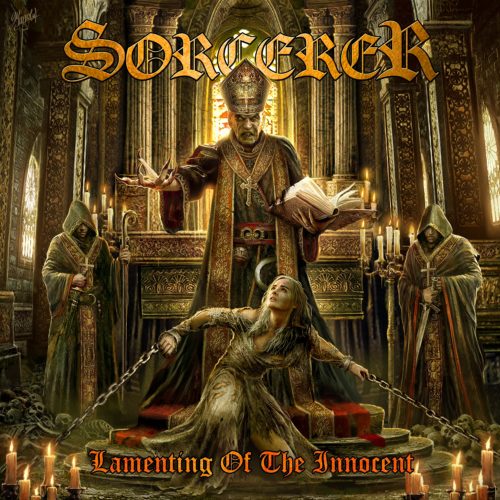
    Sorcerer_Lamenting-of-the-Innocent-500x500So why didn’t you make a concept album out of “Lamenting Of The Innocent”, it surely sounds like something you could have made a full blown concept out of?

    – Well, it’s more difficult than you think. I’ve been involved with  a band called Section A, and I did a concept album there, called “Parallel Lives”. I can tell you, it’s really hard to get a good idea out of ten songs. I we felt we wanted to record one or two or maybe even four songs on the album that were standing alone.

    As usual, I guess the lyrics are written by you and Conny. Describe how you work together when writing the lyrics.

    – It’s different from album to album. On the first one, me and Conny wrote all the lyrics while we were writing the melodies. We came up with the song title, then wrote the melodies and the lyrics at the same time. On the second album we came up with the titles and then I did most of the lyrics, while Connny put his touch on what I already had done. On this new album Justin Biggs has also contributed, so he’s written two or three lyrics, and me and Conny the rest. So its been a different process for each album, but we usually write the lyrics at the same as we write the melodies. Due to the fact that this is some kind of conceptual album, me and Conny just made bullshit lyrics in the beginning, because we didn’t want limit Justins possibilites in any way.

    There are some really strong melodies on the album. The chorus to the title track for instance or the one in “Where Spirits Die”, and some of these melodies carry a similar feeling. 

    – I agree with you. I don’t know what it is really. I’ve been doing this for so many years now, and it’s just the way I write music. Me and Conny have been together for 20 years, doing melodies and we know each other inside out. I can’t explain it, but I am thankful that you feel there is a connection between the individual tracks, because it means that we have a sound that sticks out, something that is really important.

    While most of the elements on the new album are well known in the context that is Sorcerer, there is at least one unusual element present, as there is a bit of growling on the album. Anders explains why the band has added a bit of this flavor this time around. 

    – It’s Justin actually, that is doing the growling. It’s simply a new thing we wanted to incorporate on this album, trying to do something new, something interesting. Something you wouldn’t expect from Sorcerer. I think it came out really cool. On the first single “The Hammer Of Witches” there is some growling, almost like a choir of football supporter chanting: “Burn Witch Burn”. There is also a real growl part in there by Justin. I think it fits really well.

    Being a proper clean voice heavy metal singer, what did you think of growling when it first became popular?

    – I think it was horrible really. I didn’t like it at all. I still have a hard time with some of that stuff, but some bands, Tribulation for instance, do it in a melodic way, that I  really like.  As  long as you can hear what the vocalist is singing, I can enjoy it, but when it’s just a sound coming out, I have problems with that. I  am not narrow minded, I like a lot of different genres of music so, but in my opinion, growling is not really singing.

    I am always very impressed by singers that can both sing very melodic and growl at the same time, people like your fellow Swedes Dan Swanö or Bjørn Strid for instance. 

    – Yeah, how the fuck do they do it? I certainly can’t do it. I am very impressed too. I know Bjørn, I think he is a fantastic singer. He has both the growl, the high notes and the power. I certainly would need to go and learn it to be able to do it, but it’s not my style either.

    It seems “Lamenting Of The Innocent” was planned for spring so you could do some summer festivals this year. How disappointed are you at the moment?

    – We are devastated of course, just like so many other bands. I am good friends with the guys in Wolf, they had to cancel half their tour. It’s too bad, the only thing I can say is good in all this misery, is that people are hooked up to the Internet all the time. So when we released our singles and soon the new album, people are aware, more perhaps than usually. But regarding the shows, it’s really sad. We had some great ones planned, but right now I am unsure if any of them will happen. It’s plain miserable, but it’s the same for everyone, we’re all in a situation we don’t wanna be in.

    I remember that you signed a deal for three records with Metal Blade, three albums that you now have delivered. Will you continue working with the label?  

    – We will wait and see how the album will be received. So far it looks good, we have gotten some heads up from a few of the most important magazines. We have great respect for our record label, and are super happy about what they have done so far. I guess we have to sit down and find out how we can make the next step, if Metal Blade is ready to take it with us, we will surely sgin up with them again.

    Sorcerer on Facebook