Category: news

  • Scarblade Releases New Single “Guardians of Time” From Upcoming Album

    Swedish heavy metal band Scarblade has released a brand new single and accompanying music video for the title track of their highly anticipated upcoming album, Guardians of Time. The new full length record is officially scheduled for a worldwide release on October 30 via Wormholedeath. Musically, the new single captures the soaring melodies, dynamic songwriting, and memorable hooks that define the group. Blending traditional heavy metal foundations with a modern edge, the track serves as a powerful introduction to the new era of the band, celebrating their return with energetic performances designed to stay with listeners long after the final note.

    Operating out of Gothenburg, Scarblade was originally founded in 2015 by vocalist Alicke Kostopoulou. Following the success of their 2016 debut album, the group established a strong live presence by sharing stages across Europe with prominent acts like W.A.S.P. and Kamelot. The current lineup features Kostopoulou alongside keyboardist Johan Bernspång, drummer Viktor Heineson, bassist Jorge B’Atz, and guitarist Josip Markovic, with longtime guitarist Mathias Helgesson also contributing to the new record. Now armed with their upcoming sophomore release, the five piece unit continues to strengthen their reputation within the Scandinavian metal scene by delivering a passionate and modern take on classic heavy metal.

    The post Scarblade Releases New Single “Guardians of Time” From Upcoming Album first appeared on FemMetal – Goddesses of Metal.

  • 10 Essential Rock Songs About Liars And Lying

    Sheryl Crow playing guitar for the article 10 Essential Rock Songs About Liars And Lying

    It’s kind of sad that this one was so easy to do. So many songs have been written about liars, lying, deception, and betrayal that it forces the question: what is wrong with all of us? Why is it so easy to lie, and why do we all do so much of it? Well, thankfully, this isn’t a class in psychology, but rather a celebration of some of the greatest rock songs ever written about liars. Hmmm, I’m not sure if that makes it any better. # 10 – Would I Lie to You? – Eurythmics Opening our list of

    The post 10 Essential Rock Songs About Liars And Lying appeared first on ClassicRockHistory.com.

  • Secret Rule Releases New Single “Edge of Control” Ahead Of European Tour

    Italian modern metal band Secret Rule released their heavy new single “Edge of Control” on September 1 via Rockshots Records. The track serves as the first official preview from their highly anticipated upcoming eleventh studio album. Musically, the new song introduces a sharper and more contemporary direction for the group by blending heavy guitars and crushing breakdowns with electronic textures and cinematic layers. Thematically, “Edge of Control” places the listener directly inside a mind approaching its breaking point, exploring the internal conflict of rage, doubt, and the terrifying struggle against oneself.

    Driven by the emotionally charged vocal performance of frontwoman Angela Di Vincenzo, the track seamlessly transitions from volatile verses into an explosive chorus. Guitarist and composer Andy Menario explains that the new release was designed to feel direct and unpredictable while utilizing male vocal passages to create an additional layer of tension. To celebrate the arrival of the new single and the impending album, Secret Rule will soon embark on an extensive European tour where they will share stages alongside prominent symphonic metal acts Xandria and Seven Spires.

    The post Secret Rule Releases New Single “Edge of Control” Ahead Of European Tour first appeared on FemMetal – Goddesses of Metal.

  • SELIAS Releases New Single “Bastard” From Upcoming Album “Nine Lives”

    Toronto based melodic death and groove metal band SELIAS has officially released a relentless new single and accompanying music video titled “Bastard.” The heavy new track explores the dark reality of psychological trauma and the desperate struggle to reclaim personal identity from emotional damage. Driven by aggressive guitar riffs, groove focused rhythms, and powerful vocal deliveries, the song captures the intense tension between collapsing under despair and fighting back against the weight of the past.

    Formed in 2021, the Canadian group is currently preparing for the release of their highly anticipated third studio album Nine Lives. The upcoming record promises a heavier sonic direction while remaining true to the foundational sound established on their debut album HEADSHOT and their highly successful 2025 sophomore release KILLKARMA. Following extensive touring across Canada and the United States, SELIAS continues to build a massive international audience by delivering energetic live performances alongside their evolving modern metal identity.

    The post SELIAS Releases New Single “Bastard” From Upcoming Album “Nine Lives” first appeared on FemMetal – Goddesses of Metal.

  • Emma Ruth Rundle – Debuts ‘God’s Picture’ Single

    As the official release of These Killing Times album is slowly approaching, Emma Ruth Rundle presents a video clip for another new advance single “God’s Picture”.
    Read more…
  • “I wanted to retrieve my late grandma’s voice for my mum. Then I realised what she was really talking about”: How The Anchoress found a new way of dealing with trauma from a long-lost tape

    Catherine Anne Davies, aka The Anchoress, explores past, present and future generations of her family on As We Once Were. The album finds her making peace with trauma and tackling temperamental analogue gear in the studio. She tells Prog about its creation, and the old recordings that inspired it.

    Catherine Anne Davies has rebuilt her relationship with trauma. On 2021’s The Art Of Losing she approached trauma with a strange twang of longing. Throughout the critically acclaimed release – a triumph of string-embellished agony and layered prog pop suffering – she untangled a web of her darkest, most life-altering tragedies. But alongside the pain was a yearning to mend.

    At the time The Anchoress was split in two: the record presented a version of herself after her grief and trauma, while placing the before version of herself on a pedestal. “I think there’s a toxic idea of the tortured genius that persists in music,” she reflects. “We must sit in that space of suffering, and we must sit in that space of reflection and continue to self-destruct. There’s much more value to be found in putting yourself back together.”

    Her new album, As We Once Were, concludes that to succeed in the art of losing you have to make peace with what’s been lost,“rather than continuing to break yourself” – that only prolongs the pain. “When certain things happen to us, we cannot be the same as we once were,” she says. “Our initial response is to want to try to repair. We want to go back to the pre-broken version of ourselves. That isn’t possible.”

    Peel back the layers of astute musical eccentricity, and Davies’ core is one of logic. In her mind, the importance of acknowledging and retaining trauma makes sense on a grander scale, beyond ourselves. “Evolutionary speaking, it’s useful to remember the mushrooms are poisonous,” she notes. Once we learn that fire is hot, we know not to place our hand over a flame. The same applies to generational trauma.

    Her family history includes the drownings of her mum’s older sister and and two others in the River Severn, and she remains cautious of bodies of water, especially when considering the safety of her young child. “I feel my grandmother’s trauma at the loss of her five-year-old daughter,” she says. “It kind of means I’m not gonna let mine go anywhere near water. Those traumas help us survive.”

    While The Art Of Losing served as her way of proving herself – a “stubborn refusal to collaborate” – As We Once Were sees her actively seeks the help of feminine pillars in her life to unpack and process trauma. Four generations of Davies ladies are heard in the music; her own voice is accompanied by recordings of her late gran, more recent recordgins of her mum and clips of her own daughter singing.

    “It was really emotional, finding those old tapes of my grandma,” says Davies. “I had vague recollections of my sister recording her in the lounge for her history homework, so I knew there was a tape somewhere. Then I found it at my mum’s house… It was almost like it was delivered to me. It was really chewed up, lots of sound reversal. I spent about a week doing audio restoration in the studio.

    “I originally wanted to retrieve my grandma’s voice for my mum, but when I first sent her a snippet, it was so moving I cried. Then, as I was listening to it, I realised what the interview was really about – being a woman across the 20th century – and it was inadvertently quite political and transgressive.”

    The recordings showed how strongly gran and granddaughter were aligned, not just by blood, but in their beliefs. When she began choosing clips for songs, it felt like an “epiphany,” she recalls. “Then I brought my mum’s voice into it as well, and obviously when you have a small child, you’re always recording little bits and pieces.”

    Opening track Du Temps Perdu (Introduction) bridges the gap between generations. There’s a gentle, childlike innocence in its twinkling keys and nostalgic synths, oozing a comforting memory that’s just out of reach. As her grandmother’s voice fades into Davie’s excitable child, it’s asserting a “generational column of steel” – an interwoven structure that both reminds Davies where she comes from and what to look forward to.

    “I took a little inspiration from what Kate Bush did with the voice of her son, Bertie, which is woven quite tastefully into 2005’s Aerial,” she explains. “Frank O’Hara had this idea in his collection In Memory Of My Feelings – the title of the album I did with Bernard Butler in 2020 – that a memory of a person can take on another life of immortality through art.”

    With old synths it feels like if you don’t record it in the moment it’s going to disappear. That felt so conceptually resonant

    There are plenty more literary nods to dig into; Davies is a university professor of English, after all. Throw Over Your Man contains Virginia Woolf and Vita Sackville-West’s love letters to each other in a tambourine-jangling act of seduction. She explains: “I’ve always felt a little bit guilty about my music career: it’s a very working-class guilt. So it’s nice when your work does something good for society, even if it’s just encouraging someone to dive deeper.”

    The record isn’t just Davies flicking through the family photo album and wistfully reminiscing. Hand To The Tide is one of its darker moment – and its ominous, creeping sense of fear captures the horror of her relatives who were died in the “freak tidal wave accident.” Stop The World is her most vulnerable track to date; she approached it like a wounded animal, as if it could attack at any moment. The work is defined by a sound that’s actively “embracing the imperfect.”

    Rather than using perfected digital synth models, Davies went to Pete Townshend’s studio to get hands-on with some of his analogue synths to capture the feeling. “There was this sort of dual congruence with my old recordings and these old analogue instruments from the 70s and 80s,” she says. “I almost thought I should put, ‘This record was made by humans’ in the credits.

    “When you work with an old analogue synth, it can take two and a half hours to get to a specific sound. With modern synthesisers, you can save your preset and go back to it, but with old synths there’s this sense of grabbing gold dust as it’s coming through your fingers. The circuits are so unstable. Nobody else could get exactly the same sound as you, and it feels like if you don’t record it in the moment it’s going to disappear. That felt so conceptually resonant.”

    She points to the midpoint track, All I Really Want Is Peace. As it says on the tin, she’s now beyond the drama – and the piece closes out into a glitching, liminal meadow clearing, as intimate recordings of her daughter signal the beginning of Stop The World. It makes the Richard Rohr quote paired with All Fall Down feel particularly poignant: “If we don’t transform our pain, we will most assuredly transmit it, usually to those closest to us.”

    As We Once Were is that transformation, as Davies summarises: “If I’m not making something new and useful for myself and my daughter, what’s the point?”

    As We Once Were is on sale now.
  • Smoulder – Unveil New Track

    Smoulder have premiered the second single, “Shadow Of The Vulture”, from their forthcoming long player Witch Wife In An Alien World.
    Read more…
  • Soliloquium – Will Put Out New Record Next Month

    Following last year’s Famine release, death doom one-man act Soliloquium is already set to return with the new full-length. Entitled Upheaval, it will be set free on October 23rd via Meuse Music Records.
    Read more…
  • “You could buy them at any novelty store. Nobody tried to name him. He just became the Not Man.” The story of the ’80s toy which accidentally became Anthrax’s iconic mascot

    In 1985, Heartland created a series of Monster Toys, palm-sized rubber faces which could be distorted into many grimaces, simply by placing your fingers into the back of the toy.

    There were four to collect, each more hideous than the last. Some toy historians say they came with an animatronic body which held a red, glowing axe and moved around to the strains of When the Saints Go Marching In, much to the annoyance of anyone in close proximity. It was a different time.

    Heartland had also created an iconic thrash metal mascot, quite by accident.

    Following the release of Spreading the Disease, which emerged in the same year as Monster Toys, Anthrax had their own gurning anti-hero; a moustachioed maniac would appear on their tour shirts. He’d later appear on album and single artwork, too, as well get inked into drummer Charlie Benante‘s upper left arm.

    “I remember one day we were in a store in Boston, and we see the little doll,” singer Joey Belladonna recalled during a 1988 interview. “You ever seen the thing before? And then Island records had put a thing out on Spreading The Disease that said ‘By George, I think he’s got it’; it was his face and we figured we’d have him along with us basically. Nothing really big, he just happened to be around us. He’ll be in the new video!”

    “You could buy it at any novelty store,” remembers Scott Ian. “We all thought it was cool. Nobody tried to name him. He just became the Not Man.”

    But why ‘Not Man’? And not something similar to Murray, like Dio’s demon pal?

    “I knew this kid, Alan Luckman, and he used to say it all the time in about ’74, ’75. And that’s what made me say it,” Ian told Guitar World in 1993. “That’s how it became Scott Not and all that kind of crap.”

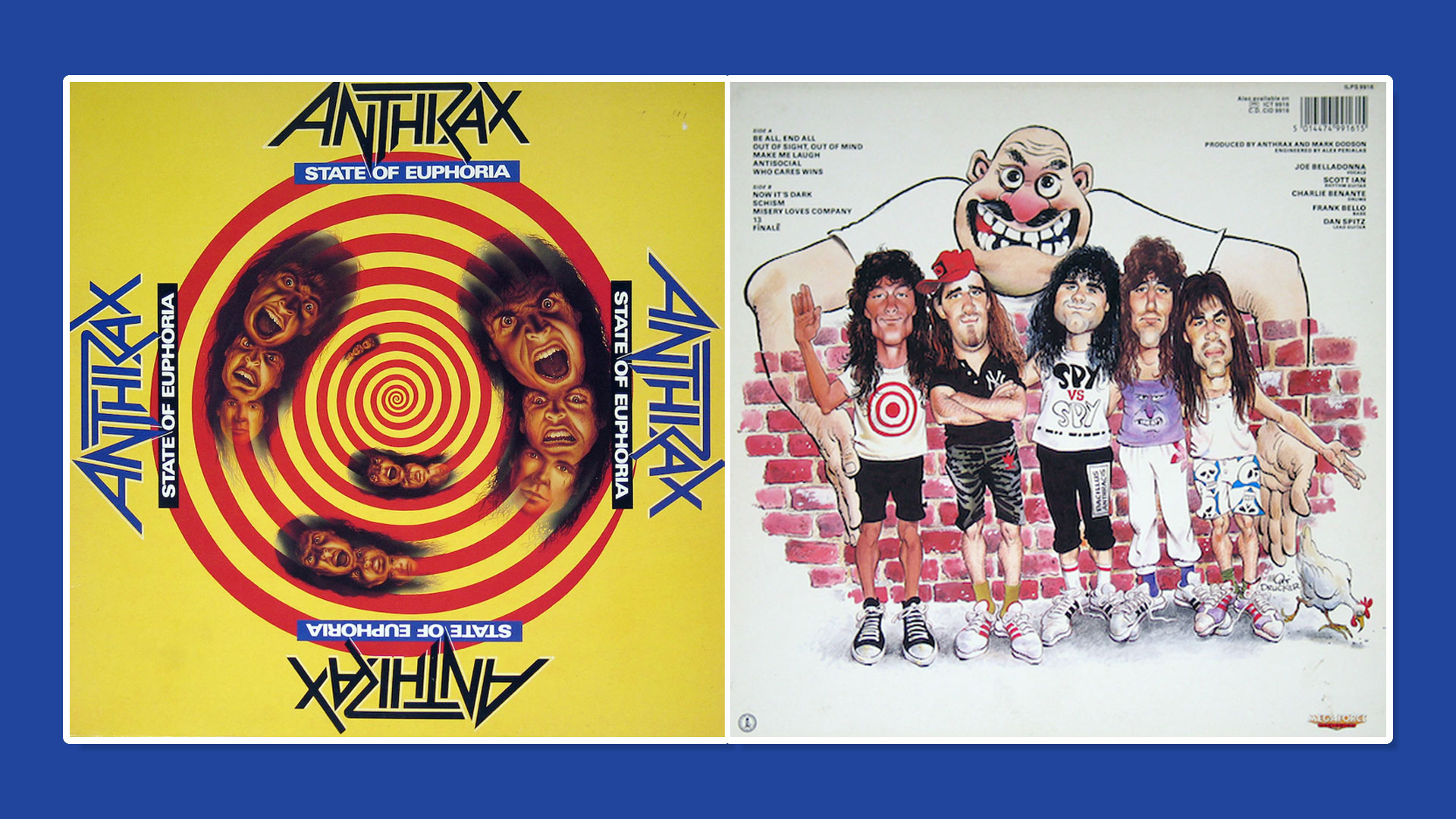
    The front and back artwork for Anthrax's 1988 album State of Euphoria

    The artwork for Anthrax’s 1988 album State of Euphoria (Image credit: Island Records)

    Metal mascots were largely serious brand extensions of globally successful bands. Iron Maiden had Eddie, Megadeth had Vic Rattlehead, while Dio had the evil-sounding demon Murray.

    The Not Man was a case of the band planting their tongue firmly in their cheek. After all, the band were wearing Bermuda shorts, recording rap singles and employing legendary MAD magazine illustrator Mort Drucker to draw their new mascot cradling the band on the back of their 1988 album State of Euphoria.

    International versions of their single Antisocial depicted the Not Man spray painting a wall. In the accompanying video, their drum tech John Tempesta (who’d go on to join Exodus, Testament, White Zombie, The Cult and Helmet) wore a big papier-mâché head and enthusiastically high-fiving the crowd. As a joke, the head was removed at the end of the video to show it was a legendary vocalist was under there all along. Spoiler: he wasn’t, really.

    “We got Ozzy to wear the Not Man head,” laughs Ian, still seemingly in disbelief decades later. “He agreed to do that! Ozzy was stoked. It’s hard to explain how stuff like that felt because it was unbelievable.”

    While Not Man has made fleeting appearances over the years, he has remained an iconic part of Anthrax’s visual history. He appeared in the band’s 2021 graphic novel Among the Living, and in 2023, a zombified version also featured in Iron Maiden’s mobile game Legacy of the Beast.

    “We couldn’t be happier to be featured in this game,” read a statement from the band. “When the idea came up, we were completely taken aback by it, like, ‘are you serious?’ You have Eddie, one of the greatest mascots of all time, and the Not-Man!”

    In coming months, the band will publish their forthcoming book NOT: The Illustrated Oral History Of Anthrax through Z2 comics, and is heavily featured in early glimpses of the artwork, including a very cheeky parody of the DC Comics one-shot Batman: The Killing Joke by Alan Moore, Brian Bolland, and John Higgins.