In 19th-century colonial India, a girl’s future could be decided before she was old enough to have much say in it. Child marriage was common, and girls could be married years before they were old enough to understand what marriage would mean for their adult lives. Once the marriage had been performed, however, the question of what happened when the girl grew up was considerably less simple. Could a marriage entered into during childhood bind a woman who had never chosen it for herself? In the 1880s, that question found its way into a courtroom through the case of a young woman named Rukhmabai.
Rukhmabai had been married at eleven to Dadaji Bhikaji, who was nineteen. She did not immediately move into his household. Instead, she remained with her mother and continued her education, becoming an unusually well-educated young woman for the time. She read widely and followed the social reform debates taking place around her. As she grew older, Dadaji expected her to join him and begin married life. Rukhmabai had other ideas. She did not believe that a decision made for her when she was a child should decide where she lived, whom she lived with, or what happened to the rest of her life.
Dadaji took her refusal to court. He filed a suit for “restitution of conjugal rights,” a legal remedy inherited from English law and used in the colonial Indian courts. In practical terms, he was asking the court to order Rukhmabai to live with him as his wife. The case therefore involved more than a disagreement between two people. It raised an uncomfortable question about what a childhood marriage actually meant once the child had become an adult.
In 1885, Justice Robert Pinhey ruled in Rukhmabai’s favor. He concluded that the court could not simply force her into a marital relationship she had not consented to as an adult. Dadaji challenged the decision, and the dispute continued through further legal proceedings as the courts wrestled with Hindu marriage law and the colonial doctrine of restitution of conjugal rights. Eventually, Justice Farran issued a decree ordering Rukhmabai to live with her husband. If she refused, she faced six months in prison.
She refused.
Rukhmabai made it clear that imprisonment was preferable to being forced into a marriage she had never chosen for herself. She also took the argument outside the courtroom. Writing under the name “A Hindu Lady,” she published letters in the press about child marriage, women’s education, and the idea that a marriage arranged during childhood should remain binding for the rest of a woman’s life. The case attracted attention in both India and Britain, drawing social reformers and the press into an increasingly heated debate about marriage, consent, and the rights of women.
The dispute finally ended in 1888. Dadaji agreed to give up his claims in return for Rs. 2,000. Rukhmabai did not have to move into his household, and she did not serve the prison sentence that had been threatened. By then, however, the woman who had spent years fighting over the right to decide her own future had another plan for that future. With financial support from people who had followed her case, she went to England to study medicine.
She enrolled at the London School of Medicine for Women and trained at the Royal Free Hospital. Becoming a doctor was hardly an ordinary path for a woman at the time, and completing her medical education required further study in Edinburgh. Rukhmabai eventually returned to India as one of the country’s early women physicians. In 1895, she became Chief Medical Officer at the Women’s Hospital in Surat and later held the same position at the Zenana Hospital in Rajkot. She spent decades treating women and children and continued working as a doctor until retiring around 1930.
Her case also became part of the larger debate surrounding child marriage and marital consent that contributed to the passage of the Age of Consent Act in 1891. The law did not outlaw child marriage. Instead, it raised the age at which sexual intercourse with a wife was legally treated as rape under the Indian Penal Code. Rukhmabai’s case was one of several developments that pushed the subject of child marriage and the legal rights of girls further into public discussion.
The India in which Rukhmabai lived had laws and customs very different from those of today. Still, there is something unsettlingly straightforward about the problem she faced. A decision had been made about her when she was eleven, and years later, the legal system was being asked to make that childhood decision binding on the adult woman she had become. Rukhmabai spent years arguing that it should not. Then she went on to become a doctor, treating women and children in a country where women had only recently begun entering the medical profession. The marriage that had been chosen for her did not disappear from her history, but it did not get to decide what happened next.
Recorded and released during the second half of 1965, Rubber Soul is probably the most pivotal album of the Fab Four catalog. At this stage in their career, The Beatles were the biggest act in the world. And they weren’t about to lay down their arms and get all comfy. Their success fueled a desire to improve, to make better records, to go where no recording artist had gone before. After Help!, this is exactly what they did.
Until Rubber Soul, Beatles singles were more revered than their albums. The UK and US catalogs were also mismatched, sometimes confusing. Aside from A Hard’s Day Night and Help!, UK Beatles albums had different titles than US Beatles albums, which were loaded up with A- and B-side singles. While the trend continued with having a different track listing between the UK and US versions of Rubber Soul, the Beatles certainly set about recording a proper album, not just a collection of hits. As a nod to the influences around them, it was given its name by the Beatles. Its cover was especially photographed and stretched to reflect the album title. To smooth the transition and keep the brass happy, they opted to release a double A-side single of “Day Tripper” and “We Can Work It Out” alongside Rubber Soul. Fans scooped up both in copious quantities.
The music on Rubber Soul show tremendous growth in terms of songwriting and innovation. John Lennon and Paul McCartney’s individual personalities became more recognizable and distinctive from one another. There was McCartney the sunny-side up optimist and Lennon the acerbic cynic — perfect temperaments to spark a creative flame. For every “Nowhere Man,” there’s “Michelle.” Then again, McCartney’s anguish with then-girlfriend Jane Asher seeps through on “You Won’t See Me,” “I’m Looking Through You,” “Wait,” and even “We Can Work It Out.” The trademark cheerful disposition was neatly tucked away for those numbers.
Without his tongue firmly in his cheek, Lennon wrote one of his greatest songs for Rubber Soul — the timeless “In My Life.” It’s well-known he wrote songs mostly about himself, and “In My Life” certainly encapsulates the “friends,” “lovers,” and “places” who passed through his life. Thematically, it transcends the silly little love songs that lifted the group to the “toppermost” of the pop charts. Blossoming into world-class songwriters, John Lennon and Paul McCartney were now rated in the same league as Rodgers and Hammerstein.
George Harrison was also upping his game as a songwriter, bringing “Think for Yourself” and “If I Needed Someone” to the table, as well as making major contributions to the arrangements and instrumentally. We can all agree his sitar work on “Norwegian Wood” defines the entire mood of the song. You can also thank the guitarist for the tambourine and middle eight waltz idea in “We Can Work It Out.”
In addition to writing better songs, the Beatles were also intent on making their records sound better. Though they reportedly favored mono over stereo, they unanimously pushed for more volume and bass. At the same time, their imaginations were pushing the technology to its limits. Revolver would, of course, take it even further.
Fast forward to 2026, and the tech has come of age. This is apparently what it took to finally give Rubber Soul its due as an expanded Super Deluxe Edition box set, available in four CD and five LP configurations. The folks behind Beatles reissues haven’t always followed a particular strategy. Maybe they could have gotten a jump on both Revolver and Rubber Soul for their 50th anniversaries, but the ball didn’t get rolling until 2017 — 50 years after Sgt. Pepper’s Lonely Hearts Club Band, whose half-century birthday could not be overlooked. And it went from there with The Beatles (aka The White Album), Abbey Road and Let It Be all getting expanded makeovers 50 years after their release.
Even though it came out in 1966, Revolver had to wait for expansion until 2022. Which means that Rubber Soul, the only remaining Beatles album of any consequence, was, thanks in part to the 1962-1966, 1967-1970, and Anthology reissues, also delayed. Just in time before the holidays, it’s finally happened and the Rubber Soul box set is here.
Of course, recording technology has made giant strides, especially in the last few years. Old four-track tapes can not only be digitized, cleaned up, and broken down; now, through the use of AI technology developed by Peter Jackson’s WingNut Films, instruments and voices once recorded together can be separated, tinkered with, enhanced where necessary, and mixed across stereo and multichannel spectrums.
Expanded Special Editions of Rubber Soul enable audiophiles to hear a 2026 stereo and Dolby Atmos (on a Blu-ray that’s sold separately) mix, while purists can revisit the original mono mix and the original Capitol US release. The 2026 stereo mix taps into the depth and musicality of all the songs with a brighter return than your earbuds deserve. The hot tip is to play back the high-resolution stereo and Atmos mixes on a high-end system to uncover the real profundity of the music.
Aside from the mixes, there are extras for hardcore Beatles fans to embrace and soak up. This includes 24 early session recordings (20 of which are previously unreleased takes) and three previously unreleased home demos of “Day Tripper” and “We Can Work It Out,” plus “Little Girl,” a lost John Lennon song pieced together by Giles Martin. It’s a simple little ditty, but enough to percolate Beatles circles for the time being.
What fans might find most fascinating are the segments of the Beatles — mostly Lennon, McCartney, and Harrison — talking among themselves, working out arrangements, making suggestions, and, of course, cracking jokes and goofing off. Hearing them labor through the vocal harmonies on “Think For Yourself” is a priceless fly-on the-wall experience. At one point, Lennon, focusing on a part, declares, “I know…I get something in me head, and all the walls of Rome couldn’t stop me.” Later, venting frustration, he mutters: “I’m sorry, sometimes I feel less than useless at these sessions. I really do…” You hear McCartney reel him back into the fold and they continue. Once they nail it — and beautifully so — it’s on to the next one. No doubt, there’s gold in these rough takes any fan, passing or dedicated, will savor and appreciate.
The Original Mono Master of the 14 tracks on the UK release and the Original Capitol US release of 12 tracks complete the Special Edition. While these are available in other Beatles box sets, they’re certainly nice-to-haves, in addition to the fabulous 88-page hardbound book with comments from both John Lennon and Paul McCartney on Rubber Soul, plus a song-by-song analysis, insights into the writing, recording, and reception of the album, notes on the updates, plus the usual array of rare photographs and other eye candy worthy enough for the coffee table. The 2026 stereo mix can also be had on a single CD and LP. As if that wasn’t enough to cure the fever, there’s limited-edition orange vinyl and D2C exclusive Zoetrope vinyl editions of Rubber Soul for that special someone (or yourself).
Now that Rubber Soul has been brought up to spec, one has to ask: What’s left? All the albums are covered. The hits and unreleased bits (save for a couple so-called unsalvageable outtakes and one-offs) are widely shared and shared again. Have we hit a Beatles wall? Something tells me, there’s more to come. The 60th anniversary of the Summer of Love can’t possibly pass by without the Beatles, so maybe, just maybe…we’ll just have to see.
Jeff "Mantas" Dunn and Conrad "Cronos" Lant may have had their differences, but the guitarist put it aside to pay tribute to the Venom legend. Continue reading…
Influential metal legend, Venom's Conrad 'Cronos' Lant, has died at age 63, as revealed in a statement from the band and the musician's son. Continue reading…
Ohio State University football is using Slipknot in an apparent attempt to troll the University of Iowa ahead of this weekend's Big Ten matchup.
Continue reading…
The artist known as Squindo discuses his journey from banging on bus doors to working with Metallica and getting ready for their Sphere residency in Las Vegas. Continue reading…
The death of Venom frontman Conrad “Cronos” Lant at the age of 63 came as a shock to many. Earlier this year, he gave what turned out to be his final interview to Classic Rock, and we found him in animated form, holding forth on his love of Kate Bush, his years with Venom and his unlikely second career as a multimedia engineer. “Ozzy was singing about the Devil,” he told us. “I wanted to be the Devil.”
Conrad ‘Cronos’ Lant might be the last stranger Kate Bush kissed on the lips in public. It was September 1980, and the queen of witchy art-pop was doing a signing session at Virgin Records in Newcastle during a stop-off in the city as part of her now-fabled Tour Of Life audio-visual extravaganza.
Cronos’s love of Bush and her music might seem at odds with the filth-hound racket he was making with his own band, demonic NWOBHM brat-princes Venom, but it’s just one of many unexpected and interesting things about him.
“What’s not to love about Kate Bush?” he says now, 46 years later, Geordie accent as wide as the Tyne estuary. “She’s got an incredible way of writing. I even dyed me hair red with henna because of her.”
So when Cronos heard about that signing session, he told his bosses at the recording studio where he worked that he was bunking off for a couple of hours.
“I raced in and pushed me way to the front of the queue, got as near as I could,” he recalls. “She had these posters she was signing. I said: ‘Can you write “To Cronos…”? Then I said: ‘Can I have a kiss?’”
Some might have recoiled at the sight of a short, scrawny Geordie in a leather jacket asking for a smacker. But Kate Bush was made of sterner stuff.
“She leaned over and kissed me on me lips,” he says. “My knees went. As I was walking away in a daze, the guy behind us says: ‘Can I have a kiss?’ And I heard this voice: ‘No more kisses.’ I was the last one.”
He beams like a moonstruck teenager at the memory. “I’ve still got the poster: ‘To Cronos, lots of love, Kate Bush.’”
There are two versions of Cronos. One is the gargling, bass-wrecking Beelzebubian madman who has fronted Venom on and (occasionally) off since the end of the 70s. The other is the garrulous Geordie who used to teach aerobics, is into birdwatching and growing chillis, and loves Joni Mitchell, Jethro Tull and, yes, Kate Bush.
Both versions are here on this warm Saturday morning in May in London, nursing Coke-and-ice in a booth in a Wetherspoons on Camden Lock. Later today, he and current Venom guitarist Stuart ‘Rage’ Dixon and drummer Danny ‘Dante’ Needham will descend on nearby metal shop Raven Records for their own in-store ahead of the release of the band’s sixteenth album, Into Oblivion, a wild-eyed rush of noise and sacrilege. ‘Satan ejaculates!’ Cronos snarls on one song, Man And Beast. “I just like using profanity for the fuck of it,” he says with a grin.
But it’s not just provocation. Nevermore references Cronos’s beloved Edgar Allan Poe. “The Raven, The Tell-Tale Heart, I love that stuff,” he says. He was even thinking of recording his own audiobook version of Poe’s poetry, putting his own spin on it. He begins reciting phrases from The Raven: “‘Bleak December… saintly days of yore.’”
When talking, Cronos might make Jimmy Nail sound like a minor royal, but he was born in London. South Chelsea, specifically. “The Who used to park their van around the corner and me mam used to get her cigarettes from the shop where Mick Jagger and them lot bought theirs too,” he says. “I remember seeing him on the telly and saying: ‘That’s the guy from the corner shop.’”
Moving to Newcastle at seven or eight was tough. He got into a fight on his first day of school because of his accent. “‘Cockney wanker!’” he says, then mimes a punch: “Bam!” He doesn’t say who was on the receiving end of it.
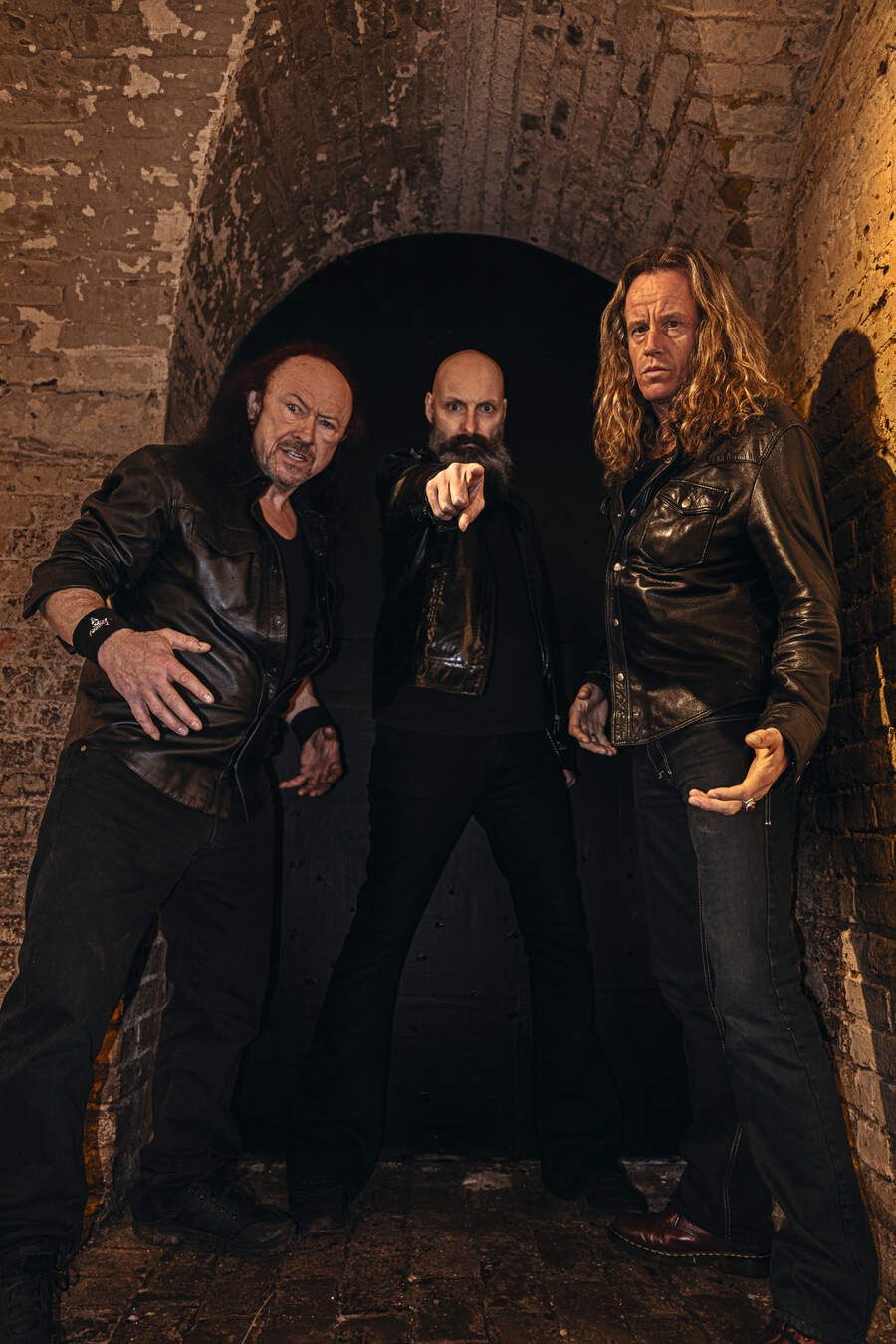
Venom 2026 (l-r): Cronos, Stuart Dixon, Danny Needham (Image credit: Necroshorns)
He grins when he describes what he was like as a teenager. “A wanker. A proper twat. Me and me mate would terrorise the school.” One day, he broke into his mum’s stash of Mogadons and washed them down with a bottle of vodka. “I can’t even remember that day at school, but apparently I was wanting to fight all the teachers.”
He wanted to join the army as a kid, which he thinks might have straightened him out, but getting shot in the eye with a pellet when he and his friends were messing about with air rifles put the kibosh on that. “I’m blind in this eye,” he says, pointing to his right peeper. “The pellet’s still in there.”
He loved music as a kid: early Queen, Jethro Tull. His elder brother, Graham, was an in-demand drummer who ended up joining local heroes Prefab Sprout. “Oh, they were shite. I hated those fuckers,” he says of the latter. “They turned up in the studio one day and the engineer said: ‘This is Prefab Sprout.’ ‘Prefab what?’ We were rolling round the floor laughing our cocks off.”
Cronos got a job in a local recording studio, Impulse. In his telling, he persuaded the owners to set up Neat Records to release singles and albums by local bands such as Fist, Tygers Of Pan Tang and, eventually, Venom themselves. “I said: ‘All this heavy music is going on. Yous needed to get on it.”
He’d joined Venom when he was 16, fuelled by the mad rush of punk. He wasn’t their singer at first. That was Clive Archer, who wore protocorpse paint make-up and had the stage name Jesus Christ. “Jeff and Bray said: ‘We think you’re better than him.’ So we kicked him out and became a three-piece. I’ve never seen him since.”
Jeff is Jeff Dunn, aka original Venom guitarist Mantas, and Bray is drummer Tony Bray, aka Abaddon. This unholy trinity were on a mission to drag rock’n’roll to Hades, and they damn near succeeded. Venom’s first two albums, 1982’s Welcome To Hell and the following year’s Black Metal are the twin fonts from which all extreme metal springs. Rough-arsed hymns of blasphemy that made Motörhead sound like The Nolans. As Cronos puts it: “Ozzy was singing about the Devil. I wanted to be the Devil.”
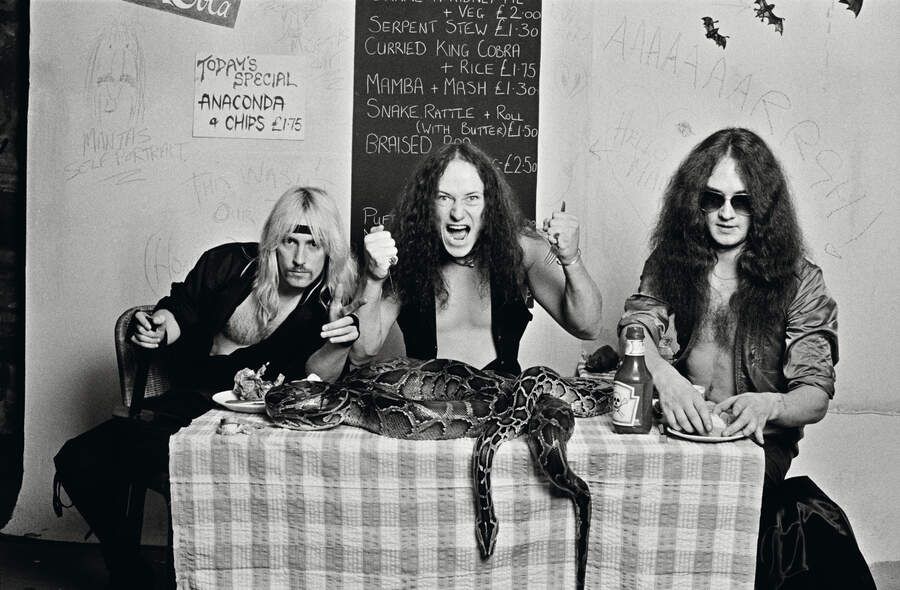
Venom in 1985: (l-r) Jeffrey ‘Mantas’ Dunn, Cronos and drummer Anthony ‘Abaddon’ Bray (Image credit: Fin Costello/Redferns)
To some, he came close. The title track of 1985’s heroically abrasive Possessed album landed them on the PMRC’s ‘Filthy Fifteen’ list of songs likely to corrupt America’s youth.
“I thought it was fucking great,” he says. “Fucking hell, you’ve got Frank Zappa and John Denver stepping up against these bored housewives. I’m a massive John Denver fan as well.” He starts singing: ‘You fill up my senses, like a night in the forest…’
The air of malevolence surrounding Venom electrified a generation of young American metal fans. Metallica and Slayer opened for Venom in the US. “Me and Cliff Burton used to hang out,” Cronos says of the late Metallica bassist. “He’d bring weed, I’d have hash. He was a proper stoner, Cliff. Good lad.”
Things were different back home in Britain. Gnarly metal fans loved Venom, but everyone else thought they were a joke, not least the press. “It seemed like England wanted fuck-all to do with Venom,” he says. “We must’ve stepped on the wrong toes.”
The only people who disliked Venom more than the press were Venom themselves.
“People have made up this myth about that line-up,” he says. “There was no camaraderie. We weren’t friends. When this band split, it was on bad terms.”
Technically, Venom didn’t split. Cronos quit in 1987, but the other two carried on without him. The original line-up reunited for one album in the mid-90s but the old problems resurfaced. One by one, Abaddon and Mantas fell away, leaving Cronos to lead the band ever since. The current three-piece line-up has been together for 17 years, almost three times as long as the original. Today there’s no love lost between Cronos, Mantas and Abaddon.
“Nah,” he says. “I don’t want anything to do with them two. Too much piss-fartin’ around.”
This is where the public perception of Cronos splits from the reality. Post-Venom, he considered quitting music. “I was gonna pack it all in. I was gonna be a slaughterman or work in the forestry commission. I love being outdoors.” Instead he formed a new band, Cronos, who leaned into more melodic heavy metal, verging on hard rock. They released two albums that are interesting rather than great.
But the early 90s saw him diversify in an unexpected fashion. He’d done his share of hard living in the 80s, but he was into weightlifting and fitness too. He’d seen how the aerobics craze had taken off on the back of Hollywood star Jane Fonda’s workout videos and he wanted in on the action. “I knew fuck-all about cardiovascular exercise, so I decided to go and learn how to do it properly,” he says. “I went to college, got top marks for everything in all me exams.”
By the early 90s he was working as a fitness instructor. “I did loads of classes. I played rave. We’d start off with mid-paced stuff, just to warm up, then it was bang! bang! bang!” He worked with guys from the military. “They used to come to the classes. We’d do it in sports halls or fields. They’d have their boots and backpacks on.”
Cronos was with his military buddies when he had the accident that nearly finished his music career for good. They’d take him climbing in Wales and Scotland. “Have you ever done it?” he asks. “The feeling you get being on top of a mountain is almost spiritual.”
He was on a climb in Wales in the early 2000s when he was hit by a falling rock. “The guy above us, the rock under his foot gave way,” he says. “I ducked out of the way, but it hit us square in the back of me neck – boom. I was braced up for a while.”
It wasn’t life-threatening, but it was serious. “I couldn’t play bass,” he says. “I certainly couldn’t stand up and play bass. I felt like I was done playing music. That’s when I took up the computer.”
This is yet another avenue that Cronos’s strange life has led him down
“A mate of mine had a computer company in Newcastle,” he says. “I was laughing at the graphics on the company logo, and he said: ‘Can you do better?’ I went: ‘Yeah.’”
He dived into Photoshop and began working as a multimedia engineer for his mate’s company. He saw it as an extension of what he’d done all his life. “Everything’s an art medium,” he says. “I could pick up some mud and create a picture on a canvas. This is the way I see creativity – nothing’s off the table. So AI comes along, and I’m like: ‘Yeah, I’ll try that.’”
He’s talking about the visual arts, not music.
“Nah,” he says. “I’ll always write me own music.”
Life today is only slightly less full-on than it has been. He grows chillis for a hobby, making sauces that he gives to friends. “If you’re talking Carolina Reapers and Nagas and all them boys, you’ve got to get your compost right,” is his tip. He was a member of the RSPB as a kid, and he still keeps an eye out for birds around his house in Northumberland. “Goldfinches, robins, wrens. We even had a heron in our back garden. I’ve always been into birds. Not just the flying ones,” he adds with a cackle.
It’s the kind of ripped-from-the-old-days gag you want from Cronos, a man who has spent almost 50 years giving less than zero fucks about what other people think of him – an approach that has brought him the good and the bad with it.
“It’s a journey and a story, and you’ve got to take everything in your stride,” he says, momentarily philosophical. “If you go back and change something, you change who you are today.”
It should sound surprising coming from a man who wrote a song called In League With Satan. But this is Cronos, and with him everything and nothing is a surprise.