If recent trends in popular culture have taught anything, it is that safeness and predictability remain the order of the day for artists looking to capture the ears of the mainstream. In this context, a fold of musicians seeking to buck said trends most brazenly, throwing proverbial caution to the wind and inviting all within earshot to step outside of their comfort zone, can’t help but be a welcome breath of fresh air.
Such has been the stock and trade of British progressive rock outfit and purveyors of the mathematical side of the sonic equation, Poly-Math, since their mid-2010s formation, eschewing the very concept of convention and fusing together disparate influences seamlessly into a compact series of instrumental jams. Their latest studio entry, sporting the esoterically themed title of Something Deeply Hidden, marks the fifth and arguably most adventurous foray into the studio LP format they’ve concocted since their 2013 debut EP Vertex.
Standing at a crossroads between the stylings of Ethio-jazz, classic progressive rock, post-rock, and math-rock, the four-piece arrangement that lays down these seven tapestries of sonic ambiguity walks a brilliant tightrope between virtuosic excess and tasteful accessibility.
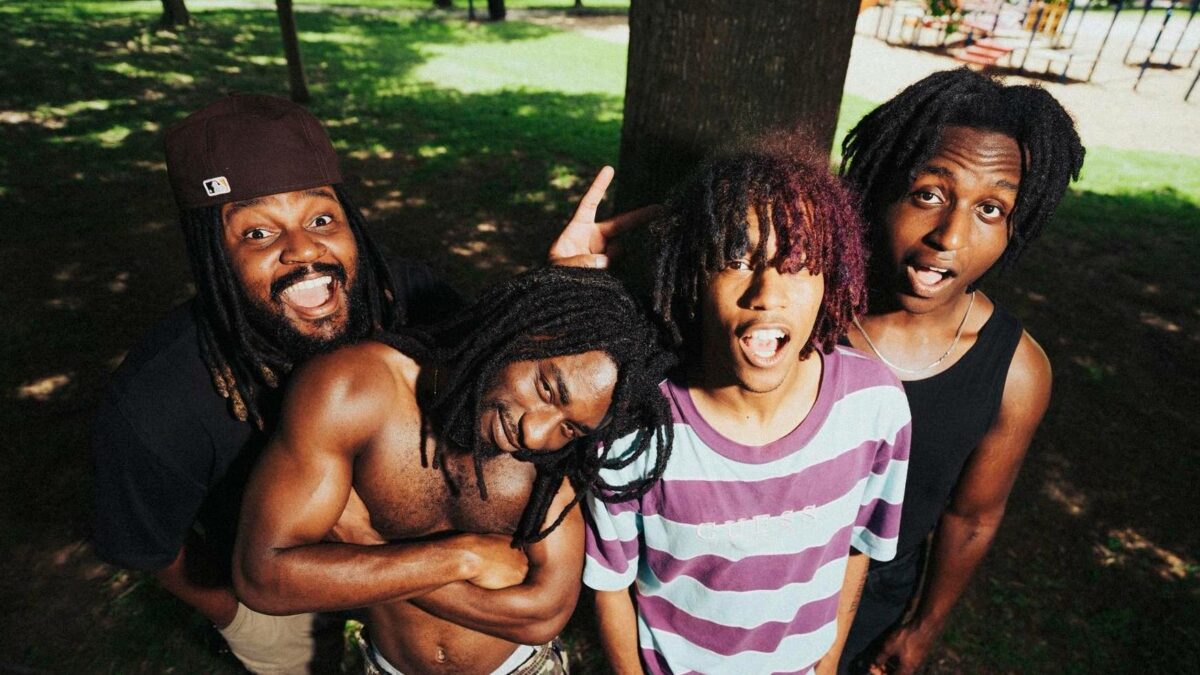
Between the loose jazzy grooves of drummer Chris Woollison, the happy traveling bass high-jinks of Joe Branton and the crunchy distorted six-string handiwork of Tim Walters; this trio that rounded out the original lineup has all the chops to hold a sizable candle to Rush at their most quirkily elaborate, yet the auditory niche that they establish mixes a greater degree of cold logic to go with the cultural mystique that flows through each composition. Much of this owes to the spacey ambience and oddball studio tricks brought to the fore by keyboardist Scott Gesner, which adds an additional layer of dissonance and depth that rockets the entire arrangement well into the cosmos.
Upon its very opening, Something Deeply Hidden establishes a tone of deep contemplation with an explosive execution, rocking as hard as some of the more aggressive mainline rock bands of the 70s while maintaining a thick, post-rock atmosphere. Consequently, the relatively compact opener “The Universe As An Engine” pounds out a mathematically elaborate rhythmic pulse between the drum kit and guitars that could be likened to an interstellar twist on “YYZ” with double the keyboard presence.
Nipping on its heels with an even more upbeat yet dissonant character is “OneTwoThreeFour Body Problem”, a rather unsubtle nod to the n-body problem (a concept in studying the motion and behavior of celestial bodies where more than 2 bodies result in an unsolvable equation) that matches chaotic drum work with highly agitated riffing and a generally spooky vibe fit for outer space.
Rounding out what might be dubbed the compact trio is the similarly short and upbeat “Chronostesia”, which crams in so many flashy, jazz-inspired twists and turns that it falls just shy of achieving sonic singularity. Generally, the longer things go, the more that the outlandish musical ideas populating this opus are given a chance to grow and develop.
The extended seven and a half minute jam dubbed “No Such Thing As Now” comes with its fair share of abrupt changes in feel and timbre, but it’s smooth grooving intro and its more agitated and hard-edged development section just past the halfway point feel less fleeting and make for a more grounded journey from A to B, even if the song’s title suggests there is no real distinction between the two.
A similar story is told on the slightly shorter “Spectral Disorder”, which sees Branton’s busy bass work enjoy a greater degree of prominence amid the deluge of jazzy drum fills, warring keyboard timbres, and crackling riffs and lead guitar passages. Yet the best is saved for last via the towering 8-minute final hurrah “Terror Management Theory”, which sees every moving part in the arrangement exploding into a kinetic war of virtuosic intrigue while having a clear sense of sectional development and progression that keeps it from being a mere showboating session.
Terms like avant-garde and experimental get thrown around when discussing any brand of progressive rock, perhaps rightly so given that the genre hasn’t really enjoyed a comparable resurgence since its peak in the early to mid 1970s, but they are labels that perfectly encapsulate just what Poly-Math is about.
At first listen, one might be tempted to dismiss this as music written solely for musicians, steeped in technical flourishes and obscure stylings that carry little appeal for those who aren’t already predisposed to performing such feats on their own respective instruments. However, a closer inspection reveals a band that has taken all of the right cues from the formative strides of King Crimson as well as the 2000s progressive/experimental revivalism of The Mars Volta and Battles and translated them into an instrumental template that can be appreciated outside of virtuoso circles.
Something Deeply Hidden rewards patience and punishes assumptions. Poly-Math have built something that belongs to no scene, owes nothing to trends, and sounds exactly like itself — which, in 2026, might be the most radical thing a band can do.
Release Date: April 10th, 2026 Record Label: The Lasers Edge Genre: Progressive Rock, Math Rock
We recently checked in with Dave at 1809 at had a great interview. Hope you enjoy! Where is the studio located? Macedon, NY (20 Minutes east of Rochester)A solar-powered recording studio is housed inside a re-purposed, 19th-century Erie Canalside Tavern. In a nice off-the-beaten-path kind of location, while still close to any amenities one needs. […]
Flying saucers, open graves, mind pollution, mushroom clouds and evil villains with a smile on their face. Meet The Ghoulstars, a fresh – and frightening blast from pop-cultureâs past. Since beaming down onto their native […]
(written by Todd Manning) “If there is a universal mind, must it be sane?”- Charles Fort The Midwest’s best-kept secret is Indianapolis’s doom/sludge juggernaut, Veilcaste. Every time they hit the studio, their sound grows, the space between the stars grows darker, the universe gets a bit heavier. Their latest single, “Embedded”, marks the current apex […]
Built with Ferentinos, Thorne, Elias + an unrevealed guest guitarist
First solo album since 2018’s View To A Thrill
Continues his independent creative direction outside RATT
“I Need U” Opens This Era Without Looking Back
Stephen Pearcy just kicked off his next album cycle — and he didn’t ease into it.
“I Need U” lands direct and stripped of anything unnecessary. The core lineup tells you exactly where this is coming from right now: Erik Ferentinos on guitar, Matt Thorne on bass, Blas Elias on drums — the same circle that’s been shaping his sound behind the scenes for years.
And then there’s the piece he didn’t explain.
An unnamed guest guitarist is on the track. No name, no hint, no timeline on when that reveal is coming.
Pearcy introduced the song with a line that says everything about how this rollout is being handled:
“This song’s on me — download it before they charge ya.”
No buildup. No overproduced campaign. Just release the track and move.
This Record Has Been Taking Shape Longer Than It Looks
This didn’t come together quickly.
Pearcy and Ferentinos have been writing across the last few years, with Thorne shaping the sound at MT Studios. When material sits that long before release, it usually means the direction is locked in — not figured out on the fly.
Back in February, Pearcy teased “Drive All Night Long,” another track tied to this album — also featuring a guest guitarist whose identity hasn’t been revealed yet.
That’s not coincidence. That’s a pattern.
And it’s the one detail that keeps this rollout from being predictable.
This Is The Space Where Pearcy Doesn’t Have To Answer To RATT
There’s a clear separation now between Pearcy’s solo work and anything tied to RATT.
RATT hasn’t released new music since Infestation in 2010. That gap carries expectations — and limitations.
This doesn’t.
Pearcy’s solo material operates differently:
No obligation to recreate a legacy sound
No fixed structure or formula
No timeline dictated by anyone else
He’s been open about it — this is where he writes whatever he wants, however he wants, and releases it when it’s ready.
If you’ve followed Loaded Radio’s coverage of RATT’s history and lineup shifts, you already know how rigid that world can be. The Dogg Mob exists outside of that completely.
The DeMartini Shows Add Another Layer To This
At the same time, Pearcy hasn’t walked away from that legacy either.
Over the past year, he’s been performing live with Warren DeMartini under the PEARCY/DEMARTINI banner — and those shows haven’t gone unnoticed by fans.
That creates a split that actually works in his favor:
Live: reconnecting with that original chemistry
Studio: pushing forward without constraints
It raises the question without forcing the answer — and that tension carries into how this album is being received before it even drops.
The One Detail Still Being Held Back
Here’s where the curiosity actually lives.
Multiple guest guitarists are confirmed across this album — and at least one is still completely unnamed.
Not teased. Not hinted at. Just withheld.
That’s intentional.
When an artist keeps names hidden this close to release, it usually means the reveal carries weight — not because they’re unsure, but because they know exactly what it will do when it lands.
It’s about continuing something Pearcy’s been building for years — now with more clarity and zero compromise.
No expectations to meet. No sound to recreate. No reason to hold anything back.
And if this is how The Dogg Mob starts, it’s not going to play it safe from here.
When tracks like this start surfacing, that’s exactly the lane that ends up fitting naturally into the Loaded Radio stream — not because of legacy, but because it still moves forward.
That mix of stripped-down grit and controlled chaos is exactly the kind of track that slides straight into rotation on the Loaded Radio stream — it doesn’t rely on nostalgia, it earns its spot.
FAQ
When Is Stephen Pearcy’s New Album Coming Out? The Dogg Mob is expected in summer 2026.
What Is The First Single? “I Need U” is the lead single.
Who Plays On The Track? Stephen Pearcy (vocals, rhythm guitar), Erik Ferentinos (guitar), Matt Thorne (bass), Blas Elias (drums), plus an unrevealed guest guitarist.
Is RATT Releasing New Music? No — their last album was Infestation (2010).
Is Warren DeMartini On The Album? Not confirmed, but Pearcy and DeMartini have been performing together live.
Stephen Pearcy Bio
Stephen Pearcy is the founder and frontman of RATT, one of the defining hard rock bands of the 1980s. Known for tracks like “Round And Round,” Pearcy helped define the Sunset Strip era. His solo career has allowed him to move beyond that framework, releasing music independently and exploring different styles without limitation.
Elder’s upcoming record, Through Zero, is the veteran heavy psychedelic/progressive rock group’s seventh full-length and first since 2022’s Innate Passages. Since starting in Massachusetts in 2006, they have evolved steadily under the stewardship of vocalist and guitarist Nick DiSalvo. From their early days as acolytes of Sleep and Electric Wizard, DiSalvo, the band’s primary songwriter, has grown exponentially as a writer, pushing the band to expand beyond their doomy roots into the cosmic realms of prog and krautrock, incorporating those and other influences into their own burgeoning sound.
…
…
Both Elder and many of their fans view 2015’s Lore as the moment where they found their voice. The record was a breakthrough, featuring long, omnidirectional songs full of shifting dynamics. No matter how many twists and turns might occur in a given track, they always seem to retain a fluidity and a sense of forward motion akin to taking a voyage down a winding river. Elder has expounded on this formula with every subsequent release, taking massive leaps forward but always retaining that organic, everything-in-its-right-place fluidity.
In the past, DiSalvo has said that Elder’s music is “strongly connected to a conceptual framework” and that there was typically a “certain theme” that ran through an entire record. With Through Zero, he’s spoken about what that framework might be, saying “Through Zero is a term borrowed from engineering and the world of music. It describes the property of a frequency being able to pass through the zero point and continue into the negative plane.” He also notes that while this concept isn’t rooted in philosophy, it inspired him to think that “perhaps reality is less linear than we tend to assume.” Through Zero then became a lens through which to explore whether perhaps “life and death, frustration and fear, helplessness and hope” all exist “along the same ‘signal path.’” After spending some time with the album, it’s certainly a unique summation of everything the band has done since Lore, while also taking another step forward. Prog, kosmische, metal, heavy rock…it’s all represented seamlessly as ever for Elder.
DiSalvo is also right to say that Through Zero cycles through helplessness, fear, frustration, and hope. All of which can be glimpsed within the record’s six sprawling tracks. Maybe it’s just what I needed, but I kept hearing traces of hope throughout this clean, yet densely produced record, not that that’s the dominant or most pervasive mood/mode. It strikes that emotional chord and many others, including the omnipresent fear and uncertainty pervading these times. With this in mind, I was excited to speak with Nick to learn more about the creation of Through Zero, which releases May 29 through Blues Funeral. The following conversation has been edited for brevity and clarity.
–Dennis J. Seese
…
For Through Zero, you’ve talked a little bit about what the title means. Could you further outline what that concept meant to you and how it guided your writing, or if it indeed guided your writing at all?
I spend a lot of time thinking and writing about these kinds of big picture topics. I always try to, when I’m writing music, do something that’s important to me and not just touch on some banal themes. And what I always come back to are life and death and mortality, amongst other things. I think we’ve all kind of come up with this idea at some point or another that maybe death and birth aren’t the end or the beginning. Maybe they’re just something along this unseeable path, what comes before, what comes after. Considering these are themes which always come back in every Elder album, including this one, that’s one of the reasons that Through Zero jumped out as the title to me, because it almost described this idea that, like, zero, if you’re looking at a signal path, it doesn’t necessarily have any connotation of finality. It’s just somewhere along the path. So I think that was initially the reason why this title jumped out to me. But I also feel like it’s a phrase which has a lot of potential for interpretation. It could also be about the hidden possibilities of the world, which you can’t see because nothing is as linear as we expect, or about finding a balance moving between negative and positive emotions, or even where we’re at in the world.
I don’t know how you see the world, but I feel like I’m more of a pessimistic worldview. And I feel like things have only gotten worse in my lifetime in many ways. And the idea–that every day I wake up and think, “Oh, it can’t get any lower than this,” and it continues to–as stupid as that sounds, thinking this has to be the bottom, but it can always go further. But just like that, it can go back up. So there’s a touch of optimism to this whole thing, too. But it’s intentionally just an open phrase. I like language. I like messing with words. I like this kind of stuff. And I like leaving things a little bit open-ended as well.
Does the entire band live in Berlin now? Can you describe the writing process on this record? I know in the past you weren’t always all living in the same place, so I’m curious as to how you navigated that and how that geographic distance impacted your writing?
Well, to answer one of your questions, three out of four of the band members live in Berlin these days. Our bassist still lives in Massachusetts, where the band originally started, and where we were for the first 10 years or so. Maybe a little less. And yeah, there were times when we all wrote music together in the same practice space. There was even a time when we all lived together in the same house. Some of us even worked together. Everything was very much like an immediate collaborative process. I was the first of the band to relocate abroad and that broke up how we could work. And since that point, it became much more like me writing everything. I’ve always been the main songwriter of the band, but it’s me writing alone, recording things, doing pre-production, and then having that be the framework for the songs, which then I bring to the guys. Then we talk about it or sometimes it’s just, like “Hey, this is the song, it’s done.” I think it’s a testament to the fact that we’ve gotten pretty good with this kind of workflow and good with the complications of our situation, that things do generally feel quite cohesive, I guess. I think a lot of people don’t expect that the band works this way, because hopefully the songs don’t come across that way.
Anyhow, we do have three of the four of us now in the same city. So when things are coming along, we three can at least meet and start working on things. I guess we’re somewhere between where we were when I first moved 10 years ago. And today, this is a middle ground, some of us can meet up and work on stuff. But yeah, I think we ‘ve gotten pretty confident in this style of working. Everyone is pretty happy with me being the primary songwriter of the band. So I just do my thing. And for this record, it was no different than the last one. We had a long-ish break for our standards. We all took time to go off and do our own thing for a while, because maybe we were a little burnt out on Elder. I definitely was feeling that way a little bit, and I think coming back after having explored some other music and taking the focus off of this band made me feel much more energetic when coming back into the songwriting process. It kick-started things and we gave ourselves a pretty quick deadline to finish the record when we finally decided that we wanted to do it. Sometimes, setting deadlines backfires. And this time, I think it actually helped focus all the energy that was floating around by sitting down and making something happen.
Blues Funeral’s press material for Through Zeronotes that the record was produced by the band and that you also co-mixed it. How important was that for you?
Yeah, well, I’m partially guilty for that being put out there because I write the promo text and I’m working on a lot of this stuff myself. I think one of the one of the things about the way we’ve started to work over these past years, by the time we go into the studio, I or we have already fully recorded the music that we’re going to record. We cobbled it together at home. I don’t want to say I’ve got a home studio. I’ve got some equipment here and I make music on it. But, by the time we go into the studio, everything’s already extremely fleshed out. I’ve already made a version of pretty much exactly how I want it to sound. Then we just have to actually record the damn thing. All of us together, real drums, real amps, real everything, you know.
And so often in that, I don’t know if you’re a musician yourself, or I guess depending on how many people you’ve spoken to…maybe just a lot of us suffer from like demo-itis. If you’ve worked on something for so long…the song’s got to be this way because that’s how it’s always been up until now. And it’s really freeing sometimes to go into a studio and rerecord a song that you’ve worked on for so long and have it come out differently. But oftentimes I’m a little frustrated because we work so meticulously on the record to get it to sound exactly the way we want and then due to time, money, whatever limitations, you don’t quite get there. So long story short, this time we said from the beginning, “Hey, we want to mix the record,” because mixing is always where the engineer is doing their thing, and you’re not at the controls. And part of that is because we haven’t set it up from the beginning to be that way. So our friend that we recorded with, we let him know to use the same software as us this time, and that we’re going to be using our hard drive.
It was recorded over the span of several months. We didn’t have enough time to do it in one solid chunk like we normally would on a record due to touring and other life commitments. So it was really cool to be able to go in and record a bunch of ground tracks, then take that session with me on tour. Usually, I’m in the van on tour working on the mixes, tweaking stuff, and just having that extra bit of control. I think we really got the sounds on this record to a place where we have never gotten them before. I think, without being overproduced, I just feel very confident that we explored everything we wanted to, to the point where I think it says exactly what we want to say, which you can’t always get. In my experience, it’s very hard to get to that point where I feel completely satisfied with a record.
Were there any new influences that came to the fore when you were writing this record?
Yeah, well, I think there are some new influences on this for sure. There always are. But I feel like that plays less of a role like in this record’s sound than just the fact that I kind of took my foot off the brakes in terms of like what all we let go into the songs, which I try to continually do. More and more of the songs we write and the more records we do I try not to stop letting things in because we all have a pretty broad palette in this band, but we know exactly what Elder is, what kind of band Elder really is at its core. It’s a heavy rock group. So we try to write with that in mind, but not having that be the sole requirement. Some of the more electronic passages and some of the softer moments in the record, I think those are the kind of newer things for me that shine through after having taken this break and played in some other groups and explored some other softer sides of my personal musical taste and also come to be comfortable with letting those shine through in the band a little bit more.
At the same time, I feel that this album references the past Elder sound quite a bit. It’s got a little bit more of the immediate riffiness than some of the other recent stuff. Maybe that’s just my own feeling. Maybe it has more to do with the production. But, I was less worried about making things complicated just to be complicated or proggy. Sometimes it’s okay to have a nice, simple riff, as long as it’s effective.
…
…
I have a question for you, personally, being the main writer and driving force behind Elder–how do you feel? And the answer might be not much or not at all. But how has living in Berlin for this long shaped your artistic development? Do you think it has made an impact?
No, actually, it’s funny you asked that because I had an interview some weeks ago and someone asked a similar question. And I said, well, undoubtedly, it has affected me. But it’s really hard for me to say how far that’s the case. Since then, I actually spent the last couple of weeks in the States. I was traveling, visiting some family, and then I was in Austin for South by Southwest, not playing personally, but just there. And when I got back to Berlin a couple of days ago, I was walking around, and it struck how different it is. And, of course, living here has affected me. Being here, it’s become home since I’ve been here for a while now. But definitely, you know, the urban nature of the place, it’s kind of industrial. It’s got a lot of history. It’s got a lot of beauty and a lot of horrible history as well. It’s a very forward-thinking place with a great arts and culture scene. You can experience a lot, whether you’re just on the street looking around or you’re at a show or a gallery or whatever.
It’s also listening to the record we just made as well and and if I listen to the last couple of records we made since I moved over here, I definitely think that being here has influenced me probably more than I consciously take stock of as well. If the band was still back in Boston, we would be playing with a different drummer. Our drummer is a German friend who joined once we moved over here. I don’t know if we…if our second guitar player.. like who knows? It would probably be a completely different band. But I definitely know that living over here has probably also given me a lot of the electronic stuff that’s come into the band. I’m not out here going to the club, but just the electronic thing is present here. And there are a lot of great electronic music stores here that specifically specialize in electronic instruments. Just even that having that in the air might have subconsciously fed into the new interest in that kind of stuff.
Do you feel like you’re out from underneath the stoner rock label, which you should be, at least in my view. Do you even think about that stuff anymore, labels and categories? I guess this is a two-part question, since I saw you went out on tour with Tool and I was wondering what that exposure and experience was like, because I don’t think people seeing Elder would automatically be like: “Oh, yeah, this is that stoner rock band.”
We came up in the scene when we were playing, you know, kind of stoner rock, heavy psychedelic rock. We still do that to a certain extent. Some elements of our band probably come from that world or could be described as that. Certainly, we have a back catalog that’s definitely got some stoner rock shit in it. I love a lot of the old stoner rock that I listened to back when we started the band. These old school dudes who maybe weren’t reinventing the wheel, but they were still at least kind of taking influence from classic rock and Black Sabbath and these kinds of 70s heavy bands. I find stoner rock nowadays to be the most derivative genre ever because now it’s just bands referencing third-generation stoner rock bands and nothing else. It just feels extremely pointless, the whole thing. I agree. But so that’s where I get bummed out being called like a stoner rock band, because we’re doing so much more than that. And just because you use a fuzz pedal doesn’t mean you’re still in that same world.
At the same time, I’ve got nothing but love for the scene that brought us up. And, you know, the fans from that world, a lot of them have become friends over the years. These are people who buy, you know, they buy records, they buy merch, they go to concerts, they fucking have a blast. And that’s why half of them end up being kind of like friends sometimes, because it is just a cool scene. People are extremely down-to-earth. And I don’t wish that we were like part of the fucking prog metal scene or something like that. So I put it in context. I think we’re kind of a band without a proper home. And so that’s why it’s hard to describe the music we play. And it’s hard for us to figure out exactly where we fit. But luckily, I guess that doesn’t matter so much.
I find this every time I’m writing the label, you know, fucking psychedelic, this psychedelic that, you know, like, what the hell is psychedelic rock? What does that even mean? All of these labels are kind of meaningless, to a certain extent, unless you really tick the boxes for like, I don’t know, the most common traits of the bands. But at a certain point, you have to give a title to something. Otherwise, there’s not going to be any marketing texts about this. I only keep bringing this perspective up because I do work for our record label. And I’m the one helping kind of put the marketing shine on the records, too. So I’m often always confronted with these questions, too.
To your question about Tool, though, I think if a Tool fan saw Elder for the first time, never having heard the band before, I don’t think they’d say they saw a stoner rock band the other night. They could be like, “I saw this band…maybe they were kind of like Mastodon or something like that,” more towards the progressive metal side of things.
On the subject of touring, I saw that you’re playing some shows with Blood Incantation in the UK this summer and then you’re doing a decent-sized European tour afterwards. Are you going to tour the States? I, and many others, would love to see you guys here. Are there currently any plans in the wings for that later this year?
Yes. The first tour we’re doing off the new record is the European run, which is mostly festivals and a few club shows. That’s how we ended up getting together with Blood Incantation, because we’re playing the same festival in the UK and had a similar route back to Europe. And there will most definitely be at least one U.S. or North American tour off this record. And that is going to happen in fall. I don’t know where you’re based, but there’s a good chance we’ll be coming nearby.
Red Giant have released new single ‘It’s All Gone Wrong‘, and it’s available on all streaming platforms – here. ‘It’s All Gone Wrong‘ is the second single from Red Giant’s highly anticipated E.P. ‘Red Giant – Vol. 1‘ released Wednesday April 29th. The E.P. is available to pre-order – here. Dave Simpson is the lead guitarist […]
Fresh off their massive run with Epica and Amaranthe, Charlotte Wessels has announced the next major milestone in her solo career. In February 2027, the Dutch vocalist, songwriter, and producer will take her band, The Obsession, on their very first headline tour across the UK and Europe. Joining them as special guest for the entire … Continue reading Charlotte Wessels and The Obsession announce first headline tour for 2027