As we wade through an era increasingly dominated by bands with only a superficial connection to heavy metal’s cherished principles, there is something hugely reassuring about the ongoing rise and rise of Amon Amarth. With proud death metal roots and an instinctive understanding of what made the genre’s greatest bands endure and prosper, the Swedes have evolved into unassailable avatars for elevated traditionalism.
If you want thunderous bombast and songs about bloody battles and mischievous Norse gods, Amon Amarth are the ultimate contemporary source of such humble thrills. As a result, there has never been any real need for the band to reinvent themselves. Instead, they’ve simply focused on becoming bigger and better at what they do. That, in a nutshell, is what their latest album is about: heavy metal with a Viking heart, strategically designed to level arenas and festival sites the world over.
The Allfather Awakens is instantly recognisable as another pummelling tour de force, with 10 new paeans to the age of Viking supremacy and a suitably momentous and imperious atmosphere. Polished to skull-shattering perfection by producer Jacob Hansen, the Swedes’ 13th album sounds as vast and unstoppable as a fleet of marauding longboats.
Its grimly ornate artwork will inevitably lend itself to a new, dazzling stage show, presumably featuring more costumed miscreants whacking the merry fuck out of each other with plastic weapons. One of the few major modern bands that seem utterly impervious to passing trends, Amon Amarth’s blinkered progress continues to be an absolute joy.
The Allfather Awakens does include one significant curveball, albeit one that belongs firmly in this band’s long-established ballpark. Upphaf is a brooding, acoustic confection, borne of moonlit campfires and mythological contemplation. But despite its lack of scything riffs and pounding drums, it fits perfectly into the musical and thematic worlds that Amon Amarth have been thoughtfully constructing over the last 34 years.
That one minor side-step aside, Amon Amarth are not in the business of surprises and shocks. Mindful of their lofty status, they’ve simply written a set of blistering new anthems to meet the moment. From the cataclysmic fury of the opening Gjallarhorn and the Maiden-tinged gallop of Eight Legs Of Thunder, to the rabble-rousing victory squall of We Rule The Waves and the monstrous rush of might and melody that is the closing Ascending Like An Eagle, every song is alive with electrifying confidence and unwavering authority.
The infectious hooks and raucous choruses that fans have come to expect over the years are as finely honed and forceful as they have ever been. Sword-wielding standouts include the hulking menace of Kvasir’s Blood, the uplifting muscularity of Die With A War Cry and the brutally catchy Oden’s Hunt, but The Allfather Awakens is as cohesive and coherent as any record in Amon Amarth’s illustrious canon, and the most unified body of work they have made since 2008’s Twilight Of The Thunder God. Onwards to Valhalla they row, these heavy metal warriors, as we raise our horns yet again.
The Allfather Awakens is out now via Metal Blade. Amon Amarth tour the UK from October 9.
Europe – Come This Madness (Silver Lining Music/Hell & Back) [Matt Bladen]
Come This Madness has been a long time coming, Swedish legends Europe last released a studio album in 2017, Walk The Earth came as part of latter period purple patch the started with 2009’s Last Look At Eden.
That record brought a resurgence in popularity for the band which has seen them reach the heady arena heights of the 80’s.
Back then you couldn’t listen to the radio without hearing their songs and while now you’ll probably just hear these tracks on Planet Rock, Europe still have a very strong following and are more importantly they are still releasing some great music that has a lot less hairspray and pomp and a lot more bluesy hard rock that comes from Led Zeppelin, Whitesake and Deep Purple, here represented by the Title Track.
With album twelve it doesn’t look like this is going to change, as One On One and The Cult Of Ignorance are both big rockers, drenched in the organs of Mic Michaeli, that blues base has become more melodic, as of the Europe of today are comfortable with merging their harder edge with the melodic rock beginnings, each track having big grooves from bassist John Levén and drummer Ian Haugland.
As the melodic side seems stronger on this record, showing off the always impressive vocals of Joey Tempest and killer guitar licks and solos from John Norum, while the album also showcases their legacy in the Swedish rock scene having Tobias Forge (Ghost) and Mikael Åkerfeldt (Opeth) on backing vocals for This Time Of Year and a couple of others.
Produced by Tom Dalgety at RMV Studios and mixed by veteran Mike Fraser, Come This Madness sees Europe return with new music after nearly a decade and brings another set of shining rock diamonds. 8/10
Coldrain – Optimise = Optdemise (Century Media Records) [Jordan Griffiths]
This review also encompasses the fact that this is my very first time experiencing Coldrain. This album, in my opinion, is such an expressive and explosive 12-track journey that completely encompasses you and holds you there, while at the same time, some of the tracks just straight up hit you in the face with their heavy instrumentals.
The album itself, serves as a showcase of the sheer range that Coldrain possesses, not only as a band, but as the individuals that create the sound that builds the band itself.
There are songs that pull you out of it, and soothe you, but there are the ones that PUNCH you straight in the face! They are heavy, loud and unapologetic.
Digitoll introduces you to this, while Free Fall delves further into the heavy nature of the album itself, and G.I.A.I.G absolutely RIPS into you. These tracks not only get your head going, but give you the surge of energy required to jump straight into the mosh pit.
Alongside the heavy tracks within the Optimise = Optdemise album, there’s also a number of slower, more heavy-rock-leaning tracks, such as Incomplete, which ends in a beautiful solo guitar riff, really complimenting the vibe of the entire track.
Then there is Sing, coming in as the tenth track in the album, and it has a much more softer, more mellow vibe than the rest of the album, and really pulls you out of the headbanging, and in a sense helps you reflect on what you’ve already experienced.
While preparing you for the album finisher, being Saviour, Feat. Kenta Koie of Cross Faith, which hits you once again, for a final blow of heaviness, and it finishes this album off extremely well.
I personally feel that Poison and Picture Perfect Hell, while still being excellent additions into this already amazing album from Coldrain, leaves a little to be desired in comparison to the rest of the selection that you have been given.
However, as someone who is brand new to the world of Coldrain, I found myself thoroughly enjoying this album across the 5-6 listens of this album, and will definitely be adding it into my rotation. 8/10
Moon Destroys – OMNI (Blues Funeral Recordings) [Rich Piva]
The first Moon Destroys record was pretty cool. It seemed to be missing just a little something, but how can you go wrong with anything that former Torche guitarist Juan Montoya is involved in?
Well, the band certainly found what was missing, and so much more, with Zach Amster from the amazing Denver band Abrams, joining as lead singer and on rhythm guitar, with the results being the gigantic second record from the band, OMNI.
Amster has this next level energy in his singing and playing that has taken this band to the next level. That paired with Montoya’s signature sound and some pretty great songs, OMNI is a huge step up for the band. Some of these songs just rip it up, like the opener, Invasion, and the killer Motion Sickness.
When the band slows it down a bit the real genius comes out. Kingdom, which you have no choice but to get serious Torche vibes from, is so great, with the chugging guitar and harmonized vocals, putting on full display some of what Amster brings to the table. The guitar effects add so much to the song as well. Killer stuff.
Sowing Stars is like a fuzzy Husker Du song, showing the band’s and Zach’s ability to make a perfect two minute fuzz punk track. But don’t worry, OMNI can be chunky too, like the riff on Missing Wish, which has some AIC grungy stuff and maybe a nod to Local H’s early stuff. Speaking of fuzzy, the riff on Nocturne shakes the room, while the spacy Lost Hearts shows how the band brings atmosphere into OMNI.
The closer gets me every time. It is not often that a cover is what seals the deal for me, but the band’s version of the early sixties song She Cried, inspired by the Birthday Party’s Rowland S. Howard’s version makes me want to cry every single time.
This is one of the saddest songs I have heard in a while, with Zach’s emotion pouring out over the drums and Montoya’s fuzzy tone, this is one of my closers of the year. Love it.
So sometimes a band is missing one thing, sometimes it is big, sometimes it is just a tweak. For Moon Destroys, bringing Zach into the fold and right up front has made all the difference. I love this record, and you will too. Go get OMNI.
Oh, and also subscribe to the Blues Funeral PostWax series and you will have this amazing record in super cool limited vinyl to blast it throughout your neighborhood. 9/10
Rorcal – Mahre (Humus Records) [Mateusz Stefanow]
Watches, chocolate and banks are not the only notable exports from Switzerland, as Rorcal’s newest release MAHRE proves. Abandoning their former hardcore and drone influences in favour of crushing sludge and a descent into madness and deepening oppression under the weight of dread and darkness with each successive Movement.
Movement 1 has the longest run time at 12:46 minutes, making up just over a quarter of the total album time; this track remains fresh throughout, starting as a melodic track before introducing cavernous screams and growls in the latter 3rd. The guitarwork is grinding and abrasive, like a buzzsaw straight to the skull; the drumming is rhythmic and conjures mental images of heavy boot falls.
Falling deeper into Movement 2, the blackened blast beats are here to stay, and starts with soaring sweeps bringing an evangelical vibe, painting a far grander image; though this is fleeting as we are whisked into further depths.
Sludgy riffs are the name of Movement 3, as the desperation mounts; alternating between crushing fast paced sections, dropping the pace to a crawl, then speeding up again gives this movement that desperation that this album embodies so well.
Movement 4 is the beginning of the end, as all hell breaks loose, placing greater emphasis on the dissonance and breaking down the rhythms to double down on that crushing darkness.
Greater discordance, more broken percussive rhythms and sections of silence, broken by blood-curdling screams and growls crown the peak of MAHRE in Movement 5; the final stone to shatter us, and leave our remains scattered in the oppressive, uncaring darkness.
Overall, this album is a grim journey into a malicious, pounding void, held together by the almost charcoal-like cover art, preparing you for what is to come; don’t sleep on this album. 6/10
A recording studio needs walls that do two different jobs. They must keep outside noise from entering the room, and they must help create an interior where microphones capture controlled sound instead of harsh reflections.
Drywall, brick, and concrete behave differently in both areas. Heavy masonry usually gives stronger isolation from outside noise, but a bare concrete room can sound terrible for recording. Drywall looks less impressive on paper, yet a properly built multi-layer wall can outperform a basic masonry partition when isolation is the goal.
The best wall therefore depends less on the material name and more on how the entire wall assembly is built.
Construction is More Important Than the Surface of the Wall
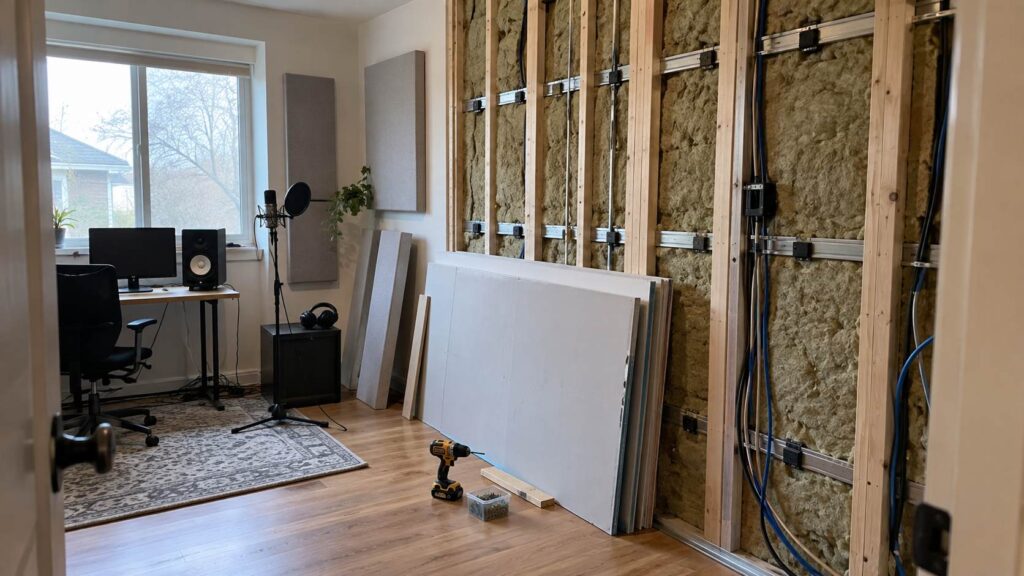
Recording studios are sometimes built inside finished rooms, which means acoustic work begins only after framing, joint finishing, and painting are complete.
Contractors such as Paintzone LLC can handle the visual finish and surface preparation, but paint itself has almost no meaningful effect on sound isolation. The important acoustic properties sit deeper in the wall.
Three factors matter most:
Mass helps stop sound from passing through a wall.
Decoupling reduces vibration transfer from one side of the wall to the other.
Absorption inside the cavity helps control resonance between wall layers.
A solid concrete wall has plenty of mass. A well-designed drywall system can combine multiple heavy layers with insulation and separate framing, giving it both mass and decoupling.
That is why a thin masonry wall is not automatically better than drywall, and a single sheet of drywall should not be compared with a purpose-built studio partition.
Drywall Gives Studio Builders the Most Flexibility
Adding insulation, extra drywall layers, and decoupling can greatly improve sound isolation.
Drywall is common in professional and home studios because the wall assembly can be modified in many ways.
A basic residential partition with one sheet of gypsum board on each side offers limited isolation. Studio construction usually goes much further.
How drywall walls improve sound isolation
Builders can increase wall performance by adding:
Two or more layers of gypsum board
Mineral wool or fiberglass inside the cavity
Resilient channels or isolation clips
Double-stud framing
Staggered-stud construction
Acoustic sealant around edges and penetrations
Extra layers increase mass, while separate framing reduces the mechanical connection between the two sides of the wall. The combination is important for bass frequencies, which travel through building structures more easily than higher frequencies.
Drywall also makes room treatment easier
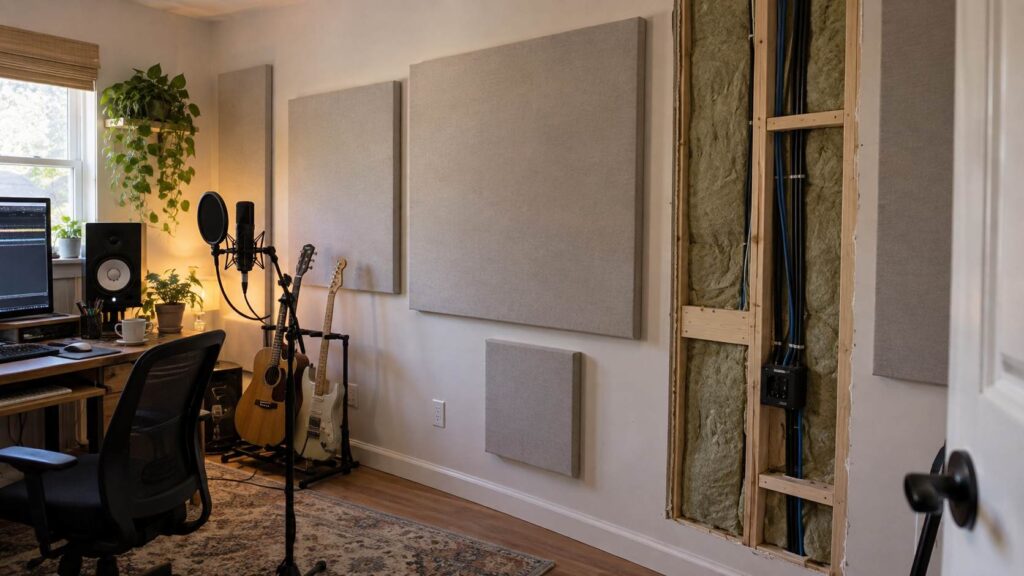
Drywall provides a practical surface for mounting acoustic panels, bass traps, diffusers, and studio furniture. Wiring can also run through cavities without cutting channels into masonry.
Another advantage appears during later modifications. A new cable route, wall panel, or additional layer can be added with far less structural work than would be required with concrete.
The weakness is that ordinary drywall construction is not enough for a serious studio. A single lightweight partition can transmit voices, guitar amplifiers, and low-frequency energy into neighboring rooms.
Brick Has Mass but Creates Strong Reflections
Brick adds useful mass for sound isolation, but exposed surfaces still reflect much of the sound inside the room.
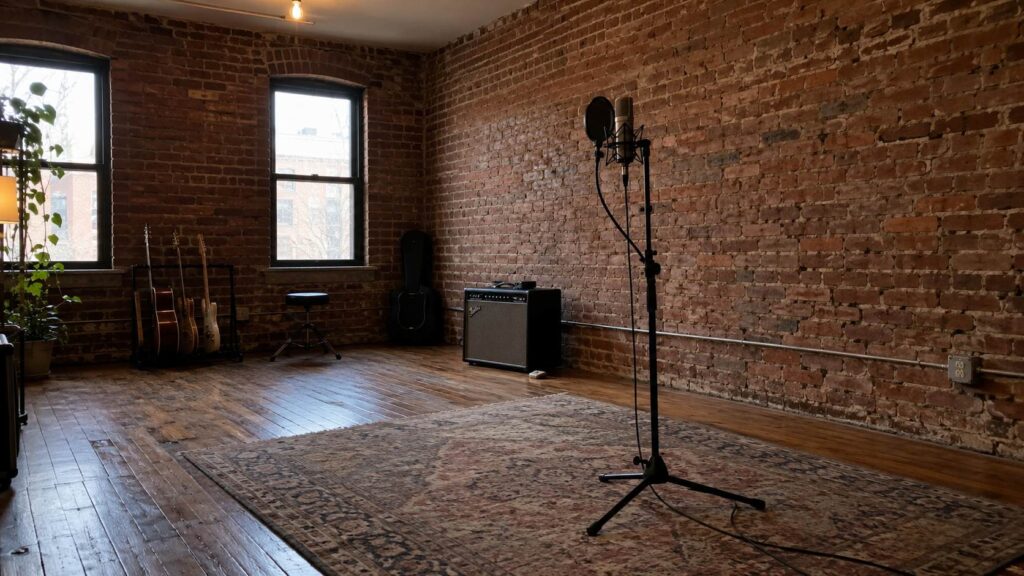
Brick walls are common in converted warehouses, basements, and older commercial buildings. Their mass helps reduce sound transmission, particularly compared with a lightweight residential wall.
From an isolation perspective, solid brick can be useful. From an acoustic perspective inside the room, exposed brick needs more thought.
Exposed brick is not acoustic treatment
The uneven surface of brick scatters some high-frequency sound, which can make it feel less severe than smooth concrete. The effect is relatively small, however. Brick still reflects a large amount of sound energy.
A studio with exposed brick on several walls can develop:
Long reverberation times
Strong midrange reflections
Flutter echo between opposite surfaces
Poor vocal clarity
Unreliable monitoring conditions
Acoustic panels are therefore still needed in most brick rooms.
Brick can work well as the outer shell
A useful studio design can combine a brick exterior wall with an independent drywall wall built inside it. The brick provides mass, while the internal wall creates another barrier and an air cavity.
Studios designed around the “room within a room” principle use a similar idea. Several separated layers make it harder for sound energy to move directly from the recording space into the surrounding building.
Concrete Provides Excellent Mass but a Very Live Interior
Concrete is the heaviest of the three common wall materials and usually offers the strongest starting point for sound isolation.
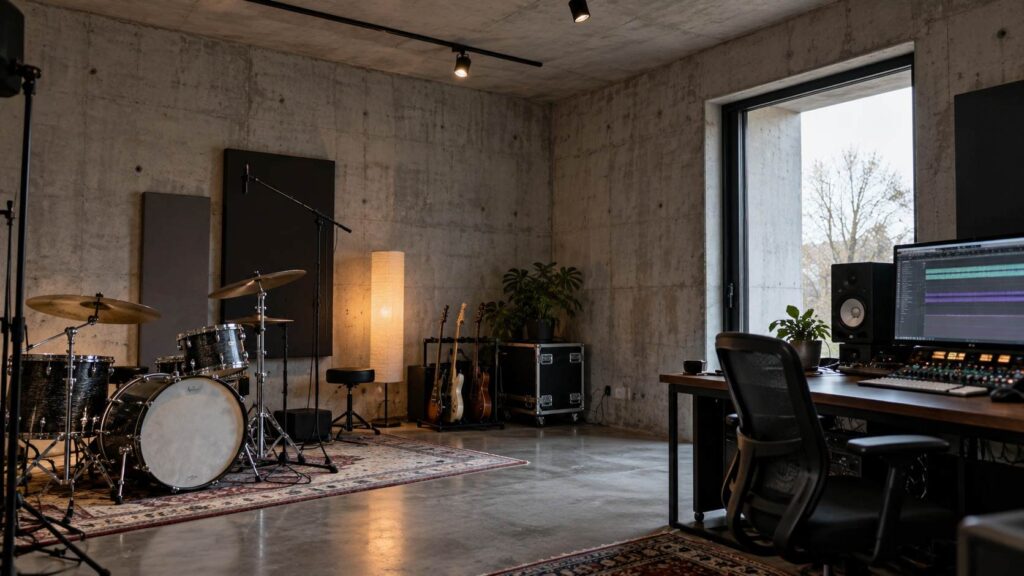
Basements, parking-level rooms, and commercial buildings with poured concrete walls can therefore provide useful studio shells, especially when outside traffic or neighboring businesses create noise.
The same density that helps isolation creates another problem inside the room.
Concrete provides strong sound isolation, but untreated surfaces can create powerful reflections and a very lively room sound.
Bare concrete reflects almost everything
Concrete absorbs very little audible sound. A room with concrete walls, floor, and ceiling can produce strong reflections in several directions at once.
Speech becomes difficult to understand. Cymbals can sound aggressive. Guitar amplifiers create long reflections, and vocal recordings can capture a pronounced room tone even when the microphone sits close to the singer.
Heavy acoustic treatment becomes important in rooms with several concrete surfaces.
Low frequencies remain difficult
Concrete walls do not eliminate bass problems inside a studio. Room dimensions still create standing waves and resonances.
A small concrete room can produce severe peaks at certain bass frequencies and deep cancellations at others. Thick bass trapping, careful speaker placement and listening-position adjustments are still required.
Drywall, Brick and Concrete Compared
Wall type
Sound isolation potential
Interior reflections
Ease of modification
Studio use
Drywall
High with multi-layer and decoupled construction
High when untreated
High
Very practical for purpose-built studios
Brick
Moderate to high depending on thickness
High
Moderate
Useful as a heavy outer shell
Concrete
High
Very high
Low
Strong isolation base that requires acoustic treatment
The comparison explains why there is no single winner based only on material. Concrete provides excellent mass. Drywall provides construction flexibility. Brick sits somewhere between them, depending heavily on thickness and wall design.
Soundproofing and Acoustic Treatment Are Not the Same Job
Many studio projects become expensive because the two goals are confused.
Soundproofing deals with sound moving between rooms.
Acoustic treatment deals with what happens to sound after it is already inside the room.
Acoustic foam on a wall can reduce reflections, but it does very little to stop a kick drum from reaching the next apartment. A concrete wall can block much more external sound, yet still create an unpleasant recording environment without internal treatment.
A practical studio usually needs both
A balanced studio construction might include:
A heavy exterior wall or multi-layer drywall partition
Insulated wall cavities
Mechanical separation between wall layers
Acoustic sealing around doors and wall penetrations
Broadband absorption at reflection points
Thick bass traps in corners
Diffusion where the room size allows it
Doors, windows, electrical boxes, and ventilation ducts deserve equal attention. A heavy wall loses much of its value if sound can escape through an untreated door gap or ventilation opening.
Which Wall Works Best for a Home Recording Studio?
For most home studios built from scratch, multi-layer drywall offers the most practical balance. Builders can add mass, insulation, and decoupling without the structural requirements of concrete construction.
An existing brick or concrete room can still provide an excellent starting point. Instead of removing those walls, the masonry can act as the heavy outer shell. An independent internal drywall structure can then improve isolation further and provide a convenient surface for wiring and acoustic treatment.
Drywall walls can combine insulation, multiple layers, and decoupling to improve sound isolation.
For vocal recording
Wall isolation matters, but internal reflections deserve equal attention. Broadband panels placed around the recording area usually contribute more to vocal quality than the visible wall material itself.
For drums and guitar amplifiers
Mass and structural isolation become far more important because both produce substantial low-frequency energy. Double walls, isolated floors, and properly treated ceilings can matter as much as the walls.
For mixing and mastering
Consistent frequency response matters most. The room needs controlled early reflections and strong low-frequency management so the monitors provide an accurate picture of the mix.
Last Words
Concrete has the greatest natural mass. Brick can provide a strong existing shell. Drywall gives builders much greater control over wall thickness, insulation, and structural separation.
A serious recording studio usually combines several materials rather than depending on one. Masonry may form the exterior boundary, insulated framing can create separation, and multiple gypsum layers can form the finished inner wall.
After isolation is handled, acoustic panels and bass treatment shape what musicians and engineers actually hear inside the room.
The wall that looks strongest is therefore not automatically the wall that sounds best. Construction depth, mass, separation, sealing, and internal treatment ultimately matter far more than the visible surface.
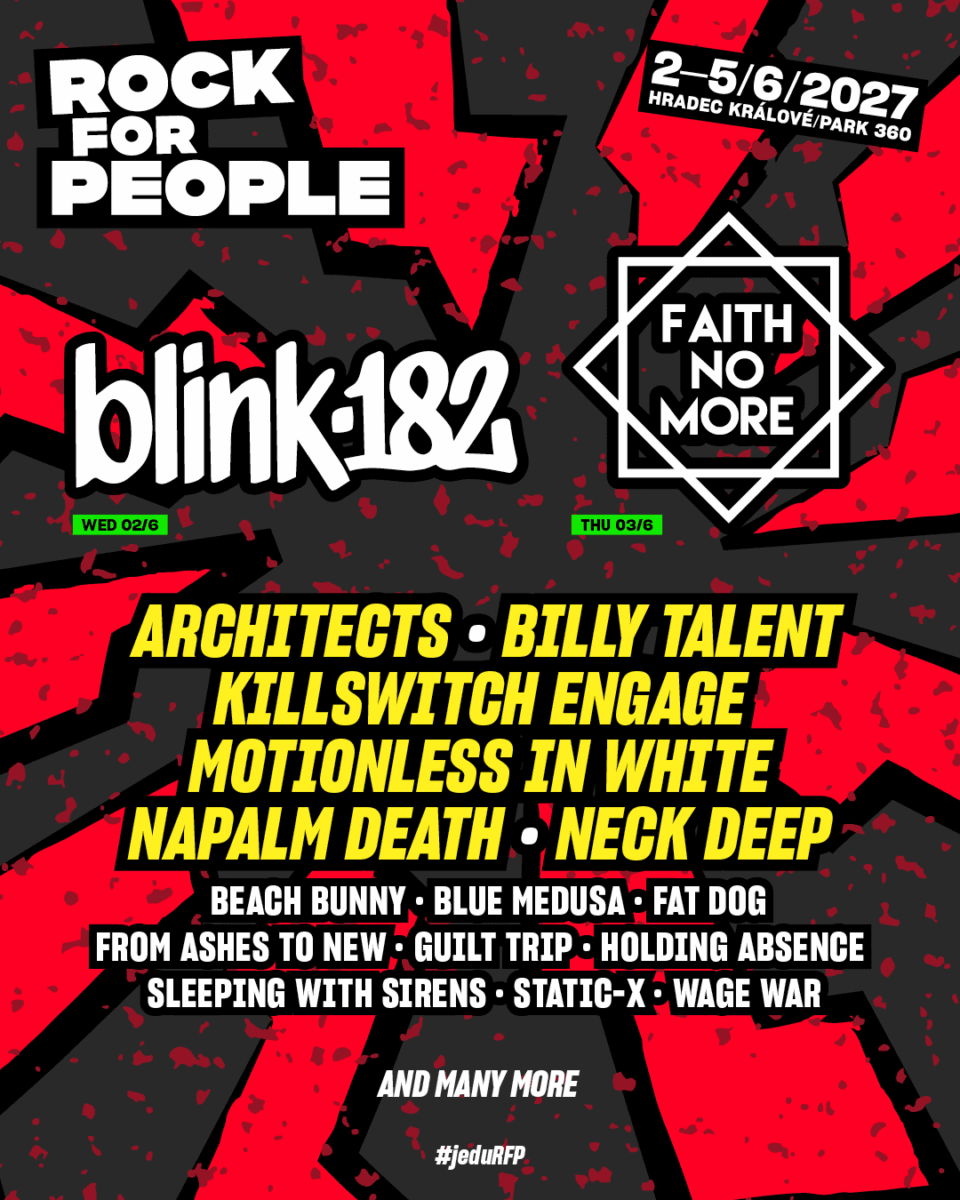
Iconic Czechia-based festival Rock For People has dropped their first big announcement for 2027. With Blink-182 recently announced as headliners, Faith No More have now joined top billing. The festival will return to Park 360 in Hradec Králové, Czechia from 2-5 June 2027, moving up earlier in the calendar.
This will mark Faith No More’s return to the European stage after more than a decade away–they last played Rock For People in 2015. Blink-182 will be gracing the stage for the first time, giving European fans a chance to see the legendary pop-punk trio.
Aside from the headliners, there’s a huge lineup set for next year, with Architects, Billy Talent, Killswitch Engage, Motionless in White, Napalm Death, Sleeping With Sirens and more heading to Czechia.
Rock for People director Luděk Motyčka said: “Bringing Faith No More as the second headliner alongside the already confirmed Blink-182 is a huge event for us. This is a band that has fundamentally influenced modern rock and metal, and Rock for People has a long history with them as well.”
Rock for People 2027 takes place at Park 360, Hradec Králové, Czechia, between Wednesday 2nd – Saturday 5th June 2027.
Rock for People 2027 Line Up So Far: Blink-182, Faith No More, Architects, Billy Talent, Killswitch Engage, Motionless In White, Neck Deep, Napalm Death Beach Bunny, Blue Medusa, Fat Dog, From Ashes To New, Guilt Trip, Holding Absence, Sleeping with Sirens, Static-X, Wage War
The best metal cruise on the planet, 70k Of Metal , added Florida death metal legends Atheist to their 2027 line-Up along with German black metallers Firtan and doom metal harbingers, Fires In The Distance.
To commemorate Atheist's 35th Anniversary of their groundbreaking album “Unquestionable Presence”, they will perform the record in its entir… Read More/Discuss on Metal Underground.com
Canadian rock powerhouse The Jailbirds lay down a relentless, high-octane assault that bridges the vintage swagger of Black Sabbath and Van Halen with the modern crunch of Royal Blood. Backed by major accolades—including Mississauga Music Awards for “Best Rock” and “Best Live Band”—and months of Spotify Hard Rock playlist domination, the band has earned global acclaim, features in Guitar World, and shared stages with rock royalty like Rival Sons and Monster Truck.
Co-written, produced, and mixed by rock titan Brian Moncarz (Alice Cooper, Our Lady Peace), their fierce new single “Where Is The Rock N’ Roll?” serves as a blistering rallying cry against the softened state of modern rock. Packed with gritty riffs, soaring powerhouse vocals, and an uncompromising, rebellious soul, The Jailbirds deliver a heavy-hitting track that turns nostalgia into a pure, explosive weapon.
I like the no frills approach to the song, catchy energetic, fun and enjoyable from start to finish, with super catchy vocals, pure rock guitars and a super solid rhythm section. The production is spot on, punchy and perfect for the genre. The song is part of the playlist Rock Rotation.
Give it a go by clicking on the Spotify player below and follow The Jailbirds if you like what you hear.
27th September 2026 Support: Cold Words: Dan Barnes Photos: to follow next week!
Colour me flabbergasted. I did not realise the Huntingdon Beech, CA, nu metal rap crew (hed) P.E. had been such regular visitors to these shores. I caught them at the first and last time at the inaugural UK Ozzfest at Milton Keynes Bowl, back in 1998, on a second stage bill also including Entombed, a Whitfield Crane-fronted Life of Agony, and headliners Coal Chamber.
As I recall the band’s set that day came in the mainstage gap between Soulfly’s UK debut and Pantera, and miles away from the stage, (hed) P.E.’s nuance was lost. Those close up seemed to having a whale of a time, but the edgy blend of funk rhythms, hip-hop and ska seemed to get lost in the vast confines of the bowl.
The Rebellion Bar does seem to be a more appropriate setting to get the full experience of one of Nu Metal’s most dogged survivors. Now clocking in with fifteen studio albums, including this year’s Relapse release, as well as a couple of covers album, and (hed) P.E. might not have been as visible as a Korn or a Limp Bizket, but damn, if every there was a poster child for keeping the faith and not losing sight of a dream, it’s the ever-present vocalist, Jared Gomes.
It’s the sophomore album, Broke, released in 2000 that is the sole focus of tonight’s show, with it being played in its entirety, though not in the established running order. Jesus (of Nazareth)’s metronomic drum and light urban beats introduce the band, with the sold-out crowd being fired into life as the tune drops for the first time. Jared is accompanied by a myriad raised voices and it’s like we’ve all been taken back to the millennium for a brief moment.
Killing Time’s earworm melodies finds Manchester bouncing as we’re introduced to one of Broke’s three singles and what should rightly have been a Nu Metal stapple and mentioned in the same breath as Freak on a Leash and Back to School. Waiting to Die gets dark and oppressive, with Kurt Blankenship’s bass sounding loose and punkish; Crazy Legs was never the most Politically Correct of lyrics, its edgy rhythms outlined by most recent (hed) P.E. recruit, drummer Stephen Arango.
The reggae-vibes of Swan Dive packs a punch as it expresses the positive benefits of diving first face into the ground – or encouraging stage divers to come on over – whichever best suits at this juncture. Feel Good has a System of a Down thing going on, unsurprising as the album’s version featured guest vocals by Serj Tankian; Pac Bell takes the band far closer to their Hip-Hop origins than their rock side, but I Got You gives guitarist, Nathan Javier, the opportunity to blast a little.
It’s clear to me by this point that, although I dismissed Nu Metal the first time around due to age – it wasn’t a genre that spoke to me at the time – I have developed an appreciation for the way it incorporated its influences, from punk and metal, through classic rock to reggae and hip-hop; nothing was off the table and nothing was beyond consideration. Not that I’ll be wearing baggy jeans and getting frosty-tips anytime soon, but the raw energy from (hed) P.E. tonight – and it must be remembered the band are doing this night-after-night – is plenty admirable.
Boom (How You Like That?) is pure Rap-Metal with Nathan conjuring some crunchy riffs beside the sounds of the street. Album single, The Meadow, closed the record in 2000 with a laidback acoustic kinda thing and tonight acts as the penultimate tune, making the way for the punchy Bartender, which feels like a blend of hip-hop verses and Faith No More choruses.
The only Broke tune not played tonight is Stevie, with the encore of Renegade from the 2009 record, New World Orphans, serving as a fitting finale. The bands from the first wave of Nu Metal have been shown to have been way ahead of their time back in the turn of the century, with genres intersecting and cross-pollinating being grist for the mill these-days. It was a lesson for me tonight, that you can’t keep a good band down; I’ll be here for (hed) P.E. next year, with a bit more background knowledge too.
Tonight’s support was given by Florida post-grunge alternatives, Cold, whose history stretches back to the Eighties. Traffic delayed me so I arrived for Another Pill’s heroic statement, Better Human’s emotional outpouring and closer, Confession. It was a shame that I didn’t manage to see more of these.
It was an evening in which I was introduced to a couple of acts I wasn’t altogether familiar with, but sometimes, not having any expectations is the best way to approach these things.
Emerging from Wiener Neustadt, Austria, four-piece hard rock band STAY BOUND delivers a high-octane blend of heavy, guitar-driven rock and multi-era influences. Built on raw power, dynamic vocals, and a formidable rhythm section, the band crafts a fresh, distinct sound designed for maximum live impact.
Their new single “Lucy” channels an infectious, pure ’90s alternative vibe, contrasting clean, groove-laden verses against a massive, punchy chorus and a brilliant second-half bridge. Boasting razor-sharp production and undeniable stage energy, STAY BOUND represents a bold new generation of rock, delivering tracks that hit hard and linger long after the music stops.
Give it a go by clicking on the Spotify player below and follow STAY BOUND if you like what you hear.
The much-loved and award-winning ArcTanGent Festival returns in 2027 between the 19th and the 21st of August, with a limited number of advance tickets available for Wednesday 18th August.
Todays line-up announcement includes two massive, and most requested main stage headliners making their ArcTanGent Festival debuts in 2027. Firstly we have the Oakland, California, post-metal band Neurosis, recently returning to playing live shows and releasing music, though now with vocalist Aaron Turner (Sumac, Isis). The band surprise released a stunning new album ‘An Undying Love For A Burning World’ in March, and their set will be one for the ATG history books. The second main stage headliner to be announced today are the Denver, Colorado progressive death metal band, Blood Incantation. The band recently released the soundtrack album to their documentary film of the same name, ‘All Gates Open’, and continue to surprise and inspire with every move they make.
Joining these two giants at the festival include – UK rock royalty The Wildhearts who are playing an exclusive, one time only ArcTanGent Festival progressive set, French rock band par excellence Slift, ATG royalty in the form of UK band Conjurer, as well as the spectacular German post-metal band The Ocean. Also announced today includes the wonderful Italian doom metal band Messa, the much loved and highly regarded Arizona band Holy Fawn, Danish black-gaze band Møl, as well as the much loved UK metal band Employed To Serve, who will be celebrating the 10th anniversary of their much acclaimed album ‘The Warmth of a Dying Sun’.
From ArcTanGent Festival organiser and booker, James Scarlett – “There’s no better way to kickstart the new chapter of ArcTanGent, for the first year at our new location in the Cotswolds, than with two of our most requested headliners. Both bands are absolutely solid gold headliners – anyone that listens to 2 Promoters, 1 Pod will likely be sick of hearing me wax lyrical about the new Neurosis album. To have them along with Blood Incantation – a band it’s frankly criminal they haven’t played before – is the dream way to kick off a new edition of ArcTanGent. We’re also unleashing the vast majority of our Wednesday line-up, bringing back some of the most exciting acts from previous years. There are a lot of bands here that stood out with huge crowds in 2026, so we’re stoked that they want to return and help us kick off the early entry day of ATG 2027. As always, this announcement is simply a list of artists I’m extremely excited about from top to bottom and can’t wait to watch live at our new Cotswolds home.”
From Ginger of The Wildhearts – “We are so excited to come up with a unique, one time only set showcasing just how musical The WiLDHEARTS are. Jaws will drop, minds will blow and joy will abound. This is going to be more fun than should be legal.”