Category: news

  • Review: Dying Grotesque “Celestial” [Archivist Records / Grand Sounds PR]

    In late autumn of last year, the Ukrainian death metal band Dying Grotesque released their sophomore full-length album Celestial via the local label Archivist Records, both digitally and on CD. This Kyiv-based trio plays a decidedly old-school brand of death metal – somewhere between the overloaded, non-melodic American sound of the 1990s and the Swedish strain that borders on melodic death metal. Continuing the path they set out on four years ago with the very solid debut Sunflower Tide, released during the first pandemic lockdown in 2020, Celestial reveals a few additional facets of non-linear perception, forming new, almost elusive layers even within such a straightforward genre as death metal.

    Formed in 2018 in Ukraine’s capital, Kyiv, Dying Grotesque first emerged with the demo Hunter’s Daughter, followed by the single “Helga”, the EP Creator Plan, and a split with Dissolution. Over the course of two years, these releases led them to their independently released debut Sunflower Tide. While the lyrics back then leaned toward Slavic mythology, the band has now shifted to more traditional death metal themes – darkness, death, war, and suffering. Still, these topics are approached in a notably emotional and poetic way, with a stronger metaphysical inclination than a social or political one. A year later came the EP Before the Imminence, followed by the single “Red Alert” another year on. After two years of silence, the band began teasing with new material from the upcoming album titled Celestial, hinting at something elevated and unearthly despite the very traditional musical framework.

    The bar was already set high with the debut, but the second album presents a more balanced and direct body of work – free from emotional swings or attempts to find its sound. Because that sound has already been found. Notably, Celestial also avoids the patriotic wave that has affected many local bands amid the prolonged military conflict, often saturating lyrics with overtly militaristic themes. Instead, the album reflects on the pettiness of human life and the trivial social problems people create for themselves when set against the infinite cosmic forces that exist independently of human consciousness.

    At times, it feels as though melodic lines on Celestial are deliberately muffled, allowing chaotic layers of guitar chords, accented by noise and dissonance, to dominate the foreground. This reinforces the album’s heaviness and brutality. It doesn’t always work flawlessly, though, and occasionally melody tears away the mask of feigned aggression and restraint, exposing more human emotions beneath. These moments are rare but striking, and they are woven in organically, without attempting to dethrone the album’s dense, uncompromising death metal core. Even the band’s name makes it clear that this music is not about beauty or life, but about grotesque and death, though the name itself is controversial. If the grotesque is dying… perhaps aesthetics are born in its place. For now, however, anger, darkness, death, ugliness, and grotesque visions of an imperfect world remain tightly concentrated within these Ukrainians, finding effective expression through musical form.

    Across just under forty minutes, the album condenses the power of old-school death metal, periodically veering into chaos, melody, or hints of a more modern sound. The slower tracks never drift into doom/death territory, while the faster ones lean convincingly towards thrash/death. The album opens with the classic “Nuclear Meadows” – an atmospheric, mature, and moderately chaotic track that serves as a strong representation of the album as a whole. Even the bridges, the transitions between brutal, raw old-school death metal and more melodic death-thrash, tend to sound restrained and almost unnoticeable. “Purification” moves closer to groove and modern metal, standing slightly apart from the overall flow, though this only becomes apparent if you listen very closely and dissect the layers to reach the song’s core. On “Satellites” strange, almost Eastern-tinged psychedelic riffs emerge, but they never become the foundation of the track or push the sound fully into psychedelia or ethnic territory. Naturally, the acoustic intro “Point of View” works wonders in terms of contrast – acoustic passages in extreme music almost always emphasize heaviness and depth, sometimes even producing a shock effect (though mostly for less seasoned metal listeners).

    Overall, Celestial is fascinating in the way its noise and heaviness, bordering on rawness and chaos, serves to sharpen sensory impact. You practically choke on this merciless wall of sound, though not to the extent of bands like Incantation, where dissonance itself forms the core of the song-writing. Just as subtly, softer elements begin to creep in – melodic, clear, and harmonious, pulling you back from abstract madness into sober realism. The album closes with “Mortality” very much in the spirit of Dying Grotesque, yet featuring an atypical ending: atmospheric, sad, and contemplative. As if these were the final sounds of a dying grotesque.

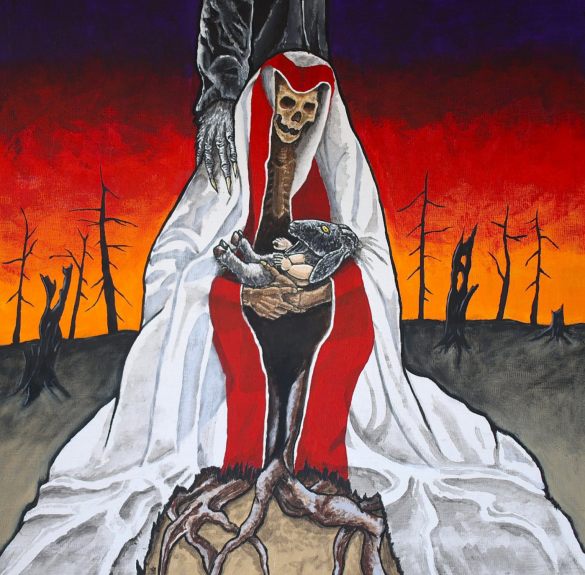
    The Ukrainian extreme metal scene continues to develop at a rapid pace, and Dying Grotesque demonstrate their skill and musical vision through a fusion of classical foundation and chaos. Celestial is a tribute to death metal legends, but with a clear gaze towards the future. Even within the music itself, there seems to be a small place of emptiness – space left intentionally for experimentation on the next release, which will likely be even more deliberate and multifaceted. The album artwork captures this nuance as well: it feels slightly unfinished (though the concept is clear and well conveyed), raw and cosmic in tone, offering the listener additional food for thought. When and where will the final point be placed? In life, or after death? And what awaits beyond death itself?

  • Review: Intra Nigrum “Logos” [Putrid Cult]

    In the final days of last autumn, the Polish one-man band Intra Nigrum, which plays atmospheric depressive black metal with ambient elements, independently released its third full-length album Logos in digital format, followed by a limited CD edition via the underground label Putrid Cult. Continuing the path laid down on previous releases, the project once again praises darkness and nature through atmospheric black metal hymns and quiet, contemplative ambient passages. Brutality can easily be set against fragility here, and because of that Logos feels well balanced, without unnecessary excess – neither drowning in overblown black metal aggression nor slipping into the neo-classical mawkishness that sometimes plagues bands who don’t know when to stop with their dungeon synth experiments, ultimately alienating black metal listeners altogether.

    Intra Nigrum is a distinctly underground act, and the lack of information about its creator only makes it more elusive when viewed through a social or biographical lens. In a way, this anonymity makes criticism more neutral, detached from personality and imposed clichés. All we really know is that the project, created by someone known only as W, first appeared in 2020 with the debut full-length album Against the Sky, followed two years later by sophomore release Night’s Mirror. Romantic and nostalgic to a degree, yet carrying the soul of a black metal artist who has clearly lived through much, Logos belongs to the same lineage – unpredictable and far from superficial, revealing subtle musical layers behind walls of noise and raw violence. There is little in the way of undisguised experimentation or exploratory intent on this album, yet the song structures are not overly polished either, retaining a sense of randomness and controlled impulsiveness. And since the band defines itself as atmospheric black metal, the music alone is not the only focal point during listening. Logos is more about the emotions evoked by the monotony of black metal riffs, their synchronicity with ambient elements, the mystical whisper, or the defiant scream of despair. In atmospheric music, a single track can last fifteen minutes, revolve around just one or two guitar riffs with cosmic synthesizers in the background, and still lodge itself in the listener’s soul as something unique. Intra Nigrum’s music is therefore not only meant for the ears, it is a story meant to resonate.

    Poland is rich in extreme metal bands, most of which never reach the mainstream, and frankly, that’s a good thing. Two or three bands are more than enough for that role (those you can always accuse of selling out or turning into posers after each new album without hesitation). Atmospheric black metal remains a niche in Poland, and Intra Nigrum further embellishes its sound with restrained, non-aggressive ambient elements, so it’s not easy to stumble upon this project by chance. But once you do – and if something catches you from the very first notes – it’s worth keeping a close eye on this one-man formation, which so far has been releasing a new album with disciplined regularity every two years. Following this logic, the next release should arrive in 2026, which isn’t that far away.

    The main characteristic of Logos is its intellectual quality and mystical spirit. It’s surprising that without progressive elements, non-experimental and largely monotone, the album still sounds polite and refined, despite its classic black metal foundation. Essentially, W follows genre’s canon, occasionally leaning too far into depressive or ambient territory, but never resorting to blunt trueness or aggression for the sake of aggression. There is nothing here that actively complicates perception, yet this is also not music you’ll sing along after a first listen. Logos demands thoughtful, attentive engagement, though it can also function as background sound, heightening sensitivity and creating a kind of mystical aura. Without oppression or fear, not expressive but harmonious and unobtrusive. Those expecting pure black metal ferocity, relentless blast beats and buzzing guitars, may find Intra Nigrum’s latest album too aesthetic and convoluted.

    The album opens with the dark, slow intro “Midnight Shadow”, monotone and grey, before erupting into slightly dissonant black metal with hints of melody – depressive, yet driven by an underlying warrior’s spirit. At times W is tired of screaming and shifts to whispering, which, combined with gloomy ambient textures, sounds like an echo from a night forest wrapped in unsettling fogs, particularly evident on the tracks “A Veil of Fog” and “Shuddering Star”. On “Above Night’s Altar” one can even hear elven echoes from fairy-tale realms, which not only soften the music but make it more mysterious and unattainable. The more noise appears over the course of the album, the more standard and predictable the black metal becomes, at times sounding overly raw and dissonant. “Shuddering Star” even flirts with post-rock, or rather post-black, muting the despair of DSBM-style screams. These forty minutes conclude with the slow, contemplative “From Blood and Blue Sky” featuring long acoustic passages – monolithic, measured, and enigmatic. The lyrics, or rather poems, though very brief, perfectly emphasize black metal tradition: darkness and pain imbued with a sophisticated touch of natural beauty and mystery.

    In the world of Intra Nigrum, darkness and light are not strict opposites; they intertwine so closely that it becomes impossible to tell where one ends and the other begins, hidden beneath dense fogs of enchanted forests. The album artwork conveys this state perfectly, washing away silhouettes and turning them into shadows, revealing countless shades of grey. It is remarkable how, through this noisy and raw album, one can hear silence itself – a state where music transforms into atmosphere, only occasionally resurfacing into reality during moments of the most desperate screams. Without excessive pomposity but with an innate grace, Logos exists simultaneously as the background itself and as the sound that emerges from it.

  • SYSTEM OF A DOWN’s DARON MALAKIAN Remembers Filling In For JAMES HETFIELD And Playing Guitar For METALLICA

    On Rick Rubin’s “Tetragrammaton,” Daron Malakian went deep on what he listens for in metal: riffs, mood, aggression, atmosphere, and how that shaped his own playing and writing. Then he got into the memory that still gives him a jolt: stepping in with Metallica when James Hetfield got hurt.

    “When I was 12 or 13, at that point I had been playing the guitar for a year,” he said. “I was with these guys in my school that, in their dad’s garage, we would play Metallica covers. That’s pretty much all we’d play — a bunch of Metallica covers. And a big part of how I learned how to play the guitar was playing either Black Sabbath, Metallica, Iron Maiden, sometimes Slayer,” he added (via Blabbermouth).

    “My friends really didn’t get Slayer, but they loved Metallica. But I loved Slayer, and I would fight with them over it. [Laughs]. But we would play these Metallica covers, so I knew all these Metallica covers,” he said. “When I got older, I knew them, and so we were on tour with Metallica on the “Summer Sanitarium” tour.”

    “I met Metallica on stage, playing with them. I never met them before,” Malakian remembered. “We’re the first band. Nobody knows us. It’s 1999, maybe, at this point. [System Of A Down‘s] Toxicity‘s [See image gallery at www.sonicperspectives.com] is not out yet. We’re on our first album. And we are on the “Summer Sanitarium” tour,” he continues. “It’s us, a band called Powerman 5000, Kid Rock was on there, I think Korn was on there, and Metallica. It was, like, five bands on the bill. We were the first band that opened up [when people are walking in]. Nobody knows who System Of A Down is at this point.”

    “And so we’re on that tour, and James Hetfield, along the way, gets injured,” he recalled. “I don’t know. They told me he was going water skiing or something, and he got injured. So they didn’t cancel the show. So all the opening bands played, and then Metallica still went on stage. And [then-Metallica bassist] Jason Newsted was singing. And then they brought the guys from Korn on, and they kind of played like this Cheech & Chong cover song or something. They didn’t know what to do, because James wasn’t there.”

    “And I turned to my tech, and I go, ‘Listen, man. I go, ‘Go tell their tech that I know a lot of their shit,’ ’cause I’ve learned it playing it in this garage with these other guys. I go, ‘I know a lot of their shit from, you could say, …And Justice For All and back.’ Next thing you know, my tech goes and talks to their guitar tech, and then my tech comes back to me,” he added. “He’s, like, ‘All right, come with me.’ [I’d] never met Metallica before,” Malakian continued.

    “And I’m telling you, Metallica was the first concert I ever went to in my life,” he said. “I was a huge Metallica fan. Faith No More opened up for them. Justice For All tour. So next thing you know, I go on the other side of the stage,” he added. “I get handed a Les Paul; I think it was one of [Metallica guitarist] Kirk Hammett‘s Les Pauls. And they’re, like, ‘All right. Go.’”

    “60,000 people. [Laughs] Yeah. 60,000 people,” he remembered. “I’m in my after show. I am wearing Lakers fucking sweats. I’m not even ready to get on stage. I’m wearing a white tank top and Lakers sweats, and I was just completely there, just watching Metallica. Next thing you know, I get handed a guitar, and they go, ‘Go.’”

    “You gotta understand. Our band’s not big yet. I’m still a kid. I’m 22 years old,” Malakian continued. “I can’t even believe that we’re even allowed to open up for Metallica. So this is all new to me at this point in my life. And they put me out there, and I turn, and I’m, like, ‘Hey,’” he said. “It’s Lars [Ulrich, Metallica drummer], it’s Kirk, it’s Jason Newsted, who was the bass player at the time. They’re, like, ‘What do you know?’”

    “I go, ‘I don’t know. “Master Of Puppets”. ‘Okay. Count it in,’” he said. “We’re playing fucking “Master Of Puppets’. I’m up there with Metallica playing “Master Of Puppets” in front of 60,000 people. And I’m, like, ‘Who’s gonna sing?’ I said, ‘Fuck it. I’ll go sing.’ And I sang,” he added. “And then there’s this thing that happened where in the middle of “Master Of Puppets”, it has this slow part.”

    “Instead of going into that slow part, they went into “[Welcome Home] (Sanitarium)”,” he recalled. “And I didn’t know they were gonna do that. And we went in, and we did the middle part of “Sanitarium” and then came out of it and went back into “Master Of Puppets”. I mean, you would think we had rehearsed it, but we didn’t rehearse it. And I didn’t even know it was gonna happen. And it happened. And I’m up there, and I am playing Metallica with Metallica in front of an audience where I would’ve been in the fucking cheap seats just three years ago,” he explained.

    “I got off stage. Next thing you know, they’re coming to me. They’re, like, ‘Hey, dude, James isn’t gonna be able to play for a few nights. They want you to come and play with them fucking everything,” he added.

    “And next thing you know, Kirk Hammett‘s in front of me with a guitar and I go, ‘Hey, bro, I know all your old stuff, but I don’t really know the Load and the Reload and all that stuff,’” he said. “So Kirk‘s trying to teach me stuff off Load. And then next thing you know, they’re, like, ‘Hey, get your shit from your bus, ’cause you’re flying on the private jet with us now,’” Malakian continued.

    “So the first plan was to have me play a whole set with them,” he explained. “And I was preparing for that, and I was relearning all the old stuff and trying to learn all the Load stuff. And so I flew with them and everything, and then they decided, ‘Hey, it would be a cooler thing if we invited different bandmembers from the different bands that were on the gig,’” he said. “So the next night I was up on stage with Metallica again.”

    “And I knew I was supposed to play ‘One’. And I got there, and I was ready to play ‘One’, and I turned to — I forgot — maybe Jason or Kirk or someone, and I’m, like, ‘Who’s gonna sing?’ Because I had no idea. They turned to me, and they were, like, ‘Bob,’” Malakian said. “And I’m, like, ‘Who the fuck is Bob?’ And I see Kid Rock come up. And I didn’t know Kid Rock‘s name was Bob.”

    “And so Kid Rock comes up, and he sings the first night, and we did ‘One’, and it’s really fucking cool because ‘One’ has the whole [middle section], and I’m thinking, ‘Dude, you’re playing this shit with fucking Metallica. You’re turning around, and it’s, like, Lars,” he said. “It was crazy. I’ll never forget it.”

    “And even after that, their techs would come up to me in different tours and be, like, ‘Dude, don’t think we forgot what you did. You brought it that day. I don’t wanna say, like, ‘You saved the show,’ but they were kind of, like, ‘You fucking brought it. They were struggling. And then you got up, you did ‘Master Of Puppets’”.

    “Yeah, man. That happened. Oh, man. I’ll never forget it,” Malakian finished. “Even though my band is where we’re at right now, it still brings goosebumps to my… that I had a chance to experience that at that point in my career.”

    The post SYSTEM OF A DOWN’s DARON MALAKIAN Remembers Filling In For JAMES HETFIELD And Playing Guitar For METALLICA appeared first on Sonic Perspectives.

  • DAVE MUSTAINE Doesn’t Want To Invite Former MEGADETH Members To Farewell Tour: “It’s Not ‘Puppet Show MEGADETH.’”

    If you pictured Megadeth’s farewell tour turning into a rotating-cast reunion, old lineups swapping in and out every few songs, Dave Mustaine made it clear that isn’t the plan. He addressed the idea again recently, and the message is simple: keep the focus on the set, the band onstage now, and the fans hearing the songs the way they came to hear them.

    In an interview with Guitar World, Mustaine got asked straight up about inviting former members to join the band during the upcoming final run. His first point: the door already opened for the right moment, with one of the most famous former members stepping back into the spotlight: “We’ve already done that with [former Megadeth guitarist] Marty [Friedman].”

    From there, he widened it out to the bigger picture, because the band’s history is deep, and a full-on “everybody gets a turn” concept becomes a massive logistical mess fast: “And I mean, let’s look at the other people we’ve played with… there’s a lot of people. [Laughs] That would be a huge undertaking. I don’t think I want to do that. I’d rather keep doing what we’re doing and let the fans [experience] Megadeth music and be happy about it. It’s not ‘puppet show Megadeth.’”

    This also connects to what he said earlier on SiriusXM’s “Trunk Nation With Eddie Trunk” on December 5, 2025, when he was pressed about the ultimate fantasy scenario: one final gig with an all-surviving-members lineup. He explained why that idea doesn’t work in real life, even if it sells a lot of daydreams online.

    “Well, I can’t really do that, because of the behavior of one of the bandmembers in the past. I just can’t — I can’t. Because, first off, it would be unfair to the other bandmembers if I didn’t play with them as well. But the thing about what we did with Marty [Friedman] in Japan [in early 2023], that was a no-brainer. That was brilliant. And I love Marty. We had our separation, and he went his way, and we went our way. But it was a very, very intense relationship I had with Marty, because that was the first relationship I had with a guitar player.”

    “My relationship with [former Megadeth guitarist] Chris [Poland] was really great, but it wasn’t as good as it was with Marty. My relationship with [former Megadeth guitarist] Jeff [Young] was good, but it wasn’t as good as it was with Marty. And I probably wouldn’t have a problem playing with any of the members of those two lineups, except the fact that [former Megadeth drummer] Gar’s [Samuelson] is deceased, and [I’m] just not gonna do anything that is gonna, in any way, seem unfair to the other bandmembers,” he added.

    He also got asked whether the final show gets promoted as the last-ever Megadeth gig, or whether the band might “quietly end” touring without a big red-circle date. His answer was half-honest, half-dark humor, because “the last one” carries weight, and he knows it.

    “I don’t know. I was joking around with our management and said, ‘You guys should probably book some fake dates at the end of the tour that I don’t know about so I won’t go out there on the last date and just blubber like a fucking 175-pound wuss.’”

    The post DAVE MUSTAINE Doesn’t Want To Invite Former MEGADETH Members To Farewell Tour: “It’s Not ‘Puppet Show MEGADETH.’” appeared first on Sonic Perspectives.

  • Two Men by the Harbor is Ulrich Jannert’s Single out now

    Good Day Noir Family,
    Listening to Ulrich Jannert and his single “Two Men by the Harbor” for the first time feels like watching a cinematic night scene where memory, choice, and restraint quietly collide.

    Two Men by the Harbor is Ulrich Jannert’s Single out now

    The track establishes a noir atmosphere that nods to the 1980s, and the saxophone line plays a crucial role in shaping that mood.

    Its phrasing feels intimate and reflective, almost as if it were breathing alongside the listener.

    Soon after, the groove settles in with a steady pulse that mirrors a heartbeat. Because of that rhythmic foundation, the song feels grounded and human. Then the vocal enters with a tone that recalls Joe Cocker, although the phrasing carries more contemporary inflections. That balance between classic grit and modern control performs a strong identity. Moreover, the vocal never overwhelms the arrangement, which allows the story to unfold naturally.

    Soon after, a warmer and more luminous atmosphere begins to surface. However, it never abandons its reflective core. Instead, the production blends modern tools with traditional instrumentation, creating a bridge between eras. At the same time, subtle details in the arrangement keep the track evolving without breaking its calm flow.

    “Two Men by the Harbor” tells a quiet but powerful story about life choices. It explores the tension between safety and freedom, not through dramatic gestures, but through suggestion and nuance. Because of this approach, the listener feels invited rather than instructed. In addition, the gradual emotional rise mirrors the internal conflict at the heart of the song.

    Later on, the saxophone returns with greater intensity. This final solo acts as the emotional resolution, summarizing everything that came before. It feels less like a technical showcase and more like a final thought spoken out loud.

    Overall, Ulrich Jannert delivers a song that values atmosphere, storytelling, and emotional pacing. While it draws inspiration from the past, it speaks clearly in a modern voice. For listeners who appreciate reflective songwriting wrapped in noir textures, this single offers a rich and rewarding experience.

    Two Men by the Harbor is Ulrich Jannert’s Single out now!


    Nocturne!

    Ulrich Jannert is an independent artist based in Northern Europe, creating melodic, soulful music rooted in reflection, warmth, and emotional honesty. His songs arise from personal experiences, with lyrics that mirror his inner world and life journey.

    Originally from Germany, Ulrich began his musical path in the 1980s, learning several instruments before discovering the saxophone, which sparked his passion for composition. For years, he wrote music privately as a space for balance, calm, and positive energy.

    Today, he blends soul, soft rock, R&B, and folk influences, combining acoustic elements with modern production. While his audience continues to grow globally, Ulrich remains focused on writing and studio work, with no plans for live performances at this time. His music invites listeners to slow down, trust their inner compass, and enjoy the journey.

    Find Ulrich Jannert Here:

    Spotify
    Instagram


    Discover New Bands Click Here


    The post Two Men by the Harbor is Ulrich Jannert’s Single out now appeared first on Edgar Allan Poets – Noir Rock Band.

  • Interview with Cineastre

    Cineastre emerged from the heart of the Lower Saxonian woodlands. Since then, their aim has been to capture the quiet poetry of moonlit passages, the mysticism of folklore, and the scents of nature, woven through a blend of Atmospheric and Melodic Black Metal with Dark Folk influences. After three years of work, Cineastre release their sophomore album: “Hymnen an die Nacht”.

  • 12 Rock and Metal Stars With a Reputation for Being Difficult Backstage

    Rock and metal have always been full of larger-than-life personalities. And if we are being honest, part of the fun is that these artists do not always act like “normal coworkers.” Some are intense perfectionists, some are chaos magnets, and some are so stubborn that even their own bandmates look exhausted in interviews.

    This is not meant to be a moral court case. It is more like a reminder that a lot of legendary music came from people who were not exactly easy to be around. These are 12 rock and metal stars who have earned a reputation for being difficult backstage, whether it was because of big egos, strict standards, unpredictable behavior, or just plain old rock star mood swings.

    1. Ritchie Blackmore

    UNITED KINGDOM – FEBRUARY 18: RAINBOW THEATRE Photo of Ian GILLAN and Ritchie BLACKMORE and DEEP PURPLE, Ian Gillan, Roger Glover and Ritchie Blackmore performing live onstage sheet 54 (Photo by Fin Costello/Redferns)

    Ritchie Blackmore is one of the most influential guitarists in heavy music, full stop. Deep Purple and Rainbow basically wrote chunks of the classic hard rock and proto-metal handbook, and Blackmore’s riffs are still being recycled by new bands in spirit, even if they do not realize it.

    But the “genius” part often came with the “try working with him” part. Blackmore has been famous for clashing with bandmates, demanding control, and generally operating like the boss even when the band was supposed to be a band. There is a reason Deep Purple’s history reads like a rotating cast list.

    The weird thing is, fans almost expect it. When people talk about Blackmore online, there is usually a sentence like: “Absolute legend, but I could never be in a room with him for longer than five minutes.” Fair.

    2. Axl Rose

    axl rose net worth
    Axl Rose

    Axl Rose is one of the most iconic frontmen in rock. Guns N’ Roses at their peak felt like danger, swagger, and emotion all at once. His voice and attitude helped turn the band into a global phenomenon, and those songs still hit like they were built to last forever.

    He has also been one of the poster children for “unpredictable rock star behavior.” The stories are endless: arriving late, stopping shows, going on rants, arguing with venues, and turning concerts into headline events for reasons that had nothing to do with the setlist.

    If you have ever read Reddit threads about GnR, you know the vibe. Some fans defend him like a family member, others say the stress was part of the ticket price, and everyone agrees the chaos was real. He is a once-in-a-generation frontman, but he can be a lot.

    3. Dave Mustaine

    Dave Mustaine vs. Metallica

    Dave Mustaine is a metal lifer. He helped shape thrash metal’s DNA, and his work in Megadeth is packed with riffs, hooks, and sharp songwriting that never really stopped being relevant. When he is locked in, he is brilliant.

    He is also known for being intense, demanding, and not exactly gentle about it. Megadeth’s long history of lineup changes is not an accident, and Mustaine has never had a problem letting people know when he is unhappy. That honesty is part of his charm, but it also makes for a difficult backstage vibe.

    A lot of fans describe him the same way: “I respect him, I love the music, but you can tell he would be terrifying as a boss.” Which is probably true. And also probably why the band sounds the way it does.

    4. Gene Simmons

    The Top 9 Songs That Gene Simmons Picked As His Favorites
    Gene Simmons – Image Credit: Facebook

    Gene Simmons built KISS into more than a band. It became a brand, a machine, and a cultural institution. Love them or roll your eyes at them, the business side of rock changed because Gene treated it like a full-time sport.

    That mindset is also why he has a reputation for being blunt, demanding, and exhausting to deal with if you are not on the same page. He is famously business-first, and when someone like that is in charge, everything becomes negotiations, rules, and “this is how we do it.”

    Fans online joke about it all the time. The general consensus is: Gene is entertaining, but you do not want to be the person who forgot to read the fine print on a backstage pass. He is the type of rock star who would absolutely remind you that time is money.

    5. David Lee Roth

    David Lee Roth

    David Lee Roth is one of the great rock frontmen because he made it look like a party even when the music was borderline athletic. Van Halen’s early era was lightning in a bottle, and Roth’s charisma was a huge reason it felt so alive. He was not just singing. He was selling the whole circus.

    The flip side is that circus energy can be hard to manage behind the scenes. Roth has long been associated with strong opinions, big personality clashes, and the kind of conflict that makes a band successful but also makes band meetings feel like survival training.

    Even fans will admit it: Roth is not boring, but he is not easy. He is that friend who is hilarious at dinner and then starts an argument with the waiter for absolutely no reason.

    6. Yngwie Malmsteen

    Yngwie Malmsteen is a guitar superhero. He took neoclassical shred into the mainstream, influenced generations of players, and still plays like he is trying to set the fretboard on fire. Technically, he is unreal.

    But Yngwie has never exactly marketed himself as “easygoing collaborator.” Over the years, he has developed a reputation for ego, control, and treating bandmates more like hired hands than equal partners. If you are the type who needs creative input, that environment can get tense fast.

    The way fans talk about him online is almost affectionate at this point. They will say things like: “He’s ridiculous, but that’s why he’s Yngwie.” The talent is real, and so is the attitude.

    7. Billy Corgan

    Billy Corgan wrote some of the biggest alternative rock songs of the 1990s, and his ambition as a songwriter is a major reason The Smashing Pumpkins reached the heights they did. He thinks big, aims high, and does not hide it.

    That intensity also comes with a reputation for being controlling and tough to work with. Corgan has often been described as someone who wants the ship steered his way, with his standards, on his schedule. For bandmates, that can feel inspiring or suffocating depending on the day.

    Fans are split, and that is part of the story. Some say he was the engine and the band needed that discipline. Others say the same thing that makes him great also makes him difficult. Both can be true.

    8. Glenn Danzig

    Glenn Danzig is a legend in punk, metal, and everything grimy in between. The Misfits alone made him immortal, and his solo work helped define a darker, heavier kind of swagger that plenty of bands still chase.

    He has also had a long-running reputation for being combative, protective of his image, and not afraid of confrontation. His history includes disputes over band names, control issues, and enough drama that fans can argue about it for hours.

    Danzig’s whole thing is intensity, and intensity is great until you are the person trying to coordinate schedules backstage. He is the kind of artist who gives you iconic music and also makes you grateful you are not the tour manager.

    9. Sebastian Bach

    Sebastian Bach is one of the most powerful voices of the late 1980s and early 1990s hard rock era. When Skid Row was firing on all cylinders, he had the pipes, the presence, and the wild energy that made arenas feel like they were about to explode.

    He has also built a reputation for being volatile. Bach has had well-known moments where he lost his temper onstage and got into confrontations with fans. That kind of personality does not magically turn calm the moment he steps backstage.

    Fans tend to describe him as entertaining chaos. He can be hilarious, charismatic, and unpredictable in the same breath. Sometimes that is rock and roll. Sometimes it is a headache.

    10. Phil Anselmo

    Phil Anselmo

    Phil Anselmo is one of the most influential metal frontmen ever. His work with Pantera helped shape modern heavy music, and his voice and delivery became a template for countless bands that followed.

    The difficult reputation comes from two places: conflict and controversy. Anselmo has had long-discussed tensions with bandmates over the years, and he has also been involved in public incidents that created major backlash and forced him to respond and apologize.

    A lot of fans have complicated feelings here. People can respect the music and still admit the baggage is real. That tension shows up in online discussions all the time, and it is part of why his name stays polarizing.

    11. Geoff Tate

    Geoff Tate was the definitive voice of Queensrÿche’s peak era, and his work helped prove metal could be smart, theatrical, and emotionally heavy without losing power. Albums like Operation: Mindcrime are still held up as classics for a reason.

    But his departure from Queensrÿche turned into one of those messy, headline-friendly band breakups. There were reports of backstage altercations, public accusations, and a long legal fight over the band name. For fans, it was confusing and exhausting, because it felt like watching a great legacy get dragged through the mud.

    Even now, the story gets told like a cautionary tale. Some artists leave bands quietly. Others leave with a courtroom soundtrack.

    12. Liam Gallagher

    The Family Feud Liam and Noel Gallagher

    Liam Gallagher might not be metal, but he absolutely belongs in any conversation about rock stars who can be difficult. Oasis built a generation of anthems, and Liam’s voice and attitude were a huge part of why those songs felt massive and personal at the same time.

    He is also famously unpredictable, with a long history of feuds, backstage blowups, and the kind of behavior that makes promoters and bandmates sweat. If there is one thing Liam has never been known for, it is diplomacy.

    The funny part is that fans almost treat it like part of the brand. Online, you will see people laugh about the chaos and then immediately admit they still love him. That is Liam in a nutshell: a headache, an icon, and somehow both at once.

    The post 12 Rock and Metal Stars With a Reputation for Being Difficult Backstage appeared first on Metal Shout.

  • HAKEN Announce Departure Of Guitarist CHARLIE GRIFFITHS And Bassist CONNER GREEN, Promise New Music In 2026

    Haken have announced that guitarist Charlie Griffiths and bassist Conner Green have left the band, marking a major lineup change for the UK progressive metal mainstays.

    In a brief statement shared via the band’s social media, Haken said they were parting ways “with heavy hearts,” thanking both musicians for their years of writing, recording, and touring contributions, and calling them “irreplaceable” as players and people. The band added that Griffiths and Green “will always be a part of the Haken family,” and closed with a tantalizing hint: new music is expected later this year.

    While no further details were provided about replacements or upcoming live plans, the announcement arrives after a period of uncertainty around the band’s schedule, following the cancellation of their Euroblast Festival appearance and their withdrawal from dates with Coheed and Cambria — moves that had already fueled speculation among fans.

    Griffiths joined Haken in 2008 and has appeared across the band’s studio catalog, while also launching a solo project under the name Tiktaalika in recent years. Green joined the band in 2014, stepping in after the departure of original bassist Thomas MacLean and becoming a key part of the band’s modern era.

    For now, Haken haven’t shared who will fill the vacant spots, or whether the upcoming material will feature new collaborators, but with “new music coming this year” now confirmed, more news seems imminent.

    The post HAKEN Announce Departure Of Guitarist CHARLIE GRIFFITHS And Bassist CONNER GREEN, Promise New Music In 2026 appeared first on Sonic Perspectives.

  • How eGames Are Harnessing The Power Of Rock Music

    The online gaming industry is experiencing explosive growth, becoming one of the most dominant forms of digital entertainment globally. The latest industry analysis shows that the global online gaming market is projected to grow to $333.20 billion by 2030, fueled by mobile accessibility, advanced technology, and increasingly immersive experiences. Among the most exciting sectors within this landscape are eGames—interactive, often skill-based digital games designed for online platforms.

    As eGames continue to evolve, developers are turning to a source of raw energy and cultural influence that has stood the test of time: rock music. By integrating iconic bands, high-octane soundtracks, and rebellious aesthetics, many eGames are finding a new and devoted audience in the rock community. In this fusion of rhythm and adrenaline, eGames are not just embracing rock, they’re amplifying it.

    A Brief History of Rock Music and eGames

    The relationship between rock music and gaming goes back decades. In the early 2000s, the rise of rhythm games like Guitar Hero and Rock Band proved that rock had a place in interactive entertainment. These games didn’t just use rock as background noise—they made it the centerpiece.

    Since then, the connection between rock and digital gaming has deepened. Several legendary rock bands have gone beyond licensing songs — they’ve inspired entire games. Here are four iconic bands that have made their mark in the eGaming world:

    • Guns N’ Roses – Featured in multiple official slot and arcade-style games, including ones with concert-style visuals, riff-heavy soundtracks, and signature symbols like Slash’s hat and Axl Rose’s mic stand. With Guns N’ Roses touring in 2026, their live and digital versions continue to remain popular.
    • KISS – The glam rock legends have inspired arcade games and slot machines filled with fire, bass solos, and theatrical flair.
    • Motörhead – Known for their hard-hitting sound, Motörhead’s themed games often feature tracks like “Ace of Spades” to create intense, fast-paced gameplay.
    • Ozzy Osbourne – The Prince of Darkness has been immortalized in video slots and eGames, combining gothic imagery with his signature metal anthems.

    These rock-inspired games blend nostalgia, audio intensity, and striking visuals to capture the essence of rock in a virtual environment. But it’s not just legacy bands making waves—developers like Jili Games are pushing the genre even further.

    Jili Games: Rock Energy Meets Digital Innovation

    Jili Games is one of the largest and most innovative eGame developers in the global market, known for producing engaging, mobile-optimized content across multiple genres. While they’re widely respected for their arcade, slot, and skill-based games, Jili has also earned recognition for integrating rock music themes into their gameplay — appealing directly to fans of the genre.

    Jili’s titles often feature high-tempo soundtracks, electric guitar riffs, and designs that echo the raw aesthetic of classic rock culture. Their games don’t just use rock as flavor — they make it part of the core experience.

    Here are three Jili eGames clearly inspired by rock music:

    1. Super Ace

    Jili’s portfolio of games takes a lot of inspiration from rock music. On Solaire Online, Jili super ace is packed with high-energy animations, explosive win effects, and a driving soundtrack that evokes the vibe of a stadium concert. Its fast-paced gameplay is underscored by punchy percussion and power chords — creating an immersive, high-adrenaline experience.

    2. Rock Star Legends

    This title puts players in the shoes of a rising rock star, navigating through bonus rounds like “Backstage Pass” and “Encore Mode.” Featuring custom guitar solos and visuals that include leather jackets, amps, and neon lights, it’s a tribute to the rock lifestyle.

    3. Thunder Riot

    A game that channels the chaos and intensity of a mosh pit, Thunder Riot combines heavy distortion-laden audio with battle-like gameplay. It’s loud, fast, and completely unapologetic—just like the best rock tracks.

    Why Rock and eGames Are a Perfect Match

    There’s a reason rock music works so well in eGames—it’s about energy, immersion, and identity. Rock has always been about pushing boundaries, breaking rules, and connecting emotionally through sound. eGames, with their rapid feedback loops and immersive designs, tap into the same emotional currents.

    Jili Games excels in this area thanks to its use of HTML5 technology, which allows for rich, cross-platform experiences without sacrificing performance. Whether you’re playing on a phone, tablet, or desktop, HTML5 ensures the games load fast, run smoothly, and retain every ounce of their sonic and visual punch.

    This technology allows developers to incorporate dynamic audio, responsive animations, and cinematic transitions — crucial elements for delivering the kind of impactful, music-driven experiences that rock fans crave. Unlike older formats limited to static reels or basic audio loops, HTML5 empowers developers to build interactive soundscapes and real-time visual effects that feel like being inside a live gig.

    Conclusion

    As the eGaming industry surges toward a projected $333.20 billion valuation by 2030, the fusion of rock music and online games offers a powerful way to captivate players seeking more than just flashy visuals and quick wins. For rock fans, these games deliver an immersive tribute to the genre’s energy, attitude, and legacy.

    With innovative developers like Jili Games leading the charge — creating HTML5-powered, rock-infused titles like Super Ace and Thunder Riot — it’s clear that eGames and rock music don’t just fit together. They amplify each other.

    The post How eGames Are Harnessing The Power Of Rock Music appeared first on Sonic Perspectives.

  • Reload is Hollow Shift’s EP Out Now

    Good Day Noir Family,
    Listening to Reload by Hollow Shift for the first time feels less like discovering an EP and more like stepping into a carefully staged nocturnal ritual.

    Reload is Hollow Shift’s EP Out Now

     The duo does not rush to introduce itself. Instead, it establishes mood, tension, and intention with patience and control.

    Play the Game opens the record with an epic and almost ancestral presence. A heavily reverberated female voice introduces wordless vocal lines that feel ceremonial, as if marking the beginning of a rite rather than a standard track. Shortly after, the rhythm tightens and pushes forward. The atmosphere turns gothic and slightly industrial, while still remaining cinematic. The track breathes slowly, yet it carries weight and purpose.

    Next comes All Alone, which shifts the focus toward a more hypnotic and intimate space. The opening keys have a clear 1980s flavor and instantly recall the eerie elegance of classic Italian horror cinema, especially the work of Dario Argento. The female vocal returns, soft but commanding, guiding the listener through a track that invites movement without urgency. It feels designed for late-night dancing, restrained and introspective rather than explosive.

    The title track Reload raises the pulse again. The beat becomes more insistent, while the synthesizers sketch dystopian urban landscapes. At this point, the EP leans strongly into imagery reminiscent of Blade Runner, with neon-lit isolation and futuristic melancholy coexisting in the same frame. These sensations continue in Heat, which amplifies the epic dimension and expands the emotional scale without abandoning the duo’s dark electronic core.

    The closing track, Fatal, stands out as a highlight. Its opening keys immediately bring to mind the ominous minimalism often associated with John Carpenter. The mood is nocturnal, mystical, and slightly avant-garde. Instead of resolving the EP conventionally, the track leaves the listener suspended in a shadowy space, thoughtful and alert.

    Throughout Reload, Hollow Shift demonstrates a clear artistic vision. The duo blends darkwave, gothic electronics, and cinematic references with coherence and restraint. Moreover, the production choices support the emotional intent rather than overpower it. Each track feels connected, yet distinct, and the EP unfolds like a single journey rather than a collection of unrelated pieces.

    Reload is Hollow Shift‘s EP Out Now!


    Ritual!


    Reload is Hollow Shift’s EP Out Now

    Hollow Shift is a dynamic electronic music duo that blends the moods of dark wave, the pulse of new wave, and the raw edge of post-punk. Inspired by artists like Tempers, Molchat Doma and New Order, their sound is strikingly introspective, and irresistibly danceable.


    Find Hollow Shift Here:

    Spotify
    Instagram


    We like Rock, Alternative, Hard Rock, Metal, Folk, Country, Darkwave, and Classical Music so if you have a cool tune we are all ears. Submit Your Music Now!

    Discover New Bands Click Here


    The post Reload is Hollow Shift’s EP Out Now appeared first on Edgar Allan Poets – Noir Rock Band.