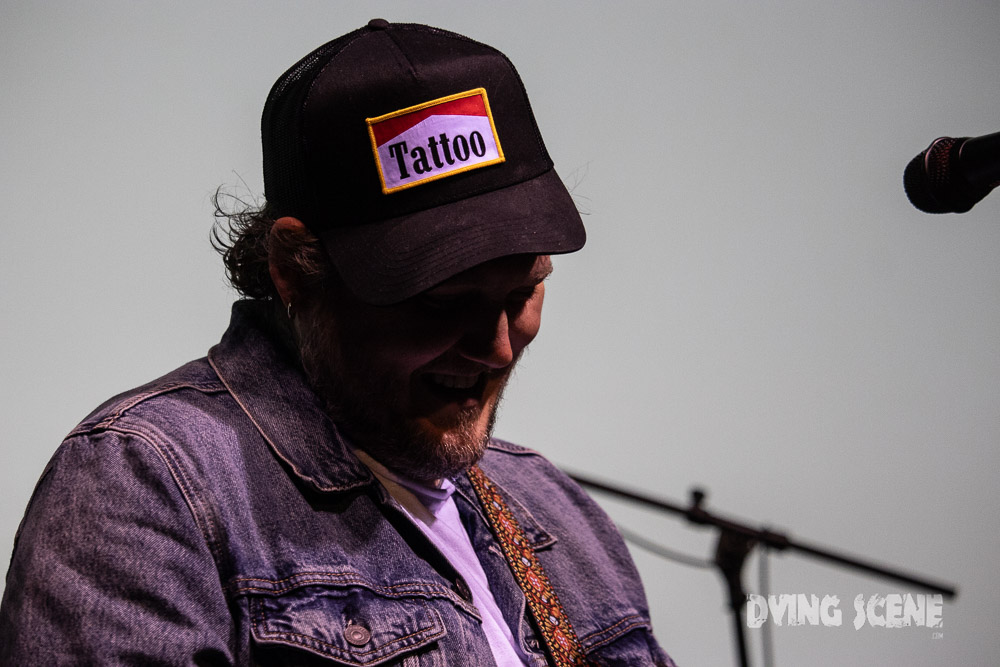
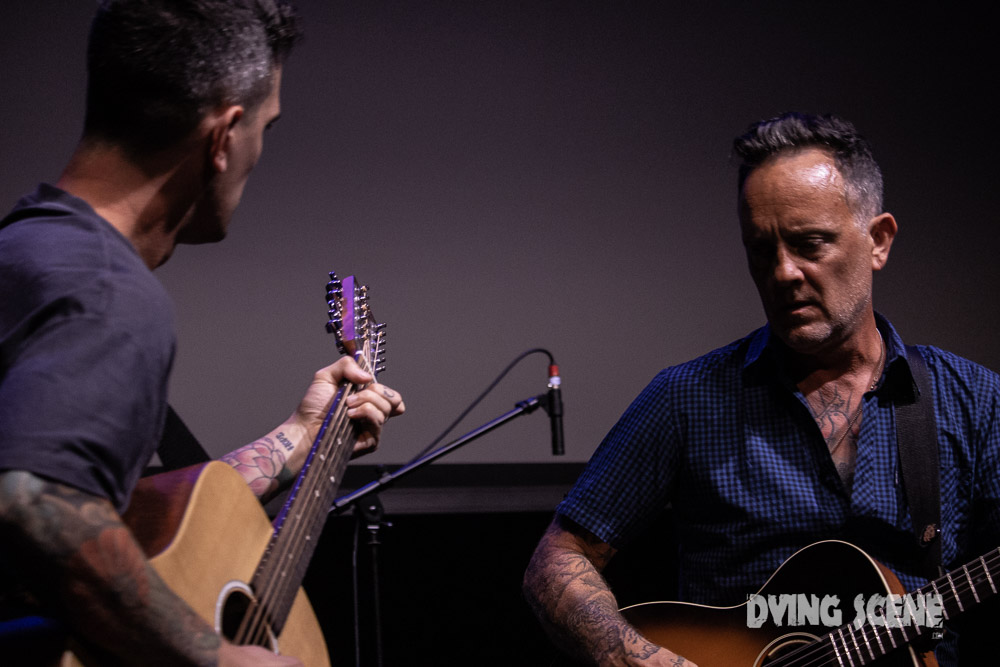
Upon making landfall on the shores of AMG, Southern goth rock outfit Wailin Storms stirred up strong sentiments in our esteemed staff. Madam X praised this Texas-turned-North Carolina quartet’s One Foot in the Flesh Grave (2015) for its ‘oddly dark and tricksy’ swirl of Danzig and 16 Horsepower. Since this (Great) debut, subsequent squalls have been weaker but still potent. Cherd found Rattle(2020) a moving, if unvaried, gust of ‘dark psychedelic twang,’ while The Silver Snake Unfolds(2022) blew fresh air into the band’s ‘fire-and-brimstone snake handling speaking in tongues nightmare music.’ 1 In the Year of Our Lord 2026, Wailin Storms play The Arsonist on their new home, Season of Mist. Conjuring a conflagration for their fifth album, these Durham doom-punk goth rockers may once again set fire to the Score Safety Counter.
The Arsonist stokes the shift Wailin Storms started around Rattle. There, the band refined their swampy pastiche into a more measured fusion of their influences. Past outings in this idiom suffered from songwriting redundancy and sore-thumb tracks. The Arsonist, however, proceeds as a dynamically-sequenced, organically-produced dance between barn burners and smoldering pits. “Dead End” ignites the album with the darkly driving guitar enmeshments of Justin Storms and Ben Melton. Meanwhile, “You Never Answered” bursts with spasmodic rhythms from drummer Mark Oates and bassist Steve Stanczyk. Even when the fires abate, Wailin Storms bring the heat. “Heart of Mine” and “The Arsonist” excel at slow-burn setups with sizzling sendoffs, singeing the skin from within. Whether in the energetic or meditative category, the songs consistently hit the spot, feeling wrought to just the right degree. At 45 minutes, The Arsonist breathes when it needs to and scorches when it wants to.
The apex of this blaze are the vocals of Justin Storms, who mightily impresses with his range. Storms’s wail has recalled Glenn Danzig since Flesh Grave, and it continues to power some affecting choruses (“You Never Answered,” “The Arsonist”). Subsequent releases, however, have seen the frontman branch out beyond the Shirtless Wonder. On The Arsonist, Storms incorporates stylings akin to the silky mid-range of Chris Cornell (Soundgarden) and the alien warbling of Thom Yorke (Radiohead). On that latter reference: Storms’s voice, at its most tender and brittle, brilliantly inflects somber material that wouldn’t sound out of place on Hail to the Thief (“Heart of Mine,” “It’s All Dark Now Where Your Eyes Used to Be”). He even dips into some down n’ dirty blues moans, mixed with a flitting falsetto (“Saved”). Storms is not the only voice on The Arsonist, though; Melton melts faces with aggro shouts, imbuing the blues rock with a noisy edge (“Dead End,” “Never Rest”).2 As thrilling a display as I’ve heard in 2026, The Arsonist stand as a surefire frontrunner for Vocal Performance o’ the Year.3
Criticisms of The Arsonist are minimal and wispy, affording opportunities for further praise. Lighting a spark and growing into a flashover, The Arsonist does falter a tad in its pre-decay transition. “Patient Night” pleases with fun, shaker-fueled shimmies, but it’s a bit simplistic and truncated, comparatively speaking. Following this tune is “The Wind,” a more expansive number possessing sweet pseudo-metal punctuations. Its subdued ending, however, feels like a slightly redundant transition into the excellent closing piano ballad (“It’s All Dark Now…”). Another nitpick concerns lyrics. The Arsonist excels at marrying emotional realism with surrealist imagery. But one moment always sticks out: the punk ending of “Never Rest,” where Storms snarls an equally punk rallying cry (‘Fuck your fucking war…Fuck your fucking war’). I’m no puritan when it comes to profanity, and I like a good protest song as much as the next guy. Alas, something about these lyrics momentarily takes me out of the album’s arrestingly eerie aura.
Extinguishing these critical flamelets reveals a Safety Counter set ablaze. After three attempts, I didn’t think Wailin Storms would ever again produce an album as great as One Foot in the Flesh Grave. The Arsonist proved me wrong, though it’s greatness is of a different kind. Whereas Flesh Grave grounds its twists and turns in Danzigian blues rock/metal, The Arsonist enchants with its seamless shifts between combustible laments and fiery bangers. Arson may be a crime, but missing out on The Arsonist—whether you’re a longtime fan or a newcomer to Wailin Storms—would be the real crime.
CRUMBLING GHOST SHARE VIDEO FOR SLOWCORE/GRUNGE INSPIRED SINGLE ‘LAST OF ALL SLEEP’
NEW ALBUM ‘FOUR’ RELEASED 7TH AUGUST (NEW HEAVY SOUNDS)
Within the broad church of ‘rock’ or ‘alternative’ and its many offshoots – it remains a minor thrill to stumble across a group who seem to exist at a slight tangent to everything else.
Crumbling Ghost is one such anomaly and an irresistible one at that: a group who feel less like a discovery than a secret belatedly shared. Their new album ‘Four’ set for release on 7th August (New Heavy Sounds) was announced last month.
Crumbling Ghost are not newcomers. They’ve been operating for some time, releasing records sporadically, Four’ is in fact their fourth release. Along the way they’ve accumulated a fervent coterie of followers, not to mention the occasional nod of approval from tastemakers such as Stuart Maconie, Stewart Lee and Tom Ravenscroft. And though they’ve appeared at Roadburn, shared stages with Hawkwind and even Damo Suzuki, they remain (possibly by design) curiously under‑the‑radar. That might change with the quite wonderful ‘Four’.
The group’s core idea is deceptively simple: traditional folk material rearranged and refracted through the haze and heft of fuzzy and dreamy, psyche tinged rock with a smattering of noise and shoegaze.
What Crumbling Ghost latch onto is not folk as a museum piece, but as a lived experience, the dramas rooted in the culture, stories, and daily lives of ordinary people, the folklore, the tales of love and death, murder and adultery, freedom and oppression.
On ‘Four’ those narratives are dragged into the present via churning distortion, hypnotic repetition and a sense of looming atmosphere. Fairport Convention with fuzz. Trees with heft. A pastoral Sonic Youth.
The result is a set of murder ballads, supernatural reckonings and cautionary tales, all wrapped in slabs of heavy, thumping fuzz and atmospheric sonics. Harnett’s voice sits at the centre: unmistakably folk‑rooted, but shorn of prettification, melodic yet capable of real bite. There’s no “hey nonny nonny” here.
Musically, it’s a combination that really does work, and it’s delivered in some style too. And to fully appreciate the world of Crumbling Ghost, listening closely pays dividends, and those stories come to life.
New single “Last of All Sleep” is not a Crumbling Ghost reinterpretation of a dark and distant folk murder ballad, nor a cover of a little known 90’s SubPop grunge downtuned, downtempo album-track-that-should-have-been-a-single, but it feels like a song you’ve wanted to hear and yet known for years, in other words, an instant classic.
If you were “Last of All Sleep” was written by Kristin Hersh when she spent a month in the desert with Kyuss and then gave the song to Earth (who are still to record it), you would be excited to hear it. You should be.
“Last of All Sleep” is Crumbling Ghost visiting the pantheon of slowcore with effortless cool and groove, along with oozing heavy Fuzz that Mudhoney, Alice in Chains or Melvins would head-nod to. It has also a killer vocal with hooks that Blackwater Holylight or Faetooth would kill for. And that solo at the end..! The band comment,
“Last Of All Sleep first emerged a little while back when Katie and I played in a previous band called Mordros. When rehearsing material for Four I brought this song back to the practice space as I thought it would compliment and contrast nicely with the rest of the material lined up for the new album. At the time it was written I was listening to a lot of Will Oldham which probably influenced the vibe to an extent. It’s telling a personal story based on the changing seasons, restlessness, and how the past teaches us to be present in the moment.” – John Mosley (guitar)
“For me, I first heard it when Johnny brought it in and I immediately wanted to add some subtle Kim/Kelley Deal Breeders overdrive to Johns finger picked clean guitar. As usual I got carried away and with Wayne (Adams) help, ended up with that monster guitar tone.” – Donny Hopkins (guitar)
“It is funny how we all interpret songs and to me the song is about a new relationship as it develops and blossoms through the year. The person in the song having potentially found their “significant other”. There is an ease about the way they float from season to season and appear to grow to understand one another. But hey, this is just my somewhat romantic interpretation, however, because of this I felt the vocal should be quite understated to reflect its day dreamy quality, mirroring the instrumental that chugs along reassuringly” – Katie Harnett (vocals)
7 songs, 7 worlds, all honed to perfection by producer Wayne Adams (Green Lung/Big Lad) that will reward every repeated listen.
‘Four’ amply and beautifully demonstrates that when it comes to ‘folk horror’ there’s nothing quite as horrible as folk … Here, the horror such as it is, and it must be said, the moments of light, comes not from theatrics, but from the songs themselves – which, after all, is where it’s always lived.
Here, the horror such as it is, and it must be said, the moments of light, comes not from theatrics, but from the songs themselves – which, after all, is where it’s always
lived.
‘Four’ will be released by New Heavy Sounds on August 7th on a 300 only limited edition red and white marbled vinyl. Also available on limited edition CD and download. Pre-order now:
The final day of Outbreak 2026 brings with it the usual trudge of tired festival-goers, ready for one final day of moshing. It’s still warm, but the cooler breeze and semblance of cloud cover means that the sunburnt are at least unlikely to be any more so by the day’s close. Sunday brings more hardcore, not least thanks to the wealth of bands here today from Baltimore, one of the genre’s undeniable spiritual homes. But there’s also the usual mixture of genres that makes Outbreak 2026 so eclectic. Shoegaze, indie and emo all feature, making it another day of variety at one of the UK’s premium homes of all things heavy.
Words: Ben Williams
Nothing
Operating at the more direct end of shoegaze, Philadelphia’s Nothing revolves largely around Domenic Palermo. His on-stage persona is retiring. Head down, he studies his guitar almost as much as his effect’s pedals, something he has in common with his bandmates who are similarly indifference to ostentatious showmanship. Conversation is kept to a minimum too. We learn that Palermo doesn’t like the heat: “the sun sucks,” he says obliquely, but that’s about it. Nothing are simply content with creating foggy landscapes of distorted guitar the pass by meditatively, something that they do rather well.
End It
Given that End It recently became notorious for a mid-gig confrontation between the band and a man dressed as a banana, the enormous crowd they draw is expected. But those hoping to see another fruit-related incident were instead treated to the most faithful of hardcore bands. Indeed, the word “hardcore” is used so frequently during frontman Akil Godsey’s stage patter that it begins to sound like gibberish. It’s a volatile performance. During an opening monologue, which somehow namedrops both Jesus and Stalin, Godsey informs everyone to expect “25-27 minutes” of hardcore; and that is what happens. Everything about the performance feels dangerous, even down to the animated devils that hold the band’s projected logo behind them. It all feels rather more serious than it perhaps should be, but there’s a refreshing honesty with which End it pay tribute to the genre.
La Dispute
Jordan Dreyer is a natural storyteller. The La Dispute frontman’s charisma is tangible as he traverses songs from the Michigan band’s 2025 album ‘No One Was Driving The Car’, with highly conceptual and impressively complex song structures. What results is a performance that isn’t as confrontational as it is introspective, with the content of Dreyer’s lyrics forming the fundamental centrepiece for the performance. This is epitomised by ‘King Park’, a heartbreaking song from the band’s second album ‘Wildlife’ that is devastatingly visceral. And as Dreyer’s imagery comes to life, the bleakness of his lyrics are every bit as affecting as the musicality on display.
Snail Mail
Standing out as one of the festival’s stranger bookings, Snail Mail’s comparatively gentle indie rock is pleasant in the sunshine. Effectively a Lindsey Erin Jordan solo project, Baltimore’s Snail Mail does admittedly possess a fragile approach to lyricism that’s akin to the festival’s opening night of emo opulence. When performed live, her songs also evoke the sounds of slacker rock, which gives her guitar playing a groovier feel than on record. It cannot, however, be ignored that the paucity of festival-goers watching Snail Mail is due to an abundance of attendees watching Hatebreed at the smaller indoor stage, which is promptly closed to avoid over-crowding. It’s always pleasing to see something different on the lineup, but the scheduling of these two artists feels unfortunately misguided.
Trapped Under Ice
Trapped Under Ice’s three albums in almost 20 years sounds unproductive. Yet considering how busy the band are with their other projects (Angel Du$t, Cold Mega, Turnstile) it’s remarkable they’ve found any time to play at all. It’s a performance of merciless aggression. This is hardcore punk that is upfront and hostile; there’s as consistent a stream of stage divers as there’s been all weekend to prove it. Justice Tripp’s vocals are as gnarled as barbed wire. His growl roars from the speakers with a fierce intent. Occasional interruptions to this take place only in the form of the audience members who periodically acquire Tripp’s microphone. These vocals are a little less impressive but stand as a reminder that hardcore is egalitarian. Band and audience are at one, as proven by the lack of barrier between them.
Suicidal Tendencies
Mike Muir is the only original member of Suicidal Tendencies. He is at once a frontman, a hype man and the glue that keeps the legendary project alive. Known for creatively combining elements of punk and trash, the band now have a legacy to uphold, but solemnity is not in their wheelhouse. Instead, there’s something wonderfully silly about much of the performance. Muir’s rambling political addresses wouldn’t hold to scrutiny, but chants of “SC” and a David Byrne vocal style are enough to delight this weary Sunday crowd. The combination of “You Can’t Bring Me Down” and a head-banging Muir is a joyous sight. It isn’t the slickest of performances but it might be the most fun anyone has all weekend.
Basement
Basement are Outbreak regulars. They headlined in 2024, having played numerous times before then. It makes them a somewhat uninspired booking, but the fact they’re tried-and-tested helps them deliver a crowd-pleasing hour of alternative rock/emo. Having released their last album ‘WIRED’ earlier this year – their first in eight years – there is added impetus to the show. That said, it takes time for Basement to warm up. A string of new songs leaves everyone waiting for the jubilation brought by older songs like ‘Covet’ and ‘Spoiled’. There are many attendees sporting Basement T-shirts today, but the lack of a reaction to songs from ‘WIRED’ suggests that not all of their fans are here for Basement’s new music. Then again, to end Outbreak Festival 2026 – which celebrates its 15th anniversary edition with one eye looking into the past – with a band who are veterans of the festival feels thoroughly apropos.
Black Sabbath’s Bill Ward states that he’s “still a drummer” despite increasingly relying on a wheelchair to get about.
In a statement posted to Facebook on Thursday (July 9), the pioneering heavy metal sticksman, 78, reveals that he is unable to walk long distances without assistance but refuses to give up his instrument because of it.
He writes: “I’m announcing today somewhat sadly but nonetheless truthfully, that I’ve reached a place where publicly more and more I need to use a wheelchair, mostly in airports, or public events.
“I can still walk, let there be no doubt, but I can’t walk very far without needing to rest, meaning I need to sit down.”
Ward says that he started using his wheelchair “about 18 months ago, mostly in airports”, but defiantly adds that “I was a long distance walker, I’ve walked in many different parts of the world, and I’m still a drummer. I can still play pretty good for 78 years old”.
“My talents and ambitions, and my unyielding need to be artful, and to play drums, is still as strong as it was so many years ago now,” he continues.
“I’m just saying if you see me in a wheelchair, I’m just catching a ride, I’m not in retirement or ill or giving up, or any of those thoughts that ignite when we see people in wheelchairs. I’m making myself public and transparent about my new transport, and letting you know I’m OK.
“If you see me in the airports or visiting friends in the music arenas or theatres say hi, I don’t bite, I’ll just look different.”
He signs off: “Much love to you all and I’ll keep rocking until I’m dead.”
Ward co-founded Sabbath with singer Ozzy Osbourne, guitarist Tony Iommi and bassist Geezer Butler in 1968. Even though he speaks out against retiring in his new post, the band retired on July 5, 2025, after putting on a grand final bow at Villa Park stadium in their hometown of Birmingham.
The all-day extravaganza, which marked the founding Sabbath lineup’s first time performing onstage together since 2005, featured support from such rock and metal titans as Metallica, Guns N’ Roses, Tool, Gojira and Mastodon. Osbourne played a short solo set before doing four songs with Sabbath. The night marked the Prince Of Darkness’ last time onstage before his death aged 76 following a heart attack on July 22.
Last June, Ward revealed that, despite Sabbath’s then-impending split, he was busy working on two new solo albums. Talking to Long Beach radio station 99.1 KLBP-FM, he said that the efforts were “nearly finished” and that he’d been “living in the studio”.
“I’ve just let everything go. I basically don’t give an ‘F’, and I think it shows up in the record. I don’t have anything to swagger about. I wanted to play something that plays in my heart and then comes out of my soul. I wanted to play some things that keep me awake at night.”
Neither of Ward’s albums have been officially announced at time of publication.
Jawdropped, the rising four-piece from Los Angeles, today announce their debut album, Secret To Spare, due 18thSeptember via Transgressive Records / Canvasback.
Crack Den Blues finds Flowers for Juno drifting through a fog of blown-out guitars, tape hiss, and ghostly reverb, crafting a sound that feels hypnotic, unsettling, and strangely beautiful. Echoing the decayed, narcotic atmosphere of early-era SALEM, but filtered through a shoegaze and indie rock lens, the track balances dense textures with buried pop instincts. Its woozy production, haunting vocals, and slow-burning intensity create an immersive listening experience that grows more captivating with each spin. Equal parts abrasive and dreamlike, Crack Den Blues is a fearless exploration of noise, mood, and melody that leaves a lasting impression.
In the summer of 2002, Red Hot Chili Peppers scored their first ever UK number one album with By The Way. In this archive interview, conducted later that same year, Anthony Kiedis, Flea and John Frusciante look back upon one of the most challenging, but beautiful, years of their storied career.
January 2002: Red Hot Chili Peppers are in Cello Studios in Hollywood with producer Rick Rubin, two months into the recording of their eighth studio album
Flea: “The real work on By The Way started in February 2001, when we first got together in a rehearsal room to write. We spent six months straight writing and arranging every day, so that by the time we get to the studio we’re just laying the songs down. Cello is a great place to record, but sometimes recording can be exciting and beautiful, sometimes it’s just another humdrum day at work. Writing is fun, it’s boring, it’s happy, it’s miserable, it’s always different. But we’re disciplined and focused enough to go into the studio every day and work. It’s not some champagne and caviar rock star party for us.”
John Frusciante: “I started recording most of my parts for By The Way in February. I actually probably enjoy being in the studio more than being onstage, just because you can take one moment and capture it for infinity just by pressing the ‘Record’ button. That’s a wonderful powerful feeling for me.
“In the past, particularly when we were writing BloodSugarSexMagik, I’d be writing to fit into the style of what the Chili Peppers – the band that Anthony and Jack (Irons, former RHCP drummer) and Hillel (Slovak, former RHCP guitarist) and Flea created – were like, but now I don’t feel the need to make our music sound like the Chili Peppers, I don’t feel the need to fit within the blueprint laid down by the early albums. More often that not now songs come from jams, and then Flea and I have what we call a ‘face off’ where we each try to write a part that’ll be right for that song. One of us goes into the alley by the studio to write and the other stays inside and then we compare the two, and we did that on pretty much every song on the record. I’d come up with a basic framework for songs like Cabron and Venice Queen but everyone writes their own parts so there are always alterations to be made.”
Writing is fun, it’s boring, it’s happy, it’s miserable, it’s always different
Flea
Flea: “There are always differences in the studio with ideas and egos and being at different places in our lives, but our ability to connect with each other gets deeper over time. We know more about ourselves, more about each other, more about music and more about accessing the spiritual content of the songs.”
Anthony Kiedis: “When we finish the completed basic tracks, we’ll sit back in the studio and listen to them and smile at one another, knowing that all the hard work was worthwhile.”
February 2002: Anthony Kiedis takes up residence at the Chateau Marmont on LA’s Sunset Boulevard to record vocals for the album. On March 18 he’ll take a night off to induct Talking Heads into the Rock And Roll Hall Of Fame.
Anthony: “The Chateau Marmont is probably the most beautiful, soulful building in all of Hollywood. There’s a good spirit in that building, and they treat us nice there. I had lived at the Chateau in the past, and John was living there at that time, and as he was doing a lot of harmony vocals we thought, ‘Why hang out in an enormous recording studio that costs a ton of money when we could just check into a room, set up some microphones and do the vocals there.’ So we rented a room on the seventh floor and moved in the Pro Tools computer gear and made it our own. It’s always nice when you’re doing vocals to find a space that you can call your own and decorate in your own way. I had a load of vintage film posters from the ‘30s and ‘40s all around my microphone, which helped me get into the vibe.
“I thought I had written a lot of lyrics. I had lyrics for about twenty different songs, but my band had written about a thousand songs and they wanted to record about thirty of those. So each and every morning I’d spend the first few hours writing before I went in to sing. I probably finished about 30 per cent of the lyrics in the Chateau. Sometimes I just have to listen to the music and start writing and the lyrics will be there, but other times it’s painful and methodical, like figuring out your next move in a chess game.”
(Image credit: Kevin Mazur/WireImage)
April 2020: Artist and film-maker Julian Schnabel, father of John Frusciante’s girlfriend Stella Schnabel, turns his ideas for album artwork over to the band.
John: “My girlfriend’s father offered to do the album art, and so we sent him rough mixes of eight songs and he got the vibe of the album from that. He said that he wouldn’t be offended if we didn’t like it, but we loved what he did. He’s also given us great covers for all the singles. He’s a true artist.”
May 2020: The video for album title trasck By The Way is filmed in LA by award-winning video directors Jonathan Dayton and Valerie Faris, who have previously helmed the band’s Otherside and Roadtrippin’ videos.
Influenced by a car chase featured in the Mexican film Amores Perros, the video sees Anthony Kiedis kidnapped and taken for a ride by a lunatic taxi driver, played by comedian David Sheridan.
Anthony: “That video was funny. We got to do our own stunts and hang out with comic genius David Sheridan. He never broke character for the four days that we were shooting [May 17-20], and he never ran out of dialogue that wasn’t side-splitting. I actually wanted Jim Carrey to be in the video, but Valerie, our director, said, ‘I know someone who’s better’. I was like, Better than Jim Carrey? Are you sure? But he ended up being the best choice we could have made.”
John: “The guy was really funny. I have an hour-long video tape of the improvised stuff he’d be doing between takes, or during our lunch breaks, and it’s just brilliant. Most of the time with videos you spend your time sitting around in the RV waiting to be called, but he actually made that one quite fun.”
On May 31, the Chili Peppers play The Garage in London, their first indoor UK show since December 1999.
John: “That show was a lot of fun. I love playing huge shows but playing little clubs is great. It’s fun for me to be able to see people’s faces close up, and feel like we’re all one together.”
Flea: “Bands always say they prefer little shows because they like the contact with the people, and I like that too ,but I also like the feeling of things moving and changing. We’ve played a billion little clubs and I think that it makes sense for this band to be playing big places right now. I was kinda in a bad mood that night, I was having a little tantrum, so for me personally that show was a little weird.”
Anthony: “You’re kidding! I guess there’s no accounting for a bad mood but personally I was in heaven, that was just about as much fun as you can have playing a show.”
July 2002: By The Way is released as a single in the UK on July 1, entering the charts at number two. The following week, its parent album is released. Selling 134,000 copies in the UK in its first week on sale, the album debuts at number one. The album also tops the charts in 15 other countries.
Anthony: “I thought that single was an uber-bombastic assault of non-commercialism. For it to be so well received over there was shocking to me, but thrilling at the same time. It’s a good feeling when that island of yours embraces our band.”
Flea: “In England you can be a great genius one minute and three minutes later you’re the biggest asshole that ever lived, but I’m not going to complain now that we’re popular. I think people connect with the honesty and craftsmanship in our music. It’s not like we’ve had some overnight surge of popularity, but as time has gone by I think people have connected in a deeper way. I’m happy with the way the public relate to what we do.”
In England you can be a great genius one minute, and three minutes later you’re the biggest asshole that ever lived
Flea
Anthony: “For us the true experience of an album is the days and weeks and months we spend throwing music around in the studio, so when the album is due for release, we’re kinda like, the world can do with this what it will. When the mix is finished, we all get to drive around with copies in our cars, and we do swell up with a little bit of satisfaction, but after that we’re kinda detached, but hoping for the best. Of course we get elated when we get a positive response to what we do. We feel like we’re making a contribution to the positive energy of the world.”
John: “It made me feel really good to read the reviews of this album and to see it doing so well in England. I’m more proud of this album than anything I’ve ever done.”
July 2002: the quartet play a 90 minute show on Ellis Island in New York City for competition winners, family members of September 11 victims, and lower Manhattan businesses. The Ellis Island Immigration Station was the entry point to the United States for more than 12 million immigrants from 1892 to 1954.
Flea: “That was a trippy gig. It was raining and raining and we were out on this little island where the immigrants used to get totally fucked by the government, so the gig had this really bizarre energy. You could feel the history of what happened there.”
John: “My girlfriend’s mom and brother were in the audience which was fun, but it was kinda a rough show for me. Every time I stepped on my distortion pedal the volume would drop to half so I couldn’t hear my guitar solos. It was one of our first shows and so we were stilling ironing out the kinks.”
September 2002: The band team up with Jonathan Dayton and Valerie Faris once more to shoot the video for The Zephyr Song.
Anthony: “The performing part of the video wasn’t that exciting for us, but being there for the go-go girl dancing shooting was fun. We had this girl called Amy Christie dancing, and she was really beautiful and sexy and she danced very well and had that Russ Meyer’s enthusiasm to her female form. And then we had the talented and lovely Tobey Torres dancing too. She’s the girl whose crotch you actually stare into in the video. She’s awesome, a great girl.”
On September 27, the Chili Peppers kick off a ten date South American tour at the Plaza de Toros in Guadalajara, Mexico.
John: “The people in South America were wild, they really respond to the music. We had a lot of great shows in South America. I think we definitely went up a notch in improvising on stage, and because the audience were so into it.”
Flea: “South America was a fucking trip. The gigs were outstanding, because those crowds are incredible, the best crowds in the world, they go apeshit for every show and just explode.”
“I lost it when we flew into Santiago, Chile actually. I snapped at the airport, and I was just screaming and swinging at people. I’m not proud of it. People invade your privacy and at first you understand it and tolerate it but it gets to the point where you’re like, Get the fuck away from me! I wasn’t really looking and all of a sudden there were 50 people all over me, pulling at my clothes, and I just freaked.”
Anthony: “In South America the fans have a frightening habit of laying siege to the hotel and that can get painful and isolating, it makes it hard to just exist. But we managed to escape a couple of times, we found a beautiful empty surf break in Costa Rica and came back from there feeling rejuvenated and the same thing happened in Brazil. Basically this is the best job in the world and I can never complain about it.”
October 2002: The LA band fly to Japan for a seven date tour, to be followed by shows in Australia, New Zealand, Singapore and Thailand. They will end 2002 in Paradise, literally, with a New Year’s Eve show at the Hard Rock Hotel in Paradise, Nevada. By November 2003, when the By The Way tour finally wraps at the Hollywood Palladium, the album will be nudging towards 2 million sales in both the US and UK.
John: “Our shows are just getting better, we’re definitely sharing some ESP moments on stage now, learning how to think inside each other’s brains. The freedom to be able to make music and get pleasure out of it is a wonderful feeling that I don’t want to ever stop. I’m as happy as I’ve ever been now, both in the band and in my own life, and I just hope that next year I have the time to do everything I want to do. I feel like the luckiest person in the world.”
Mastodon have addressed the speculation surrounding the factors that led to the departure of their late guitarist Brent Hinds.
Hinds, who parted ways with the band in March 2025, died last summer following a collision with a car while riding his motorcycle in Atlanta, Georgia. He was just 51 years old.
In a 35-minute film titled The Mastodon in the Room, the band – Brann Dailor, Bill Kelliher and Troy Sanders – remember the life of their friend and bandmate, while detailing the circumstances which led to Hinds’ exit.
A statement from the band reads: “As we enter a new chapter of Mastodon, we want to do this the right way and talk about Brent. We’ve all seen the clips, headlines, and speculations, but we haven’t told our story in our own words about our 25 year relationship.
“It isn’t easy to talk about Brent, he was our family, someone we all loved wholeheartedly,” it continues. “He was a wild man, our wild man, and that came with some challenges. Both things are true and we aren’t interested in chasing one truth over the other. Losing him has meant sitting with a type of grief we never expected. No more hugs, no more high fives, no more disagreements, no more making up. That part has been hard, it’s real.
“We put this conversation out there so you can hear it directly from us, you all deserve that.”
As the surviving members watch archive footage of their late friend in a cinema, Sanders says that Hinds’ problems with alcohol causing rancour in the band, and peaked during the recording of their 2021 album Hushed and Grim.
“His dissociation was very evident during [that] period – both his energy and his effort towards us,” says Sanders. “It’s like, no one’s required to be here, but we’re in it for the heart, the purity, and the authenticity of what we do and what we’ve built.
“And that led to the recording process, which was, in my opinion, the most separate that we’ve ever been in a studio recording a double album. The dark tones, the alcohol, and the things that had grips had their nails in him harder than ever before. There have always been ups and downs for the 25 years of our band, but I think it was at its peak, unfortunately, during these past five years.
“I mean, those few years of touring on Hushed and Grim was the weakest band solidity and performance that we had had in a decade. And I knew in my heart that this was possibly going to plateau. And what happens after it plateaus is it goes down.”
(Image credit: Clay McBride)
The band called a meeting to tell Hinds what their issues were for the sake of their own mental health, after it was clear that repeated discussions about his drinking were being ignored. Hinds walked out of the meeting, and later said he was fired from the band on social media.
“Unfortunately, we knew in our hearts that this was never going to change,” admits Sanders. “I cannot tell you how many heart-to-hearts that the three of us had – daytime, sober – as a four-piece, pleading to someone that you’ve been with the bulk of your life to listen to us: ‘You need to take these avenues for your happiness, for your health, for our sake, for your sake, for your wife’s sake, for all of this.’
“I think it got to the point where the shows were declining in the live environment and we were exhausted,” he continues. “Exhausted by throwing all this love at something that was straight up not listening or not caring. At some point we realised, we can’t do anything else. What is there to do? We’ve exhausted all of this. Are we going to continue shooting ourselves in the foot, or are we going to keep conquering the world?”
Dailor describes the day Hinds left the band as “horrible” but the decision came from “a place of love.”
“It was really depressing and sad and fucked up,” says the drummer. “And we just wanted that beautiful, amazing creature, Brent Hinds, to be out there serving up the honey-baked ham and screaming his head off and playing, ripping amazing, incredible, beautiful solos. We desperately wanted that guy, but he showed us time and time and time and time and time again that that person wasn’t coming back without some kind of dramatic change.
“We really were coming from a place of love,” he adds. “It’s like, maybe this will be like some kind of bottom for him. You know what I mean? You never know. We had to set some boundaries and we had to take care of our own sort of mental health.”
A new petition has been launched by the Emerson Lake & Palmer Appreciation Group on Facebook, calling on the BBC “to recognise and celebrate the enduring musical and compositional legacy of Keith Emerson through significantly increased programming, performance, documentary coverage, and inclusion within the 2027/2028 BBC Proms seasons.”
The new petition centres solely on Emerson, who, according to the petition, “aspired not merely to popularity, but to be remembered as a serious twentieth-century composer whose complex and multi-layered works would stand the test of time.”
2027 will be the 50th Anniversary of Emerson’s Concerto Number 1, which was composed and recorded in 1976, and released on ELP’s Works Volume 1 a year later.
The petition specifically calls upon the BBC (and others) to:
* Increase the broadcast presence of Keith Emerson’s compositions and solo works on BBC Radio 3.
* Commission and broadcast new BBC Four documentaries and retrospective programmes exploring Emerson’s role in twentieth-century musical innovation.
* Include the music and compositions of Keith Emerson within the BBC Proms 2027/2028 seasons, particularly through orchestral, symphonic or contemporary interpretations that properly reflect the scale, breadth, and ambition of his work.
* Recognise progressive rock and crossover composition as an important and legitimate part of Britain’s modern musical heritage, which has now begun with the inclusion of Prog Rock: A Fanfare for the Common Man in 2026.