[Cover art by Larisa Brechun]
With age, you begin to understand that genuine loss is not the haunting shadow you once thought. It isn’t a short-lived grief that disappears in a few days. Instead, it’s more than a shadow; it’s a scar you bear until you confront the inevitable yourself.
Or, in the words of the great Kirk Windstein, sometimes, time heals nothing.
Mother of Graves resonates with what it means to be human. In my bones, I sense a connection that I have a difficult time describing, but maybe that’s just my Midwestern bias. They’re able to hit certain notes that conjure feelings of despair and the weight it carries. At times, it’s nostalgic, but even that’s a reminder that the days of old float away with the breeze, dancing with the leaves as it pushes between frail tree limbs.
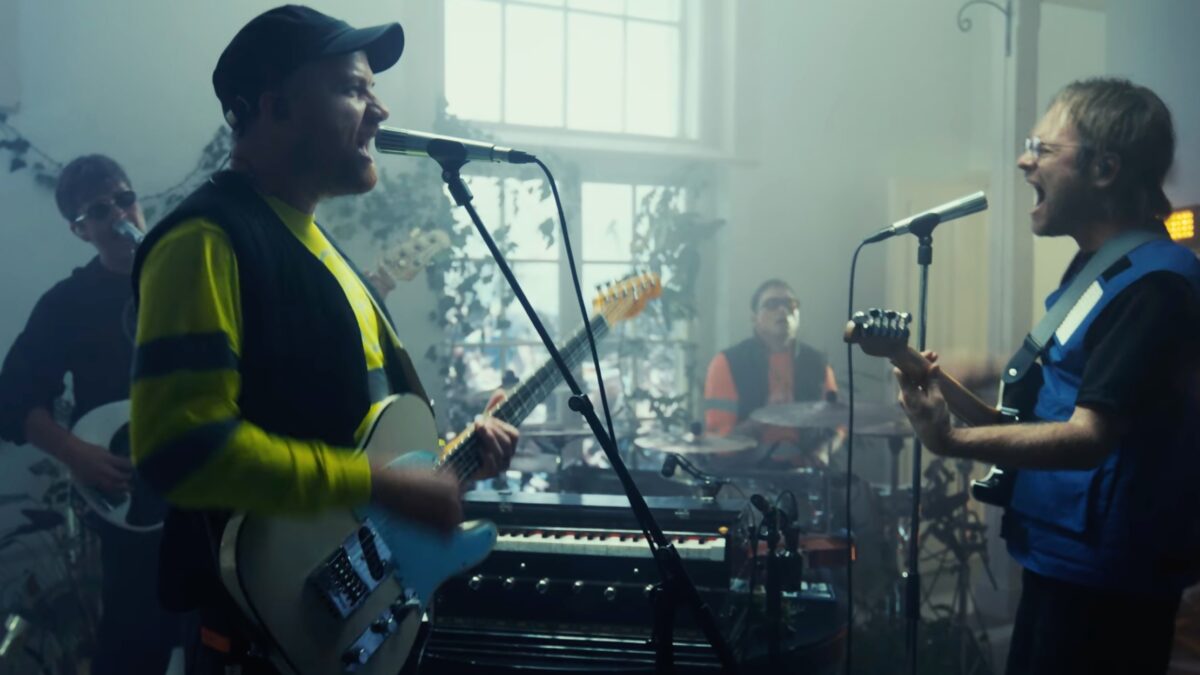
Founder and guitarist Chris Morrison started writing songs for Mother of Graves when one of his best friends and bandmates suddenly passed away. You could hear the sorrow in the melodies on Where the Shadows Adorn’s “The Emptiness of Eyes.” You can hear similar anguish on The Light That Keeps Us’s second single “The Silent Weight of the Stars.” If you’re a fan of Paradise Lost’s Gothic, you’ll find it quite alluring. Speaking of which, I’m reminded of Katatonia’s “Rainroom” at times, specifically in the vocal arrangements and clean guitar interludes. Then, there’s “Through the Pale Shade” to showcase how tastefully the band interweaves keys to emphasize those beautiful guitar leads. Holistically, it helps the music rip and tear at the heart strings. Think Tiamat’s Wildhoney. Just based off the singles alone, I can’t help but feel that in just six or so years, Mother of Graves have reached the upper echelon levels of death-doom. You could turn to the album intro “Wingless Soul” (featuring Dan freakin’ Swano) as another example. The piano builds up to a mashup of Edge of Sanity’s Crimson and Katatonia’s Dance of December Souls. The clean vocals are a nice touch, adding some duality to the mix.
I’d be remiss if I didn’t acknowledge the poetry of Brandon Howe. I understand that may roll some eyeballs, but lyrically and in delivery, the songs are just that—poetry. The title track is brooding and anthemic, much of which is enabled by Corey Clark’s work on bass, which in turn gives Howe the opportunity to annunciate his lines almost as if every word is being carved into him. While “The Light That Keeps Us” bestows perhaps my favorite vocal performance on the record, he maintains similar deliveries and moments throughout the album’s duration. “A Moonlit Tryst” is strong in that regard, too, but the band as a whole hits on all cylinders here. It sounds like their most ‘90s track to date, and for a band so influenced by that time period, that’s saying a lot. But, man, it’s heavy in more ways than one, too. The emotional weight of the around-the-campfire acoustic intro, the guitar harmonies, spoken word passages—dude—pound-for-pound my favorite track they’ve ever written. And the final minute-and-a-half is some of the best heavy music you’ll hear all year.
Production-wise, it’s perfect. “The Beggar’s Allegory” is warm, and with a nice pair of headphones, you can pinpoint each layer of instrumentation, including the little crackles in the background during the piano intro. The song also features the highest-BPM moment on the album at around the halfway point. The band offers up a double kick-tremolo riff combo in the vein of something off Purgatory Afterglow. Overall, the song ebbs and flows nicely, almost as if it’s allowing you to contemplate an answer just before throwing you back into a sense of questioning. You’re never really able to draw a true conclusion, but that’s exactly the balance it’s going for. It ends abruptly so it can send you off with “The Endless Climb.” In terms of atmosphere, the curtain-closer comes off as a eulogy. Ironically, it’s as close to funeral doom as the band gets on LP number three. It doesn’t quite reach Skepticism Stormcrowfleet levels of slow, though. And it wouldn’t be such a terrible thing if it did, for what it’s worth.

All in all, an incredibly strong final chapter to the band’s finest effort to date.
Before I trail off, I do want to reiterate and go over a few more anecdotes. There’s something about the way Mother of Graves approach grief, longing, and the search for meaning that feels fundamentally true to the human experience. On The Light That Keeps Us, more so than ever.
Why is there so much tension between wanting to believe in something transcendent and recognizing how elusive that something can be? Why does love become a sort of salvation? Beauty a kind of religion? And why is the promise of something greater the ultimate prize for human suffering? Although that promise is never quite fulfilled, is it?
The climb continues.
You and I both know longing itself never disappears.
Even when Howe begins to question the very thing he once believed would save him, he can’t bring himself to abandon it. A painfully recognizable contradiction. We want to believe that love can make us whole. Suffering can lead somewhere meaningful. That there’s a reason to keep reaching for something beyond ourselves. And yet, so much of being human seems to involve learning to live with the possibility that we may never find the answers we’re looking for.
That’s what makes Mother of Graves so meaningful to me. They’re a reminder that there’s no easy catharsis, no neat resolution. In fact, suffering may not be redeemed and, in all actuality, nothing may ever make sense. There will always be this persistent, almost unbearable yearning for connection, transcendence, and peace. Even when broken or standing beneath a sky that offers no answers, I suppose you just keep climbing. Via melody and heaviness, Mother of Graves preach that good word.
Again, maybe that’s the Midwestern part of me talking. There’s a familiarity in the sense that you carry certain things with you because there’s no real way to put them down. Or maybe it’s something more universal than that. Perhaps in some divine way Mother of Graves understands that being human isn’t necessarily about finding meaning or achieving some kind of spiritual resolution. Maybe it’s about continuing to search for both, even when the search itself becomes a source of suffering. Because you really have no other choice, even if you’re haunted by something as daunting as grief.
Even writing those words down is cathartic.
And I hope that makes sense. It does to me, at least.
I knew I needed a new Mother of Graves record, but I didn’t know I needed it this much.
You know what?
10/10.

The post Mother Of Graves – The Light That Keeps Us Review appeared first on Last Rites.