Bobby Gillespie, frontman and founder of Primal Scream, is perched in his publicist’s office in North London, wondering just where it all went right. He’s here to talk about Screamadelica, the genre-bucking phenomenon that spun 1991 on its head.
A glorious starburst of acid house, psychedelia, dub, funk and old-school rock’n’roll, it was the album that scooped the inaugural Mercury Music Prize, helped forge the reputation of Alan McGee’s Creation Records, and a record that united the hitherto largely disparate factions of indie rock and dance music. More importantly for Primal Scream, it also saved the band.
“I honestly never thought it would be a commercial record,” Gillespie says. “I thought it was going to be just a really cool underground album, like Tago Mago by Can. But then it started getting amazing reviews and just kept selling and selling. I believe it’s sold a couple of million now.”
The success of Screamadelica – led off by two UK Top 30 hits in Loaded and Come Together – was as swift as it was unexpected. Emerging from Glasgow’s early-80s indie scene, Primal Scream had been formed by Gillespie and schoolmate Jim Beattie, fired by punk and the licentious rock’n’ruin of the Stooges and MC5. In fact Gillespie was the drummer for The Jesus And Mary Chain by the time of the Primals’ first official gig, in 1984.
There were a couple of unsteady PS singles, followed by the inclusion of Velocity Girl on the NME’s fabled C86 cassette, a compilation that celebrated the new jingle-jangle dawn of British indie bands. Primal Scream’s debut album, Sonic Flower Groove, in 1987, was an awkward conflation of Love, the Velvet Underground and the Byrds, recorded for McGee’s micro-label Elevation. It peaked at 62 on the UK chart.
1989’s self-titled follow-up, by contrast, was a full-on rock album in thrall to the Stones and the Stooges, Ramones and the MC5, Gillespie’s cutesy vocals battling it out with a classic Les-Paul-through-Marshall-stack wall of guitars. Despite classics like Ivy, Ivy, Ivy, She Power and Lone Star Girl, it wrong-footed some fans and the music press pounced on them for being ‘sad old rockers’, with Melody Maker dubbing them “Primal Tap”. McGee later admitted that “Primal Scream, media-wise, were a fucking joke”.
Gillespie remembers it all too well, but says he never lost faith in the band’s own abilities: “We never sold a lot of records, but we toured that album all over Europe. But we really believed we were a great band and had something that nobody else had. We always believed we were fucking great.
“I know it sounds really arrogant, but when it did happen for us with Screamadelica we weren’t surprised. We’d been out there for years and knew how to play live. And we were fucking ready for anything. It wasn’t like we were some band who came out of nowhere, had success then didn’t know what to do with it. Plus we were still angry too. We were total punk rockers.”
Despite the media’s almost unstinting disapproval, that second Primal Scream album did at least snag the imagination of one punter. The band’s press officer, Jeff Barrett, had given a copy to his good friend Andrew Weatherall, a club DJ and publisher of a fanzine called Boy’s Own. Weatherall was much taken with the album’s ballads, particularly I’m Losing More Than I’ll Ever Have. Urged on by Barrett, Weatherall remixed the song, dug out a drum loop from an Italian bootleg version of an Edie Brickell tune and added an intro from the old Peter Fonda biker flick The Wild Angels: ‘Just what is it that you want to do?/We wanna be free/ We wanna be free to do what we wanna do/And we wanna get loaded’. The band themselves were intrigued and, thus, Loaded was born.
The acid-house boom and the Primals’ own highly eclectic listening habits seemed made for one another. “I have this big thing about the fact you should be able to dance to rock’n’roll,” explains Gillespie. “What I liked about the whole acid thing was that you were dancing. Maybe you were dancing because you were on MDMA, but nevertheless there were a lot of electronic funk rhythms going on. Marry that to the fact we were into the Beach Boys, the Stones and free jazz, as well as lots of American blues.
“In Loaded there’s a bit where I go: ‘I’m gonna get down/I’m gonna get deep down’. There was a long outro section on the original song Andy Weatherall mixed it from, and I had this book of Robert Johnson lyrics, so decided to read some of it: ‘I’m gonna get deep down/Keep on tanglin’ with your wires/When I mash down on your little starter’ [1936’s Terraplane Blues]. So a bit of that ended up on Loaded. Nobody really knows that, but I just had all this stuff – Howlin’ Wolf, John Lee Hooker, gospel music… And we’d grown up with pop radio in the seventies, so you had stuff like Deep Purple and Led Zeppelin, but you’d also have the Stylistics, the O’Jays and all that great black American soul that came out of Philadelphia.”
Loaded was released as a single in March 1990, and reached made No.16 in the chart. It was Primal Scream’s first UK Top 40 hit, and one that had the curious effect of crowning this most rock’n’roll of bands as the new darlings of the rave scene. The success of Loaded led to Alan McGee putting the band on a weekly wage of £50.
We always believed we were fucking great. I know it sounds really arrogant, but when it did happen for us with Screamadelica we weren’t surprised.
Bobby Gillespie
“We were on the Enterprise Allowance Scheme just before that,” Gillespie recalls. “We were absolutely skint. He gave us an advance of a few thousand pounds, so we built a studio in Hackney, on Tudor Road. We rented an office and turned it into a writing studio. We wrote a lot of Screamadelica in there. We wrote a lot of the songs on keyboards, though I shouldn’t really be saying that in Classic Rock. I mean, we are a guitar band live, a high-energy rock’n’roll band.”
They were certainly living the life. Screamadelica was a filthy party animal of a record. It was a place where the tribal edicts of rock’n’roll were played out amid the glowstick rallies of rave. The album’s unbowed hedonism was typified by songs like Higher Than The Sun, Gillespie intoning to some imaginary Golden God: ‘I live just for today/Don’t care about tomorrow.’
“That’s exactly how I felt,” Gillespie says today. “I didn’t care if I died. I know that sounds dramatic, but it’s all there in the lyrics. We were out there taking ecstasy and speed. Speed was our main drug of choice, then people got more money and got into cocaine, then they got into heroin and it kind of fucked everything up. But I can’t really include heroin here, because while we were making the record it’d be speed and ecstasy. We’d never record on it though; you can’t play rock’n’roll on ecstasy.
“Acid house was similar to the LSD explosion of the sixties. The music was different, but I think it released a similar amount of energy and creativity in people who maybe hadn’t realised they had that inside them before. The energy in the clubs was intense. It reminded me of early rock’n’roll and punk. And that energy was extremely seductive. So we were up for days, living what it says in the songs. Being up for days meant we were exposed to a lot of great scenes and wild, strange, dangerous people. And fucking weird scenes with weird women. But we were a serious band when it came to recording and gigs. We may have partied at the weekends, but every week we were in the studio writing. At that point in your life you’re really out to prove to the world what you can do.
“We had a fucking great time, and that found its way into the music and the songs. I think it’s a very euphoric record. To me it’s ecstatic rock’n’roll. It’s what rock’n’roll should be: joyous and celebratory.”
Amid the mixes by Weatherall, Hypnotone and The Orb – who took Higher Than The Sun into the freakoid realm of cosmic dub – Screamadelica was notable for a more obvious Primal Scream influence. Jimmy Miller was the producer behind The Rolling Stones’ killer streak of albums from 1968’s Beggars Banquet through to Goats Head Soup in ’73.
When engineer Colin Leggett quit three days into the sessions for Movin’ On Up, Gillespie knew just who to call to finish what was already an ultra-Stonesy track: “The one guy in the world I wanted to mix us was Jimmy Miller. But he was hard to find, because within the music industry he was seen as a burn-out. But I went up to Eden Studios and he mixed Movin’ On Up for us there. And it was incredible. Then he did Damaged with Andrew Innes. We were blown away. He was really into groove and rhythm. On Movin’ On Up there’s this mad percussion thing going on, and it’s Jimmy playing two Coca-Cola bottles.”
So was Screamadelica ultimately a balancing act between guest producers and the Primals’ own artistic vision?
“With Andy Weatherall, I think we were both coming from the same place,” Gillespie offers. “I think we married a rock’n’roll attitude and sensibility and songwriting instinct to Andy’s knowledge of the dancefloor and contemporary rhythms. Also, Andy was a bit of a punk. He wasn’t a musician, but what he had was ideas in abundance. I think the best records are not just made by people with loads of technique, it’s about attitude and imagination. #
“And between Andy and us – and The Orb and Jimmy Miller – we made a fantastic record. I’ve got to give those guys credit, but then they did what producers are supposed to do. Producers are supposed to enhance your songs and suggest things. For example, I know the Stones struggled with the rhythm of Honky Tonk Women, then Jimmy Miller came up with the cowbell intro. Charlie Watts said that it was Jimmy’s riff. And that’s one of the most famous intros in the whole of rock’n’roll.”
True to their own wilful nature, Primal Scream refused to repeat Screamadelica. Give Out But Don’t Give Up, in ’94, was instead a return to the visceral charge of time-worn rock’n’roll. The music press largely bemoaned the fact that this was no Son Of Screamadelica, and duly waded in. True, the album may have been uneven, but there were more than a few choice moments.
“Even if we’d wanted to we couldn’t have made another Screamadelica,” reasons Gillespie. “We were in a different place, and so was Andy Weatherall. I know that he didn’t – and we didn’t – expect that success. And then we went away and toured the world. Some of the band got into heroin. My take on it is that the creativity seized up a little. It was a really strange period, then out of that came the …Don’t Give Up album. We could have made a better record than that, but maybe that record was as good as it could be. There are two songs from that that we play live every night: Rocks and Jailbird. At the time, the music press in Britain slagged it. But when we play Rocks at our gigs these days, younger and younger generations just love it and the place goes fucking nuts. To me it’s like School’s Out by Alice Cooper.”
Primal Scream have made some striking albums since – chiefly Vanishing Point (’97) and Riot City Blues (’06) – but none more memorable than 2000’s XTRMNTR. Coming at the opposite end of the decade, it can almost be seen as the sinister flip-side to Screamadelica. It’s a dense, punishing listen, shot through with abrasive riffs, hard-nosed electronica and a misanthropic world-view. It’s like that second Summer of Love never happened at all.
“Screamadelica is an emotionally warm record,” Gillespie agrees, “whereas XTRMNTR is the other end of the scale – angry, paranoid, vitriolic, scathing. But then that’s part of my character and part of the character of the band. When he heard XTRMNTR, Alan McGee said to me: ‘That’s the record you’ve wanted to make all your life.’ And I went: ‘Yeah, you’re right.’
This article originally featured in Classic Rock magazine issue 155.

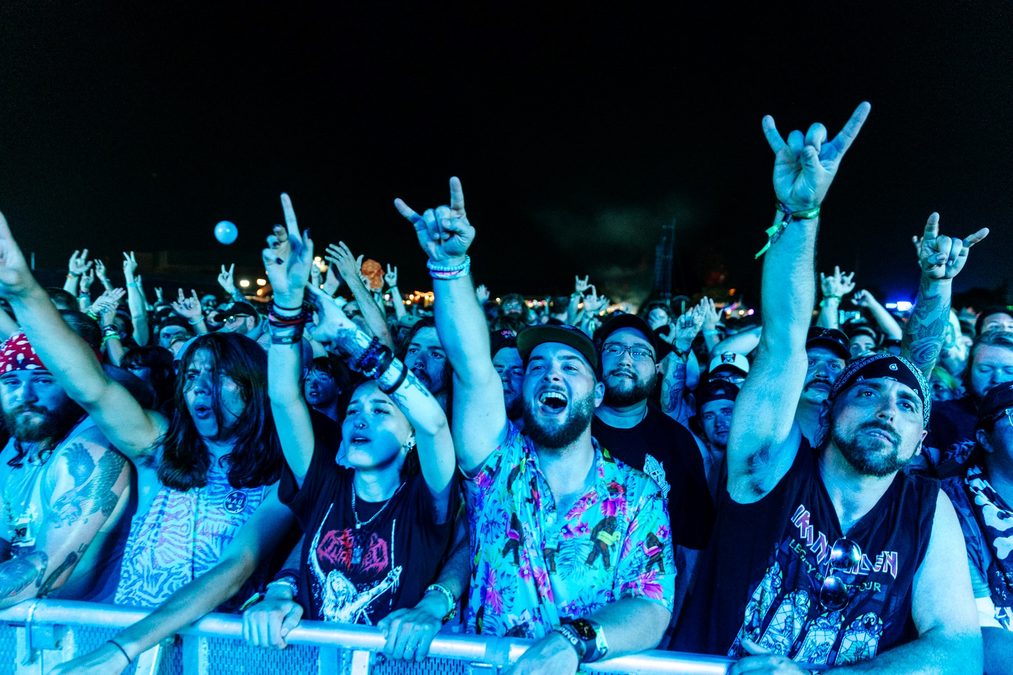 Photos thanks to Jake Miller (DWP) The 12th annual Louder Than Life festival took over the Kentucky Exposition Center in Louisville from September 17–20, delivering the largest lineup in the event’s history. Over four action-packed days, “America’s loudest rock and metal festival” hosted nearly 200 bands performing across seven massive stages. The record-breaking weekend was […]