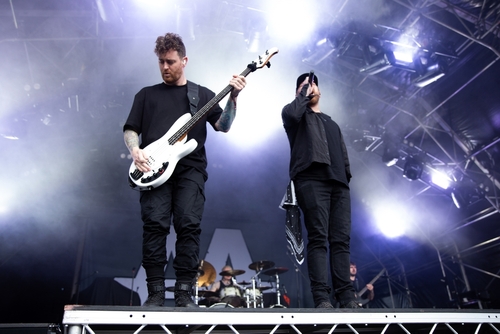
A trailer has landed for Travis Barker: Louder Than Fear, a warts-and-all look at the life of drummer, producer and rock fixture Travis Barker. The documentary drops August 13 on Hulu and Disney+ bundle for U.S. subscribers, with a Disney+ release for international viewers.
The film has Barker walking through the 2008 plane crash that claimed the lives of his assistant, Chris “Lil Chris” Baker, his bodyguard, Charles “Che” Still, and both the pilot and co-pilot. Barker and Adam “DJ AM” Goldstein made it out alive but suffered severe burns. Goldstein was found dead in his New York City apartment roughly a year afterward.
Interviews in the trailer include Barker‘s Blink-182 bandmates, Mark Hoppus and Tom DeLonge, plus appearances from Mötley Crüe‘s Tommy Lee and the late Foo Fighters drummer Taylor Hawkins.
Louder Than Fear premiered this past June at the Tribeca Festival, with the screening followed by a live conversation featuring Barker.
The film’s synopsis frames it as the story of a drummer who survived a near-fatal plane crash and came out the other side changed. Before Barker ever sat behind a kit for Blink-182, he was collecting trash in Laguna Beach; stepping in as the band’s replacement drummer set off a rise that would make him one of the most recognizable players of his generation. Underneath that success, the documentary digs into a man wrestling with grief, pain and the fine line between pushing through and giving in, told through the people who know him best.
Louder Than Fear comes from Media Weaver Entertainment, directed by Justin Krook and Michael Dwyer, and produced by Matthew Weaver and Nick Stern. Lawrence Vavra and John Janick serve as executive producers.
Barker‘s résumé spans hip hop, alternative rock, pop and country. Beyond his main gig, he’s a member of rap-rock outfit Transplants, co-founded +44, and has played with Box Car Racer, Antemasque and Goldfinger. He handled drums on Avril Lavigne‘s The Best Damn Thing and Love Sux, as well as Machine Gun Kelly‘s Tickets To My Downfall and Mainstream Sellout. His solo record, Give The Drummer Some, shows off range that goes well beyond any single genre or band.
Barker‘s recovery from the 2008 crash was extensive: burns across 65% of his body, 11 weeks in the hospital and close to 30 surgeries. After treatment that included multiple operations and PTSD therapy, he returned to Blink-182. He wrote about the experience in his memoir, Can I Say: Living Large, Cheating Death, And Drums, Drums, Drums.
Outside music, Barker built the clothing brand Famous Stars And Straps and launched two record labels, LaSalle Records and DTA Records, alongside partnerships with DC Shoes and Zildjian on signature gear. He also drummed for Post Malone‘s Nirvana tribute set, staged as a fundraiser for the WHO COVID-19 Solidarity Response Fund. Between the technical skill, genre-hopping collaborations and personal comeback story, Barker has carved out a lasting spot in modern rock.
Over the decades, former Fleetwood Mac bandmates Stevie Nicks and Lindsey Buckingham have shared one of the stormiest relationships in rock ‘n’ roll history. The fallout from their various misadventures was enough to drive an all-time classic album like Rumours, and it didn’t stop there. After a great many breakups and reunions over the years, Fleetwood Mac finally fired Buckingham in 2016. Later on, Nicks said it was her decision. But now, Buckingham and Nicks are apparently quite cordial — according to Buckingham, anyway.
Topeka, a major player in the U.S. destination-vacation music scene, has unveiled fresh additions to this year’s “Rockin’ In Paradise With Styx & Friends” beach weekend, set to return to Miramar Beach, Florida, October 8-10.
New for 2026, the three-day getaway brings in three yacht rock legends: Peter Beckett of Player, Elliot Lurie of Looking Glass and Walter Egan. The trio will team up with Yacht Rock Revue for a one-off collaborative set built around some of the genre’s most beloved songs.
Organizers have also rolled out single-day ticket options, giving fans more flexibility in how they attend.
The lineup once again centers on two full headlining sets from Styx, backed by a stacked bill featuring Tesla, The Marshall Tucker Band, Yacht Rock Revue, Don Felder, Edwin McCain, The Band Feel, 38 Special, Jefferson Starship, The Outlaws, The Velcro Pygmies, Jay Psaros, School Of Rock and exclusive guest segments hosted by rock radio fixture Eddie Trunk.
Friday night’s already-buzzy Yacht Rock Revue headline set just got bigger with three special guests added to the bill:
Peter Beckett (Player) — the voice behind “Baby Come Back”
Elliot Lurie (Looking Glass) — known for “Brandy (You’re A Fine Girl)”
Walter Egan — the man behind “Magnet And Steel”
The collaborative performance will run through a batch of classic rock’s most familiar hits in a beachside setting built for the occasion.
New ticket tiers give fans more ways to take in the weekend:
Day Pass Cove — reserved seated cove, $119 per person, per day
Grand Lawn Pass — $68 per person, per day, open lawn seating with room to stand, sit or dance; blankets allowed
Pit Pass — $345 per person, per day for standing-room space right up front
Beyond the two nightly Styx sets, attendees get an exclusive Styx Q&A hosted by Trunk, daytime beach activities and Topeka‘s signature hospitality touches.
The 5,500-capacity venue was built to skip the usual festival headaches, with guests relaxing in their own reserved cove while food, drinks and merch get delivered straight to their seats. Air-conditioned restrooms and easy walks from nearby beach lodging round out the setup.
Full schedule and vacation package details are available here.
Recording new music remains central to the band’s identity, and Styx backs that up with Circling From Above, its 18th studio album, out now via Alpha Dog 2T/UMe. The 13-track record explores the tension between technology and nature through the lens of the human experience. Critics have called it the band’s third straight “masterpiece,” following 2021’s Crash Of The Crown and 2017’s The Mission. All seven current members appear on the record: founding guitarist/vocalist James “JY” Young, guitarist/vocalist Tommy Shaw, original bassist Chuck Panozzo, longtime drummer Todd Sucherman, keyboardist/vocalist Lawrence Gowan, guitarist/vocalist Will Evankovich and bassist Terry Gowan.
All seven members remain committed to bringing their A-game to Paradise and beyond, drawing from five-plus decades of hits, singalongs and deep cuts. A typical Styx set moves through the sweeping ambition of “The Grand Illusion,” the blue-collar grit of “Blue Collar Man,” the devotion of “Lady,” the pointed jab of “Miss America,” the isolation of “Man In The Wilderness,” the searching drive of “Crystal Ball,” the soaring reach of “Come Sail Away” and the rough-and-tumble swagger of “Renegade.”
Every week the Stereogum staff chooses the five best new songs of the week. The eligibility period begins and ends Thursdays right before midnight. You can hear this week’s picks below and on Stereogum’s Favorite New Music Spotify playlist, which is updated weekly. (An expanded playlist of our new music picks is available to subscribers on Spotify and Apple Music, updated throughout the week.)
As they celebrate their tenth anniversary, we – alongside fans, bands, and industry professionals – go right back to the beginning and examine the lasting effect and early complexities of Sleep Token’s debut track ‘Thread The Needle’.
We have some very prominent new releases today, including a couple bands that have played a major role in shaping their respective styles of music over the last couple decades. But we also have some really scary, avant-garde, and brutal stuff to show you as well.
I’m sure you’ll like at least something you hear.
—
Ceremony – Tell Me Your Dream
Ceremony have always done their own thing, one way or another. Emerging in the noisy hardcore environment of the late 2000s, they steadily became a name associated with originality, quality, and daring innovation — while still holding a thread to their origins. Although Still Nothing Moves You will always be “my” Ceremony record, it’s always worth hearing what they’ve been up to since then. On Tell Me Your Dream, there’s definitely elements of Rohnert Park (most prominently on “Other Hells”), but these come informed by the post-punk work the band has done since then. Alongside the echoes of New Order and JoyDivision, there’s some moments that remind me a lot of London Calling-era The Clash. I’m not complaining.
Dark, mean, no-nonsense death metal in the style of Autopsy, Obituary, and early Death. Along with just being packed with solid riffs and growls, the album also boasts a very compelling concept that pulls everything together. According to the band, the album is based on “a dying man who, standing at the edge of his final breath, encounters a monstrous entity offering him eternal life – but immortality demands a price… Driven by the fear of death, the man begins feeding the creature with human sacrifices in exchange for more time among the living. What starts as desperation slowly turns into obsession, as the line between survival and damnation fades beneath a growing pile of corpses.” I’d watch a movie about that. Especially if this is the soundtrack. I bet there would be a really great scene for “The Ingestion.”
Hulder‘s journey through frigid winds continues on Verbolgen, an album which takes the power exhibited on Verses in Oath and enriches it with a palpable pagan spirit. The band’s core sound remains intact, with a distinct increase in the Aeternus influence that’s always been present. In fact, Vrolok even performs session drumming on tracks two, three, six, and seven! It took me a few listens to really get into this album, but the time invested is more than worth it. Songs like “The Crowning,” “In Blood And In Earth,” and “The Glow Of Dawn” hit with the power of a thunderstorm but retain an air of medieval mystery that’s always set Hulder apart.
Before I go on, I’d like to confirm that “abditory” is a real word. It means “A concealed location used for storage or to hide items.” And I guess that’s fitting for an album like this — one you’d expect to find in the secret backroom of the record store that requires a password for entry. Although it’s clearly an experimental, avant-garde work of black metal terror, there’s something majestic and theatrical about it. In other words, it has more to offer and explore than just being “weird.” Check out “Threondy Pt.II (Exequial Dirge)” to hear what I mean.
Satie’s Gymnopédie No. 1: Melancholy as Musical Architecture
A few gentle notes emerge from the piano and dissolve into silence. Nothing rushes forward. Nothing demands attention. The music seems suspended between movement and stillness, creating an atmosphere that feels strangely familiar. More than a century after its composition, Erik Satie’s Gymnopédie No. 1 continues to captivate listeners through an emotion that is difficult to define but immediately recognizable.
Many composers express melancholy through drama. Satie chose another path. His music avoids grand gestures, emotional outbursts, and virtuosic displays. Instead, it creates a quiet environment where reflection becomes possible. The result feels less like a performance and more like a place.
This unusual quality explains the composition’s enduring appeal. Whether heard in a concert hall, a film, or a solitary room late at night, the piece invites listeners to slow down and inhabit a different sense of time. It does not push emotions toward a conclusion. It allows them to linger.
More than a beautiful piano work, Gymnopédie No. 1 represents a radically different understanding of musical expression. Rather than describing melancholy, Satie constructs a space where melancholy can exist.
Satie transformed melancholy from an emotion into a musical environment.
A Composer Who Chose Simplicity
When Erik Satie composed the Gymnopédies in 1888, European music was moving toward greater complexity. Large orchestras, dense harmonies, and dramatic emotional narratives dominated concert halls. Composers sought to expand the scale of musical expression, often creating works designed to overwhelm audiences through sheer intensity.
Satie responded by doing less.
His compositions often feel stripped to their essentials. Unnecessary decoration disappears. Melodies unfold without urgency. Harmonies move gently rather than forcefully. Every element seems carefully chosen, not to impress, but to create atmosphere.
This restraint was not a limitation. It was an artistic decision. Satie understood that emotional depth could emerge through simplicity. A handful of notes, placed with care, could reveal more than an entire orchestra struggling for attention.
The Gymnopédies remain among the clearest expressions of that philosophy.
The Mystery of the Title
Even the title contributes to the composition’s enigmatic atmosphere. The word “Gymnopédie” refers to an ancient Spartan festival involving ritual dances. Exactly why Satie chose the term remains uncertain, and the composer never provided a definitive explanation.
The ambiguity feels appropriate. Like the music itself, the title resists straightforward interpretation. It suggests something ancient, distant, and partially forgotten.
Listeners encounter a world that seems detached from ordinary reality. The piece feels suspended between memory and imagination, history and dream. That sensation of timelessness would become one of its most distinctive qualities.
How Satie Builds Melancholy
The emotional power of Gymnopédie No. 1 does not come from dramatic themes or technical complexity. It emerges from the relationship between a few simple musical elements.
A steady accompaniment moves beneath the melody with almost hypnotic calm. Above it, the melodic line drifts gently from phrase to phrase, rarely seeking dramatic contrast. Nothing feels rushed. Nothing feels forced.
The harmonies contribute equally to the atmosphere. Chords seem to float rather than resolve decisively. The listener senses movement without feeling a strong pull toward a destination.
This combination creates a remarkable emotional effect. The music appears to move forward while simultaneously remaining still. It occupies a space between expectation and fulfillment, certainty and ambiguity.
Melancholy often feels exactly the same way. Thoughts wander. Memories return. Time slows. Emotions remain present without demanding action. Satie captures that experience with extraordinary precision.
The Beauty of Uncertainty
Many compositions rely upon tension and release. They create problems and then resolve them. Satie takes a more subtle approach.
The music rarely offers complete emotional closure. Instead, it remains suspended between states. Listeners experience longing without a clear object, nostalgia without a specific memory, and calm without complete comfort.
Because the emotions remain undefined, each listener discovers something different within the piece. Personal memories, moods, and associations naturally fill the spaces that Satie leaves open.
The composition does not tell listeners what to feel.
It creates a place where feeling becomes possible.
Silence as Architecture
Perhaps the most remarkable feature of Gymnopédie No. 1 is not the melody itself but the space surrounding it. Satie understood something many composers overlook: silence can be as expressive as sound.
In most music, pauses serve a practical function. They separate phrases, create contrast, or prepare the listener for what comes next. Satie uses silence differently. The spaces between notes become part of the composition’s emotional structure.
Every phrase is allowed to breathe. Notes linger briefly in the air before giving way to the next idea. The music never feels crowded. Instead, it unfolds with a patience that encourages attention and reflection.
This approach creates the sensation of moving through an environment rather than following a narrative. The listener is not carried toward a destination. The listener inhabits a space.
A Room Built from Sound
Architecture shapes experience through proportion, balance, and emptiness. A cathedral feels different from a narrow corridor because the space itself influences perception.
Satie achieves something similar through music. The notes function like walls and columns, while silence becomes the open area between them. Neither element can exist effectively without the other.
This balance explains why the composition feels larger than its simplicity suggests. The music leaves room for thought. Instead of overwhelming the listener with information, it invites participation.
Every listener enters the same structure, yet each experiences it differently.
A Dream Suspended Between Past and Present
Many listeners describe Gymnopédie No. 1 as dreamlike. The description feels appropriate because the piece seems detached from ordinary time.
Most music creates a clear sense of progression. Themes develop, tensions increase, and resolutions eventually arrive. Satie minimizes these expectations. The composition drifts forward gently without insisting upon dramatic change.
As a result, listeners often lose track of time while listening. Minutes pass without feeling measured. The experience resembles memory more than narrative.
Memories rarely unfold in strict chronological order. They emerge quietly, carrying emotions that remain difficult to explain. Satie’s music captures that sensation with extraordinary delicacy.
The Emotional Logic of Memory
One reason melancholy feels so complex is that it rarely focuses on a single event. It often combines longing, gratitude, regret, beauty, and acceptance at the same time.
The emotional atmosphere of Gymnopédie No. 1 reflects this complexity. The music never becomes entirely sad, yet it never feels completely joyful. It occupies a space between emotional extremes.
This ambiguity allows listeners to project personal experiences into the composition. Someone may hear nostalgia. Another may hear peace. A third may hear loneliness.
The music remains open enough to accommodate all of these interpretations.
Why the Piece Feels Gothic
At first glance, Gymnopédie No. 1 may seem far removed from Gothic aesthetics. There are no haunted castles, supernatural events, or dramatic tragedies. Yet the piece shares important qualities with Gothic art.
The Gothic imagination often thrives on suggestion rather than explanation. Mystery becomes more powerful when it remains partially hidden. A shadow can be more evocative than a detailed image. Silence can create greater tension than noise.
Satie’s composition follows the same principle. The music reveals enough to engage the listener while leaving many questions unanswered. Its emotional meaning remains intentionally incomplete.
This restraint gives the piece an atmosphere that feels quietly haunted, not by ghosts but by possibilities.
The Presence of Absence
Many Gothic works explore absence. Lost love, vanished worlds, fading memories, and unattainable desires appear repeatedly throughout the tradition. Characters often find themselves haunted by what is no longer present.
A similar feeling permeates Gymnopédie No. 1. The music seems aware of something just beyond reach. Listeners sense longing without knowing precisely what has been lost.
This quality contributes to the composition’s enduring emotional power. The piece never provides a definitive answer because its subject is not a specific event. Its subject is the experience of yearning itself.
The music remains moving because that experience is universal.
The Noir Connection
Although Gymnopédie No. 1 was composed decades before the emergence of film noir, the emotional atmosphere of the piece feels surprisingly compatible with noir sensibilities. Both embrace ambiguity, introspection, and emotional restraint.
Classic noir rarely offers clear resolutions. Characters are often trapped between memory and desire, hope and regret. Their struggles unfold within worlds shaped by uncertainty rather than certainty.
Satie’s music inhabits a similar emotional territory. The composition refuses dramatic conclusions and avoids obvious emotional signals. Instead, it creates an atmosphere where reflection becomes more important than action.
This quality explains why the piece feels so cinematic. It does not tell a story directly. It creates the emotional conditions from which stories emerge.
Music for the Inner World
Many compositions direct attention outward. They celebrate victories, depict conflicts, or describe dramatic events. Gymnopédie No. 1 turns inward.
The piece feels less concerned with external action than with private experience. It resembles the moment after a conversation ends, when thoughts continue unfolding in silence. It resembles a solitary walk through empty streets after midnight. It resembles the feeling of remembering something that cannot be recovered.
These experiences occupy a central place in both noir and Gothic art. They remind us that some of life’s most significant moments occur internally rather than publicly.
Satie gives those moments a voice.
Why the Piece Endures
Many compositions achieve popularity during their own era and gradually fade from public memory. Gymnopédie No. 1 followed a different path. More than a century after its creation, it continues finding new audiences.
Part of its longevity comes from its simplicity. The piece does not depend upon a specific cultural trend, historical event, or artistic movement. Its emotional language remains accessible because it addresses experiences that are fundamentally human.
People continue experiencing nostalgia, uncertainty, longing, reflection, and quiet moments of introspection. As long as those emotions exist, Satie’s music will remain relevant.
The composition feels timeless because its subject is timeless.
A Refuge from Noise
Modern life often rewards speed. Information arrives constantly. Attention shifts from one distraction to another. Silence has become increasingly rare.
In this environment, Gymnopédie No. 1 offers something unusual. It asks listeners to slow down.
The piece creates a temporary refuge from urgency. Nothing demands an immediate response. Nothing competes for attention. The music simply exists, inviting listeners to do the same.
This invitation may be one of the reasons the composition feels even more relevant today than it did when Satie first wrote it.
The Architecture of Melancholy
The enduring power of Gymnopédie No. 1 lies in its ability to transform an emotion into a place. Satie does not describe melancholy. He builds it.
Through careful pacing, gentle repetition, unresolved harmonies, and meaningful silence, he creates an environment where listeners can explore their own memories and emotions. The composition functions less like a narrative and more like a room filled with shadow, light, and possibility.
Every listener enters that room carrying different experiences. Yet the structure remains remarkably welcoming. The music provides enough guidance to create atmosphere while leaving enough openness for personal interpretation.
That balance is extraordinarily difficult to achieve. Satie makes it appear effortless.
A Place to Pause
When Erik Satie composed Gymnopédie No. 1 in 1888, he challenged assumptions about what music could be. Rather than pursuing spectacle, he embraced restraint. Rather than overwhelming listeners, he trusted simplicity. Rather than offering answers, he created space for reflection.
More than a century later, the piece continues rewarding those choices. Its quiet voice remains powerful because it speaks to experiences that rarely disappear: memory, longing, uncertainty, and the search for meaning.
Many compositions ask listeners to follow a story.
Satie invites them into a room.
Once inside, the silence does the rest.
Wear the Darkness
If Gothic music, Edgar Allan Poe, noir aesthetics, and the beauty of melancholy inspire you, explore the Edgar Allan Poets store. Discover apparel and artwork created for lovers of mystery, music, literature, and shadow.
Join the Noir Newsletter
Receive Gothic music history, noir psychology, Edgar Allan Poe analysis, dark culture, and mysterious stories directly in your inbox.
Frequently Asked Questions
Why is Gymnopédie No. 1 considered melancholic?
Its slow tempo, gentle repetition, unresolved harmonies, and spacious phrasing create an atmosphere of reflection rather than dramatic sadness.
What makes Erik Satie different from other composers of his era?
While many composers pursued greater complexity and emotional intensity, Satie embraced simplicity, restraint, and atmosphere.
Why does the piece feel timeless?
The music explores universal emotions such as memory, longing, uncertainty, and introspection rather than relying on specific historical references.
Is Gymnopédie No. 1 connected to Gothic aesthetics?
Although not a Gothic composition, its atmosphere of mystery, ambiguity, emotional restraint, and longing resonates strongly with Gothic sensibilities.
Why is the piece still popular today?
In a fast-paced world, its calm and reflective atmosphere offers listeners a rare opportunity to slow down and engage with their thoughts.
London MetalFest 2026 BUY TICKETS HERE OFFICIAL WEBSITE London has never exactly struggled when it comes to metal gigs, but the upcoming London Metalfest 2026 […]
The second installment of the Foo Fighters‘ Are Playing Where??? live EP series is finally here.
Are Playing Where??? Vol. II collects six blistering performances recorded earlier this year during the band’s packed, sweat-drenched underplay shows at Irving Plaza in New York City and Starland Ballroom in Sayreville, New Jersey. The EP is up now on Bandcamp for whatever price fans want to pay, with proceeds benefiting local charities tied to both cities. Worth digging around the page while you’re there, too, since it’s a good spot to find other artists worth a listen.
Foo Fighters is currently deep into the North American run of its “Take Cover” stadium tour and just added a batch of South American dates for early 2027.
The band’s most recent full-length, Your Favorite Toy, dropped in April via Roswell Records/RCA Records. The record was co-produced by Foo Fighters and Oliver Roman, with Roman also handling engineering duties and Mark “Spike” Stent on the mix. Its release lined up with the kickoff of the “Take Cover” world tour.
Foo Fighters played its first show with new drummer Ilan Rubin on Sept. 13, 2025, at the Fremont Theater in San Luis Obispo, California. The band gave just a day’s notice before the surprise all-ages gig at the 900-capacity venue, which marked Rubin‘s official live debut behind the kit. Rubin, formerly of Nine Inch Nails, had joined the Dave Grohl-fronted band earlier that year.