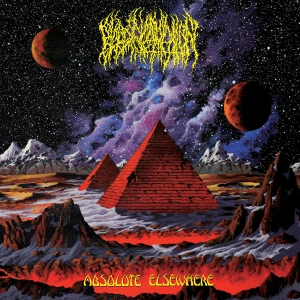
Absolute Elsewhere dominated the voting ballots for our favorite death metal albums of the decade. However, it proved polarizing, with one writer saying, “I’d be down to contribute, only problem is if we get writer consensus and it’s a bunch of lame shit like Blood Incantation or whatever, I probably won’t be that stoked to write blurbs.” Beefs and hilarity ensued in the email chain. Enough so that those who derided Absolute Elsewhere passionately did so, and it would’ve been immoral not to platform their thoughts, since we are a democratic workers co-op, and all dissenting opinions of this magnitude are welcome, even those from our loyal intern Joel Madden.
Seeing as how Absolute Elsewhere was a lightning rod for heated takes, we decided to showcase our arguments for and against it being crowned our favorite death metal album of the decade thus far, albeit begrudgingly.
…
…
Blood Incantation went all the way with Absolute Elsewhere. “The Stargate” and “The Message” each run for about twenty minutes, giving the band room to move through death metal, ’70s prog and electronic music. Blast beats and guttural vocals can suddenly drop away for Mellotron, clean guitar or a long stretch of synthesizers, only for the heaviness to come rushing back.
The guitar work is a huge part of the album’s character. Dense, dissonant riffs sit alongside melodic solos that sometimes feel almost weightless by comparison. Morris Kolontyrsky’s David Gilmour-inspired lead early in “The Stargate” is a great example, bringing a completely different texture into the song before the death metal takes over again. Later, Tangerine Dream’s Thorsten Quaeschning appears on synths, taking the song even further into the ’70s electronic experimentation that runs through the album.
There’s a real sense of freedom and adventure to Absolute Elsewhere. It’s a wonderfully bizarre and highly ambitious record made up of two enormous songs, and it became one of the most acclaimed metal albums of 2024, reaching an audience far beyond death metal. TIME even ranked Absolute Elsewhere the seventh-best album of the year. Blood Incantation’s roots in death metal run through the entire record, but they’re just as invested in seeing how far they can stretch its boundaries. The prog passages have room to develop, the solos are memorable in their own right, and the heavier sections retain their aggression. It’s an album that keeps changing as you listen, with each new direction feeling like a natural part of the record. This record is a reminder of what can happen when musicians are willing to take real risks and see where their ideas take them.
–Lily O’Delia
…
The fact that Absolute Elsewhere didn’t make a strong impression on me is its own sort of condemnation. Blood Incantation’s discography is full of stunning proggy moments. When I hear those sliding, melodic basslines on “Subterranean Aeon,” or the psychedelic reverb-heavy exhalations throughout the bridge of “Hidden Species,” or the huge gong hit (no pun intended) and subsequent clean guitar on “The Giza Power Plant,” I can’t help but grin with that same vaguely conspiratorial glee that I experienced when I used to pore over those Time Life Mysteries of the Unknown books. By contrast, much of Absolute Elsewhere went in one ear and out the other, and the parts that did stand out were jarring genre shifts where the seams between death metal and prog rock weren’t just glaringly obvious–they were of entirely different colors.
I remember precisely two passages on the album after multiple listens. At the two-minute marks on both “The Stargate [Tablet I]” and “The Message [Tablet III],” there are incredibly awkward transitions–or lack thereof–from cleaned-up versions of Blood Incantation’s trademark spacefaring death metal and extended prog sections that feel like entirely different songs from an entirely different band. As mentioned above, Blood Incantation typically punctuates these inflection points with some kind of percussion or perhaps a melodic throughline. Here, we have nothing of the sort, just Dragon Ball instant-transmissions to other, less interesting realms. This incongruity only becomes more pronounced as each movement continues exploring the, erm, far side of Earth’s largest natural satellite, if you catch my drift. When the songs eventually slam back into death metal mode with emphatic OUGHs, I can’t help but wonder what these prog-first excursions contributed to either the journey or the destination.
Some of you fellow prog fans might argue that the genre has always been full of awkward segues. Do I also nitpick those weird double-time bursts of hard rock on Rush’s “Xanadu” or that bizarre funk that bubbles around Robert Fripp’s spiderlike fretboard maneuvers on “Lark’s Tongues in Aspic Pt. 1,” or…[gestures in the direction of Gentle Giant’s discography]? Occasionally, yes. However, I would argue that those moments are as memorable on their own as the musical leaps that precede and succeed them, and that is precisely where Absolute Elsewhere falls short.
–Alex Chan
…
Absolute Elsewhere may not be best understood as a death metal record, although the fact that it came from death metal feels critical to its expansiveness and insistence on driving towards its aims; lots of extreme metal wants to get cosmic, but only death metal wants to open a university about it. In presenting itself as one text, two songs, and six “tablets” all at once, the record invites an approach that processes how its treasures are nested within each other, to be read in various combinations, zoomed-in and zoomed-out on. Blood Incantation’s familiar, titanic death metal becomes a sort of slipstream via which portals containing very different song modes can be entered, absorbed, and maybe reintegrated back into the whole, your close listen becoming a process the same story is received by very different means. I could expand on those portals—there’s the Floydian chants that arise in “The Stargate” and orbit back around in “The Message,” the peak indie cloud-breaking of the opening passage of “The Message,” the part where they visit the Tangerine Dream plane, literally— but at the risk of calling this record a campaign setting, the only way to understand it is to get involved. Absolute Elsewhere is stately, powerful, and gloriously, fundamentally progressive. Metal might be the only genre where it can be a problem if you’re too good to go unnoticed by all but the first ten rows; just ask Deafheaven, or more recently Agriculture. Don’t let a bunch of noise at the gates stop you from passing through. Inside, it’s all music.
–Josh Rioux
…
…
What made me appreciate Blood Incantation’s demo and Starspawn so much when it first came out was how the band would play with progressive ideas while still delivering crushing death metal songs. It sounded like they knew what they were doing and had a competent grasp on music theory without feeling like they got high on the smell of their own farts. Then, Hidden Histories came out. Something felt off to me. I couldn’t place it at first, but after a while I realized that the album was implying grandiose ideas without ever paying them off. After a year of seeing Histories praised to no end in every publication, I wrote the band off as something that wasn’t for me anymore. With the release of the ambient Timewave Zero (a release I, in fact, did enjoy), it became apparent that Blood Incantation wasn’t a death metal band, but merely a band using death metal as a conduit to express their “artistry.” By the time Absolute Elsewhere came out, I was over it. It feels like the band is talking down to you because you “just don’t get it, man,” but with the same patronizing demeanor of a college kid who decided to get REALLY into the Criterion Collection and weed. The big problem is that nothing after Starspawn makes me feel anything. It’s empty.
There was a time in my life when I would have called Blood Incantation one of my favorite modern death metal bands. This was also a time in my life when Tomb Mold wasn’t getting called posers for wearing PlayStation shirts on magazine covers and we had no idea that Sanguisugabogg was going to turn into one of the worst things to happen to modern metal (I miss when they only had that demo about taking a piss or whatever). Unfortunately, that time has passed; I’m no longer the same whippersnapper I was back then in my early ‘20s, when I could down an entire 24-pack of shitty beer in one night and then show up to my shift the next morning half-drunk and KILL it. What I’m trying to say is that things change; sometimes you wake up and realize you do, in fact, get hangovers, and sometimes you hit play on an album and realize that a band you thought was cool are actually dorks. I don’t care about your college thesis; I just want to hear some riffs.
–Caylen Darling
…
I can accept, admittedly, the argument that Absolute Elsewhere is not best described singularly as a death metal album; its balance is certainly a progressive rock album that subsumes progressive and extreme metal elements rather than the other way around. But where for, say, Ne Obliviscaris you can utterly bypass the extreme metal and still have the core of their sound, that isn’t the case on Absolute Elsewhere. Blood Incantation’s lineage as a death metal band is what wields the progressive rock, with it being used in the places a typical death metal band, especially a proggy one, would have mellower sections for heightened contrast. Opeth, a band that was producing predominantly progressive rock records as far back as Still Life, doesn’t have their work of that early era facing this same debate, even if it would perhaps better reframe their later work. This sonic expansion was always on the docket; their demo clearly signals toward the “Vitrification of Blood” 20-minute suite of their debut, which in turn signals toward the inverted 2112 album structure of Hidden History of the Human Race and its similarly monumental Side B suite. Absolute Elsewhere does not represent a pivot of the band from death metal. It is the completion of their vision of death metal that happens to contain these other elements as fundamental pillars.
–Langdon Hickman
…
Absolute Elsewhere is a stapled-together construction of progressive rock and death metal that is so derivative of its influences that it deifies them. I love it, but I have to as it is rather than as a death metal album because approaching it as the latter disappoints. “The Stargate [Tablet I]” pivots away from its voracious opening too quickly and suddenly to fully satisfy one’s bloodlust, a problem that doesn’t exist when the record is taken as a transient being but becomes apparent when considered as a death metal album. It inserts death metal snippets where there should be songs. While the cosmic logic dictating the album allows for this and asks you to rethink the purpose of transitions and cohesion, the groove and harmonious disharmony of death metal is neutered by it.
Death metal doesn’t congeal with its surroundings on Absolute Elsewhere. It sparks against them. Which is not inherently bad, and once again, what I enjoy about the album, but it does nothing to advance the death metal itself. On Starspawn, Blood Incantation turned their ambition into the genre and explored it. Comparatively, on Absolute Elsewhere, their death metal feels inert, as if they put it on hold to expand their parameters. The metallic core remains unchanged since Starspawn. It feels wrong to call an album that’s only half death metal–that death metal being in suspension since 2016–“the best death metal album of the decade.”
Absolute Elsewhere doesn’t mine the carcass dry like Blood Incantation did before on “Viltrification of Blood (Part 1),” but sucks the blood like a mosquito before flying to a new host. The death metal here represents only the easy parts of the genre; what should be elementary in Blood Incantation’s book. And, for a band as good at writing both caveman death metal and death metal that explores the genre’s inner workings, it’s disappointing that Blood Incantation do plunge deeper. Absolute Elsewhere misses the connective tissues, song structures, and other intangibles that separate a token death metal band from one you listen to after leaving the venue. To reiterate, that was the intention with Absolute Elsewhere, and the album benefits from this when it’s taken as being “music with death metal in it,” but when looked at as the death metal album of the 2020s, is it not too much to ask for the death metal to be more than a carousel?
–Colin Dempsey
…
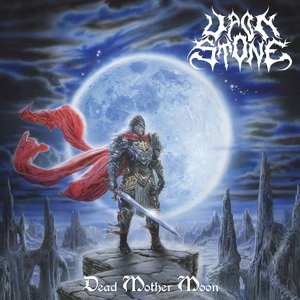
 , and yeah, it’s awesome, though its appeal doesn’t end there. How about some of the best melodic death metal riffing to ever emerge from the USA? Upon Stone tears through thirty minutes of the most European-ass music not to come out of Gothenburg that I’ve heard since first discovering The Black Dahlia Murder’s Miasma in 2005. Absolutely killer.