For the second consecutive show, Journey brought Steve Perry lookalike and soundalike HugoValenti onto the stage during the band’s Japan run.
Valenti joined Journey again Tuesday night in Tokyo, where he handled vocals on “Faithfully,” following his appearance on the same song at Saturday’s show in Fukuoka. He also took the mic for “Keep on Runnin’,” a deeper cut from Escape.
Fan-shot footage, shared by rocknpics, of both performances has surfaced online, giving fans a look at the unusual collaboration.
Valenti is the frontman of Hugo: The Ultimate Journey Tribute and has previously said that he auditioned to replace Perry in Journey. According to Valenti, he was ultimately turned down because he looked too much like the singer he was being considered to replace.
The Tokyo concert featured five different musicians handling lead vocals at various points. Alongside Valenti and longtime singer Arnel Pineda, those duties were shared by drummer Deen Castronovo, keyboardist and guitarist Jonathan Cain, and keyboardist Jason Derlatka.
So far, neither Journey nor Valenti has publicly confirmed any plans for additional appearances or a formal collaboration.
Following three Labor Day weekend performances in Honolulu, Journey will resume its tour on Sept. 12 in Los Angeles. Guitarist Neal Schon has described the upcoming run as the group’s “final fall dates.”
The band’s The Final Frontier tour also represents the final stretch for longtime keyboardist Jonathan Cain as a member of Journey. The current itinerary runs through Nov. 28, when the band is scheduled to play its hometown of San Francisco.
Whether that San Francisco performance will ultimately serve as the tour’s final stop remains unclear.
Due to high demand for the Rewind Tour – All Killer, No Filler tour, one of Australia’s most enduring and beloved musical acts, Hoodoo Gurus, confirm a new Hobart show added to the highly anticipated 45th anniversary tour in November and December 2026. The now 8-date expanded headline tour will see the epic Gurus play […]
Throughout the summer we’ve been posting new songs from gash, the Eau Claire indie deconstructionists who’ve won over local legend Justin Vernon (they played his relaunched Eaux Claires festival) and signed to the great Fire Talk imprint Angel Tapes. So far their forthcoming album at least you know what you’re laughing at has yielded “good and bad” and “risking heaven.” Today they serve up one more advance track, “data master.” It’s a woozy experimental electronic number with rock foundations, in that post-Spirit Of The Beehive sense, and by the end a tapestry of guitars has come to the fore. Watch the video below.
In the liner notes of The Acoustic Verses, the final album of Green Carnation’s first iteration, guitarist/ bandleader Tchort teased the second part of a trilogy that promised to be a continuation of their absolutely essential second album, Light of Day, Day of Darkness. The Chronicles of Doom never came to be, as the band disintegrated roughly a year after The Acoustic Verses dropped. I, as a rabid fan, was crushed by this dissolution and was more than just a little hyped when the band reunited a little under a decade later.
As promised, Tchort and his reassembled co-Tchorts ceased the experimentation that defined much of their previous output and focused on creating epic, progressive, and fucking excellent doom when they began releasing new music again. And though that trilogy didn’t pan out the way as originally intended, it has now been completed. And it’s damn good.
A Dark Poem, Part III: The Messiah Complex concludes a triad of explorations not unlike Natalie Merchant’s in the late 1990s: to examine Ophelia, the partner of the titular character in Shakespeare’s Hamlet, but through the lens of 19th-century French poet Arthur Ribaud. A fittingly tragic character who embodies all that is good and just but is driven mad by her lover’s feigned madness, it’s little wonder that Ophelia has inspired centuries’ worth of artistic endeavor across multiple genres and disciplines. We won’t go into any literary analysis here (my days as a student of literature are decades in the past anyway), so we’ll stick to the music itself.
Briefly, The Messiah Complex fucking owns. “Unconditional Artificial Chemistry” opens with a distant and appropriately moody piano, with an equally distant melody that feels part keyboard, part theremin, and part disembodied spirit floating nervously over it. A deep and pummeling doom riff with a variation on that same harrowing motif almost sliding overhead preps us for the unmistakable voice of Kjetil Nordhus, a man whose understated power has perfectly paired with Green Carnation’s bleak nature for over a quarter century. Tchort has absolutely held to his conviction that Light of Day, Day of Darkness is the quintessential Green Carnation sound, and his compatriots have done a remarkable job of staying true to that identity during his leave of absence. With Tchorty back in action and the sound largely unaltered, we’re reassured that Nordhus and bassist Stein Roger Sordal have faithfully held to Tchort’s mission: to expand the Light of Day journey without merely recycling it.
The title track follows with due diligence: it is a lengthy, somber, and largely unpredictable voyage that hits us with multiple callbacks from the rest of the Dark Poem trilogy without ever feeling like a rehash, always keeping us guessing, and taking multiple cues from 70s prog and psychedelia without ever sounding forced or stale. This has been key to Green Carnation’s many faces over the decades: even when they went goth rock with Blessing in Disguise, straight-ahead metal/rock with The Quiet Offspring, and fully mellow on The Acoustic Verses, they never once sacrificed the cohesion that made them instantly recognizable as only Green Carnation. I can think of few other outfits who can don as many masks as Green Carnation has without sacrificing an ounce of their identity. Are these guys a metal band, or are they formally trained thespians?
“Broken Souls, Common Enemies” is the last conventional song of the trilogy, a beast of a tune that greets us in 5/4, briefly breaks into some amorphous meters, and then alternates between its previous groove and other odd times. Time sigs aside, “Broken Souls, Common Enemies” is a journey to the end of night unto itself, replete with flute-laden acoustic breaks, twangy guitar solos befitting an Americana record, and waltzable blast beats supporting Grutle Kjellson’s returning roars, all neatly packaged into a brief-feeling epic that never sounds forced or disjointed. Blink, and nearly ten minutes have gone by behind you.
The true conclusion of the Dark Poem trilogy is one I’m frankly under-qualified to properly critique: it is an actual orchestral suite that revisits the many themes and motifs we’ve heard throughout this spellbinding trilogy. All the hallmarks of formal composition are present: harmonic inversions, meticulous arrangement, sparse use of parallels, yada yada yada. Properly employed compositional theory is all yay and bravo and stuff, but what ultimately matters is how it hits the listener. And lemme tell you, “A Dark Poem: Orchestral Suite” hits hard; it is a beautifully and sensually woven piece that, especially at its apex, masterfully illustrates with sound Ophelia’s descent into madness after her father’s death and her rejection by her supposed beloved. You can literally feel her drowning while listening to this suite, and it doesn’t take much imagination to visualize her flower-adorned corpse as this composition concludes. Dayum.
I’ve often remarked that Load and Reload would have been much better if the fluff had been scrapped and the highlights of those albums had been released as a single record. With A Dark Poem, Green Carnation has done the opposite, but with much greater effect. Like that pair of Metallica albums, this trilogy feels like a cohesive whole, but with each installment deliberately kept brief and impactful, Green Carnation have delivered a trio of albums that feel like a thoughtfully scripted miniseries. Each chapter stands on its own, but the whole towers when unified. Given its premeditation, execution, and bravery, I daresay it might even stand alongside Light of Day, Day of Darkness.
Release Date: September 4th, 2026 Record Label: Season Of Mist Genre: Progressive Metal
Musicians:
Kjetil Nordhus / Vocals
Alejandro Perez / Drums
Stein Roger Sordal / Bass
Terje Vikk “Tchort” Schei / Guitars
Bjørn Harstad / Guitars
Endre Kirkesola / Keys
A Dark Poem, Part III: The Messiah Complex Tracklist:
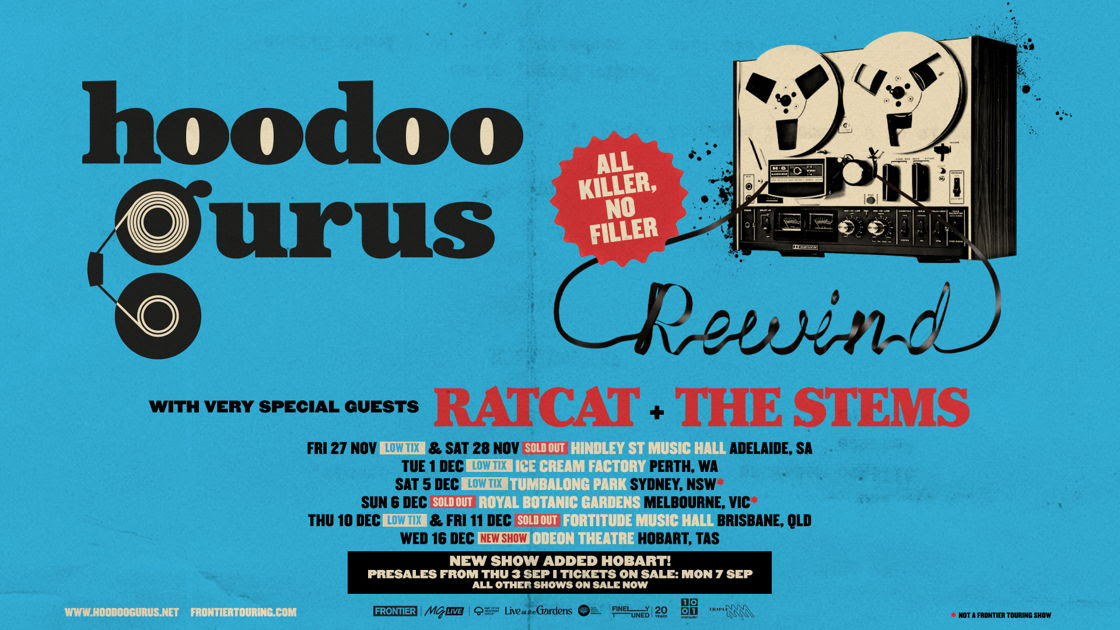 Due to high demand for the Rewind Tour – All Killer, No Filler tour, one of Australia’s most enduring and beloved musical acts, Hoodoo Gurus, confirm a new Hobart show added to the highly anticipated 45th anniversary tour in November and December 2026. The now 8-date expanded headline tour will see the epic Gurus play […]
