Colin Stetson is a busy man. Earlier this year, the master of tense drone-moan-squawk baritone sax teamed up with fellow avant-garde OGs Greg Fox and Trevor Dunn to release the album Nethering. Next month, Stetson and experimental bagpiper Brìghde Chaimbeul will release their new collaborative LP All The Light In The World. Now Stetson is also one third of 10¹⁷, a new band that also includes Stian Westerhus and Erland Dahlen, two powerhouse musicians from the Norwegian jazz world.
Based in a North London shopping mall, the O2 Islington Academy is a small, no-frills venue with some super-friendly staff. Tonight it is hosting the Outstanding Tour, in support of the Japanese band Lovebites‘ fifth and most adventurous studio album, Outstanding Power, released earlier in the year. Rising from the ashes of their 2019 support slot with Dragonforce, Lovebites are now a well-established and popular Power Metal band.
There is no support act tonight, so the crowd are left under darkened purple lighting to admire Haruna’s drum kit as the band complete their European Tour.
What stands out are the unusually large bronze Zildjian cymbals, floating like alien spaceships, above the chrome-plated steel drums and a star-shaped cymbal in the middle of it all, with Lovebites / HARUNA imprinted on it in a circle.
Lovebites – O2 Academy Islington – 3 August 2026. Photo: Steve Ritchie/MetalTalk
By the time Lovebites come on, the venue is packed to its 800 capacity, and the assembled fans are cranked up to fever pitch, which contrasts with their entrance. Uncertainly but with confidence, one by one the band emerge from a side curtain, initially seeming surprised to be on stage as the roar for the band erupts.
Swiftly, Haruna takes her seat, and the guitarists, Midori (guitar), Miyako (guitar/keyboard) and Fami (bass) take their positions with Asami (vocals) shouting “Come on London”.
Lovebites – O2 Academy Islington – 3 August 2026. Photo: Steve Ritchie/MetalTalk
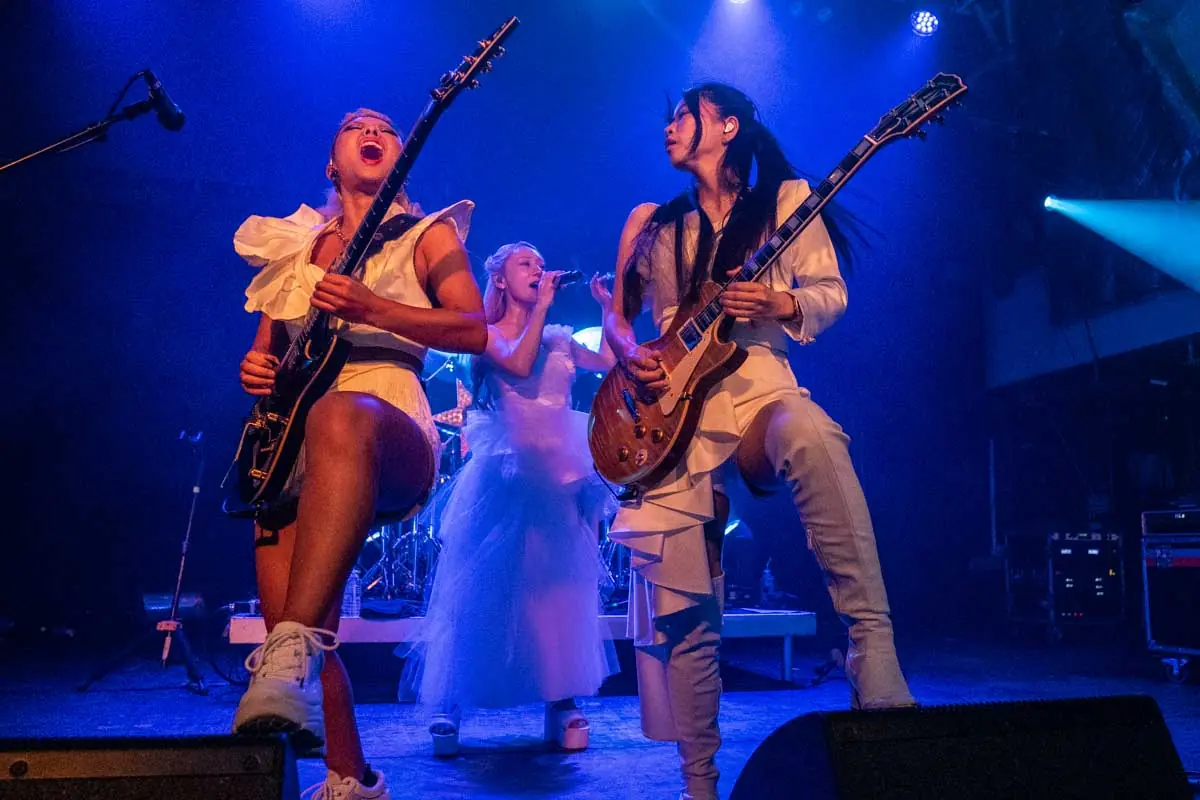
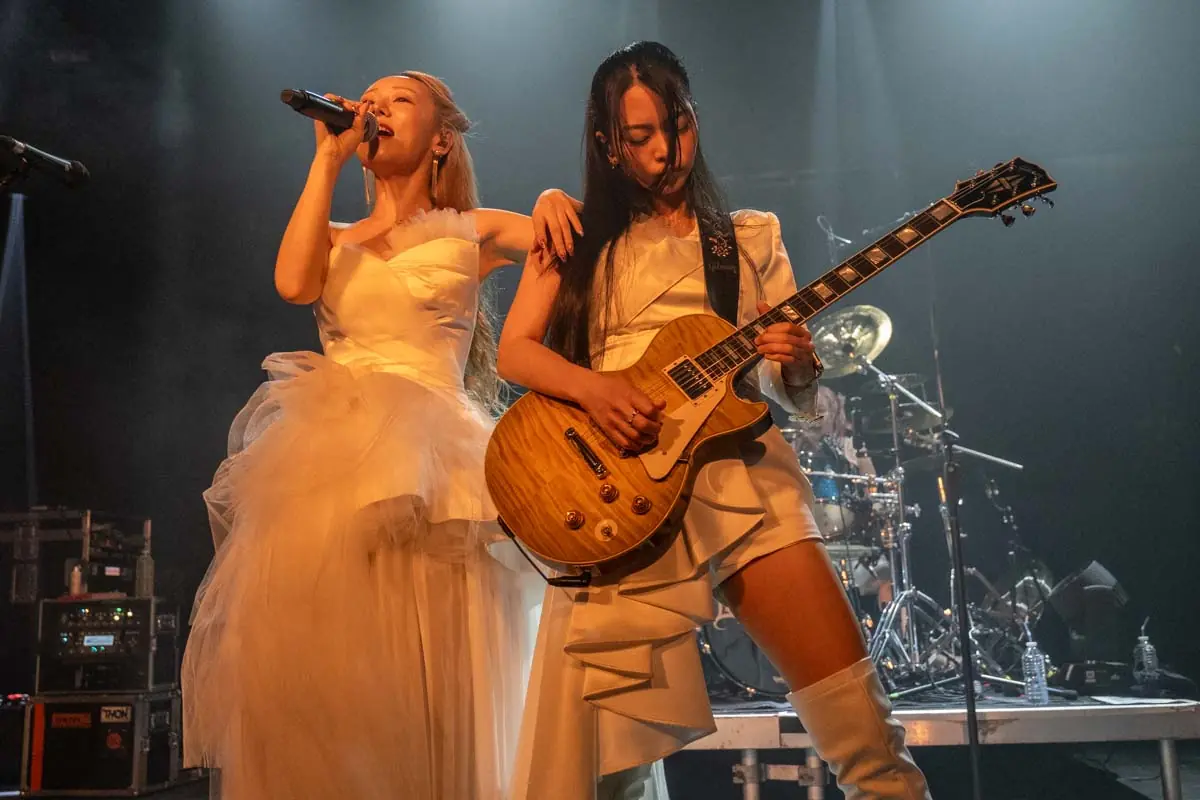
From here on, the prescription the fans ordered is delivered in spades. Speed, astonishing musicianship, chant-along songs and Japanese Idol style presence, all delivered by a band, dressed in white, looking like a cross between a Swan Lake ballet troupe and a bridal party.
Kicking off with Castaway, the opening track from their new album, gets the fans singing along. Clearly they are not just here for the old classics but the new ones too.
Lovebites – O2 Academy Islington – 3 August 2026. Photo: Steve Ritchie/MetalTalk
Throughout the gig, the band have clearly defined on-stage personas.
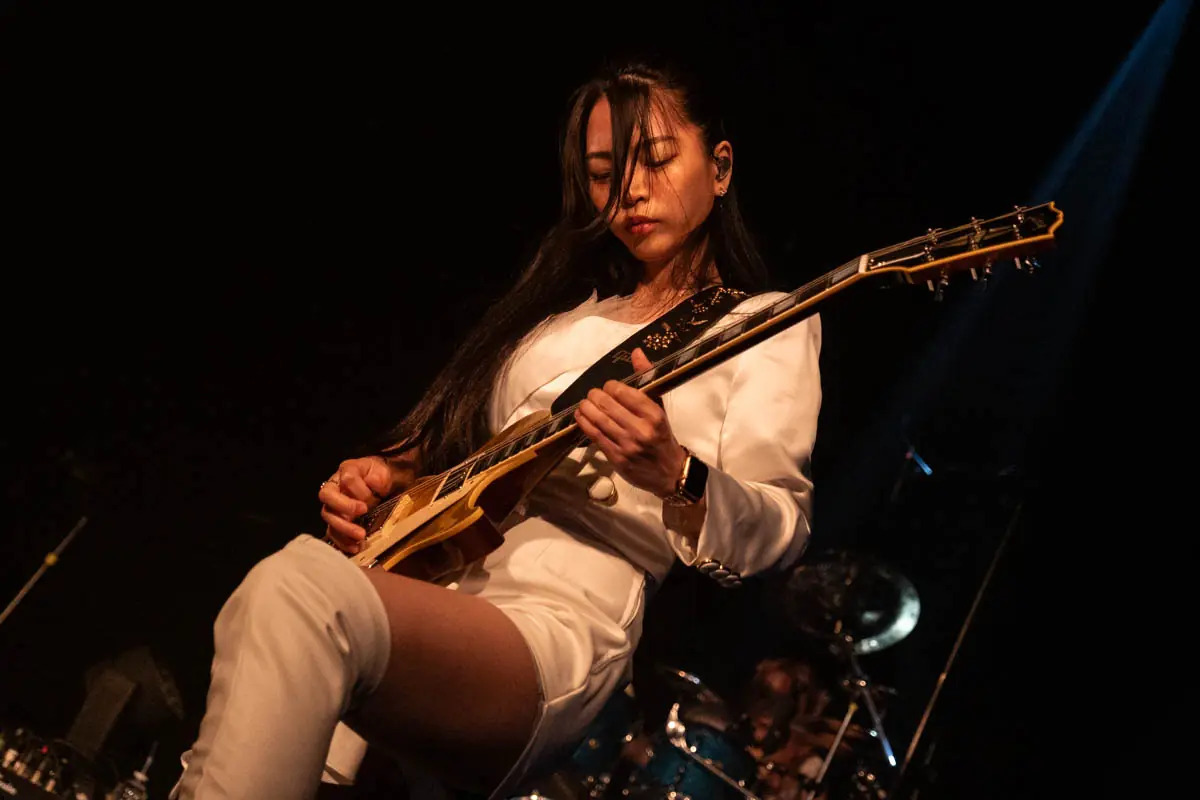
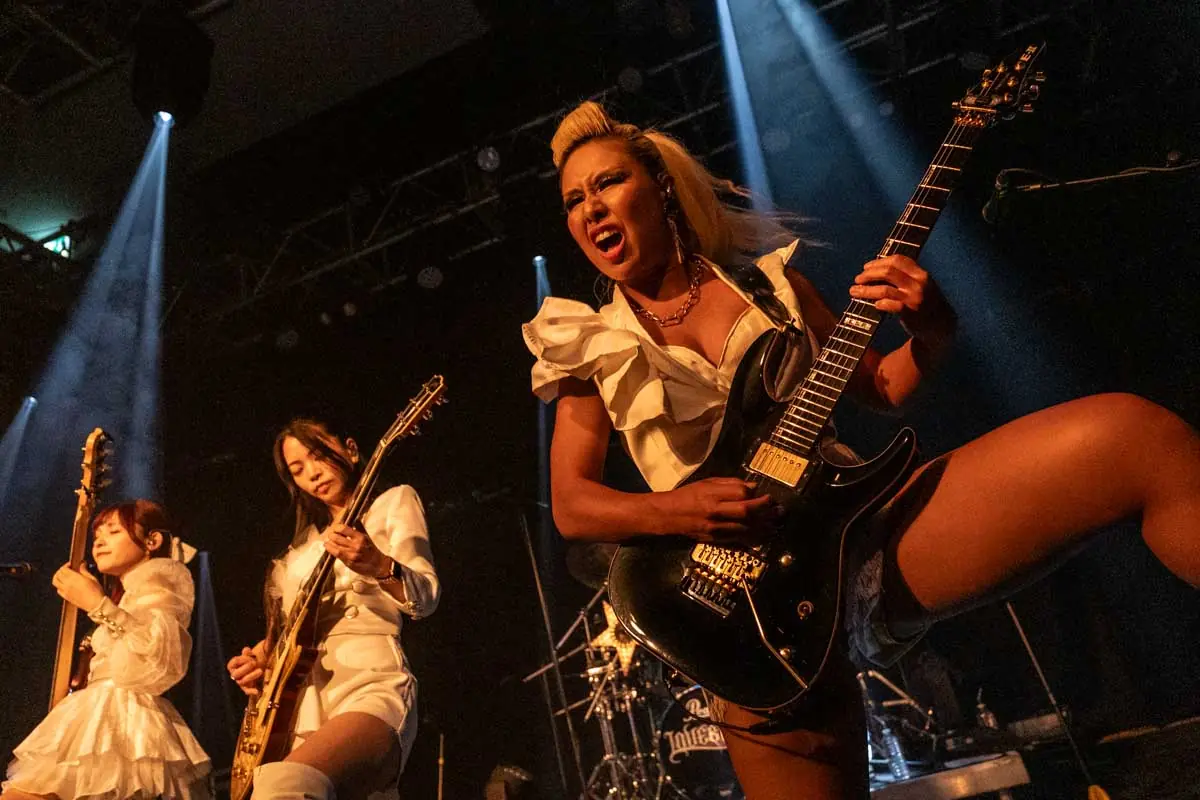
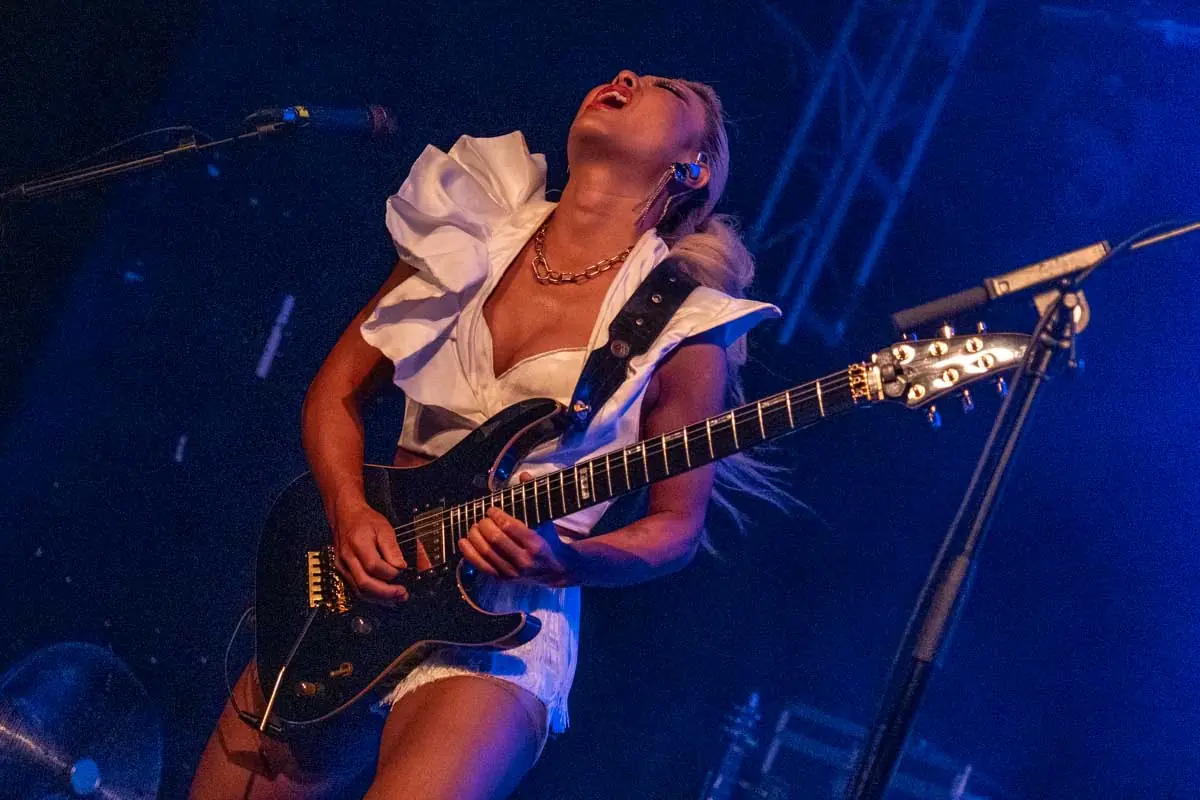
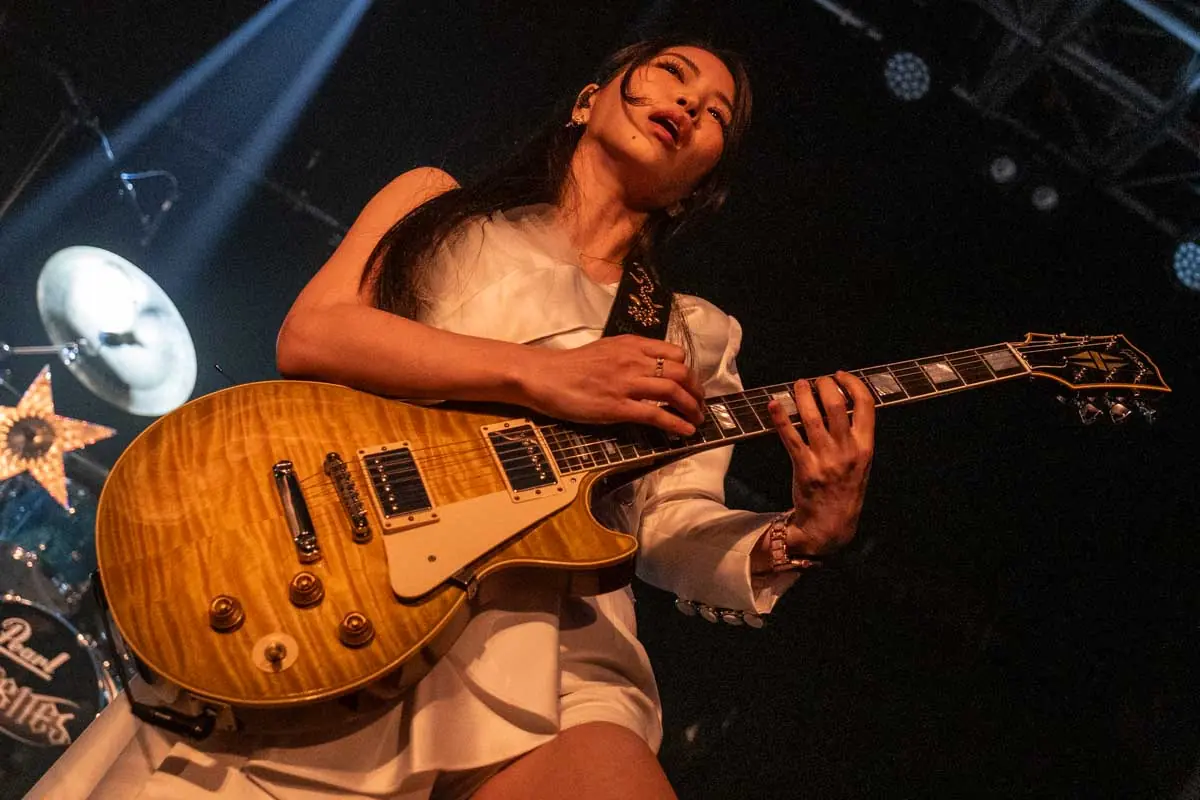
Miyako is all seriousness and focused attention as fast notes and scales, up and down the fretboard, shower the crowd. Midori, alternately smiling and super focused, forms the other half of the guitar maestros.
When they play their harmonised twin guitar duos, which they often do, they are a pair worthy of inclusion alongside Smith/ Murray, Downing/Tipton and probably most aligned with Hansen/Weikath.
Lovebites – O2 Academy Islington – 3 August 2026. Photo: Steve Ritchie/MetalTalk
Miyako and Midori are building on the shoulders of giants, with some riffs being very familiar, but they also have unique guitar phraseology with intriguing riffs that take you on new sonic journeys. It is beautiful to hear and a relief that when the classic twin guitar acts leave the stage, these talents are there to carry on the magic. Amongst all this, Miyako can also be seen playing keyboards. Such a talented group.
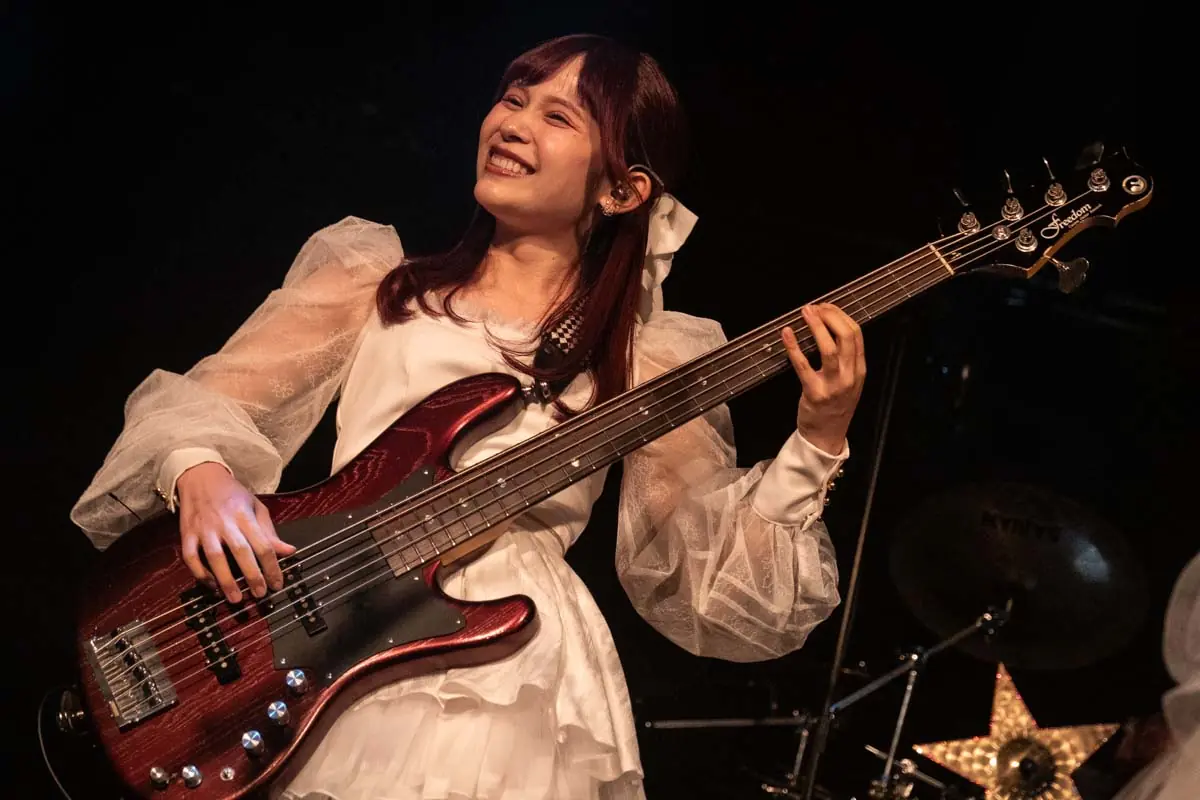
Fami draws in the eye with an infectious, beaming smile which almost never drops and a honky tonk style performance, settling slightly back from the rest of the band. But when bass takes the lead, the musicianship stands out as much as any of the virtuosic work of Miyako and Midori.
Lovebites – O2 Academy Islington – 3 August 2026. Photo: Steve Ritchie/MetalTalk
Guitars are ruling the roost tonight, but this is not to forget Haruna’s pounding, tight, high-energy drumming, which is the powerhouse engine of the machine and is equally intriguing and highly skilled but subordinated to building the sound stage on which the guitars can shine.
Asami’s voice complements the other instruments perfectly live, and her skill in connecting with the crowd is exceptional. Constantly engaging not just with the upstairs and downstairs of the venue but spotting individuals reacting to their music and copying them and pointing to them to let them know she has seen them, making as many fans as possible have a special, unique moment.
Lovebites – O2 Academy Islington – 3 August 2026. Photo: Steve Ritchie/MetalTalk
This is all complemented with the usual exhortations to jump, chant and throw devil’s fingers but also some unusual quirks of her own with balletic waves of the arm and forming hearts with her fingers to the crowd. The band connect too, waving and pointing, but Asami has the time, charisma and skill to make all feel included.
Each band member is extraordinarily talented, but together they are more than the sum of their parts.
Lovebites – O2 Academy Islington – 3 August 2026. Photo: Steve Ritchie/MetalTalk
The set continues with more songs from their new album, including Blazing Halo, Reapers Lullaby and One Will Remain.
Asami introduces Reapers Lullaby with “You’re not asleep, are you?” This is an extraordinary song, combining power, Thrash and Black Metal in equal parts, making an instant Speed Metal classic. The band play it with the lighting producing blackened silhouettes, headbanging all the way.
The crowd react accordingly, although the night is remarkable for a lack of mosh or circle pits. I am at a loss to explain this, as songs like MDO and Reapers Lullaby in particular are built for total mayhem.
Lovebites – O2 Academy Islington – 3 August 2026. Photo: Steve Ritchie/MetalTalk
That is not to say the fans do not react energetically. They do, punching the air and shouting along. Possibly it was just too packed in the centre, but I’ve never seen this stop a mob before. Maybe Asami simply needs to tell the pit to pit.
Lovebites now have a full set of classics from their career. All go down a storm, with Liar standing out when the three guitarists play together front of stage with a triple guitar medley. You have to include MDO, with its tearing intensity and repeated chant sung by each member of the band in turn, and Stand and Deliver played as a funky, sing-along song, in this classic list too.
Lovebites – O2 Academy Islington – 3 August 2026. Photo: Steve Ritchie/MetalTalk
The night ends with a medley of the three most poignant songs of the set, One Will Remain, When Destinies Align, and We the United, binding the crowd together and all beaming with joy.
Tonight was a combination of kawaii (cute) and kakkoii (cool, stylish, badass) in a performance combined with phenomenal musicianship.
BABYMETAL blew the doors off for Japanese Metal acts. But Lovebites might just be the greatest band from the wave of Japanese Metal that is crashing onto UK shores.
You did it! You participated in the democratic process! Now that you’ve all cast your ballots and we’ve counted them, we at Stereogum are happy to reveal the results of our annual Song Of The Summer readers’ poll. Below, check out the top 10 vote-getters, revealed, quite suspensefully, from 10 to 1. Then stick around to stream these tracks in handy playlist form. Enjoy, and we’ll catch y’all back here at Gummys time.
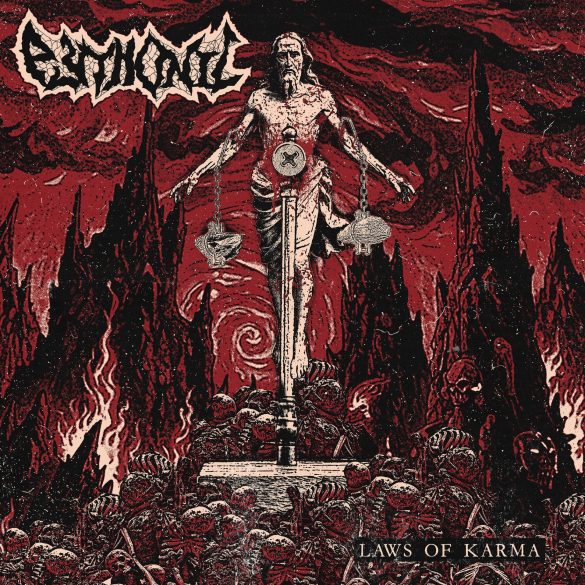
According to the internet, which never lies, there are nine species of snakes that call Saskatchewan home. Only one of them is venomous — the Prairie Rattlesnake — and none of them are pythons. So, you’d have to ask the members of this Saskatoon death/thrash/groove quintet the story behind the moniker they settled on back when they originally formed in 2015; if there’s a compelling, reptile-related tale, or if they’re actually computer nerds making reference to writing code. Whatever the case, Pythonic have a brand new EP, entitled Laws of Karma, that’s been out and available for about a month now. The five song release tackles a variety of topics including the state of the world and mankind, “the band’s collective struggles with disability, surgery, abusive relationships, fractured identity and karmic reckoning,” as well as vocalist Morgan Warriner dealing with a period of “physical recovery and emotional hardship.”
However, as former Saskatoon resident and long time Decibel correspondent Adrien Begrand will tell you, it’s not all doom and gloom in ol’ Saskabush. Laws of Karma may teem with darkness and despair, but Pythonic still know how to turn frowns upside down, as evidenced in their new video for “Set You Free,” which we are premiering today. Witness the charmingly sweet (literally!) backdrop and balloon animals in the pit taking whatever small amount of the edge off the serious subject matter guitarist Vincent Kohut. describes: “’Set You Free’ came out as an absolute banger of a track when we were recording it! Once we were doing our initial test mixes, we figured it needed to be one of the singles off the EP for sure. We definitely put in a lot of extra effort on this track, re-tracking parts to make them hit just right and re-doing vocals to hit the perfect disgusting sounds we needed. The track itself being about the controversial hereticism that is found in large organised religions, we knew it needed to come off sounding just as disgusting as the subject matter.
“After some talks with Shadowscape Pictures, it ended up being the track we also did a music video for. They were coming to shoot our live set in Edmonton on June 6th, 2026, so we thought it would be sweet to get a live video made up from that show. The other song we considered was the first single, ‘Sentience,’ but ‘Set You Free’ won the spot for just being heavier and more anthemic. Working with Shadowscape was an awesome experience. They really know what they are doing when it comes to shooting and editing videos; it turned out way better than we could have imagined. We highly recommend their work!”
The brands are getting involved with underground music again. In this case, the brand in question is Stone Island, the Italian luxury sportswear company with the nautical-star logo. The underground music is four of the biggest and best bands involved in hardcore and its adjacent worlds: Angel Du$t, Haywire, High Vis, and Knocked Loose. Together, those four bands are the subjects of The Calm & The Chaos, a new short film and photography project that documented all four bands while they were on recent tours. It involves members of those bands, both onstage and off, wearing what the company Instagram account calls “a mix of current and vintage Stone Island garments.”
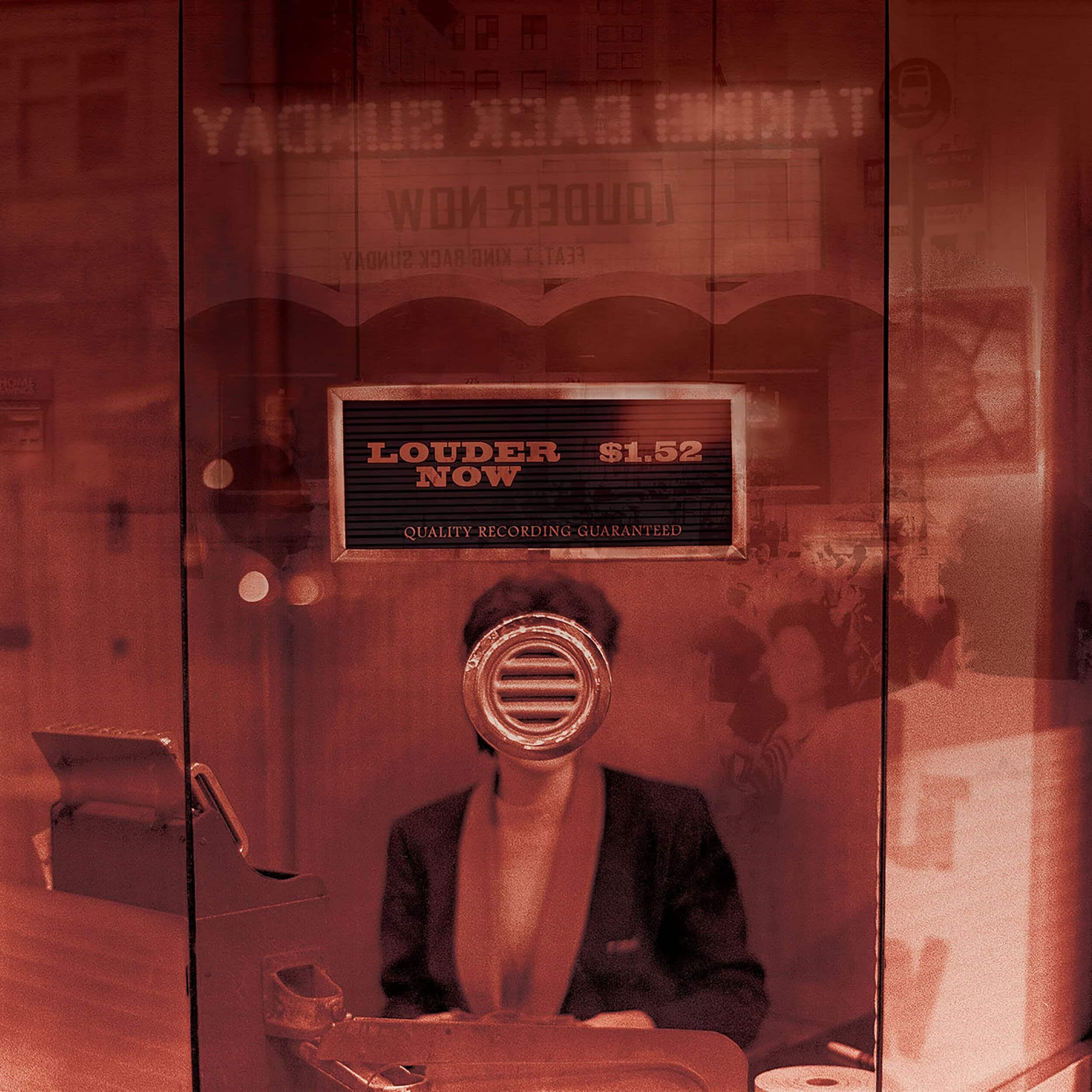
Taking Back Sunday have announced they’re reissuing their third studio album Louder Now to mark its 20th anniversary.
It’ll arrive on October 16 via Craft Recordings in deluxe vinyl and CD packages, complete with the bonus tracks Sleep and Brooklyn (If You See Something, Say Something. On the LP version, they’ll be presented on a 7-inch single, while both songs will be included on the deluxe CD.
Frontman Adam Lazzara says: “Our record Louder Now represents a huge milestone for me and to know it has made an impact on so many other people’s lives as well is something I still struggle to get my head around.
“To have the opportunity to celebrate that record with both John Nolan and Fred Mascherino onstage together, along with Shaun Cooper, is incredible to me. The songs sound stronger than I can ever remember live and I can’t even begin to tell you how excited I am to share that with everyone.”
Taking Back Sunday are currently on tour, with their next live performance scheduled for Musikfest in Bethlehem, Pennsylvania, on August 8. They also have further dates planned with Thrice and Saves The Day.
Next year, the band will head back out on the road with Weezer for their run of UK and European shows, with the first date taking place in Dublin on May 12.
(Image credit: Craft Recordings)
Taking Back Sunday: Louder Now Deluxe
Vinyl edition
Side A 1. What’s It Feel Like To Be A Ghost? 2. Liar (It Takes One To Know One) 3. MakeDamnSure 4. Up Against (Blackout) 5. My Blue Heaven
Side B 6. Twenty-Twenty Surgery 7. Spin 8. Divine Intervention 9. Miami 10. Error Operator 11. I’ll Let You Live
7″
Side A 1. Brooklyn (If You See Something, Say Something)
Side B 2. Sleep
CD edition
1. What’s It Feel Like To Be A Ghost? 2. Liar (It Takes One To Know One) 3. MakeDamnSure 4. Up Against (Blackout) 5. My Blue Heaven 6. Twenty-Twenty Surgery 7. Spin 8. Divine Intervention 9. Miami 10. Error Operator 11. I’ll Let You Live 12. Brooklyn (If You See Something, Say Something) 13. Sleep
Looking for a budget turntable for your ever-growing vinyl collection? We have you covered
Freight trains don’t normally have the ability to rumble their way around the entire world. Fortunately, no one told that to the white-hot Parker Barrow Band, who are doing just that.
In the middle of a high-speed United Kingdom tour, band members Megan Kane and Dylan Turner took the time to talk to Blues Rock Review (BRR) about their latest album, the tour, and the growth of the band.
The band evolved over the past eight years, starting with a partnership between drummer Dylan Turner and singer Megan Kane. It has grown into a dynamo, currently firing on all cylinders.
Kane explained the process of building a winning team. “We (she and Turner) met eight years ago and we’ve been married for three years. When we first met, we both set out to chase a dream, and along the way, we were trying to find people who also shared that vision and that dream. Thankfully, we were able to meet Alex (Bender), guitarist and musical director, about four years ago. I think we would all agree that’s really when the band took a turn and started to become something very stable and something of a foundation, to be built. From there, we met Eric (Safka) on keys; bassist Kyle (Priber) we’ve known for about five years, and we met our guitar player Will (Tipton) about two years ago. Now we feel like one big happy family where all the pieces fit together. We all get along pretty well, and we have a great time getting to travel and do all this together. It has been an evolution of sorts, but I definitely feel at home now and feel like all the pieces are now working together for the greater purpose.”
The band was touring the UK when the new record dropped, but Kane said there was no added pressure from the two events colliding.
“I think it probably is a good thing because we’re so busy that we have time to really focus on the now. Recording the songs and now finally getting it released into the world, it’s almost like a weight lifted. Now it’s out there and we get to just travel in the world and play our songs and that’s really all we can ever hope for. It’s a bit of a whirlwind, but you can’t really think about it while you’re in the middle of it.”
The new 9-track album, Hold The Mash, was officially released on July 17 and it contains some straight-ahead, high-energy blues-based rock and roll, but there is a mix of sounds to keep listeners engaged. One particular track, for example, “Ruby’s Reckoning”, has a distinctive roots feel.
Turner told BRR that the changing tempos and themes contained in the album are not necessarily by design. “When Alex and I were coming up with some ideas for different songs, he played one he had been working on for a long time. It had this really cool, rootsy kind of vibe and it inspired me to do more of a storytelling type of song. I had some stuff that I had been working on, and it (“Ruby’s Reckoning”) just came together.”
He continued, saying they don’t really have a set approach to writing. “We don’t put a whole lot of emphasis on our writing process or how we’re supposed to do it,” he said. “Whether it starts with a riff or a word, whatever kind of happens, happens. Alex is constantly working on riffs, and he’ll say, hey man, I’ve been working on this, check it out. A lot of times I had been working on something lyrically, we found they kind of just worked together. We put these things together, and Megan finds a way to sing it and, almost like magic, it worked a lot of the time.”
Turner said the combination of Bender and producer Stephen McNight is also working well. “With Megan and I, Stephen and Alex – having the four of us being able to bounce ideas off of each other and, coming from similar but adjacent backgrounds, gives us sort of an edge in the studio which helps us to honor our influences without the whole rinse-and-repeat kind of thing that you can get caught in sometimes. So it was a real treat for me, and Megan too, to get to watch those guys bounce off each other and create together in the studio and I think it made for sort of an eclectic mix of sounds and textures and vibes on this record.”
The band drew its name from the legend of Bonnie (Parker) and Clyde (Barrow). Also rooted in a home-grown history, the band grew from a young Turner watching performers in his dad’s coffee/music house to gracing world stages.
He said, “We’re still very much in that unique position as a band where we can do anything from playing a fraternity show to playing a sold-out theatre. We’re doing so many different things right now that it’s crazy sometimes, specifically this run in the UK. We’re playing some pretty substantial festivals that host several thousand people over a weekend and then we’re doing some smaller 200 or 250-seater club shows. We really, really enjoy this space that we’re in right now where it’s still very intimate. A big part of this for us, and it always has been and, hopefully always will be, is about the connections that we’re able to make while touring. This dream of music has taken us, not just all over the country, but now internationally and we’ve been lucky enough to meet some, now, really good friends over in Spain and here in the UK and in Canada. We love doing it and it never feels much like work. We’re just trying to make the best of each opportunity and hopefully see some growth and progress. This year has really been amazing for us.”
The band is most often described as southern rock but has drawn comparisons to the Allman Brothers, Led Zeppelin, The Black Crowes and even AC/DC. And that’s cool with them, noted Kane.
“We love those bands, so to be compared to them is incredible. It’s the music that we love. It’s who we listen to, so if people put our names next to theirs, then that’s awesome. We all come from such different backgrounds musically, but I do think it all kind of bleeds through our music to make its own thing. But the fact that people compare us to our favorite bands is a dream come true.”
Even the album cover, designed by Sleepy House, is a throwback to the glory days when vinyl art meant something. This one is peppered with symbols and song references. “Yes,” said Kane. “There’s a lot of fun little treats in there because I feel that’s what it’s all about. The music should be cohesive with the art. And for us, this definitely feels like a good time stamp of where we are right now and where we’re heading next.”
Gauging the success of a live show is difficult when you’re the one on stage, but Kane said they rely on each other for feedback, growth and success.
“I think we all go off of our gut instinct. Obviously, Alex is at the helm of directing the show and choreographing it and making sure we’re all being utilized to our best ability, but we all try stuff. We’re all very human in our approach to music and I feel like when you come to a show you can see that on stage with all of us. If something doesn’t work one night, then you get to do it again the next and try something new and it will work. But you’ve always got to push yourself. You always have to reach for higher levels and hope that something lands. And if it doesn’t, then that’s just a human element of it all. When we’re on stage together and the trust that we have between each other is that, if I don’t succeed, we’re all there to pick each other up, on and off the stage.”
Even in conversation, their enthusiasm and passion saturate every response. And, to them, it’s all about the live performances. Turner described what new fans can expect when they see Parker Barrow live and on stage.
“The live show for us is absolutely the whole thing. That’s what we’re most passionate about. We all write and record music so that we have songs to go play live and a reason to go and tour. It’s really what we love to do the most, and because of that we spend a lot of time on that live show – thinking about it, sculpting it, creating it. The way I describe our live show is it’s like a freight train at full speed going downhill, and there’s a sharp turn coming. And we don’t know if we’re gonna make it or not but we’re holding on for dear life. It’s a lot of energy and something that, we hope, will bring people joy. That’s one of our big things – getting the opportunity to do this for a living and play shows all over the country and all over the world. The least we can do in return is spread some joy. We have a ton of fun in our live shows and getting to do what we love with the people we love is an absolute blessing. We hope that we have many, many more opportunities to do it.”
Kane added to that, saying, “It’s one of those things that, when you love it as much as we do, when you’ve given your whole life to this thing and you’re out there on the road, getting the opportunity to do it, it’s really hard not to enjoy it. We just want people to have a good time with us.”
Parker Barrow will be touring the US through October
Our Top 10 Blue October Songs list presents ten of the band’s most powerful and best-loved recordings, including “Into the Ocean,” “Hate Me,” “Calling You,” and several songs from the group’s later albums. Blue October formed in Houston, Texas, in 1995 around singer, guitarist, and songwriter Justin Furstenfeld, his brother Jeremy Furstenfeld on drums, multi-instrumentalist Ryan Delahoussaye, and original bassist Liz Mullally. Matt Noveskey joined the band in 1998 and became a central part of its most recognizable lineup. Blue October built its identity around emotional honesty. Justin Furstenfeld’s lyrics have addressed love, addiction, mental health, family, regret, recovery, and