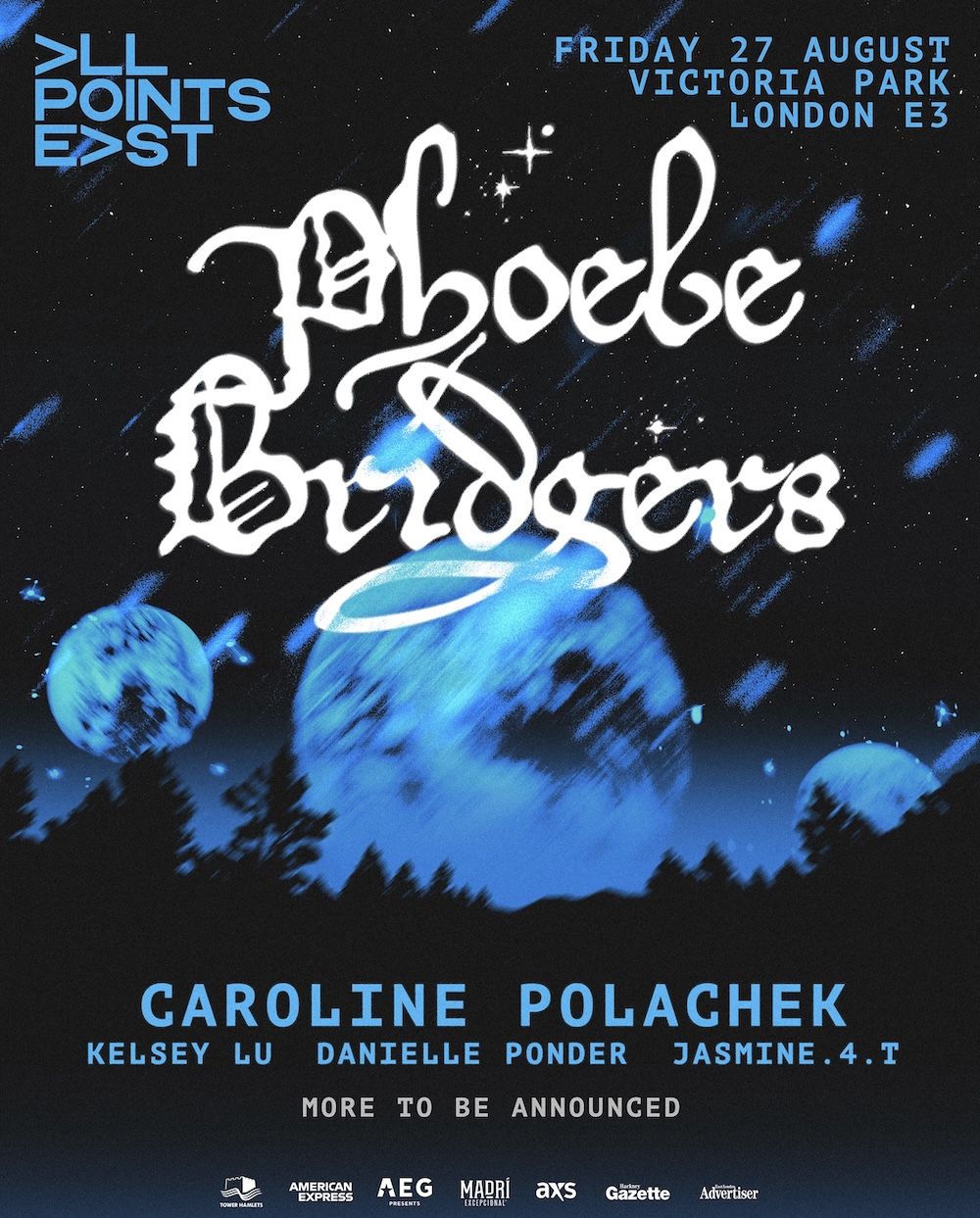
Phoebe Bridgers has been announced as the first headline act for next year’s All Poiints East festival in London.
The US singer/songwriter’s debut performance at Victoria Park in East London on Friday August 27 will be the biggest headline show she has ever undertaken.
The supporting bill will feature Caroline Polachek, Kelsey Lu, Danielle Ponde and jasmine.4.t, with more artists yet to be announced.
Tickets for the event will be available from 10am on October 29, here.
Bridgers scored her first UK number one album during the summer, when her third solo album Lost Weekend topped the charts in August. The album included a cameo appearance from industrial metal and post-metal pioneer Justin Broadrick (Godflesh), as Bridgers is a fan of his side band Jesu.
Branching out, this week Bridgers will be seen making her acting debut in the A24 drama Primetime, directed by Lance Oppenheim and starring Robert Pattinson, release on October 30. She also contributed the film’s end title song, On Video.
(Image credit: APE)
The 2026 edition of All Points East welcomed headliners Jorja Smith and Tems (August 21), Lorde (August 22), Deftones (August 23) Tyler, The Creator (August 28 and 29) and Twenty One Pilots (August 30).
Further headline acts for 2027 will be revealed in coming weeks.
Pennsylvania-based prog metal collective Parius will put out their fourth long player, Alchestronomy, on November 13 through Willowtip Records. Engineered by AJ Viana and Chris Kelly. Mixed and mastered by Jamie King. Two new songs can be listened via Bandcamp widget below. Read more…
Swiss black metal unity Hån have premiered “Ashen Frozen Thrones” track, which will appear on the band’s next studio album Whispers Of The Nocturnal Aeon. Read more…
Steven Wilson has shared a video for his new single, A Basket Of Bees, which is the third track he’s released from his upcoming ninth studio album, Requiem For A Village, which he released through Fiction Records on November 6.
The video is part of a series of “Village Hall Sessions”, which sees tracks from the album recreated in an appropriately retro studio environment by Wilson, Randy McStine and Russell Holzman, and all captured on film by regular collaborator Miles Skarin, who worked with Wilson on last year’s The Overview.
At the same time, Wilson also announces a very special one-off event in London to help tell the story behind the album.
He will sit down with comedian and Prog Awards host Al Murray for an evening’s conversation at the Bush Hall in Shepherd’s Bush, where the pair will talk about Requiem For A Village and the wider world that the album sits in.Wilson will sign copies of Requiem For A Village after the talk. The event takes place at 8pm on Tuesday 10th November. Get tickets.
Requiem For A Village will be available on CD, Blu-Ray, 140g two 12” black vinyl, oxblood coloured two 12” vinyl and as a boxset featuring 2 CDs, Blu-Ray disc packaged in a 96-page hardback book box. Limited quantities of signed CDs will be available through Amazon, and CDs with exclusive packaging will be available through HMV.
You can order a special dark green vinyl variant of Requiem For A Village, plus a 12″ x 12″ exclusive art print, plus a copy of the latest issue of Prog with Steven on the front cover, with our new and exclusive bundle. Order yours here.
Before their new record Graines officially comes out on November 6th, black metallers Les Chants De Nihil offer in listening another new track in preview “Graines: L’imprégnation”. Read more…
While the rock and roll bands in the ‘60s laid the foundations for rock and roll to take over the world, the top 16 rock bands from the ‘70s took everything to the next level. Yes, ready or not, in this decade, the world experienced some of the biggest, most ambitious, and most grandiloquent rock shows and tours in history.
Although some of the bands you’re about to see were formed in the late ‘60s, their most prominent work and subsequent fame came along in the ‘70s.
Yes, this is the time arena-ready rock and roll anthems were born. So, be ready to put on a bandana, ignite your lighter, and sing your lungs out with these huge ‘70s rock and roll acts.
What Made Rock Bands in the 70s Special?
Huge crowds, stadiums, paraphernalia, costumes, and elements like fireworks made the ‘70s the golden era of bombastic rock and roll performances. Not only did the anthems become more popular, but there were also songs designed to make arenas roar. Some of the most played classics in rock and roll history were born in this era.
Also, let me tell you that much of what happened in the ‘60s (especially the late ‘60s), like Woodstock, for example, gave promoters and tour managers the certainty that there was no cap to what rock and roll could achieve. Crowds kept getting bigger, and so did venues for a genre that just didn’t stop growing in popularity.
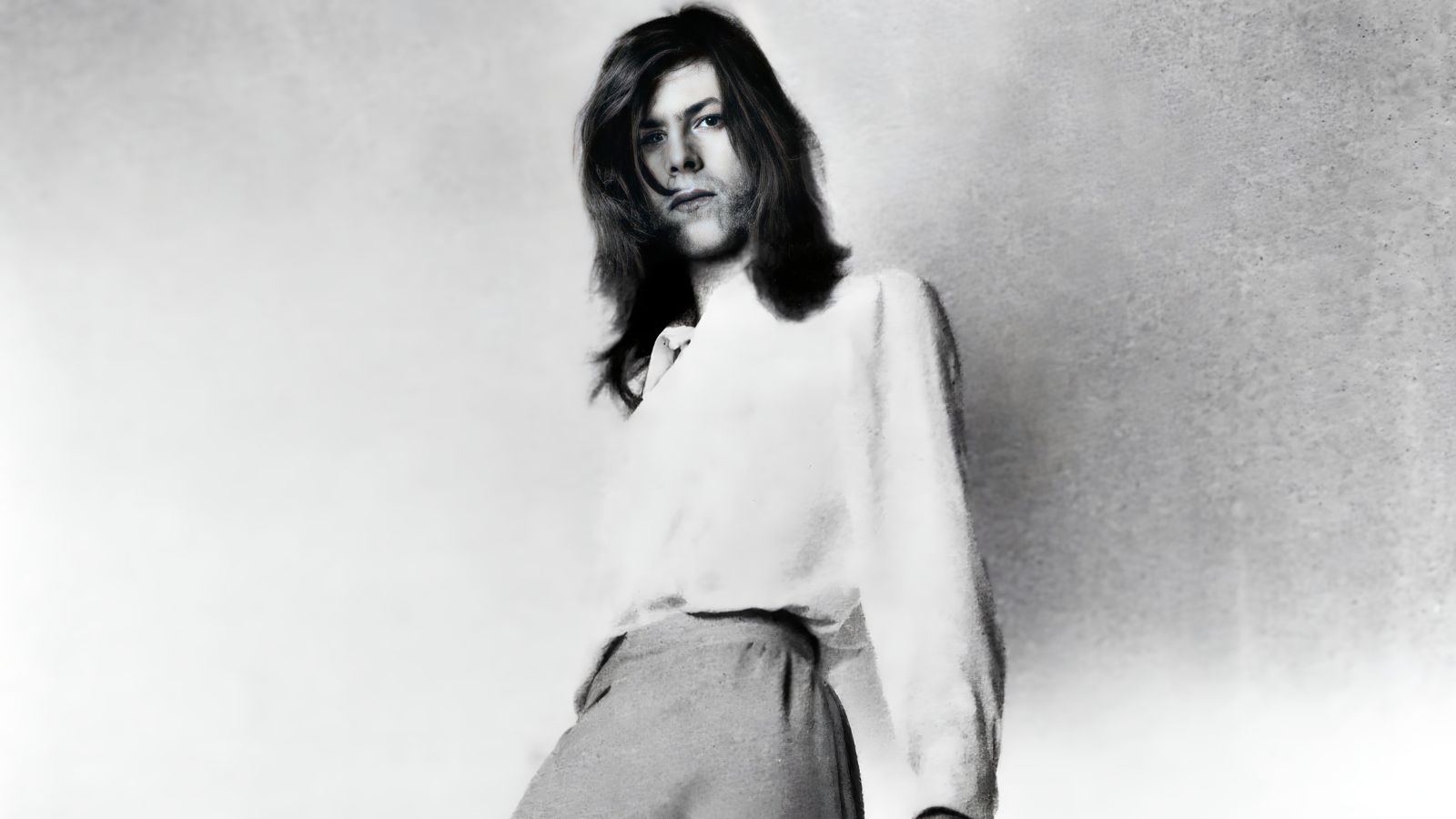
David Bowie was more than a composer and a singer or performer and actor. He was a creative force that took the entire rock genre up a notch. Indeed, his 1972 album Ziggy Stardust and the Spiders from Mars was like nothing else the world had ever witnessed before. The theatricals, the costumes, the sound, the acting- all part of creating the Bowie legend.
Furthermore, while intensely touring, he also found time to co-produce and sing vocals in Transformer (1972), the first solo album by Lou Reed, and mix Raw Power (1973), the third Stooges album, along with Iggy Pop.
But why is David Bowie so relevant in the history of rock music? Well, first of all, because of his legacy. He taught the world how rock and roll could become a vessel for more profound meanings, soulful poetry, and stadium-sized theatrical presentations. Furthermore, he was also a moving creative force who came up with character after character in an attempt to make a puzzle that would talk about David Bowie.
Nowadays, after his passing in 2016, Bowie is admired by peers, fans, and critics, and his work is considered among the most important of the 20th century. As proof of that, a short time ago, Billboard claimed that David Bowie influenced more musical genres than any other rockstar.
You can’t enjoy ‘70s rock without including David Bowie in your playlist.
2. Queen
Queen – Image Credit: Spotify
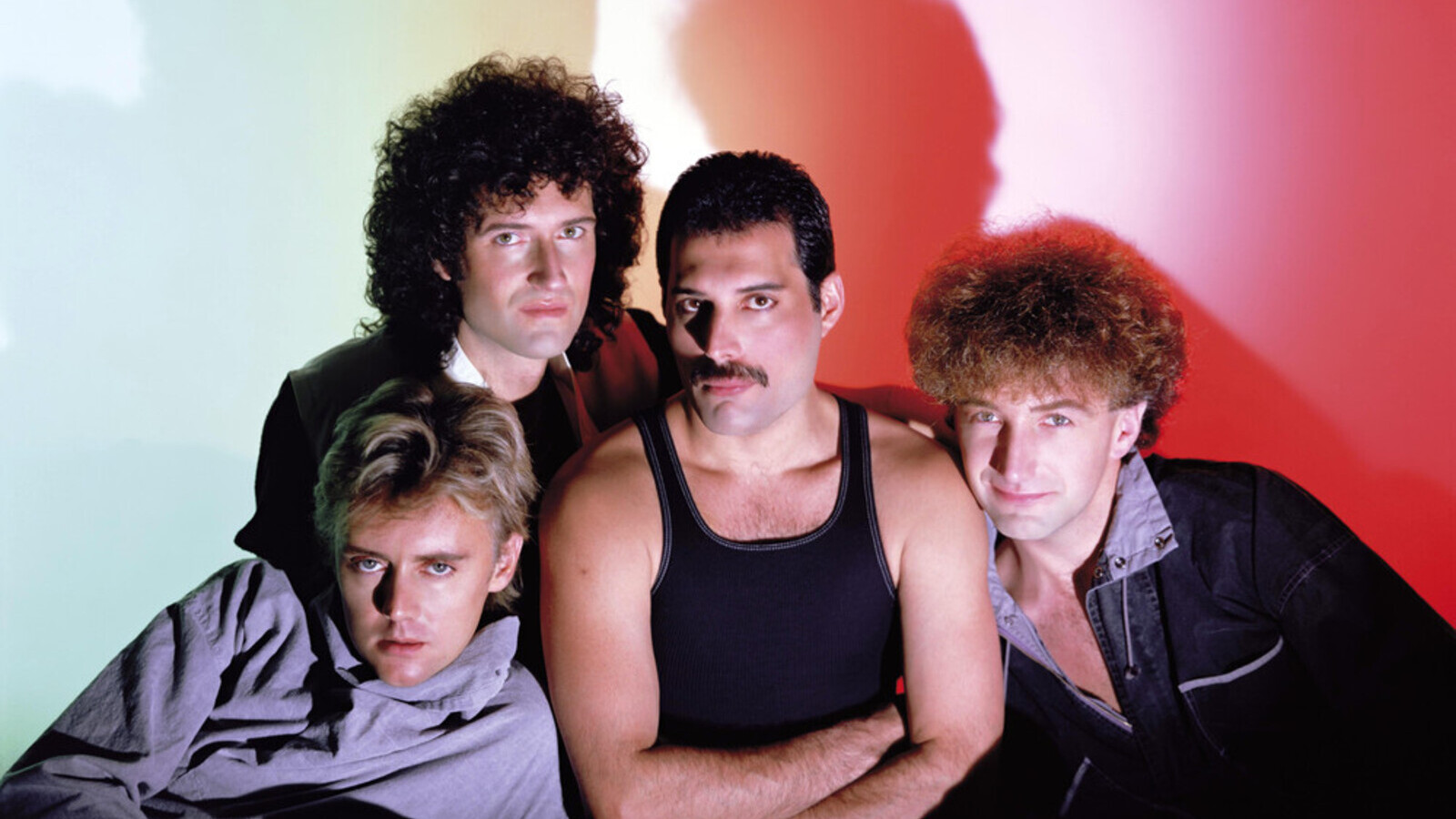
Who can forget the opera part of “Bohemian Rhapsody” turning into heavy metal? Also, the iconic, utterly simple bass line that gives life to Queen’s collaboration with David Bowie, “Under Pressure.” Or, what about the hypnotic drum fill that gives life to “We Will Rock You”, and the eternal chant of the winners called “We Are The Champions”.
Just by naming a handful of songs by Queen, you already know that they’re part of your musical DNA, part of the soundtrack of your life.
Well, if there was a frontman who embodied the grandiloquence and theatrical aspect of arena performances in the ‘70s, that was Freddie Mercury. He started Queen along with guitar god Brian May, and Roger Taylor on drums. John Deacon was recruited to play bass a year later.
The Queen ruled the planet until Freddie’s sad passing in 1991. After the man was gone, the band kept on playing with several singers and touring the world to great success, but the legend was already written in stone.
If you want to get into Queen, I suggest you start with the two most memorable albums by the band: A Night at the Opera (1975) and News of the World (1977).
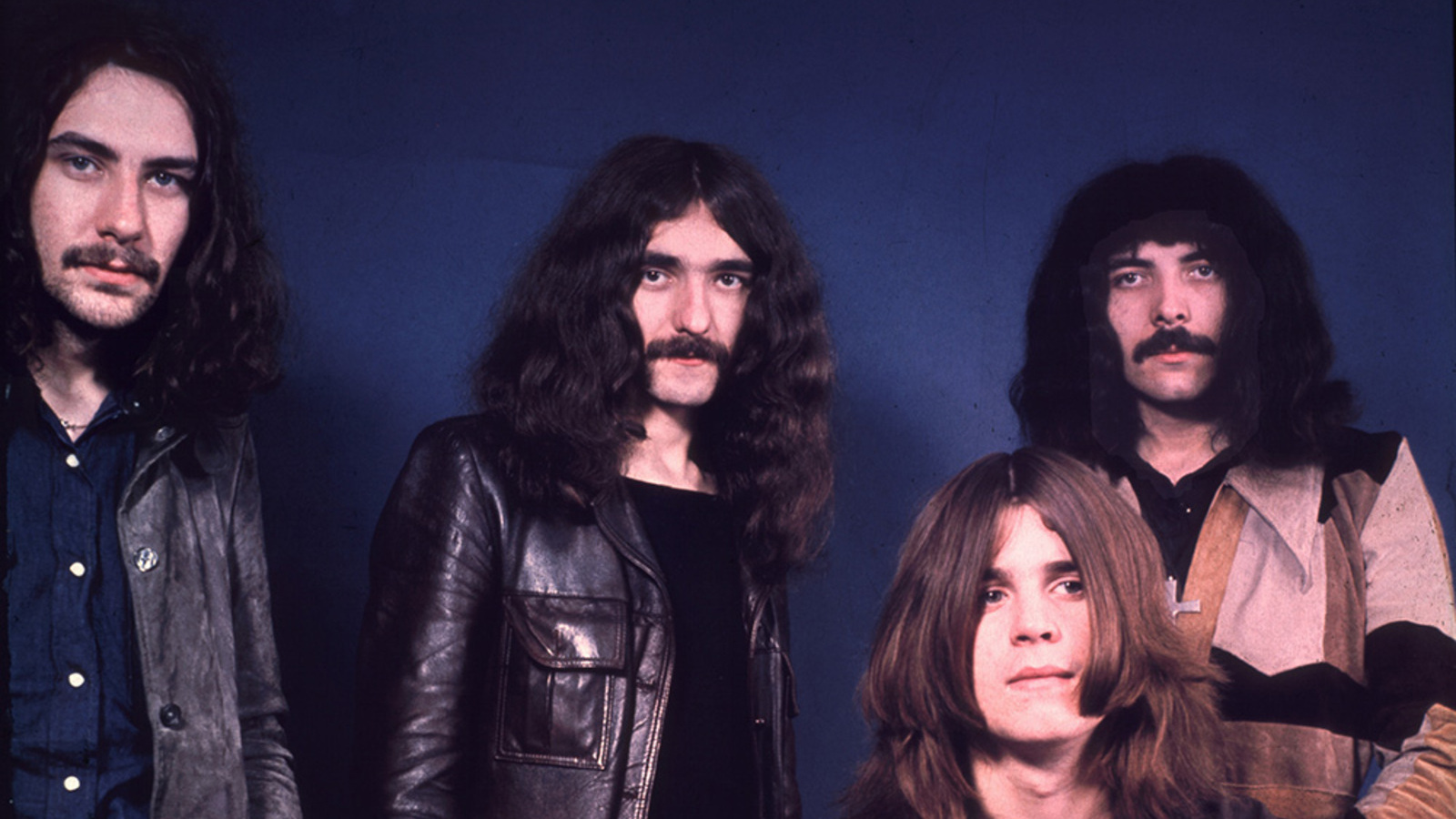
3. Black Sabbath
According to some publications, Black Sabbath invented heavy metal. Although there was “Helter Skelter”, Cream, Hendrix, and The Who before them, nobody took it to the obscure with such a grinding mix of guitars as the early Sabbath records did.
Although they created the style and influenced thousands of bands to come, the band, and especially Tony Iommi, wanted nothing to do with the term “Heavy Metal.” They preferred to be called a “heavy rock” band instead. Despite their struggle, they’re considered the inventors of the style and the band that helped shape heavy modern music as we know it today.
I mean, the black clothes, inverted crosses, satanism allegations, chewing off bats’ heads on the stage, and dark personalities contributed to creating the culture behind heavy metal music. The same that year after year still congregates hundreds of thousands of music lovers in many festivals around the planet.
If you’re a newbie to Black Sabbath’s music, I suggest you start with Paranoid (1970) and Sabotage (1975).
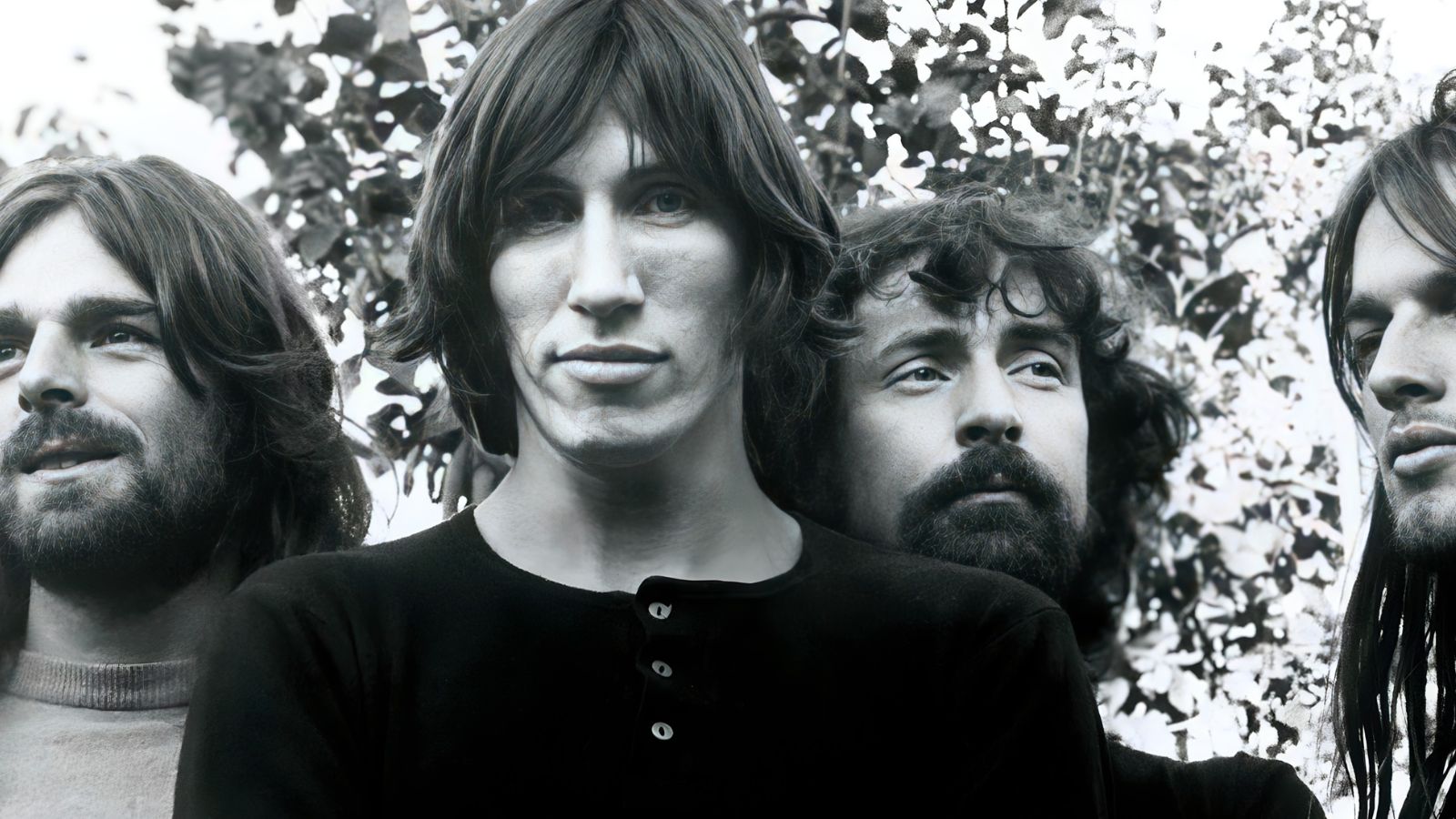
4. Pink Floyd
Formed in London in 1965, Pink Floyd is widely known as prog-rock’s most popular band. In fact, a recent reader’s poll carried on by Rolling Stone Magazine left them in the second position after Rush. Yet, truth be told, Pink Floyd exceeds the Prog-Rock world to become a bigger monster, one that needs to feed on more than one musical style to survive.
Perhaps the best example of Pink Floyd’s grandiloquent approach to music is their 1973 record The Dark Side of the Moon, an album that stayed on the Billboard 200 for 14 years. But it wasn’t just an album, it was also the inaugural step to a series of ‘70s rock statements that ended with the hugely acclaimed, audiovisual, and theatrical The Wall (1979).
That stream of albums is the one I recommend the most and is completed with Wish You Were Here (1975) and Animals (1977).
Although Roger Waters is 79 years old and into his farewell tour era, Pink Floyd’s music is still present in the mainstream. For example, Miley Cyrus covered “Wish You Were Here” on Saturday Night Live, exposing an entire new generation to Pink Floyd’s music.
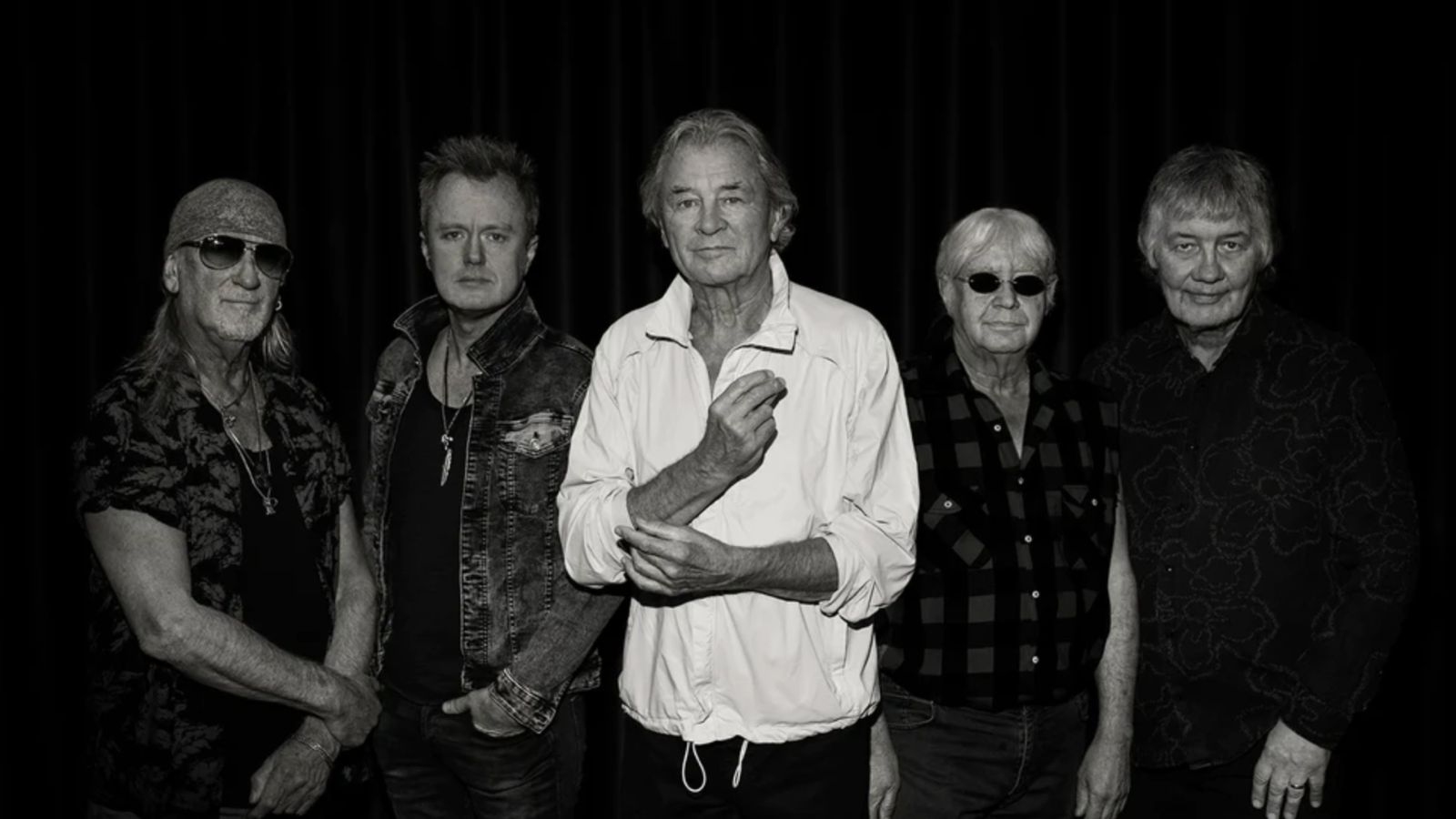
Although they’re part of that unholy trinity, they’re a wildly underrated band for what they’ve done for rock music. I mean, they were inducted into the Rock and Roll Hall of Fame in 2016 by no other than Lars Ulrich, Metallica’s eccentric drummer.
But let me tell you two things about Deep Purple. To begin with, they were the first-ever rock band to play with a full symphony in a live show (Concerto for Group and Orchestra in 1969). Something that has been replicated many times after. Also, they’re the band that wrote “Smoke on the Water” drawing inspiration from no other than Beethoven himself!
If you’re about to dive into Deep Purple for the first time, I suggest Machine Head (1972) and Burn (1974).
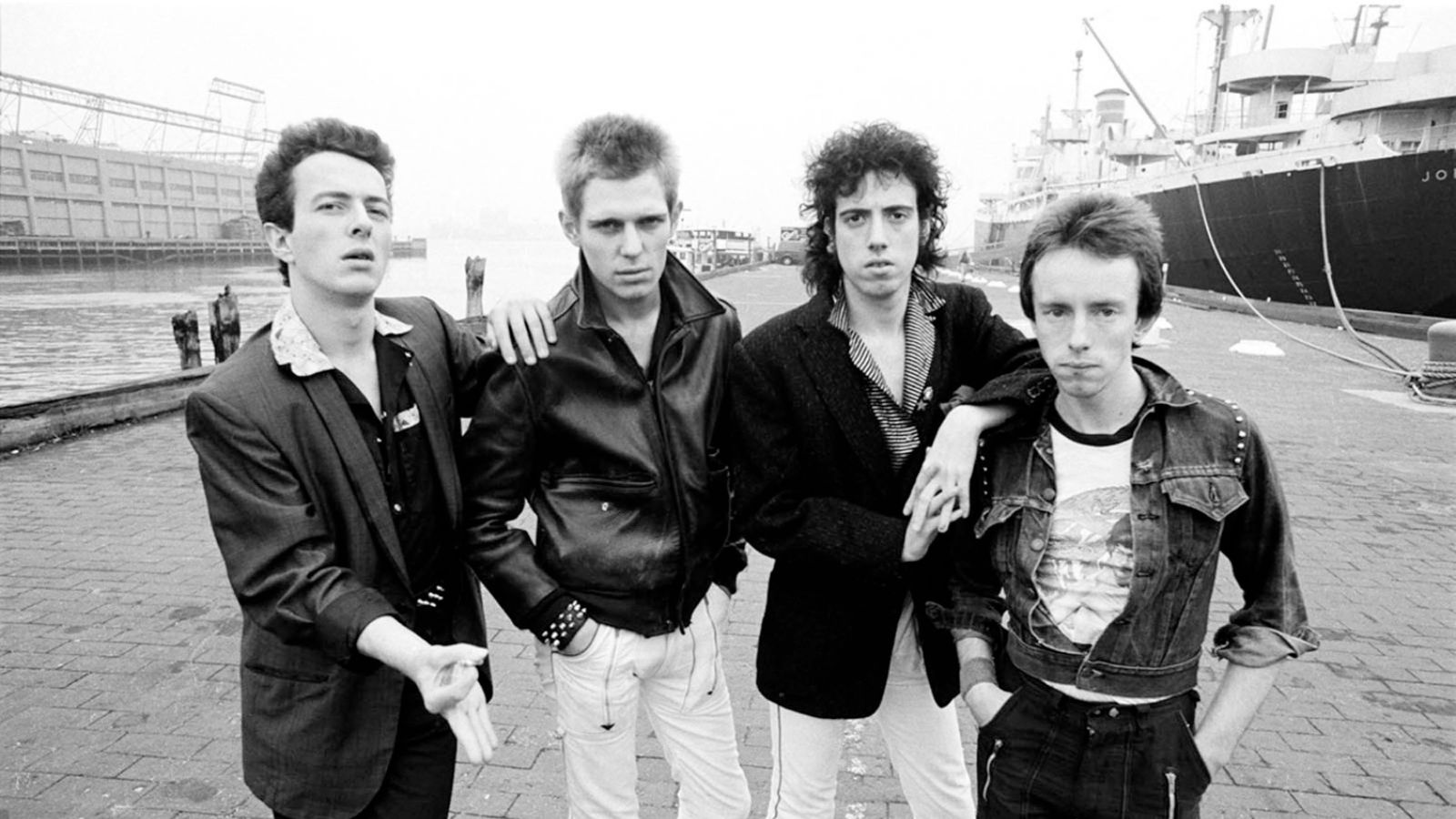
6. The Clash
Few bands in music history were able to mix so many styles and come out with a sound of their own. Yes, no other band in history sounds quite like The Clash. They used a mixture of rock and roll, rockabilly, punk rock, ska, dubstep, reggae, funk, and ska to create simple tunes that made a generation dance and influenced other generations to stand up and fight.
Perhaps the best way to understand The Clash is to think of music as a vessel for a bigger message. These English rockers did exactly that and set the foundations for a lot of bands that came after, including Rage Against the Machine.
In a recent interview, Tom Morello stated that his number-one influence in terms of bands was The Clash.
Are RATM and The Clash similar in terms of sound? No, but what sets both bands apart from the rest is the fact that both of them had something to say about the reality around them.
Although all of their records are amazing, if you’re getting started with The Clash, I suggest you go for London Calling (1979) and take it from there.
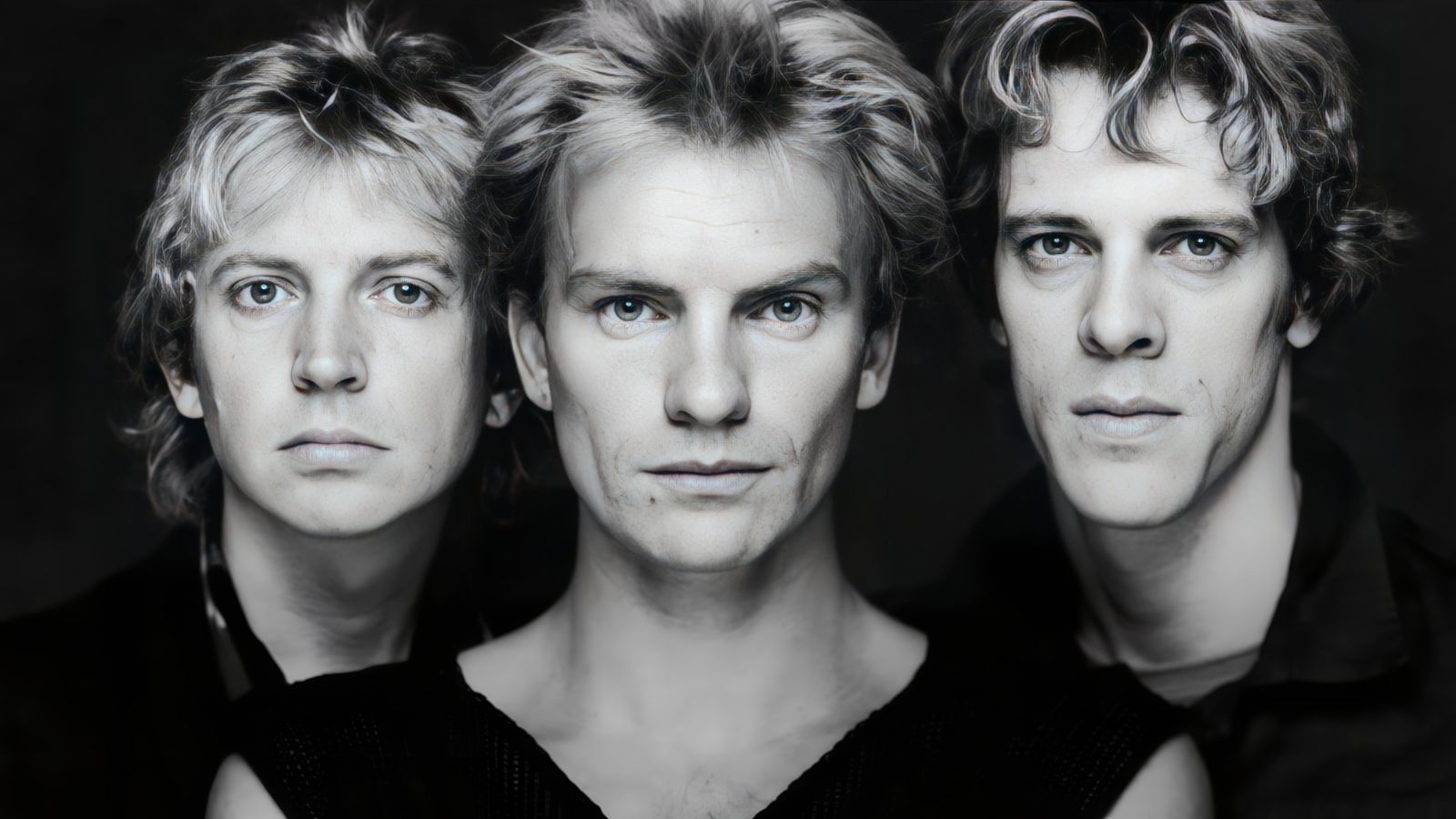
7. The Police
The first time I heard Outlandos D’Amour (1978) I just couldn’t believe it. In fact, I don’t know if the world was ready to receive such a wild combo made of reggae, rock, punk, rock and roll, ska, and a lot of attitude from one of rock and roll’s greatest frontmen of all time, Sting.
The band was more technically advanced than the rest of the players in the scene since all members had cut their teeth playing academic music and jazz and learning music theory. That knowledge, mixed with a world-conquering attitude and arena-ready songs, made The Police a hit band that took over the world like a storm in a very short but intense ride from 1977 to 1986.
Why is The Police an important and influential band in music history? Well, just like The Clash, they helped blur the limits between rock and all other genres in Western music, giving birth to a whole new generation of musicians who are not afraid of academia and willing to push the style’s boundaries further.
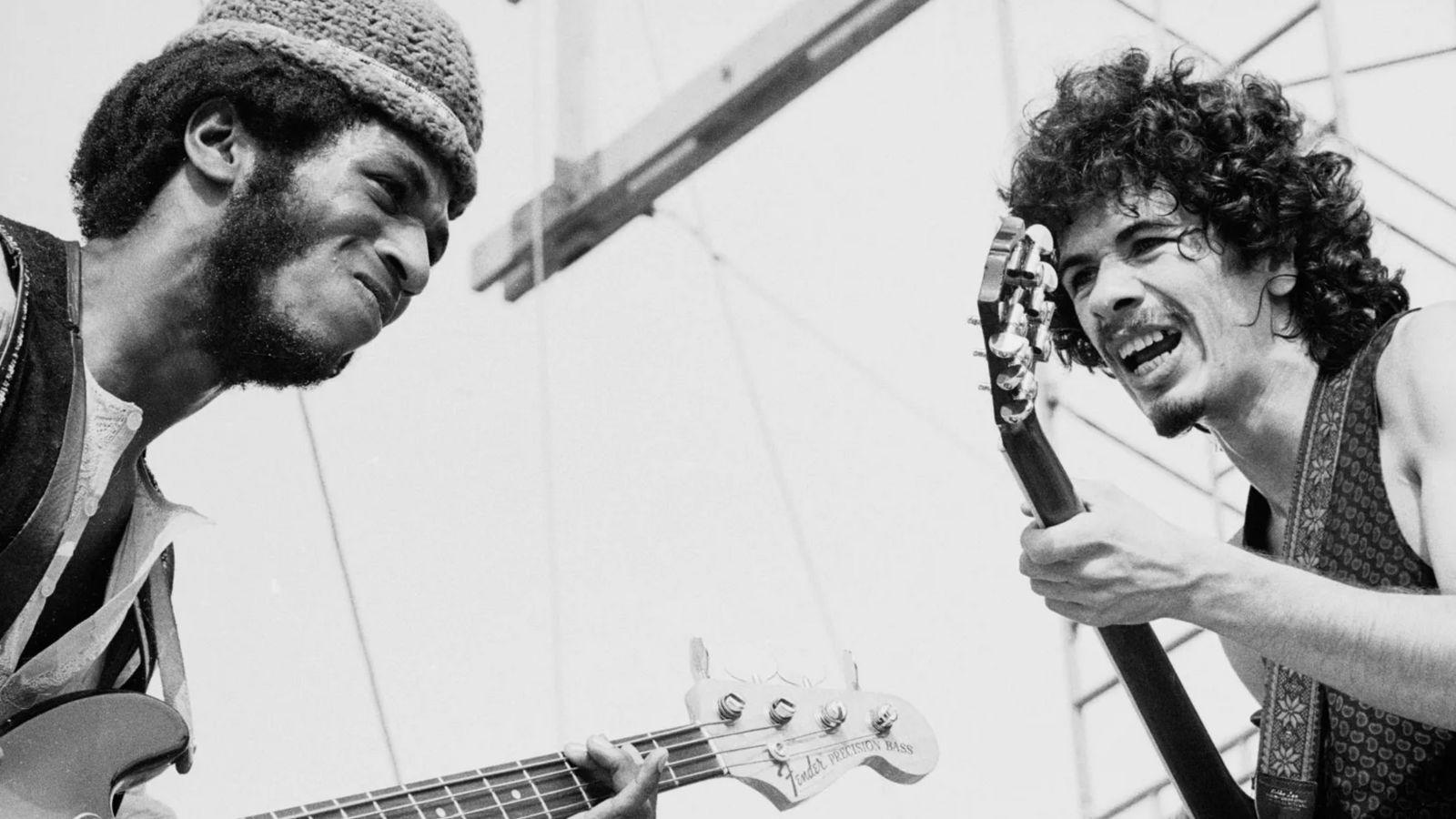
8. Santana
One of the most unique rock acts to come out of the 1970s was, undoubtedly, Santana. Their fusion of Latin rhythms with rock and roll sounds and attitude became a standard in the industry that allowed many other bands to enter Western music’s mainstream. Furthermore, very, very few guitarists in history can claim to be recognized after playing just one note, and Carlos Santana is one of them.
Santana was formed in the late ‘60s and made it out of the San Francisco scene. They had a deal with Bill Graham (who handled the famous Fillmore Auditorium) in the early days. Graham was called to organize Woodstock and he said he would do it under the condition Santana played there. That was, perhaps, the first go at fame Santana had.
After that psychedelic, hallucinogen-fueled presentation, Santana was rocketed to stardom where it continues to be today. If you’re new to Santana I would suggest two records from very different times: Abraxas (1970) and Supernatural (1999).
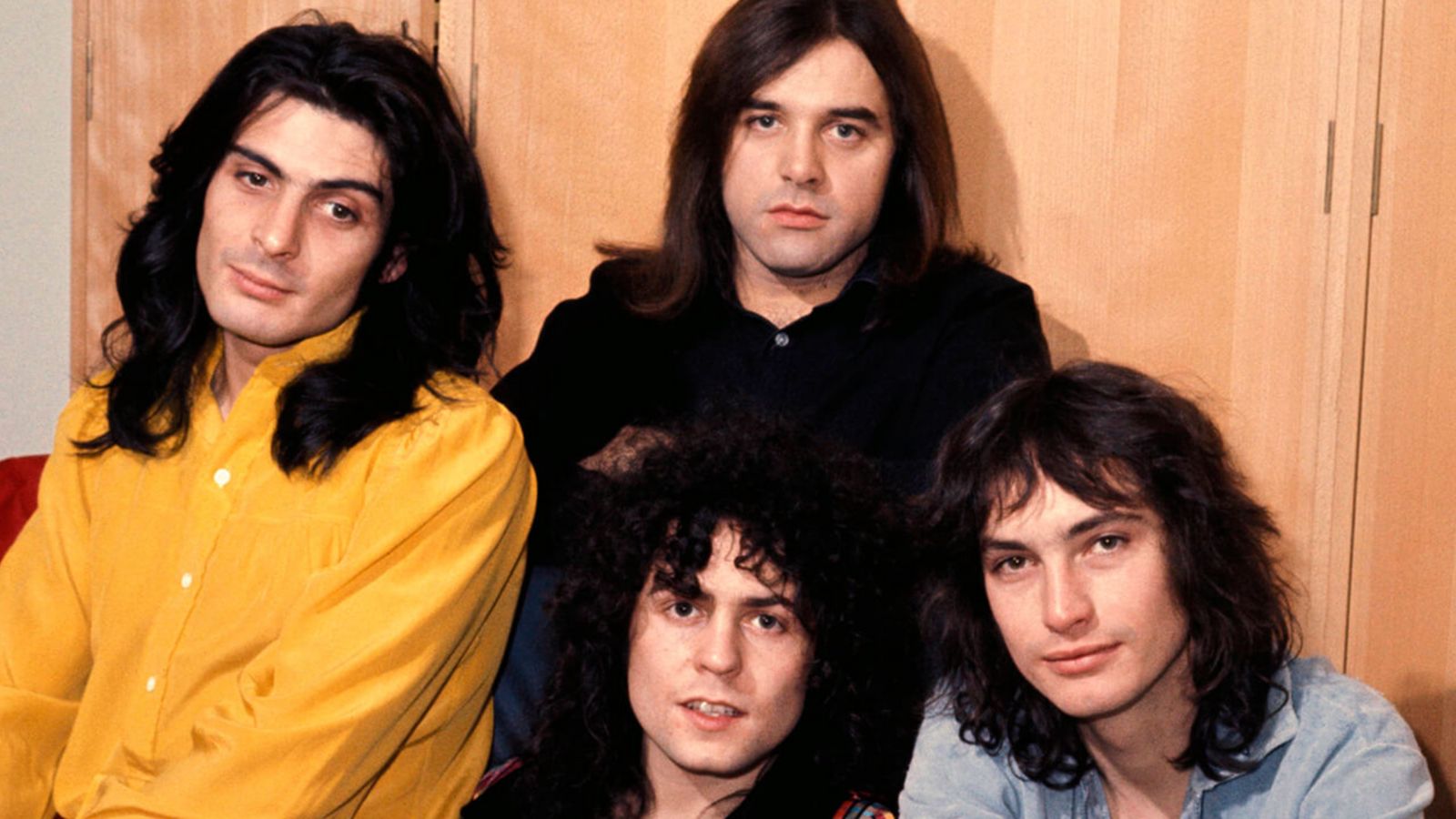
9. T. Rex
Although Bowie is largely credited for the appearance of glam in rock and roll and for adding performance, burlesque, and theatrical elements to his performances, Marc Bolan and his band, T. Rex, did it as contemporaries. Indeed, Marc Bolan is regarded by legends the size of Elton John as one of the main drivers of a new music scene in which everything was allowed.
Elton John recently said about Bolan, “He was the perfect pop star, his songs were great, his records rocked, he had attitude, he had performing skills, he looked fabulous, he dressed the part. At a time when I was still becoming Elton John, he was a great role model. I thought: ‘This guy doesn’t give a f—, he’s just being who he is and he’s loving every single minute of it.’ And that had a great effect on me.”
Beyond influencing influential artists, the size of Elton, T. Rex also had amazing songs. In fact, from 1970 to 1973, T. Rex had an epic run of eleven top-ten singles. Furthermore, four of them reached number one.
If you’re not familiar with Marc’s work with T. Rex, the perfect place to start is Electric Warrior (1971).
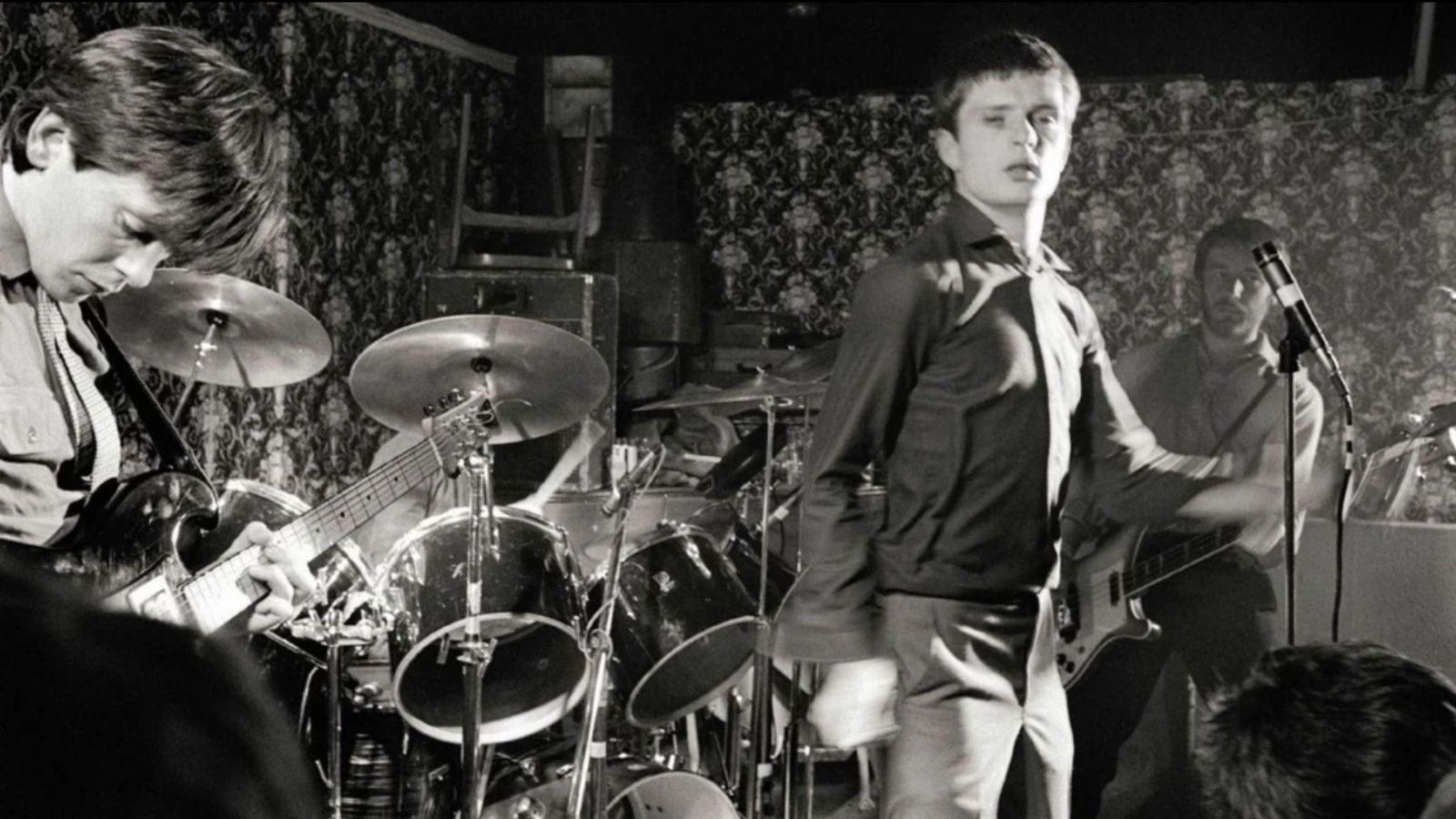
10. Joy Division
Although their debut album came out in 1979, Joy Division created a musical style that was born from all the excess and loud glamorous rock life of the seventies. Indeed, the entire industry centered on the bigger-means-better motto was falling apart, and Ian Curtis was singing those tortuous lines dressed in black and dancing like a madman.
You might have heard Joy Division’s “Love Will Tear Us Apart,” a post-punk anthem that gave life and purpose to a plethora of bands coming after them. Robert Smith, from The Cure, recalls the time Joy Division opened for them in the UK and remembers them as a great band: “They were of that generation of bands, which is my generation of bands. They were so powerful…that was our best show that year, I think, we went on after them and we had to really we had to try hard to match what they did… it’s a shame about Ian Curtis… it’s like Jimi Hendrix or Kurt Cobain…people that good come around far too infrequently.”
If you want to get into Joy Division, their album Unknown Pleasures (1979) is the best way to do so.
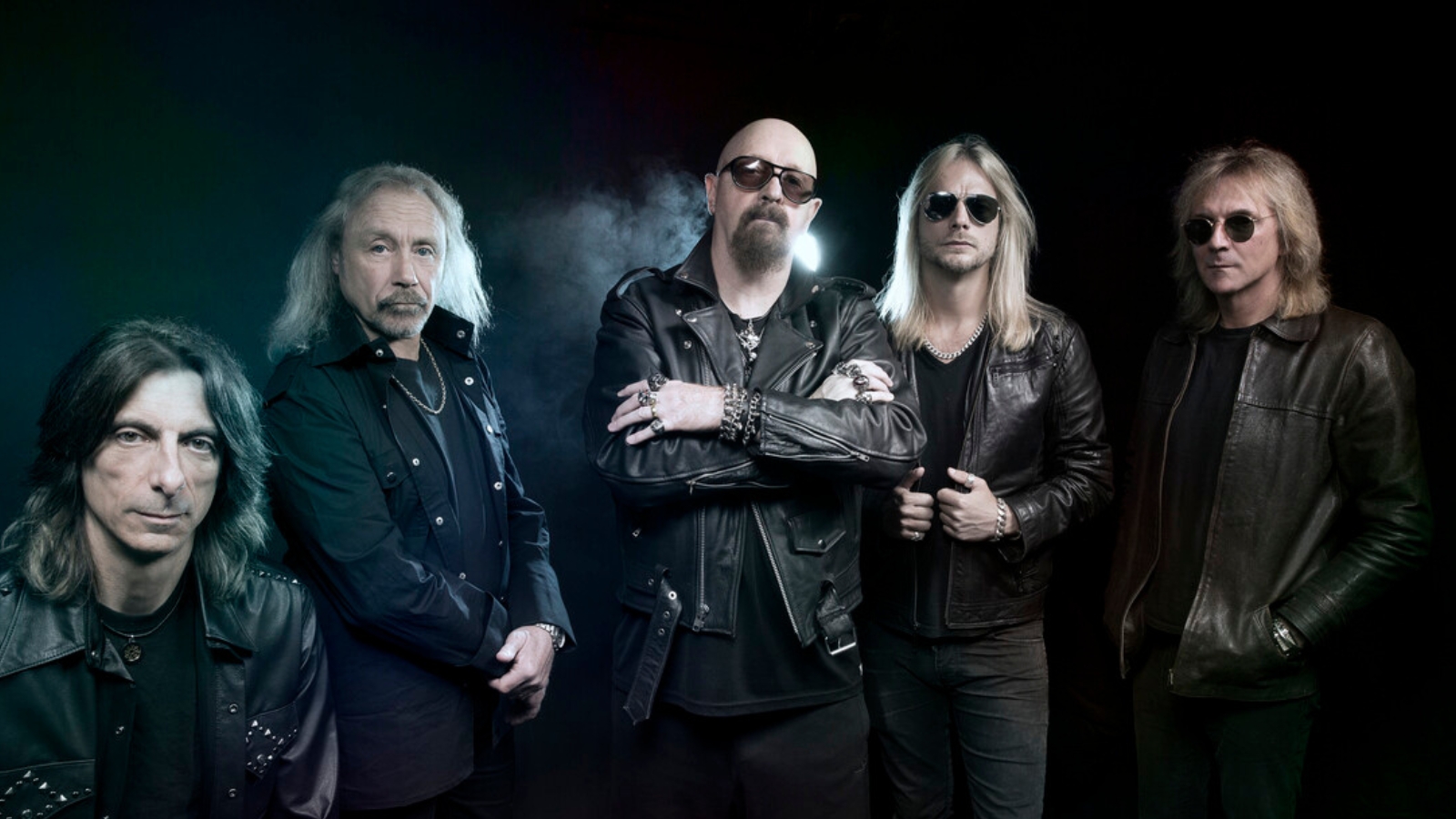
Let me talk to you about not only the musical aspect of Judas’ impact on heavy music but also from a fashion point of view. Indeed, they were the ones to introduce the leather culture to heavy metal fans taking the whole pointy-stuff fashion from Punk Rock bands. Nowadays, leather jackets are a must for most metalheads in the world.
From a musical point of view, Rob Halford has said in many interviews that Judas Priest was the first-ever metal band. He stated to Revolver Magazine “I’ve always pushed that Sabbath were a heavy metal band, but my friend Tony Iommi will always go, ‘No, we’re like a rock band, a hard rock band. I said, ‘No, you’re heavy metal.’ ‘No, no…’” Therefore, he claims the throne for his band, Judas Priest.
They’re still playing live, so if you get the chance, go see Judas play. Otherwise, you can dive into Killing Machine (1978), British Steel (1980), and Painkiller (1990).
12. AC/DC
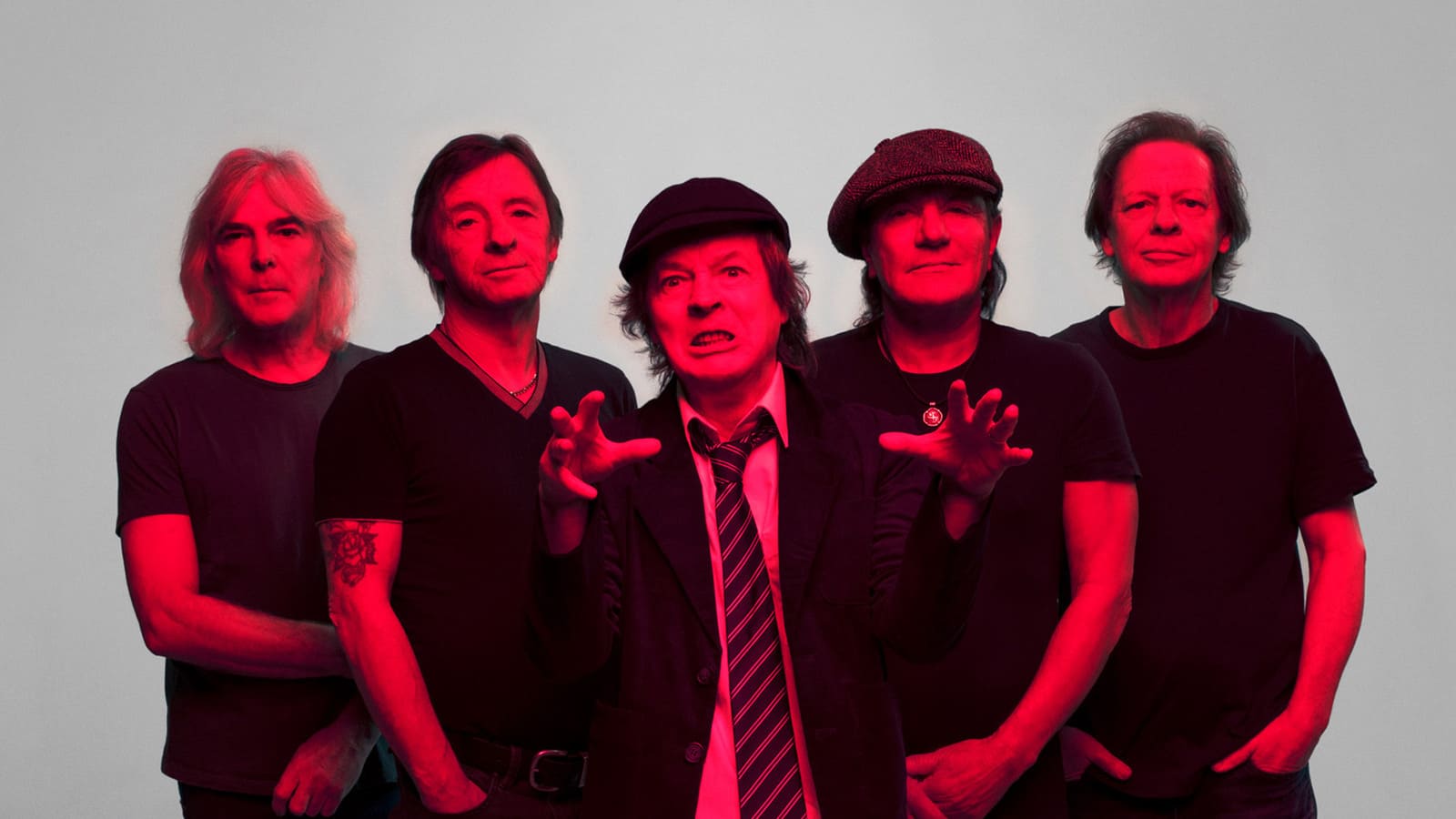
AC/DC – Photo Credit: Press
AC/DC is an Australian band that helped shape the sound of rock and roll as we know it today. Indeed, they harnessed the Australian sound and attitude with incendiary guitar riffs, stellar performances, and a one-of-a-kind guitarist who dresses as a schoolboy to rock the world.
The band was born in 1973 with singer Bon Scott, but it wasn’t his voice that led brothers Malcolm and Angus Young to worldwide stardom. On the contrary, after his passing, the band recorded their most relevant and successful album yet, Back in Black (1980).
Arguably, Back in Black is the pinnacle of a seven-year preparation career full of dirty clubs, empty roads, and endless rocking. According to some critics, rock music was never the same after AC-DC put out that legendary album. For example, guitar god Slash (Guns N’ Roses, Velvet Revolver) said, “With the exception of the Stones, the greatest rock ‘n’ roll band ever.”
If you’re not familiar with them yet, I’d suggest you start with Dirty Deeds Done Dirt Cheap (1976), Highway to Hell (1979), and Back in Black (1980).
13. Led Zeppelin
Led Zeppelin on stage in the ‘70s.
Remember when I mentioned the “unholy trinity of British hard rock” in the Deep Purple section? Well, it would be a crime against rock and roll to finish this list without including the final, and arguably biggest, piece of that puzzle: Led Zeppelin. While they formed in the late ‘60s, the 1970s belonged to them.
They didn’t just play stadiums; they defined what a stadium rock band looked and sounded like. With Jimmy Page’s wizard-like guitar riffs, Robert Plant’s banshee wail, John Paul Jones’ multi-instrumental genius, and the thunderous drums of John Bonham, they created a sound so massive it arguably remains unmatched. Why are they essential? Because they took the blues, injected it with steroids, and created a template for hard rock that every band since has tried to copy.
Dave Grohl of the Foo Fighters once said, “Heavy metal would not exist without Led Zeppelin, and if it did, it would suck.” They were mysterious, they didn’t release singles, and they let the music do the talking on a massive scale. If you have somehow missed the Zeppelin train, you need to listen to Led Zeppelin IV (1971) immediately.
It features “Stairway to Heaven,” the most famous rock song in history. After that, dive into the sheer scale of Physical Graffiti (1975).
14. KISS
Ace Frehley of KISS, in full makeup.
If the introduction to this article promised you costumes, fireworks, huge crowds, and bombastic performances, then KISS is the band that delivers on that promise more than anyone else.
Bursting out of New York City, Gene Simmons, Paul Stanley, Ace Frehley, and Peter Criss decided that just playing music wasn’t enough—they had to be the show. They painted their faces, wore 7-inch platform boots, breathed fire, spat blood, and used enough pyrotechnics to rival a military operation. They weren’t just a band; they were comic book superheroes come to life. Critics at the time didn’t always get it, but the fans, the “KISS Army”, certainly did.
They proved that rock and roll could be a massive, immersive spectacle. They were the ultimate marketing machine of the ‘70s, but underneath the makeup, they had the catchy, hard-rocking anthems to back it up.
To understand the energy that saved their record label and made them superstars, you have to start with Alive! (1975), which is widely considered one of the greatest live albums ever recorded. For their studio work, Destroyer (1976) is the absolute essential listen.
15. Aerosmith
Aerosmith in 1973. Image Credit: Columbia Records
If Led Zeppelin ruled British hard rock, Aerosmith were America’s answer, and Boston’s pride and joy. Steven Tyler, Joe Perry, Tom Hamilton and Joey Kramer got together in 1970, Brad Whitford joined a year later, and the band spent the early ‘70s playing every bar, high school gym and college hall that would have them.
Critics wrote them off as a Rolling Stones knock-off, and Tyler’s lips and scarf-draped mic stand didn’t exactly help. But as a musician, let me tell you: nobody borrowed the riff to “Walk This Way” from anyone. Perry and Whitford built a two-guitar attack that was loose, swaggering and impossibly groovy, and by the middle of the decade the “Toxic Twins,” Tyler and Perry, were packing arenas from coast to coast.
Their ‘70s run is as good as American hard rock gets. Toys in the Attic (1975) gave us “Walk This Way” and “Sweet Emotion,” and Rocks (1976) is so heavy and raw that Slash has named it as one of the records that changed his life. You can hear it all over Appetite for Destruction.
Half a century later, they still have a pull few bands can match. Aerosmith retired from touring in 2024 after Tyler’s vocal injury, and yet they’re back this fall for two special nights at the Hollywood Bowl with friends like Guns N’ Roses and Run-DMC. If you’re new to them, start with Toys in the Attic (1975), then go straight to Rocks (1976).
16. Fleetwood Mac
Fleetwood Mac in the Rumours era. Image Credit: Press
No band on this list turned heartbreak into hits quite like Fleetwood Mac. They started out in London in 1967 as Peter Green’s blues band, but the Fleetwood Mac the whole world knows took shape at the end of 1974, when Mick Fleetwood invited a young American duo, Lindsey Buckingham and Stevie Nicks, to join.
Their self-titled 1975 album gave us “Rhiannon” and “Landslide,” but it was what came next that made history. Rumours (1977) was written and recorded while the band was falling apart: John and Christine McVie were divorcing, Buckingham and Nicks had split up, and Mick Fleetwood’s marriage was collapsing too. So they did what any sensible band would do and wrote songs about each other.
What still amazes me as a musician is how effortless it all sounds. “Dreams,” “Go Your Own Way,” “Don’t Stop” and “The Chain” are perfect pop songs sitting on a rock rhythm section that never overplays a single note. Rumours won the Grammy for Album of the Year and has sold more than 40 million copies, and in 2020 a TikTok of a guy skateboarding with a bottle of cranberry juice sent “Dreams” back up the charts more than four decades later.
If you’ve somehow never heard it front to back, start with Rumours (1977). Then try the self-titled Fleetwood Mac (1975) and the gloriously weird Tusk (1979).
Last year, Sarcator flew under the radar with a pretty rad platter. On the heels of their mixed sophomore outing, 2025’s Swarming Angels & Flies served up delectable blackened thrash with necrotic notes and refreshing traditional/surf-rock side dishes. A year later, I’m surprised to see them already plating The Ones We Follow. Also surprising was word that this Swedish trio has all but abandoned thrash on album four, adopting a flavor profile they don with a curious descriptor: ‘death’s rock.’ Skepticism-inducing as any major sonic shift should be, the rock elements of Swarming Angels & Flies did elevate my excitement over Sarcator’s riffy brand of thrash with the crispy skin. In turning this element into the main course, I’m left wondering if these young Swedes returned to the kitchen prematurely.
Despite the generic shift, Sarcator still retain the unhinged aggression characterizing their blackened thrash menu. Indeed, guitarist/vocalist Mateo Tervonen belts an acerbic ‘owww!’ on opener “The Ones We Follow,” with drummer Jesper Rosén speeding between kit pieces underneath. It’s the guitar work, however, that distinguishes old from new Sarcator. Rather than relying on syncopated palm mutes and serpentine riffs, Tervonen and Leo Buchalle favor twangy licks and careening power chords. The solos also affirm this new, ‘classic’ approach, adding bluesy soul into the mix. Almost rockabilly in nature, it’s as if Hellripper collided with Shadowy Men on a Shadowy Planet. As the record progresses, Sarcator introduce a host of country western elements—slide guitar, harmonica, the occasional snake rattle—with big Wayfarer1 energy (“Volatile Insight,” “Ain’t Fit to Live”). These country western-isms might imply a seismic shift, but it’s not as if Sarcator sound like a completely different band. The sandwich is now (western-tinged) rock, but its wrapper is still youthful, abrasive, and—yes—blackened.
Sarcator build this batch of tunes atop time-tested chord progressions, with Tervonen’s vocals tasked with cutting through the listener’s palette. For the most part, he delivers. The choruses on “In Search of Oblivion” and “Volatile Insight” hit the sweet spot between attitude and stickiness through deliberate spacing and cadence. Tervonen’s tongue trills are tantalizing, becoming a bit of a signature throughout. Not every song, however, strikes a salutary balance. “The Underground Streets” could pay off its guitar earworm with a stronger vocal hook, while “Bleeding Ages” is in need of memorability. Penultimate country rocker “Wasteland Strider” tosses a vocal curveball, containing clean singing before it gets death n’ rolling. It’s a jarring change that, while well executed, feels a little like variety for variety’s sake this late in the album. Production-wise, Tervonen’s voice is a bit more prominent in the mix than I’d like, at the expense of melodic support from the bass.2 But overall, The Ones We Follow sounds open and punchy, with Tervonen’s voice commanding deserved attention.
While not their longest meal, The Ones We Follow pits a girthy album length against a mostly immediate vibe. Shorter songs like “The Ones We Follow” and “You Gotta Possess Me” kill it, kicking in the door with controlled chaos. The clash between immediacy and girth, however, reveals itself mostly in the album’s epics. Seven-minute centerpiece “Rotting Chapels” implies scope with its key-changing buildup, but it ends up sounding like a longer version of the abrasive surf rock heard earlier. Meanwhile, closer “Wanderlust” epitomizes its title, wandering from mid-paced cowboy bumps to “Hot for Teacher”-style fretboard gymnastics and harmonica-sweetened blues dirt. It’s highly entertaining stuff, skirting the line between jamming and riff salad-ing. The album’s 50 minutes may look long on paper, but there’s enough head-turning developments to keep things interesting. The Dire Straits-y ending to “Rotting Chapels” comes to mind, as does the brush-fueled gallop in “Bleeding Ages.”
Leaving me a little hungry at first, The Ones We Follow ultimately won me over with its blackening of a more rustic protein. I applaud Sarcator for daring to change, and there’s lots of tasty stuff on here, with nothing off-putting. Still, The Ones We Follow could elevate its addictive attitude and classic songwriting with more vocal hooks and judicious editing. What crystal clear, however, is that the members of Sarcator are having a hell of a lot of fun here, rocking out and experimenting in equal measure. I’ll continue following these Swedes in the future, as they show signs of following The Ones We Follow with something seriously sumptuous.
Have you ever stared at an M.C. Escher painting? You know the ones. Where there’s a staircase that goes around and around but has no beginning or end. Or the flock of white birds flying one way and the flock of black birds flying the other. They’re a kind of optical illusion. You can see one thing, or another, yet trying to see both exposes a logical twist, making your brain feel very strange indeed. It’s an experience similar to listening to the new Boss Keloid album. But don’t worry, it’s a very good thing.
If you haven’t encountered Boss Keloid, their sound is a progressive mixture of rock, metal, stoner, doom, sludge and a lot more in between. It’s wrong to say they sound like Mastodon, but they don’t not sound like them. They exist in a similar creative space. Back in 2018 they caught everyone’s attention with the gruff beauty of ‘Melted On The Inch’. Three years later they earned accolades with the rich song-scapes of ‘Family The Smiling Thrush’. Their most recent album ‘The Calming Influence Of Teeth’ threw something of a curveball, featuring a more raw and riff-based repetitive sound. This new record takes a different direction. Over the course of an hour, the seven songs that constitute ‘Float & Aperture’ explore a richer and more varied sound. It doesn’t contain simple songs, or short songs, and each feels like a mass of contradictions, but it’s easily their most accessible work. There’s even a chorus or two.
On previous records their work often felt more like abstract art similar to Picasso, where a series of incongruent shapes and images represent a feeling. Here the songs seem to work in the opposite direction. The best way to describe the music is as a jam session where everyone’s playing a different song. While that might sound off-putting, what results is Paul Swarbrick and Alex Hurst using their guitars to evoke feelings with effective emotional depth. As their shifting styles switch between bright licks and effect-pedal filters, they create a strange tapestry. That’s where it’s reminiscent of an Escher painting. You can hear one part, or another, but the way they fit together has an uncomfortable logic. It’s an extremely intoxicating sound, almost like a magic trick.
While the guitars often feature effects like wah-wah, the most interesting choice is a pitch-shifted sound. It takes prominence on the wandering parts of ‘Landslide’, where the light notes glisten strangely while the heavier riffs feel blurred in the opposite direction. Nonetheless, you can feel it threaded throughout. It’s a choice that helps shape the record’s character, giving it a loose, indistinct quality, but it never feels intangible. The reason for this is the drums. The rolls, like the ones that open ‘Breeze’, feel massive but the smaller sounds, like the thump and tick and constant tink-tink,all have a real gravity so they cut across the songs in different ways. On the loose, watery ‘Weight’ it feels like Ste Arands is steering a ship across the ocean, fighting against the musical tides and forcing the sound to shift direction. This gives it an unpredictable energy and it’s a joy to listen to.
One of the album’s most notable elements is the way Alex Hurst’s gruff singing takes prominence. Compared to their previous work it’s more flavoured and is expressed as a kind of country rocker sound. It gives the album a more approachable, carefully crafted vibe which is where you really feel the band’s evolution. In fact ‘Pedestal’ almost sounds like a ‘proper’ song despite the music twisting and squirming beneath his voice. Throughout the album’s runtime, he scatters some really cool vocal motifs like on ‘Aros’ where he sings the word ‘around’ with the weight of an iron girder or on the heavier sections of ‘Accord’ where he gets to use a big, distorted bellow that emphasises the song’s tempestuous emotions.
The album’s overall feel is one of interaction and it has a crisp, clean sonority that sounds as if it was recorded live. There’s certainly a depth and honesty to the sounds, especially in how notes ring out, giving it texture while enhancing its differing flavours. Notably the bass stands out on ‘Aros’ and there is an delightful Eastern style to the refrain that holds ‘Landslide’ together.
Every song is a trove of interwoven ideas and it is difficult to pick highlights. The most obvious choices are the watery tones of ‘Aros’ which feel particularly inspired or writhing, tickling guitar riffs and clicking muted parts on ‘Breeze’.However the album is rich in sonic experiments, especially on landslide’ where their contrasting guitar styles create an evolving, uncomfortable picture that constantly feels like it’s slipping away.
Although the Escher staircase goes around and around without beginning or end, the real marvel is its construction. Similarly the record’s layout means that although the songs lead into each other, it’s their relative positions that enhance the overall experience. Because the track length tapers inward, becoming longer and then trailing away, it gives the album quite an unusual flow. However, the amazing feat is that it retains focus and cohesion despite the rolling, twisting song style. It’s not as simple as being the band’s ‘best’ album but it is a clearer and more effective expression of their ideas. Whichever way you look at it ‘Float & Aperture’ is a work of art.


 Last year, Sarcator flew under the radar with a pretty rad platter. On the heels of their