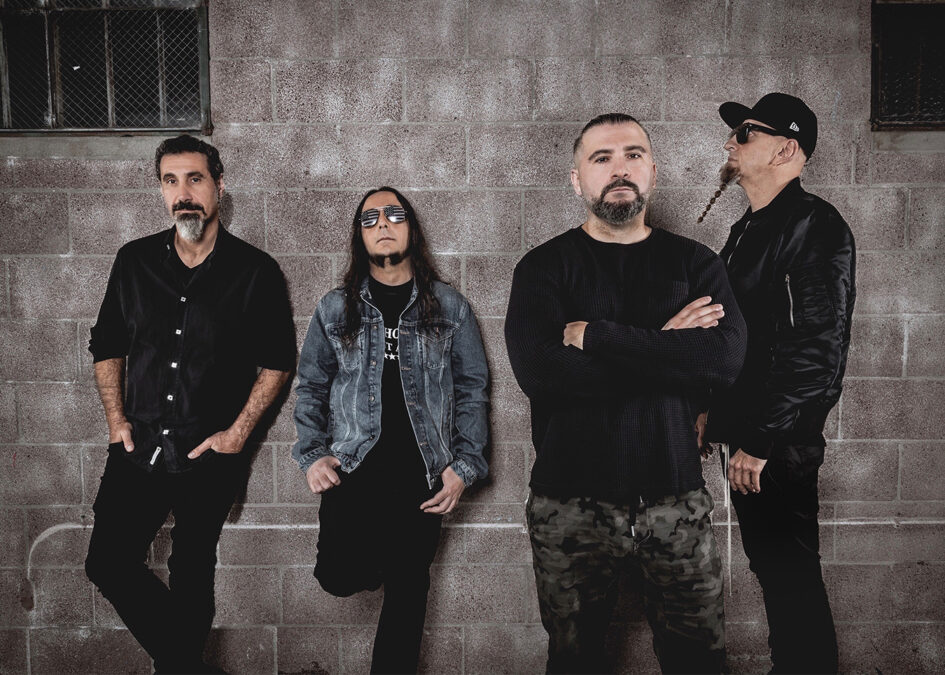
Ragga metal band Skindred‘s a new album You Got This is coming out next month and this morning they’ve released “Can I Get A”, the latest single off that record. And while it’s every bit as energetic as you’d expect from the Welsh outfit, it’s still managed to fit in a more uplifting message in its meaning.
Described as an “inspiring song of resilience and defiance,” this latest track has a sort of bouncy, playful energy that’s hard to not find infectious. But for vocalist Benji Webbe, this track is more than just a feel good tune — it’s a look back on the life he had growing up poor but still having the love and support from those closest to him.
“It’s me as a child seeing my friends with all these amazing things that people take for granted that I never had. I was eleven years old and was worried what my life would become. A lot of kids where I lived got into trouble and ended up in prison. I was just gonna grab that microphone and see where it would take me. I want to empower people to know that you can be what you want to be. Don’t spend your life worrying about what you haven’t got. Live your life because now is the time.”
This new single comes roughly two months since the announcement of You Got This and the release of its lead single “This Is The Sound”. Both released singles are just part of the album’s 11 new songs coming pretty soon.
Yes. Data from industry reports shows rock and metal consumption is increasing across streaming, live concerts, and physical media — even if it isn’t dominating mainstream pop charts.
TL;DR:
Heavy music may not dominate radio, but the numbers tell a different story. Streaming for rock continues to grow, metal festivals remain among the most attended in the world, and vinyl — a format heavily supported by rock fans — continues its long-term resurgence. The data suggests heavy music is thriving in ways that don’t always show up on mainstream charts.
I’ve watched the “rock is dead” debate resurface every few years, but when you step back and actually look at the numbers, the story becomes a lot more interesting.
Because depending on how you measure success, heavy music may be doing just fine.
Maybe even better than people think.
And the data backing that up comes directly from the music industry itself.
Streaming Numbers Tell A Different Story
Streaming is the dominant form of music consumption today, and rock continues to hold a major share of that ecosystem.
According to Luminate’s annual music report, rock generated 260.5 billion on-demand streams in the United States in 2025, up from 234.2 billion the previous year.
That represents 6.4% year-over-year growth for the genre.
Globally, music streaming continues to expand at a massive scale.
More than 5.1 trillion songs were streamed worldwide in 2025, a nearly 10% increase year-over-year, according to industry tracking data reported by the Associated Press.
That growth matters.
Even if rock and metal aren’t topping every chart, they are still commanding hundreds of billions of plays every year.
According to Live Nation concert industry data, attendance at hard rock and metal concerts increased 14% in 2025 compared with the previous year.
Metal also now accounts for 13% of arena and stadium concerts in the Live Nation ecosystem — the highest level recorded in their internal data.
That trend lines up with what festival promoters are seeing around the world.
Take Graspop Metal Meeting, for example.
The Belgian festival regularly attracts around 200,000 total visitors across its four-day run, making it one of the largest metal gatherings on the planet.
Meanwhile, massive festivals like Welcome To Rockville continue expanding lineups and attendance year after year.
That’s not what a dying genre looks like.
Vinyl Sales Continue To Explode
Physical music formats are another surprising indicator of heavy music’s strength.
Vinyl records — long associated with rock collectors — continue to surge.
The Recording Industry Association of America reports that vinyl has now experienced nearly two decades of sustained growth, with revenues surpassing CDs in recent years.
In the UK, vinyl album sales grew 13.3% in 2025 alone, according to music industry data reported by The Guardian.
And historically, rock and metal audiences have been among the most dedicated vinyl collectors.
That means every time vinyl surges…
Heavy music benefits.
Why Heavy Music Sometimes Looks Smaller Than It Really Is
The perception that rock or metal has faded often comes from looking only at mainstream pop charts.
But the modern music economy doesn’t revolve around charts the way it did in the CD era.
Today’s industry is driven by three things:
• streaming consumption • live touring revenue • fan-driven physical media
Heavy music performs strongly in all three categories.
Which means it can thrive even without dominating radio playlists.
If you look at the cultural conversation alone, it’s easy to assume rock has faded.
But when you actually look at the numbers, the picture is different.
Streaming is growing. Concert attendance is growing. Vinyl sales are growing.
And heavy music continues to sit right in the middle of all three.
Which raises an interesting question.
Maybe the genre didn’t disappear at all.
Maybe it just stopped playing by the old rules.
Because…well, it’s metal.
FAQ
Is rock music still popular in 2026? Yes. Streaming data shows rock continues generating hundreds of billions of plays annually worldwide.
Are metal concerts still drawing large crowds? Yes. Industry data shows attendance at hard rock and metal concerts increased significantly in recent years.
Why does rock seem less visible on charts? Streaming platforms distribute listening across many artists rather than concentrating it in a few major chart hits.
Is vinyl still growing? Yes. Vinyl has experienced nearly two decades of consistent growth and now generates more revenue than CDs.
The Modern Heavy Music Landscape
Heavy music spans multiple subgenres including classic metal, metalcore, deathcore, and progressive metal. While mainstream chart dominance has shifted toward pop and hip-hop in recent decades, metal and hard rock continue to maintain massive global fanbases through streaming platforms, festivals, and dedicated fan communities.
Unverkalt Teams Up with Rotting Christ’s Sakis Tolis for Blistering New Single “I, The Deceit”
Post-metal visionaries Unverkalt are hitting harder than ever on their new album Héréditaire , and the latest single “I, The Deceit” proves they’re not holding back. The track features none other than Sakis Tolis of Rotting Christ , adding a layer of grim gravitas to an already intense sonic assault.
Released via Season of Mist , Héréditaire marks a bold evolution for the band, trading the velvet shadows of their previous work for a blackened, weighty atmosphere. Critics are already singing its praises: Dead Rhetoric gave it an 8/10, calling it a “compelling listen that rewards over time,” while Revolver highlighted its seamless blend of post-metal melancholy and black-metal fury.
“I, The Deceit”: A Furious, Emotional Core
Described by vocalist Dimitra Kalavrezou as “capturing the stillness of those who let the world burn, not out of ignorance, but because it serves them,” “I, The Deceit” is a track built on simmering contempt and visceral emotion. Tolis adds his signature growl over the song’s storm of blast beats and crushing guitar, delivering lines like, “The world falls apart / And you just stand there / Watching it burn down.”
Kalavrezou’s haunting cleans provide an emotional counterpoint, giving the song a sense of intimate despair amidst its apocalyptic weight. The band’s guitarist and composer, Themis Ioannou, describes the album as “a lament for what is far older than our very existence,” exploring generational trauma and humanity’s darkest inheritances.
A Visual Statement
The video for “I, The Deceit,” directed and edited by Ioannou at RAWBITE Studio, enhances the song’s brooding power. Cinematography and on-set visuals, including stark lighting and meticulous styling, make the track’s thematic weight visible as well as audible. The video is now live on YouTube:
Available Everywhere
Héréditaire is out now in multiple formats: CD digipack, 2×12” vinyl gatefold in black, and a black & gold “Sunburst” edition. Stream or order here: https://orcd.co/unverkalthereditaire.
With Héréditaire , Unverkalt deliver a work that is as heavy as it is heartfelt, a record that refuses to shy away from darkness while still finding cracks of beauty within. “Even in the suffocating stillness, there’s a lingering ache for truth,” Kalavrezou reflects—and it’s this unflinching honesty that makes Héréditaire impossible to ignore.
“This stuff is constantly stressful but always incredible,” smiles Jeffrey Moreira, rubbing a glaze of exhaustion and relief from his eyes. “I’m in a permanent freefall of emotions, whatever it is I do…”
It’s true, Poison The Well’s imposing but utterly affable frontman has a lot on his plate this right now.
In just over two weeks, the Florida post-hardcore icons will drop awesome sixth album Peace In Place, their first in almost 17 years. Ramping up for release, he’s undertaken this rare interview, hoping to really “say something that makes sense in the context of the history of our band”. Until this evening, all that’s been on hold, too, as four weeks ago Jeff become the father to first-born son Weyland (as in Weyland-Yutani from the Alien series) and they’re just back from 72 hours in the local emergency room after he suffered an aggressive eye infection uncommon in kids so young.
“It was scary there for a minute,” Jeff sighs, “when you have 10 doctors coming into the room to tell you they’ve never seen this kind of thing in a baby before. It had swollen and was leaking discharge but they did a little operation and sorted it out. Weyland’s okay now, but it was a whole ordeal.”
Plenty of musicians would have waved off press duties under that kind of pressure, or at least delegated them to other members of their band. Jeff, however, has been waiting more than 15 years to sink his (cracked) teeth back into the business of making music and rather than interfering with his art, real-life challenges – career, family, finance – have only sharpened his perspective.
“I’m more self-aware now than I’ve ever been,” he explains. “That wasn’t there when I was in the band before. I had very little patience for people. I couldn’t be bothered with the issues of others. I’d always interrupt people when they were speaking. I’d never just sit down and listen. If someone came to me with a problem, I probably wasn’t the best – which is never ideal in a band where the relationships are [squabbly], like those between lovers or siblings.”
Flash back to the turn of the millennium, where those bonds were forged in the fire of a stellar ascent. PTW had gone through a series of breakneck early evolutions when guitarist Ryan Primack and drummer Chris Hornbrook were still in high school, but it was Jeff’s arrival in late 1998 that cemented their enduring backbone (these days they’re also joined by guitarist Vadim Taver and bassist Noah Harmon). Dropping the very next year, landmark debut The Opposite Of December… A Season Of Separation would iron-clad their reputation as heavy pioneers, and quickly become foundational for both the emerging melodic metalcore scene and that of post-hardcore more broadly. Contemporaries drew on its caustic formula of aggression and emotion, heavy riffs and catchy melodies, throat-ripping screams and clean vocals – everyone from Norma Jean and The Chariot to Killswitch Engage and Bring Me The Horizon have drunk from its cup.
Unwilling to stand still and soak in the adulation, PTW chose to shapeshift instead, cherishing the unexpected. Rather than veering into radio-friendly listenability, for instance, 2003’s first (and only) major label LP You Come Before You was an experimental, unwieldy, undeniably brilliant beast. And after walking away from that lucrative corporate machine, citing creative differences, 2007’s Versions and 2009’s The Tropic Rot continued a bold evolution, leaving behind many metalcore trappings in favour of bigger, proggier sounds not anchored to the scenes they helped create.
“I’m not the same person I was when I stopped being in this band”
Jeffrey Moreira
Such strong-mindedness aggravated as much as it enthralled. One backlash after another swept their ever-changing fanbase. Line-up instabilities and dramatic episodes punctuated their journey. Even as critics and aficionados of the genre began to preach PTW’s importance as pioneers of a whole generation of heavy music, the band themselves were creaking, forced to take part-time jobs to survive financially and enduring serious illness on the road – like the early tour where Jeff had undiagnosed pneumonia for a month. September 15, 2009 in Detroit was a clear breaking point, the theft of their van, trailer and all their equipment following the first night of tour with Billy Talent leaving them reeling. And although they saw out commitments through the UK tour, culminating at Cardiff University’s Great Hall on November 22, after eight months of silence they announced on July 14, 2010 that they would go on hiatus to explore other interests.
“I don’t want to say ‘normal life’ like we were soldiers coming back from a warzone calling everyone else ‘civilians’, but coming home and getting a job after hiatus was incredibly different from what had been the rest of my adult life,” Jeff reflects. “Going back to Miami, starting my business, starting a family and having the responsibilities that come with that built my character a knowledge base. Getting the first vinyl press of Peace In Place really brought it home. All of this has felt, not like it could fall apart at any point, but that I had to ease back into old roles in a new body and mind. I’m not the same person I was when I stopped being in this band. My life has been shaped differently by years away, but between our time on the road and mine back home, I feel like I’ve caught up. I’m a pretty well rounded person today.”
So, would Jeff change anything if he could go back and talk to his younger “dumbass” self?
“I wish I could go back and talk to pretty much any band member about money and their financial situation,” he smiles wryly, now the owner of a successful company. “But generally I believe that 20-somethings should be allowed to make their own decisions and learn from their own mistakes. You can’t tell someone about an experience you had and expect them to not do it because the outcome was bad for you. Sometimes you’ve got to smash into that wall for yourself.”
Poison The Well never officially broke up. Uninterested in the farewell/reunion gravy train, they allowed their band to rest dormant in the shadows for the most part, indulging in the odd show when opportunity and inclination guided them. Jeff, Ryan and Chris have remained good friends over the last 16 years. When opportunities to celebrate their catalogue have come along, they’ve collaborated, organising anniversary editions and monitoring business in the background.
The idea of that they might have more music left in them was first mooted a decade ago. But finding the time and confidence to commit to writing new songs would take another six years.
Deciding to give fans a 20th anniversary release of 2002’s dynamite second album Tear From The Red, Jeff and the boys ransacked the archive for anything that had gone unreleased that they might tag on. Finding that literally every tidbit had made its way online, they realised that the record’s acoustic centrepiece Horns And Tails was ripe for a rework: an opportunity to both reward fans and get back in the studio without having to put their songwriting boots on.
“I remember all of us coming out of that little studio together and Ryan saying, ‘That was good. We should do more of that!’” Jeff remembers of the 2022 breakthrough. “The rest of us were like, ‘We should definitely do more of that.’ We didn’t fight. We didn’t disagree about what it should sound like. People were more comfortable giving and receiving opinions without being offended that someone else was trying to do their job for them. For whatever reason, in the past, one of us would not be be in a position to discuss writing new music, they’d feel pressured then they’d be upset. Finally, we had reached a point where it didn’t feel antagonistic to talk about finally making [album six].”
Characteristically, it would take another four years to get said album out. Between shows like the massive You Come Before You anniversary run, and two sessions with Will Putney – the first of which produced standalone single Trembling Level, before much of the rest of that session was cut – there was a sense of gradual ascendancy. For dedicated career man Ryan, it was the path to rediscovering a confidence that never really went away. Fred saw it differently: every raucous gig and lyric screamed in anger a step “towards the storm that I’ve been chasing this entire time”.
Jeff would like it if people were confounded by the title of Peace In Place. Held up beside gnarly album artwork showing off a plaster cast of his own chipped teeth (not thanks to a stray spin-kick, but a wayward pebble in a Wendy’s salad) and music that is unapologetically emotionally heavy and pissed off, there’s little calm amidst the tempest, but getting it out is the most important thing.
“In the beginning, my emotion was uncontrolled,” Jeff explains. “It was a reaction to all the things going on around me by a youthful, adolescent, inexperienced person. I have more understanding now, a sharper focus. The subjects might not have changed – I’ll still write about being in love or having my heart broken – but there are other things I never expected to happen at my age, like lifelong friendships that have fallen apart when you thought you were in the clear. There are people I expected to be surrounded by my whole life, but those friendships are gone.”
“In the beginning, my emotion was uncontrolled. I have more understanding now, a sharper focus”
Jeffrey Moreira
Named after his old high school mascots, standout single Thoroughbreds addresses that topic directly, over a juddering palm-muted riff that sits the brink of a nervous breakdown. Unhinged opener Wax Mask contextualises the album title: ‘These hands that drag us down / We claim our peace in place.’ Everything Hurts, meanwhile, extols the benefit of finding empathy, even in the faults of others (‘We’re the same, I had my moments, too’) even as Weeping Tones is an unhinged reminder that some situations are inescapably suffocating (‘It’s a light around the rose, but it’s gone, so gone’). Plague Them The Most is a pulsating final shot, a promise to ‘never again grind my teeth in the name of kindness, never again to bite my tongue in the name of mercy’.
“It’s about that balance of black and white, good and evil,” Jeff continues. “But we don’t look at this as a pissed record about how shitty this time has been. I think it’s the opposite of that. It’s about dealing with subject matter that is sad and heavy while being able to come up for air. I like that there’s that element of [positive catharsis] and also an anger there that will live forever, spreading its message or meaning or whatever music has as it lives on. Mostly, it’s about holding up all those years of hope and doubt, a love for the craft that you had to step away from but which continued to grow in a dark corner, and finally getting to have this record in our hands.”
Even more than that, it’s a reminder of the strange magic of making music itself. Jeff has an active imagination, but beyond managing his employees, scribbling down ideas for everything from movie plots to household gizmos (“If I could sell all the bathroom gadgets I’ve dreamed up, I’d be a millionaire!”) he has few outlets. He never wanted to be in a band with anyone but the friends he knew and loved. There was no better reminder than getting back into it, of what his art is all about.
“I remember sitting there getting ready to write my first new lyrics,” he smiles. “It was so hard. Like, ‘What the fuck?’ It was kind of like that feeling where you want something really bad – maybe getting back with an ex-girlfriend – but in doing it you feel like it’s a horrible idea. Sitting down to write, I was like, ‘Why did I reintroduce this stress to your life?!’ But I was just being weak-ass and dumb. I needed to remember that one of the things I most liked about being in a band was that it isn’t easy. It wasn’t just some job where you could put your hours in and walk away.”
Under grey Mancunian skies, with every drumbeat echoing back off the surrounding warehouses and some 7,000 fans heaving through the car park of Bowlers Exhibition Centre, June 30, 2024 at Outbreak Fest was a day that Poison The Well will never forget. Last time they’d visited the UK, Jeff and his bandmates were playing spaces like the 200-cap Camden Barfly. A warm-up at the capital’s 350-cap New Cross Inn suggested that not much had changed. Heading north to arguably the biggest hardcore gathering on the planet presented an intoxicating cocktail of tension and exhilaration.
“Did that experience embolden us going into making the album?” Jeff considers “A lot. For me, it created more pressure. For others in the band, it gave confidence that people still cared. Going into the show we had been asking, ‘Will people still remember us?’ or, ‘Will we be overshadowed by all these bigger bands?’ On the day, I was starting to get sick, too, reminding me of one of the greatest trials of touring: stressing out about how my body will react because my instrument is my voice. But on that stage I was just looking out into that crowd thinking, ‘Fuck!’ I still watch videos, wishing for that one show I could just have been out in the crowd to take in our band live. And although I don’t think it was a perfect gig, the sum of its parts was incredible.”
With 100 million total streams across their catalogue, you might imagine that Poison The Well are comfortable in their status as heavy godfathers. Jeff counters that the granular data available on platforms like Spotify is less flattering: “It’s impressive when you look at the dataset totals, but less so when you log on and see 58 people are listening to you – though all 58 of those people are awesome.”
Rather, nothing is more demonstrative of how far they’ve come than the shows themselves. On one level, that’s about demolishing rooms the size they’d never even dreamed of headlining first time out. Even more important has been realising that those bigger crowds aren’t just an amalgamation of all the fans who came and went, but rather a whole new generation who’ve latched onto and love his band’s songs.
“It’s so impactful playing to those kids so young they couldn’t have seen us the first time, singing along just as hard as the audiences were when we were first out there playing VFW halls. It’s incredible to see that people so much younger than I am, growing up in a different time dealing with their issues, emotions, relationships and whatever else, still connecting to our songs enough where they learn the words. You can see those connections with the songs forming. It feels so good as a musician to see that your music isn’t stuck in the time it was written, and to know that years later they understand what we were going through when that music was first created.”
“It feels so good to see that your music isn’t stuck in the time it was written”
Jeffrey Moreira
Aside from fans, there’s a whole new generation of bands who owe a debt to Poison The Well, too. Although specific sounds have moved on, it’s possible to tie many modern heavyweights to PTW, from the melodic adventure of Turnstile to the bludgeoning emotional impact of Knocked Loose.
“I don’t feel like, ‘We walked so those bands could run!’ or anything like that,” Jeff laughs. “They had to leave stuff behind, spend years on tour, play shit venues, and slowly build themselves to this point. That’s what anyone does following their dream. It’s great that fans are more accepting now. We were called sell-outs just for signing to Atlantic, even though we put out arguably the heaviest record on Atlantic at that point. I’m happy that bands don’t have to deal with that shit anymore.
“I don’t know if there are remnants of PTW still hanging in the atmosphere of this current scene – if there are, they’re barely-perceptible wisps of smoke – but hopefully that much broader fanbase of acts like Spiritbox or Knocked Loose will go back and discover some of the awesome bands that came before.”
Whether they do or not won’t be life or death to Poison The Well in 2026. Where on their first time round – scraping by and sleeping on parents’ couches the few weeks a year they weren’t on tour – setbacks could be calamitous, in 2026 their music is all gift and no burden. Gone are the vicious cycles of investment, failure and resentment. Forgotten are pressures to come up with a sound that sells. And working this way has produced the purest iteration of PTW.
“We’re writing to fulfil the things we love in this band,” Jeff signs off. “If any of us wanted to do anything different, we’d start another band. Whether that’s made for ‘a classic’ is something that only time will tell. On The Opposite Of December…, we were just trying to get people to sing along. On You Come Before You, we wanted to have the heaviest record on a major label. Here we wanted an album that tastefully and respectfully understands what Poison The Well is – and an acknowledgement that Jeffrey likes a bunch of heavy shit.
“Beyond that? We’ve already talked about writing more songs. And more than the songs themselves, I think it’s a good sign that we’re already talking about the next record. Seeing the outcome of our labours has been a big motivator. It hasn’t been easy. There were a bunch of blockades. But having that finished vinyl in your hands gives you such a massive high. So I guess now we’ll just keep making music until we don’t want to anymore – or until there’s no-one left to listen…”
Peace In Place is released on March 20 via SharpTone – get your limited-edition vinyl and photo book bundle now
Vegas Un‑Alive Fest 2026 Brings Death Metal Mayhem to Sin City
Las Vegas is about to get brutally un‑alive. Rising from the ashes of the now-legendary Las Vegas Deathfest, Vegas Un‑Alive Fest is kicking off its inaugural edition on March 20–21, 2026, and it promises a full-scale assault on the senses for extreme metal fans. Helmed by JJ Jackson of Moonshine Bandits and Dave Oshann of Trip to the Morgue, this festival is shaping up to be the city’s newest hub for chaos, carnage, and headbanging debauchery.
Set at the iconic Divebar (4110 S. Maryland Pkwy), the two-day festival will feature two stages and 25 bands from across the globe. Beyond the music, festival-goers can expect custom cars and bikes, tattoo artists, freakshow acts, firebreathers, and all the food and drink a metalhead could want.
Headliners That Hit Hard
Decrepit Birth will dominate the Death or Glory Stage on Saturday, March 21st. The Santa Cruz veterans are bringing their signature technical death metal and cosmic brutality on their “The Uncreation of Civilization West Coast Tour.” Expect hyper-technical riffing and jaw-dropping musicianship that live audiences have come to worship.
Sharing the Death or Glory Stage spotlight, The Convalescence bring their symphonic deathcore firepower. Celebrating a decade of venom with their “Celebrating 10 Years of Poison Word Tour,” the band recently dropped a cinematic new video for “Bloodletter,” featuring a guest appearance by Ricky Myers of Suffocation .
Over on the Divebar Stage , Casket Robbery takes Saturday night by the throat. With industrialized death metal riffs and occult-tinged melodies, this Wisconsin act has been tearing up North America alongside Cannibal Corpse , Psycroptic , and Suffocation , and their sophomore album Rituals of Death cements their position as masters of horror-laden extreme metal.
Pessimist , Baltimore death-metal pioneers, co-headline the Divebar Stage with their first full-length in over 20 years, Keys to the Underworld . Fans can expect old-school thrash influences wrapped in a relentless, dark atmosphere that is both nostalgic and brutally fresh.
Friday night kicks off with Brazilian/Las Vegas crossover legends Claustrofobia , opening the Divebar Stage with a career-spanning set. Since forming in 1994, they’ve shared stages with Iron Maiden , Slayer , and Anthrax , leaving a trail of international fans in their wake.
Full Lineup
Friday, March 20 – Doors 6:30 pm
Claustrofobia
Rottenness
Scattered Guts
Lacabra
Anubis
Papsmear
Last Rites
Saturday, March 21 – Doors 2:30 pm
Death or Glory Stage
Decrepit Birth
The Convalescence
Hunt the Dinosaur
Lazarus Casket
Trip to the Morgue
Embryonic Devourment
Skeleton Crew
187
Divebar Stage
Casket Robbery
Pessimist
Gravehuffer
Abolishment of Flesh
Cerebral Desecration
Mantra of Morta
Blistering Rot
The Brown Sound
Tickets and passes are available now:
Weekend Pass: Ticketor
Single Day Ticket: Ticketor
Facebook Event: Vegas Un‑Alive Fest 2026
Spotify Festival Playlist: Listen Here
With Las Vegas’ metal scene roaring back to life, Vegas Un‑Alive Fest 2026 is shaping up to be a weekend of chaos, fire, and uncompromising heaviness. Whether you’re a die-hard death metal fan or just chasing the most extreme live experience Sin City has ever seen, this festival is not for the faint of heart.
After announcing their 5th album "The Dark We Keep" in January, the Swedish prog band Port Noir continue with "Ebb And Flow," another single ahead of the record's release. The single offers a modern alt-metal track exploring disconnection, decay, and the struggle to stay awake in a world on autopilot. "Ebb And Flow" speaks to fans of dark, atmosphe… Read More/Discuss on Metal Underground.com
Port Noir release new single “Ebb and Flow” from their upcoming album “The Dark We Keep”
Promo Picture Port Noir
New album to be released May 15th 2026, via InsideOutMusic, available for pre-order NOW;
After announcing their 5th album “The Dark We Keep” in January, the Swedish prog band Port Noir continue with “Ebb and Flow”, another single ahead of the record’s release. The single offers a modern alt‑metal track exploring disconnection, decay, and the struggle to stay awake in a world on autopilot. “Ebb And Flow” speaks to fans of dark, atmospheric rock with progressive edges.
“Ebb and Flow” is the fourth single the band has released from their upcoming record and follows on “Complicated” , “Redshift”, and “Noir”.“The Dark We Keep” will be the 5th full length album by Port Noir, to be released May 15th, 2026, via InsideOutMusic.
“The Dark We Keep” is available for pre-order here.
Listen to “Ebb and Flow” hereand watch the video here
The band comments on the new single:
“Sometimes we don’t write songs to arrive somewhere. We write them to move. Instead of verses and choruses, we let ideas drift, repeat, and change shape. The movement is the destination. This is a formula we explored and utilized on our earlier albums and something wewanted to tap back into while writing ‘Ebb and Flow’.
Lyrically it portrays a world caught in endless cycles of numb repetition, where weslowly lose awareness, identity, and agency without resisting.There’s no collapse or climax, only quiet erosion. The Ebb and Flow keepseverything moving just enough to feel alive, while actually preventing change.”
Port Noir – The Dark We Keep
Tracklist:
1.Complicated
2.Redshift
3.Noir
4.Ebb and Flow
5.My Destroyer
6.Vargtimmen
7.Burst
8.Reverie
9.This View
10.Bloodlust
11.We Shall Die Together
The album will be available in the following formats:
·Ltd. CD Digipak
·Ltd. ultra clear LP
·Digital album
Port Noir – “The Dark We Keep” (Artwork)
++
Port Noir are:
Love Andersson – Vocals, Bass & Guitar
Andreas Hollstrand – Guitar, Keys & Backing vocals