It always sucks when you discover a cool band and then that band immediately breaks up. But on the other side, it’s cool when that band then suddenly returns. Maybe they were gone for such a short period that you barely had time to miss them. Maybe they return with a brand-new surprise album. With all that in mind, Dog Date are back.
FOR IMMEDIATE RELEASE
Death of the Heron Unleashes Progressive Metal Journey Blood of Yesterday
Minneapolis, MN — July 17, 2026 — Minnesota progressive metal force Death of the Heron has released their highly anticipated debut full-length album, Blood of Yesterday , through Harambe Media International . A sprawling and emotionally charged offering, the album showcases a band determined to push beyond genre boundaries while delivering a powerful exploration of grief, identity, loss, and the human condition.
Produced by Daniel Schmitt and Chad Helmonds , with mixing and mastering handled by Will Maravelas of 14:59 Studios , Blood of Yesterday is a meticulously crafted progressive metal experience that spans over an hour of atmospheric depth, crushing heaviness, and intricate songwriting.
Drawing influence from the likes of Opeth, Gojira, and Amorphis , Death of the Heron creates a sound that thrives on contrast and sonic duality. The album moves effortlessly between crushing syncopated riffs, harsh vocal intensity, haunting atmospheres, and moments of unexpected melodic beauty. Every track serves as part of a larger emotional journey, balancing technical musicianship with raw vulnerability.
At the heart of Blood of Yesterday is an exploration of the fragile nature of existence. Vocalist and guitarist Daniel Schmitt guides listeners through themes of past versus present, self versus loss of self, and the weight of inevitable change. The album dives into the darker corners of human experience, confronting grief, personal downfall, death, desire, rage, and the struggle to accept what cannot be controlled.
“Blood of Yesterday” stands as both a reflection and a reckoning, a record built around the idea that comfort is the enemy of growth and that true artistry comes from constantly challenging yourself.
About Death of the Heron
Death of the Heron is a Minnesota-based progressive metal band known for their expansive compositions, emotional intensity, and refusal to be confined by a single genre. With a foundation built on experimentation and relentless creative evolution, the band crafts immersive soundscapes that combine technical precision with genuine emotional expression.
The band’s approach is rooted in a simple philosophy: never being content. Death of the Heron continually pushes against their own boundaries, embracing complexity, contrast, and vulnerability in pursuit of creating something meaningful.
Their debut album, Blood of Yesterday , represents the culmination of that vision, delivering a bold statement from a band unafraid to explore the darkest and most challenging aspects of the human experience.
With their latest release, Death of the Heron solidifies their place within the Twin Cities metal scene while introducing their uncompromising sound to listeners around the world.
Blood of Yesterday
Death of the Heron Released July 17, 2026 Label: Harambe Media International
For Fans Of: Opeth, Gojira, Amorphis
Connect With Death of the Heron
Website: deathoftheheron.com Facebook: https://www.facebook.com/profile.php?id=61554682697999 Instagram: https://www.instagram.com/deathoftheheron/ YouTube: https://www.youtube.com/channel/UCDQUzHHAADudCOXwOA9YbVA Bandcamp: https://deathoftheheron.bandcamp.com Spotify: https://open.spotify.com/artist/044KEmRyLDlhgFyYhLlh7y Apple Music: Death of the Heron
Media Contact: Daniel Schmitt deathoftheheron@gmail.com
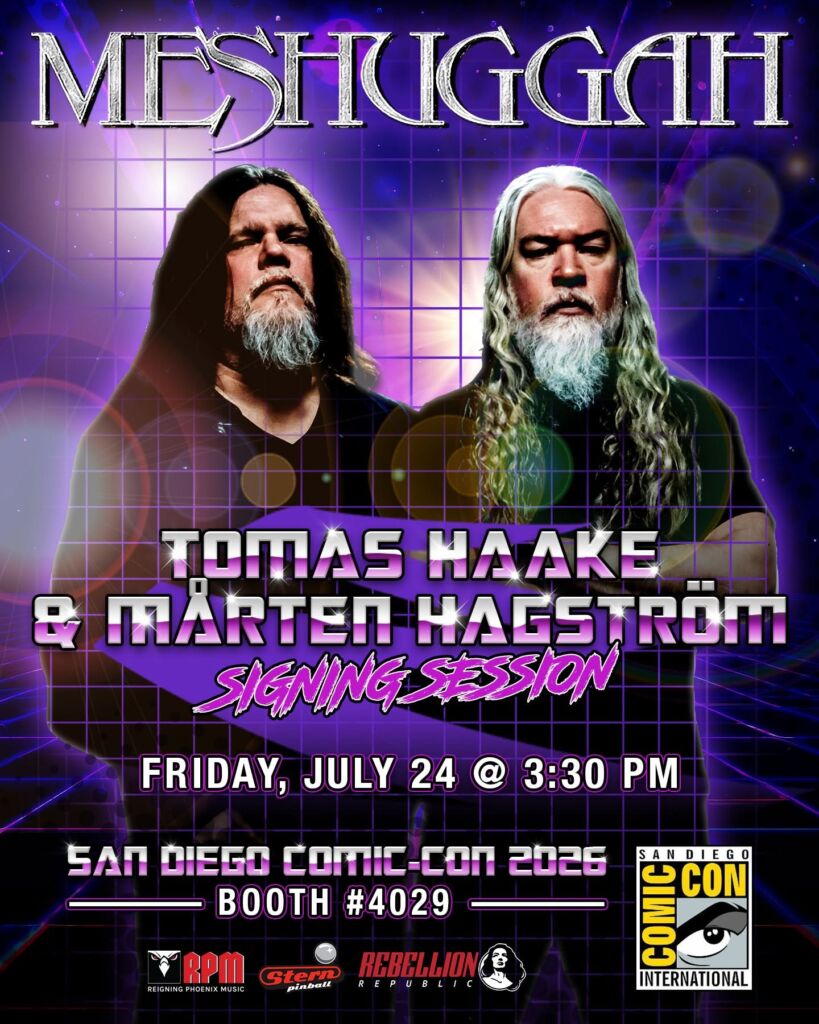
Meshuggah members Tomas Haake and Mårten Hagström are set to appear at San Diego Comic-Con, where they will meet fans during a signing session at the Reigning Phoenix Music/Stern Pinball booth (#4029) on Friday, July 24, beginning at 3:30 p.m.
The event also marks the launch of a limited-edition Meshuggah x Hasbro Transformers T-shirt, created to celebrate the 40th anniversary of The Transformers: The Movie and the 30th anniversary of Meshuggah’s landmark album Destroy Erase Improve.
The design is inspired by Megatron’s transformation in the 1986 animated film. After being defeated by Optimus Prime, Megatron is betrayed by Starscream and left drifting in space before Unicron rebuilds him as Galvatron, reflecting the concept behind the title Destroy Erase Improve.
Commenting on the collaboration, Mårten Hagström said: “Big machinery. Massive destruction. Reconfiguration. A pretty accurate analogy to our sound, is it not?”
The artwork combines the destructive and transformative themes of the Transformers universe with the mechanical precision and evolving sound that have defined Meshuggah for decades. The illustration was created by veteran Transformers and G.I. Joe artist Ken Christiansen, whose work for Hasbro and Activision has included Generations toy packaging, Covenant Of Primus artwork, Transformers video game concept art, and IDW comic book covers.
Speaking about the project, Christiansen said: “Two of my favorite things are ‘Transformers’ and metal music, when the chance came up to combine the two, how could I pass that up? And to do it for a killer band like Meshuggah, can’t get much better.”
Reigning PhoenixMusic will also mark the anniversary by offering San Diego Comic-Con-exclusive splatter vinyl editions of the newly remastered Destroy Erase Improve and Catch Thirtythree.
Fans attending the signing will have the chance to meet Tomas Haake and Mårten Hagström while checking out the exclusive merchandise and limited vinyl releases. Both the collaborative T-shirt and the exclusive vinyl variants will be available only while supplies last.
Formed in Umeå, Sweden, in 1987, Meshuggah have spent nearly four decades expanding the possibilities of extreme metal. Their combination of complex polyrhythms, heavily down-tuned guitars, dissonant textures, and precise musicianship has influenced countless bands across the modern metal landscape.
From their early technical thrash recordings through albums such as Destroy Erase Improve, Chaosphere, Nothing, Catch Thirtythree, ObZen, and later releases, Meshuggah have consistently developed their sound on their own terms. Their approach helped shape the rhythmic style later associated with djent while maintaining an identity that remains uniquely their own.
Rather than following trends, Meshuggah created a musical language built on mechanical precision, crushing heaviness, and relentless experimentation. Combined with their reputation for powerful live performances, the Swedish veterans continue to rank among the most respected and influential names in heavy music.
Midnight. Neon reflected in rain-soaked pavement. A cigarette burning down to the filter while somebody tells a story nobody should believe. Somewhere a jukebox is playing for an audience of one. This is the world Tom Waits has inhabited for more than five decades. It is also the world noir has always called home.
Most musicians write songs. Tom Waits builds entire neighborhoods populated by drunks, gamblers, washed-up dreamers, lonely lovers, criminals, and ghosts. His characters wander through bars that never seem to close, streets illuminated by flickering signs, and cities where hope survives only because nobody has yet found the strength to kill it completely.
This is why Tom Waits occupies a unique place in modern music. He did not merely borrow noir imagery. He transformed noir into sound. Through broken voices, unconventional instrumentation, and stories that blur the line between poetry and cinema, Waits became the genre’s most important musical storyteller. His songs feel less like recordings than forgotten films playing inside the listener’s imagination.
Tom Waits transformed noir from a visual genre into a world of sound, stories, and unforgettable characters.
The Sound of a City After Midnight
Classic film noir emerged during the 1940s through directors who filled movie screens with shadows, moral ambiguity, and damaged protagonists. The heroes were rarely heroic. The endings were rarely happy. Cities seemed alive with temptation and danger. Films such as Double Indemnity, The Big Sleep, and Out of the Past introduced audiences to a universe where every decision carried consequences.
Tom Waits inherited those themes but abandoned the camera. Instead of photographing dark streets, he allowed listeners to hear them. His gravelly voice became a narrator guiding audiences through worlds populated by people who exist at society’s edges.
One of the earliest examples appears in Tom Traubert’s Blues, a song that immediately establishes the emotional landscape that would define much of Waits’ work.
“Wasted and wounded, it ain’t what the moon did,
I got what I paid for now.”
Within a single line, Waits introduces a narrator who already sounds defeated. There is no dramatic revelation waiting at the end of the song. The damage has already occurred. Like the protagonists of classic noir films, he begins the story carrying the weight of previous mistakes.
This perspective separates Waits from many singer-songwriters. His songs rarely focus on triumph. Instead, they explore what happens afterward. What happens when the dream fails? What happens when love disappears? What happens when a person continues moving forward despite knowing they have already lost?
Those questions sit at the heart of noir storytelling.
The Broken Souls of Tom Waits
One reason Waits feels so deeply connected to noir is his fascination with damaged people. Traditional popular music often centers on extraordinary individuals. Waits gravitates toward the forgotten. His songs celebrate outsiders, failures, drifters, and survivors.
These characters are not romanticized. They drink too much, and they make terrible decisions. They frequently sabotage themselves. Yet Waits treats them with extraordinary compassion.
Consider Martha, one of his most heartbreaking compositions. The song unfolds as a telephone conversation between two former lovers separated by decades.
“And those were the days of roses,
Poetry and prose and Martha, all I had was you.”
The lyric contains none of noir’s traditional violence, yet it captures something equally important: regret. Noir is not simply about crime or corruption. It is about people confronting the consequences of time, desire, and memory. Waits understands that some of the deepest wounds leave no visible scars.
Throughout his catalogue, lost opportunities often haunt characters more persistently than any villain. They continue moving through life while carrying invisible ghosts beside them.
This emotional depth is what elevates Waits beyond stylistic imitation. He does not use noir aesthetics as decoration. He understands the loneliness that created them.
Swordfishtrombones and the Reinvention of Noir
Everything changed in 1983.
When Swordfishtrombones arrived, Waits abandoned many of the conventions that had defined his earlier work. Traditional arrangements gave way to scrapyard percussion, unusual instruments, carnival textures, and sounds that seemed rescued from forgotten alleyways. The album felt like a noir film dismantled and rebuilt from rusted metal.
Songs such as Underground transformed the city into something almost mythological. Rats, shadows, hidden tunnels, and strange figures populated a landscape that felt both real and dreamlike.
“Take a left off of Delancey Street
And go down the alley.”
The instruction sounds simple, yet it functions like an invitation into another world. Much like a Raymond Chandler novel, the city contains hidden layers invisible to ordinary people. Waits repeatedly guides listeners through these secret territories.
The result was revolutionary. Noir no longer sounded like jazz clubs and detective films. It sounded like industrial machinery, broken carnival rides, distant train whistles, and voices drifting through darkness. Waits expanded the vocabulary of noir while preserving its soul.
Rain Dogs and the Geography of Noir
If Swordfishtrombones reinvented Tom Waits’ sound, Rain Dogs perfected his noir universe. Released in 1985, the album feels less like a collection of songs than a map of a forgotten city. Every street corner contains a story, and every bar shelters another broken soul. Every character seems trapped between escape and surrender.
The album’s title comes from a simple but powerful image. Rain dogs are dogs that become lost when heavy rain washes away familiar scents. They can no longer find their way home.
That metaphor could describe nearly every great noir protagonist. They are individuals who have lost their bearings. Something has disappeared—a lover, a dream, a sense of purpose—and they spend the story searching for something they may never recover.
Unlike many songwriters who use cities as backdrops, Waits transforms urban environments into living characters. New York in Rain Dogs is not merely a location. It breathes, deceives, seduces, and abandons. The city becomes a maze where memory and reality constantly overlap.
This approach places Waits closer to writers such as Raymond Chandler than to traditional rock musicians. Chandler’s Los Angeles was not simply a setting for detective stories. It was a psychological landscape reflecting corruption, loneliness, and desire. Waits applies the same principle to music.
Jockey Full of Bourbon and the Noir Antihero
Few songs capture Waits’ noir sensibility more perfectly than Jockey Full of Bourbon. The narrator moves through a dreamlike world populated by gamblers, criminals, drifters, and mysterious figures. The song feels simultaneously dangerous and strangely playful.
“Hey little bird, fly away home,
Your house is on fire, your children are alone.”
Like the best noir dialogue, the lyric resists straightforward interpretation. It sounds like a warning, a joke, a threat, and a piece of poetry all at once. The ambiguity forces listeners to participate in the story rather than simply consume it.
This uncertainty is essential to noir. The audience rarely possesses complete information. Motives remain hidden. Truth arrives fragmented. Waits understands that mystery is often more powerful than explanation.
The narrator of Jockey Full of Bourbon resembles countless noir antiheroes. He moves through a world governed by instinct rather than certainty, making choices without fully understanding their consequences. The listener follows him not because he is admirable but because he feels real.
Bukowski, Kerouac, and the American Night
Tom Waits did not invent his fascination with outsiders. His artistic lineage stretches through some of America’s most influential literary voices. The Beat writers and Charles Bukowski provided a vocabulary for describing lives that mainstream culture often ignored.
Jack Kerouac filled his novels with wanderers searching for meaning on highways and city streets. Allen Ginsberg transformed personal experience into poetic revelation. Bukowski focused on society’s forgotten corners, populating his stories with bartenders, gamblers, factory workers, renegades, and dreamers.
Waits absorbed elements from all three while creating something entirely his own. Like Bukowski, he is fascinated by people living outside respectable society. Like Kerouac, he understands movement as both freedom and exile, and like Ginsberg, he searches for unexpected beauty within chaos.
Yet Waits rarely sounds like an imitator. His genius lies in translating literary sensibilities into musical form. Where Bukowski wrote prose, Waits writes songs. Where Kerouac created road narratives, Waits creates sonic journeys through urban darkness.
The connection to noir becomes obvious when we examine the characters populating these worlds. They are not heroes. They are survivors. They improvise their way through uncertain circumstances, carrying emotional wounds that never fully heal.
The Beauty of Broken Things
One of Waits’ greatest achievements is his ability to find beauty in places where others see only decay. This quality separates him from artists who merely imitate noir aesthetics.
Classic noir often focuses on corruption and disappointment. Waits acknowledges those realities but refuses to stop there. Beneath the grime, he discovers moments of tenderness, humor, and humanity.
Songs such as Christmas Card from a Hooker in Minneapolis demonstrate this balance perfectly. The narrator’s story is filled with disappointment and self-deception, yet Waits treats her with empathy rather than judgment.
“I wish I had all the money we used to spend on dope.
I’d buy me a used car lot and I wouldn’t sell any of ’em.”
The line is funny, heartbreaking, and strangely hopeful all at once. That emotional complexity lies at the heart of Waits’ noir vision. His characters are damaged, but they remain profoundly human.
The best noir stories are never simply about darkness. They are about the people trying to survive inside it. Few musicians understand that truth better than Tom Waits.
Why Waits Sounds Like a Noir Film
Perhaps the most remarkable aspect of Waits’ work is that listeners often describe his songs visually. People talk about seeing his characters, imagining his streets, and picturing his bars. This reaction reveals something important about his artistry.
Waits composes cinematically. His songs unfold like scenes rather than traditional narratives. Sound effects, unusual instruments, and fragmented storytelling combine to create vivid mental images. The listener becomes a spectator moving through an invisible film.
This cinematic quality explains why filmmakers have been drawn to Waits for decades. Directors such as Jim Jarmusch recognized that his music already contained many of the qualities associated with visual storytelling. His songs did not need adaptation. They already functioned like miniature movies.
Noir began as a visual language of shadows, reflections, smoke, and neon. Tom Waits achieved something extraordinary by translating those images into sound. In doing so, he created an entirely new way of experiencing the genre.
Nick Cave, Leonard Cohen, and the Children of Noir
By the late twentieth century, Tom Waits had become far more than an influential songwriter. He had established an entirely new way of approaching narrative music. His impact can be heard in countless artists, but few reveal his influence more clearly than Nick Cave.
Like Waits, Cave populates his songs with murderers, lost lovers, drifters, saints, and sinners. Both artists understand that darkness becomes meaningful only when it reveals something human. Yet their approaches differ in fascinating ways. Cave often embraces the mythic and biblical. Waits remains grounded in alleyways, bars, train stations, and forgotten neighborhoods.
Leonard Cohen provides another illuminating comparison. Cohen explored noir themes through philosophy, spirituality, and emotional introspection. His songs frequently examine the relationship between desire, faith, and disillusionment. Waits approaches similar territory from street level. Where Cohen contemplates darkness, Waits walks through it.
This distinction helps explain why Waits occupies such a unique position within modern music. He rarely presents himself as an observer. He sounds like someone sitting at the same table as his characters, sharing their stories over one final drink before closing time.
The result is a body of work that feels intensely lived rather than merely imagined.
The Difference Between Darkness and Noir
Many artists explore dark themes. Not all of them create noir.
Noir is not simply sadness, violence, or pessimism. It is a particular way of seeing the world. Characters are trapped between hope and defeat. Morality exists in shades of gray rather than black and white. Beauty appears unexpectedly in damaged places.
Tom Waits understands these contradictions instinctively. His songs rarely divide people into heroes and villains. Most of his characters contain elements of both. They lie, fail, drink too much, make terrible choices, and still manage to inspire sympathy.
That moral complexity connects Waits directly to the tradition established by writers such as Raymond Chandler, Dashiell Hammett, and James M. Cain. Like the great noir authors, he recognizes that human beings are often most interesting when they are imperfect.
The Question of Authenticity
Critics have spent decades debating Tom Waits’ carefully constructed persona. Is the gravel voice genuine? Is the image of the barroom philosopher authentic? How much of the mythology is performance?
The debate itself misses something essential. Noir has always existed in the space between reality and storytelling. Humphrey Bogart was not Philip Marlowe. Yet audiences believed in Marlowe because the performance communicated emotional truth.
Waits operates according to a similar principle. Whether every detail of his persona reflects autobiography is ultimately irrelevant. The important question is whether the stories feel emotionally authentic.
The answer becomes clear when listening to songs like Martha, Time, or Hold On. These compositions resonate because they capture experiences nearly everyone recognizes: regret, longing, resilience, loneliness, and the passage of time.
Noir has never required documentary accuracy. It requires emotional honesty. Waits possesses that quality in abundance.
The Sonic Architecture of the Underworld
The title “poet of noir” is not simply a compliment. It describes a unique artistic achievement.
Film noir gave audiences shadows, rain-soaked streets, morally ambiguous detectives, and unforgettable femme fatales. Noir literature expanded those themes through language. Tom Waits accomplished something equally remarkable. He transformed the entire aesthetic into sound.
His voice carries the texture of worn pavement and cigarette smoke. His instrumentation often resembles the soundtrack of a city after midnight. Most importantly, his songs are populated by characters who embody noir’s central concerns: loss, desire, failure, redemption, and survival.
Throughout his career, Waits has shown extraordinary compassion toward society’s outsiders. He writes about people many artists overlook. Taxi drivers. Drunks. Runaways. Waitresses. Small-time criminals. Lonely dreamers staring through diner windows at three in the morning.
These individuals are not background scenery. They are the protagonists of his universe.
Like the great poets before him, Waits transforms ordinary lives into myth without stripping away their humanity. He discovers beauty inside disappointment, humor inside tragedy, and dignity inside failure.
That ability explains why his music continues resonating with new generations. The settings may be smoky bars and forgotten streets, but the emotions remain universal.
The Last Call
Nearly every great noir story ends with a sense of uncertainty. The mystery may be solved, but the emotional questions remain. Tom Waits understands this instinctively.
His songs rarely offer clean resolutions. Characters drift away. Lovers disappear. Cities continue breathing long after the story ends. The listener is left alone with echoes, memories, and unanswered questions.
Perhaps that is why Waits feels so essential to noir culture. He recognizes that life itself rarely provides perfect endings. People carry scars. Regrets linger. Dreams evolve into memories.
Yet somewhere in the darkness, a jukebox keeps playing. Another story begins. Another stranger enters the bar.
And Tom Waits is still there, singing about all of them.
Wear the Darkness
If Tom Waits’ world of rain-soaked streets, lonely dreamers, and noir storytelling speaks to your imagination, explore the Edgar Allan Poets store. Our apparel and artwork celebrate Gothic culture, noir aesthetics, and the strange beauty hidden within darkness.
Join the Noir Newsletter
Receive Gothic literature, noir cinema, dark music, Poe analysis, and hidden cultural connections directly in your inbox.
Enter the Noir Atmosphere
Continue exploring noir music, Gothic storytelling, and cinematic atmosphere through the official Edgar Allan Poets playlist.
Frequently Asked Questions
Why is Tom Waits associated with noir?
Tom Waits is associated with noir because his music explores moral ambiguity, loneliness, urban landscapes, and damaged characters through cinematic storytelling and atmospheric sound.
What are Tom Waits’ most noir-inspired albums?
Many fans consider Rain Dogs, Swordfishtrombones, and Heartattack and Vine among his most noir-inspired works because of their characters, settings, and storytelling style.
Did Tom Waits influence Nick Cave?
While Nick Cave developed his own artistic voice, many critics and listeners recognize similarities in their use of dark storytelling, outsider characters, and noir-inspired themes.
Who influenced Tom Waits?
Waits drew inspiration from Beat writers such as Jack Kerouac and Allen Ginsberg, along with Charles Bukowski, jazz musicians, blues traditions, and classic noir literature.
Why is Tom Waits called the Poet of Noir?
Because he transformed noir’s visual language into music, creating songs filled with unforgettable characters, cinematic atmospheres, and emotionally complex stories that capture the essence of the genre.
Right back into it as the full capacity of the 2026 2000trees Festival descends and the main arena warms up for action. Bands old and new from near and far brace for impact as the alternative scene’s most voracious community seeks out its yearly fix of the best there is to offer.
2000trees Festival 2026 – Thursday
Still In Love
Arriving on stage with an unassuming “Ello”, the Metallic Hardcore mega-group throws us right in at the deep end, with piercing screams and an aggressively paced assault on the senses.
Still In Love – 2000trees Festival 2026. Photo: Mac Praed
Sounding as if it were ripped straight out of the brains of Bring Me The Horizon or Architects in the late noughties, it is a no-brainer for Still In Love to be zooming up the M5 to join the Count Your Blessings 20-year anniversary show, not least given that current Still In Love guitarist Curtis Ward was a fundamental part of Bring Me The Horizon in their early days.
Still In Love – 2000trees Festival 2026. Photo: Mac Praed
With their debut set to celebrate its first birthday at the end of this summer, packed with huge live dates, performances like this are sure to drag a rabid horde of spin-kicking Hardcore kids along for the ride, ravenous at the thought of what is next.
Cowboy Hunters
Channelling the same pissed-off racket that we have come to love the Lambrini Girls and Soft Play for, Cowboy Hunters live in the outrageous and seek to conquer our brains, already delirious from the summer heat.
Cowboy Hunters – 2000trees Festival 2026. Photo: Gareth Bull
The combination of outright aggression and hilarious wit tying the songs together with the most off-the-cuff tangents you could not think of refuses to surrender your attention as if the whole show was improv and never to be seen again.
Mariachi El Bronx
Listening to mariachi music in the grilling midday heat, you would be forgiven for thinking that our tiny little strip of Gloucestershire countryside had been transported directly to Latin America for a short while.
Mariachi El Bronx – 2000trees Festival 2026. Photo: Jez Pennington
Needless to say, the stars have aligned with this one. The Mexican alter ego of one of 2000trees favourite bands gives some much-needed downtime as we all figuratively sit down for a cocktail by the pool, with a local Taco stall definitely benefiting from the vibe.
Frontman Matt Caughthran brags that they are the only band to play as a mariachi band and as a punk rock band in the same dayin the history of 2000trees, a record I think they will hold onto for quite some time.
Mariachi El Bronx – 2000trees Festival 2026. Photo: Jez Pennington
A stark contrast to their other identity, the show was a dreamy mirage of seductive guitar licks and triumphant trumpets, a beautiful moment to put ourselves back together ahead of a rowdy evening.
Mariachi El Bronx – 2000trees Festival 2026. Photo: Jez Pennington
Truck Violence
You do not need to hear Truck Violence to feel them. Vocalist Karsyn Henderson channels every sound and lyric through his body and face as if it were some sort of interpretive dance.
The show takes a journey through flavours of ruthless Hardcore all the way through to folk and Midwest-influenced tenderness, even as far as touching on spoken word.
2000trees Festival 2026. Photo: Gareth Bull
Few would have expected a banjo to make an appearance on the heaviest stage of the festival, but somehow it absolutely works, both cutting through the rage with a stripped-back section but also playing the banjo in a way that felt subtly menacing.
Native James
It has been a huge summer for Native James with a first appearance here at 2000trees preceded by his festival opening set on the Avalanche stage of Download festival.
Native James – 2000trees Festival 2026. Photo: Jez Pennington
The breakout star has us eating from the palm of his hands, belting out sing-alongs and joining in with not one, but two walls of death spanning the entire forest crowd.
The singer jokes that we are going to form a cult after this, but honestly, if these are the vibes, who would not sign up?
Delilah Bon
If rebellion is the name of the game, then Delilah Bon stands on business. The cries to “keep politics out of music” didn’t just land on deaf ears with this artist, but they had their vitriol chewed up and spat right back at them.
Deliah Bon – 2000trees Festival 2026. Photo: Madga Campagne
Punk is alive and well where it really needs to be, and Delilah just gets it!
An emotional run-down of songs addressing as many of the world’s problems as you can pack into a 50-minute show, she is clearly with her people, whooping and cheering to every spit of defiance.
Deliah Bon – 2000trees Festival 2026. Photo: Madga Campagne
Don Broco
There was a brief moment less than a week ago where it seemed we may have no headliner at all today, let alone one of the calibre of the bullish Bedford boys.
A last-minute dropout from much hyped and long-booked intended headliners Alkaline Trio, due to an untimely bout of sickness for frontman Matt Skiba, had the festival organisers scrambling right as the gates were set to open.
Don Broco – 2000trees Festival 2026. Photo: Jez Pennington
Kidnapped directly from their Biffy Clyro support set at Finsbury Park, Don Broco have barely had an opportunity to come to terms with the headline show, let alone discover any nerves.
Stomping out into the Gloucestershire sunset, you need not question whether the returning headliners are up to the task. They could not look more comfortable rolling out long-time favourites and future classics from their latest album Nightmare Tripping.
Considering the turnaround, the band packs an impressive light and pyrotechnics show to complement their cheeky stage performance, which even includes a compulsory World Cup-style hydration break.
Don Broco – 2000trees Festival 2026. Photo: Jez Pennington
It is impossible to please everyone, and it is certain that there will be some extremely upset Alkaline Trio fans in the fields this weekend. But in the absolute bleakest of circumstances, it must be said that 2000trees have pulled off some miracles here to deliver a headliner that was perfectly fitting of the role and delivered a performance that was worthy of the honour.
Hyro The Hero
If you can drag yourself away from the bright lights and booming tunes of the main stage, there is plenty of entertainment to be had tucked away in the forest with Hyro The Hero.
Hyro The Hero – 2000trees Festival 2026. Photo: Gareth Bull
Armed with a touch of Dutch courage, the American rap-rocker is plenty loose on stage, creating his very own mosh pit, bouncing off his supporting musicians and tying them up with his mic cord. If he seems untethered mid-song, he is off the wall between songs.
Launching hopefully playful abuse at the crowd, claiming he hates the UK, you are reassured he does not truly mean that as he even joins us in the crowd for a song.
Packed with his own material and a couple of wildly popular covers such as the House Of Pain’s Jump Around, the set is exactly the atmosphere you want for the first full day of a festival with infectious party energy.
Closing out for the evening, the artist downplays the show with “yeah I had a good time”, and you know what, so did we.
Hyro The Hero – 2000trees Festival 2026. Photo: Gareth BullMariachi El Bronx – 2000trees Festival 2026. Photo: Jez PenningtonNative James – 2000trees Festival 2026. Photo: Jez PenningtonCowboy Hunters – 2000trees Festival 2026. Photo: Gareth BullCowboy Hunters – 2000trees Festival 2026. Photo: Gareth BullStill In Love – 2000trees Festival 2026. Photo: Mac PraedDeliah Bon – 2000trees Festival 2026. Photo: Madga CampagneThe post Don Broco Answer The Call As Thursday Roars To Life At 2000trees first appeared on MetalTalk – Heavy Metal News, Reviews and Interviews.