Black Sabbath’s Bill Ward states that he’s “still a drummer” despite increasingly relying on a wheelchair to get about.
In a statement posted to Facebook on Thursday (July 9), the pioneering heavy metal sticksman, 78, reveals that he is unable to walk long distances without assistance but refuses to give up his instrument because of it.
He writes: “I’m announcing today somewhat sadly but nonetheless truthfully, that I’ve reached a place where publicly more and more I need to use a wheelchair, mostly in airports, or public events.
“I can still walk, let there be no doubt, but I can’t walk very far without needing to rest, meaning I need to sit down.”
Ward says that he started using his wheelchair “about 18 months ago, mostly in airports”, but defiantly adds that “I was a long distance walker, I’ve walked in many different parts of the world, and I’m still a drummer. I can still play pretty good for 78 years old”.
“My talents and ambitions, and my unyielding need to be artful, and to play drums, is still as strong as it was so many years ago now,” he continues.
“I’m just saying if you see me in a wheelchair, I’m just catching a ride, I’m not in retirement or ill or giving up, or any of those thoughts that ignite when we see people in wheelchairs. I’m making myself public and transparent about my new transport, and letting you know I’m OK.
“If you see me in the airports or visiting friends in the music arenas or theatres say hi, I don’t bite, I’ll just look different.”
He signs off: “Much love to you all and I’ll keep rocking until I’m dead.”
Ward co-founded Sabbath with singer Ozzy Osbourne, guitarist Tony Iommi and bassist Geezer Butler in 1968. Even though he speaks out against retiring in his new post, the band retired on July 5, 2025, after putting on a grand final bow at Villa Park stadium in their hometown of Birmingham.
The all-day extravaganza, which marked the founding Sabbath lineup’s first time performing onstage together since 2005, featured support from such rock and metal titans as Metallica, Guns N’ Roses, Tool, Gojira and Mastodon. Osbourne played a short solo set before doing four songs with Sabbath. The night marked the Prince Of Darkness’ last time onstage before his death aged 76 following a heart attack on July 22.
Last June, Ward revealed that, despite Sabbath’s then-impending split, he was busy working on two new solo albums. Talking to Long Beach radio station 99.1 KLBP-FM, he said that the efforts were “nearly finished” and that he’d been “living in the studio”.
“I’ve just let everything go. I basically don’t give an ‘F’, and I think it shows up in the record. I don’t have anything to swagger about. I wanted to play something that plays in my heart and then comes out of my soul. I wanted to play some things that keep me awake at night.”
Neither of Ward’s albums have been officially announced at time of publication.
Jawdropped, the rising four-piece from Los Angeles, today announce their debut album, Secret To Spare, due 18thSeptember via Transgressive Records / Canvasback.
Crack Den Blues finds Flowers for Juno drifting through a fog of blown-out guitars, tape hiss, and ghostly reverb, crafting a sound that feels hypnotic, unsettling, and strangely beautiful. Echoing the decayed, narcotic atmosphere of early-era SALEM, but filtered through a shoegaze and indie rock lens, the track balances dense textures with buried pop instincts. Its woozy production, haunting vocals, and slow-burning intensity create an immersive listening experience that grows more captivating with each spin. Equal parts abrasive and dreamlike, Crack Den Blues is a fearless exploration of noise, mood, and melody that leaves a lasting impression.
In the summer of 2002, Red Hot Chili Peppers scored their first ever UK number one album with By The Way. In this archive interview, conducted later that same year, Anthony Kiedis, Flea and John Frusciante look back upon one of the most challenging, but beautiful, years of their storied career.
January 2002: Red Hot Chili Peppers are in Cello Studios in Hollywood with producer Rick Rubin, two months into the recording of their eighth studio album
Flea: “The real work on By The Way started in February 2001, when we first got together in a rehearsal room to write. We spent six months straight writing and arranging every day, so that by the time we get to the studio we’re just laying the songs down. Cello is a great place to record, but sometimes recording can be exciting and beautiful, sometimes it’s just another humdrum day at work. Writing is fun, it’s boring, it’s happy, it’s miserable, it’s always different. But we’re disciplined and focused enough to go into the studio every day and work. It’s not some champagne and caviar rock star party for us.”
John Frusciante: “I started recording most of my parts for By The Way in February. I actually probably enjoy being in the studio more than being onstage, just because you can take one moment and capture it for infinity just by pressing the ‘Record’ button. That’s a wonderful powerful feeling for me.
“In the past, particularly when we were writing BloodSugarSexMagik, I’d be writing to fit into the style of what the Chili Peppers – the band that Anthony and Jack (Irons, former RHCP drummer) and Hillel (Slovak, former RHCP guitarist) and Flea created – were like, but now I don’t feel the need to make our music sound like the Chili Peppers, I don’t feel the need to fit within the blueprint laid down by the early albums. More often that not now songs come from jams, and then Flea and I have what we call a ‘face off’ where we each try to write a part that’ll be right for that song. One of us goes into the alley by the studio to write and the other stays inside and then we compare the two, and we did that on pretty much every song on the record. I’d come up with a basic framework for songs like Cabron and Venice Queen but everyone writes their own parts so there are always alterations to be made.”
Writing is fun, it’s boring, it’s happy, it’s miserable, it’s always different
Flea
Flea: “There are always differences in the studio with ideas and egos and being at different places in our lives, but our ability to connect with each other gets deeper over time. We know more about ourselves, more about each other, more about music and more about accessing the spiritual content of the songs.”
Anthony Kiedis: “When we finish the completed basic tracks, we’ll sit back in the studio and listen to them and smile at one another, knowing that all the hard work was worthwhile.”
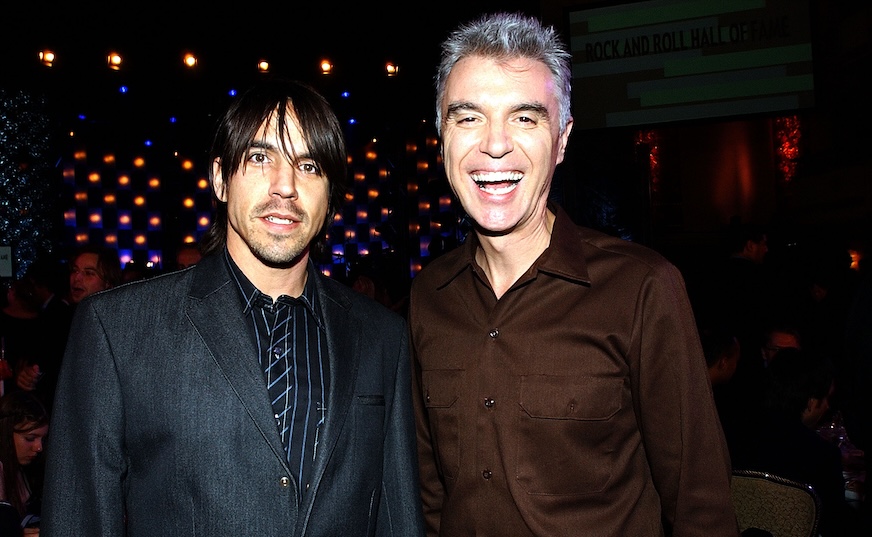
February 2002: Anthony Kiedis takes up residence at the Chateau Marmont on LA’s Sunset Boulevard to record vocals for the album. On March 18 he’ll take a night off to induct Talking Heads into the Rock And Roll Hall Of Fame.
Anthony: “The Chateau Marmont is probably the most beautiful, soulful building in all of Hollywood. There’s a good spirit in that building, and they treat us nice there. I had lived at the Chateau in the past, and John was living there at that time, and as he was doing a lot of harmony vocals we thought, ‘Why hang out in an enormous recording studio that costs a ton of money when we could just check into a room, set up some microphones and do the vocals there.’ So we rented a room on the seventh floor and moved in the Pro Tools computer gear and made it our own. It’s always nice when you’re doing vocals to find a space that you can call your own and decorate in your own way. I had a load of vintage film posters from the ‘30s and ‘40s all around my microphone, which helped me get into the vibe.
“I thought I had written a lot of lyrics. I had lyrics for about twenty different songs, but my band had written about a thousand songs and they wanted to record about thirty of those. So each and every morning I’d spend the first few hours writing before I went in to sing. I probably finished about 30 per cent of the lyrics in the Chateau. Sometimes I just have to listen to the music and start writing and the lyrics will be there, but other times it’s painful and methodical, like figuring out your next move in a chess game.”
(Image credit: Kevin Mazur/WireImage)
April 2020: Artist and film-maker Julian Schnabel, father of John Frusciante’s girlfriend Stella Schnabel, turns his ideas for album artwork over to the band.
John: “My girlfriend’s father offered to do the album art, and so we sent him rough mixes of eight songs and he got the vibe of the album from that. He said that he wouldn’t be offended if we didn’t like it, but we loved what he did. He’s also given us great covers for all the singles. He’s a true artist.”
May 2020: The video for album title trasck By The Way is filmed in LA by award-winning video directors Jonathan Dayton and Valerie Faris, who have previously helmed the band’s Otherside and Roadtrippin’ videos.
Influenced by a car chase featured in the Mexican film Amores Perros, the video sees Anthony Kiedis kidnapped and taken for a ride by a lunatic taxi driver, played by comedian David Sheridan.
Anthony: “That video was funny. We got to do our own stunts and hang out with comic genius David Sheridan. He never broke character for the four days that we were shooting [May 17-20], and he never ran out of dialogue that wasn’t side-splitting. I actually wanted Jim Carrey to be in the video, but Valerie, our director, said, ‘I know someone who’s better’. I was like, Better than Jim Carrey? Are you sure? But he ended up being the best choice we could have made.”
John: “The guy was really funny. I have an hour-long video tape of the improvised stuff he’d be doing between takes, or during our lunch breaks, and it’s just brilliant. Most of the time with videos you spend your time sitting around in the RV waiting to be called, but he actually made that one quite fun.”
On May 31, the Chili Peppers play The Garage in London, their first indoor UK show since December 1999.
John: “That show was a lot of fun. I love playing huge shows but playing little clubs is great. It’s fun for me to be able to see people’s faces close up, and feel like we’re all one together.”
Flea: “Bands always say they prefer little shows because they like the contact with the people, and I like that too ,but I also like the feeling of things moving and changing. We’ve played a billion little clubs and I think that it makes sense for this band to be playing big places right now. I was kinda in a bad mood that night, I was having a little tantrum, so for me personally that show was a little weird.”
Anthony: “You’re kidding! I guess there’s no accounting for a bad mood but personally I was in heaven, that was just about as much fun as you can have playing a show.”
July 2002: By The Way is released as a single in the UK on July 1, entering the charts at number two. The following week, its parent album is released. Selling 134,000 copies in the UK in its first week on sale, the album debuts at number one. The album also tops the charts in 15 other countries.
Anthony: “I thought that single was an uber-bombastic assault of non-commercialism. For it to be so well received over there was shocking to me, but thrilling at the same time. It’s a good feeling when that island of yours embraces our band.”
Flea: “In England you can be a great genius one minute and three minutes later you’re the biggest asshole that ever lived, but I’m not going to complain now that we’re popular. I think people connect with the honesty and craftsmanship in our music. It’s not like we’ve had some overnight surge of popularity, but as time has gone by I think people have connected in a deeper way. I’m happy with the way the public relate to what we do.”
In England you can be a great genius one minute, and three minutes later you’re the biggest asshole that ever lived
Flea
Anthony: “For us the true experience of an album is the days and weeks and months we spend throwing music around in the studio, so when the album is due for release, we’re kinda like, the world can do with this what it will. When the mix is finished, we all get to drive around with copies in our cars, and we do swell up with a little bit of satisfaction, but after that we’re kinda detached, but hoping for the best. Of course we get elated when we get a positive response to what we do. We feel like we’re making a contribution to the positive energy of the world.”
John: “It made me feel really good to read the reviews of this album and to see it doing so well in England. I’m more proud of this album than anything I’ve ever done.”
July 2002: the quartet play a 90 minute show on Ellis Island in New York City for competition winners, family members of September 11 victims, and lower Manhattan businesses. The Ellis Island Immigration Station was the entry point to the United States for more than 12 million immigrants from 1892 to 1954.
Flea: “That was a trippy gig. It was raining and raining and we were out on this little island where the immigrants used to get totally fucked by the government, so the gig had this really bizarre energy. You could feel the history of what happened there.”
John: “My girlfriend’s mom and brother were in the audience which was fun, but it was kinda a rough show for me. Every time I stepped on my distortion pedal the volume would drop to half so I couldn’t hear my guitar solos. It was one of our first shows and so we were stilling ironing out the kinks.”
September 2002: The band team up with Jonathan Dayton and Valerie Faris once more to shoot the video for The Zephyr Song.
Anthony: “The performing part of the video wasn’t that exciting for us, but being there for the go-go girl dancing shooting was fun. We had this girl called Amy Christie dancing, and she was really beautiful and sexy and she danced very well and had that Russ Meyer’s enthusiasm to her female form. And then we had the talented and lovely Tobey Torres dancing too. She’s the girl whose crotch you actually stare into in the video. She’s awesome, a great girl.”
On September 27, the Chili Peppers kick off a ten date South American tour at the Plaza de Toros in Guadalajara, Mexico.
John: “The people in South America were wild, they really respond to the music. We had a lot of great shows in South America. I think we definitely went up a notch in improvising on stage, and because the audience were so into it.”
Flea: “South America was a fucking trip. The gigs were outstanding, because those crowds are incredible, the best crowds in the world, they go apeshit for every show and just explode.”
“I lost it when we flew into Santiago, Chile actually. I snapped at the airport, and I was just screaming and swinging at people. I’m not proud of it. People invade your privacy and at first you understand it and tolerate it but it gets to the point where you’re like, Get the fuck away from me! I wasn’t really looking and all of a sudden there were 50 people all over me, pulling at my clothes, and I just freaked.”
Anthony: “In South America the fans have a frightening habit of laying siege to the hotel and that can get painful and isolating, it makes it hard to just exist. But we managed to escape a couple of times, we found a beautiful empty surf break in Costa Rica and came back from there feeling rejuvenated and the same thing happened in Brazil. Basically this is the best job in the world and I can never complain about it.”
October 2002: The LA band fly to Japan for a seven date tour, to be followed by shows in Australia, New Zealand, Singapore and Thailand. They will end 2002 in Paradise, literally, with a New Year’s Eve show at the Hard Rock Hotel in Paradise, Nevada. By November 2003, when the By The Way tour finally wraps at the Hollywood Palladium, the album will be nudging towards 2 million sales in both the US and UK.
John: “Our shows are just getting better, we’re definitely sharing some ESP moments on stage now, learning how to think inside each other’s brains. The freedom to be able to make music and get pleasure out of it is a wonderful feeling that I don’t want to ever stop. I’m as happy as I’ve ever been now, both in the band and in my own life, and I just hope that next year I have the time to do everything I want to do. I feel like the luckiest person in the world.”
Mastodon have addressed the speculation surrounding the factors that led to the departure of their late guitarist Brent Hinds.
Hinds, who parted ways with the band in March 2025, died last summer following a collision with a car while riding his motorcycle in Atlanta, Georgia. He was just 51 years old.
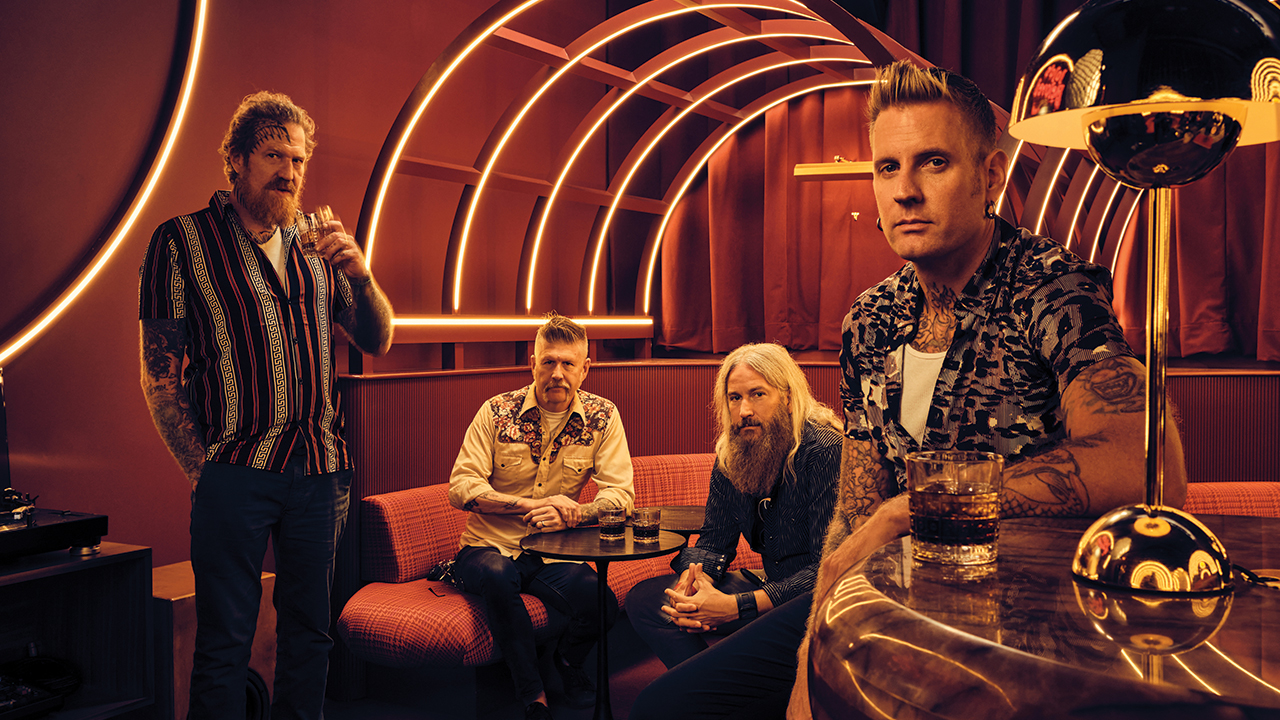
In a 35-minute film titled The Mastodon in the Room, the band – Brann Dailor, Bill Kelliher and Troy Sanders – remember the life of their friend and bandmate, while detailing the circumstances which led to Hinds’ exit.
A statement from the band reads: “As we enter a new chapter of Mastodon, we want to do this the right way and talk about Brent. We’ve all seen the clips, headlines, and speculations, but we haven’t told our story in our own words about our 25 year relationship.
“It isn’t easy to talk about Brent, he was our family, someone we all loved wholeheartedly,” it continues. “He was a wild man, our wild man, and that came with some challenges. Both things are true and we aren’t interested in chasing one truth over the other. Losing him has meant sitting with a type of grief we never expected. No more hugs, no more high fives, no more disagreements, no more making up. That part has been hard, it’s real.
“We put this conversation out there so you can hear it directly from us, you all deserve that.”
As the surviving members watch archive footage of their late friend in a cinema, Sanders says that Hinds’ problems with alcohol causing rancour in the band, and peaked during the recording of their 2021 album Hushed and Grim.
“His dissociation was very evident during [that] period – both his energy and his effort towards us,” says Sanders. “It’s like, no one’s required to be here, but we’re in it for the heart, the purity, and the authenticity of what we do and what we’ve built.
“And that led to the recording process, which was, in my opinion, the most separate that we’ve ever been in a studio recording a double album. The dark tones, the alcohol, and the things that had grips had their nails in him harder than ever before. There have always been ups and downs for the 25 years of our band, but I think it was at its peak, unfortunately, during these past five years.
“I mean, those few years of touring on Hushed and Grim was the weakest band solidity and performance that we had had in a decade. And I knew in my heart that this was possibly going to plateau. And what happens after it plateaus is it goes down.”
(Image credit: Clay McBride)
The band called a meeting to tell Hinds what their issues were for the sake of their own mental health, after it was clear that repeated discussions about his drinking were being ignored. Hinds walked out of the meeting, and later said he was fired from the band on social media.
“Unfortunately, we knew in our hearts that this was never going to change,” admits Sanders. “I cannot tell you how many heart-to-hearts that the three of us had – daytime, sober – as a four-piece, pleading to someone that you’ve been with the bulk of your life to listen to us: ‘You need to take these avenues for your happiness, for your health, for our sake, for your sake, for your wife’s sake, for all of this.’
“I think it got to the point where the shows were declining in the live environment and we were exhausted,” he continues. “Exhausted by throwing all this love at something that was straight up not listening or not caring. At some point we realised, we can’t do anything else. What is there to do? We’ve exhausted all of this. Are we going to continue shooting ourselves in the foot, or are we going to keep conquering the world?”
Dailor describes the day Hinds left the band as “horrible” but the decision came from “a place of love.”
“It was really depressing and sad and fucked up,” says the drummer. “And we just wanted that beautiful, amazing creature, Brent Hinds, to be out there serving up the honey-baked ham and screaming his head off and playing, ripping amazing, incredible, beautiful solos. We desperately wanted that guy, but he showed us time and time and time and time and time again that that person wasn’t coming back without some kind of dramatic change.
“We really were coming from a place of love,” he adds. “It’s like, maybe this will be like some kind of bottom for him. You know what I mean? You never know. We had to set some boundaries and we had to take care of our own sort of mental health.”
A new petition has been launched by the Emerson Lake & Palmer Appreciation Group on Facebook, calling on the BBC “to recognise and celebrate the enduring musical and compositional legacy of Keith Emerson through significantly increased programming, performance, documentary coverage, and inclusion within the 2027/2028 BBC Proms seasons.”
The new petition centres solely on Emerson, who, according to the petition, “aspired not merely to popularity, but to be remembered as a serious twentieth-century composer whose complex and multi-layered works would stand the test of time.”
2027 will be the 50th Anniversary of Emerson’s Concerto Number 1, which was composed and recorded in 1976, and released on ELP’s Works Volume 1 a year later.
The petition specifically calls upon the BBC (and others) to:
* Increase the broadcast presence of Keith Emerson’s compositions and solo works on BBC Radio 3.
* Commission and broadcast new BBC Four documentaries and retrospective programmes exploring Emerson’s role in twentieth-century musical innovation.
* Include the music and compositions of Keith Emerson within the BBC Proms 2027/2028 seasons, particularly through orchestral, symphonic or contemporary interpretations that properly reflect the scale, breadth, and ambition of his work.
* Recognise progressive rock and crossover composition as an important and legitimate part of Britain’s modern musical heritage, which has now begun with the inclusion of Prog Rock: A Fanfare for the Common Man in 2026.
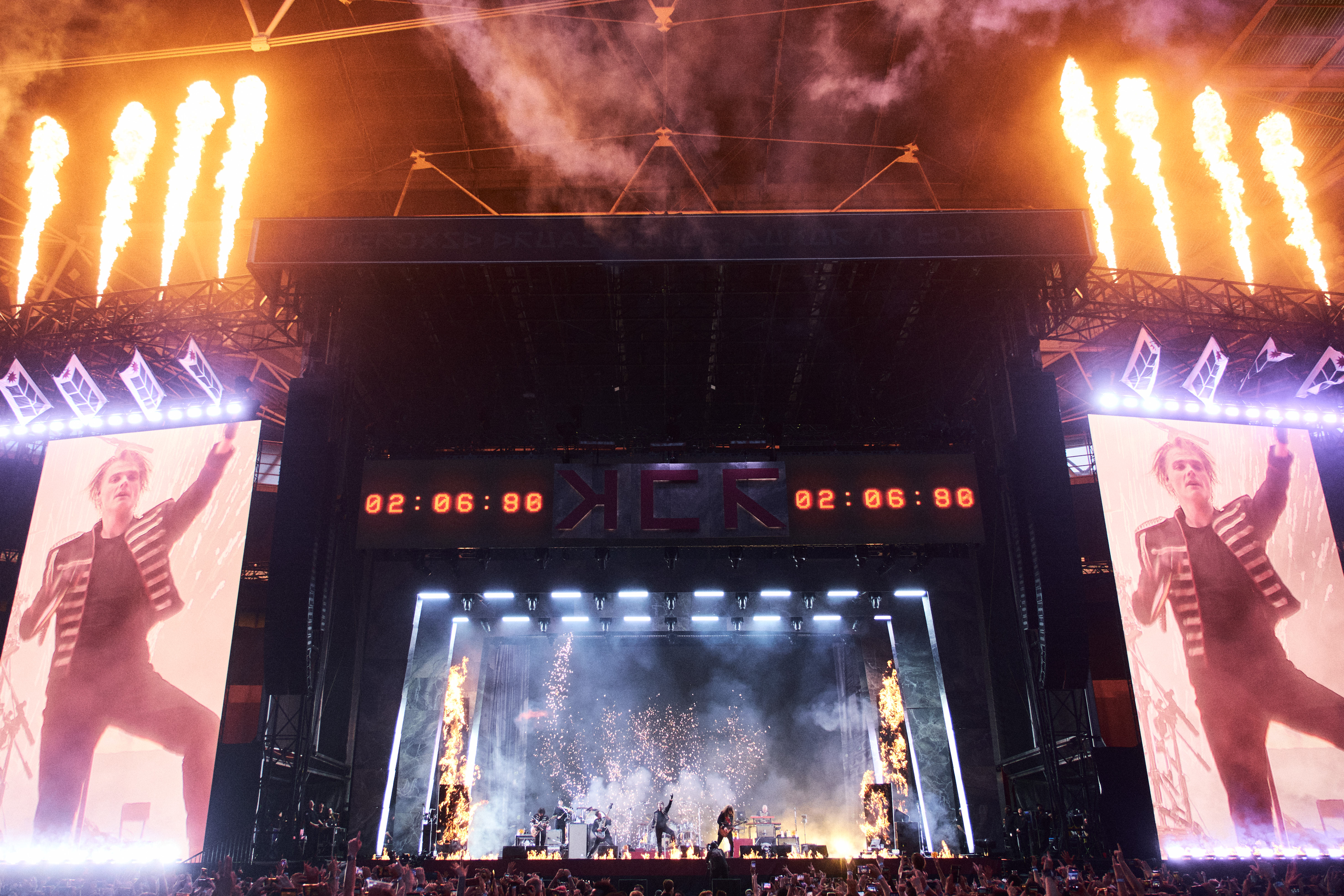
Gigs keep reminding us of the unyielding passage of time lately. Two weeks after Alexisonfire and Billy Talent united in Wembley Arena to celebrate 20 years of their respective breakthrough albums, contemporaries My Chemical Romance are filling the stadium next door three times over as they mark the platinum anniversary of their era-defining The Black Parade. And they’re not taking any half-measures, either. The emo superstars have brought two stages, elaborate sets and an armoury’s worth of pyro – not to mention a new rock opera narrative to refresh their millennial anthems.
Even the support act was picked to fit their highly thought-out design. Frontman Gerard Way fell in love with SKUNK ANANSIE after seeing their cameo in 1995 sci-fi thriller Strange Days. The homegrown alt-rockers make Wembley Stadium feel far smaller than it actually is, as guitarist Martin “Ace” Kent’s crunching riffs fill the 90,000-person space. The heart of it all, however, is frontwoman Skin. Not just the owner of a pristine set of pipes, she’s also a magnetic presence, especially when she hops the barrier to howl amidst the masses. A reliably excellent showing from a consistently underrated band.
19 years ago, MY CHEMICAL ROMANCE loudly killed off their alter-egos The Black Parade, to the point that their demise was the focus of a 2008 live album. But tonight they’re rewriting history. The band now suggest that their black-clad other halves were kidnapped by a nation called Draag and brainwashed into being spokespeople for its authoritarian government.
It’s under this pretense that the New Yorkers return to the stage, introduced by a militaristic procession of drummers, soldiers and scowling politicians. Later, Way hosts a sham election and has a group of people ‘executed’ for frivolous reasons. “The grand immortal dictator demands that you participate in democracy,” he states, trying and failing to stifle a laugh. Any relation to sitting US presidents living or dead is probably not coincidental.
In between, the Black Parade songs prove how the album restructured the face of alternative culture. The End. and Dead! revel just as much in Queen and David Bowie glam rock posturing as they do in post-hardcore hitmaking. Wembley has unsurprisingly memorised every word and belts them out at full force.
This Is How I Disappear, The Sharpest Lives and the monolithic Welcome To The Black Parade continue the series of hits, and as the set drifts into its latter half, the production grows more and more dazzling. Draag becomes embroiled in a farcical war during Mama (again, probably not coincidental), so flames rocket from the stage in ludicrous volume and fireworks explode around the open-air stadium. A stunt performer even sprints past the band completely engulfed in flame.
The pageantry crescendos with album closer Famous Last Words. A countdown runs throughout the climactic anthem, after which more pyro fires from every angle and The Black Parade’s members are either dragged offstage or violently murdered. Then a dude dressed as a clown blows himself up. It’s theatre kid bombast in stadium rock clothing, and it’s magical. Even with an hour of showtime left, MCR have done more with their fans’ ticket money than any other band of their generation.
After a short interlude lets London process the overdose of pomp that’s just been injected into its eyeballs, the band break character and man the intimate B-stage, playing in the round on an island mid-venue. Honey, This Mirror Isn’t Big Enough For The Two Of Us and a cover of Morrissey’s Jack The Ripper (its first performance since 2003) cast a joyous nod to debut album I Brought You My Bullets, You Brought Me Your Love. Songs from 2004’s Three Cheers For Sweet Revenge continue this scrappy throwback, although 2010’s Danger Days gets represented by deep cuts Planetary (Go!) and Destroya.
As I’m Not Okay (I Promise), Na Na Na (Na Na Na Na Na Na Na Na Na) and Helena end the extravaganza with a torrent of singalongs, it’s hard to think of anything diehard fans could complain about tonight. The theatricality that lifted MCR from the underground is here in excelsis, with every hit and a smattering of obscurities populating a show that never felt frontloaded, despite opening with one of the essential albums of the 21st century. No hyperbole necessary: this band just cemented themselves as rock’s greatest showmen right now.
My Chemical Romance return to Wembley on July 10 and 11, then tour Europe.
(Image credit: Bryce Hall)
My Chemical Romance setlist: Wembley Stadium, London – July 8, 2026
The End.
Dead!
This Is How I Disappear
The Sharpest Lives
Welcome To The Black Parade
I Don’t Love You
House Of Wolves
Cancer
Mama
Sleep
Teenagers
Disenchanted
Famous Last Words
The End. (reprise)
Blood (from tape)
Cello interlude (From A To B by Clarice Jensen)
Honey, This Mirror Isn’t Big Enough For The Two Of Us
On paper, the partnership looks weird. On one side there’s Bonnie Tyler, a pop and country singer and a coal-miner’s daughter from a Welsh village who’d struck global-chart gold with an MOR-tinged singalong in 1977, It’s A Heartache. On the other is Jim Steinman, a composer and record producer from New York, renowned for bringing Meat Loaf’s bombastic, sweat-soaked rock theatre to the masses with the mega-selling Bat Out Of Hell the same year.
However, after her fourth studio album Goodbye To The Island in 1981, Tyler was distancing from her manager-songwriter-producers Steve Wolfe and Ronnie Scott (the pop writer, not the jazz club owner), who kept pursuing a soft country rock route.
Tyler had a naturally bluesy, raspy voice – made even more so by a throat operation to remove nodules – and she wanted a change, to “sing more raunchy songs, songs with a bit of energy”. She was impressed with Bat Out Of Hell and asked her record company, CBS, to contact Jim Steinman, with a view to production and songwriting.
“They said, ‘He’s never going to do it, Bonnie, it’s a long shot’,” Tyler told BBC Breakfast in 2021. “and I said ‘Please try’.”
Steinman initially turned the offer down – he’d been knocked back by a fall-out and litigation with Meat Loaf – but after hearing demos from Tyler, said yes. He’d grown up on classical music and opera, and felt Tyler had that in her vocal skillset.
“I was a little bit surprised they would ask me, but my second thought it was a real challenge because of that,” Steinman told Rolling Stone. “And I thought she [had] one of the most passionate voices I’d heard in rock’n’roll since Janis Joplin.”
The two met at Steinman’s penthouse pad in Central Park. “[My manager and I] stepped out of the lift and we were met with a trail of M&Ms leading up to his front door… I knew we were in for a surreal experience,” Tyler recalled in 2020.
Steinman tested Tyler’s music taste by playing her Creedence Clearwater Revival’s Have You Ever Seen The Rain and Ian Hunter’s Going Through The Motions. She loved them both, and the songs ended up on their first album together, 1983’s Faster Than The Speed Of Night.
Steinman’s background in musical theatre, love of classical music and Phil Spector Wall-Of-Sound-style came through on one track in particular that he’d been refining for a long time, Total Eclipse Of The Heart. Originally a song called Come In The Night, from a high school musical he had written and starred in 1969, The Dream Engine, and he revisited it for a concept based on FW Murnau’s 1922 vampire film Nosferatu.
Now titled Vampires In Love, and composed during a lunar eclipse by the nocturnally-industrious writer, Steinman needed someone to do it justice. He later stated: “[Bonnie’s] was the perfect voice for what I was trying to get across… her performance was like an exorcism.”
“Jim never did any demos – I learned all the songs beside him at the piano,” Tyler told Tim’s Twitter Listening Party in 2020. “I’ll never forget the feeling when he played me Total Eclipse for the first time. [Regular collaborator] Rory Dodd sang the vocals. I couldn’t believe he was offering it to me.”
Like all the songs on the upcoming album, takes were recorded live at The Power Station studio in New York. An all-star line-up surrounded Tyler – The E-Street band’s Roy Bittan and Max Weinberg reprised their roles from Bat Out Of Hell, joined on guitar by Rick Derringer, while Steve Buslowe – who played on Dead Ringer For Love and on Steinman’s own Bad For Good – contributed bass.
They’d do nine takes of each track, listen to them at home, then come back the next day and discuss it. Total Eclipse… was Take Two of the session, with overdubbing undertaken on a more-is-more 64-track desk. Later, it would be mixed for over 12 hours by engineer Neil Dorfsman, who recalled to the FT that “Jim wanted the biggest drum sound ever recorded” but faders were at capacity and they “ran out of reverb”.
Everything went into the near-seven-minute album track – Phantom Of The Opera organ, synth cannon sounds, a choir, even sleigh bells. And the legendary supernatural video – shot in Holloway Sanatorium, Surrey, and directed by seasoned pop clip producer Russell Mulcahy, who would go on to Highlander – was even more over-the-top than the track.
At the end of recording, Steinman told Dorfsman, “This is going to be the biggest song you’ve ever recorded.” He was right; and not just in audio terms. At its peak it sold 60,000 copies a day and shot to Number 1 on both sides of the pond, and many other countries across the world.
Tyler’s passionate, powerhouse performance was a triumph, and the song became a highlight of her live show. It’s Steinman’s most-streamed composition on Spotify with nearly 508 million plays, trumped only by the video’s 890 million views on YouTube.
“It is an incredible song. I never get tired of singing it,” Tyler told Rock Cellar in 2021. “Every time I sing it is like the first time. I never would’ve dreamed when it was released that it would sell six million copies worldwide.”
“Of course I met Meat Loaf – and he was really pissed off with Jim giving me that song!” she once told The Telegraph. “He said: ‘That song was meant for me!’ I said, Tough shit, I’ve got it. ”
Watch Bonnie and Jim in rehearsal, and lip-syncing to Total Eclipse… for TV below.
Few rock songs have enjoyed an afterlife quite like Rage Against The Machine‘s Killing In The Name did. Its adoption by a Facebook campaign in December 2009, intended to put the blocks on X Factor winner Joe McElderry claiming that year’s Christmas No.1 spot, was a phenomenal success. Killing… raced to the top by racking up more than half a million downloads, leaving McElderry behind and becoming the fastest-selling digital single ever.
The feat was all the more remarkable given that the track was 17 years old and peppered with potty-mouthed expletives – and the fact that Rage Against The Machine, who recorded it, had little to do with this second coming
“It took us completely by surprise,” admits guitarist Tom Morello. “It was a tremendous David and Goliath story. We only joined the campaign in the final week. It was completely ruled by the fans, and was one of the greatest things in my life.”
Killing In The Name was riven with meaning, written at a key moment in recent American history. The beating of black motorist Rodney King by four LAPD officers in March 1991, captured on CCTV footage, had enraged the nation after it was serially beamed across every news channel.
It was an episode that fed directly into the wiring of Rage Against The Machine, a radical bunch of rap metal-heads who railed against all manner of societal and political ills. Formed in Orange County, California that year, they were led by singer Zack de la Rocha, son of a Chicano political artist and grandson of a Mexican revolutionary, and Morello, himself the scion of African insurrectionists.
The track, Rage Against The Machine’s first single, bit hard on several levels. A righteous slam-bam of punk, hardcore and hip-hop, Killing In The Name was heavy on venomous polemic, burning its gaze into what the band saw as endemic racism in US security agencies. De la Rocha’s repeated mantra ‘Some of those that work forces are the same that burn crosses’ alludes directly to the Ku Klux Klan.
“I was in LA when the whole Rodney King episode went down,” explains Garth Richardson, producer of the song and 1992’s self-titled parent album. “That was a big thing for the city. Zack and I had a long talk about the power of speech and how whatever he needed to say, he had to say it. Malcolm X was a major influence in Zack’s life, and this was not the time to back down.”
The track’s slamming guitar motif, which echoed the no-compromise ferocity of its message, was more serendipitous.
“I was actually in the middle of playing bass in a guitar lesson,” Morello recalls, “and was teaching a student about the drop-D tuning when it came to me. I said to him: ‘Hold on one second’, and scribbled it down. Then we went into rehearsals that night and worked it out. It was part of the second wave of songs we ever wrote.”
Killing In The Name is particularly notorious for its final verse, in which de la Rocha, having built to something of a belligerent frenzy, hollers: ‘Fuck you! I won’t do what you tell me!’ no less than 16 times, topped off by: ‘Motherfucker! Uggh!’ It’s an extraordinary climax, made all the more primal by Richardson setting up the studio with a concert PA and recording the band as if it were a live show.
“My jaw hit the floor,” he recalls. “The song was a standout for an anthem and it knocked me off my feet. We all felt this was going to be big. I knew that Tom’s sound was going to change the way guitars were being heard.”
“Zack and I had a long talk about the power of speech and how whatever he needed to say, he had to say it. Malcolm X was a major influence in Zack’s life, and this was not the time to back down.”
Garth Richardson, producer
However, the band did not instantly earmark it as a single.
“Heavens no!” Morello laughs. “We had a particular guy at the record company, Michael Goldstone, who was very sympathetic to what we were trying to say as a band. He was our ‘fifth Beatle’ for a while and very much high in our counsel. It was his suggestion that we release it as our first single.
“It didn’t come from the band. So it was a case of, ‘Okay, let’s get this straight: it’s the record company who want our first record to be the one that goes, “Fuck you! I won’t do what you tell me!” 16 times, followed by a “motherfucker”?’ Sold! That wouldn’t have been my choice, but that’s how it worked.”
Goldstone may have been adamant about its release, but he nevertheless felt the track was too long. He asked Rage to remove two sections, but the band were having none of it.
“Michael called me, and I was the go-between with the band,” Richardson says. “It went like this. Michael: ‘I want you to cut out those parts’. The band: ‘Tell him to fuck off’. Michael: ‘Tell them to fuck off’. Band: ‘Fuck you’. We all knew this song was a huge hit. It had so much power that the band and I were unwilling to let anybody change it.”
It drew even more potency by the time it was released on the album, in November 92. Rodney King’s police assailants had somehow been acquitted by a jury in court that April, a barely believable verdict that instantly triggered the LA riots. The whole affair did little to dispel the song’s claims of institutional racism in certain sections of American society.
Killing In The Name, unsurprisingly enough, was slapped with a radio ban across most US stations. The unedited video version was also censored on MTV.
It was instead left to Europe to carry the flag, where the song enjoyed substantial airplay (albeit in ‘clean’ form, apart from one priceless moment when Radio 1 jock Bruno Brookes unwittingly played the original version in full on his Top 40 run-down) and made No.2. in the UK in February 93.
Bullet In The Head and Bulls On Parade were bigger UK hits for Rage in the 90s, but Killing In The Name remains their signifier.
“Having a UK Christmas number one in 2009, after all that time was a thrill of a lifetime,” says Richardson. “It just shows how much power people have and what they can do when they work as a group.
“This band is like no other, what they stand for and what they’ve done. I don’t think anyone will be able to copy them. They changed the musical landscape forever.”