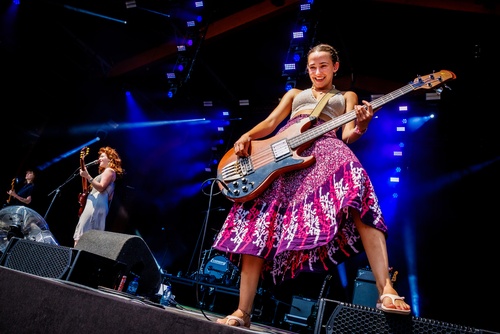
Fifty-five-plus years into its run, Foghat shows no signs of slowing down. The current lineup — Roger Earl on drums, Bryan Bassett on lead and slide guitar, Scott Holt on lead vocals and guitar, and Rodney O’Quinn on bass and vocals — has spent the last two years crisscrossing the U.S., Canada, Mexico and Europe behind the 2025 Slow Ride 50th Anniversary Tour and the still-running “Twang & Bang Tour,” which included the band’s first U.K. dates in 52 years. Through it all, Foghat has kept leaning on the same blues-boogie-rock formula that made “Fool For The City,” “Slow Ride” and “I Just Wanna Make Love To You” staples in the first place.
That road work is now being properly documented. Foghat will release a new triple-vinyl set, Live & Loud Across The U.S.A., on Oct. 30 through the band’s own Foghat Records, distributed by Select-O-Hits under the Sun Records umbrella. The package comes as two gold vinyl discs of live material plus a bonus red vinyl disc carrying the first-ever vinyl pressing of Shaken & Stirred, the long-running fan favorite from Earl & The Agitators, the side project Bad Wolves… — sorry, side project featuring members of Foghat, produced, mixed, and mastered by Bryan Bassett. Pre-orders are open now.
The video for the album’s lead single, “My Babe,” dropped today and is available to watch below.
Numbered, autographed copies of Live & Loud Across The U.S.A. are available through TalkShop.Live. Roger Earl, Scott Holt and Jason Peverett (son of the late Lonesome Dave),along with a handful of fans, sat down with host Steve Harkins on the platform’s Rock & Roll Channel to dig into the new release and look back on the band’s history.
Live & Loud Across The U.S.A. marks the first live album from this specific incarnation of Foghat, pulled together from shows across the U.S. throughout 2024 and 2025. Much of what’s on it has never been released in live form before, and it’s meant as proof that the band, active since 1971, hasn’t lost a step.
The current lineup traces back to 2014, when Roger and Bryan crossed paths with Scott Holt, who had spent more than a decade on the road and in the studio with Buddy Guy. The chemistry was immediate. Scott ended up writing and performing on 2016’s Under The Influence, a session that produced 17 songs total. A year later, Tom Mix — who’d won a Foghat lyric-writing contest while stationed in Afghanistan as a pilot — came home and enrolled at the Dark Horse Institute in Franklin, Tennessee. He invited the band to record at the school’s studio as part of his graduation project, with students handling the mixing and the band keeping the masters.
More songs got written and tracked over the following days. During one session, guitarist Bryan Bassett floated the name Earl & The Agitators — reportedly over a bottle of Foghat Cellars Cabernet Sauvignon — and it stuck. The side project started playing shows, often opening for Foghat itself, before the music finally surfaced online in 2018 as Shaken & Stirred, where it’s remained a cult favorite since.
Foghat isn’t just touring, either. Its most recent studio album, Sonic Mojo, came out in November 2023 and spent 34 weeks on Billboard‘s Top 10 Blues Albums chart, two of them at No. 1 — the band’s first-ever No. 1 on any Billboardchart, a feat even “Slow Ride” never managed. Sonic Mojo is out on CD with 12 tracks in a six-panel digipak, along with a limited 180-gram neon purple vinyl edition featuring 11 tracks and a gatefold jacket.
Tucked into the Live & Loud Across The U.S.A. packaging is a note from Roger Earl: “People often ask me if we’re ever going to slow down. The answer is… not yet!
“The performances on this album were recorded in cities across the United States during the past two years. We didn’t set out to make a live record, we simply wanted to capture Foghat doing what we’ve always loved to do: playing live. Most of these songs have never been released as official live recordings before, and I think they show where the band is today.
“For the second disc, we wanted to include something that many people may not realize is also part of the Foghatstory. Earl & The Agitators isn’t another band, it’s us.
“Whether you know us as Foghat or Earl & The Agitators, it’s always been about playing music we believe in and sharing it with people who love it as much as we do.
“Thank you for coming along with us on this incredible journey. We couldn’t have done it without your support, and we hope these recordings bring you as much enjoyment as we’ve had making them.
“See you down the road…”
Live & Loud Across The U.S.A. recording lineup:
Roger Earl / Drums Scott Holt / Lead Vocals and Guitar Bryan Bassett / Slide and Lead Guitar Rodney O’Quinn / Bass and Lead and Background Vocals Eddie LeFebvre / Percussion and Background Vocals
Shaken & Stirred (Earl & The Agitators) recording lineup:
Roger Earl / Drums Scott Holt / Lead Vocals and Guitar Bryan Bassett / Slide and Lead Guitar Rodney O’Quinn / Bass, Lead, and Background Vocals Craig McGregor / Bass Mark Petrocelli / Percussion (live tracks) Tony Bullard / Guitar (live tracks)
Indianapolis doom crew Veilcaste are back withHellward, their fourth album in six years, later this week and Decibel has an early sampling of the release for your early listening consumption. Hellward recalls the melodic side of doom, Cathedral and their ilk, mixed with the brooding anger of nastier sludge, like Crowbar and Eyehategod, and the quiet/loud intensity of post-metal.
Veilcaste approach doom in a way that’s heavy without losing its rocker tendencies. The music is often sonically despondent but the band never lose their sense of rhythm and motion (“Embedded,” “Chains,” “Worn in Stone”). There are moments of psychedelic melody that duel with the downtuned riffs and acoustic passages that feel as empty as vocalist Dustin Mendel’s emotive howls.
You can hear the album early at the links below and you can head directly to Veilcaste’s Bandcamp page to pre-order the album.
Every generation believes there was a better time. Some imagine the elegance of the Victorian era. Others long for the music of the 1960s, the fashion of the 1980s, or the simplicity of childhood. The details change, but the pattern remains remarkably consistent.
We look backward and see beauty where previous generations often saw difficulty, uncertainty, and conflict. This contradiction reveals something important. The past itself is not what attracts us. Our idea of the past does.
Memory is not an archive that stores reality exactly as it happened. It is a creative process that selects, edits, and rearranges experience. Certain details fade. Others become more vivid. Pain loses its sharpness while moments of beauty remain surprisingly durable.
As a result, history often appears softer and more coherent from a distance than it did when people were actually living through it. This tendency extends beyond personal memory. Entire cultures construct idealized visions of earlier eras, transforming history into a source of comfort, identity, and meaning. The Gothic tradition understood this impulse particularly well.
Long before psychologists began studying nostalgia, Gothic writers were exploring why people become fascinated with lost worlds, ruined civilizations, ancient traditions, and vanished ways of life. Their stories suggested that romanticizing the past is not simply an act of remembrance. It is a response to the uncertainties of the present.
Why We Romanticize the Past
Memory Is Not History
One reason people romanticize the past is that memory rarely preserves events objectively.
Psychologists have long observed that recollection is selective. Human beings do not remember every detail with equal clarity. Experiences are constantly reinterpreted through emotion, personal growth, and changing circumstances.
This process often softens negative experiences over time.
The frustrations of everyday life gradually lose their intensity, while meaningful moments remain emotionally vivid. Looking backward, people frequently remember the atmosphere of an era more strongly than its difficulties.
This tendency helps explain why nostalgia can feel so persuasive.
The past appears simpler because memory removes much of the confusion that originally accompanied it. Problems that once seemed overwhelming become manageable in retrospect. Uncertainty transforms into narrative.
The result is not necessarily false.
It is incomplete.
Romanticized history emerges when memory preserves emotional truth while gradually discarding complexity.
The Psychology of Nostalgia
Modern psychology increasingly views nostalgia as more than sentimental longing.
Research suggests that nostalgic reflection can strengthen feelings of continuity, belonging, and personal identity. During periods of uncertainty, people often revisit memories that provide emotional stability.
Cultural theorist Svetlana Boym offered an especially useful distinction.
In The Future of Nostalgia, she separated nostalgia into two forms. Restorative nostalgia attempts to rebuild an imagined past. Reflective nostalgia recognizes the distance between past and present while still finding meaning in remembrance.
The difference matters.
One approach seeks to recover a lost world. The other accepts that the world is gone and explores why its memory remains powerful.
Much of Gothic culture belongs to the second category.
Ruins, abandoned castles, faded photographs, and forgotten traditions are rarely presented as realities that can be restored. Their power comes from absence. They remind us that time changes everything while simultaneously preserving traces of what once existed.
Nostalgia therefore becomes more than a longing for the past.
It becomes a way of understanding the present.
When the Present Feels Uncertain
Periods of rapid change often produce waves of nostalgia.
This pattern appears repeatedly throughout history. Industrialization inspired renewed interest in medieval culture. The digital age generated fascination with analog technologies. Social upheaval frequently increases public interest in traditions, heritage, and historical identity.
The reason is not difficult to understand.
When the future feels unpredictable, the past appears stable. Historical periods acquire symbolic qualities that help people make sense of contemporary anxieties. The reality of those eras becomes less important than what they represent.
Victorian England, for example, is often remembered through images of elegance, craftsmanship, and ritual. The hardships of the period remain historically significant, yet they rarely dominate nostalgic imagination.
Memory gravitates toward symbols.
Nostalgia transforms those symbols into emotional anchors.
The Gothic imagination recognized this tendency long before modern psychology gave it a name.
Its fascination with ruins, ancestral histories, and lost worlds reflects a deeper understanding that the past often becomes most attractive when the present feels uncertain.
The Gothic Revival and the Invention of Modern Nostalgia
Although people have always looked backward with longing, the modern habit of romanticizing the past took shape during the Gothic Revival.
Beginning in the eighteenth century and expanding throughout the nineteenth, the movement transformed medieval history into a source of fascination. Castles, cathedrals, ruins, legends, and chivalric traditions suddenly returned to cultural prominence. Writers, architects, and artists turned toward earlier centuries not because they wished to reproduce them exactly, but because those eras seemed to offer something missing from the present.
The timing was significant.
Europe was experiencing profound change. Scientific progress, industrialization, urban growth, and new political ideas were reshaping everyday life. Traditional social structures appeared increasingly unstable. In this environment, the medieval past acquired a powerful symbolic value.
It represented continuity.
It represented permanence.
Most importantly, it represented an imagined alternative to modern uncertainty.
The Gothic Revival therefore did more than revive historical styles. It helped establish a cultural habit that remains familiar today: using the past as a mirror through which contemporary anxieties can be explored.
Horace Walpole and the Dream of a Lost World
Few figures illustrate this process more clearly than Horace Walpole.
In 1764, Walpole published The Castle of Otranto, a novel widely regarded as the first Gothic work. The story combined medieval settings, supernatural events, ancestral secrets, and ancient prophecies. Readers encountered a world that felt distant from contemporary life yet emotionally compelling.
The novel’s importance extends beyond literary history.
Walpole understood that the past possessed imaginative power precisely because it was no longer accessible. Medieval society could be transformed into a stage upon which fears, desires, and fantasies could unfold.
His fascination extended beyond fiction.
Walpole famously rebuilt his home, Strawberry Hill, in a Gothic style inspired by medieval architecture. The project was not an attempt to recreate historical reality with scholarly precision. Instead, it created an idealized vision of the past designed to evoke emotion and atmosphere.
This distinction remains important.
Nostalgia rarely seeks historical accuracy. It seeks emotional resonance.
Walpole helped demonstrate how the past could be transformed into an imaginative landscape shaped as much by desire as by history.
Why Ruins Became Beautiful
One of the most revealing symbols of Gothic nostalgia is the ruin.
From abandoned monasteries to crumbling castles, ruins became recurring subjects in literature, painting, and architecture. Their appeal may seem strange at first. After all, a ruin represents decay, loss, and the passage of time.
Yet those very qualities made ruins attractive.
Unlike functioning buildings, ruins invite imagination. Missing walls, broken towers, and empty halls encourage viewers to think about what once existed. The structure becomes a dialogue between presence and absence.
Artists such as Caspar David Friedrich understood this instinctively.
Paintings like The Abbey in the Oakwood present ruined architecture not as historical evidence but as emotional landscapes. The viewer encounters traces of a vanished world and instinctively begins imagining the lives, beliefs, and stories connected to it.
This process reveals an essential feature of nostalgia.
People are often attracted not to complete histories but to fragments. Gaps encourage imagination. Absence invites interpretation.
The ruin becomes beautiful because it allows the mind to participate in rebuilding what has been lost.
Ivanhoe and the Romantic Middle Ages
If Walpole helped invent Gothic nostalgia, Sir Walter Scott helped popularize it.
Published in 1819, Ivanhoe presented medieval England as a world of knights, tournaments, honor, and adventure. The novel achieved enormous success and shaped public perceptions of the Middle Ages for generations.
Modern historians would point out that Scott’s version of medieval life was highly selective.
That selectivity was precisely the point.
The novel transformed history into a cultural myth capable of expressing values that nineteenth-century readers felt were disappearing. Chivalry became a symbol of integrity. Castles became symbols of continuity. Medieval society became a stage upon which modern concerns could be projected.
This mechanism remains recognizable today.
Every generation constructs its own imagined golden age. Sometimes the chosen era is Victorian. Sometimes it is the 1950s, the 1980s, or even the early years of the internet. The historical period matters less than the psychological function it serves.
The past becomes attractive when it appears to contain qualities that feel absent from the present.
The Gothic Revival transformed that impulse into an enduring cultural tradition.
Gothic Nostalgia in the Digital Age
The impulse that fueled the Gothic Revival did not disappear with the nineteenth century.
It simply found new forms.
Contemporary Gothic culture frequently draws upon earlier aesthetics, technologies, and artistic traditions. Darkwave musicians incorporate sounds associated with post-punk and early Gothic rock. Steampunk artists reimagine Victorian technology through a lens of fantasy and alternative history. Gothic fashion continues to revisit mourning attire, antique jewelry, lace veils, and silhouettes inspired by earlier centuries.
These movements are not attempts to recreate the past exactly as it existed.
Instead, they transform historical fragments into something emotionally meaningful for the present. A Victorian pocket watch, a cathedral silhouette, or an antique photograph acquires symbolic value because it evokes continuity with worlds that have largely disappeared.
The same pattern appears throughout digital culture.
Online communities celebrate vintage photography, abandoned architecture, analog media, and historical aesthetics with remarkable enthusiasm. Social media platforms allow people to curate idealized visions of earlier eras, much as Gothic Revival artists once transformed medieval history into an imaginative landscape.
The technology is new.
The psychological impulse remains familiar.
People continue searching the past for symbols that provide meaning, beauty, and continuity within a rapidly changing world.
Why Every Generation Invents a Golden Age
One of nostalgia’s most fascinating characteristics is its adaptability.
Every generation tends to identify a different period as uniquely desirable. The era chosen often reflects present concerns more than historical reality.
For some, the Victorian period represents craftsmanship, elegance, and ritual. Others idealize the 1950s, the cultural revolutions of the 1960s, or the popular culture of the 1980s and 1990s. Younger generations increasingly express nostalgia for periods they never personally experienced.
This phenomenon reveals something important.
Nostalgia is rarely about returning to a specific historical moment. It is about constructing a narrative that helps make sense of contemporary life.
The chosen era functions as a symbol. Certain qualities become amplified while others recede into the background. Complexity gives way to coherence. Contradictions become easier to ignore.
The process resembles storytelling.
Like novelists shaping a narrative, people select details that support a meaningful emotional interpretation of the past. Historical accuracy often becomes secondary to psychological significance.
This is why every generation discovers its own golden age.
The idealized past changes because the needs of the present change as well.
The Gothic Understanding of Nostalgia
Gothic culture offers a particularly sophisticated understanding of nostalgia because it rarely treats the past as something that can be fully recovered.
Ruins remain ruined. Ghosts remain absent. Lost worlds survive only through fragments, memories, and traces. The Gothic imagination recognizes that time moves in one direction.
This awareness distinguishes Gothic nostalgia from simple sentimental longing.
A ruined abbey becomes meaningful not because it can be restored to its original condition but because it reminds viewers of history’s fragility. A faded photograph gains emotional power because it preserves a moment that can never return. The distance between past and present becomes part of the experience itself.
Rather than denying loss, Gothic aesthetics often embrace it.
The result is a form of nostalgia that feels reflective rather than restorative. Memory remains valuable even when recovery is impossible.
This perspective explains why Gothic literature and art continue to resonate. They acknowledge the beauty of the past while recognizing that the past exists largely through interpretation.
Why We Keep Looking Back
The enduring attraction of nostalgia reveals a fundamental aspect of human psychology.
People need stories that provide continuity between past, present, and future. Memory helps construct those stories, even when it simplifies or reshapes reality in the process.
The past therefore becomes more than a collection of historical events.
It becomes a source of meaning.
We romanticize earlier eras not because they were necessarily better but because they help us understand who we are. Lost worlds, vanished traditions, old photographs, abandoned buildings, and inherited objects all create connections across time. They remind us that individual lives form part of larger narratives extending beyond the present moment.
The Gothic imagination recognized this truth long ago.
Its fascination with ruins, ancestral histories, forgotten stories, and fading beauty reflects an understanding that memory is never merely about preservation. It is also about interpretation.
The past survives because each generation recreates it.
Not as it truly was.
But as it needs it to be.
Wear the Darkness
If Why We Romanticize the Past speaks to your fascination with Gothic culture, nostalgia, history, and memory, explore the Edgar Allan Poets store. Our apparel celebrates the beauty of forgotten worlds and the stories that continue to echo across time.
Join the Noir Newsletter
Receive more essays on Gothic culture, nostalgia, literature, memory, symbolism, and the psychology behind the stories we tell about the past.
Enter the Noir Atmosphere
Continue the atmosphere behind Why We Romanticize the Past through the official Edgar Allan Poets playlist, where memory, melancholy, and cinematic storytelling meet in sound.
Frequently Asked Questions
Why do people romanticize the past?
People often romanticize the past because memory selectively preserves emotionally meaningful experiences while reducing the intensity of everyday difficulties and uncertainties.
What is nostalgia?
Nostalgia is a complex emotional response involving longing, reflection, memory, and personal or cultural connections to the past.
What is the difference between history and nostalgia?
History seeks to understand the past as accurately as possible, while nostalgia interprets the past through emotional and psychological experiences.
Why is nostalgia important in Gothic culture?
Gothic culture frequently explores ruins, memory, loss, and vanished worlds. These themes naturally connect to nostalgia and the emotional significance of the past.
What is reflective nostalgia?
Reflective nostalgia acknowledges that the past cannot be recovered while still finding value and meaning in memory and remembrance.
Marillion’s revolutionary crowdfunding campaign, which they ran to fund their 2001 Anoraknophobia album, came after they’d been dropped by their major label in 1995. The prog icons are credited with building the pledge model, which exploded across the industry until the collapse of PledgeMusic in 2017.
By that time Marilion – who’d released F.E.A.R. with the defunct platform a year earlier – had moved on. Looking back in 2016, singer Steve Hogarth recalled just how far they’d come after making the great escape, and inspiring other artists to do the same.
“The major labels are not doing it because they love you. If they’re really honest, they’re not even doing it because they’re excited about the music.
They’re excited about the new Coldplay album because they can hear there’s a hit that’s going straight on the radio, and it’s worth a million quid. I’m talking here about the people who work on the top floor, not the people who work in the offices.
Another thing I learned – which really shocked me – was that the people in the offices actually had no kind of clue about what kind of deal you’re on, what your royalty payments are like, whether you’re getting one per cent or 90 per cent of an album. They just assume that all the artists are paid really well for what they do, and all get rich.
I remember speaking to a girl there and telling her what we earned and her jaw hit the floor. She had no idea. So there are only four people in these major labels, in the business affairs department, who have any clue what the artists are being paid.
Back in those days, I don’t think we felt directly pressured to change the music. The way they would exert their influence was, they would bring a producer in and they would whisper in his ear.
The phone would ring and it would be, “Is there this and is there that? Have you made sure there’s enough of that?” That way, they didn’t have to come to us as artists and say, “Can you sing it a bit more like that and is there enough chorus?” —because they were whispering at the producer.
The label would always insist on appointing a producer because he was their control system: who knows what the fuck you can do with artists, but you can whisper in a producer’s ear.
(written by Islander) Today we help pave the way for the return of the Australian black metal band Nontinuum after an extended absence, and so a bit of background may be useful. They were originally founded in 2010 as a bedroom recording project rooted in atmospheric and depressive black metal, and their debut demo Dwelling […]
Not so much a new studio album as a revisitation of some of themes and ideas that didn’t make the grade originally but have been dusted off and reappraised. Behemoth’s latest collection, I Scvlptor, is more of a compilation than a new album, coming less then eighteen months after the release of last year’s The Shit ov God.
Intended to act as something of a bridge between the band’s black metal roots and their more-recent death-centric style, I, Scvlptor is comprised of eight tracks, some new, some re-recorded, some not-heard-before hidden gems, which makes this album as more than a curio in Behemoth’s back-catalogue.
The title-track, and first single, begins with eerie and creepy darkness, orchestral bleakness and a haunting ambience occupy the early parts of the tune; those classical motifs run through the whole composition, giving a bombastic and uncomfortable vibe to the second half, taking classic Behemoth blasphemies and giving them a modern twist. Thematically, it is a song about the endless process of self-recreation, which is the over-arching consideration of the record.
The previously unheard Lord ov the Horizons is laced with a morose acoustic riff, which never once waivers no matter which direction the track takes. Doomy at times, yet with a choral section that suggests Nergal had recorded the combined choirs of the Satanic Realm as backing vocals. Also included here is the studio rough mix of this song which, for me, was preferable to the finalised version for the very fact of it being unrefined.
The third previously unreleased track on I, Scvlptor is Begotten, a fast-paced classic black metal-era Behemoth tune that utilises the second wave’s preoccupation with the lo-fi and creates and explosive and uncompromising four-minutes. It is a fine reminder that the Poles started life as a Church—bothering Black Metal act, only introducing the death metal elements on 1997’s Bewitching the Pomerania EP.
Early tracks Rise of the Black Storm of Evil, from the 1993 demo, The Return of the Northern Moon, and In Thy Pandemaeternum, found on the Pandemonic Incantations third full-length in 1998, have been re-recorded with Behemoth’s modern aesthetic without losing the original spirit or intention of the songs.
And, although without any need to do so, Behemoth have gone back to source and have included an acknowledgement of the debt owed to two of the original founders of the whole damn scene. Venom’s In League With Satan features a contribution from Dimmu Borgir main man, Shagrath, to reinterpret the track life a full-bloodied rite to the dark lord himself. Big and bombastic, it oozes filth and sin, the chanting chorus is as though Nergal has found more work for that Demonic choir.
A live version of Bathory’s The Return of Darkness and Evil is included and features Sakis Tolis of Rotting Christ in what becomes a rollicking run-through of one of the genre’s seminal tunes. The live energy and the fleshing out of the sound give this cover a presence that cannot be ignored.
Looking at the progression of Behemoth from their second wave-adjacent formative years to the blackened-death metal monster – the Biblical behemoth, if you will – we know today. I, Scvlptor is a peak behind that curtain to see if the newer fans want to tread the infernal path the band themselves took in the early nineties. I’d recommend you do – they have such pleasures to show you!
Bad Wolves‘ cover of Dolly Parton‘s “Jolene” is out now, though not in the form anyone originally pitched. Parton was set to add her own vocals to the band’s heavier take on her 1973 classic, but she died on Aug. 25 following a short cancer battle before that could happen.
Bad Wolves‘ label, Better Noise Music, put the track out today without Parton on it, directing proceeds to her Imagination Library, a charity that sends free books to kids from birth through age 5.
The release lands just three days after guitarist AJ Rebollo walked away from Bad Wolves, calling the decision to put “Jolene” out the “final nail in the coffin.”
Rebollo announced his exit on Friday (Aug. 28) over social media, ending a two-year run with the band. He accused Better Noise Music of acting in bad faith by pushing the Parton cover out so soon after her death.
“I am making the decision to step away as a member of Bad Wolves,” Rebollo wrote in his statement.
“In short, I can no longer in good faith remain a member and co-sign the decisions constantly being made FOR this band by the label, among other issues I have with the inner workings of the business.”
According to Rebollo, the band itself pushed back on releasing the song once Parton had passed.
“We, as an entity, told the label we had no interest in releasing the cover after learning of Dolly‘s unfortunate passing as her collaboration on the song was no longer a possibility, and we felt it would (understandably) be interpreted as somewhat of a capitalization on her passing from an outside perspective,” he wrote. “They went ahead and posted that we were releasing it anyway, despite efforts from more than one member, myself included, to oppose it.
“While the donation to her Imagination Library is an incredible choice to do something good with the profits, I can’t help but feel there is ill intent behind the decision to release the song,” he added.
Rebollo framed the “Jolene” fight as one symptom of a larger problem with how the band’s business gets run.
“With the label completely disregarding numerous decisions we make out of passion, and ultimately just unknowingly exhausting the band’s attempts to fully enjoy being here, I am no longer happy here,” Rebollo wrote.
“The amount of hate, negativity, and harassment we receive on a daily basis due to decisions made outside of our control has taken a massive toll on our sanity.”
Bad Wolves has already been through a fair amount of lineup turnover. Original singer Tommy Vext left in 2021 and was replaced by Daniel “DL” Laskiewicz, who later left to join Falling In Reverse as their bassist. Bad Wolves brought in Sara “Killboy” Skinner as its new singer earlier this year.
Last week, Skinner posted a video claiming Bad Wolves got dropped from Christian rock act Skillet‘s upcoming tour after that band’s fanbase spread a false rumor that Skinner was a “trans OnlyFans bitch.” Her response left the door open just enough: “only one of those things is true. Have fun finding out, and we will see you on the next tour.”
When the “Jolene” cover was first announced last week, Bad Wolves founder, drummer and songwriter John Boecklin explained how the collaboration came together in the first place.
“Our singer is a big fan of Dolly and had posted a bunch of videos of her covering ‘Jolene.’ So, we decided to make a heavy metal cover version for our next album. On hearing our version, our label CEO Dan Waite sent the finished demo to Dolly‘s manager, Danny Nozell, with a request for Dolly to guest feature on our version. We heard back that Danny had played the track to Dolly, and that Dolly loved our version, and that Dolly was going to go into the studio and add her vocals very soon.
“We then sent over the stems for Dolly‘s studio engineers to work with. Like everyone, we were devastated of this week’s news of Dolly‘s passing. We will honor Dolly‘s incredible legacy by donating proceeds from ‘Jolene’ to the Dolly Parton‘s Imagination Library.”
This isn’t the first time Bad Wolves has released a tribute cover in the immediate wake of tragedy. Eight and a half years ago, the band put out its version of The Cranberries‘ “Zombie” just four days after singer Dolores O’Riordan died in January 2018, with proceeds going to her three children. O’Riordan had actually been scheduled to record her own vocals on that track the day she died.
That one didn’t sit well with her surviving bandmates either. The Cranberries, whose 2019 album In The End included posthumous vocals from O’Riordan, told ABC New Radio they weren’t fans of the Bad Wolves version.
“[I] didn’t really like it,” drummer Fergal Lawler said. “It wasn’t my cup of tea.”
Guitarist Noel Hogan agreed, saying the timing felt off. “The whole thing seemed insensitive or something,” Hogansaid, adding that the cover came out “a bit too soon. For my liking, anyway.”