Bikini Kill blew away its fanbase in New Haven with a set of iconic feminist punk-rock anthems.
The post Bikini Kill Resurrects Rebel Girl Spirit on 2026 Fall Tour appeared first on Rockmommy.com.
Bikini Kill blew away its fanbase in New Haven with a set of iconic feminist punk-rock anthems.
The post Bikini Kill Resurrects Rebel Girl Spirit on 2026 Fall Tour appeared first on Rockmommy.com.
Canadian melodic death thrash force Invicta return with “Overthrow Divinity,” the first single from their upcoming EP Sapienomachy.
Active since 2017, Invicta have carved out a reputation for aggressive old school riffing, sharp melodic hooks, and a modern approach to death and thrash metal. With one EP and two full-length albums already behind them, the Kitchener-Waterloo band now enter a new chapter with Sapienomachy, a concept-driven release that expands their sound into power metal, traditional metal balladry, and progressive storytelling.
Inspired by Greek mythology, Sapienomachy takes its name from mythic conflicts such as the Titanomachy and Gigantomachy. The EP reimagines the tale of Prometheus giving fire to humankind, following a story in which humanity turns that gift into a weapon and wages war against the gods, ultimately destroying their universe.
The EP’s artwork was created by legendary German artist Andreas Marschall. Drawing from Greek myth, the cover depicts Prometheus embedded in the mountain, offering his final flame to humankind.
“Overthrow Divinity” launches the EP with fast-paced power metal influence, twin harmony guitar leads, and relentless drumming. Lyrically, the song is told from the perspective of humanity rising against the gods after generations of oppression and restraint. Its story also speaks to modern anxieties: mankind given tools and technologies meant to help, only to turn them toward destruction in a relentless lust for power.
Sapienomachy also marks a unique creative moment for Invicta. Originally written as part of a full-length album, these songs were set aside and shaped into their own standalone release, allowing the band to explore a more narrative, dynamic, and mythological side of their writing.
Invicta features Kyle Edissi on guitar and vocals, Jonah Kay on guitar, Reef Hassanien on drums, and Chip Tanner on bass. The band’s discography includes The Executioner EP, Halls of Extinction, and Triumph and Torment, alongside singles and covers including “Rising Force,” “Forces of Annihilation,” and “Hatebreeder.”
Invicta have toured across Canada and the United States, including runs supporting Heathen and First Fragment, and have shared stages with Lich King, Soulfly, Toxic Holocaust, Napalm Death, and Primitive Man.
“Overthrow Divinity” is the first glimpse into Sapienomachy, a release that pushes Invicta into grander, more mythic territory while retaining the speed, aggression, and melodic bite that has defined the band since its earliest days.
Invicta is:
Kyle Edissi / Guitar, Vocals
Jonah Kay / Guitar
Reef Hassanien / Drums
Chip Tanner / Bass
The post INVICTA Unleashes New Single “Overthrow Divinity” From Upcoming EP “Sapienomachy” appeared first on Sonic Perspectives.
Elyvilon’s newest project Lichenthrope is a (literal) organic splinter of the eminent dungeon synth auteur’s wider philosophy. Gone are the hymn-like synths of prior albums inspired by Finnish mythology, misty isles, or Yuletide. Lichenthrope is the transformed, miasmatic voice of Elyvilon. I can only describe the immersive, ritualistic sound as “bio-mythological.” It is good, but, unlike the Elyvilon albums, Lichenthrope’s first record, Call of the Moss Moon, is more conceptually murky and unapologetic in strangeness. A cryptic mythology suffuses the album, manifesting in something profound and simultaneously squirmy in the sound.
…
…
Lichenthrope establishes this spliced microbe of gloomy dungeon synth with advertised “vintage Yamaha and Korg hardware.” It sounds a touch like John Carpenter if he was a type of ophiocordyceps unilateralis, but it also reminds of that old tale by Clark Ashton Smith, “The Garden of Adompha,” about a mad wizard’s garden of impossible colors at the end of eternity. The fungal perception of time on Call of the Moss Moon is infectious, gnawing away in vegetal samsara.
The first half of the album is the Lesser Vehicle of the mushroom. “Gnosis,” the opener, is knowledge of the musty apocalypse. It’s heavy with the string and synth ambiance anyone familiar with the synthesizer stylings of dungeon synth knows. “Gibbous Dream Conduit” is when the Weird Fiction transformation of doom sets in. This languorous, humming track asks: do mosses feel pain? The entire project is built on looping, organic sequences, but “Gibbous Dream Conduit” introduces the echo parallel of chimes and vibrant synths. “Mildew Scraper” is when the bazaar bells of the midnight market bellow. Lichenthrope here enters fairy woodland in the older sense of the world, faery woodland, with knockers in the hills tapping out a funeral march. Abandoning the idealized chimes of “Gibbous Dream Conduit,” “Mildew Scraper” focuses on electronic drumbeats which puts the danger in the (almost) chiptune soundscape. The beat and the heavy, resounding bell of “Mildew Scraper” establish a synthetic texture that moves like an organic, breathing symphony. It claims the title of “fungal dungeon synth” and is the best of the album. “All Honors of a Vine-Chocked Grave” (great title, old school in sound too) finishes up the pristine (to plant life) sacraments of the hidden woodlands. It’s weaker than “Mildew Scraper,” but “All Honors of a Vine-Choked Grave” is the world above as seen from below, dealing, appropriately, more in the faux-brassy “low-fi” textures. All those “honors” are an echoing dirge through the Gothic shadowlands of a remote, moss choked Upper Peninsula.
The second half of the album falls to the physical, the perishable, but, perhaps, that is preferable as to keep the air of our rarefied dreams pleasant. “Miasmatic Chamber” is the pseudo-resumption of “Mildew Scraper,” but, though darker, it is the weaker track due to its 10-minute length. As the longest track on the album, “Miasmatic Chamber” presents life seen through glowing eyes in the dark, yet prolongs the experience too much. The following song, “A Glimmering,” is much more economical. It’s a rather lonely tune, like wandering through a forest path of live ambience: crickets, frogs, wind in the branches, scuff in the dirt, piano in the night sky. The warm forest ambience acts as an interlude to draw out the cold fugues of extraterrestrial melody which dominate the second half of “A Glimmering.” “Shambling Mycomaton,” then, depicts a Hitchcock-esque monster thumping through the woods. It is built with artificial hums and computerized violin stings. One has no idea what a “mycomaton” actually is, but the synthesized pseudo-staccato raises terror at the thought of it. “Call of the Moss Moon,” the title track, carries on with that tension, but the the modulated, discordant drums provide a funky rhythm that acts as a denouement to the rest of the album, eventually evaporating into the sound of rain and distant thunder in the distance.
The moss of the crypt creeps upwards through the gutters to infect the mind of the public! One need only take a look at the looming, shamanistic silhouette by Grave Stench Stench on the cover as evidence of this mossy apotheosis. Whatever the terror or revelation, the transformation of the figure reflects Call of the Moss Moon’s invasive, biological looping through one’s mind. While it’s a little green in experimentation, the first transformation always is, so Call of the Moss Moon is an easy recommendation to anyone looking for dirges of dark, peculiar ambience.
…
Call of the Moss Moon is available via Bandcamp.
Welsh bilingual nu-metal duo C E L A V I have released their new single and video AR DY LINIAU (ON YOUR KNEES). The track is taken from their forthcoming EP, PRAELIA, arriving Friday 13th November. With the band set to climb even further, we checked in and asked for this exclusive breakdown of the songs that have greatly influenced their sound:
We always try to push the boundaries of what we can achieve sonically. Every time we work on new music we try to evolve and not be complacent. BMTH are a great example of how it’s done right. And this song encapsulates that fearlessness from early in their career.
It’s hard to pick just one song from NIN’s catalogue as they’re a band we could talk about for great lengths. We love this song as it’s a great example of how they have multiple great hooks in a song while still retaining the band’s dark identity.
Rammstein was probably the first non-English speaking metal band we heard. Which in itself was a massive inspiration. We became enamoured the more we discovered about them; their intelligent wit, incredible live show and crushing riffs. They are an archetype of what a band should be on record and live.
Arguably one of the greatest songs ever written in general, not just in metal. Incredible guitars, beautiful soaring vocals, a solid groovy drum beat and a beast of a breakdown at the end. Perfection.
Seeing the success BABYMETAL have achieved speaking their native language has been an absolute inspiration to us. It shows that metal music transcends all borders.
For more on CELAVI, see
www.wearecelavi.com
https://www.instagram.com/wearecelavi
https://www.facebook.com/WEARECELAVI
https://www.youtube.com/@WEARECELAVI
https://open.spotify.com/artist/4OEzNJIkgsH8PTw0y86ATx

For all the latest news, reviews, interviews across the heavy metal spectrum follow THE RAZORS’S EDGE on facebook, twitter and instagram.
The post Celavi: The Songs That Influenced Us appeared first on The Razor's Edge.
As the years pass, it gets harder and harder to believe that Mark Sandman was a real guy — that he made the music that he did, that he looked like that, that he was actually named Mark Sandman, and that he died in the way that he did. He was like a character that Jim Jarmusch might dream up. Sandman sang in a deep and lascivious baritone and played two-string slide bass as the frontman of Morphine, a jazzy Boston rock band who basically sounded like nothing else, before or since. Morphine made four albums, including the solid-gold 1993 classic Cure For Pain, before Sandman died from an onstage heart attack while playing a 1999 show in Italy. A fifth Morphine album, The Night, came out in 2000, after Sandman’s death. Now, more than a quarter century later, another posthumous Morphine album is about to see release.
The post Morphine Announce New Album <em>Cocoon</em> Featuring Recordings Mark Sandman Made Before His 1999 Death appeared first on Stereogum.
(Andy Synn once more serves as our in-house ambassador for the UK Metal scene) Like I’ve said before, many times, it’s impossible for any of us here at NCS to cover all the artists/albums we really want to, which means some hard choices have to be made each month. This extends, obviously, to these irregular “Best […]
The post BEST OF BRITISH: JØTNARR / KULK / REMOTE VIEWING appeared first on NO CLEAN SINGING.

– September 24th, 2026 –
“Howl From Underground” Full-Length From Swedish Lycanthro Practitioners Nears October 9th Release On Metal Blade Records
Watch/stream WOLFBRIGADE’s “Doomrunner” HERE
Swedish lycanthro punk practitioners WOLFBRIGADE are pleased to unleash their latest single, “Doomrunner.” The ferocious new track comes off the band’s equally punishing Howl From Underground full-length, set for release on October 9th through Metal Blade Records.
Comments the band plainly, “The universe owes us nothing. That’s where “Doomrunner” begins. What keeps us moving anyway? Maybe not hope. Maybe instinct.”
Watch WOLFBRIGADE‘s “Doomrunner” video HERE
Watch WOLFBRIGADE‘s previously released video for first single, “Cold War Bootlicker,” HERE

Photo by Therese Öhrvall
With the amps still warm from 2024′s coruscating comeback Life Knife Death, veteran Swedish punk-metal masters WOLFBRIGADE strike back like a wounded cobra with their loudest, fullest, thickest-sounding record yet. And that’s no happy accident. On their twelfth LP (the first three released under the Wolfpack moniker, 1996-99), Howl From Underground, the quintet concertedly resolved to shake up their habitual processes and interrogate their customary methodology.
“As the songs started to fall into place, we decided to do something we hadn’t done in many years,” explains the band. “For the last decade we’ve recorded, produced, and mixed our albums ourselves. This time we wanted to work with someone from outside the band whose work we respect and who we felt would understand what WOLFBRIGADE is about.” The honor fell to Lawrence Mackrory – already a trusted collaborator with the likes of Meshuggah, Katatonia, Paradise Lost, and Bloodbath – at Necromorbus Studio, the converted Baptist church where Watain and Mayhem refined their occult chaos.

The strength of these decisions pay off instantly in the massive, febrile intensity of the captured sound as it bursts from the speakers like a haywire freight train. “Rather than building the songs layer by layer, we wanted to capture the band as a single unit,” notes WOLFBRIGADE. “The push and pull that happens when five people are locked into the same moment. There’s a tension in those kinds of performances that’s difficult to recreate any other way. Without a safety net, the focus sharpens and something else takes over. Sometimes the songs begin to take on a life of their own. More than anything, it leaves room for the unexpected.”
The urge to initiate a new working environment may have been emboldened by the return of drummer David “Dadde” Stark, who originally hammered the d-beats for WOLFBRIGADE from 2002-2015. “Everything clicked immediately. The chemistry was still there,” attests the band. “The shows felt vital, and suddenly it felt both interesting and relevant to return to the old songs again.” This fresh boost of energy and spirit resulted in 2025′s seat-of-your-pants live album Kill To Live, a heartening reaffirmation of the band’s first principles.
“Recording it was a reminder of what WOLFBRIGADE is at its most fundamental level,” observes the band. “Instead of taking a break afterwards, we moved almost straight into working on Howl From Underground, and began developing ideas that had always been embedded in the concept of lycanthro punk.”

Howl From Underground will be released on CD and digital formats as well as vinyl in the following color variants:
Silver Merge (US)
180g Black (EU)
Red/Black Marbled (EU)
Gold Metallic (EU – Ltd. 500)
Grey/Black Dust Splatter (EU – Ltd. 300)
Crystal Clear/Black/White Splatter (EU – Ltd. 300)
Red/Black Dust Splatter (TNOR/Band Exclusive – Ltd. 200)
Find all pre-orders at: metalblade.com/wolfbrigade
Howl From Underground Track Listing:
01. Caveman Motherfuck
02. Doomrunner
03. Howl from Underground
04. Born to Rot
05. When Dogs Cry
06. Cold War Bootlicker
07. Fat Man Hellscape
08. Headhunting
09. Cosmic Meatgrinder
10. Seeking Scapegoats
11. Man Is Wolf to Man
12. Tangled Steel Mask
WOLFBRIGADE:
Micke Dahl – vocals
Erik Norberg – guitar
Jocke Rydbjer – guitar
Johan Erken – bass
Dadde Stark – drums
https://www.instagram.com/wolfbrigadeofficial
https://www.facebook.com/lycanthropunks
There are a few things in music that have a direct path to the pleasure centre of my brain. Fuzzed out bass, high energy riffs, and a filthy Glaswegian accent are all at the top of that list. What a treat to have all three served to me in spades in ‘Life Is Bliss’, the explosive sophomore album from Glasgow punks Gallus. After spending time touring with bands like Biffy Clyro and Teen Mortgage, ‘Life Is Bliss’ feels like a victory lap – a confident album, complete, coherent, and very cool.
Lead single ‘Sick Bastards’ acts as a mission statement for the album as a whole. It’s extremely nineties in tone and style during the verses with vocals and sampled record scratches are layered into back of the mix. Meanwhile the rhythm alternates between a bouncing, groovy riff and surprisingly tender guitars. The chorus, introduced with the spoken title of the song, is massive, dropping the nineties production effects for a full dunk in the sonic fuzz, while Barry Dolan’s vocals wax lyrical about close calls with Glasgow’s police fuzz.
‘MK Des (Miss Out)’ pulses with a similar energy. An off-kilter lead line accents the driving chorus and presages the verse’s syncopated rhythms. The vocals here sing, often soaringly, of social faux pas and self-deprecation. The result is playful and makes you want to move; to bounce, to dance, to sing along.
At the same time, the lyrics are ironically bittersweet for an album called ‘Life Is Bliss’ – catchy poems about working class life in Glasgow, filled with a thousand personal mistakes and haunted by the alienation of neoliberal austerity. Dolan yearns for “something” in ‘Alert Alert’; in ‘Something There’, he keeps on “getting nowhere, getting nowhere.” He’s “never good at working it out” on ‘MK Des’, he’s lost his mind in ‘Sick Bastard’, and as the album ends, on ‘M8’, he just has a feeling “we forgot what made this place.”
That dark lyrical tone contrasts with the prevailing high octane music on ‘Life Is Bliss’. Opening track ‘Au Contraire’ is a rollicking ride, Dolan equally catchy when hitting high notes as when yelling his heart out. That energy persists, never letting up, until at least after ‘Donnie Murdo’, by which point most of the album has blasted through, fuelled by petrol fumes. The groove never lets up. Sometimes it’s riffier – as in ‘Better Than Nothing’, ‘Stupid Dog’, and ‘Just A Man’ – sometimes more relentless, but the rhythm is consistently upbeat.
Even when Gallus let the energy drop in the back end of the album, it’s with intent – ‘Something There’ is as close as they get to a ballad, with a driving chorus that brings Dinosaur Pile-Up to mind. It’s followed by ‘Jesus Wept’ which picks the pace up but still allows the lead guitar to float above the merciless beat of the rhythm section.
And then there’s ‘M8’, the closing song, with a chugging bluesy rhythm underneath echoing, dissonant lead lines. The effect is one of unease, as restless as it is haunting. That haunting element picks up in the final moments of the album, as a voiceover talks over distorted feedback and street sounds about the deindustrialisation of Glasgow and its impact on the local community and economy: ghosts of the past and lost futures all that remain.
WILL BRIGHT
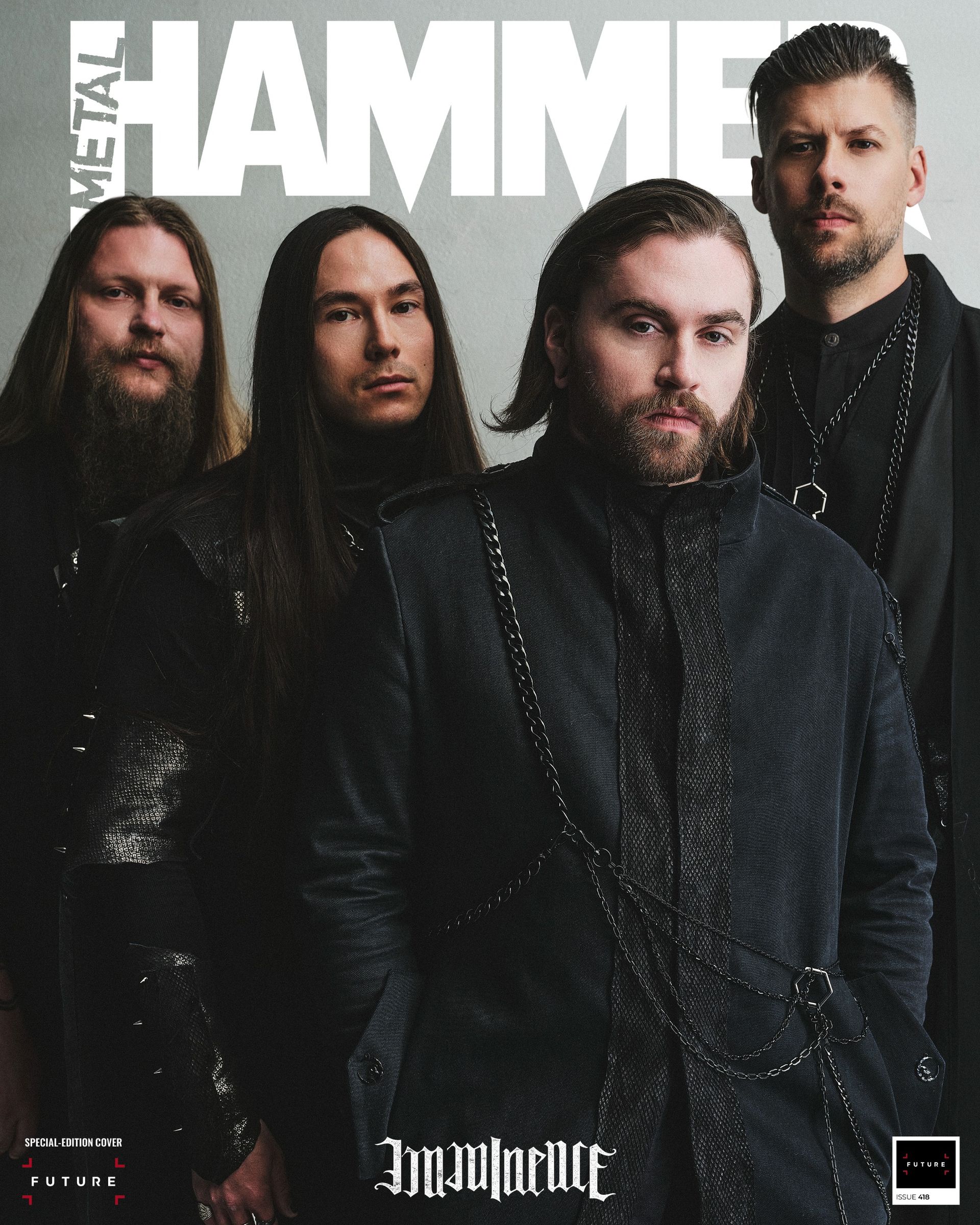
Celebrate the imminent release of Imminence’s new album, Axis Mundi, with an exclusive Metal Hammer bundle!
Available to preorder now only through the Louder store, you can get a copy of the new issue of Metal Hammer with the band on the cover. Plus, there’s a red, yellow and black marble blend double-vinyl of Axis Mundi not available anywhere else and a set of stickers. Get your while stocks last!
Imminence are interviewed inside the new Hammer, telling us about Axis Mundi, their story so far and how they refined their signature ‘violincore’ sound.
“We felt that we didn’t need to put the violin everywhere, and writing [2019 album Turn The Light On], we still didn’t know how people would react to it,” singer/violinist Eddie Berg says.
“‘Violincore’ – that’s what people called it,”adds lead guitarist Harald Barret. “I think it hit that sweet spot of drama and emotional content. It was very hard and raw and honest, but very beautiful at the same time. It’s the duality of these two things.”
They also remember one of their most intense fan interactions. “There was a lady at a meet and greet, and she had been planning to go to our concert with her son, who had unfortunately passed away very recently,” says Eddie. “We were his favourite band, and he had been hoping he would be healthy enough to come to the concert. She wanted to send the signatures with him to his grave. It’s very hard to take these things in sometimes.”
Also in the new Hammer is an extensive interview with keyboardist Tuomas Holopainen of symphonic metal stars Nightwish, as the band celebrate their 30th anniversary. He opens up about his nervousness ahead of the six-piece’s debut concert all those years ago.
“I was so scared I thought I was going to die,” he admits. “I think I vomited before the show. I’d played shows before, but I was just the keyboardist in those bands, I wasn’t responsible for those songs. Nightwish was my baby, I was like, ‘I can’t fucking do this!’”
Plus, we recall the demons, gremlins and erections involved in making and releasing Slayer’s infamous Reign In Blood. In This Moment frontwoman Maria Brink gets the Hammer Interview treatment, explaining what it was like to be a teen mum, how she moved to Los Angeles at 25 to pursue her musical dreams – and why she’s always felt like a witch.
Satyricon reveal how they ended up playing a fashion show, Orbit Culture frontman Niklas Karlsson explains how he went from working in a slaughterhouse to playing on a stage, and Atreyu are our guides at Amsterdam’s massive MagiCon, the Magic: The Gathering convention bringing together fans of wizards, spells, and… metalcore?
Get the new issue – in that exclusive Imminence bundle – now through Louder!
People showed up to the festival in polka dots. The polka dots took many forms. Homemade T-shirts. Facemask hoodies. A pretty decent number of kids who painted themselves white and then added the black spots. Angine de Poitrine, the gimmicky and otherworldly Quebec math-rock duo who inspired those getups, have been virally famous for, what, a few months now? Their KEXP session, currently at 19 million views and counting, went online in February. Seven months later, grinning teenagers dress up as dalmatians at a rock festival. That’s a steep trajectory. It says something. I wish I could figure out what.
The post Buzz-Band Generations Converge At Iron Blossom appeared first on Stereogum.