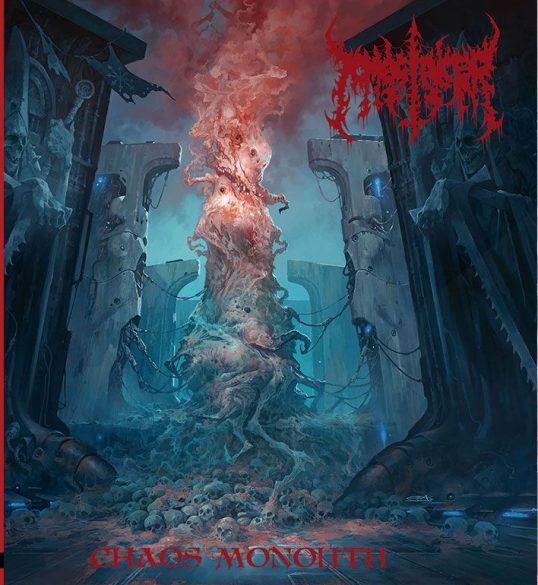
Formed in 2008, Lexington, Kentucky d-beat loving death dealers Tombstalker are just now getting around to releasing their sophomore effort, Chaos Monolith, (a follow-up to 2015’s Black Crusades), and we’re here to give you a first listen. The eight-track full-length features a revamped lineup—Conqueror Horus (vocals/guitars), Gruftspüre (guitars), Defiler (bass), Storm Bolter (drums/synths/cinematic)—which partially accounts for the decade-plus between releases. The intervening years between albums, however, haven’t blunted the band’s hyper-aggressive attack. This crusher spits nails from the majestic opening title track to the crusty closer “Eternal Enslavement.”
Chaos Monolith was recorded, mixed, and mastered by Jason Groves at Sneak Attack Studios. It’s set for release on CD and digitally via Awakening Records. Place your preorder here.
The band offered this take on its new effort:
“Chaos Monolith represents a culmination of all our inspiration and devotion we imbue in our expression of extreme metal and punk spirit after many years of uncertainty and strife. A sincere underground gem is now offered to the dark gods!”
Last year saw Crobot grace our shores for the first time in over six years and it’s been seven since I last spoke to their magnetic frontman, Brandon Yeagley. As always with our chats, it’s like we last saw each other last week as we discuss everything that’s happened to him and the band since … Continue reading Hella Rock Festival 2026 Interview: Brandon Yeagley of Crobot
There are few things more satisfying in progressive rock than watching musicians take a format that should be physically impossible and make it sound completely natural. On Sunday, September 20, Stick Men—Tony Levin, Pat Mastelotto and Markus Reuter—turned the UCSC Music Center Recital Hall into a laboratory for rhythm, texture and controlled sonic mayhem. The 8 p.m. Santa Cruz performance was part of the band’s Let’s THRAK Again tour, supporting the new album of the same name, a tribute to King Crimson’s 1995 album THRAK made with Robert Fripp’s blessing.
The evening began with “Improv,” an appropriate opening statement for a band whose live identity depends as much on interaction as composition. Rather than easing the audience into the evening, Stick Men immediately established the vocabulary: Levin’s Chapman Stick supplying bass weight and melodic counterpoint, Reuter’s touch guitar filling the upper register with everything from jagged attacks to atmospheric textures, and Mastelotto constructing an enormous rhythmic landscape from acoustic drums and electronics. The trio’s instrumentation gives them the sonic footprint of a much larger ensemble, while the visual reality remains three musicians locked together onstage.
“Cusp” and “Brutal” pushed that tension between precision and improvisation further. The music can be sharply angular one moment and surprisingly spacious the next. “Brutal” in particular lived up to its title, with Mastelotto’s drumming providing a relentless engine underneath Levin and Reuter’s interlocking lines.
Then came “Ringtone” and the title track, “Let’s THRAK Again,” which made the purpose of the tour unmistakable. The latter has the DNA of the King Crimson universe without simply functioning as nostalgia. Stick Men have taken that vocabulary—odd meters, muscular bass, metallic guitar textures and sudden dynamic shifts—and made it their own. The band describes its music as blending art rock and progressive rock with an emphasis on improvisation, and live, that description makes considerably more sense than any conventional genre label.
The middle of the set was particularly strong. “Crack in the Sky,” “Tentacles,” “Fandango,” and “Mantra” moved through contrasting moods without breaking the momentum. “Fandango” brought a different rhythmic character to the performance, while “Mantra” demonstrated how effectively the trio can create atmosphere without sacrificing their characteristic density.
The first of three King Crimson pieces, “VROOOM VROOOM,” followed. It’s drawn from THRAK itself, which tied it directly to the premise of the tour. Given Levin’s and Mastelotto’s histories with King Crimson, these songs aren’t generic covers. The connection is fundamental to the sound and history of Stick Men. The performance retained the piece’s mechanical intensity while giving Reuter considerable room to put his own stamp on the guitar textures.
The subsequent run of “The Well,” “Komodo,” “Swimming in Tea,” and “Prog Noir” was a showcase for the band’s newer material. “Swimming in Tea,” with its improvisational possibilities, was especially suited to the concert setting. Across the evening, the distinction between a written composition and an improvised performance seemed deliberately porous: themes emerged, fractured, disappeared and returned in altered forms.
The main set concluded with “Larks’ Tongues in Aspic, Part Two,” another King Crimson composition and perhaps the clearest bridge between Stick Men’s present and the musical history that helped create them. It was followed by a one-song encore: “Level Five.”
Ending with “Level Five” was fitting. The piece is built around propulsion and repetition, but in Stick Men’s hands those qualities become something almost physical. Mastelotto’s rhythmic attack, Levin’s formidable low-end presence and Reuter’s guitar work combined into the kind of dense, aggressive sound that makes a three-piece seem vastly larger than it is.
The Santa Cruz concert ultimately worked because Stick Men never treated technical ability as the point of the evening. The musicianship is obvious—almost unavoidable—but the performance was about what those abilities make possible: three players listening closely enough to one another to create music that can move from tightly arranged passages into spontaneous exploration and back again.
The 16-song performance, including the encore, covered material from Let’s THRAK Again, Prog Noir, Tentacles, Deep and the band’s King Crimson repertoire. The result was a concert that felt less like a conventional progressive-rock recital and more like an extended demonstration of what can happen when rhythm, technology and improvisation are given equal billing.
For a band built around instruments and techniques that can easily become exercises in virtuosity, Stick Men kept the emphasis where it belongs: on the music.
French dark folk ensemble SKÁLD have released a lyric video for “Dǫkksalir,” a new track from Ørlǫg, arriving on September 25, 2026, through Napalm Records. The song pairs gentle, lullaby-like melodies with a darker narrative centred on the seductive and threatening voices of sirens. The album marks SKÁLD’s first release for Napalm Records and precedes […]
Rush and its fans have hit the $1 million target for the Neil Peart Memorial planned for Lakeside Park in St. Catharines, Ontario, closing out a long fundraising push for the late drummer’s tribute.
The campaign officially wraps Oct. 15, 2026, and until then supporters can still give, including by buying a commemorative fan panel that will be engraved with a personal message on the memorial. Space is limited.
Geddy Lee and Alex Lifeson handed over a $785,000 check to the Neil Peart Commemorative Task Force Fundraising Sub-Committee and city staff after finishing their hometown Toronto run with an Aug. 13 show at Scotiabank Arena. On the band’s “Fifty Something” tour, a share of the proceeds from VIP experiences and packages went to the memorial, so fans who bought in helped build the tribute to the Rush drummer. Lee had also given $1 from every ticket sold on his fall 2023 My Effin’ Life book tour.
City manager for community programs and parks Eric Lamothe said the Rush donation pushed the campaign over the line:
“After years of dedicated work by the Neil Peart Commemorative Task Force and the incredible community support that brought us near the finish line, this remarkable contribution from Rush secures our $1-million fundraising goal,” Lamothe said.
“This public art memorial will be far more than a tribute to Neil Peart; it elevates the park into a world-class cultural landmark. We are thrilled to see a space that is already a beloved destination for residents and tourists become a global beacon for enthusiastic music fans to gather, reflect, and celebrate an icon for generations to come.”
City Council formed the task force after Peart died Jan. 7, 2020. It staged an official launch at Lakeside Park in September 2024 to kick off the fundraising drive for a public work of art in his honor.
The group ran a competitive selection process and picked Morgan MacDonald of The Newfoundland Bronze Foundry (Morgan Sculpture Inc.) in late 2022 to create the piece beside the Neil Peart Pavilion. The winning concept features two larger-than-life bronze sculptures of Peart, linked by a pathway with interactive and interpretive elements covering his personal and professional legacy, including his years in the band.
Task force chair Meg Symsyk said the memorial is meant to match his connection to the city: “Our mission has always been to build a physical tribute that does justice to Neil‘s immense legacy and his deep connection to St. Catharines. Neil was an extraordinary lyricist and Canadian poet, and “Lakeside Park” was, in many ways, a love letter back to this place. There is something incredibly powerful about standing here and experiencing the place behind those lyrics,” Symsyk said.
“We already see Rush fans from around the world making the journey to Lakeside Park and visiting the pavilion. This memorial will deepen that connection even further, creating a lasting destination for fans, residents and visitors to celebrate Neil and the music and words that continue to mean so much to so many.”
A staff report detailing next steps is due at a City Council meeting in September. City staff tentatively expect the memorial to open in late 2027.
Peart spent his formative years in St. Catharines and often spoke warmly of his summers in Port Dalhousie, which inspired the Rush song “Lakeside Park.” A Rock And Roll Hall Of Fame inductee and Order of Canada recipient, he is widely considered one of the greatest drummers ever.
I was stunned when Ezra Collective drummer Femi Koleoso told me he’s just 31 years old. (He’ll be 32 in October.) I’ve been listening to him for a decade, since the group’s 2016 debut EP, Chapter 7, and two albums he played on the following year, Nubya Garcia’s Nubya’s 5ive and Camilla George’s Isang. The bassist on those latter two releases was Daniel Casimir, but in Ezra Collective, Koleoso is joined by his brother TJ, as well as keyboardist Joe Armon-Jones, trumpeter Ife Ogunjobi (who replaced Dylan Jones on 2022’s Where I’m Meant To Be), and saxophonist James Mollison.
MYSTIC PROPHECY have released a lyric video for “March Or Die,” a new single from their forthcoming album, In Metal. The record arrives on November 27, 2026, through PERCEPTION – Powered by Reigning Phoenix Music, featuring three new members alongside vocalist R.D. Liapakis and guitarist Markus Pohl. Although the song uses battlefield imagery, its subject […]
Red Hot Chili Peppers is set to headline the Silverlake Conservatory of Music’s 25th-anniversary benefit concert alongside Dave Grohl and Vince Staples. The show goes down Oct. 17 at the Hollywood Palladium in Los Angeles.
Tickets are on sale now, with sponsorship packages and VIP options also available. Anyone who wants to donate to the school can do so at silverlakeconservatory.org.
The concert caps a milestone year for the conservatory, which has spent 25 years delivering music education to the Los Angeles community. Award-winning musicians Michael “Flea” Balzary and Keith “Tree” Barry founded the school in 2001 with help from their longtime friend Peter Weiss. It plugs holes in music programming across L.A. public schools and teaches more than 900 students each week. Its scholarship program supports over 200 kids whose families can’t cover the cost of lessons, supplying free instruction, instruments, supplies, ensemble classes and events.
The school normally throws a private benefit evening every year to raise the $1.5 million it takes to keep its programs running. Past headliners include Red Hot Chili Peppers, Patti Smith, Eddie Vedder, Neil Young, KD Lang, Bruno Mars, John Legend, Beck, Kamasi Washington and Tracy Chapman, among others.
For the 25th anniversary, the conservatory is skipping the private dinner and hosting its annual birthday party at the Hollywood Palladium instead. The organizers are billing it as a star-packed salute to the people who make up the heart of the school and the city it serves.
The Silverlake Conservatory of Music is a 501(c)(3) nonprofit dedicated to dynamic music education for beginners and advanced players of every skill level. Its main focus is local youth, though anyone can sign up. It offers affordable private lessons on all orchestral and band instruments, including voice, plus a range of ensemble classes. Qualifying children whose families couldn’t otherwise pay for lessons receive scholarships.
Funding comes from personal and corporate donations, instrument gifts and in-house fundraising, which has allowed the school to build a strong roster of committed young players while countering the decline of arts education in L.A. schools. Its stated goal is to keep teaching standards high in a friendly, fun, and supportive setting, on the belief that studying music enriches students, teachers, and the wider community.
“Tales Of Trees”, the second preview tune from Enslaved‘s forthcoming long player Mið, is out now and available for streaming together with an official music video directed by Marius Marthinussen Søreide. Read more…