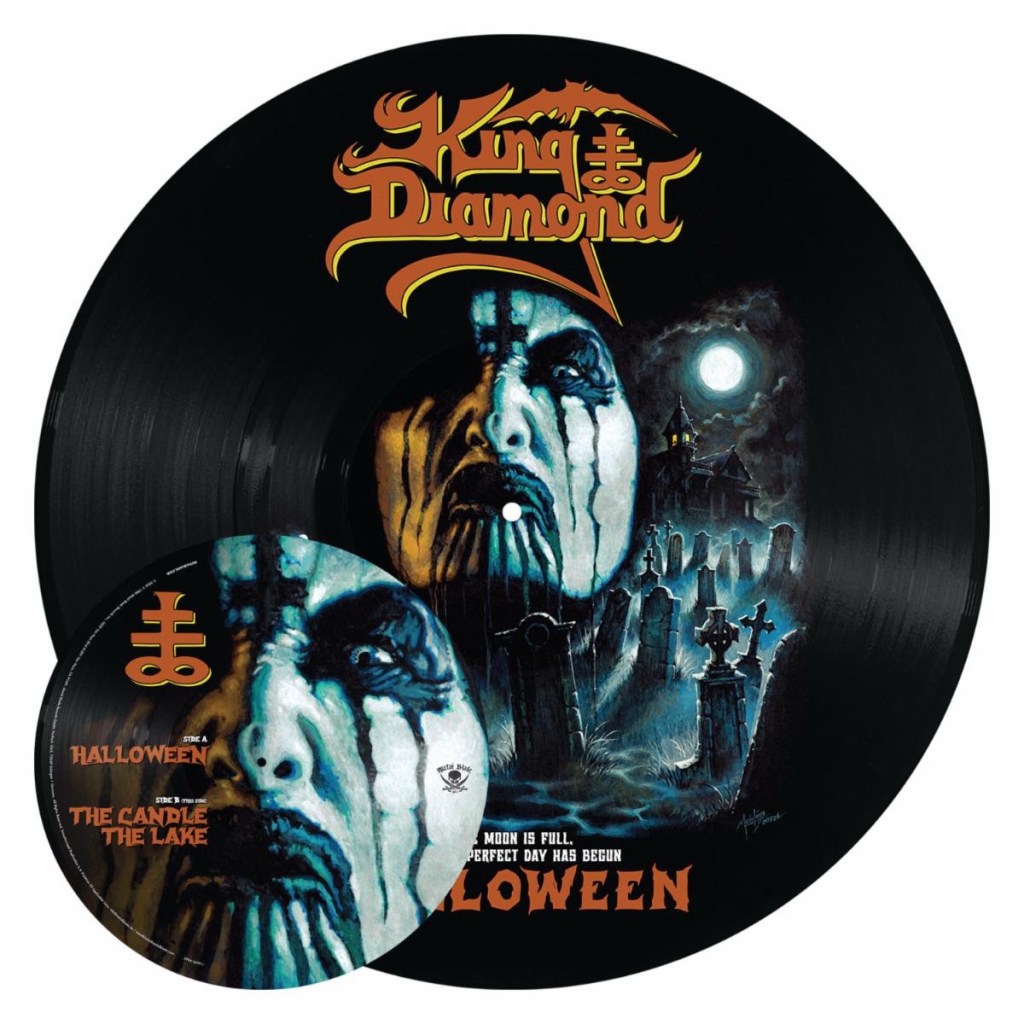
KING DIAMOND’s Halloween, the three-track LP picture disc originally released in 1986, will be re-released worldwide with new art by Mario Lopez on October 23rd via Metal Blade Records, just in time for the season!
The Halloween title track comes off KING DIAMOND‘s debut album, Fatal Portrait (1986), as does “The Candle,” which served as the opening track on Fatal Portrait, and was part of the early storytelling approach that would become central to KING DIAMOND‘s future discography. “The Lake,” while recorded during the same general period as Fatal Portrait and associated with those sessions, wasn’t included in the original nine-track album.
Halloween was produced by KING DIAMOND and Rune Höyer with production assistance by Michael Denner and engineered by Roberto Falcao.
Halloween LP Track Listing: A1. Halloween B1. The Candle B2. The Lake
KING DIAMOND Halloween Lineup: King Diamond – lead vocals, backing vocals Andy LaRocque – lead guitar Michael Denner – lead guitar Timi Hansen – bass guitar Mikkey Dee – drums
Photos thanks to Jake Miller (DWP) The 12th annual Louder Than Life festival took over the Kentucky Exposition Center in Louisville from September 17–20, delivering the largest lineup in the event’s history. Over four action-packed days, “America’s loudest rock and metal festival” hosted nearly 200 bands performing across seven massive stages. The record-breaking weekend was […]
It’s been a busy couple of years for Imminence, having re-recorded their first album, and the Swedish outfit continue to push the boundaries of the genre with Axis Mundi. Yes, this is the metalcore band with the violinist, and they’ve made the violin an integral part of their identity rather than a gimmick.
Imminence have clearly poured an enormous amount of ambition into Axis Mundi, and the band aren’t shy when it comes to exploring their emotional side, but it is wrapped up in a huge ball of intensity and distortion.
The album demonstrates straight away what’s in store. ‘Twisting in the Wind’ is soft and melancholic before it reveals its harsh reality. Vocalist Eddie Berg is absolutely devastating in his delivery. This continues with ‘The Sword That Never Bends’, a song which featured on the preceding four-track EP, If Not Now, When. If played live, it’s easy to imagine the chorus being bellowed back at them by the fans.
‘Devil May Try’ is a high point, erupting with a thunderous intro. Listeners of a certain age will be reminded of a certain hack ’n’ slash video game. In fact, the song suits Devil May Cry perfectly. The track marries crushing brutality with emotional elegance, weaving the two together in a seemingly intricate dance.
‘Crestfallen’, ‘False Light’ and ‘If Not Now, When’ complete the aforementioned EP. These are all strong songs, and that may be where it runs into a slight problem. The rest of the album struggles with repetition, except for ‘Didn’t Think About You (Lately)’, which actually feels out of place in the context of the rest of the record.
The issue isn’t the theme of the album: the duality works brilliantly well. The problem is the lack of variation. There is little change in the plodding atmosphere, with much of the album occupying a similar emotional and sonic space. Fans of that sound may find this to be the band’s strength. None of these songs are executed poorly. In fact, this is a band that has previously set its own bar extremely high. The issue is not one of quality, but of variation.
Despite this, the album ends strongly. ‘Power Divine’ highlights why Berg sometimes gets compared to Will Ramos of Lorna Shore. The emotion and control shown here are masterful.
Finally, ‘Exodus’ closes the chapter superbly. It’s huge, haunting, and Alex Arnoldsson’s guitar solo shows not only his technical ability, but his restraint – an overlooked skill in the world of lead guitarists. This all comes together with a stunning piano and violin duet.
It’s beautiful. It’s heartbreaking. But contained within is grace, hope, and a very promising future.
When it comes to vikings and metal, generally there is one band that everyone thinks of and that is Amon Amarth. For nearly 35 years, Amon Amarth have risen from an underground death metal act to one of the leading figures in Swedish melodic death metal with anthems centred about norse mythology meaning that they now command large stages and headline festivals with ease. They are a band that have barely strayed from their tried and trusted formula and their sound is as easily recognisable now as it was back in 1998 when they released their debut album.
“The Allfather Awakens” is the band’s thirteenth album and is one that sees the band far more focused and energised with some of the best songs they have released in a decade. Amon Amarth have been guilty of playing it safe and going through the motions on recent albums but it seems that the band have had theirs fires stirred as “The Allfather Awakens” is what I have been hoping to hear from Amon Amarth in a good while – soul stirring, epic and anthemic anthems with plenty of death metal grit and rousing melodies. The album starts as it means to go on with two songs which are destined to be Amon Amarth classics.
Album opener ‘Gjallerhorn’ is a song born for the concert hall with its anthemic woah oh section guaranteed to be reciprocated by the crowd and ‘Eight Legs Of Thunder’ is another rousing anthem which is just pure Amon Amarth. ‘Kvasir’s Blood’ has a darker and heavier feel to it but also contains one of the best melodic sections on the album and ‘We Rule The Waves’ is a wonderfully corny song with its “We are, we are vikings” chorus. The leftfield moment on the album comes in the form of ‘Upphaf’ which is Amon Amarth’s first acoustic song but fear not, they have not gone the road of the ballad but have created an atmospheric song that sounds like it was recorded under the stars and around a campfire. ‘DIe WIth A War Cry’ is a chunkier and groovier piece of melodeath goodness, ‘Raven God’ and the title track are fist pumping anthems, ‘Oden’s Hunt’ dishes back out the heaviness with it’s relentless double kick drum attack and the album finishes in epic style with ‘Ascending Like An Eagle’.
“The Allfather Awakens” sees Amon Amarth in tremendous form. Having maintained the same line up since 2016, the band are a well oiled machine. The furious roar of frontman Johan Hegg shows no signs of wear, the guitar work from Olavi Mikkonen and Johan Söderberg is as great as ever with crunching riffs, soaring melodies and killer leads whilst the rhythm section of bassist Ted Lundström and drummer Jocke Wallgren are devastating. As I mentioned earlier, Amon Amarth have played it a bit too safe on recent albums but on “The Allfather Awakens” the band sound awakened themselves. It doesn’t quite reach the heights of classic Amon Amarth albums such as ‘Versus The World, ‘With Oden On Our Side’ or ‘Twilight Of The Thunder God’ but it is the best the band have sounded in a good while and this album is chock full of fun metal anthems for you to raise your fist and drinking horns to.
Ozzy Osbourne made twelve solo studio albums across forty years and went through five lead guitarists doing it, and the argument about which songs actually hold up has never once been settled. This is my ranking of the 40 best Ozzy Osbourne solo songs, counting up from forty to one, and it covers everything from Blizzard of Ozz in 1980 to Patient Number 9 in 2022. No Black Sabbath — that’s a different band and a different argument. What I’ll say up front is that the song you’re expecting at number one is not at number one, and I’ve explained exactly why when we get there.
How This Is Ordered
One question decides it: does the song still work when you put it on today, with no nostalgia doing any of the lifting?
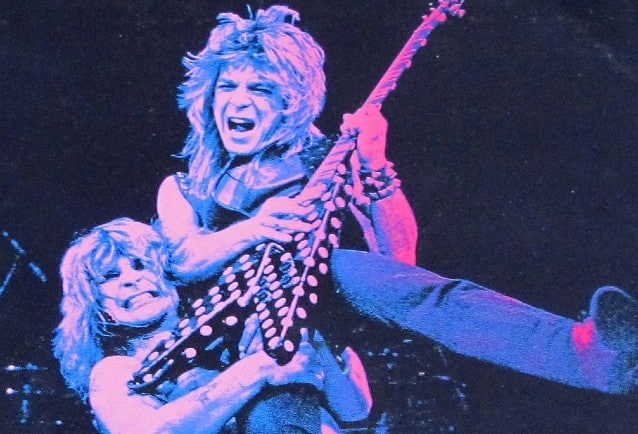
That means chart positions count for very little here. It means a couple of enormous radio songs sit lower than people will like, and a couple of album tracks sit higher. It also means the Randy Rhoads albums take up a lot of room at the top, because two records made in eighteen months by a man who died at 25 set a standard the next forty years kept measuring itself against.
The eras, so you know what’s coming: Randy Rhoads on the first two albums, Jake E. Lee on the next two, Zakk Wylde on the six after that, Gus G on Scream, and Andrew Watt producing and playing the last two.
This Is The Whole Career. The Era Guides Are Separate.
Worth saying before we start, because it changes what this page is for.
This ranking is about where a song sits in forty years of work. A Jake E. Lee track here is being measured against Randy Rhoads and against 2022, not against the other songs on Bark at the Moon. That’s a completely different question from how good the Jake era was on its own terms, and it produces a completely different order.
If the era is what you’re after rather than the career, we’ve done those separately and in much more depth:
This page doesn’t rank a single album and it doesn’t go deep on any one era. It answers one question and one only: across everything he ever released under his own name, which songs are the best? Every era entry below points you to the full breakdown rather than repeating it.
The Solo Albums At A Glance
Note what that column does. His chart peaks climb almost perfectly as the records get less essential. By the time he’s hitting No. 3 with regularity, nobody’s arguing about the songs any more. That gap between commercial position and actual quality is most of what this list is about.
Slash on guitar, Chad Smith on drums, and the first thing anybody heard from the comeback record. It’s a good, mean riff and Ozzy sounds more present than he had in a decade. It’s this low because it’s a very well-made song rather than a memorable one, and forty years of catalogue is a hard room.
39. Tonight (Diary of a Madman, 1981)
The ballad on Diary that nobody talks about, and there’s a reason — it’s the one moment on that record where the pace drops and the atmosphere goes with it. Rhoads plays beautifully on it. The song underneath him is ordinary.
38. Thunder Underground (Ozzmosis, 1995)
Ozzmosis opens heavier than its reputation suggests, and this is the proof. Geezer Butler on bass, Zakk digging in, and a low, grinding groove. It drags in the last minute, which is the whole album’s problem in miniature.
37. Hellraiser (No More Tears, 1991)
Co-written with Lemmy, and Motörhead’s own version is better, which is the polite way of saying Lemmy kept the best one. Ozzy’s take is a big dumb hook delivered with total commitment, and there’s nothing wrong with that.
36. Let Me Hear You Scream (Scream, 2010)
Gus G’s arrival, and he plays the daylights out of it. The song is built for arenas and lands exactly where it’s aimed. It’s the best thing on Scream and it still sits at 36, which tells you what Scream is.
35. Waiting for Darkness (Bark at the Moon, 1983)
The closer on Bark at the Moon, and the moodiest thing Jake E. Lee played on. It builds properly instead of just arriving. There’s more on that record worth your time than most people remember — we ranked the Jake E. Lee era on its own terms here.
34. Zombie Stomp (No More Tears, 1991)
Six and a half minutes of Zakk Wylde grinding one idea into the floor, and it works far better than it has any right to. The middle section is genuinely hypnotic. It’s also the track most likely to make someone skip ahead, and I understand that too.
33. Not Going Away (Black Rain, 2007)
Black Rain is the album where Ozzy went back to being angry on purpose, and this is the sharpest result. It’s mechanical in places. It’s also the last time before 2020 that a new Ozzy song sounded like it had a reason to exist.
32. Ordinary Man (Ordinary Man, 2020)
A duet with Elton John about knowing you’re near the end, released five years before he died. It’s a lot to sit with now. As a piece of music it’s over-produced and slightly stiff, and I’d be lying if I ranked it on how it makes me feel rather than how it sounds.
31. See You on the Other Side (Ozzmosis, 1995)
Co-written with Lemmy again, and the best ballad of the Zakk era by some distance. It’s patient, it’s genuinely sad, and Ozzy sings it without a single bit of showing off. Buried on an album most people gave up on by track four.
30. Dreamer (Down to Earth, 2001)
Ozzy’s attempt at ‘Imagine’, and I’ve watched rooms go quiet for it. The lyric is clumsy in places and the sentiment is laid on with a trowel. It still gets there, because he means every word and you can hear it.
The opening riff is one of Zakk’s heaviest and the verse does something genuinely odd with the phrasing. It’s a deep cut that rewards going back to it, which is more than most of the album’s back half manages.
27. You Can’t Kill Rock and Roll (Diary of a Madman, 1981)
Nearly seven minutes, and the title is the least interesting thing about it. Rhoads spends the whole song doing quiet, considered work — the arrangement keeps opening up and closing again. It’s the track on Diary that guitar players talk about and radio never touched.
26. I Don’t Want to Change the World (No More Tears, 1991)
Won him a Grammy in its live form and it’s the most straightforwardly fun thing on No More Tears. It’s also the least ambitious. Ranking it higher would mean rewarding a song for being loud, and there’s plenty of loud further up this list doing more.
25. Gets Me Through (Down to Earth, 2001)
“I’m not the kind of person you think I am” — a man of fifty-two opening an album by telling his audience he isn’t the character they bought tickets for. It’s the most honest thing he recorded in the 2000s and the riff underneath it is excellent.
24. The Ultimate Sin (The Ultimate Sin, 1986)
The title track, and a better song than the album around it. Jake E. Lee wrote genuinely intricate parts for this record and the 1986 mix flattened them into wallpaper. Listen to what he’s actually playing here and then be annoyed about it with me. The full Jake era ranking is over here.
23. Devil’s Daughter (No Rest for the Wicked, 1988)
Zakk Wylde’s first album opener, and he arrives swinging. There’s a squealing, unhinged quality to his playing here that he later refined into a signature and slightly lost in the process. This is him before anybody told him what he sounded like.
An anti-nuclear song that starts acoustic and ends up somewhere else entirely, and the most ambitious thing on either Jake E. Lee record. It’s overlooked because it sits on the album everyone dismisses. Go and find it.
20. Patient Number 9 (Patient Number 9, 2022)
Jeff Beck plays on it, which makes it one of the last major recordings Beck ever made, and he does what Beck always did — ignores the song and improves it anyway. It went to No. 1 on Mainstream Rock. The arrangement is a bit crowded, but the moment those two are in the same room is worth the entry.
19. Under the Graveyard (Ordinary Man, 2020)
The comeback song, and the first time in twenty years a new Ozzy track made people stop. It’s slow, it’s ugly in the right way, and the lyric about the man he used to be lands without any decoration. No. 1 on Mainstream Rock, and deserved it.
18. Road to Nowhere (No More Tears, 1991)
The closer on No More Tears, written as a goodbye when he thought he was retiring in 1992. He toured for another thirty-three years, which is very funny in hindsight and doesn’t make the song any less good. The last two minutes are among the best things Zakk played for him.
17. Believer (Diary of a Madman, 1981)
That bass intro, then Rhoads comes in over the top of it doing something completely unexpected. Diary is full of moments where you can hear a guitarist thinking, and this is the clearest one. Bob Daisley’s writing contribution across these records is a story he’s still telling, and it’s worth knowing.
16. Shot in the Dark (The Ultimate Sin, 1986)
One of his biggest rock radio songs of the eighties and a properly good pop-metal record. It sits at 16 rather than higher because it sounds exactly like 1986, in a way that the Rhoads material and even the No Rest material managed to avoid. I played this a lot. It hasn’t aged as well as I wanted it to.
15. S.A.T.O. (Diary of a Madman, 1981)
Pure momentum. The riff does not let up for four minutes and Rhoads’ solo is the most aggressive thing on either of his albums. It’s the Diary track that people discover last and then play constantly.
14. Miracle Man (No Rest for the Wicked, 1988)
Ozzy going directly after a televangelist who’d spent years attacking him, at the exact moment that preacher’s career collapsed. It’s vicious, it’s funny, and it introduced Zakk Wylde to the world with one of the best riffs of his life. Revenge songs are rarely this good.
13. Perry Mason (Ozzmosis, 1995)
The strongest thing on Ozzmosis by a mile and the best Zakk-era opener. That descending riff, the strings underneath it, the way the chorus opens up — it’s a genuinely well-built song, and it reached No. 3 on Mainstream Rock. If you wrote off the mid-nineties, start here.
12. Revelation (Mother Earth) (Blizzard of Ozz, 1980)
Six minutes that start as a piano ballad and finish with Rhoads playing the most classically-minded solo in the catalogue. It’s the track that proves Blizzard of Ozz wasn’t a hard rock record with good guitar on it — it was a composed album, and Rhoads was arranging, not just soloing.
11. Goodbye to Romance (Blizzard of Ozz, 1980)
His goodbye to Black Sabbath, written while he was still raw about it, and the most emotionally direct thing he ever put on tape. Rhoads plays the outro like he knows exactly what the song is about. Every Ozzy ballad that came afterwards was trying to get back here.
10. Mama, I’m Coming Home (No More Tears, 1991)
His highest-charting solo single, No. 28 on the Hot 100, with a lyric written by Lemmy. It’s a big soft rock ballad and it is completely unembarrassed about it, which is why it works. Thirty-five years on it still stops a room, and after July 2025 it does something else entirely.
9. Flying High Again (Diary of a Madman, 1981)
The most purely enjoyable song he ever recorded. The riff bounces, the chorus is enormous, and Rhoads’ solo is a masterpiece of economy — it says everything in about twenty seconds and gets out. Not a wasted bar anywhere on it.
8. I Don’t Know (Blizzard of Ozz, 1980)
Track one, side one, first song of the solo career, and it’s a statement. The riff is all angles and stops, nothing about it is obvious, and it announced immediately that this was not going to be Sabbath with a different logo. Openers this confident are rare.
7. Suicide Solution (Blizzard of Ozz, 1980)
Widely misread for four decades. It’s a song about drinking yourself to death, written in the shadow of Bon Scott’s death earlier that year, and Ozzy always described it as a warning rather than an endorsement. Lawsuits brought against him over it were dismissed. Set all of that aside and what’s left is a heavy, lurching, genuinely unsettling piece of music, and one of Rhoads’ best performances.
6. Bark at the Moon (Bark at the Moon, 1983)
Jake E. Lee’s finest three and a half minutes and the hardest job in rock history — following Randy Rhoads. That opening riff is one of the fastest, cleanest things anybody played in 1983, and the song is built like a proper piece of theatre. He never got the credit Rhoads or Wylde got.
This is the only Jake E. Lee song in the top ten of a forty-year catalogue, which is the whole point of measuring it this way. Whether it’s also the best thing he did with Ozzy is a separate argument we’ve had in full.
5. No More Tears (No More Tears, 1991)
Seven and a half minutes, that bass line, and a structure that has no business working. It’s the most ambitious song of the Zakk era and the last time Ozzy made a record that genuinely moved forward. The keyboard section in the middle should be ridiculous and instead it’s the best part.
4. Over the Mountain (Diary of a Madman, 1981)
Lee Kerslake’s drum intro, and then the whole thing takes off and doesn’t come down. It’s the fastest, most joyful song on either Rhoads album, and Rhoads plays it like a man who has worked out he can do absolutely anything. If you want one track to explain why guitarists still talk about him, it’s this.
3. Diary of a Madman (Diary of a Madman, 1981)
The last song Randy Rhoads finished for Ozzy, and it’s the most serious piece of music in the catalogue. Classical guitar, an actual choir, a structure that goes somewhere rather than repeating, and an ending that genuinely unsettles you. He died five months after it came out, at 25. Nobody has made a heavy metal song quite like this since, and a lot of people have tried.
2. Crazy Train (Blizzard of Ozz, 1980)
The most famous song he ever recorded and one of the ten most recognisable riffs in the genre. It made him a solo star inside a month, it got to No. 39 on the Hot 100 in an era when metal did not get near the Hot 100, and it has been played at every sporting event on earth since. It’s perfect and I’m not taking anything away from it.
It’s at two because of what’s at one.
1. Mr. Crowley (Blizzard of Ozz, 1980)
Here’s the argument.
‘Crazy Train’ is the song that sold Ozzy Osbourne. ‘Mr. Crowley’ is the song that proved what the band could actually do. It opens on a church organ, moves into a riff that’s genuinely menacing rather than just heavy, and then Rhoads plays two solos — one in the middle and one that carries the song out — that are still, forty-six years later, the two most studied pieces of guitar in heavy metal. Guitar students learn ‘Crazy Train’ in a week. They spend years on this.
And it’s not a technical exercise. The outro solo is a piece of composed music with a shape and a destination, played with a tone nobody has properly copied. That was the whole point of Randy Rhoads — he brought structure to a genre that mostly ran on instinct, and this is the clearest four and a half minutes of evidence.
Ozzy sings it like he believes it, too, which matters more than it sounds. There’s no wink in this performance.
Put ‘Crazy Train’ on and you get a great song. Put this on and you hear the moment heavy metal realised it could be composed. That’s the difference, and that’s number one.
What Didn’t Make It
‘Dee’, the ninety-second acoustic piece Rhoads wrote for his mother, is beautiful and is left off because it’s an interlude rather than a song. ‘Fire in the Sky’, ‘Time After Time’, ‘Old L.A. Tonight’ and ‘Diggin’ Me Down’ were all in the last ten and all came out. Under Cover is excluded because it’s covers, and Speak of the Devil is excluded because it’s live Black Sabbath material.
No Sabbath songs here at all, before anyone asks. ‘War Pigs’ and ‘Paranoid’ belong to four men, not one.
Forty songs across forty years, and the two best ones were both recorded in 1980 by a man who’d just been sacked from his own band and a guitarist who had five months left to live when the follow-up came out. That’s the story of this catalogue, and nothing after 1981 quite got back to it.
TL;DR
Forty Ozzy Osbourne solo songs ranked from twelve studio albums, 1980 to 2022. No Black Sabbath material.
‘Mr. Crowley’ is the best Ozzy Osbourne solo song, ahead of ‘Crazy Train’, on the strength of Randy Rhoads’ two solos and the song’s composition.
The Randy Rhoads albums take nine of the top twelve places, from eighteen months of work.
‘Mama, I’m Coming Home’ is his highest-charting solo single at No. 28 on the Hot 100; ‘Crazy Train’ reached No. 39.
The chart peaks of his albums rise as the songs get weaker — his last four studio albums all reached the US top four.
Ozzy died on 22 July 2025, aged 76, seventeen days after his final show at Villa Park.
FAQ
What is Ozzy Osbourne’s best solo song?
‘Mr. Crowley’ from Blizzard of Ozz, released in 1980. It has the two most studied guitar solos in heavy metal, both played by Randy Rhoads, and it’s the song that proved Ozzy’s solo band could build composed music rather than straightforward hard rock. ‘Crazy Train’ is more famous and ranks second here.
How many solo albums did Ozzy Osbourne make?
Twelve solo studio albums of original material, from Blizzard of Ozz in 1980 to Patient Number 9 in 2022. That count excludes Under Cover, a 2005 covers album, and Speak of the Devil, a 1982 live record of Black Sabbath songs.
What was Ozzy Osbourne’s biggest solo hit?
‘Mama, I’m Coming Home’ from No More Tears, which reached No. 28 on the Billboard Hot 100 in 1991 and No. 2 on Mainstream Rock. It’s his highest-charting solo single. ‘Crazy Train’ peaked at No. 39 on the Hot 100.
Who were Ozzy Osbourne’s solo guitarists?
Randy Rhoads played on Blizzard of Ozz and Diary of a Madman before his death in March 1982. Jake E. Lee played on Bark at the Moon and The Ultimate Sin. Zakk Wylde played on six albums from No Rest for the Wicked through Black Rain. Gus G played on Scream, and Andrew Watt handled guitar and production on Ordinary Man and Patient Number 9.
When did Ozzy Osbourne go solo?
In 1979, after being fired from Black Sabbath. His first solo album, Blizzard of Ozz, was released on 12 September 1980 and reached No. 21 on the Billboard 200.
Forty songs and I’ve put ‘Crazy Train’ at number two, so I already know how this goes. Tell me where I’m wrong in the comments, and tell me which one I’ve buried too far down. Follow Loaded Radio for daily rock and metal news.
Last month, progressive trailblazers Enslaved officially announced their forthcoming studio album, Mið, set for release on October 30 via Nuclear Blast Records. Throughout their 35-year journey, across 17 albums, the Norwegian vanguard have continually redefined the boundaries of progressive black metal, weaving Old Norse histories and sacred traditions into complex modern soundscapes. With their latest offering, Enslaved turn their gaze toward the fundamental concept of the axis: the middle, the origin, and the infinite reach of the present moment.
Building on the momentum of their latest tracks ‘Solar Will’ and ‘Spirit Helper’ (feat. Kevin Kicking Woman)’, the band have now unveiled the album’s next captivating single, ‘Tales Of Trees’. The song uses the majesty and fragility of the natural world as a mirror for the human condition. Through a blend of complex progressive structures and searing black metal atmosphere, the band draws a poignant parallel between Mother Nature and the psyche.
Voicalist / bassist Grutle Kjellson states:
“Tales of Trees is indeed tales about trees, but perhaps not first and foremost in a botanical sense. Trees can grow, shine, and flourish, but they can also wither and burn. They need to be tended to and looked after in one way or another, and thus serve as a fitting parallel to the human mind, let alone humanity as a whole. Trees as symbols of something more than mere botanical creatures have appeared throughout history, both in mythological tales and in folklore. So, I think this tale is a fitting accompaniment the the heavy and yet dynamic tunes of this composition”
Guitarist Ivar Bjørnson adds:
“‘Tales of Trees’ can be both a tribute to our wooden relatives on this planet – who have had rather a lot of patience with us; and a metaphor for so much more. The winding time signatures of folk music and the adventurous spirit of classic prog are natural ingredients in my songwriting, and they feel particularly at home here.There is something about our kinship with trees that is both deeply familiar and wonderfully strange: everyday encounters with something we barely understand. That sense of recognition and mystery is at the heart of this song, opening another path into the world of ‘Mið’.”
1. Non-Being
2. I Am Ice (featuring Johan Sara Jr)
3. Solar Will
4. Mountain
5. Spirit Helper (featuring Kevin Kicking Woman)
6. Parting
7. Tales of Trees
8. I Miðju
To celebrate the arrival of Mið, Enslaved will hit the road across the UK and Europe in February 2027 as a co-headline with Iceland’s Sólstafir, with support coming from Norway’s Gaahls Wyrd.
Enslaved commented:
“Europe! In February we are heading out on a co-headlining tour with our good friends in Sólstafir. There is a kinship here that goes beyond a shared enthusiasm for questionable weather: the belief that music should be allowed to find its own path, even when it refuses to explain where it is going. Bringing ‘Mið’ into that company, and into a room with all of you, feels very right. Making a record is one part of the adventure; discovering what happens to it when we meet you out there is another. That exchange still means everything to us. See you in the flesh!”
Tickets will go on-sale on September 25 at 9am BST / 10am CEST from https://enslaved.no/
ENSLAVED & SÓLSTAFIR
CO-HEADLINE TOUR 2027
w/ Gaahls Wyrd
04/02/27 – DE Berlin, Festsaal
05/02/27 – DE Leipzig, Felsenkeller
06/02/27 – DE Hamburg, Fabrik
07/02/27 – DK Copenhagen, Amager Bio
08/02/27 – DE Frankfurt, Batschkapp
09/02/27 – FR Strasbourg, La Laiterie
11/02/27 – FR Rennes, Antipode
12/02/27 – FR Clermont-Ferrand, La Cooperative de Mai
13/02/27 – FR Toulouse, Le Metronum
14/02/27 – ES Barcelona, Razzmatazz 2
16/02/27 – FR Paris, Elysee Montmartre
17/02/27 – UK London, Electric Ballroom
18/02/27 – BE Liege, OM
19/02/27 – NL Nijmegen, Doornroosje
20/02/27 – NL Utrecht, Tivoli Pandora
21/02/27 – DE Cologne, Live Music Hall
23/02/27 – CH Solothurn, Kofmehl
24/02/27 – IT Milan, Magnolia
25/02/27 – AT Vienna, SIMM City
26/02/27 – PL Warsaw, Progresja
27/02/27 – CZ Brno, Fleda
18 years ago, Scarlett Johansson released Anywhere I Lay My Head, her unexpected debut album made up of Tom Waits covers. Now, the actress is co-starring in the new animated Netflix movie Ray Gunn with the legendary singer-songwriter.
Chad Gilbert, founding guitarist of New Found Glory and vocalist for Shai Hulud, died this week due to complications from brain cancer. Today, his ex-wife, Hayley Williams, has posted a written tribute to Gilbert.

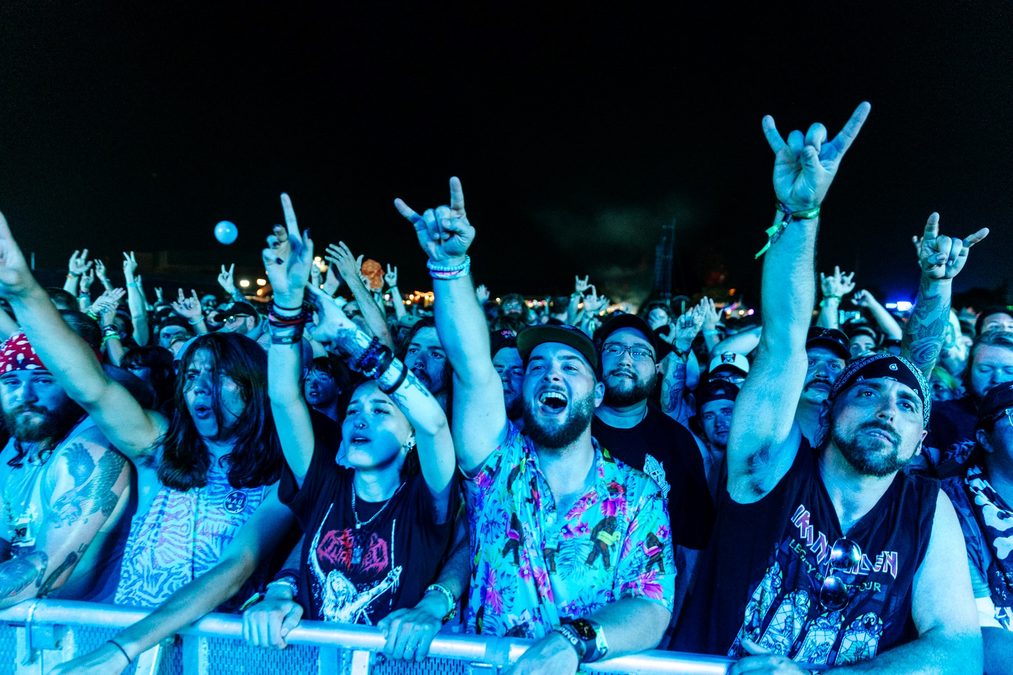 Photos thanks to Jake Miller (DWP) The 12th annual Louder Than Life festival took over the Kentucky Exposition Center in Louisville from September 17–20, delivering the largest lineup in the event’s history. Over four action-packed days, “America’s loudest rock and metal festival” hosted nearly 200 bands performing across seven massive stages. The record-breaking weekend was […]