Blog

  • The Death of the Major Oak: The Legendary Tree of Robin Hood Falls Silent

    The Death of the Major Oak: The Legendary Tree of Robin Hood Falls Silent

    For centuries, visitors entered Sherwood Forest searching for a single tree. It was not the tallest oak in England, nor the oldest tree in Europe. Yet few trees anywhere in the world carried a greater weight of history, folklore, and imagination than the Major Oak.

    Now, after standing for an estimated 1,200 years, experts believe the legendary oak has finally died. The Royal Society for the Protection of Birds (RSPB), which has managed the Sherwood Forest National Nature Reserve on behalf of Nottinghamshire County Council since 2018, announced that the tree failed to produce leaves this spring after years of visible decline.

    Its death marks far more than the loss of an ancient tree. It represents the disappearance of one of Britain’s most recognizable living legends—a natural monument that survived Viking invasions, medieval kings, civil wars, industrialization, and modern tourism before finally succumbing to age and environmental pressures.
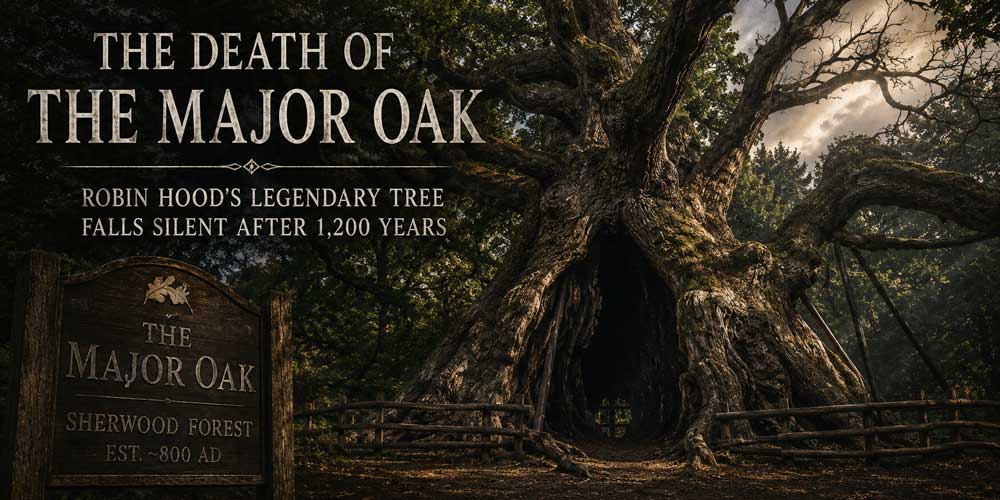
    Atmospheric illustration of the Major Oak in Sherwood Forest, the legendary ancient tree linked to Robin Hood, showing its massive hollow trunk beneath dramatic skies after its reported death.


    An Oak Older Than the Robin Hood Legend

    Although the Major Oak is forever linked with Robin Hood, the tree itself is almost certainly older than the legend that made it famous.

    Most experts estimate the oak germinated between the ninth and eleventh centuries, placing its origins around the late Anglo-Saxon period. At that time England was still divided into competing kingdoms, while Viking settlements remained active across large parts of the country.

    By the time stories of Robin Hood began appearing in medieval ballads during the fourteenth and fifteenth centuries, the oak was already a mature giant dominating Sherwood Forest.

    Its immense hollow trunk naturally inspired local folklore. Long before becoming a tourist attraction, people imagined the tree as a place where fugitives, hunters, travelers, or outlaws could disappear within the forest.

    Whether Robin Hood ever stood beneath its branches remains impossible to prove. Yet the tree became inseparable from the legend because it perfectly embodied the image of a hidden refuge deep within England’s most famous woodland.


    Why the Major Oak Became a Symbol

    The Major Oak was extraordinary not simply because of its age but because of its remarkable physical appearance.

    Its massive trunk eventually became almost completely hollow, creating a vast internal chamber large enough for several adults to stand inside. The canopy stretched across an enormous area, while the trunk grew to nearly eleven meters in circumference.

    As the centuries passed, the oak became increasingly fragile. Heavy branches required elaborate support systems to prevent collapse under their own weight. Modern visitors often saw metal braces and wooden supports holding portions of the tree together, a reminder that even legendary giants require protection.

    Unlike many historic landmarks built from stone, the Major Oak remained a living organism. It continued growing, healing, adapting, and aging throughout its long existence, making its survival all the more remarkable.

    Its gradual decline therefore became visible long before its death was officially announced. Each passing year revealed the enormous challenge of preserving a living monument that had already survived more than a millennium.


    What Finally Killed the Major Oak?

    Scientists emphasize that no single event caused the death of the Major Oak.

    Age alone placed the tree under enormous biological stress. Few oaks survive for more than a thousand years, and even healthy ancient trees become increasingly vulnerable as their internal structures slowly weaken.

    Environmental pressures compounded these natural challenges. More than a century of intensive tourism gradually compacted the sandy soil surrounding the tree, reducing the amount of water, oxygen, and nutrients reaching its already weakened root system. Recent investigations by soil scientists revealed that the roots were far smaller and less healthy than previously believed.

    Climate change also appears to have played a significant role. Recent years have brought increasingly unpredictable weather patterns to Britain, including prolonged droughts followed by intense rainfall. Ancient trees often struggle to adapt quickly to such rapid environmental changes.

    The extensive support structures installed around the oak over many decades prolonged its life considerably, but conservation can only delay the natural aging process. Eventually, even one of Europe’s most carefully protected trees reached the limits of its biological lifespan.


    The Robin Hood Myth That Changed Everything

    The Major Oak achieved worldwide fame because of its association with Robin Hood, England’s legendary outlaw.

    According to popular tradition, Robin Hood and his Merry Men used the hollow oak as a secret meeting place and refuge while resisting the Sheriff of Nottingham. Although medieval sources never identify the Major Oak specifically, later generations embraced the story so completely that the tree became one of the defining landmarks of the Robin Hood legend.

    Its appearance seemed almost designed for folklore. Hidden deep within Sherwood Forest, massive enough to shelter numerous people, and ancient beyond memory, the oak embodied everything audiences imagined about medieval England.

    As Robin Hood evolved from medieval ballads into novels, films, television series, and popular culture, the Major Oak became one of the most photographed trees in the world, visited by hundreds of thousands of people each year who hoped to stand beneath the branches of living legend.


    Sherwood Forest Before Robin Hood

    Although Robin Hood made Sherwood Forest famous, the woodland possessed a remarkable history long before medieval legends transformed it into the home of England’s greatest outlaw.

    Following the Norman Conquest of 1066, much of Sherwood became a royal hunting forest reserved for kings and noble families. Strict Forest Laws governed the land, limiting hunting rights and imposing severe punishments on ordinary people who killed deer or damaged royal property.

    These harsh regulations helped shape the Robin Hood legend itself. The outlaw became a symbol of resistance against unjust authority, defending common people from officials who controlled both wealth and access to the forest.

    Whether the historical Robin Hood ever existed remains uncertain, but the social tensions that inspired the legend were very real. The Major Oak stood silently through this period, witnessing centuries of changing rulers, shifting laws, and evolving folklore.


    Lesser-Known Facts About the Major Oak

    Despite its international fame, several fascinating details about the Major Oak remain unfamiliar to many visitors.

    For much of its history, the tree was not known as the Major Oak at all. Earlier generations referred to it as the Cockpen Tree, probably because local game birds roosted among its enormous branches. The name “Major Oak” only became popular during the nineteenth century after Major Hayman Rooke, an antiquarian and historian, documented the remarkable tree while studying Sherwood Forest.

    The oak was also an extraordinary ecosystem in its own right. Ancient hollow trees provide habitats that younger woodlands cannot replace, supporting hundreds of species of insects, fungi, mosses, lichens, birds, and bats. Even as parts of the tree gradually died, other forms of life continued thriving within its decaying wood.

    Conservation efforts surrounding the Major Oak were among the most extensive ever undertaken for a single tree in Britain. Over many decades, engineers installed an intricate network of wooden props, steel supports, and carefully designed braces to reduce the enormous weight carried by its aging limbs. These interventions likely prolonged the tree’s life by many years.

    Every autumn, the oak continued producing thousands of acorns despite its advanced age. Many have been collected over the years and grown into young descendants now planted throughout Britain and beyond, ensuring that the Major Oak’s genetic legacy will survive long after the original tree has fallen silent.


    Ancient Trees in Gothic Tradition

    Few natural objects occupy such an important place in Gothic imagination as ancient trees.

    Unlike castles or cathedrals, living trees continue changing throughout the centuries. They grow, decay, heal, and adapt while silently witnessing generations of human history. Their immense age gives them an almost supernatural presence, making them appear as guardians of forgotten worlds.

    Across European folklore, ancient oaks were frequently associated with spirits, hidden kingdoms, sacred rituals, and mysterious encounters. Their twisted branches, hollow trunks, and immense roots encouraged stories of ghosts, druids, fairies, and supernatural beings living beyond ordinary perception.

    The Major Oak naturally became part of this tradition. Its enormous hollow trunk seemed almost designed for legends, while its weathered silhouette embodied the Gothic fascination with endurance, decay, and memory.

    Like ruined abbeys or abandoned castles, ancient trees remind us that time eventually transforms even the greatest monuments into fragile relics of the past.


    Why People Mourn Famous Trees

    The death of the Major Oak has generated an emotional response that extends far beyond environmental concern.

    People rarely mourn ordinary trees they have never seen. Yet iconic trees become woven into cultural memory. They witness history without participating in it, offering a rare sense of continuity in a constantly changing world.

    Standing beneath the Major Oak allowed visitors to experience something that connected the modern world with medieval England. The same living organism had survived while kingdoms rose and fell, languages evolved, and legends spread across centuries.

    Its death therefore feels symbolic. It reminds us that even the oldest living landmarks remain vulnerable to time, environmental change, and human activity.

    Yet the story does not end with the loss of a single tree. Through its descendants, its place in folklore, and the enduring legend of Robin Hood, the Major Oak continues to occupy a unique place within Britain’s natural and cultural heritage.


    The Legacy of the Major Oak

    The death of the Major Oak marks the end of an extraordinary chapter in Britain’s natural history, but it does not mark the end of its story.

    For more than a millennium, the tree stood as a silent witness to the changing fortunes of England. It survived Viking settlements, Norman kings, medieval conflicts, the Black Death, the Wars of the Roses, the English Civil War, the Industrial Revolution, and the modern age. Long after the people who sought shelter beneath its branches had vanished, the oak remained.

    Its significance has never rested solely on its remarkable age. The Major Oak became a meeting point between history and legend, where documented reality and folklore blended into a shared cultural memory. Whether Robin Hood truly stood beneath its canopy matters less than the generations who believed he might have.

    The tree also reminds us that conservation has limits. Even with decades of careful management, extensive support systems, and scientific monitoring, no living organism can escape time forever. Ancient trees are among the most resilient living things on Earth, yet they remain vulnerable to age, environmental change, disease, and the cumulative impact of human activity.

    Although the original oak may no longer stand, its descendants continue growing from acorns collected over many years. In this way, the Major Oak leaves behind not only a legend but a living legacy that will continue taking root for generations to come.


    Wear the Darkness

    If the story of the Major Oak speaks to your love of ancient forests, Gothic folklore, Robin Hood, and forgotten legends, explore the Edgar Allan Poets store. Our designs celebrate dark history, Gothic aesthetics, mysterious landscapes, and the timeless beauty of the natural world.


    Edgar Allan Poe Gothic apparel and noir-inspired fashion from the Edgar Allan Poets store


    Join the Noir Newsletter

    Receive more essays exploring Gothic history, ancient folklore, legendary places, mysterious landscapes, Edgar Allan Poe, and the forgotten stories that continue shaping the Gothic imagination.


    Frequently Asked Questions

    How old was the Major Oak?

    Most experts estimate the Major Oak was between 1,000 and 1,200 years old, making it one of Britain’s oldest and most celebrated oak trees.

    Did Robin Hood really hide inside the Major Oak?

    There is no historical evidence proving Robin Hood used the Major Oak. However, its enormous hollow trunk made it a perfect setting for the legend, and the tree has been associated with the outlaw for centuries.

    Why did the Major Oak die?

    Scientists believe the tree died from a combination of extreme age, environmental stress, heavy visitor pressure, changing climate conditions, and the natural decline that affects ancient trees.

    Why was the Major Oak so important?

    Beyond its remarkable age, the Major Oak became an international symbol of Sherwood Forest and the Robin Hood legend. It also served as an important habitat supporting hundreds of species of wildlife.

    Will the Major Oak continue to exist?

    Although the original tree has reached the end of its life, many young oaks grown from its acorns continue to thrive, preserving its genetic lineage for future generations.


    The post The Death of the Major Oak: The Legendary Tree of Robin Hood Falls Silent appeared first on Edgar Allan Poets – Noir Rock Band.


  • How The Pineapple Thief’s Bruce Soord fought off stage fright and became a rock star

    In 2016 The Pineapple Thief were on the verge of breaking through with their 11th album, Your Wilderness, their first to feature Gavin Harrison. Of course, leader Bruce Soord couldn’t know what the future held, and so Prog found him in a reflective mood – a little bewildered but still hopeful.

    Bruce Soord used to get terrible stage fright. The sort of crippling sense of dread and panic that partly explained why his band The Pineapple Thief only used to play a handful of gigs a year. It manifested itself as a nagging, foreboding tension deep in his stomach that only got worse as stage-time approached. It provoked the sort of existential crisis no performer wants to go through. “You think, ‘Why am I doing this? Why am I touring? Why am I going on stage?’” he says today. “It’s horrible.”

    All that changed a few years ago when TPT were booked to play a festival in Germany. It was one of the biggest shows they’d played to date. “I don’t know how our agent got it,” says Soord. “It was a mainstream festival. Before we went on, there was this ‘Whooah-oah-oah’-type band playing, and everyone was into it. And we were following them with our prog rock. I was at the side of the the stage going, [puts face in hands] ‘Oh god.’ And we went on and fucked it right up. It went down like a lead balloon. Someone even threw a bottle at me. That’s the only time that’s ever happened.”

    When the band came off stage, they knew something had to be done. They were booked to play another festival a couple of weeks later, and Soord knew that if that happened again, then “that would be it, it’s going to be over”. He decided to take drastic action. He decided to tap into his inner rock star.

    “The next gig I went onstage and just went ‘Come on!’ It was, like, ‘Fuck you, I’m Bruce Soord – like it or fuck off,’ rather than [apologetic voice] ‘I hope you like it.’” He smiles sheepishly. “It sounds really cheesy.” He’s right: it does sound cheesy. But it worked. He got over his stage fright.

    Soord makes for an unlikely rock star. Sprawled on the bed of his hotel room, the day after The Pineapple Thief’s headline appearance at Barcelona’s Be Prog! My Friend festival, he looks more like a typical Englishman on holiday: stripy T-shirt, scrawny legs poking out the bottom of his shorts (although his tan is surprisingly healthy for someone who describes themselves as “a bit of a studio nerd”). In truth, he doesn’t carry himself like a rock star either. He’s unfailingly polite and thoughtful, and always seems on the verge of apologising for something, even when there’s nothing to apologise for.

    But 18 hours earlier, a rock star is exactly what Bruce Soord looked like. Onstage at the Be Prog! My Friend festival, backed by a vast screen that pulsated with colour, Soord was magnetic. Restless and electrifying, wrangling his guitar like it had a thousand volts pumping through it at any given time, this was as far away from prog’s usual introspection as it gets. His face lights up at the memory.

    “When we came off that stage, we were, like, ‘Why can’t we have this more often?’ We’ve paid our dues. We’ve toured the shit holes in a crappy bus, playing to 50 or 100 people. You’re just chipping away at the surface when you do that. But this felt like going to another level.”

    It’s ironic that Soord has stepped up to the plate just as his band have made an album that delves into their prog past. Where 2014’s Magnolia was a brazen and unashamed rock record, the follow-up Your Wilderness – their 11th LP – is all moods and textures. It’s a 21st-century prog record for sure, but a prog record it undeniably is.

    “I grew up listening to prog, but also to mainstream rock,” says Soord. “And for the last three Pineapple Thief records, we tried to cross over to rock. I think a lot of people who weren’t into prog rock really loved it – but a lot of people in the prog rock world have gone, ‘This isn’t prog!’”

    So has he backpedalled with the new album? He laughs. “No. I felt like I’d written those rock songs – if I tried to do another Magnolia, it would have been the same songs but not as good. So I said to the guys, ‘I’m going to remember what used to excite me when I was a kid growing up in the 80s, which was prog rock.’ So I put myself into the mindset of having a prog rock attitude.”

    Which is what? “Not giving a fuck what people think. Or that it’s okay to play notes on a guitar longer than you would in a rock song, before the money shot comes in. It’s our 11th record. I can do whatever the fuck I want.” As soon as he says it, he looks a little sheepish.

    Steven Wilson and Opeth busted their arses touring. I didn’t do that. I guess you get what you deserve

    A few things have changed for Soord in recent years. He released his first solo album in 2015, inspired by his love of Beck (“Half of my brain wanted to take the songs in a direction that wasn’t The Pineapple Thief, so I decided to take half my brain and put it over there”), collaborated with Jonas Renske of Swedish doom-metallers Katatonia on The Wisdom Of Crowds (“He loves singer-songwriters, which you wouldn’t guess to look at him”), and began to remaster other band’s records, most notably the reissue of Opeth’s Deliverance. But the biggest change in Soord’s life was that he finally got chance to quit his day job in IT and take up music.

    “It always felt productive,” he says. “You spend seven hours a day doing something you don’t want to be doing while your brain wants to make music. When you get home, you’ve got so much energy: ‘Come on, let’s write this song!’ Weirdly, going full time, that’s gone. I remember thinking, ‘I’m going to have so much spare time that I’ll be able to write 10 albums a year. It’ll be so easy.’ But it isn’t. Even with this album, it was hard to get started. You should be careful what you wish for.”

    If he sounds downbeat, he’s not – 17 years into The Pineapple Thief, and Soord has carved out a niche for himself alongside the Steven Wilsons, Anathemas and Opeths of this world. But is he happy where he finds himself these days?

    “The stock answer is that I’m really grateful that we’re where we are. Commercially, I wish more people knew about us. It’s not about the money, although the money would be nice. The thing that frustrates me is that so many people haven’t heard of us. I don’t know why that is. We’ve been around for 17 years, and seen people like Steven Wilson and Opeth break through.”

    How have they managed that where The Pineapple Thief haven’t? “The difference is that they really busted their arses touring. I didn’t do that. I guess you get what you deserve. I stayed in my studio, stayed in my day job, writing records, and I wonder if you can break through if that’s what you do.”

    We should have bet everything on this album, doing a loss-making support tour and just going for it

    You tell us. “I don’t know,” he says. “We’re on an upward curve, but we haven’t made the breakthrough. We’re burrowing our way to the surface.” Is it down to lack of ambition? Or lack of hunger? “I think that I was quite ambivalent when it came to taking that risk. I fell into that comfort zone. I said to my wife, ‘I just want to make music – I’ve got my day job, we’re doing 10 gigs a year.’

    “And you’re never going to break through doing that. What we should have done is bet everything on this album, doing a loss-making support tour and just going for it. But you don’t know that at the time.”

    At the Be Prog! My Friend festival, Soord looked like he was truly enjoying himself, and there was the whiff of the Matt Bellamy about him in his slightly skew-whiff guitar heroics. And while prog has never had much truck with rock star fripperies, it has had its characters, from Daevid Allen to Rick Wakeman to Peter Gabriel and his wardrobe of weirdness. The question is: does Bruce Soord fancy himself as a rock star?

    The Pineapple Thief group shot 2016

    “No,” he says, wincing slightly. “It’s very awkward for me. Mike from Opeth is very similar. He doesn’t court that. He doesn’t want to be put on a pedestal. Sometimes I feel like a rock star. But then I feel guilty about it.”

    But isn’t being put on a pedestal part of the job of being a musician, prog or not? Gabriel, Jon Anderson, Fish – they all embraced that aspect of things. “[Unconvinced] Yeah. We used to get people coming up to us after gigs going, ‘Oh Bruce, your last album was amazing. And I’d be, ‘[bashfully] Oh, no!’ My keyboard player said, ‘People don’t want to hear that. They want you to be that man they’ve heard on the record.’

    It’s certainly very easy to stay in a comfort zone. If you pander to that crowd, you’ll sell records

    “That was when I realised, ‘Yeah, maybe there is part of me that needs to embrace that.’ I do enjoy seeing the impact what we do has on people. At the gig last night, I said to Jon [Sykes], the bass player: ‘I can’t believe we’re doing this. This is an extraordinary experience.’ Because it’s a positive impact.” He laughs. “Just not for my ego.”

    He’s right: there’s no obligation for anyone to start behaving like Bono. But as Soord has grown more confident onstage and off, you can’t help wondering why more musicians aren’t stepping up to the plate or even stepping out of the insular confines of the prog scene. Even Wilson – one of the big success stories of the 21st century – is still largely preaching to the converted. He’s broken through, but he’s not broken out.

    “It’s certainly very easy to stay in that comfort zone,” says Soord. “You know that if you pander to that crowd, you’ll sell records. But what do you do? When we did Magnolia, we had really high hopes that it would resonate with people in the wider world. Artistically, I think it worked, but there weren’t that many people who were prepared to go out and seek out new music.”

    Does the fact that you haven’t broken beyond the boundaries of prog get you down? “Yes, in a way. When people ask me what my expectations are, I go: ‘I haven’t got any.’ And that probably sums it up.”

    If he seems defeated, he shouldn’t be. The Pineapple Thief aren’t that far away from doing a Steven Wilson and taking their music to a wider audience. And if they don’t, well, Soord will lose sleep – but not that much.

    “Yes, we’ve got our 11th album coming out and, let’s face it, we’re still in the prog underground,” he says. “But at the same time, I’m quite rare in that I’m still doing it. That’s why all this is worth it.”

  • Lily Konigsberg – “Free Byrd”

    Both solo and as a member of projects like Palberta and My Idea, Lily Konigsberg used to be a prolific force in indie-pop, so it’s surprising that today’s new single marks her first release in four years. We’re glad to have her back in action. “Free Byrd” is a pop song with a skip in its step. There’s some real verve in those guitar parts, that drumbeat, and Konigsberg’s ever-shifting conversational melodies.

    The post Lily Konigsberg – “Free Byrd” appeared first on Stereogum.

  • On Militarie Gun’s Tour And The Alternative Rock Pivot

    Let’s talk about the Militarie Gun double-grunt. I first heard it as “oof oof” or maybe “roo roo,” but apparently it was always “ooh ooh.” I know this because they printed “ooh ooh” on the back of a T-shirt once. That sound is Militarie Gun’s catchphrase, their signature. When they play live now, they build up to every “ooh ooh,” and the crowd shouts it right along with them. It does the same thing to my brain as the phrase “JUST BLAAAAZE.” That “ooh ooh” is such a righteous primal exclamation, and it’s the reason that Militarie Gun will always belong in a hardcore column, even as the band seems to take active steps away from hardcore and into the even more loosely defined realm of alternative rock.

    The post On Militarie Gun’s Tour And The Alternative Rock Pivot appeared first on Stereogum.

  • AN NCS VIDEO PREMIERE: BLOEDMAAN — “HAUNTING CALL OF THE WANING MOON”

    (written by Islander) 2026 will be an eventful year for the Flemish black metal band Bloedmaan. On October 30th they will have their third album Circle of the Moon released by Immortal Frost Productions, and the day before that — on October 29th — Void Wanderer Productions will release an album-length split by Bloedmaan and […]

    The post AN NCS VIDEO PREMIERE: BLOEDMAAN — “HAUNTING CALL OF THE WANING MOON” appeared first on NO CLEAN SINGING.

  • DS Show Review: Hardcore Punk clash at The Boombox. Collateral “The reset” EP release show w/ Wrong intentions, 22 Grief, Barricade, Lose Sight, Combust & Scarab (Miami, FL – 9/12/26)

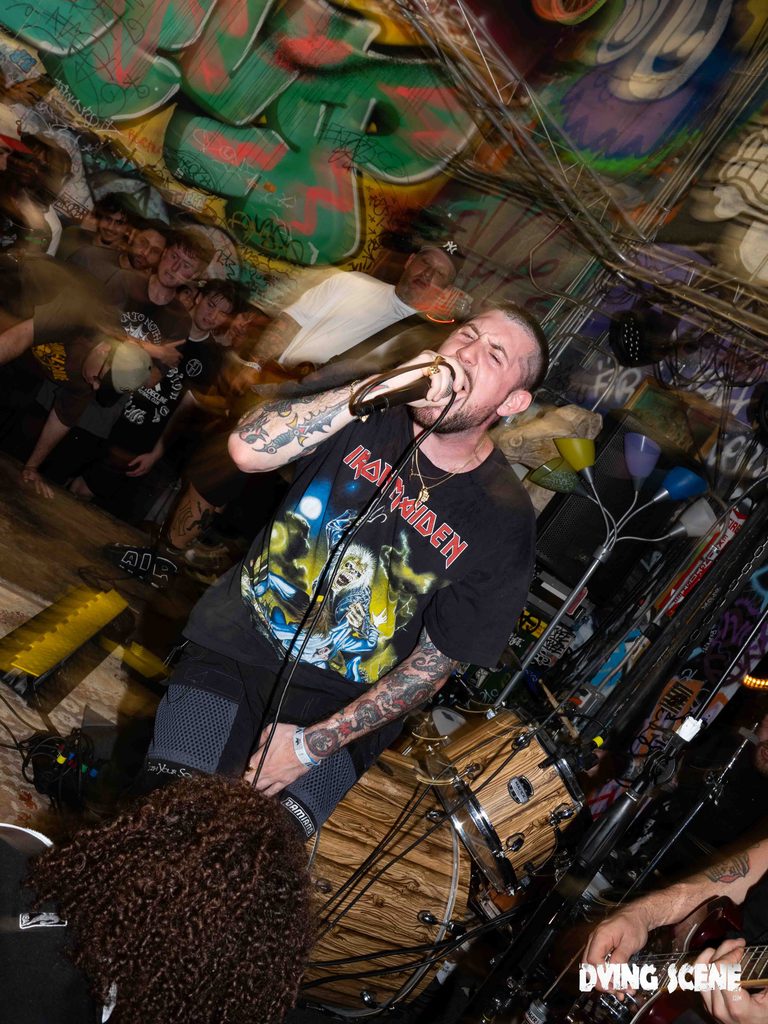
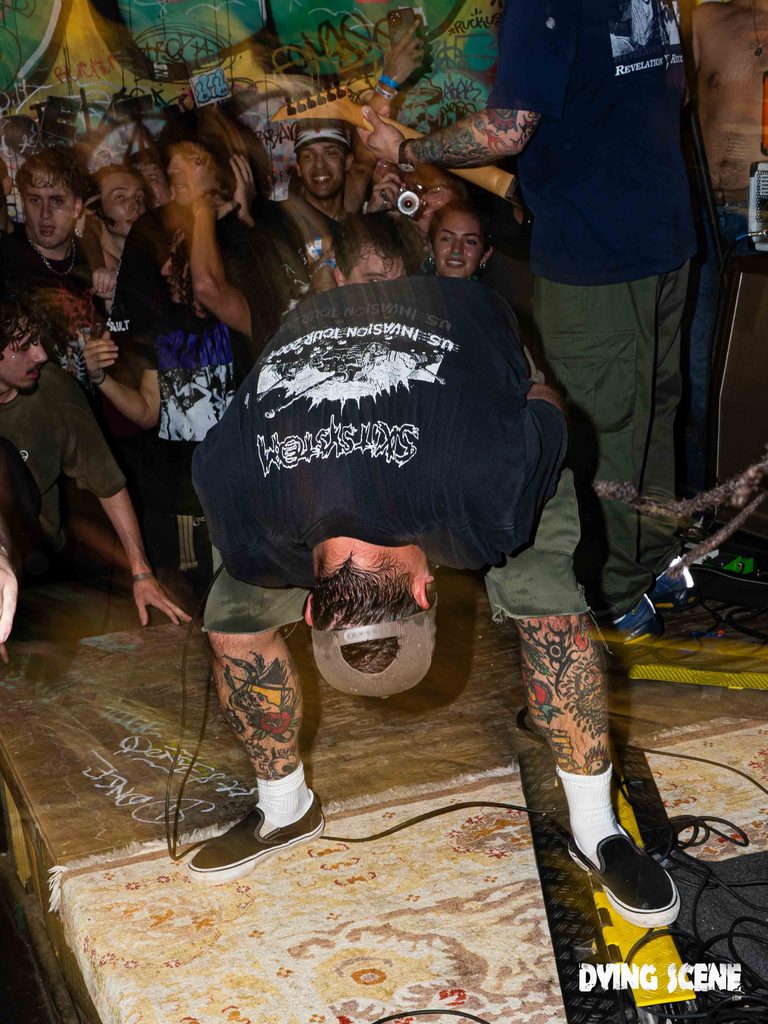
    A memorable night for the South Florida hardcore scene, bringing together local and touring bands, a passionate crowd, and the DIY spirit that continues to shape the community. The show was a celebration of the music, the bands, and the scene that keeps the hardcore and underground scene more alive than ever.


    The night started with Wrong Intentions, 22 Grief, Barricade, and Lose Sight. The sense of community was immediately one of the defining parts of the show. The pit was already starting to take shape early on, but what stood out most was seeing members of the other bands jumping in to support whoever was on stage. Members of 22 Grief and Barricade could be seen moshing, dancing, and singing along during sets. It gave the opening and idea of how a genuine DIY hardcore show feels, where the lineup felt less like a collection of separate acts and more like one scene showing up for each other.


    Combust made their first appearance at a South Florida hardcore show and brought plenty of new faces into the room with them, bringing their New York Hardcore sound to the south. The crowd welcomed them with a serious amount of energy, quickly making it clear that people had been waiting to see what they could do. Their set kept the momentum moving while introducing themselves to a South Florida crowd that seemed more than willing to give them their attention, leaving the room wanting more.


    Coming down from Philadelphia, Scarab followed with one of the most intense sets of the night. The energy in the room became noticeably more aggressive as the crowd turned the pit into a chaotic, physical space, with bodies flying, fists swinging and the crowd throwing down without hesitation.

    (Got my glasses broken during this set)


    Then came Collateral. As the band took the stage for their EP “The Reset”, it was obvious that this was the moment the crowd had been waiting for. Collateral has become one of the most embraced bands within the South Florida hardcore scene, and the response throughout their set reflected that connection. The room gave them everything, moshing, singing, and showing their support from the first song to the last. More than simply being an EP release show, the night felt like a snapshot of what makes the South Florida hardcore scene special: bands supporting bands, new people discovering the scene, and a crowd showing up for the music and each other. “The Reset” now has a release show that will be remembered as a particularly memorable night in the South Florida hardcore.


    Photographs and article review by Juan J. Zapata

  • Bleary Eyed – “Wander”

    Do people ever confuse the young Philadelphia shoegaze crew Bleary Eyed for the post-Oasis Liam Gallagher band Beady Eye, or is that just me? For their entire existence, I kept thinking of Beady Eye as “Bleary Eye,” and now there’s a Bleary Eyed. This might be what finally pushes me into the “OK grandpa, let’s get you to bed” phase of my life. The two bands don’t even look or sound anything like each other. It’s just my own brain dissolving in real time.

    The post Bleary Eyed – “Wander” appeared first on Stereogum.

  • Kenyon Records Announces Dangerous Toys: The Definitive Edition

    Kenyon Records is proud to announce ‘Dangerous Toys: The Definitive Edition‘, a landmark reissue of the self-titled 1989 debut from Austin, Texas sleaze-metal legends Dangerous Toys. Arriving Friday, November 13th, 2026, this fully authorized, band-approved release reunites the group with the man who produced their sound in the first place: Max Norman, who returned in […]

    The post Kenyon Records Announces Dangerous Toys: The Definitive Edition appeared first on ROCKPOSER DOT COM.