In 2014 Prog explored former Cream member Jack Bruce’s third solo album, 1971’s Harmony Row, viewing it from the perspective of a concept album that took him far away from the blues rock he’d prevously been known for.
“I sat at my Blüthner piano and played the thing from top to bottom,” said Jack Bruce, explaining how his third solo album arrived almost fully formed one inspirational afternoon. “The songs just came tumbling out as a complete entity in pretty much the same order as they appear on the album.”
While his 1969 debut Songs For A Tailor had mopped up material originally intended for Cream, with 1971’s Harmony Row he wiped the slate clean and delivered a sequence of songs that took him out of the mainstream.
Several pieces traverse a jazz-rock undertow and utilise unorthodox chords which owed more to classical avant-garde composer Olivier Messiaen than the blues-based rock he helped pioneer, and which he remained associated with.
After working with Eric Clapton and Ginger Baker, and what he called their “big” sound, Bruce wanted something more intimate and personal in nature. He co-opted Chris Spedding (guitar) and John Marshall (drums) from British jazz-rock pioneers Nucleus to flesh out these poetic vignettes alongside his own bass, keyboards and vocals.
“Lyricist Pete Brown had this mad idea that the songs were kind of like a big show on ice – not exactly like an operetta, but a kind of concept album in a way,” said Bruce.
Not unlike an interlinking song cycle rooted in his working-class upbringing, the album title references a tenement block in his native Glasgow, describing drifters, early-morning commuters, grinding poverty, yearning love songs and the yawning possibility of death or rebirth at each sunset.
Harmony Row’s cinematic contrasts provide starkly lit close‑ups during the reflective prelude of Can You Follow?, before rushing into the wide-open vistas of Escape To The Royal Wood (On Ice), bustling with quick-fire time signatures, abrupt vocal jump cuts and layers of processed guitar glistening in spectral reverb.
Meanwhile, on Folk Song, Bruce multitracks his own voice into an ethereal choir to devastating, poignant effect. He recalled: “It was engineer Andy Johns who came up with that idea. It was the only way we could get the kind of texture we were after. We called those voices The Jackettes!”
Harmony Row’s willingness to go beyond expectations highlights Bruce’s interest in experimentation and his contrarian disposition. This is emphatically not the work of the blues bruiser some supposed him to be, but rather a sensitive and sophisticated composer who understands how to box clever, an expert in judging precisely when to hang back and when to hit hard.
Harmony Row is an album of which, understandably, Bruce remained very proud. “All of my early solo albums are really diaries of where I was at musically at the time,” he said. “Listening to it now, I think it still stands up.”
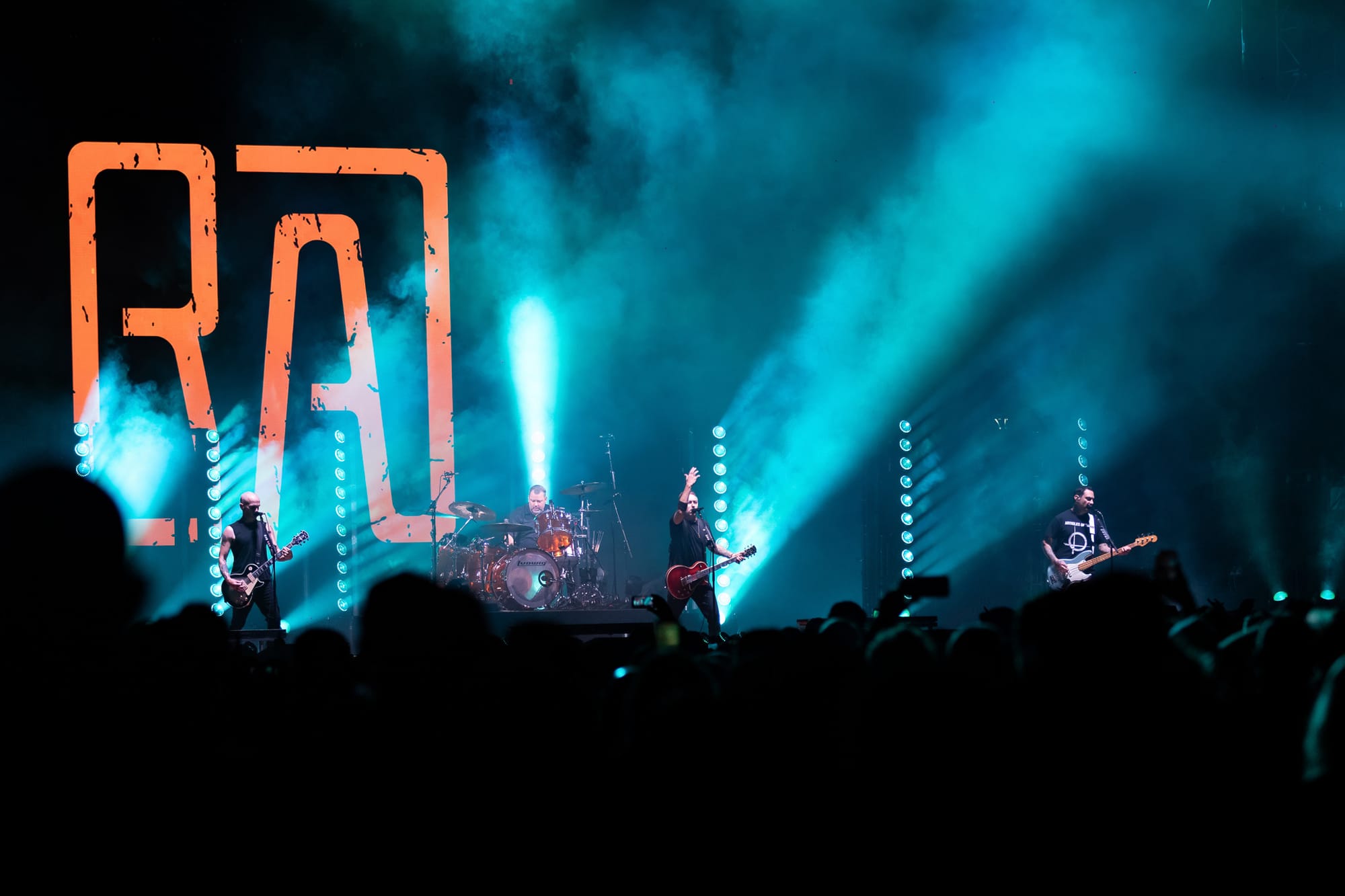
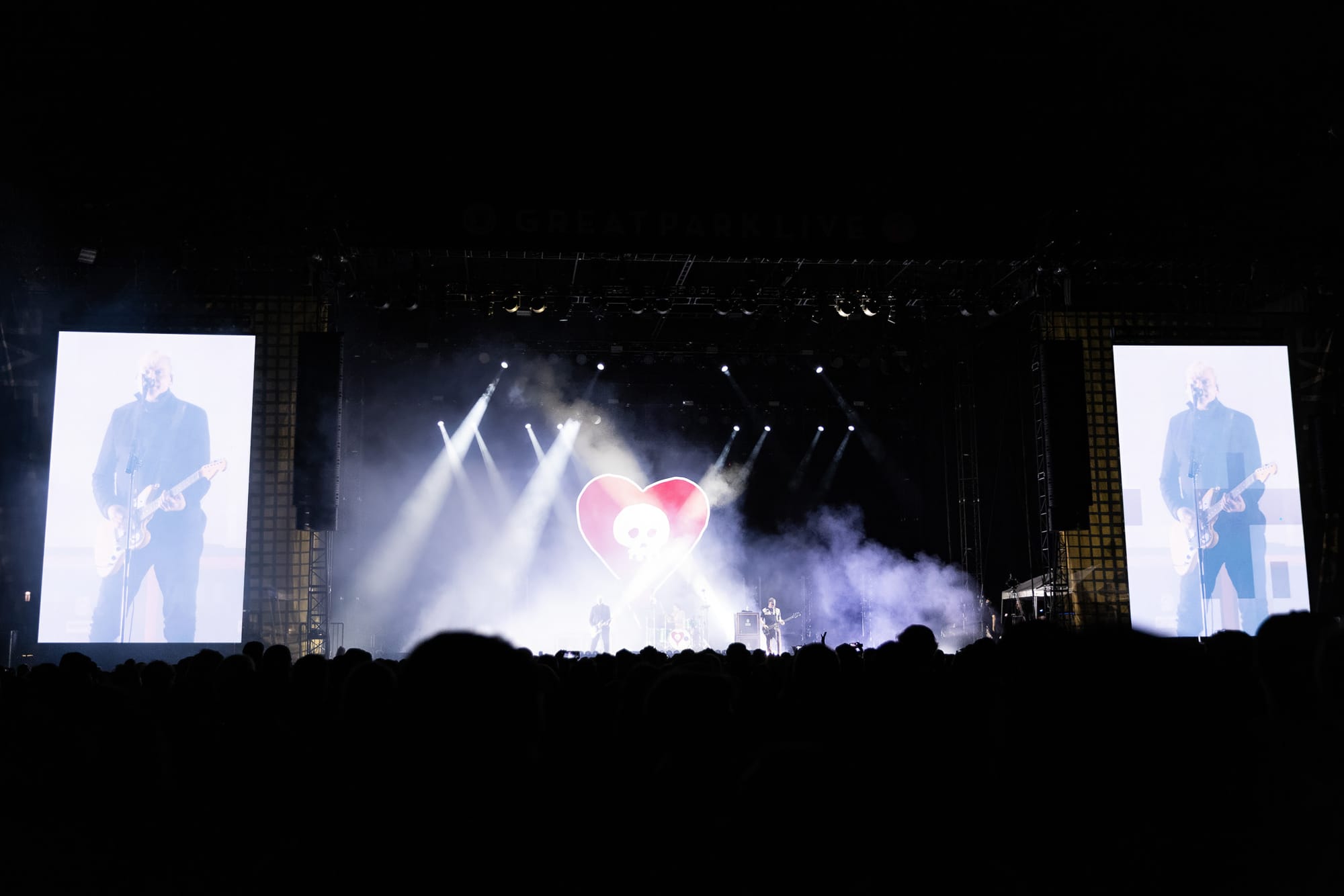
Rise Against and Alkaline Trio – Great Park Live – October 23, 2026
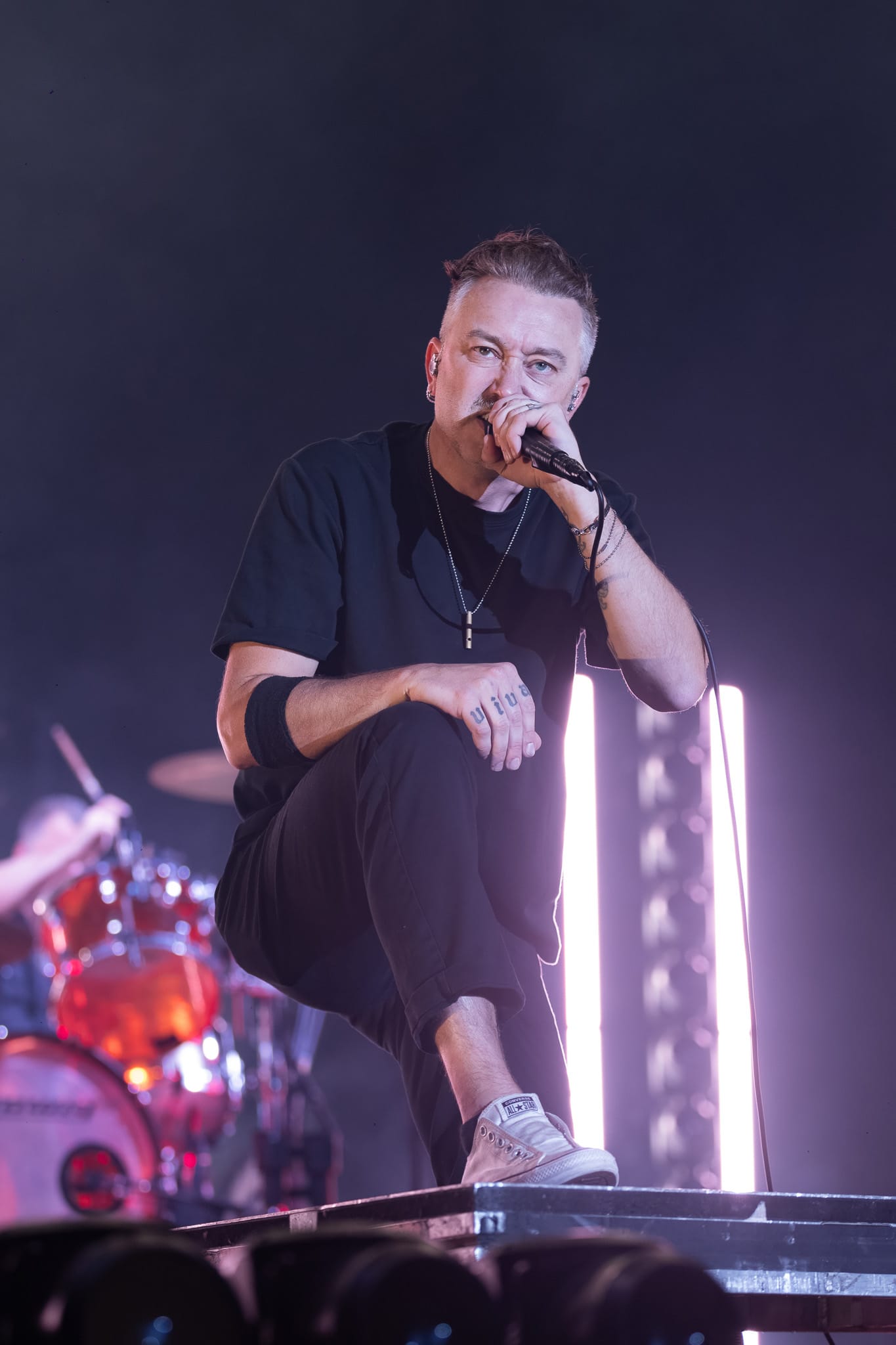
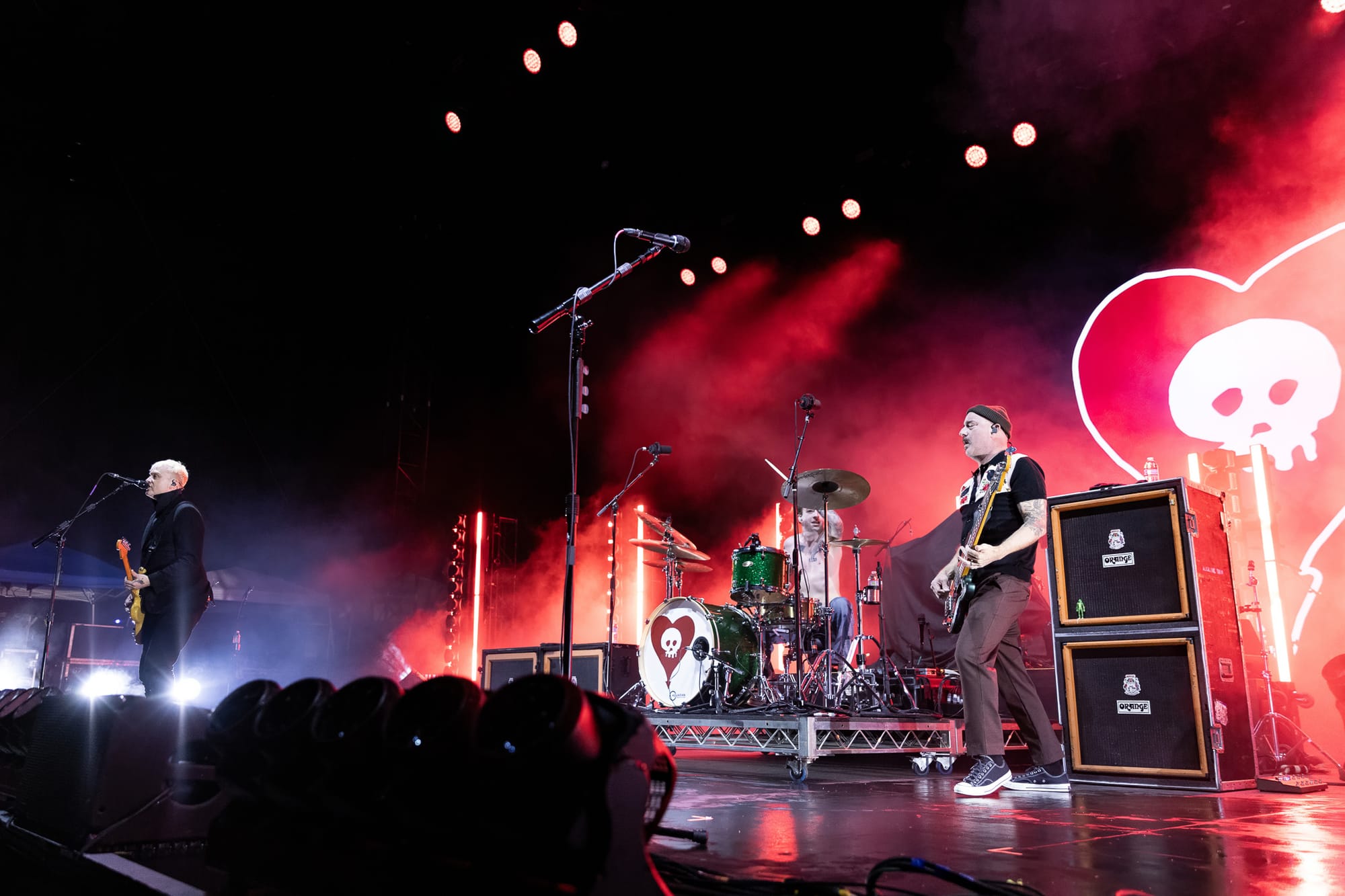
Two great bands were on dance card Friday night in Irvine, CA, but the early star of the show was Mother Nature. The doors to the outdoor venue opened at 5:30pm, and those who arrived early were treated to an amazing sunset. As day shifted to night, a massive black cloud could be seen to the east, seemingly moving at a snail’s pace towards the venue. As showtime got closer, bright flashes of lightning could be seen on the horizon, and the entire sky became eerily dark. Small drops of rain began to fall, and suddenly there was a warning broadcast over the PA system urging people to return to the safety of their cars due to incoming severe weather. I asked a security member near the exit what this meant and he said that the concert had been cancelled. I wasn’t sure if that was true, but others around me were bummed and took his words as gospel – walking to their cars and driving home. I feared it might be true, but dragged my heels leaving the venue in case more information was provided or something changed to cause optimism. Just then, the screens lit up with “Weather Alert!! Due to lightning in the area, we are temporarily evacuating the venue for everyone’s safety.” There was also a message over the PA system telling fans to go to their cars and await further instructions. I wasn’t sure how anyone would be able to hear the further instructions from their cars, but I was happy there was still a possibility the show would happen
Rise Against
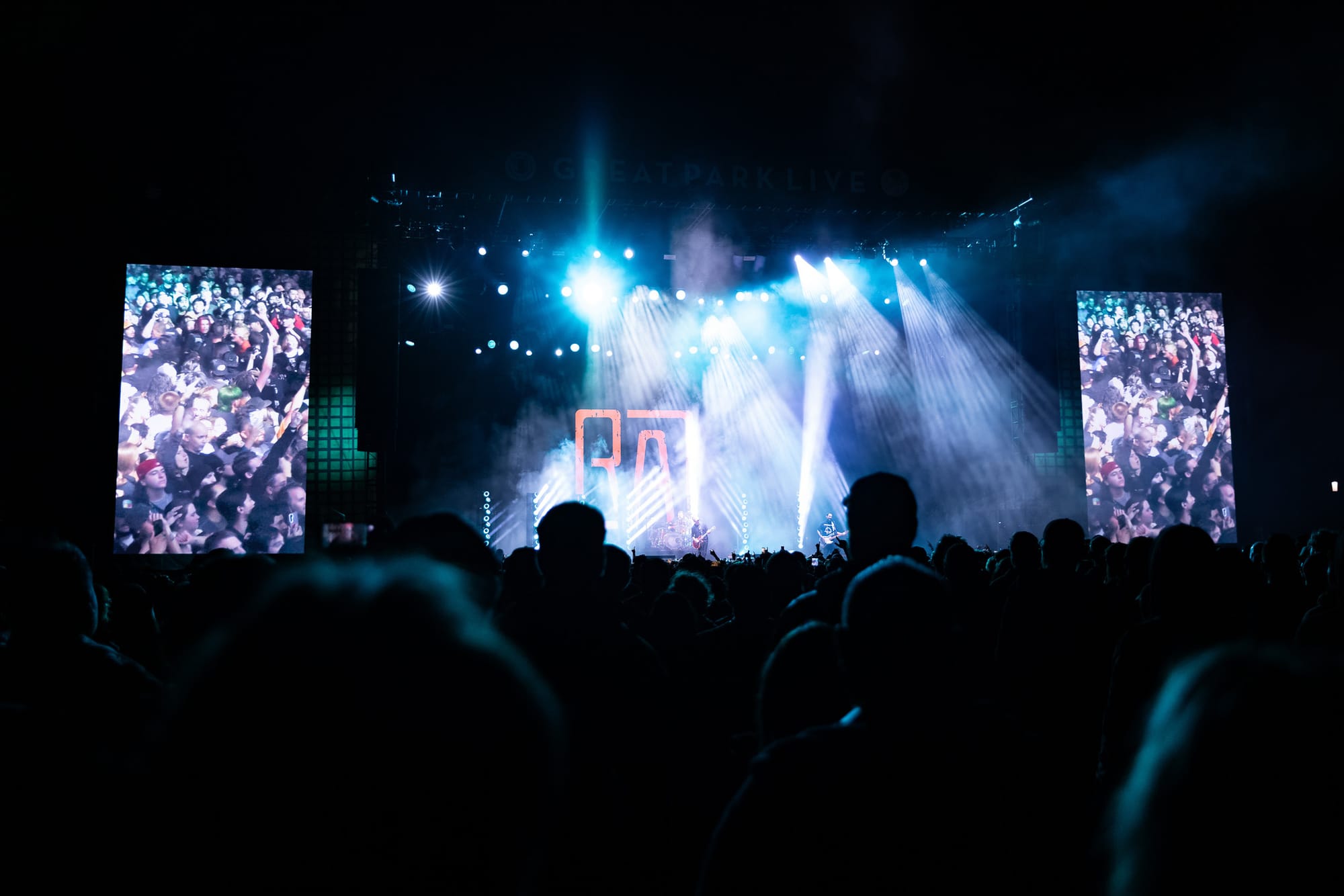
Irvine’s Great Park Live is a temporary concert venue in a large park that once housed fields of lima beans and oranges, before being converted to a Marine training base in the immediate aftermath of Pearl Harbor and the impending US involvement in World War 2. It lies in a strange area of Orange County where it is flanked on one side by a large housing development, by industrial warehouses on another, the I-5 Freeway on another, and the remains of a landing strip from the decommissioned Marine base on the other. The venue holds 10,000 people, and is essentially a massive park surrounded by a fence with a large stage at one end. Inside it is very reminiscent of a large-scale music festival – food trucks and vendors surround the grounds in a horseshoe, and a massive, manicured grass lawn stretches from one end to the other – it reminded me of a scaled-down Aftershock Festival.
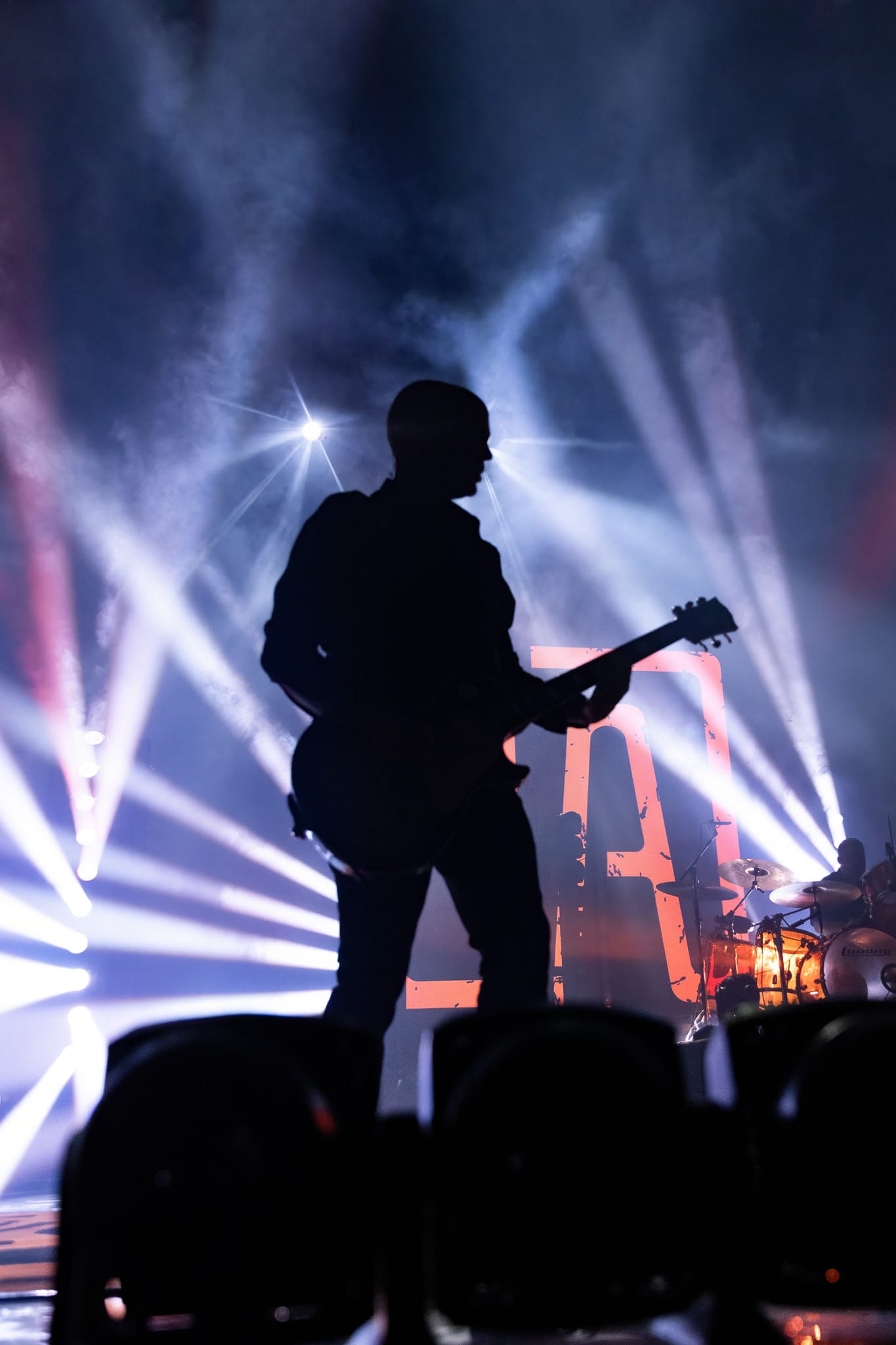
As I sat in my car sheltered from the rain and lightning while awaiting news that the show might continue, I witnessed hundreds of cars driving past me on their way home. Those that hung in there and didn’t listen to the bad information I’d been given by security, got to witness a fantastic show. The rain was nowhere to be seen by the time Rise Against hit the stage at 10:00pm, but the memory of the storm fueled an amazing set, and the fans who had been through so much to be there fed off the performance – people were REALLY stoked to be there and participated fully.
Prior to Alkaline Trio or Rise Against playing a note, the thousands of people who had been evacuated to their cars had to get back into the venue. I had a great parking spot near the entrance and within visual range of the huge screens. I could see when the evacuation notice was taken down, and I promptly stepped out of my car to try and ascertain if/when we would be allowed back in the venue. Someone had heard that they’d be opening the doors at 8:30pm, so people started working their way to the gate. Thousands upon thousands of people stood outside the venue awaiting a sign that we’d be allowed back in – the good news was that the rain had stopped by this point. Someone in line had the good idea to shout, “Let us in!!”, and the entire crowd picked it up and started chanting it over and over. Finally, the doors opened and we started inching forward – I was in the middle of the pack, and it took me 25 minutes to get back inside.
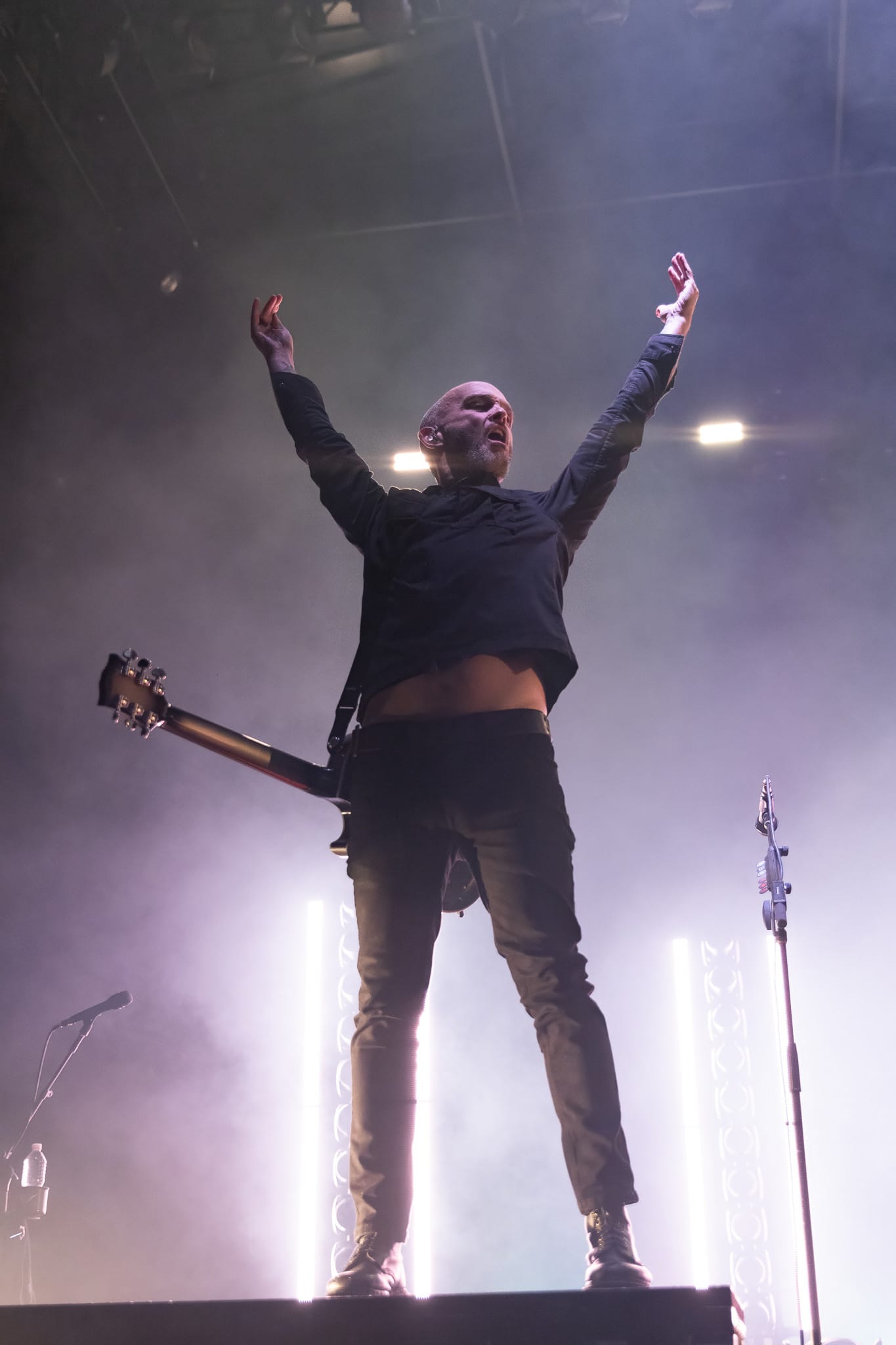
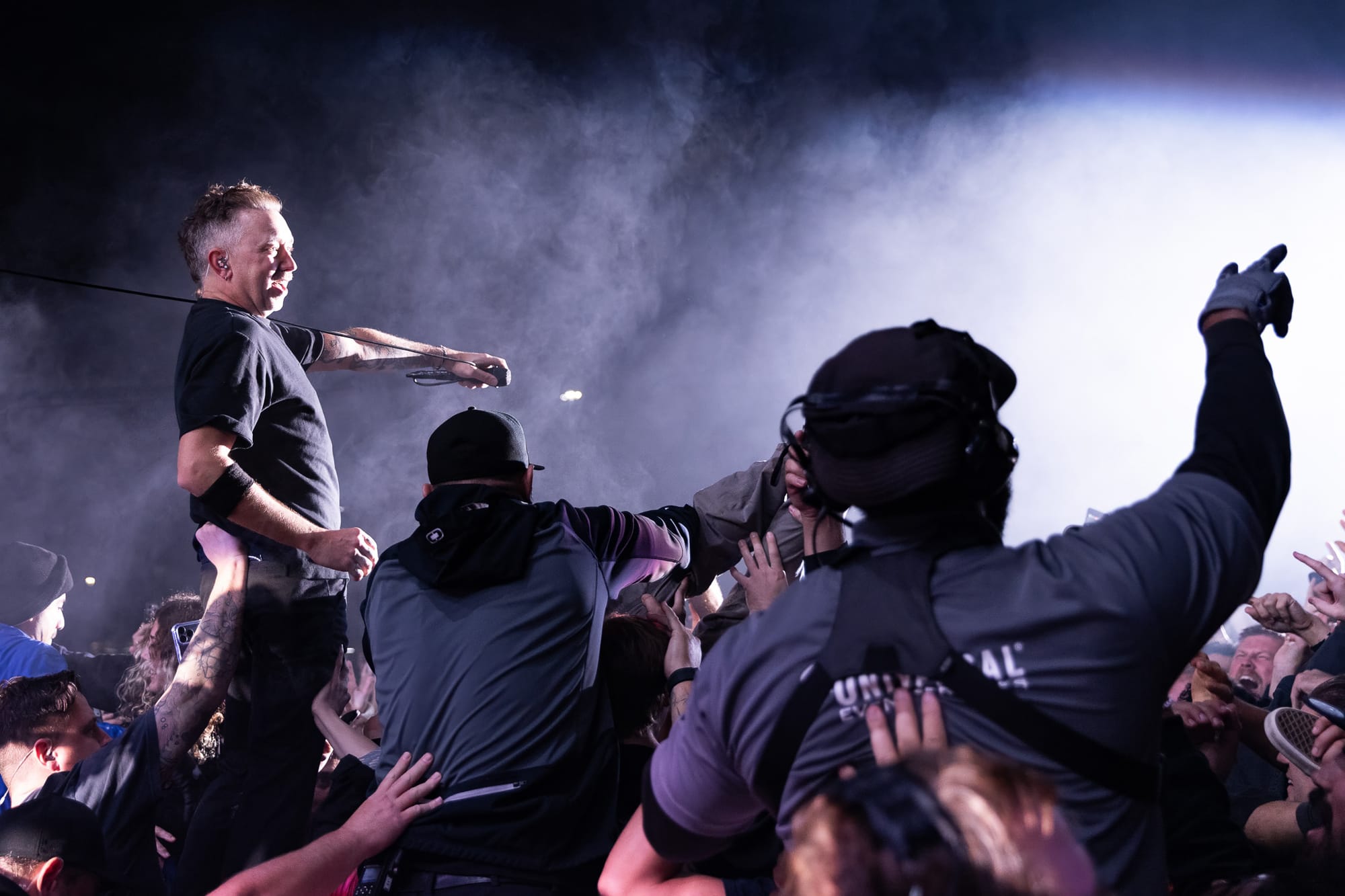
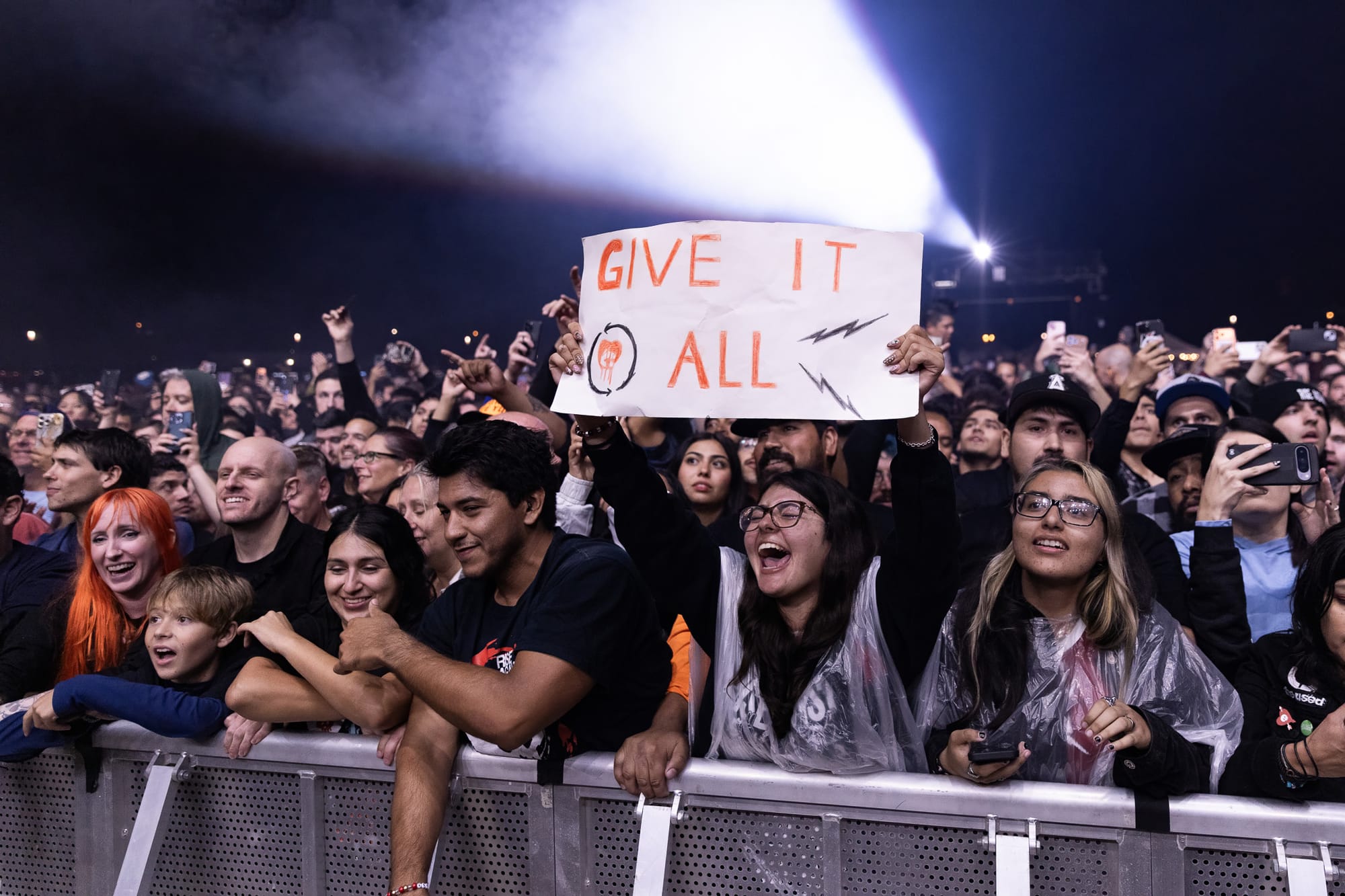
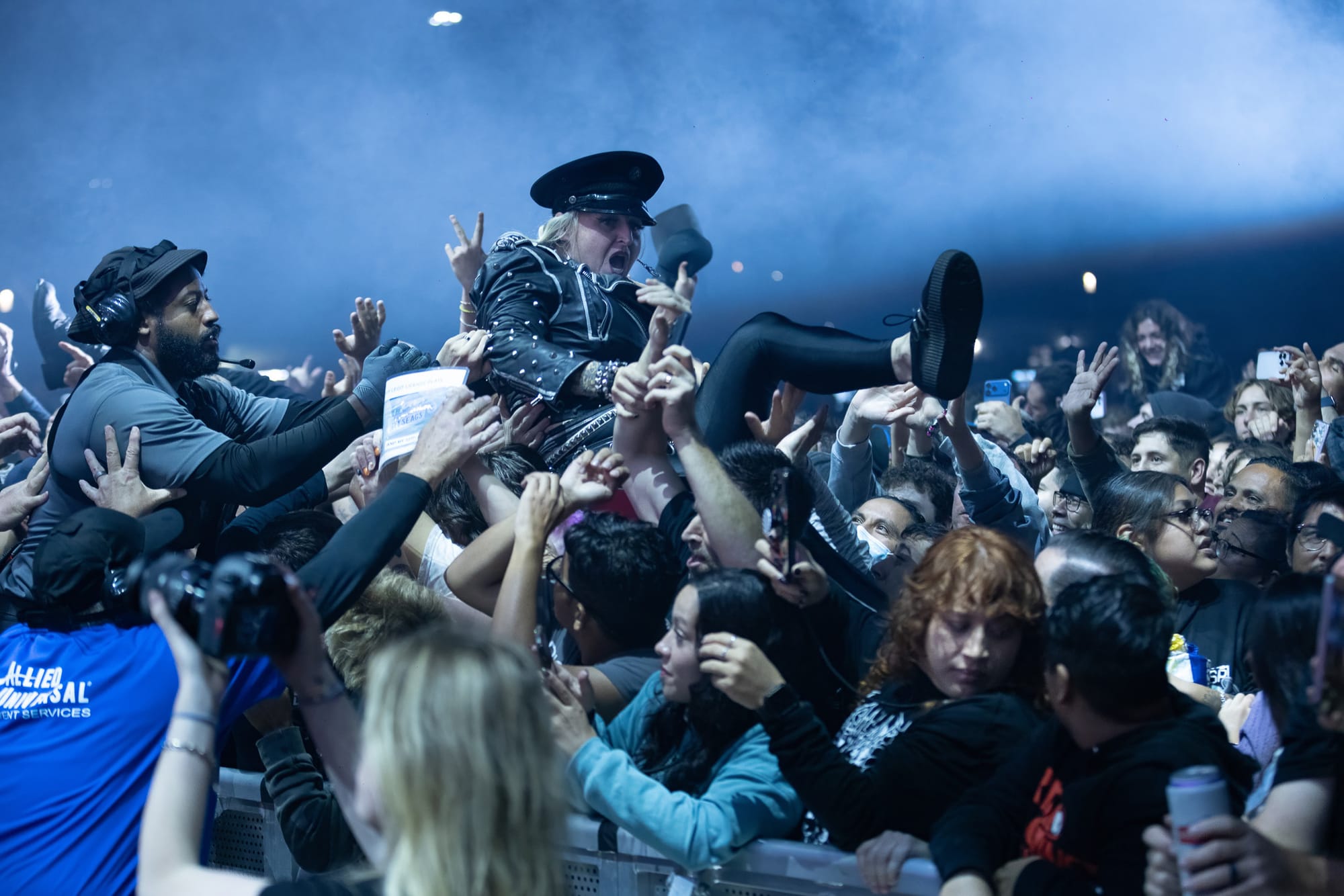
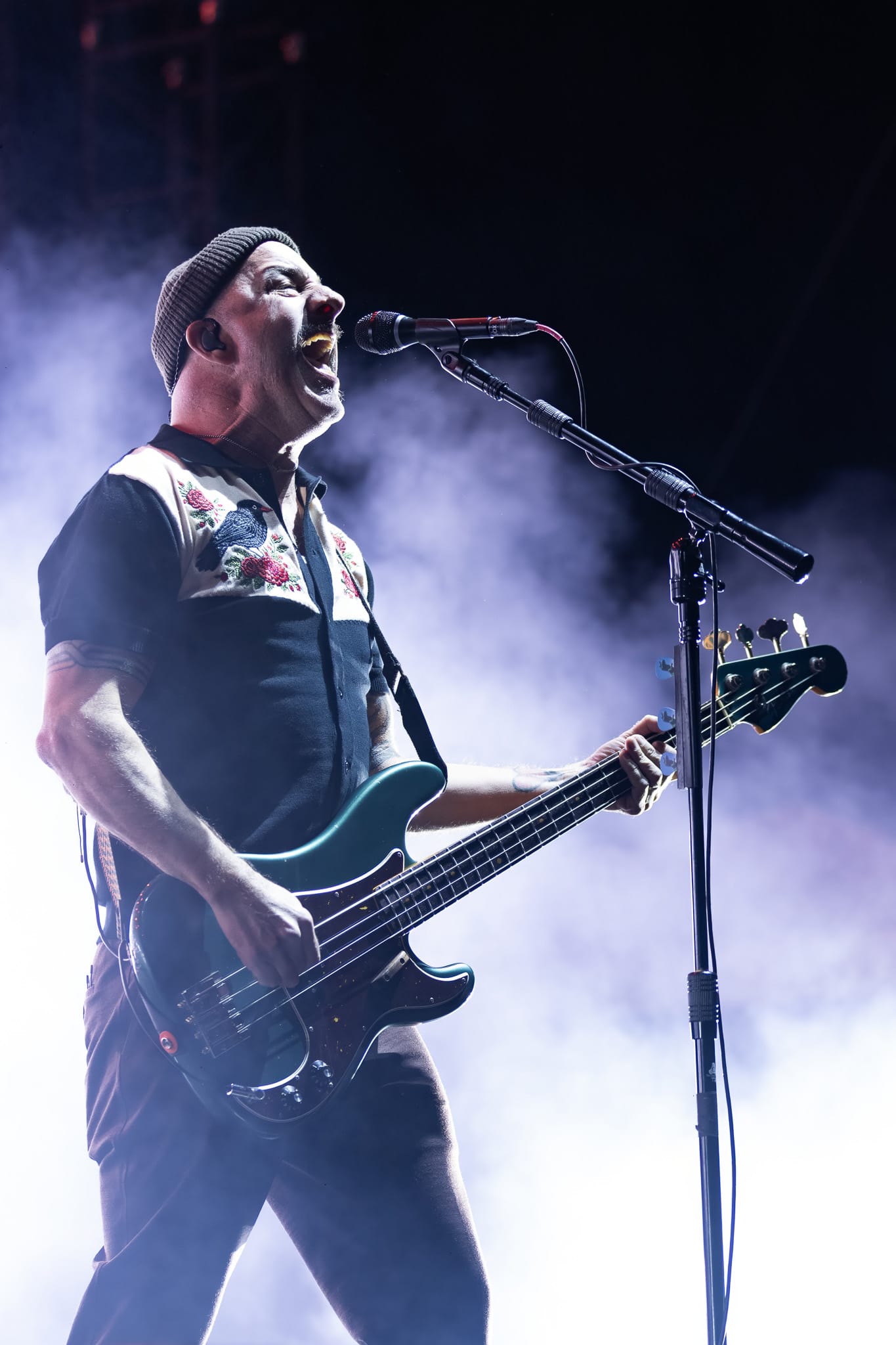
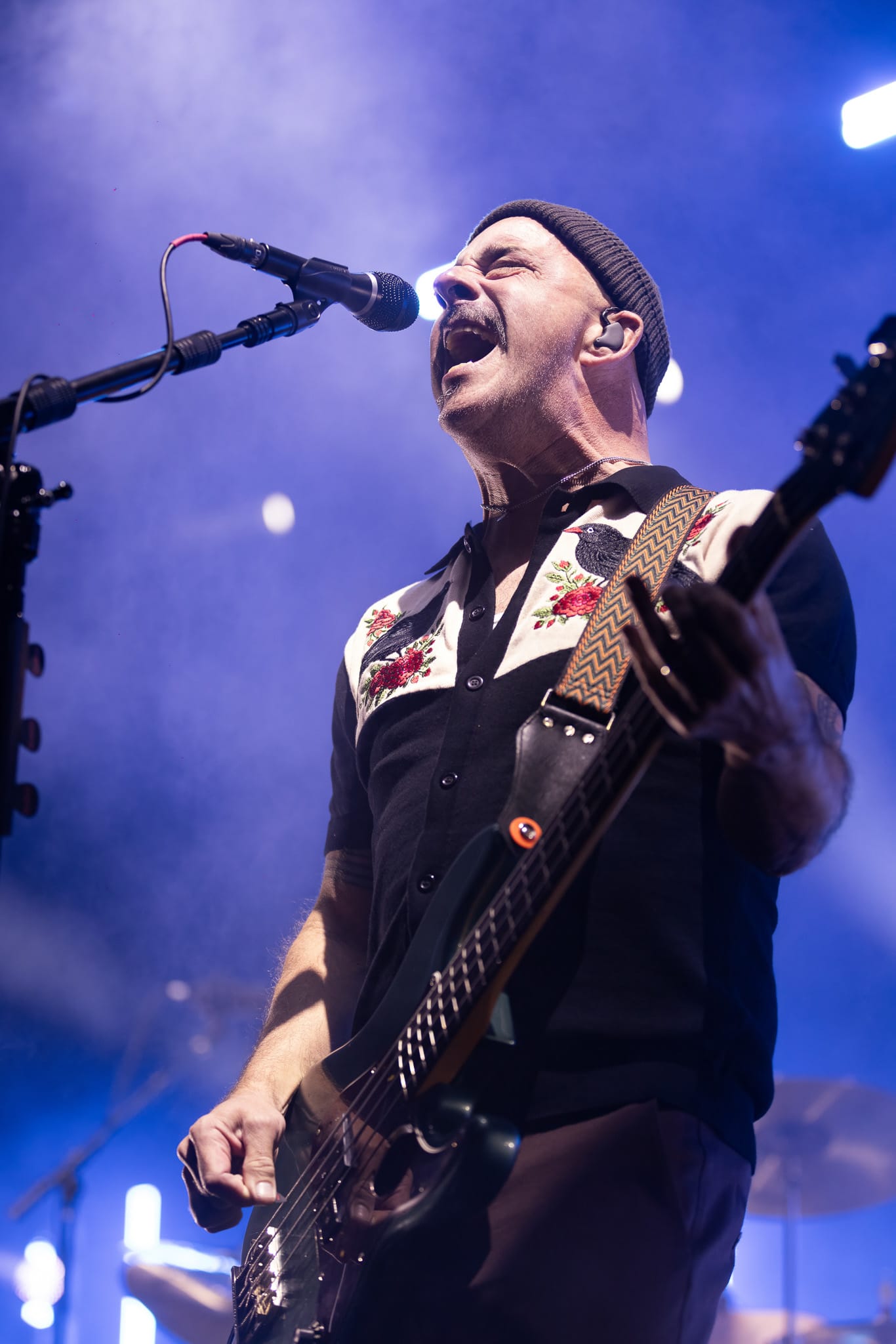
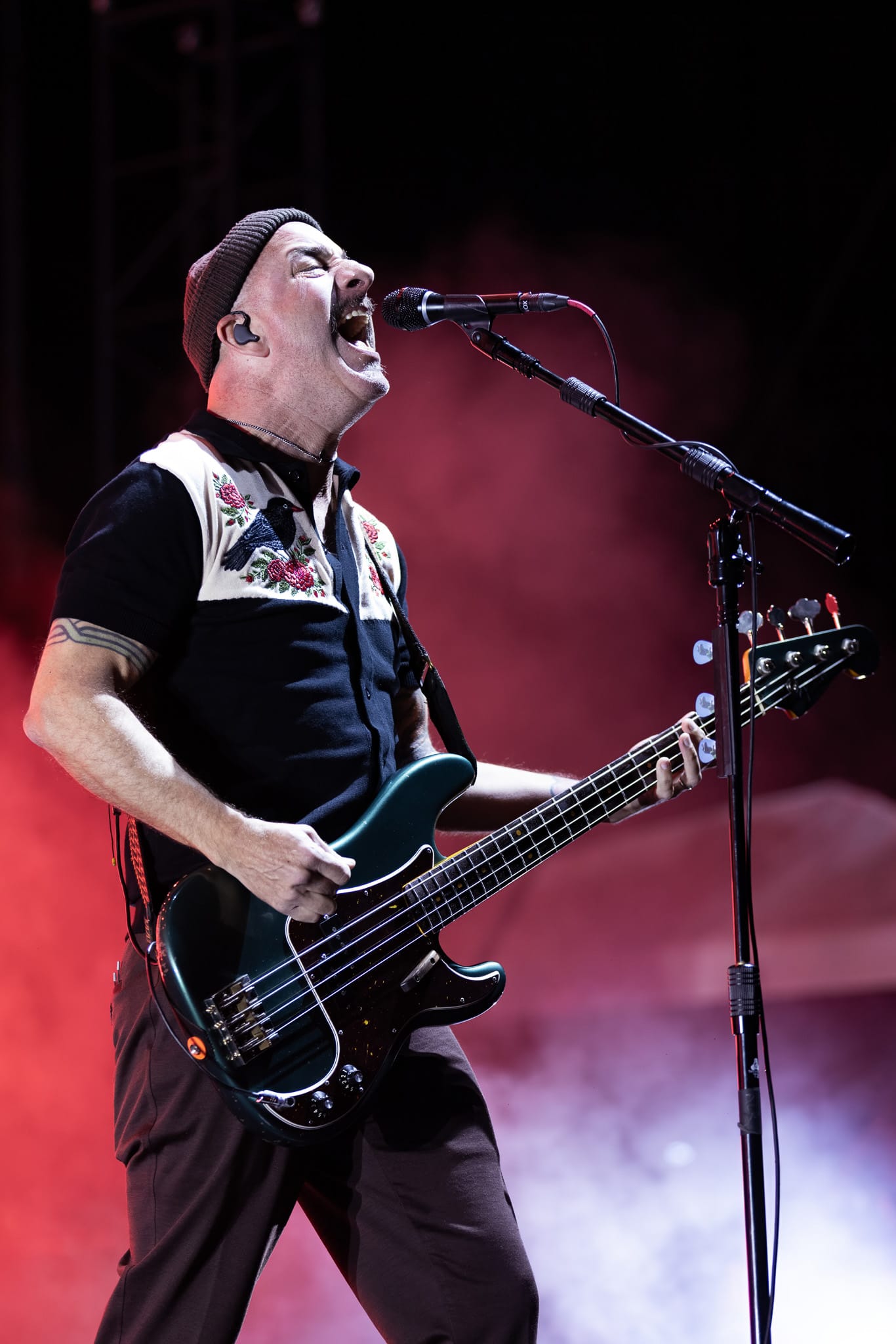
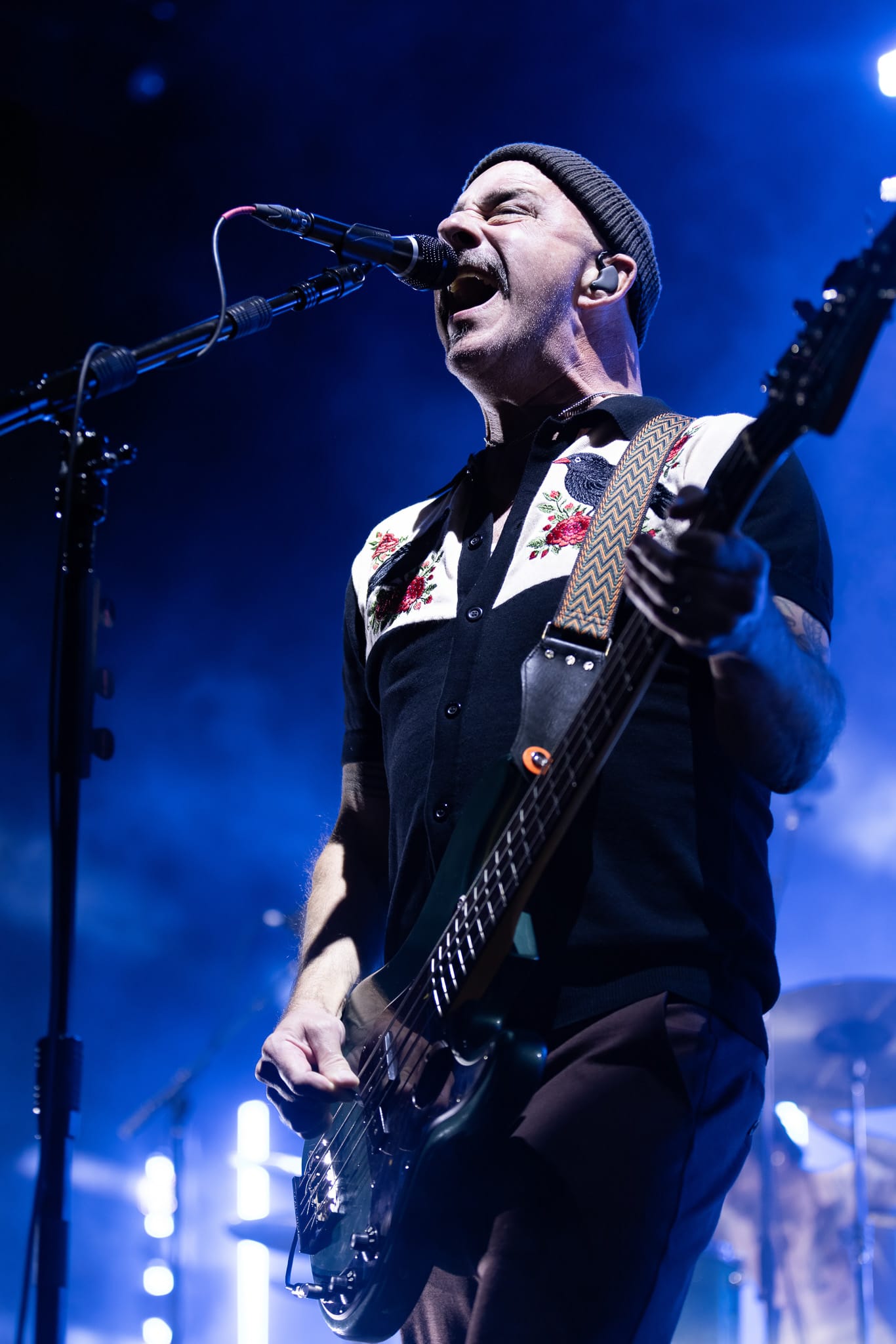
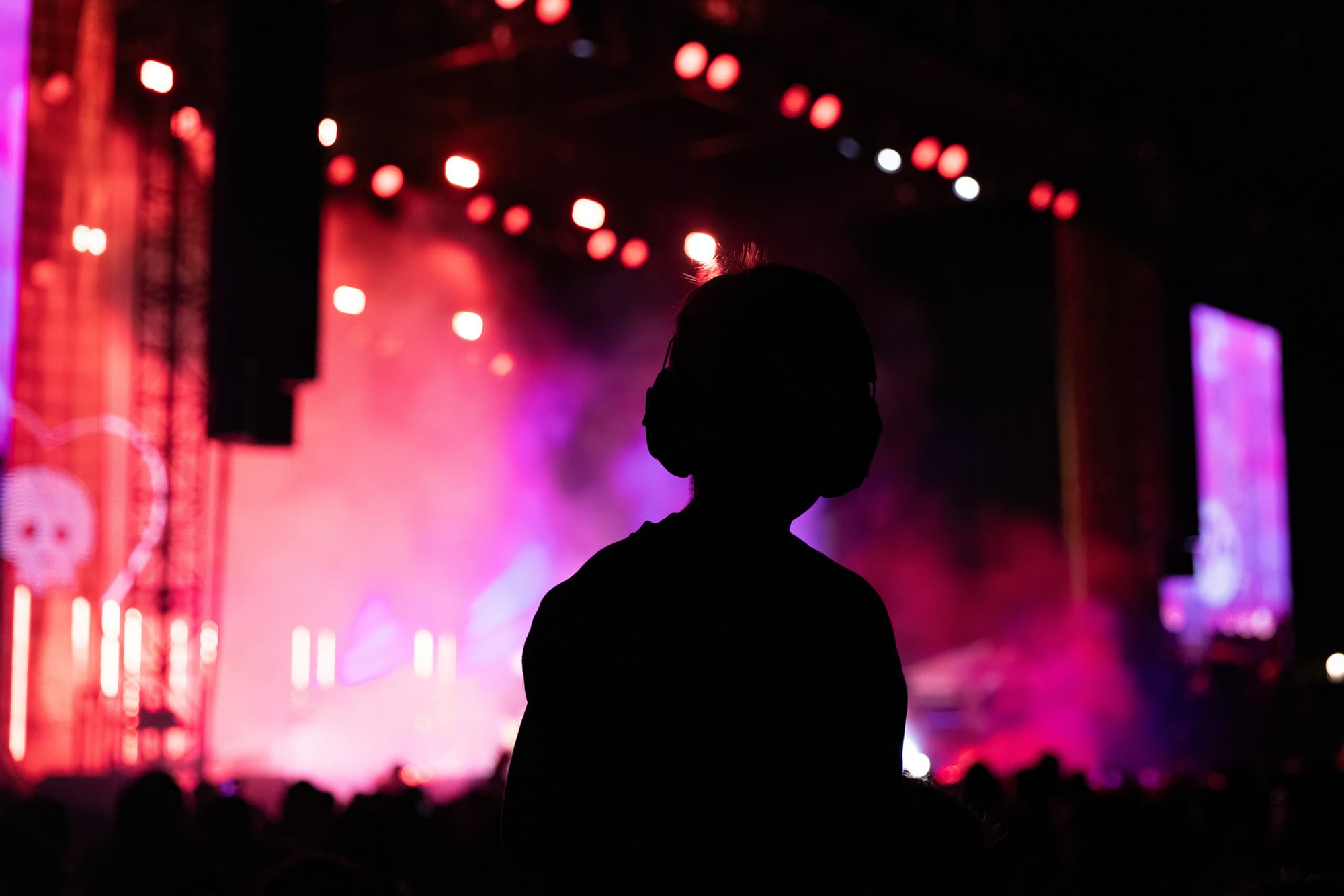
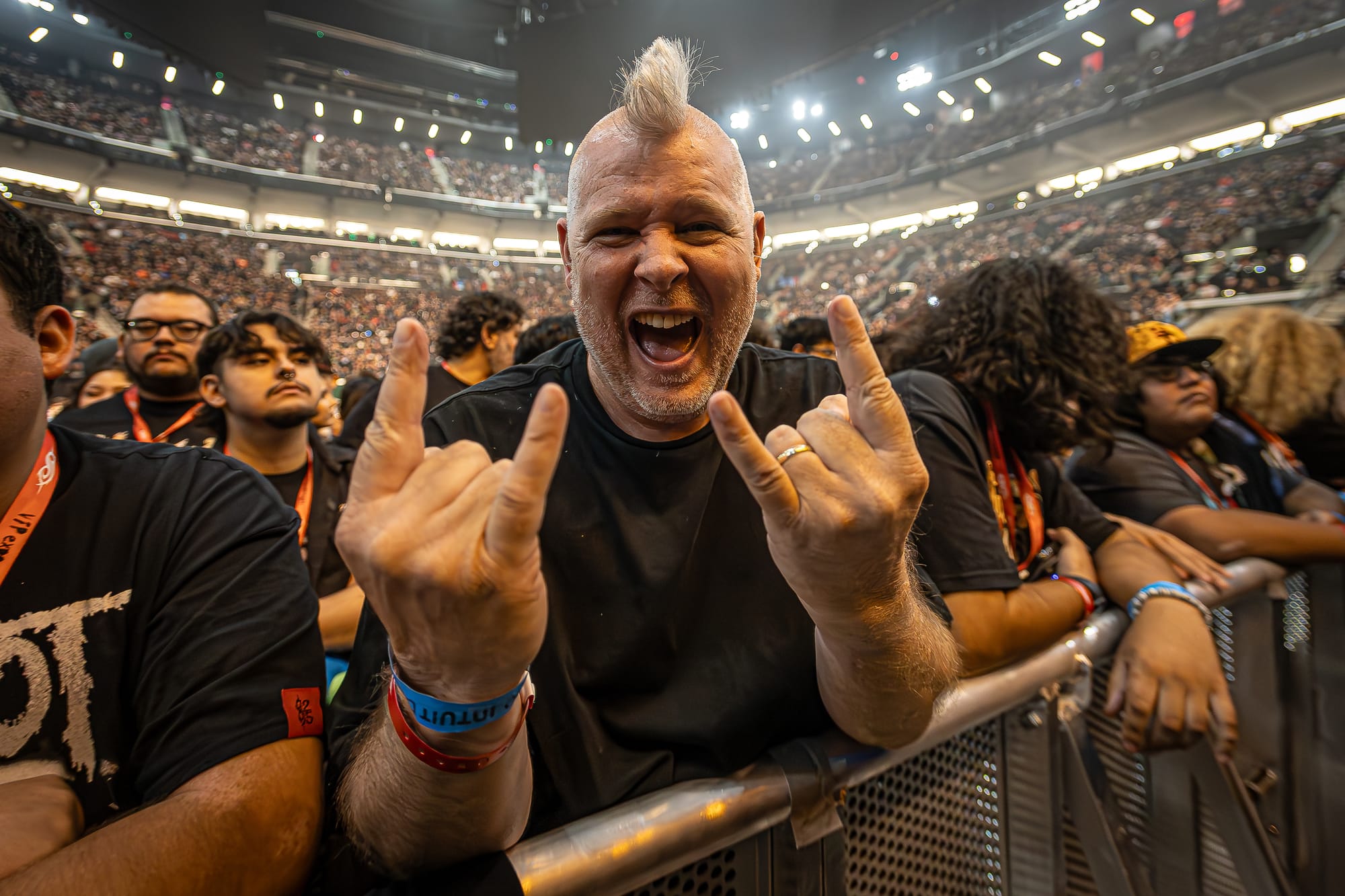
Rise Against were in Southern California on Friday night as part of the Ricochet 2026 Tour, in support of last year’s Ricochet album – their 10th studio release. They formed in 1999, and have delivered their own brand of rock since their inception – unflinchingly charged lyrics with socially conscious commentary, combined with aggressive but undeniable hooks. There are lots of bands with passionate fan bases, but Rise Against seem to have some of the most ardent. Everywhere you looked in the mass of humanity, people had huge smiles on their faces – people were genuinely excited to be there and sharing a night with their people and their band. Crowd surfers were everywhere, and the mosh pits looked lively on the jumbo screens, but were too hard to get to with cameras wrapped around my neck to see in person. People in the very front row up against the barricade held signs of support, and there were more children in attendance with their parents than any show I can remember. Multiple people I’d talked to had driven for hours to watch their favorite band and revel in the atmosphere, and after the threat of the show being cancelled, the diehard fans had made it their mission to let loose.
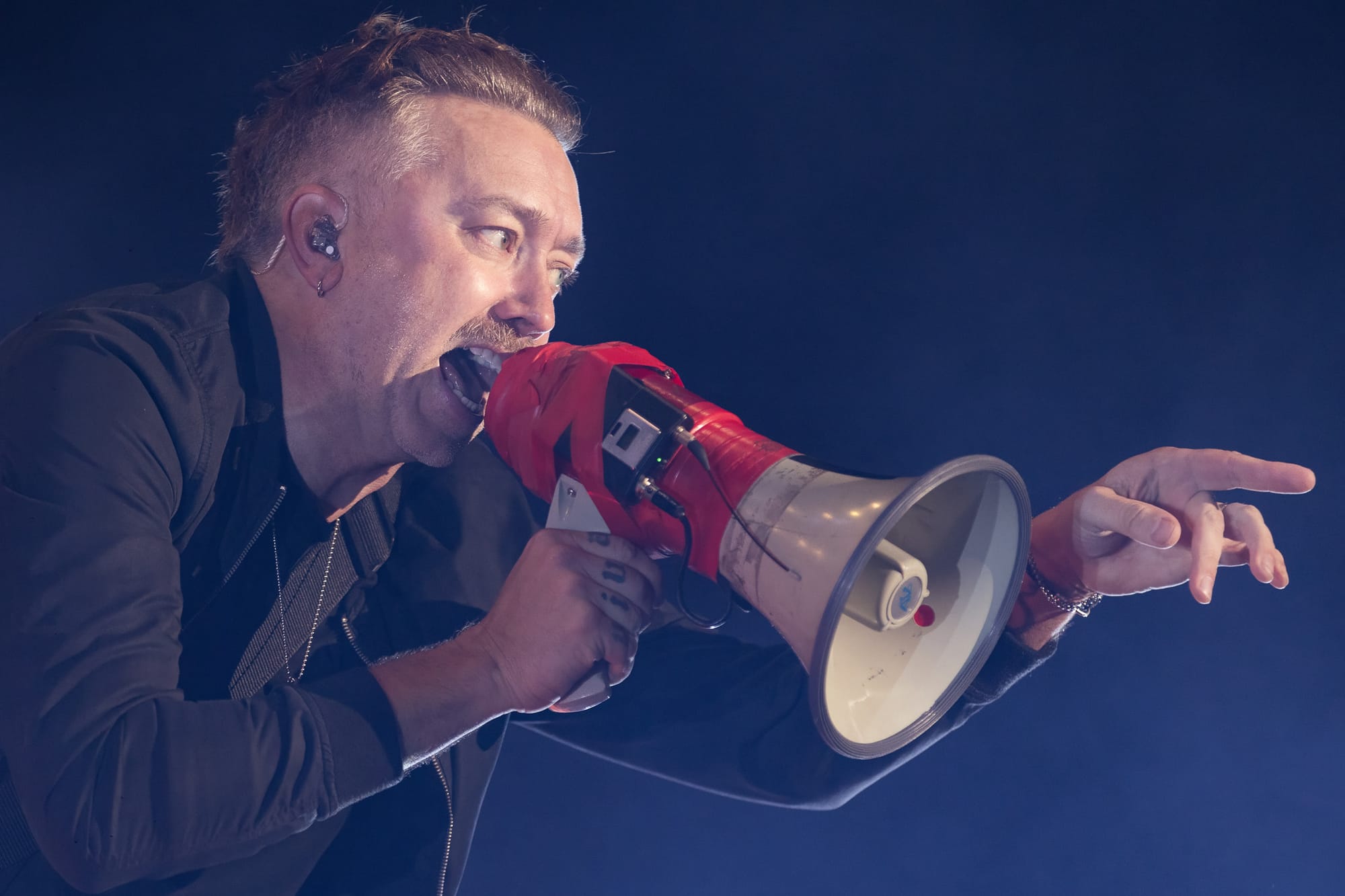
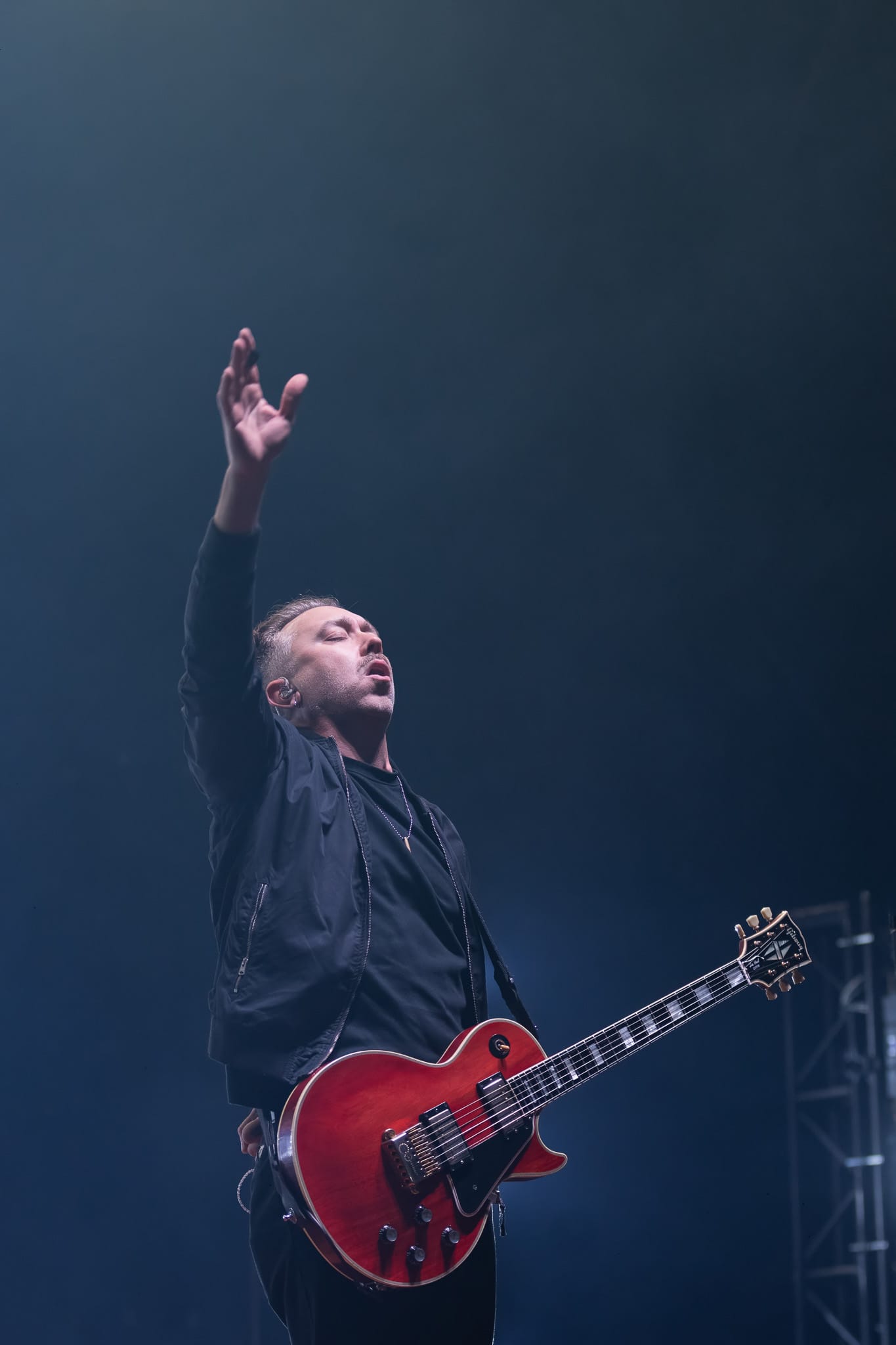
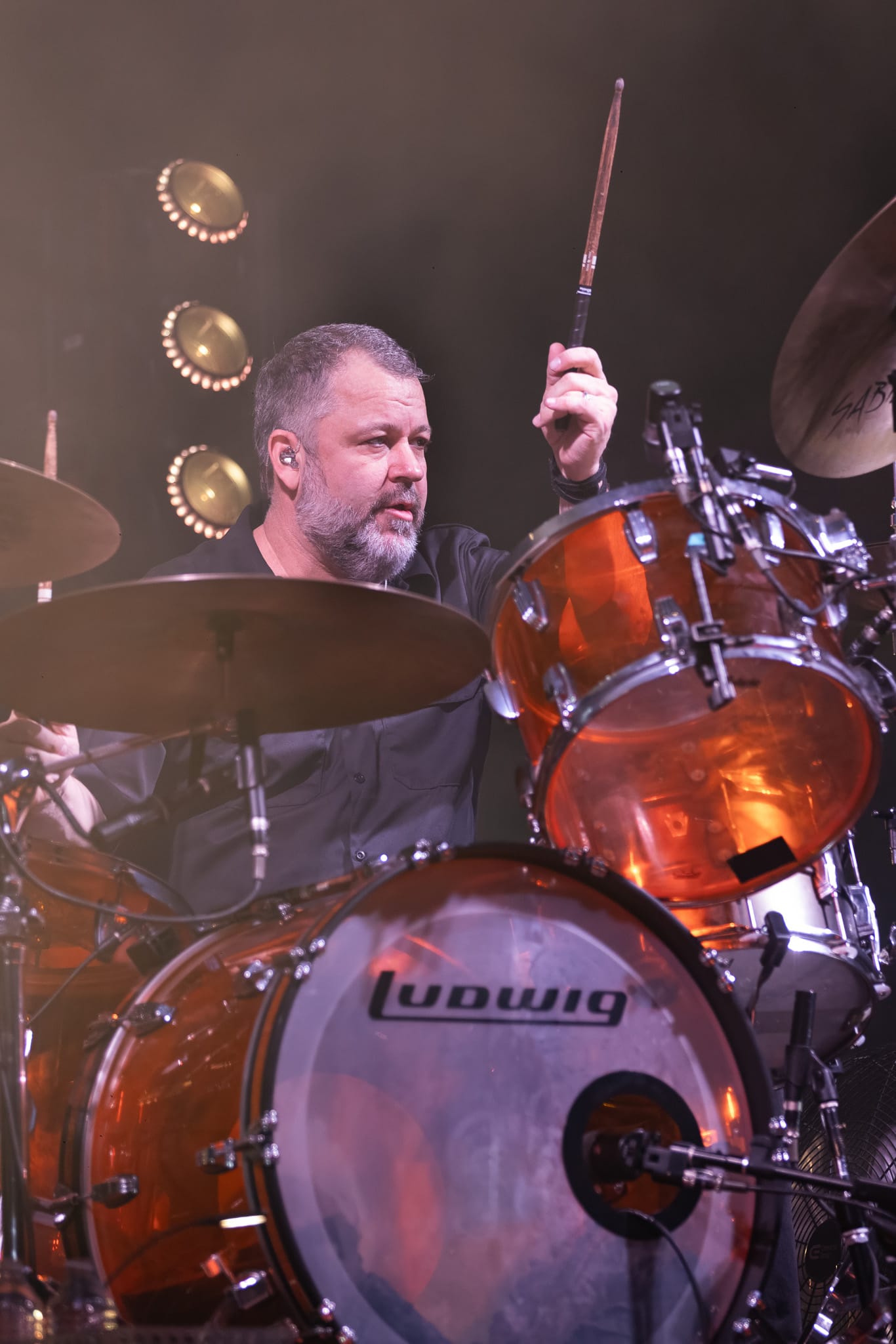
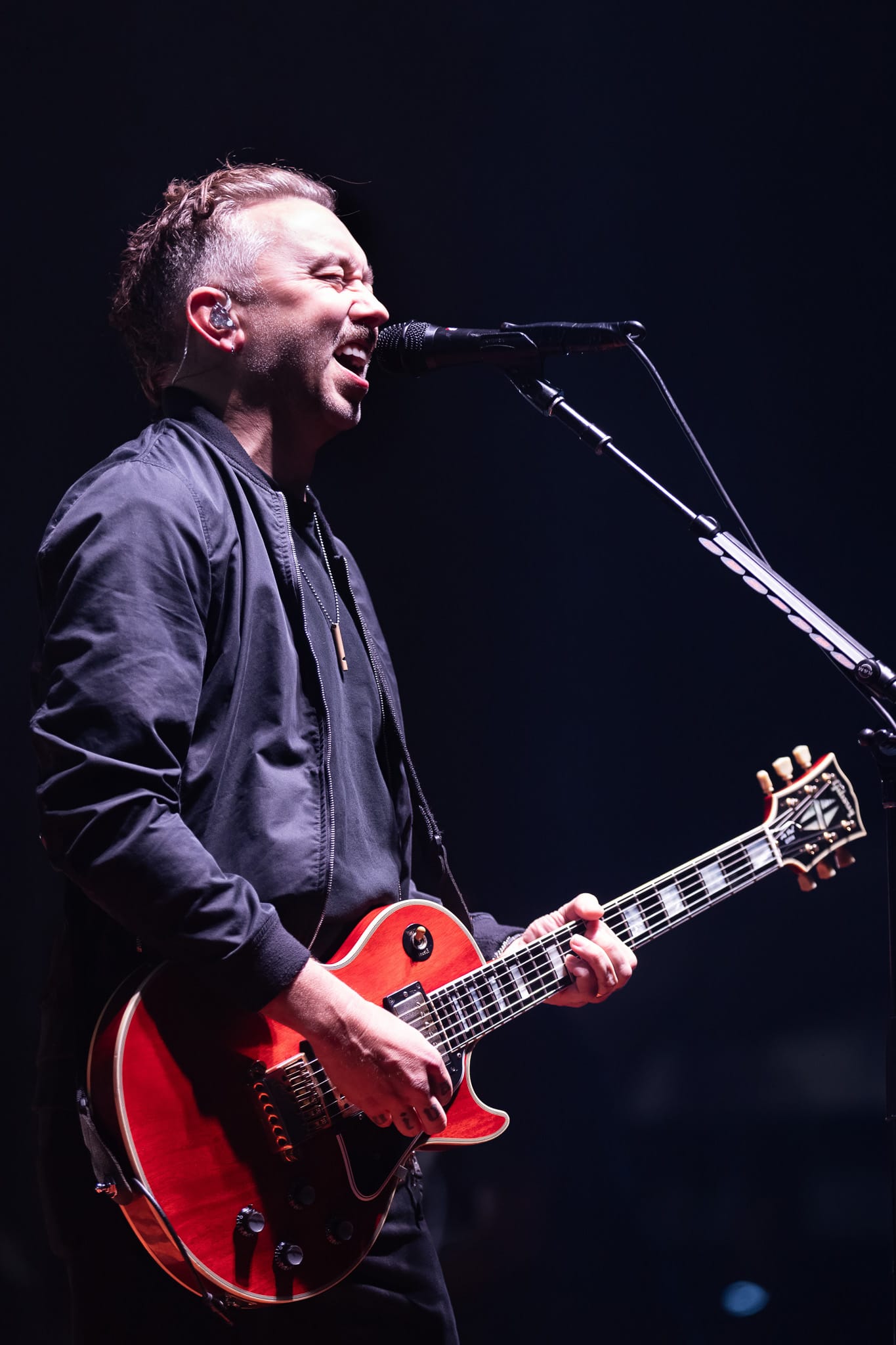
Both Rise Against and Alkaline Trio’s sets were shortened to allow for the weather delay and a strict noise curfew due to the nearby housing development, but each band put out extra effort to ensure that things were right with their fans. Tim pulled out the bullhorn for “Make It Stop (September’s Children)” and jumped off the stage during “Give It All”, and spent half the song standing on top of the security barricade to interact with fans and high-five crowd surfers. Fans and band alike were happy to be there to share the evening with each other after the threat of cancellation, and both took full advantage of it. What looked like a disastrous evening at 7:00pm had morphed into a euphoric experience by the time the gates opened at 8:30pm.
Rise Against is:
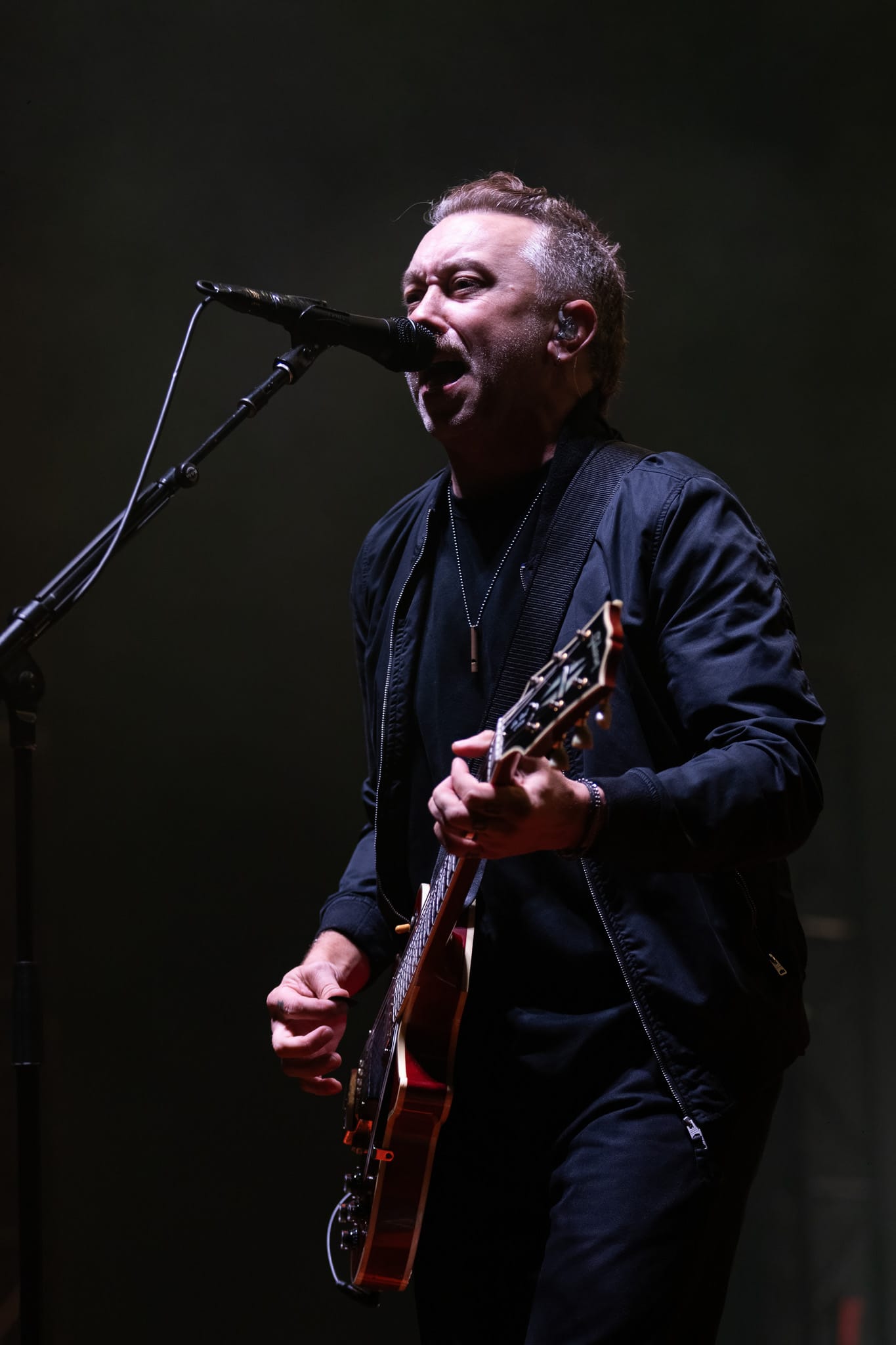
Tim McIlrath – Vocals/Guitar
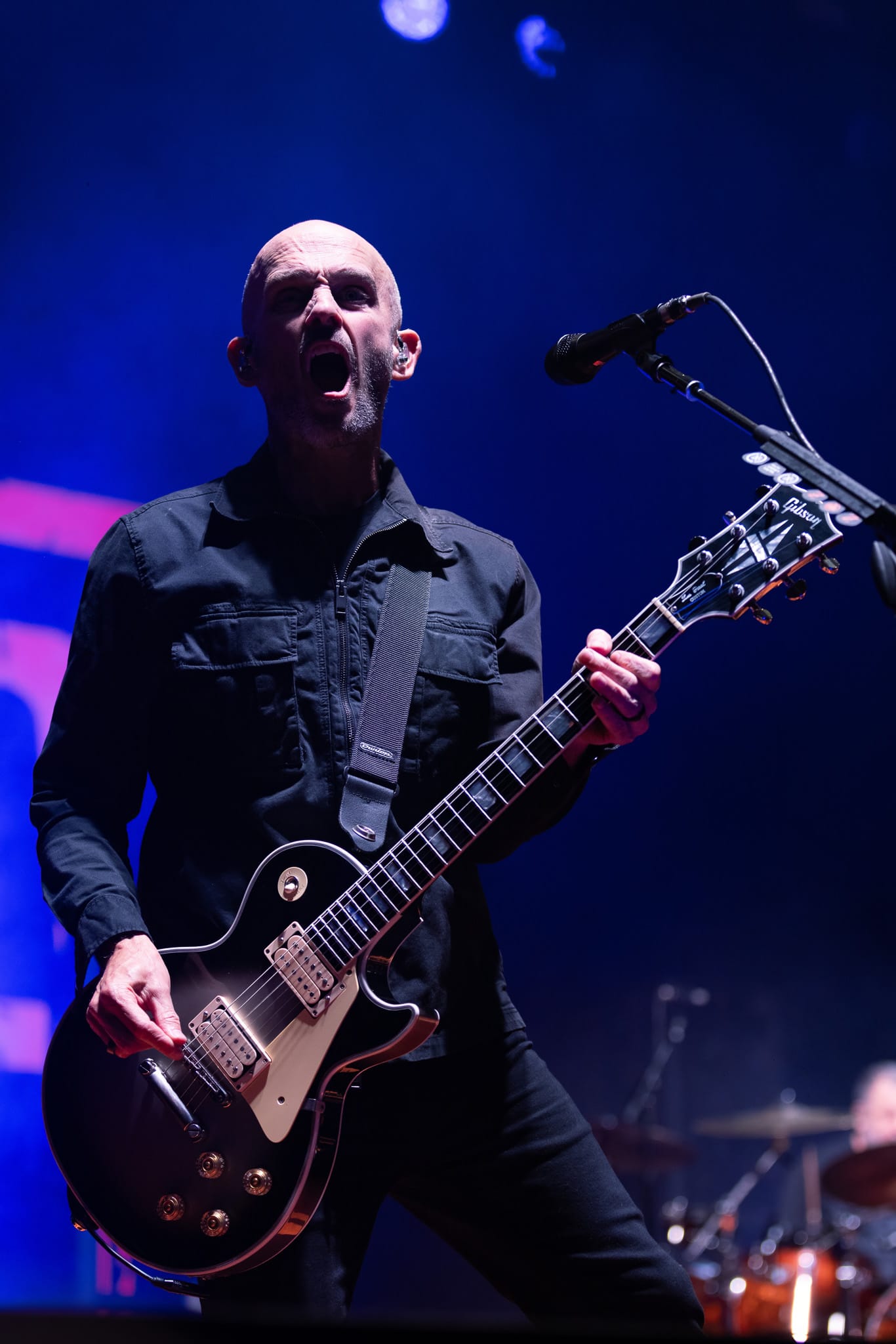
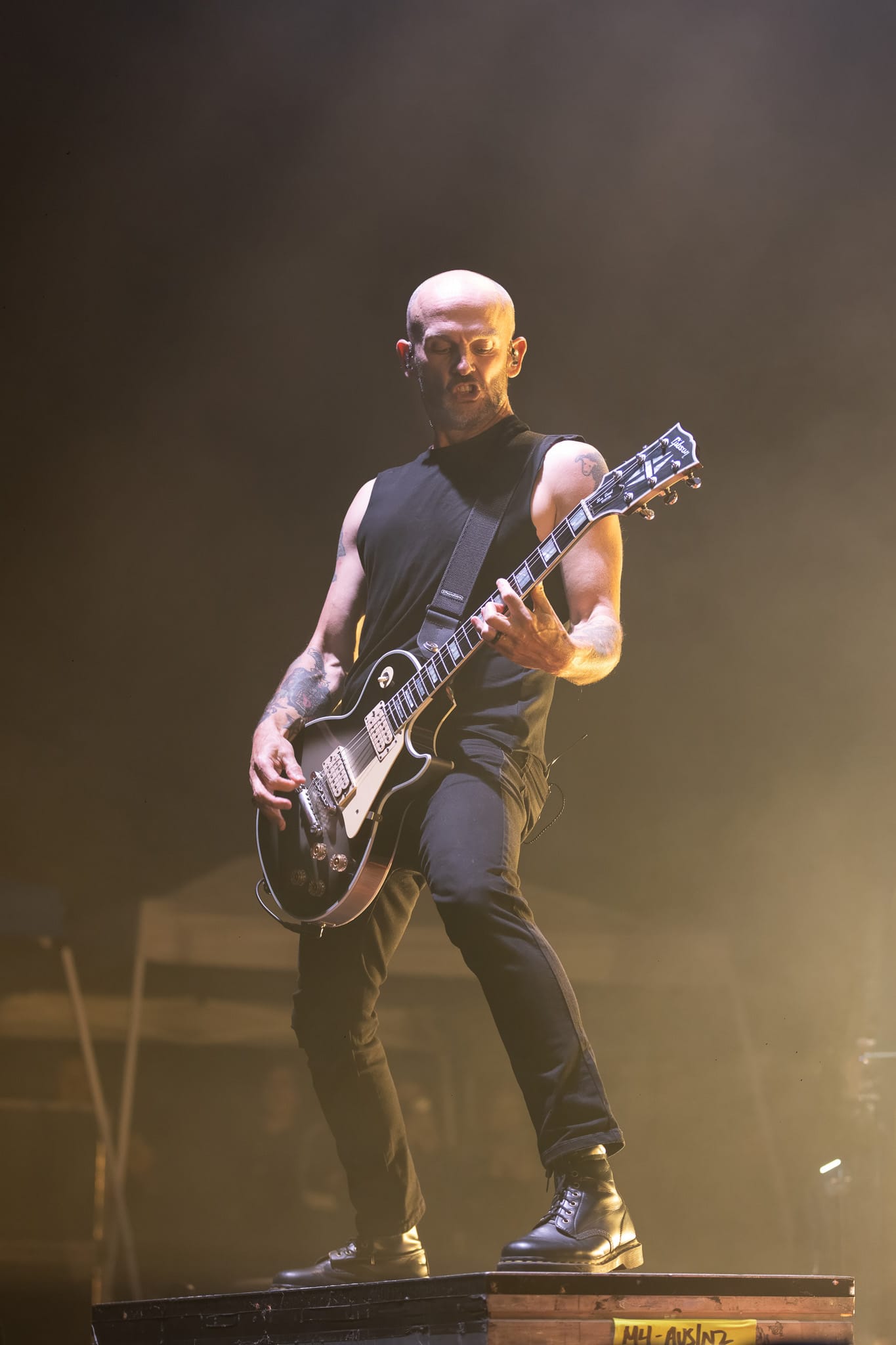
Zach Blair – Guitar
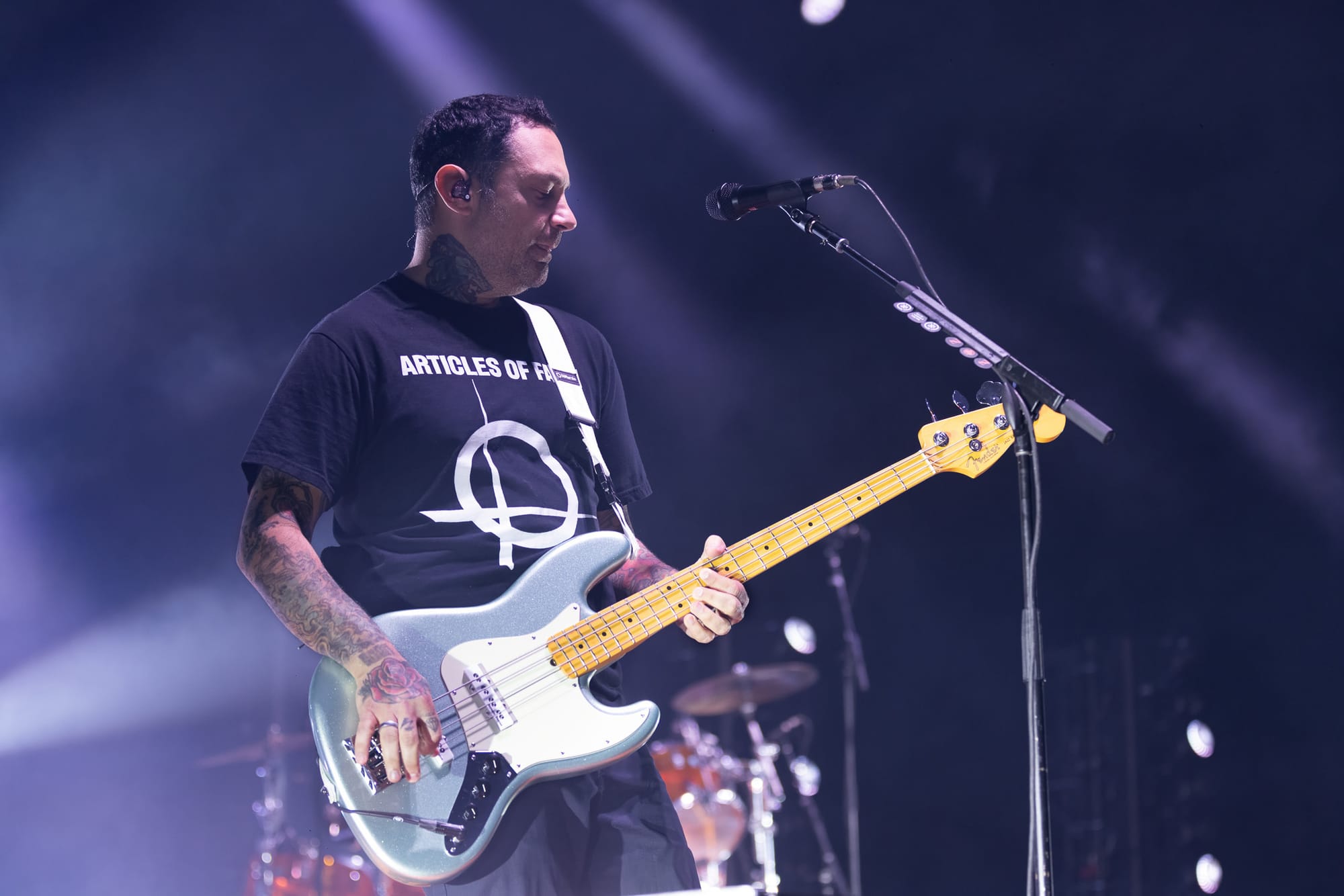
Joe Principe – Bass
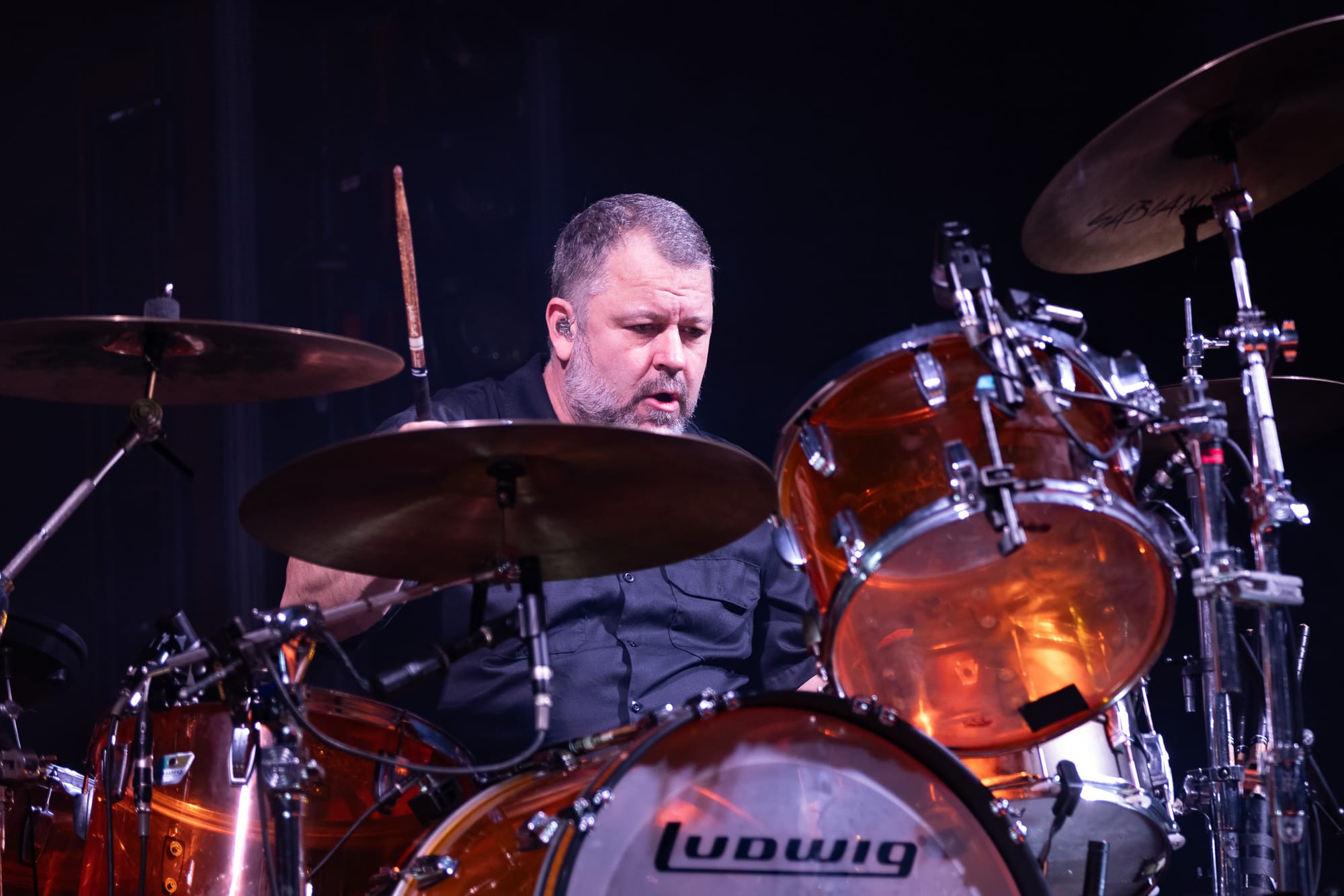
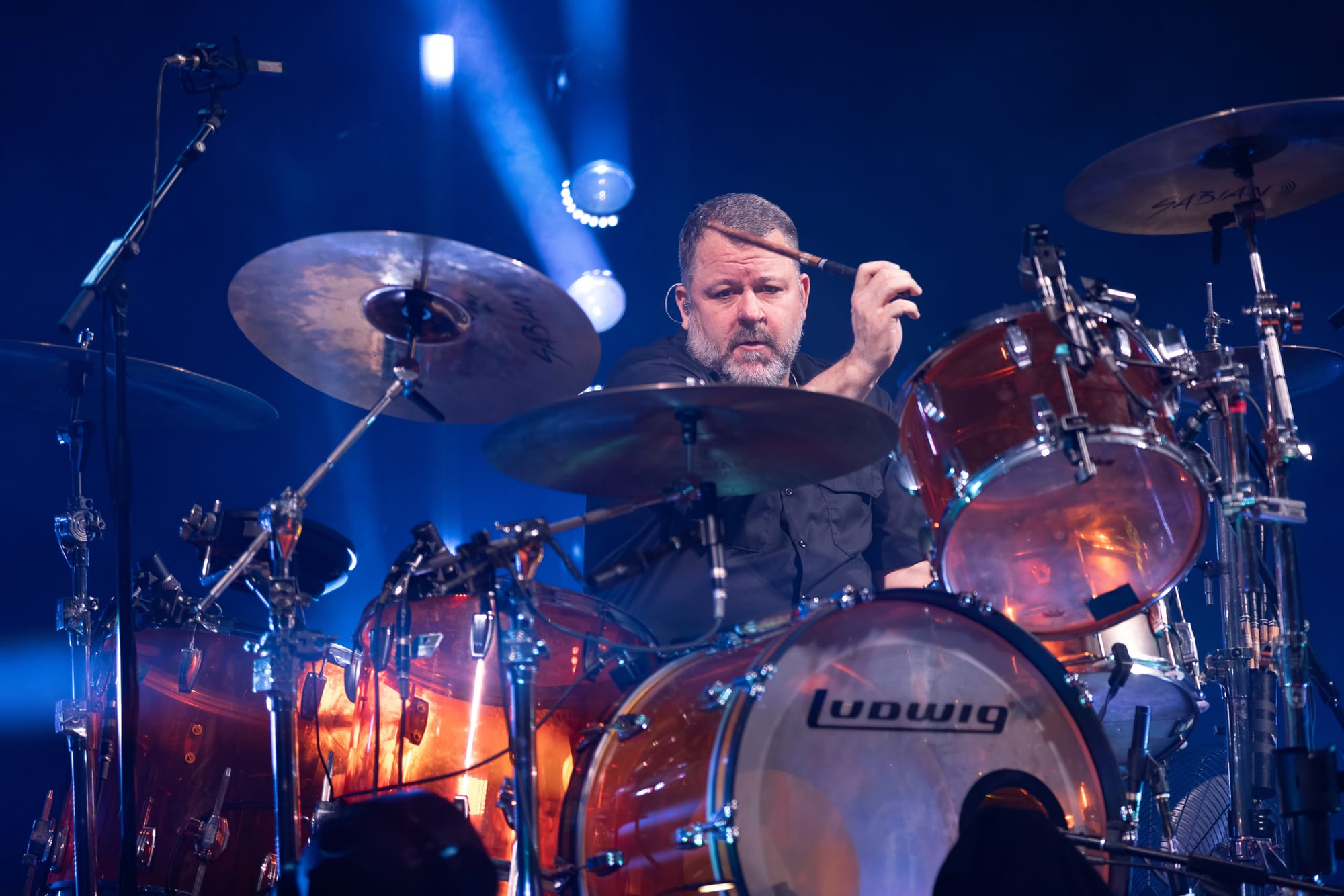
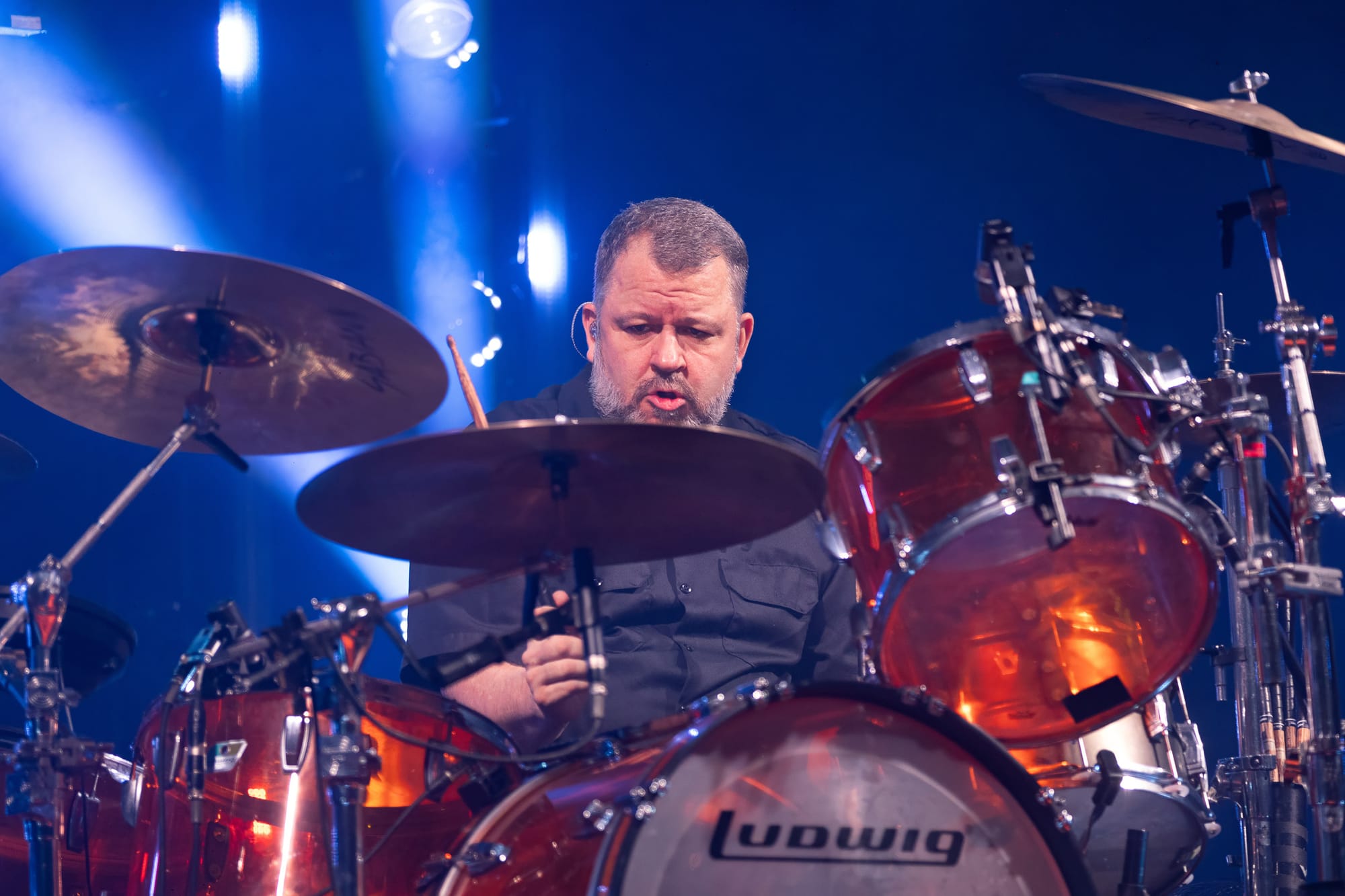
Brandon Barnes – Drums
Setlist:
1) Satellite
2) Make It Stop (September's Children)
3) Give It All
4) Help Is on the Way
5) Under the Knife
6) The Good Left Undone
7) Katy Bar the Door
8) Prayer of the Refugee
9) Swing Life Away (Acoustic)
10) Re-Education (Through Labor)
Encore:
11) Survive
12) Savior
Alkaline Trio
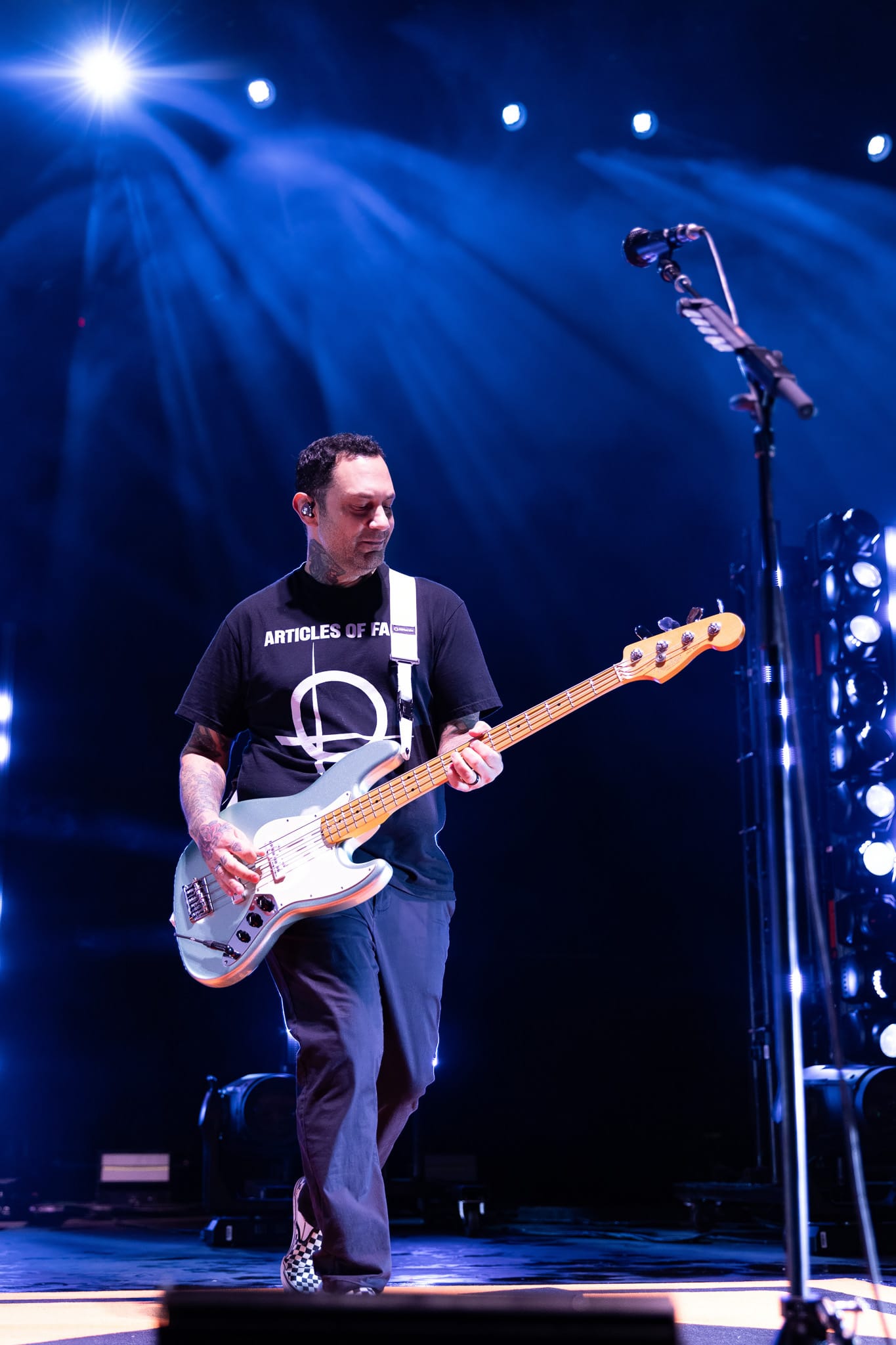
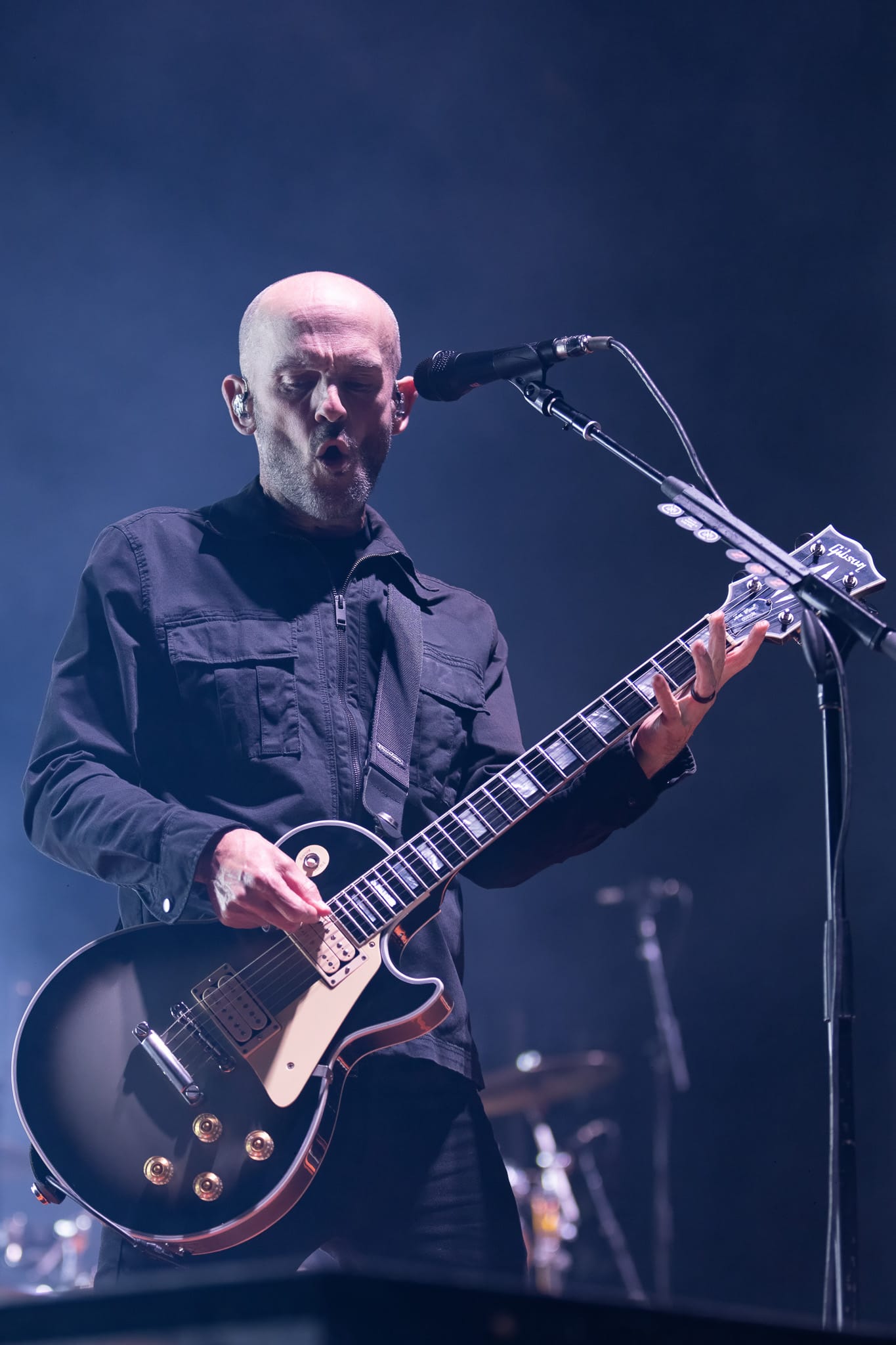
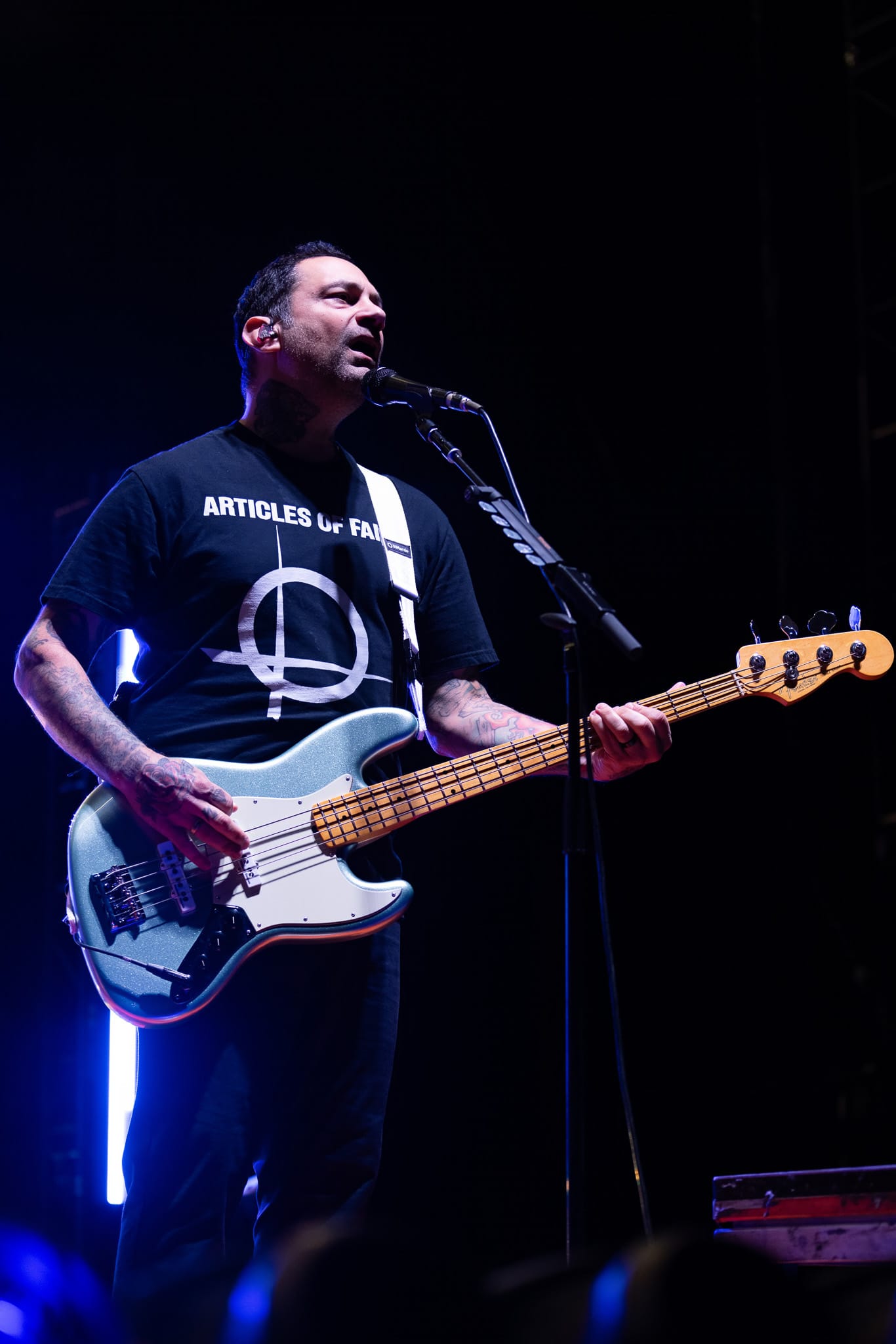
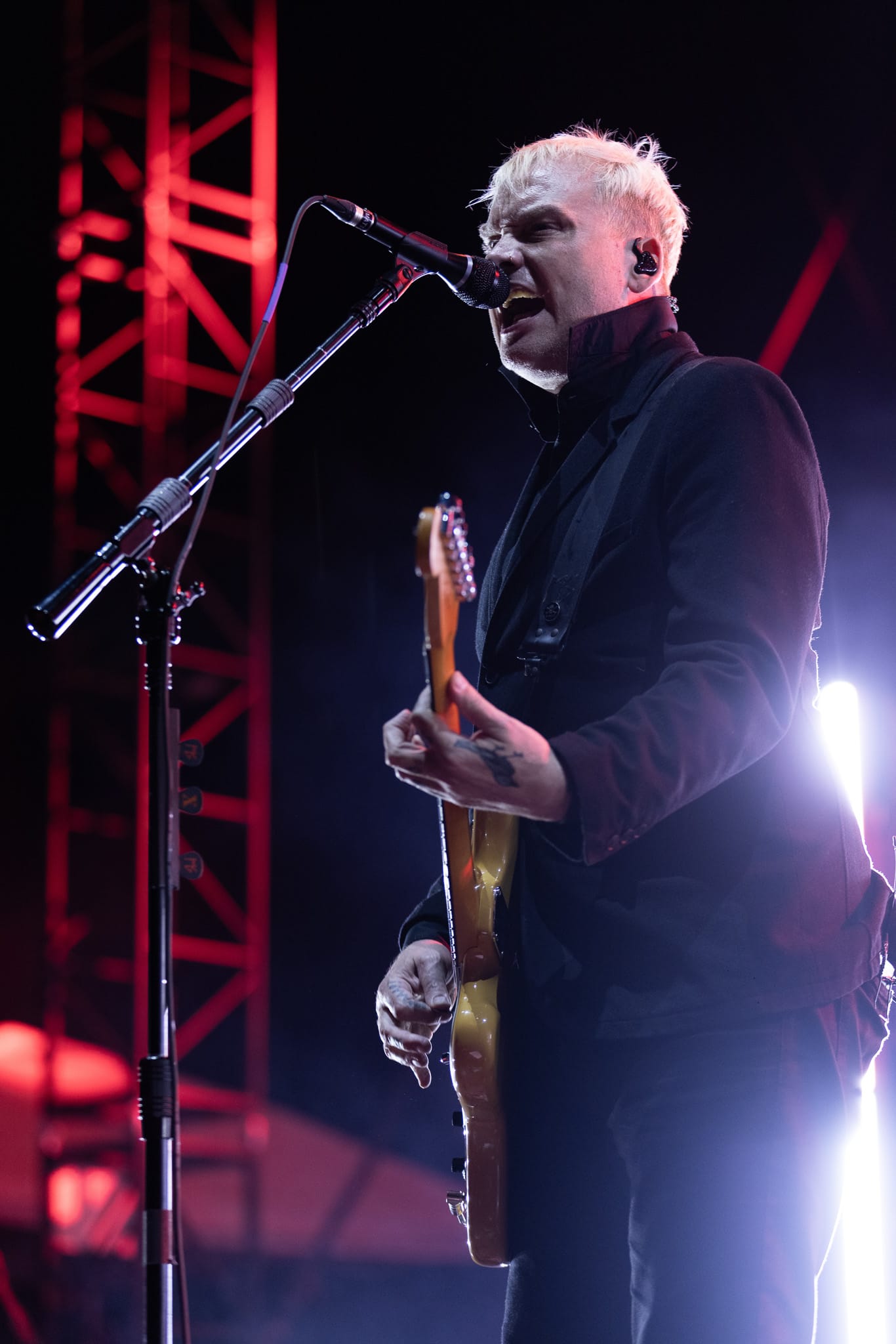
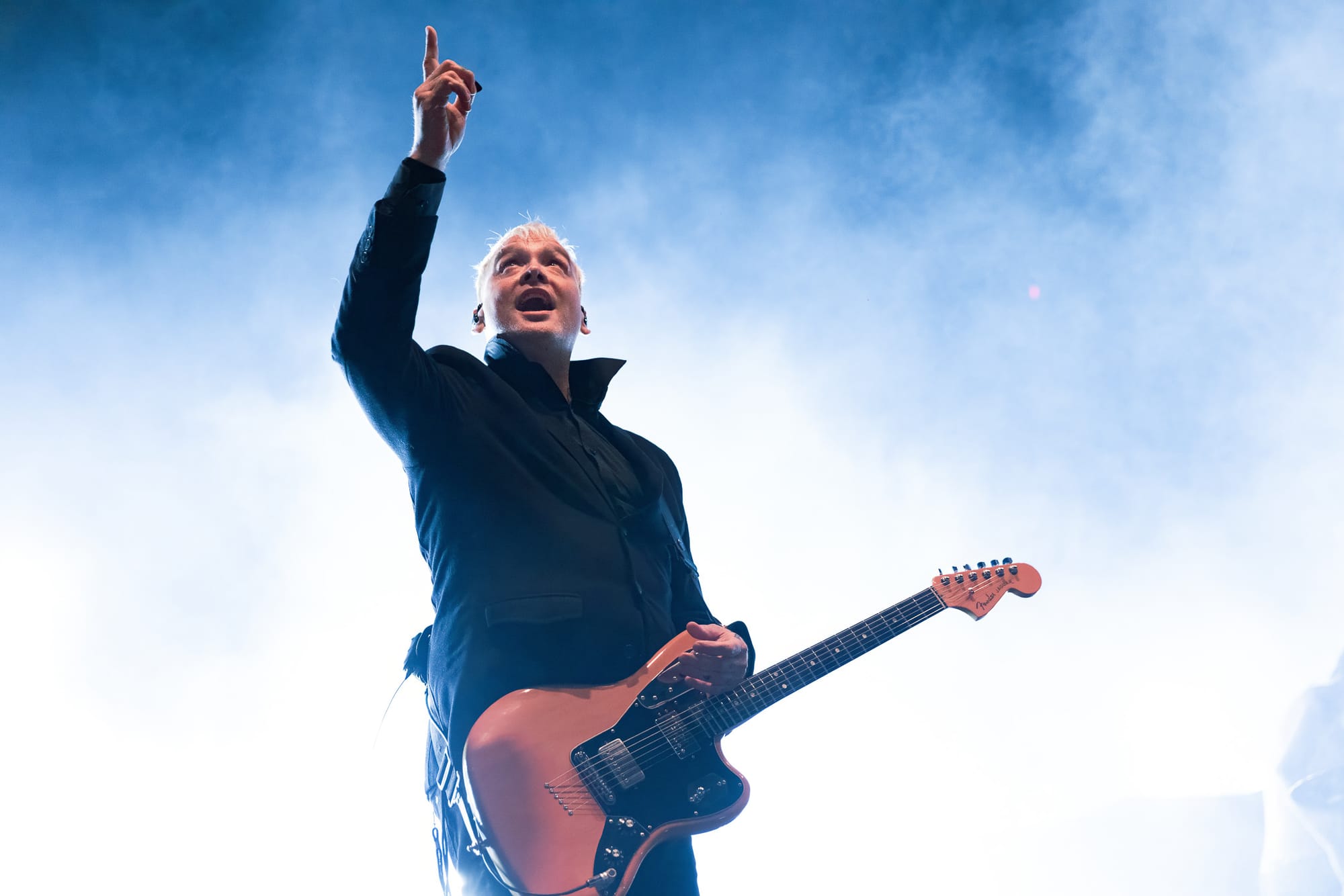
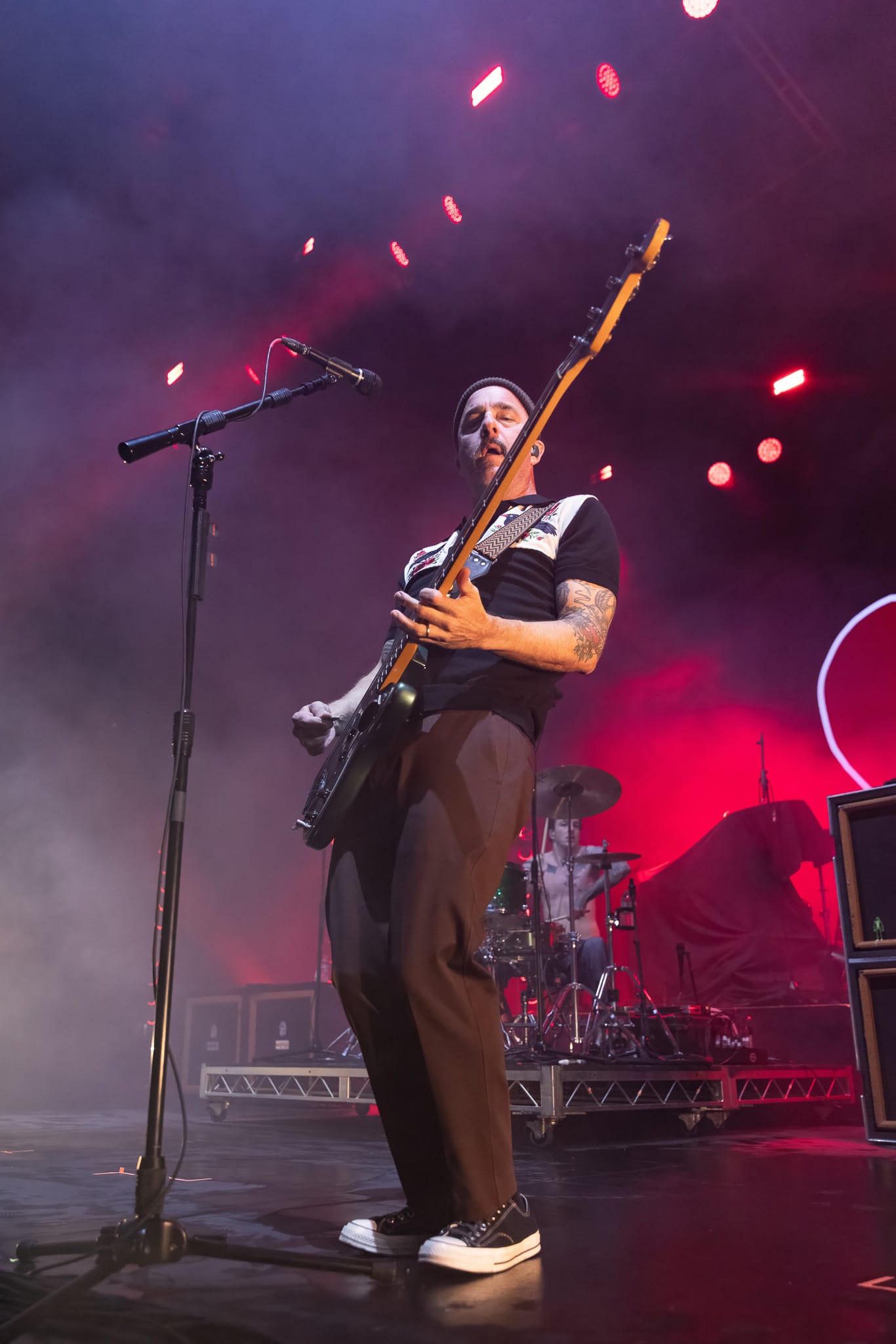
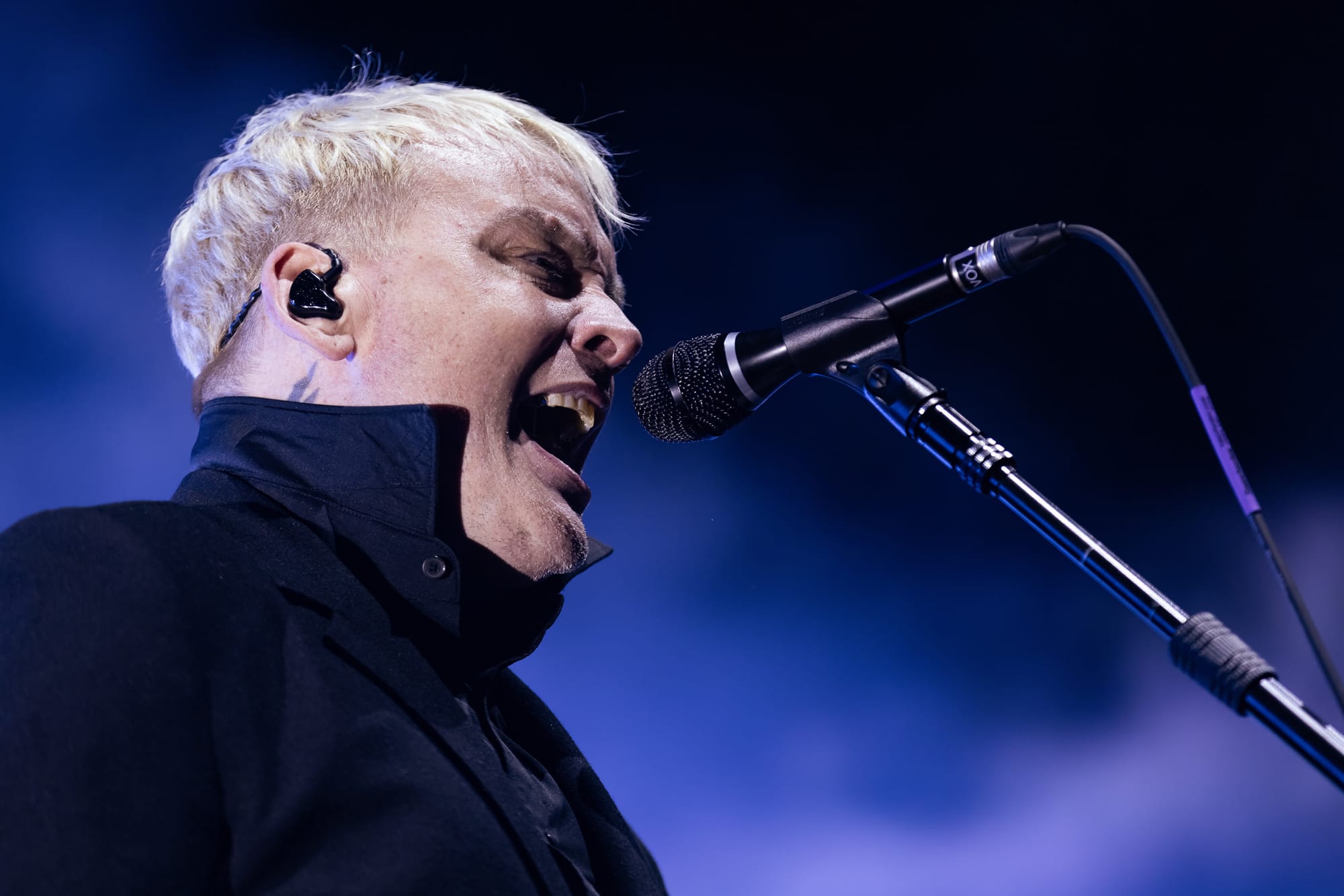
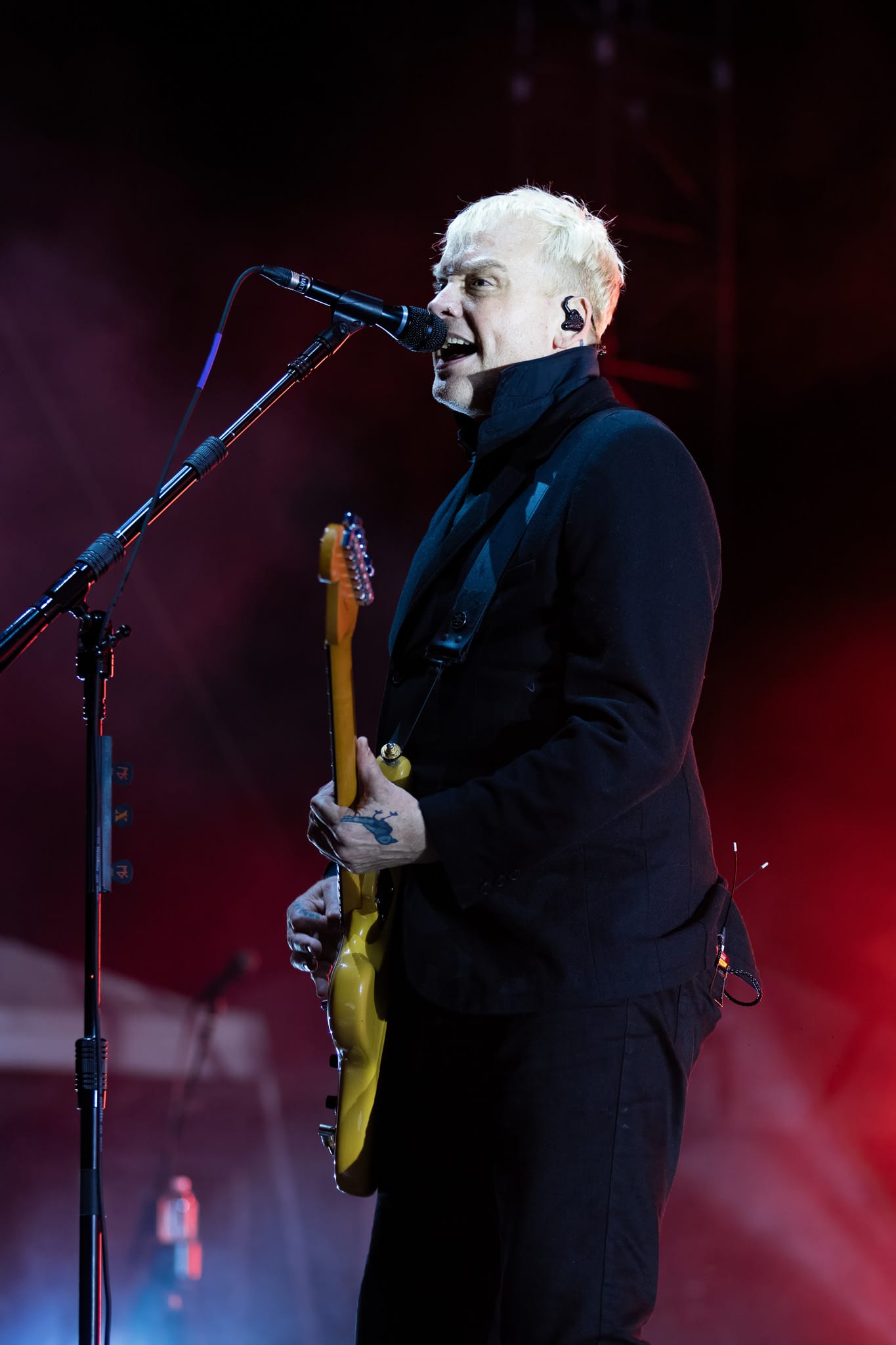
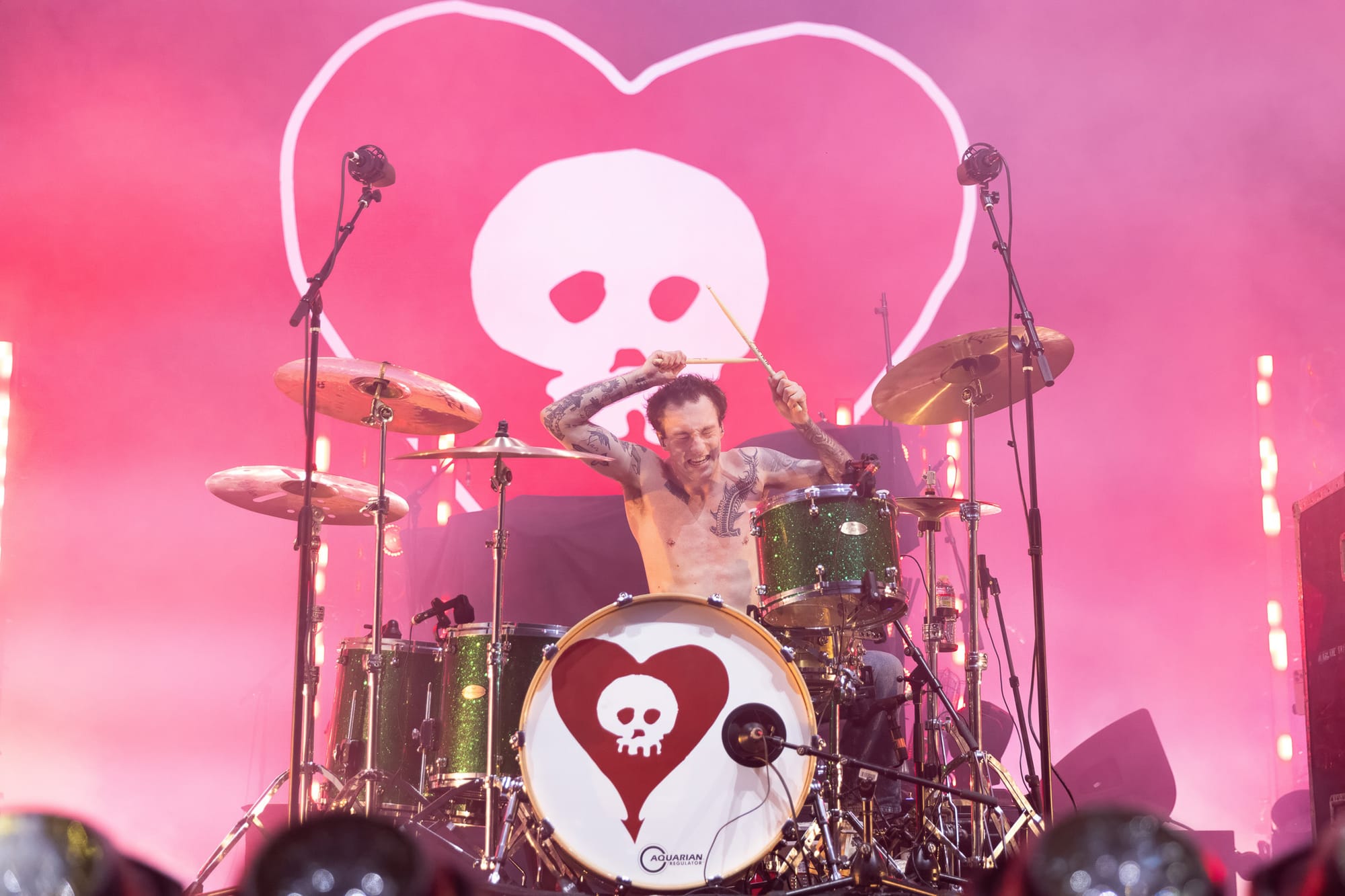
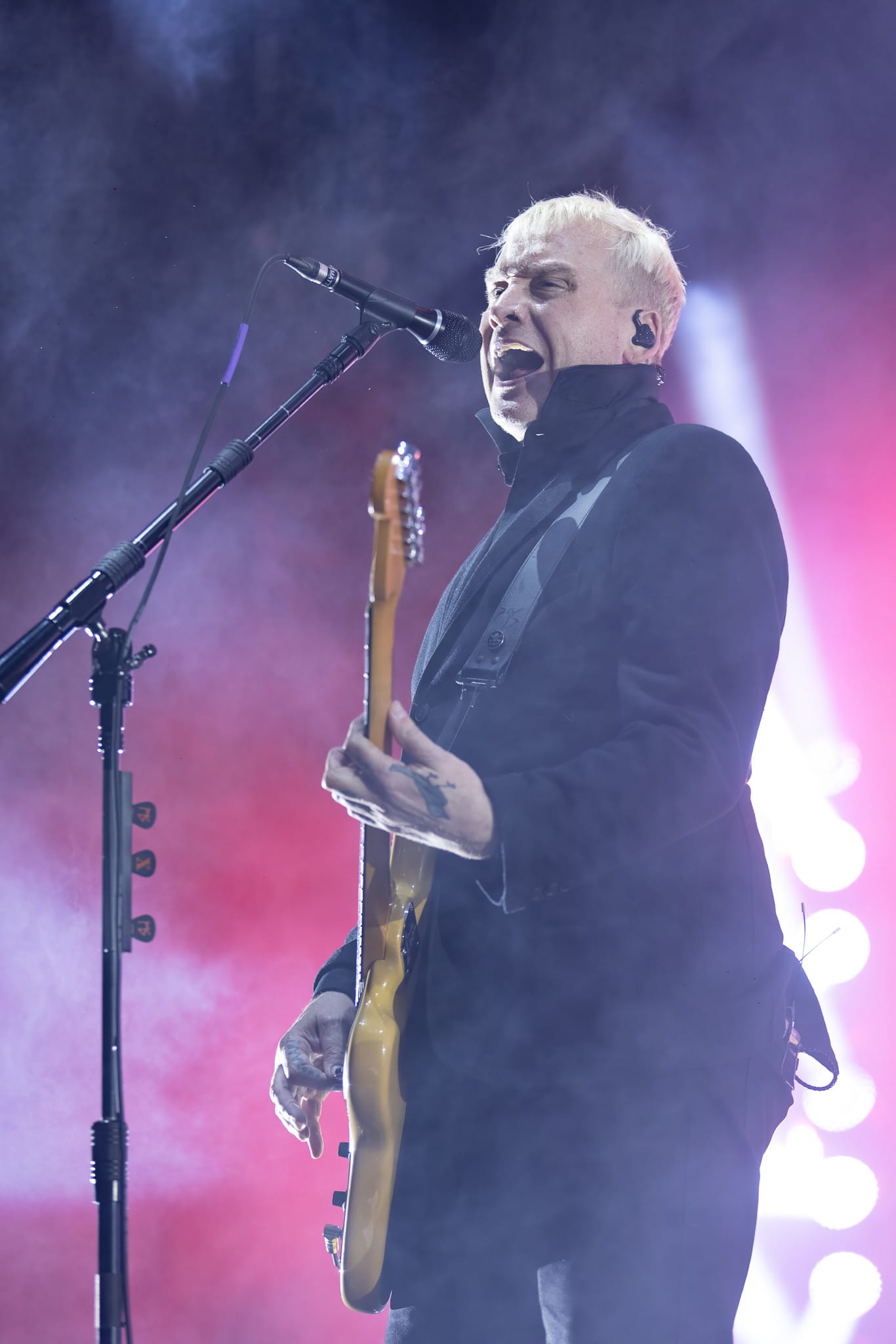
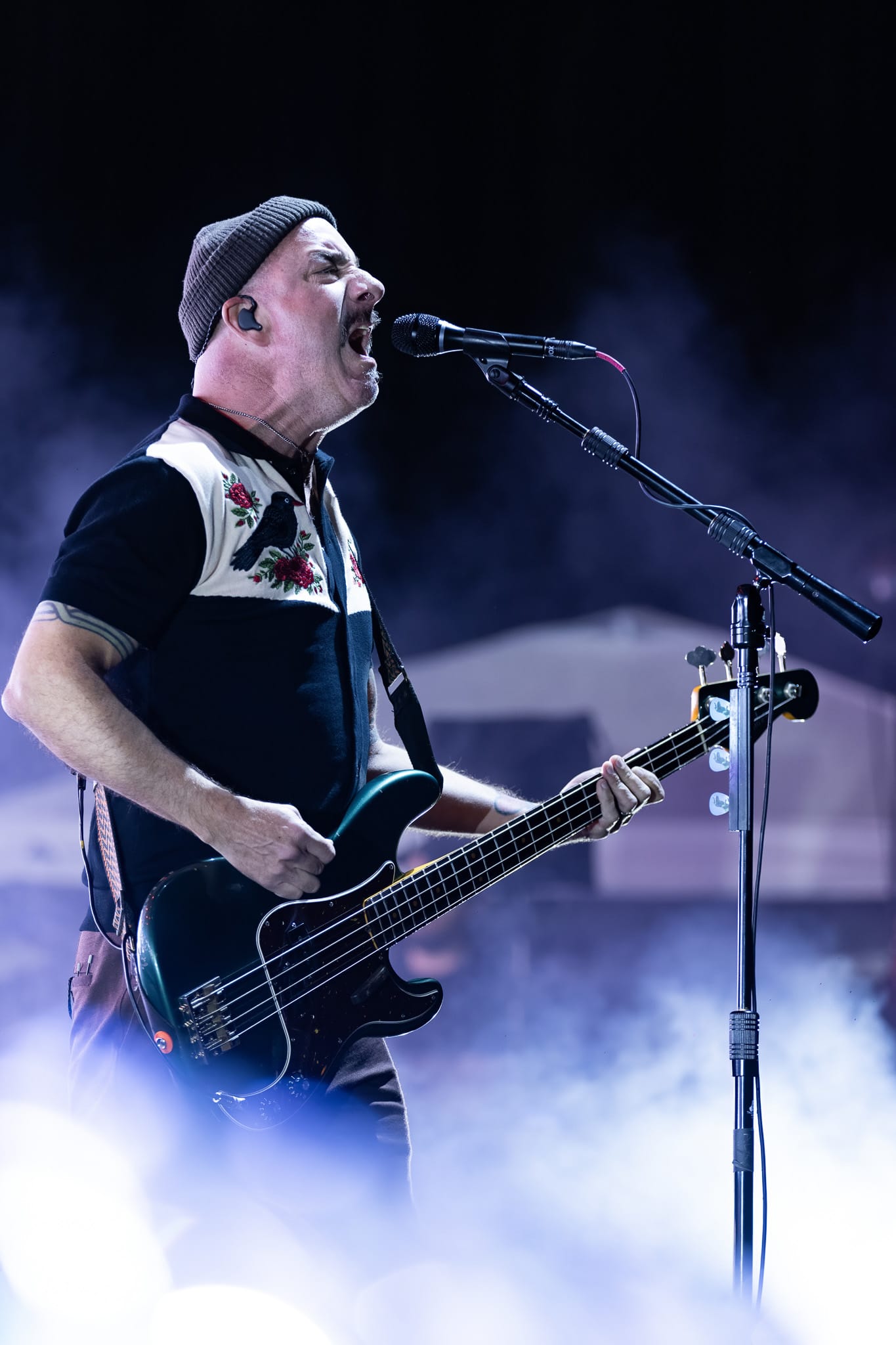
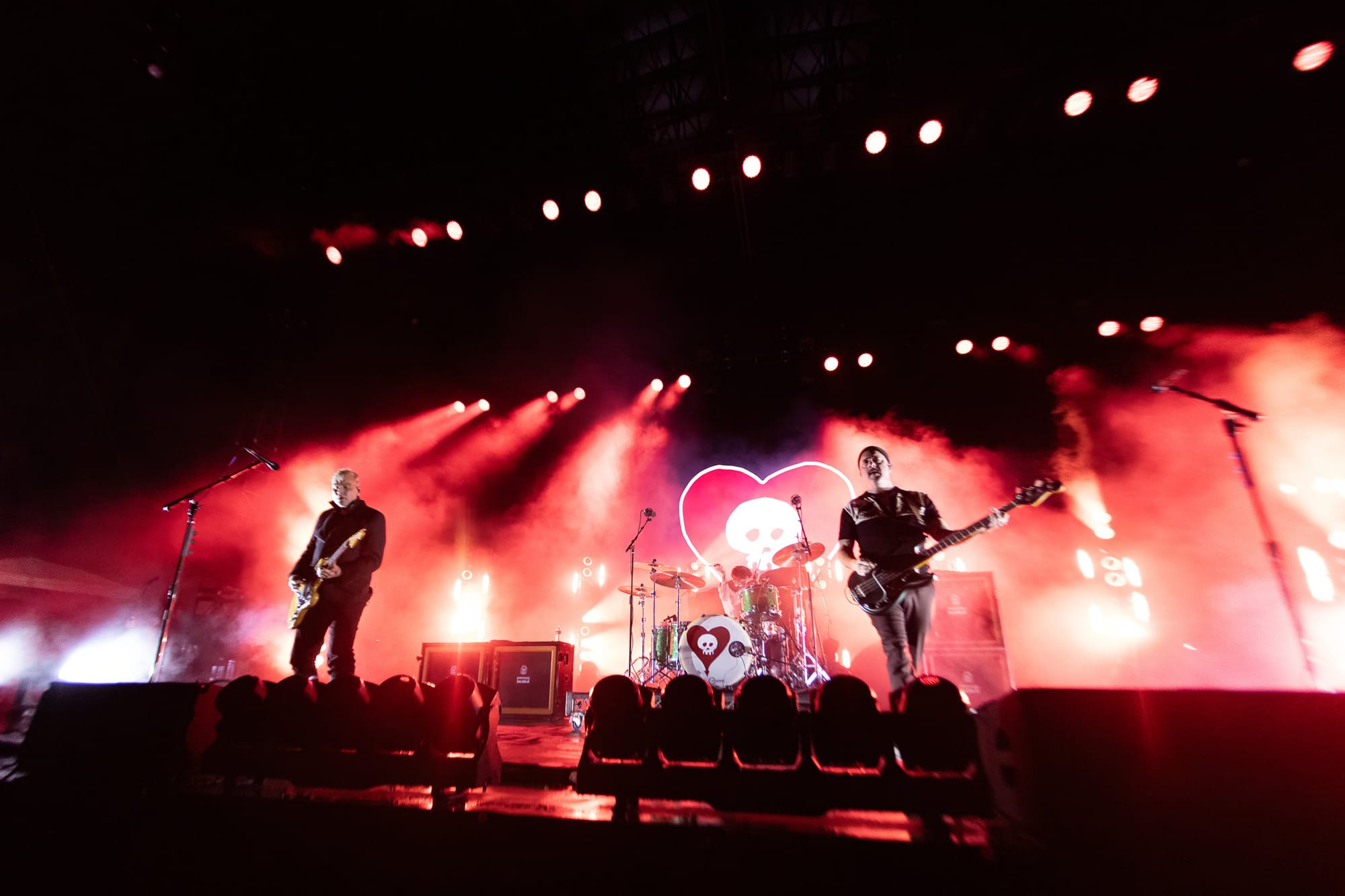
Like Rise Against, Alkaline Trio is from Chicago, forming 30 years ago in 1996. Another similarity is their fanbase, which is also borderline fanatic. Fans were beyond excited to be back inside the venue after the weather event and threat of cancellation…Alkaline Trio’s set was up first, and the fans, many of whom had driven hours to be there and risked missing it due to lightning were ready. People were ecstatic about being there, and when the lights finally came up to reveal the three-piece on stage, the roar from the crowd was deafening. The fact that the set was shortened didn’t matter – people were there to live in the moment, and Alkaline Trio put on an amazingly energized show.
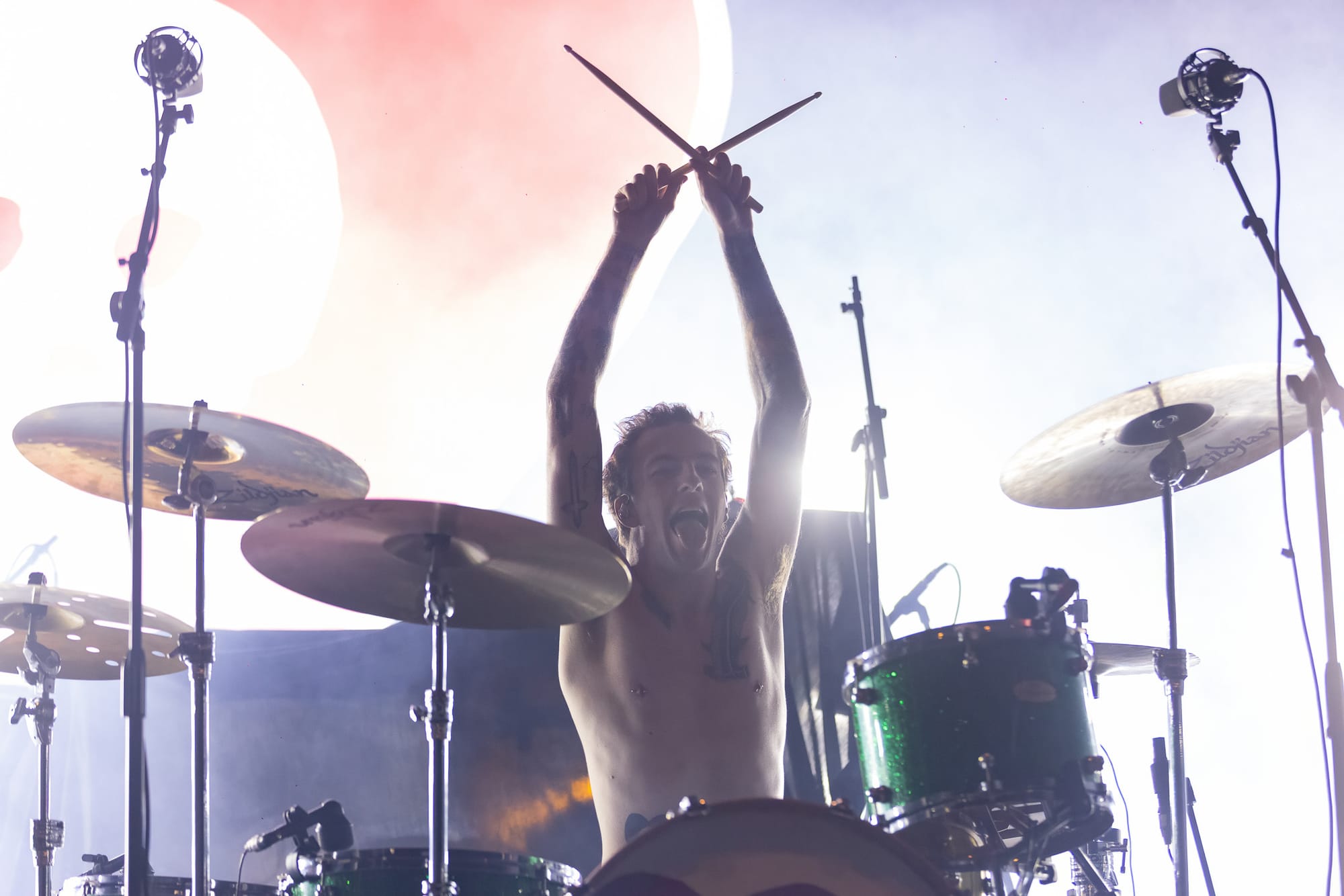
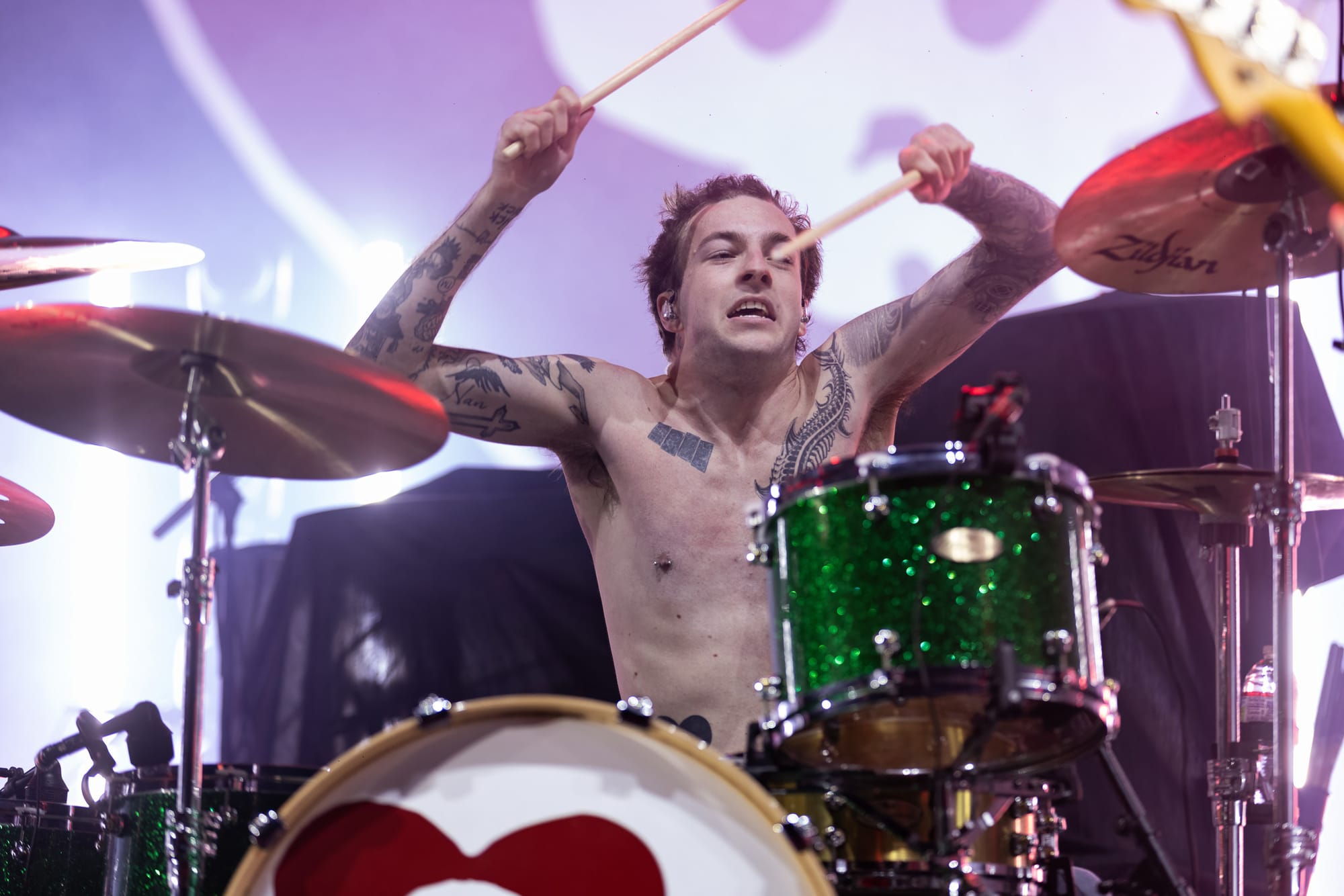
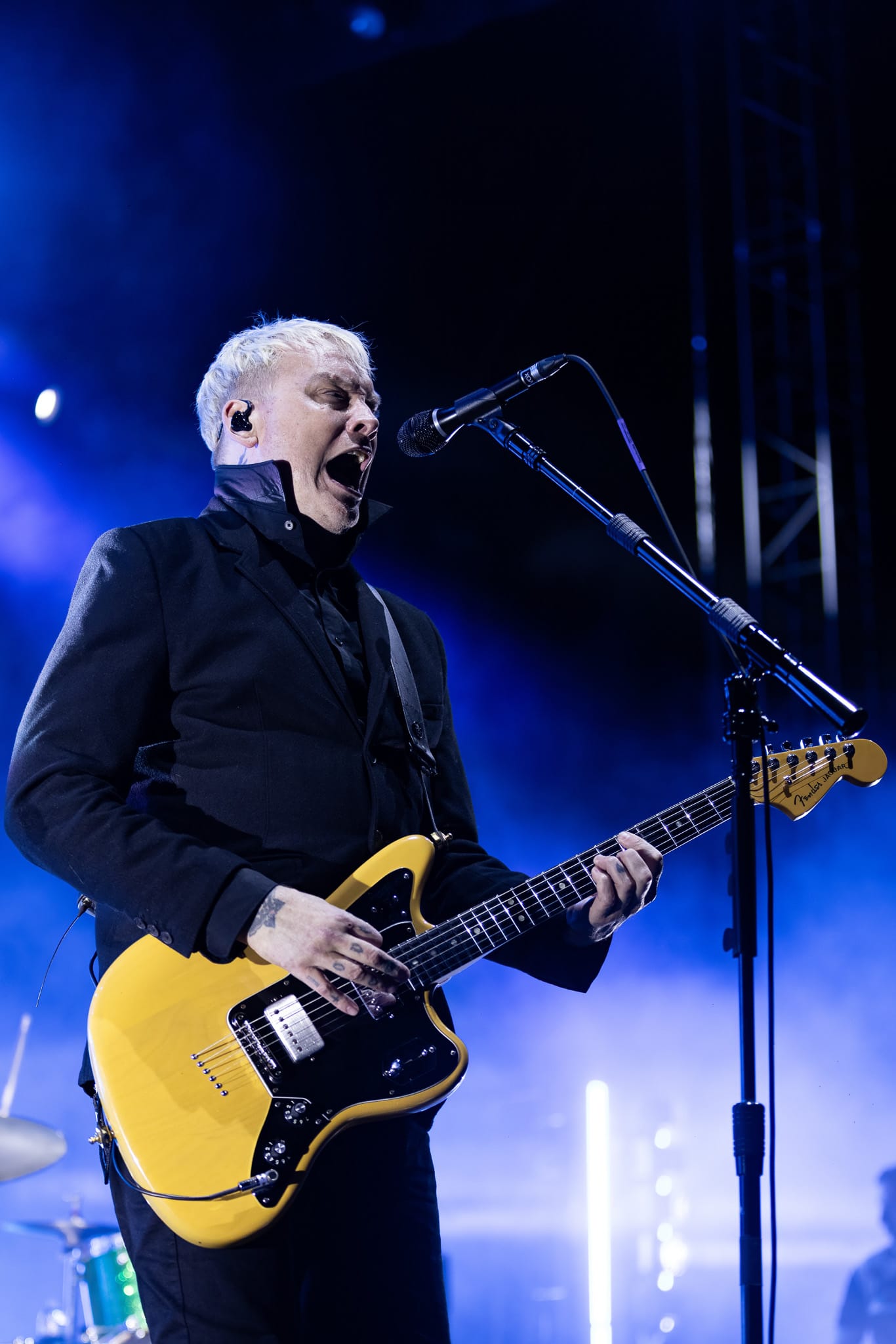
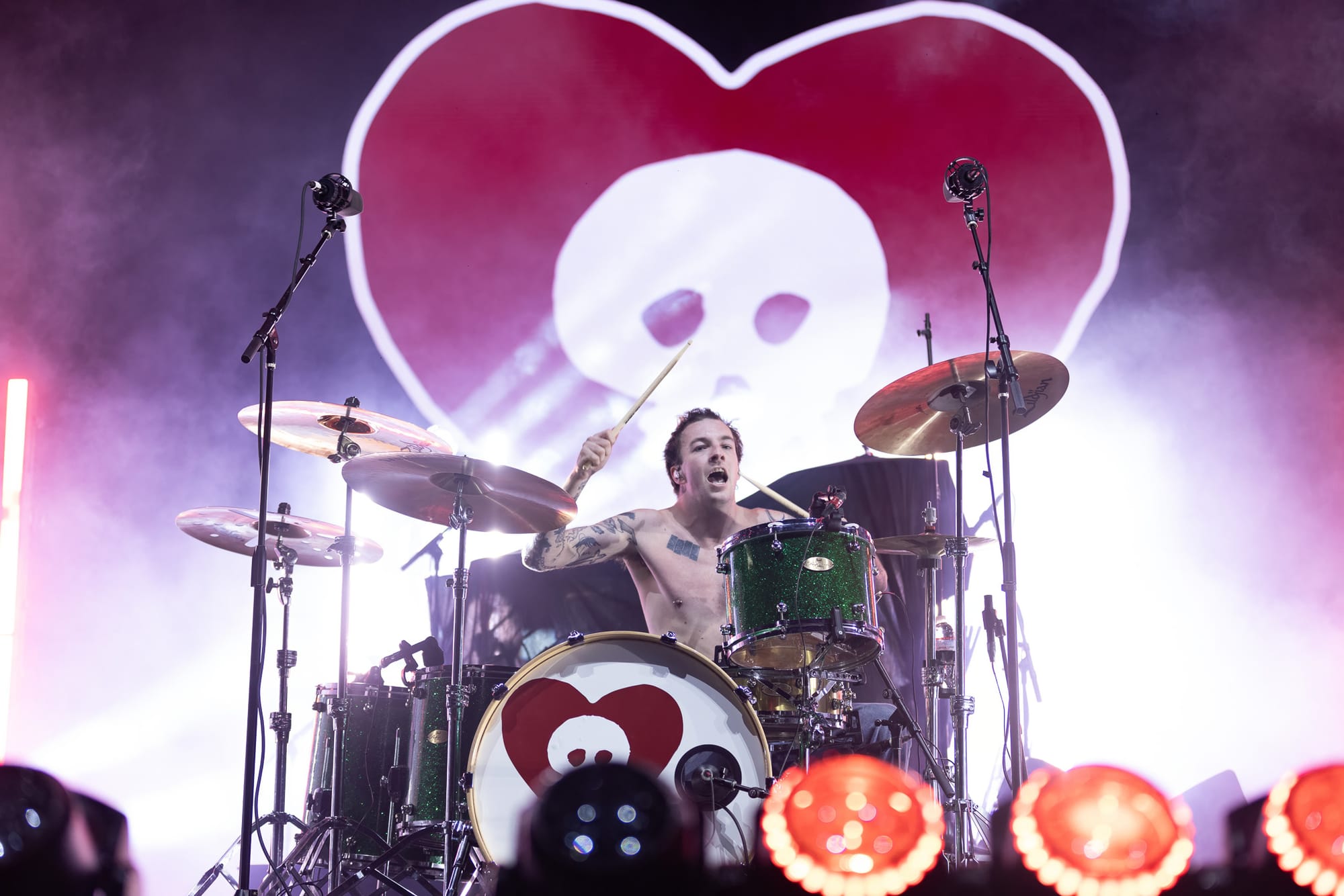
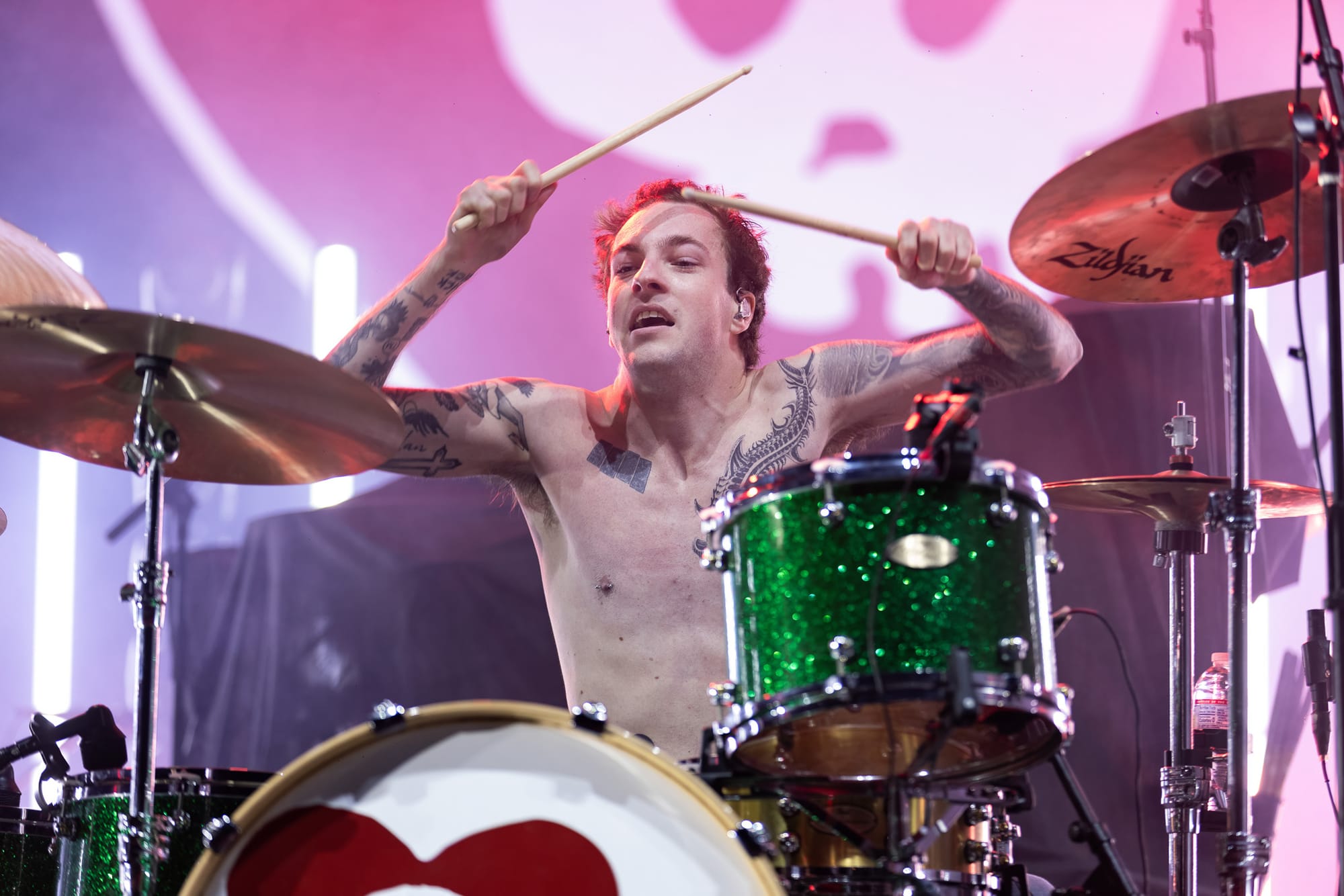
Vocalist/guitarist Matt Skiba is a founding member, and did double-duty on guitars and vocals in Blink 182 from 2015-2022 when Tom DeLonge left that band. Dan Andrian, who alternates lead vocals with Matt and plays bass, joined just after they formed and has been featured on all ten studio albums. Newcommer Tosh Peterson on drums joined earlier this year after the departure of Atom Willard. Despite being in the band less than a year, Tosh was captivating to watch, bringing an Animal from the Muppets aesthetic to the kit, while keeping the train rolling down the tracks. Alkaline Trio was incredibly tight, and delivered a short but passionate set that was exactly what their fans hoped for.
Alkaline Trio is:
Matt Skiba – Vocals/Guitar
Dan Andriano – Vocals/Bass
Tosh Peterson – Drums
Setlist:
1) We've Had Enough
2) Calling All Skeletons
3) Private Eye
4) Is This Thing Cursed?
5) Cringe
6) Oblivion
7) Every Thug Needs a Lady
8) Warbrain
9) Mercy Me
10) Radio
Brooks RobinsonPhotographer & Writer
Brooks Robinson is an LA-based concert photographer, and 30+ year freelance camera operator for film, television, and music videos. He has photographed some of the largest film/TV projects in history, and hundreds of music videos in MTV's heyday.
Forbidden are unquestionably one of the veteran names of thrash metal. With two albums that helped define the late-’80s scene, the band earned a place in metal history. The debut, Forbidden Evil, with its iconic artwork, and Twisted Into Formbelong in any serious metal record collection. After that, however, things became less consistent. Later releases… Continue Reading →
Sergiy Bolotny Reflections “Oh Human Destiny ” Review
As soon as the violin of this great composer and artist begins its first notes, listeners are transported to an expansive, snow-covered plain. The music evokes the image of a pale sun illuminating everything around in a bright white glow. In this serene yet stark landscape, one cannot help but reflect on the fragility of life and the profound mysteries that occupy the human mind.
Sergiy Bolotny’s single “Reflections ‘Oh Human Destiny’” creates an atmosphere ripe for deep contemplation. The notes cut through the air, sometimes like blades and other times like beams of sunlight that warm the soul. This duality of expression is a hallmark of Bolotny’s artistry. He skillfully conveys his most profound emotions through his music, which resonates deeply with listeners, making them ponder the greater questions of existence.
The expressive capacity of Bolotny is extraordinary. He has an exceptional gift for transforming feelings into music, creating a connection that transcends words. Every note serves as a vessel for his emotions, allowing audiences to experience the intensity of his feelings. This is not just a piece to be heard; it is an experience to be felt.
Reflections “Oh Human Destiny ” – Sound and Atmosphere
The single invites its audience into a moment of pure classical music, a journey that many will find enriching. Each phrase and each passage seems to articulate questions that are often left unspoken.
Throughout the piece, there is an ongoing contrast between the light and the dark. This duality enriches the listening experience, allowing individuals to engage with the music on multiple levels. Bolotny’s composition urges the listener to confront their own emotions, leading to an examination of one’s own place in the world.
Reflections “Oh Human Destiny ” – Performance and Production
The thematic content of “Reflections ‘Oh Human Destiny’” resonates with anyone who has pondered life’s complexities. It becomes clear that Bolotny’s music serves as a mirror, reflecting the listener’s emotions and thoughts.
Moreover, Bolotny’s profound understanding of the human experience allows him to reach listeners on a deeply personal level. His music invites shared experiences and creates a sense of community among those who listen. This universal nature of his art fosters a bond that draws people together through shared reflections on existence.
“Reflections ‘Oh Human Destiny’” is an exquisite work that stands as a significant contribution to classical music. It honors the magnitude of life’s journey and the myriad thoughts that accompany it. Sergiy Bolotny’s ability to express these themes through the voice of the violin is a remarkable achievement.
Following the release of their latest single, “Alter Ego,” we had the pleasure of chatting with Searching Out Solutions vocalist Hale about the new song, her musical background and influences, the band’s evolution since their 2022 debut album, Pieces of the Red Line, and their plans for the future.
Reuel
Hello Hale! It’s a pleasure to chat with you. How are things going for you on the life and band fronts?
Hale Naphtha
It’s a pleasure to chat with you too! I’m doing great, and I’m so happy to finally start a new chapter where I can showcase my band. It means the world to us to finally release what we’ve been working on for so long.
Reuel
This sounds amazing! You released a new single last month! Congratulations!! “Alter Ego” came out, and what a song it is! How are you feeling about the way it was received by your fans?
Hale Naphtha
I’m so glad you like it! I think it’s the best-received song in our band’s history. After taking our time, carefully preparing everything, and recording in the studio at our own pace, I think the announcement that something new was coming after such a long time made people really happy. And of course, it also caught the attention of a lot of new people, which is great.
Reuel
Fantastic! “Alter Ego” explores how people can be fake and deceitful, and your vocals perfectly reflected that pain of betrayal. What inspired this deep and relatable topic, and your great performance?
Hale Naphtha
Thank you so much. Honestly, I think it’s something we’ve all been through at some point. Sometimes it helps to open up about how we feel, and turning those negative emotions into music is something Searching Out Solutions has always done a lot. I think bringing a song like this to life can be a way to find closure. It’s almost cathartic.
Reuel
There’s Phil Collins, there’s Dave Grohl, and there’s you! How has your background as a drummer shaped the way you sing and front Searching Out Solutions?
Hale Naphtha
Wow, those comparisons are incredibly flattering! Honestly, I’ve been singing for as long as I can remember. I used to write my own songs as a little girl, and I started singing in rock bands when I was 12. I learned to play the drums when I was 15, and singing and drumming have been my inseparable companions ever since.
Being able to play drums, guitar, and sing is a huge part of my songwriting process. It allows me to understand a song from different perspectives and figure out what it needs from each instrument. I think it really helps me approach songwriting with a more complete vision of how all the different elements come together.
Reuel
How would you describe Searching Out Solutions to our readers who have never listened to your music before?
Hale Naphtha
I’d describe it as a layered cake. It’s essentially alternative metal, but there’s also a blend of alternative rock and emo running through it. We bring together a refined mix of influences, with heavy seven-string guitar riffs, hard-hitting drums, and highly versatile vocal melodies, topped off with a touch of growls 💅
Reuel
Which musicians would you say have inspired you personally throughout your life and career?
Hale Naphtha
As a frontwoman, I draw inspiration from all kinds of artists, but when it comes to rock and metal, some absolute powerhouses who have always inspired me are Angela Gossow, Alissa White-Gluz, Hayley Williams, Amy Lee, and Tatiana Shmayluk, to name a few.
And even though I’m the vocalist in this project, I’m also a drummer, so I’d love to give a shout-out to some incredible drummers who have influenced me, such as Anika Nilles, Joey Jordison, Mike Portnoy, among others.
Reuel
What comes after “Alter Ego”? Are there any upcoming releases you can tell us about?
Hale Naphtha
Of course, there will be new releases in 2027! We can’t wait to share everything we’ve been working on for so long. And alongside new music, you can also expect some European festival announcements!
Reuel
Sounds exciting! Searching Out Solutions released their debut album in 2022. How has the band evolved since?
Hale Naphtha
“Alter Ego” embodies what you can expect from our upcoming release. We’re really excited to be able to say that Searching Out Solutions has evolved musically. While Pieces of the Red Line (2022) leaned more towards alternative rock and emo pop-punk, with guitars tuned to B♭, this new album sees us diving headfirst into alternative metal without abandoning our roots. Our sound has matured quite a bit over the years, and it’s definitely gotten heavier, to the point where we’ve found ourselves moving into alternative metal.
Reuel
Thank you for your time, Hale! Is there anything else you’d like to add?
Hale Naphtha
Here are my social media links and the band’s! (mentioned below) It’s worth mentioning that any support you can give us by sharing our music, streaming our tracks, and engaging with our content means the world to us. You can also support us on Bandcamp and grab some merch. Thank you so much for all your support! It truly means everything to us.
Judge Smith 2025-2026 Running for cover and looking for refuge, an esteemed English auteur issues a double-barrel of soul-searching missives. Existing as a creator in a class of one’s own doesn’t imply loneliness – there are always friends to support … Continue reading →
Slayer’s Reign In Blood is one of metal’s all-time Hall Of Fame Albums. Released in the United States on October 7, 1986, it was darker, colder and more malicious than anything that had come before, including Metallica’s equally monumental Master Of Puppets, which arrived earlier that year. Its scalpel-cold sonics and diabolically depraved lyrics set a new bar for how far metal could go – and it remains there to this day. Forty years on, here are 40 facts that every self-respecting metal fan should know about this black-hearted masterpiece.
1 One of the most malevolent albums ever made was partly written in a bedroom in Kerry King’s parents’ house. The guitarist was still living at home with his folks when he was writing the songs for Reign In Blood, and would hunker down with a cassette recorder to capture his ideas – including Piece By Piece, the first song he wrote for the album.
2 Guitarist Jeff Hanneman wrote his Reign In Blood songs using a drum machine. “He started recording his own demos complete with the basic drum pattern, guitar riffs, some arrangements,” Dave Lombardo, the actual human drummer who played on the finished album, later recalled. “And then he would present us with cassettes. It was awesome, because it gave us a clear picture of where he was going.”
3Rick Rubin is often credited as Reign In Blood’s producer, which isn’t strictly accurate. He’s officially the album’s co-producer, along with the band themselves.
4 The majority of the music for Reign In Blood was written and demoed before the band met Rick Rubin. The original instrumental demo version came in between 33 and 34 minutes – five or six minutes longer than the finished record.
5 Rick Rubin grew up listening to punk rock, before pivoting towards hip hop and founding Def Jam Records. He hadn’t heard of Slayer until a friend who worked at MTV took him to see them play New York club The Ritz on September 27, 1985. “Megadeth played before them, and [another band] before that,” recalled Rick, who poached the band from their original label, Metal Blade, making them Def Jam’s first non-hip hop signing. “I don’t recall much of anything that night before Slayer. They totally annihilated.”
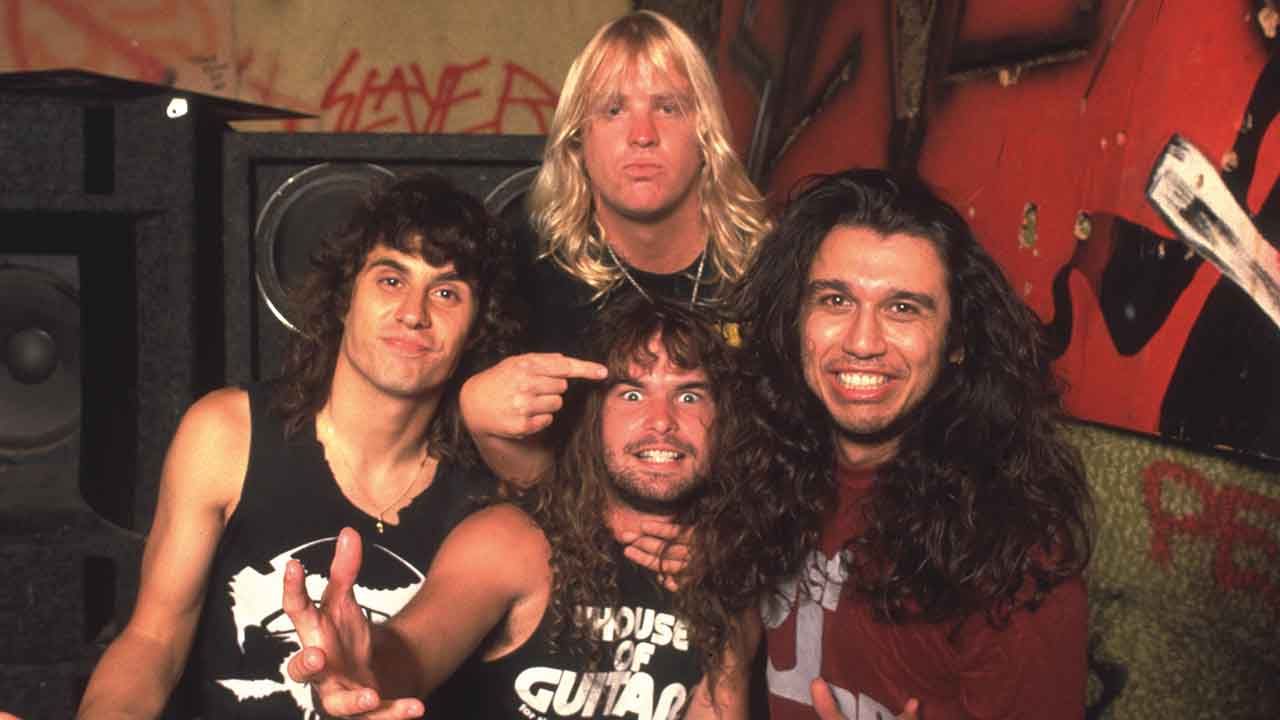
Slayer in 1986: (clockwise from left) Dave Lombardo, Jeff Hanneman, Tom Araya, Kerry King (Image credit: Chris Walter/Wire Image)
6Reign In Blood was recorded at LA’s Hit City West studio on West Pico Boulevard. Run by Reign In Blood engineer Andy Wallace, the studio’s previous clients included Mötley Crüe, soul star Bobby Womack and Mike Love of The Beach Boys.
7 Rick played Andy Wallace an unspecified Metallica album to highlight what he thought was wrong with typical metal production. “If the music you’re playing is fast and the sounds are big, there’s not enough space for those big sounds to happen next to each other,” the producer said in 2024. “There’s no punctuation; it becomes a blur.”
8Reign In Blood was the first time Slayer could afford to record during the daytime. Kerry told Guitar World in 2011 that the band tracked 1983’s Show No Mercy and 1985’s Hell Awaits from “10 at night to 6 in the morning, just because that’s when we could get the time cheapest”.
9 Opening track Angel Of Death features one of the greatest screams ever committed to tape, courtesy of Tom Araya. “Jeff was like, ‘We need something here, do a scream,’” the vocalist told Metal Hammer. “I said, ‘What kind of scream?’ They couldn’t really explain it, so I’m like, ‘OK…’, and I did this scream. When we listened back, I went, ‘OK, I know what to do, let’s do it again.’ We did it a couple more times, three or four times in total, but we were like, ‘Forget it, we got what we wanted with the second one.’”
10 The Altar Of Sacrifice riff was written for an abandoned Show No Mercy-era track called Ice Titan. Kerry later dismissed Ice Titan as “a bunch of teenage gibberish”, but a live version from 1983 surfaced on the band’s 2003 box set, Soundtrack To The Apocalypse.
11 The album’s closing song, Raining Blood, was a collaboration between guitarists Kerry and Jeff. The concept came from a dream Jeff had, then Kerry finished the lyrics under supreme time pressure. He was still writing lines while the other members were in the studio, recording their parts for the song.
12 The songs weren’t supposed to be as fast as they ended up. According to Dave Lombardo, the band sped up as they recorded new takes. “It takes you a couple takes to get to that point where the music is extraordinary,” he remembered. “Then you reach that peak. After that, you’re just exhausted.”
13 Despite the velocity of the music, no illegal drugs were consumed in the studio. Instead, Rick Rubin would ply Dave Lombardo with candy and Gatorade to keep his energy levels up. “What else were we fuelled by? Nothing. I didn’t even drink yet. It wasn’t a party,” Kerry told Hammer.
14 When the band recorded the album and shaved off those five or six minutes from the demo version, Rick had to reassure Tom that 28 minutes was an acceptable length for an album. “His only reply was that it had 10 songs, verses, choruses and leads, and that’s what constituted an album,” Tom told Hammer. “He didn’t have any issue with it.”
15 The finished album was so short that the original cassette release featured the whole thing on both sides. “Hour-long records seem to be the trend these days,” Kerry told Decibel. “You listen and it’s like, ‘You could lose this part, you could cut this song completely and make a much more intense record.’”
16 Super-producer Ross Robinson cites Reign In Blood’s second track, Piece By Piece, as proof of the album’s brilliance. “So you’ve got one of the greatest metal songs ever in Angel Of Death, right?” he tells Metal Hammer. “Then it continues – the next song is just as good! It’s the real sign that you’re not gonna be able to stop without listening to this whole fucking record. People put their best first or whatever, but having a second track that can slam just as hard is incredible.”
17 The fastest song on Reign In Blood is Necrophobic, which comes in at 248bpm. Our condolences to your neck.
(Image credit: Gene Ambo/IconicPix)
18Necrophobic was the source of simmering beef between Slayer and Napalm Death after the latter’s bassist, Shane Embury, boasted that Napalm were faster than Slayer’s speediest song. “I said some things in the media that I regret, to be honest,” Shane tells Hammer. “I’m sure I said something along the lines of, ‘We’d never slow down like Slayer,’ which is absolute bullshit because we did! But Kerry King’s forgiven me, I think.”
19 Dave Lombardo’s favourite Reign In Blood song? The penultimate track, Postmortem. “That piece is just monstrous,” he told Metal Hammer. “Postmortem into Raining Blood! It’s epic how it flows from one song to the other.”
20 The controversial album cover was painted by US artist Larry Carroll, who had previously contributed illustrations to the New York Times and The Village Voice. Larry deliberately used “banal” colours to make the image off-putting, though he did add several subtly provocative elements, including a pair of giant erections and a dismembered penis. Contrary to popular belief, the demon carrying the chair wasn’t based on Prince Charles, though there is a resemblance.
21According to Larry Carroll, the band initially disliked the image. “But then someone in the band showedit to their mother, and their mother thought it was disgusting, so they knew they were onto something,” he told journalist D.X. Ferris.
22 No one knows where the original Reign In Blood painting is today. Larry Carroll gave the piece to a fan who seemed to genuinely want it, only for them to subsequently sell it. Larry called the person a “schmuck”, and who can blame him?
23Angel Of Death proved a major flashpoint for the record. Al Teller and Walter Yetnikoff – respective heads of Def Jam’s distributor Columbia and its parent company CBS – were both Jewish and objected to the song’s lyrics. There were business concerns too: “My shareholders are all Jewish!” Yetnikoff reportedly proclaimed. He refused to distribute the record.
24 The situation could have been averted if Slayer had simply removed Angel Of Death from the album, as CBS demanded they do. “We were never, ever tempted to do that,” Tom told Hammer. “We felt we hadn’t done anything wrong. They said, ‘Take that song off the album.’ Rick said, ‘No.’ And he went and found someone else to release it.”
25 Jeff Hanneman always protested that Angel Of Death wasn’t a glorification of Nazi physician Josef Mengele and the atrocities at the Auschwitz concentration camp. Not everyone agreed with him. “I’m reading the lyrics and my first impression is like, yes, it 100% is,” Linkin Park’s Mike Shinoda told Noisey in 2018. “I’m not a fan of that at all.” He likes the music, though.
26Reign In Blood was finally released on October 7, 1986 in the US. However, the controversy meant that Def Jam struggled to find a European distributor, meaning it wasn’t actually released in the UK until six months after it dropped Stateside.
27 By the time Reign In Blood was released in Europe, Dave Lombardo had quit and rejoined the band. He initially left in December 1986, at the end of the first leg of the US tour in support of W.A.S.P. “I had been going on tour and I was coming back with no money to pay my basic bills. I was like, ‘Fuck this, man,’” Dave later revealed to Hammer.
28 One of the people who tried out to replace Dave was future Megadeth drummer Nick Menza. “As I recall, he didn’t have the dedication,” said Kerry King.
29 The man who did succeed Dave was Tony ‘TJ’ Scaglione of New Jersey thrashers Whiplash. “I was only 18 years old at the time, so it was a bit overwhelming,” he said. His time in Slayer was brief, lasting just 25 shows. By April 1987, Rick Rubin had persuaded Dave to return to the band. “We swept whatever was under the rug and carried on,” said the sticksman.
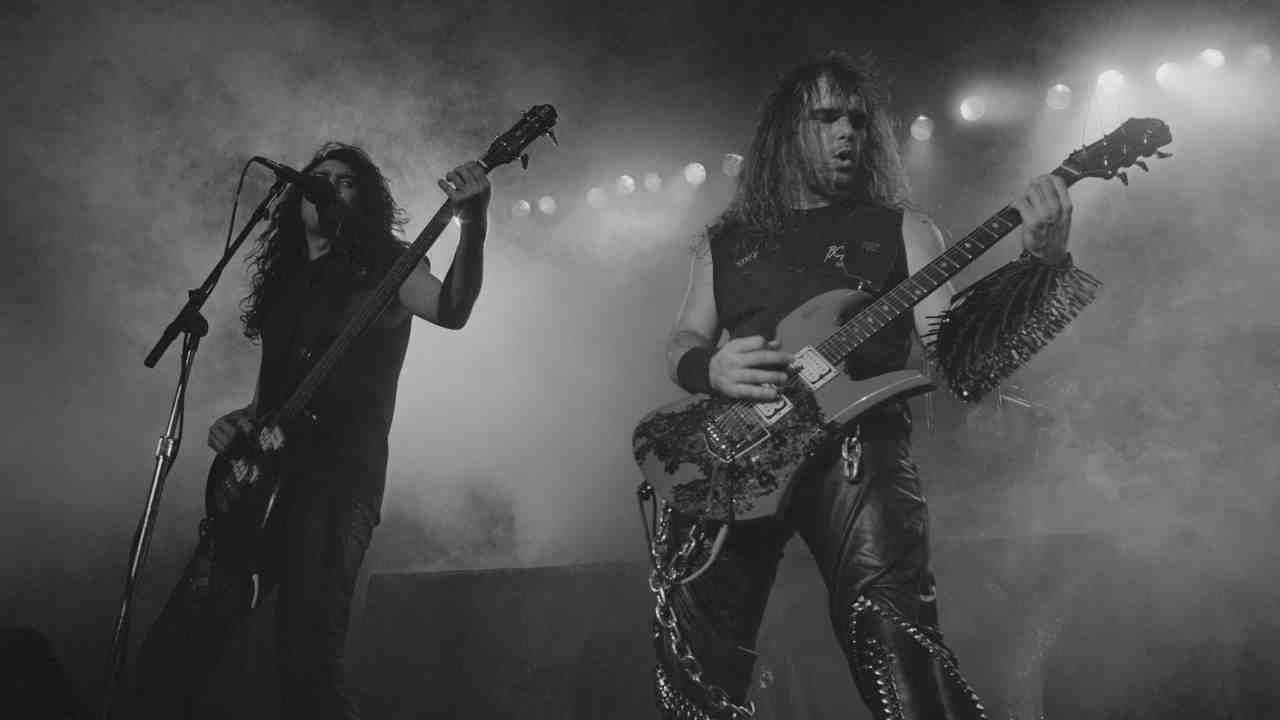
Slayer’s Tom Araya and Kerry King onstage in 1986 (Image credit: Alison S. Braun/Corbis via Getty Images)
30 Dave’s reunion with the band, in April 1987, wasn’t tension-free. The drummer insisted his wife joined them on the tour bus and the couple got their own dressing room – something that rest of the band weren’t overjoyed about. Kerry, for one, wasn’t sure whether the drummer’s return would be permanent. It was… at least until Dave left again in 1992.
31 Despite being on a successful hip hop label, and playing the solo on Def Jam labelmates Beastie Boys’ 1986 single No Sleep Till Brooklyn, Kerry was sniffy about the genre. “Was I a fan of hip hop? I wasn’t, no,” he said bluntly.
32 The feeling wasn’t necessarily mutual. Several hip hop acts sampled tracks from Reign In Blood, including Public Enemy, who used the riff from Angel Of Death in their 1988 track She Watch Channel Zero?!. “Slayer, that was like the dark side,” said Hank Shocklee of Public Enemy’s production team The Bomb Squad. “They were enigmas.”
33 Other rap artists to sample Reign In Blood songs include crunk king Lil Jon (Raining Blood on 2004’s Stop Fuckin Wit Me), Ill Bill (Raining Blood on 2007’s Awaiting The Hour) and Fat Nick and Lil Peep (uh, Raining Blood on 2016’s Oh It’s Lit).
34 Speaking of Ill Bill, the New York rapper was the only other musical act Reign In Blood artist Larry Carroll painted a cover for. He painted the cover for 2008’s The Hour Of Reprisal, whose title was a Raining Blood lyric. The album also featured a song called U.B.S. (Unauthorized Biography Of Slayer).
35 One of the most remarkable cover versions of a Reign In Blood song was Tori Amos’s near-unrecognisable take on Raining Blood from her 2001 album Strange Little Girls. “Covering that was a message for the patriarchy, especially back in 2001,” she told Classic Rock earlier this year. “My concern for women then, and now, was having so few freedoms, so few rights, and being controlled by a type of poisonous state. When I heard Raining Blood I had a vision of this huge vagina in the sky that was dripping blood everywhere, like the elements were rising up to combat this force of malevolent, patriarchal force. [Slayer] sent me a fabulous box of t-shirts for that, they were so lovely about it.”
36 The first time Angel Of Death appeared in a film was in 1990s’s Gremlins 2: The New Batch. The song soundtracks a scene where the malevolent Mohawk Gremlin turns into a spider after chugging back a weird chemical drink.
37Angel Of Death also appeared in 2002’s Jackass: The Movie, and Jackass star Steve-O used Raining Blood as his entrance music during his comedy tours. “As the tune broke, I’d start smashing [Budweiser] cans on my head until they broke and then I’d spray beer all over the crowd,” he told Hammer in 2019.
38Reign In Blood helped shape one of the most iconic albums of the 1990s. Kurt Cobain picked Andy Wallace to mix Nirvana’s mega-breakthrough, Nevermind. “I didn’t know it at the time, but I later read that the thing that interested Kurt Cobain was me mixing the Reign In Blood album,” Andy later said.
39 If there’s one song Tom Araya would have taken off the album, it’s Epidemic. “That was the one, at the time it was really great and cool, but when you sit back and look at all the lyrics on the album, that’s the one that I could live without,” he told Hammer.
40 Like most right-minded people, Tom rates Reign In Blood as Slayer’s greatest album. Asked why it’s so celebrated, he told Hammer: “Maybe it was because at the time that record came out, everybody was doing really slow stuff. Maybe the controversy. Maybe the fact that we came out on a rap label. Maybe that it was only 28 minutes – nobody felt short-changed. I can’t answer that.”
Additional Sources: Slayer’s Reign In Blood by D.X. Ferris (33 1/3)

 If you love this music: