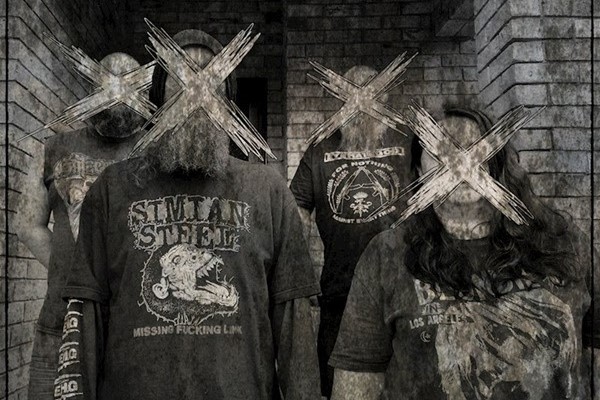
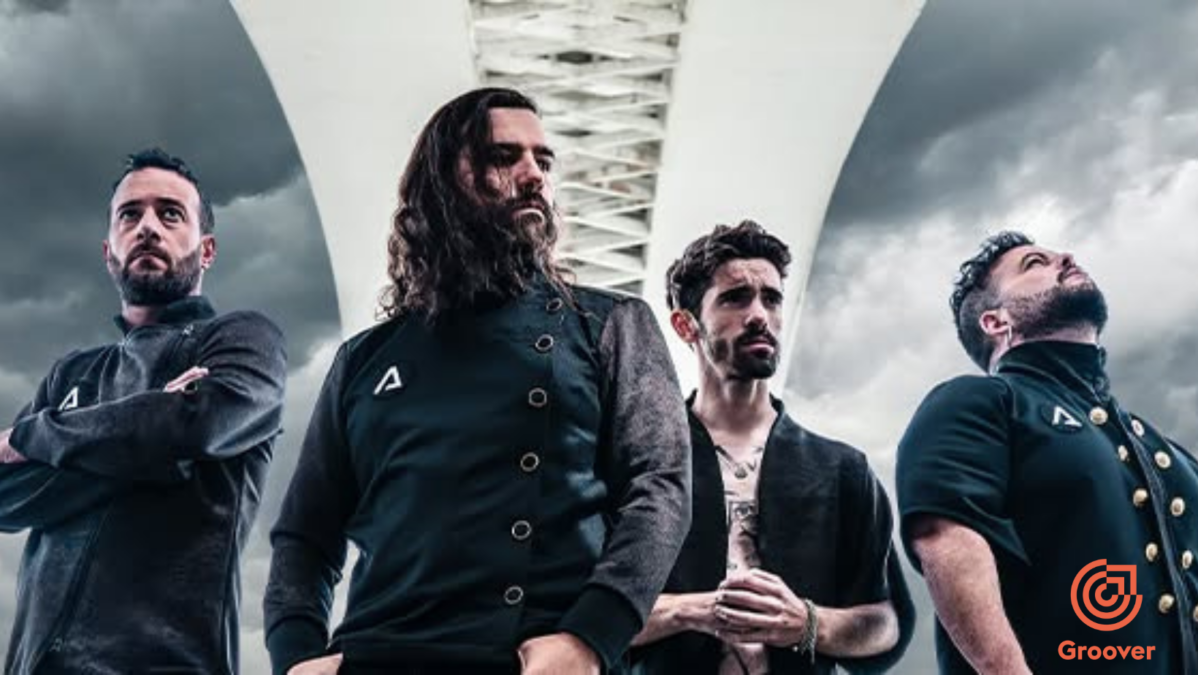
Clouds of smoke obscure your view of the stage, where amps are littered with empty glass bottles. The scents of sweat and spilled beer dance in your nostrils as five long-haired reprobates clad in denim and leather walk onto the stage, a swagger in their step and street tough bravado oozing from their pores. Looking to take in a show whilst sitting on your ass? Get fucked. Total Maniac expects you to be on your feet and moving, and if you’re not ready for that, why are you even here? These boys from Baltimore play a raucous brand of classic rock-meets-speed metal that lives somewhere between Motörhead, Mötley Crüe, and Ted Nugent, delivering no-frills cheap thrills on sophomore effort Love Overdrive. So slap on your battle vest and steel-toe boots—when adrenaline starts to flow, and you’re thrashing all around, you’ve gotta be prepared to act like a Total Maniac.
Compared to Total Maniac’s self-titled debut, Love Overdrive veers more into the trad metal/rock ‘n’ roll lane than Total Maniac’s thrash ‘n’ roll stylings. While both albums showcase Total Maniac’s snotty disregard for authority and decorum, Total Maniac dedicated more attention to thrashy chugs and barked vocals. On Love Overdrive, the focus centers on sticky leads and hooky riffs over palm-muted riffing and abrasive grit. Love Overdrive also tones down what passed for technicality on their debut. Not that Total Maniac doesn’t host capable musicians, but there are moments across the album where guitars and vocals sound like they’re pushing just past their ability. Despite that, Love Overdrive features an enthusiastic embrace of freewheeling sin-dealing that’s easy to appreciate.
What Total Maniac lacks in virtuosic prowess, they make up in impish pluck. With only twenty-seven minutes on tap, Love Overdrive never feels phoned in. Each moment sounds crafted to maximize fist-pumping carnage, from the “Panama”-meets-“Wild Side” riffing in “Love Overdrive” to the Phil Campbell-inspired soloing toward the end of “Flatline.” It’s unclear which of Total Maniac’s guitarists takes the lead at any given point, but both Mike Brown and Nick Etson lay down earworm after earworm, frequently breaking away for a quick solo before snapping back to let vocalist Diamond Dustin regale you about hard living, hard loving, and hard rocking. Double-D doesn’t lack conviction, although his upper range sometimes gets away from him. It’s not a deal-breaker, as this sort of rowdy street metal lends itself to imperfect performances that enhance its DIY charm, but piercing falsettos occasionally hit like a sour King Diamond. As for the rhythm section, drummer Vaughn Volkman does a commendable job keeping Love Overdrive’s eight tracks on the rails, but it’s bassist Ben Martin who steals the show. His beefy grumbles and well-mixed countermelodies offset Total Maniac’s dual-guitar attack, creating a well-balanced stringed menace that defines my favorite aspect of Love Overdrive.
Though Total Maniac bleeds authenticity and fun, Love Overdrive does little to stake an identity that hasn’t already been claimed. Many of the riffs seem like variations on MötleyCrüe’s 80s heyday, with “Early Grave” echoing the main motif from “Kickstart My Heart” and the intro from “Set Fire to the Sun” hitting the same mid-paced groove and brief bass sustains as “Shout at the Devil.” The mid-song break in “Drinkin’ Our Way to Hell” even reminds me of Nugent’s crackpot rant towards the end of “Wango Tango.” In this way, Love Overdrive feels like a step back from Total Maniac, which was rougher around the edges, but better defined a unique voice for the band.
Total Maniac does a fantastic job of harnessing the spirit of the music I grew up listening to, but Love Overdrive rarely captures moments that achieve the promise of their inspirations. Fun abounds, and the music encourages beer-chugging shenanigans with a shit-eating grin, yet in the end Total Maniac leaves me wanting to revisit songs I already know rather than learn these new ones. Even so, it’s a quick listen worthy of a spin for anyone craving new material harkening to simpler times. I look forward to hearing where Total Maniac ventures next, and I hope they find a way to continue celebrating the glory of the past while sending their future into Overdrive.
British rockers Cats In Space have released details of their only two full-band electric shows for this year, with dates in Coventry and Newport this November.
Highly regarded for their lush, ’70s-infused hard rock sound, the chart-topping band have been ensconced in the studio putting the finishing touches to their as-yet-unnamed seventh studio album, which promises to be as ambitious and epic as ever.
Following the departure of Jeff Brown and Dean Howard after 2024’s Time Machine album, the core line up of Greg Hart, Damien Edwards, Steevi Bacon & Andy Stewart, are joined by Chris Childs (Thunder, Tyketto) and Sam Wood (Black Star Riders, Wayward Sons) ensuring that the next era of Cats In Space will be memorable for all the right reasons.
Cats In Space & Bobbie Dazzle join Jeff Lynne at BST Hyde Park 2025 for ELO final UK show. Photo: Steve Ritchie/MetalTalk
These are the only two full electric shows scheduled for 2026 to launch the new album campaign. There will be a chance to buy and hear the new album before anyone else at these shows only.
Cats In Space will also be playing an Acousti-Cats show at The Half Moon, Putney, on April 26th as a celebration of their first decade as a band, where fans will get to hear special versions of songs, plenty of stories and some surprises too.
Celebrating a decade of melodic, theatrical rock, Cats In Space have firmly established themselves as one of the UK’s most vibrant modern classic rock bands,
Event Details
Celebrating a decade of melodic, theatrical rock, Cats In Space have firmly established themselves as one of the UK’s most vibrant modern classic rock bands, blending ’70s-inspired grandeur with contemporary energy.
There are only two full electric shows planned this year. Tickets and more details are available from catsinspace.co.uk/uk-tourdates.
Celebrating a decade of melodic, theatrical rock, Cats In Space have firmly established themselves as one of the UK’s most vibrant modern classic rock bands,
Event Details
Celebrating a decade of melodic, theatrical rock, Cats In Space have firmly established themselves as one of the UK’s most vibrant modern classic rock bands, blending ’70s-inspired grandeur with contemporary energy.
There are only two full electric shows planned this year. Tickets and more details are available from catsinspace.co.uk/uk-tourdates.
Speed have been announced as the next headliners for this year’s Burn It Down Festival.
The Sydney titans will join Drug Church atop the bill, with the Torquay event – which takes place across four venues in the Devon town between September 3 – 5 – confirming that Speed’s performance will be a no-barrier set. There’s still a third headliner to come, but elsewhere Burn It Down’s 2026 line-up boasts everyone from As It Is to unpeople, Grove Street, PENGSHUI, Meryl Streek, The Chisel, The Meffs, Trauma Ray and loads more. Tickets are on sale now.
Next month Speed will kick off their UK tour with Whispers and Bodyweb, stopping off in Brighton, Birmingham, Bristol, Newcastle, Leeds, Glasgow and London. They were also recently announced for Reading & Leeds in August, so you’ve got plenty of chances to catch ’em throughout 2026.
Hayley Williams has kicked off her highly-anticipated Hayley Williams At A Bachelorette Party solo tour.
Launching the 2026 global run at Tabernacle in Atlanta, Georgia on Friday night (March 27), the Paramore superstar performed every single song from last year’s 5/5‑rated album Ego Death At A Bachelorette Party – albeit out of order – along with a cover of Nina Simone’s Don’t Let Me Be Misunderstood. On the first night of the tour, Hayley was joined by The Chariot frontman Josh Scogin for final track Parachute, while the following night at Tabernacle saw her joined by KT of Upchuck.
For the next two months, the Hayley Williams At A Bachelorette Party tour will travel across North America. Then in June she’ll be coming over to Europe and the UK, stopping off in London, Manchester, Glasgow and Dublin.
1. Mirtazapine 2. Showbiz 3. Disappearing Man 4. Zissou 5. Ice In My OJ 6. Hard 7. Kill Me 8. Blood Bros 9. Ego Death At A Bachelorette Party 10. Whim 11. Glum 12. Negative Self Talk 13. True Believer 14. Don’t Let Me Be Misunderstood (Nina Simone cover) 15. Brotherly Hate 16. Love Me Different 17. Dream Girl In Shibuya 18. Good Ol’ Days
Encore:
19. Discovery Channel 20. I Won’t Quit On You 21. Parachute (with Josh Scogin)
Sophie Lloyd is a powerhouse on guitar. Her rise via social media opened doors for a new age of players, and her induction into Machine Kelly’s band amplified that. But Lloyd’s journey didn’t start like the players she grew up idolizing, like Joe Satriani or Steve Vai’s. Embarrassingly, it was SpongeBob SquarePants,” she laughs. “There’s an episode where he plays a version of ‘I Wanna Rock’ by Twisted Sister, and he’s flying through the air with a V-shaped guitar. I remember watching that and thinking, ‘That’s exactly what I want to do.’” Humorous as that is, we all have to
“Stilllllllllaaaaaaaamennnnnntum.” If you love it when a band sings the album title, you’ve hit the jackpot with “Nimbus,” the opening song of Gorrch’s second album, Stillamentum. At the very top of that first track on this six-track album, the Italian black metal duo of brothers — Chimsicrin (drums, vocals, and keyboards) and Droich (guitars, bass) — recites the album title with an ominous incantation: “Stilllllllllaaaaaaaamennnnnntum.” It’s droned with a monastic simplicity, which makes sense given the lack of set scenery: no guitars, no drums, just voice. But, jeez, is it powerful: an invocation. It feels like a deep inhale before the coming storm.
Let’s stay with that title for a moment. Like everything else Gorrch does, Stillamentum serves a purpose beyond demonstrating that the brothers are good at Latin. Formed from the verb “stillare” (to drip) and using the suffix “mentum” (the product of an action), Stillamentum could mean something like “that which drips,” or, more artistically, the residue of that dripping.
A related, although distinct formation is “stillicidium” — “stilla” (drop) and “cadere” (to fall). For the Romans, it had different meanings that developed in parallel. In De Architectura, Vitruvius used it to describe an architectural concept, specifically how the eaves of temples shed water and why that design feature came to be. In law, it was a doctrine governing water from one’s roofline dripping onto a neighbor’s land — the genesis of history’s earliest HOA, maybe. That said, the concept is less of a snooze than it sounds, given the broader implications the law sought to address: the effects of habitation — the noise, the shadows, the redirected raindrops — don’t end at the property line. Those drips? They don’t just disappear. They’ll travel farther than you might consider.
Release date: January 30, 2026. Label: Avantgarde Music.
Wouldn’t you know it? Following “Stilllllllllaaaaaaaamennnnnntum,” “Nimbus”‘s downpour begins. Appropriately, Gorrch’s tremolo riffs fall like sheets of rain, the blasting drums like the rapid-fire impact of heavy droplets striking a hard surface. Makes sense for a song titled “Nimbus.” And then Gorrch twists things. When Chimsicrin starts screaming, his raspy growl feels so much more insidious than the sounds surrounding him. It poses a question: What if the rain is carrying something corrosive? Here’s the answer: In “Nimbus”‘s middle, Gorrch pulls back on the speed and settles on a lurching, more deliberate groove. Now, it’s almost like that corrosive substance is carving its way through the earth.
2.
Cavaso del Tomba, the home of Gorrch, sits at the edge of the Venetian Plain and at the foot of the Dolomites, the picturesque mountain range in Italy’s northeast. Before receiving their current name in the 1700s, the Dolomites were known locally as Monti Pallidi — the Pale Mountains. In folklore, the range was transformed by the king of the Salvans dwarves, who worked for a prince to alleviate the homesickness of his moon princess. Thus, the once-dark peaks were turned into the lunar surface she’d left behind. But the Pale Mountains have color, too. The enrosadira, the Ladin name for the famed Alpenglow, is thanks to another dwarven royal, King Laurin. After the prince of Latemar spied the king’s daughter, Ladinia, in the kingdom’s rose garden and kidnapped her, King Laurin cursed the garden to be invisible by day and by night. Ah, but there was an oversight: he forgot to add twilight to the list. Therefore, at dawn and dusk, the Dolomites glow pink and red, an effect amplified by the pale carbonate rock. The connection between the two tales runs a little deeper thematically. Both myths are animated by absence: the longing for a princess to see her home and a king to see his daughter. In a sense, then, the mountains stand as monuments to loss — what you have now might not be there in the future.
The geological record is as interesting as the legends. Two hundred and fifty million years ago, the area that would become the Dolomites was under the sea. Over the next few megaannums, coral reefs began to grow atop atolls. Then, 80 million years ago, the African and European tectonic plates collided, driving the coral reefs upward. What was once a sea floor soon scraped the sky — the Sella Group, with its precipitous cliffs, is a petrified atoll. Exposed to wind, ice, and rain, those mountains eroded into their striking shapes. And, while it will take many more millions of years, those same forces will continue carving away at the Dolomites until they are nothing. What goes up will eventually come back down.
3.
The top three similar artists on Gorrch’s Encyclopaedia Metallum page are Deathspell Omega, Ad Nauseam, and Thantifaxath, in that order.
Ad Nauseam, Gorrch’s Italian compatriots and Avantgarde Music labelmates, makes sense: guitarist Andrea Petucco produced Stillamentum. Beyond that, the two also share a similar approach to wringing drama out of riffs. “Nimbus,” for example, maps pretty well onto Ad Nauseam’s “Sub Specie Aeternitatis” from 2021’s Imperative Imperceptible Impulse. While the two are plying their trades in different styles, black metal for Gorrch and clattering technical death metal for Ad Nauseam, there’s a sonic kinship when it comes to the way their respective riffs drill down while leads rend the sky. Both bands excel at a kind of metal verticality, where the macro is as important as the micro — there’s a distinct sense of an up and a down.
In terms of song construction, Thantifaxath checks out, too. There are differences: the Canadian band is slipperier with its time signatures, while also favoring consonance over dissonance. However, it finds common ground with Gorrch in that they both write music that sounds like a sine wave on a graph. While the song flow and rhythms push steadily along the x-axis, there’s a lot of movement on the y-axis, too. It imparts a feeling that you’re reaching the crest of a wave before descending into its trough. Thantifaxath’s 2023 full-length, Hive Mind Narcosis, will almost give you motion sickness if you don’t have your Dramamine-buttressed riff legs — a sensation that is delightfully doubled in a live setting. Gorrch is definitely a relation in that respect. Even though it doesn’t have the same wave height or wave length, Stillamentum still undeniably undulates.
The tougher comparison is Deathspell Omega. Granted, Gorrch and the indescribably influential French black metallers are not exactly opposing magnets: both play black metal with avant-garde ambitions that are more philosophical than the replacement-level blargh band. But, over the past decade, there’s been a knee-jerk reaction among listeners, particularly those without a strong grasp on music theory, to call any band that sounds sour a DsO disciple. Sure, plenty of poor imitators abound — more than many thought possible following the once-believed-to-be singular Fas – Ite, Maledicti, in Ignem Aeternum and Paracletus — which has created a DsO bubble that’s bound to burst. And boy, have critics noticed, grumbling about a buyer’s market rife with highly accomplished riff weirdos. The knock-on effect, then, is that, due to its soon-to-be ubiquity, the Deathspell Omega influence functions as a weird tag that’s both a badge of success and a scarlet letter. If it’s pinned upon you, you’re good enough to breathe the same rarified air as the gods, but few will dig into your material because the assumption for the many is that they’ve heard it all before. Therefore, the good is damned by the great; you’re stuck in the shadow of the mountain.
4.
In 2019, Bend Studio’s Days Gone was released for the PlayStation 4. Despite being teased at E3 2016, the video game, in which you play as a biker puttering around in a post-apocalyptic world filled with zombie-like “freakers,” experienced many delays. By the time it was on consoles, the culture was teeming with zombie properties. Roll call: The movie 28 Days Later, and the truly abysmal sequel 28 Weeks Later, were already more than a decade in the rearview mirror; the novel World War Z and its spinoffs had spent several weeks on the New York Times Best Sellers list; the TV series The Walking Dead, which debuted in 2010 and just completed its ninth season, had already spawned its sister show, Fear the Walking Dead; and perhaps most importantly, the video game The Last of Us hit the shelves in 2013 and became one of the most acclaimed games of all time.
So, on the surface, what Days Gone was offering wasn’t exactly new. It was a third-person open-world game released in the wake of Grand Theft Auto V, Red Dead Redemption 2, and Horizon Zero Dawn. It had a storyline that an LLM with a zombie-only corpus could’ve autocompleted. It played the hits with the same old PS4-generation game mechanics: stealth combat, skill trees, and on and on. Oh, and it had a ton of ‘we’re not calling them zombies’ zombies.
Given Days Gone‘s well-worn features, critics weren’t kind. “All of that effort feels wasted, especially in a world where Sony also publishes the brilliant The Last of Us, which took a seemingly straightforward post-apocalyptic zombie narrative in interesting new directions,” Andrew Webster wrote in The Verge. “Meanwhile, in Days Gone, the end of the world is somehow incredibly bland.” On Metacritic, the game’s initial release scored a 71, earning it a “mixed or average” aggregated appraisal. Another aggregator, OpenCritic, pinned a “fair” upon it. The world was “boring,” the narrative was “bland.” It was just another zombie game in an overflowing zombie genre. And, perhaps most damning of all, it was not The Last of Us.
The players, though? They loved Days Gone. Its Metacritic user score is 8.5, classifying it as “generally favorable.” Ian Chainey, who is not a video game reviewer and is generally a hack, called it a “masterpiece” “…that produces so many memorable moments” in Stereogum’s The Black Market. Nearly seven years on, Days Gone is something of a cult classic, revered for its atmosphere and ability to sustain a persistent sense of dread.
There are many theories regarding the reason for the schism between critics and players. Pacing, maybe: Days Gone opens up after its first few hours, becoming tenser once a newer mechanic is unveiled, and allows for more immersion once the lore deepens. But really, it comes down to a simpler idea: It’s difficult to recognize nuance when you’re on a deadline, and it’s similarly tough to see the vision when all of the similar properties are within eyesight. Days Gone isn’t new to this phenomenon — soulslikes likely have it far worse — but what kills these games is the same: they’re not seen for what they are, but for what they are not.
In metal, many DsOlikes now abound. Deathspell Omega’s “similar artists” tab on Encyclopaedia Metallum runs for many mouse wheel scrolls. And while there are some predictably oddball inclusions that’ll ping anyone’s WTF radar, you can get a sense of what the masses think qualifies as shared traits. Where that gets tricky is when those traits are considered particularly DsO-coded or DsO-derived. Thus, any band that follows with those traits is just doing a DsO, even if that’s, honestly, pretty nebulous thinking to begin with, and not how musical influence tends to work in practice. It’s like an addendum to “I know it when I hear it” cataloging: If I hear it, it is DsO.
Now, that’s not to say there aren’t conscious DsO clones: it feels like half of Iceland is on a “what if DsO but…” odyssey. And it’s probably true that DsO had a hand in opening up a new path for black metal to take. But the prevalence of a supposedly codified DsO aesthetic muddies things more than it clarifies them. It widens the net, catching not only clones but bands that bear a passing aural resemblance. Subsequently, everything gets tossed into the same bucket — a wide range of bands whose commonality is the perceived surface traits they share with a more well-known band.
Given the breadth of bands now falling under the DsO tag, one might even say that, between DsO’s black metal and Ulcerate’s death metal, dissonance fatigue is setting in. There are *a lot* of these once-recherché acts, with more trickling in every day. From a critic’s perspective, it feels like every tenth promo has been harvested from the DsO fields. To effectively cull one’s inbox, then, especially one flooded with higher-priority releases, a delete-first-ask-later sorting system becomes advantageous. “This sounds like DsO. Next.” Even if one of these albums makes it through to a review, a deadline forces a jaded writer to find a throughline quickly. Mostly, that means putting a name to it that readers might recognize that doesn’t balloon the word count. Nevertheless, there is a consequence to that action: By putting a name to something, it’s almost like you’ve conquered it. “I know what this is now; it’s no longer a mystery. Case solved.” But…like…the actual contents of the thing? That’s still a mystery! You haven’t touched that stuff. Can you even know something if you don’t observe it for what it is, if you don’t dig into its guts and find its true essence?
This practice of DsOlike categorization tends to erode the descriptor over time. In a way, it’s like karstic dissolution — acidic water hollowing out a formation from the inside while the exterior remains intact. Deathspell Omega rises from the sea of black metal, becoming this towering monolith. Every new comparison is another drop of acid working through the rock. Eventually, the interior collapses. The descriptor crumbles into a totally meaningless tag that is applied too often, like how any trad band with a galloping rhythm section is doing an Iron Maiden. But even if the mountain is no more, the baggage of that tag remains. And, when applied too loosely, it saps the lifeforce of anything it touches. In due course, a once great mountain becomes a bunch of dull pebbles, and, man, there sure do seem to be a lot of them around.
The question, of course, is this: What if a thing didn’t have to be a “like,” and it could just be a thing? What if Days Gone wasn’t a zombie game, but just a game? What if Gorrch wasn’t a DsOlike, but just a band? Does that change the calculus? Can you so readily conquer it? Do you look into it deeper? Do you give it time? Do you accept that it just…is?
5.
There’s this analogy that I keep returning to lately. In “The Accursed Items,” a short story in J. Robert Lennon’s See You in Paradise, the author lists objects transformed by new circumstances. An excerpt ran on the 205th episode of This American Life, where J. Robert Lennon said this:
My eyeglasses, covered with a thickening layer of dust that I never seem to notice, that I simply adjust to, until at last, I clean them out of habit, and discover a new world sharp and filled with detail, whose novelty and clarity I forget about completely within 15 minutes.
Looking at the lyrics on Stillamentum is like cleaning my eyeglasses. Once I explored those lyrics and gained a bearing on the greater themes at play, the album became sharper, filled with detail. I could finally hear what Gorrch was trying to achieve at both the micro and macro levels. This band wasn’t a Deathspell Omega disciple. Gorrch is more purposeful than that. But I’m not sure I would’ve been able to fully conceptualize that distinction without first taking the time to look.
That said, Gorrch gave my lenses a bit of a scrub earlier than Stillamentum. Its 2020 EP, Introvertere, was a relatively compact ripper that used swells of droning tremolos to create a sensation of free-falling. What set it apart from similar swellers was its spikiness and sense of timing, giving the band an almost mathcore immediacy. When my friends and I first found Introvertere, we were taken aback that Gorrch was Italian. Despite sharing some sonic hallmarks with Lorn, one of the other bands Chimsicrin drums in, Gorrch sounded so outside our accepted generalization of the Italian black metal idiom.
But Gorrch is very, very Italian, in fact. Stillamentum‘s lyrics make that clear from the jump. The first full phrase in “Nimbus” contains the word “crode,” the Ladin word for the Dolomites’ steep spires. Yep, it’s the easiest GeoGuessr hint you’ll ever get. And it sets up a fascinating duality: Gorrch’s lyrics are esoteric, yet ever so intentional.
Stillamentum has a story. As previously discussed, “Nimbus” is the storm moving across the landscape. “Vorago” traces water as it descends into the earth. “Larvæ” details how a decomposition process can still be generative. “Cryptæ” is a resurgent transformation. “Angor” is an inversion of “Larv攑s propagation. And “Phlegma” is the system consuming itself.
Oh, but you can go so much deeper into Stillamentum if you wish, with each stratum revealing new questions. What’s up with the horde praying in secret in “Nimbus”‘s storm? How is the water transformed in “Vorago” as it drips into abyss after abyss? What is feeding upon the divine nectar, the liquid result of putrefaction, in “Larvæ”? Was the cave in “Cryptæ” sculpted by drips, or was it by the newly roused being that is now crying out? Who left the anonymous carcass in “Angor,” the one now subject to infinite decay? Where is the forest in “Phlegma” that drinks greedily of its own poisonous seed? Again, this is Gorrch’s arcaneness at work. Make of it what you want. As stated in “Larvæ”: “Il verbo è vostro,” the word is yours.
Still, Gorrch gives you a lot. There’s an uncommon precision to Gorrch’s use of Latin that transcends the try-hard nature of black metal’s self-serious set — not look-at-us pseudo-erudite window dressing, but Latin that fits the themes. There are the song titles — Cloud, Abyss, Larvae, Crypt, Anguish, Phlegm — but also the wordplay within them, too. In Latin, “larva” can mean the literal larva or “mask,” the latter often used in relation to lemures, the spirits that the poet Ovid wrote were di manes of the underworld. And, of course, there’s the coinage of Stillamentum. If you missed it, in “Cryptæ” there resides the Italian word from which stillicidium is derived: “Con echi di stillicidio” — with echoes of dripping.
That’s kind of the thing: Gorrch’s influences run so much deeper than just the musical. The band references folklore, geology, and, uh, Roman architectural theory. It might be easy to hear only Deathspell Omega, but that’s like mistaking the surface for the whole formation. Gorrch takes that musical influence and lets its other interests slowly carve into it. What lies below is vast, intricate, and unique.
And for as fast as Gorrch ramps up the blasting BPMs, it does have a sense of time that is more geological. Stillamentum is about systems cycling. That theme is enforced in a lot of ways, most notably by how the riffs always seem to be circling back on themselves. Black metal isn’t a stranger to the Riff Ouroboros, but Gorrch’s application feels different. It’s like each repetition is eroding the songs from within. The band isn’t simply writing about the cyclical; it has built its own cyclical system.
So, on the one hand, Stillamentum drips, drips, drips, using the deliberateness of water as a guiding force for where it wants its music to go. Those drips carve out more of the earth, dripping ever deeper, opening up Gorrch’s world; what was once a puddle on the surface is now a near-infinite expanse of a cave system. On the other hand, it’s also a model for listening to Stillamentum, demonstrating the quirks of time’s passage, the contradiction in how we, as humans, perceive it. Time slows as you follow the drip into a cave, the one formed over millions of years of dripping. Con echi di stillicidio. We are but a drop.
Once “Phlegma” draws to a close, it feels like an exhale. There’s only a hint of sound remaining, like there are only pebbles left of Stillamentum. But like how mountains will fall only to rise again over many geological epochs, Gorrch isn’t done. There’s no finality to Stillamentum. If you have the album on repeat, seemingly seamlessly, there you are again at “Nimbus.” The cycle starts again. It’s an endless loop. “Stilllllllllaaaaaaaamennnnnntum.”
6.
De Rerum Natura, Lucretius’s attempt at poetically illustrating Epicureanism, takes on, well, everything. In six books, the reader receives not only the totality of the human experience — birth, death, love, sex, sleep, dreams, the Cleveland Browns losing — but everything else in the universe. The logline is basically this: If it can be observed, it can be interpreted down to its very atomic structure. In William Ellery Leonard’s translation, you can get a sense of the scope with two of De Rerum Natura‘s subheads. Book 1, Section 1: “Substance is Eternal.” Book 5, Section 1: “The World is Not Eternal.”
The poem, which is also, believe it or not, thought to be unfinished, is too big to dissect fully in the space of a stupid heavy metal review — ironic, perhaps, given its importance to atomism. But Book 6 is loaded with relevant material. Around line 639, we get this: “haud igitur redit ad nihilum res ulla, sed omnes discidio redeunt in…” — therefore, nothing returns to nothing, but all things return to division. I prefer the slightly more poetic take that someone posted on Goodreads: “What once sprung from the earth sinks back into the earth.”
The mountain rises, the mountain falls: it is not eternal, but its substance is. Accordingly, the cycle begins again: something becomes something else, and then it’s returned to division. The cycle loops over and over and over — “Nimbus” to “Phlegma” and “Phlegma” to “Nimbus.” But if you’re lucky enough to be there to observe it, it can be known. It just takes time.