Two guitar legends who met as teacher and student in 1973 are finally releasing their first album together after five decades of friendship. Continue reading…
Ahead of its September 4 release, HADOPELAGYAL have opened the entirety of Zalmathic Necroichorion for an advance stream. The four-track EP is now playing exclusively through the No Gleaming Light YouTube channel. Running for just under 23 minutes, the release follows the German entity into forgotten spaces beneath the realm of death. Its imagery revolves […]
For over two decades Chicago based trio Russian Circles have been releasing their own brand of dense instrumental post metal, and with this, their aptly titled ninth album ‘Nine’, they add another stellar addition to their already impressive catalogue. Undeniably consistent, over the years Russian Circles have refined and perfected their sound with each album, playing with different textures and moods to create distinctly singular records that all manage to sound uniquely them. Since 2016’s ‘Guidance’, Converge’s Kurt Ballou has been at the production desk too, bringing out a much heavier, crisp and raw sound to the band’s newer albums, and ‘Nine’ is no exception. Comprising seven tracks of near unrelenting musical heft, ‘Nine’ is a muscular, dark, rich and involving record that grows further under your skin with each listen.
Opening proceedings is the goliath ‘Borehole’, composed of surging guitar arpeggios bolstered by the thunderous bass tone of Brian Cook and the commanding and precise drumming of Dave Turncrantz. The guitar melodies here feel almost lyrical, lending the track a near sing along quality. Lead single ‘Empath’ is one of the heaviest and downright claustrophobic tracks the band have ever produced. Opening with an eerie siren-like synth, Cook’s earth shattering bass soon crashes in, accompanied by a succession of filthy, monstrous riffs courtesy of guitarist Mike Sullivan. Reminiscent of 2016’s ‘Guidance’ heavier tracks, ‘Empath’ gradually gets more oppressive as the minutes pass, culminating in a whirlwind of airless weight that doesn’t let up until the final second.
The grand and cinematic ‘Eluvial’ opens with addictive synth bleeps, with tension slowly building as layers of malevolent bass and reverb drench guitars are added, sounding like an ominous soundtrack to an epic, interstellar-set movie. With genuinely moving and melancholic melodies interwoven amongst the track’s heavier passages, the track feels like the album’s emotional core and stands as a true standout. ‘E2’ follows in similar fashion, but with a greater emphasis placed on the grooves and fills of Turncrantz, whose dry and punchy drumming once again perfectly drives the song forward. ‘Meridian’ is similarly propulsive, and features some of the album’s more melodic and celestial passages, as addictive synth melodies are bolstered by crunchy riffs and the ever present, pummelling bass lines of Cook.
There is some brief, light relief from the intensity in the form of the elegant, mournful acoustic ‘Arletta’, beautifully played on nylon string guitar, Ballou has captured the gentleness of this track with effective grace. However, after this short and sweet reprieve the heavy returns with swirling, crush of ‘Seventh Seal’. With its fast chugging riffs, chaotic synths and groove oriented drumming creating a vortex of disorientating, revolving heaviness, it’s an absolute beast of a closing track that serves as a reminder of just how huge Russian Circles sound at their heaviest.
Twenty years into their career, Russian Circles sound as fierce, forward thinking and heavy as ever. With ‘Nine’, they have once again produced an exceptional slice of post-metal that is distinctly their own. Intense, naturally heavy and with a fittingly organic production from Ballou, ‘Nine’ is a document of three musicians operating at their creative zenith, and further proof that Russian Circles are without doubt one of the best instrumental bands performing today.
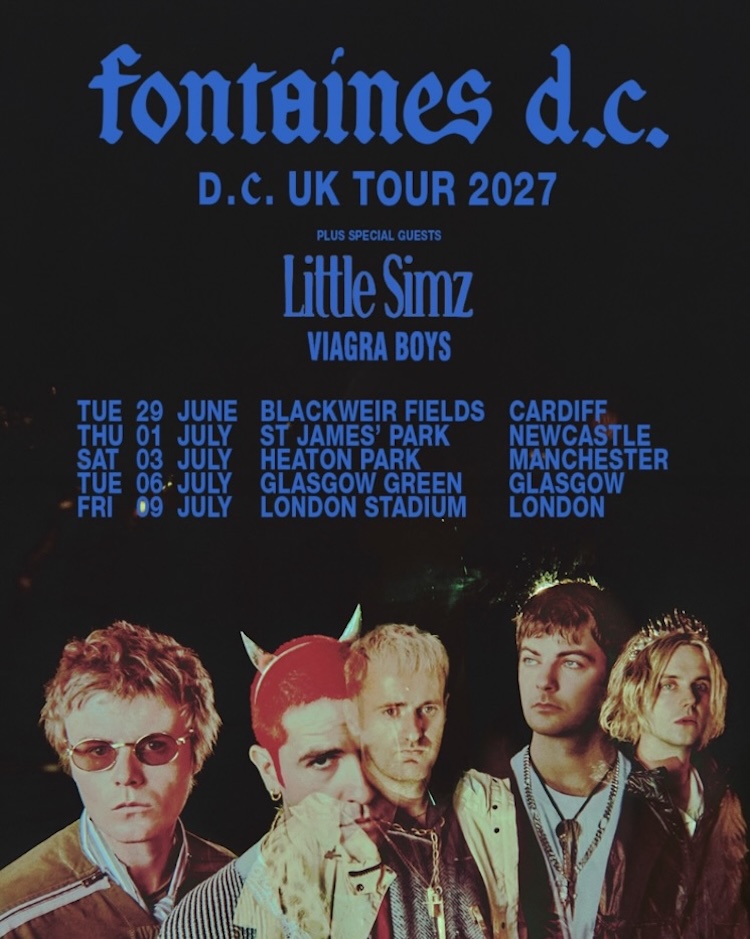
Fontaines D.C. have announced plans to play their biggest ever headline shows in the UK and Ireland next summer.
Having just headlined Reading and Leeds festival, the Dublin quintet will play two stadium shows and three huge outdoor shows in the UK in June/July next year, and also play two massive homecoming shows in Ireland at the 80,000-capacity Slane Castle.
The dates are:
Jun 26: Slane Castle, Ireland Jun 27: Slane Castle, Ireland Jun 29: Cardiff Blackweir Fields, UK
Jul 01: Newcastle St. James’ Park, UK Jul 03: Manchester Heaton Park, UK Jul 06: Glasgow Green, UK Jul 09: London Stadium, UK
Support at the UK shows will come from London rapper Little Simz and Swedish punks Viagra Boys. Tickets will go on sale here on September 10.
(Image credit: Press)
The Dubliners will be following in the footsteps of fellow Irishmen Thin Lizzy and U2 in playing the iconic County Meath venue. Slane Castle has also hosted gigs by Bruce Springsteen, Queen, David Bowie, The Rolling Stones, Bob Dylan, Metallica and more. Tickets are on sale here.
Special guests at Slane will be Hayley Williams, Damien Dempsey and Madra Salach.
The Irish band recently announced details of their fifth album, Dopamine Chamber. The follow-up to 2024’s Romance, it’ll arrive via XL Recordings on October 16.
“The album itself is a dopamine chamber,” says frontman Grian Chatten. “You step inside, and we test these different mind- or mood-altering pieces of music on you.
“I thinkRomancewas maybe 60 per cent human and 40 per cent corrupted by automation, and a loss of feeling. This one feels more like 60 per cent corrupted – the mask is wearing the face a little more.
“I felt it would be more powerful to leave the hope out and reflect the ugliness honestly. This one needed to feel more like a catastrophic warning.
“There’s a poignant sense of us being on the brink of some other kind of form of humanity, or non-humanity.”
“Our albums have always questioned a sense of place,” adds bassist Conor Deegan. “First Dublin, then being away from Dublin, and then trying to find the romance elsewhere. On this record, the question became: where do you escape to?”
One of the most potentially fascinating albums on the docket right now is ZIRP!, the new one that Brooklyn fuzz-guitar vets DIIV recorded with PC Music co-founder and Charli XCX collaborator A. G. Cook. At least in their press materials, DIIV are framing the record as part of a “New Alternative” movement that also includes acts like Slayyyter, Eartheater, and Turnstile. Sure! Why not! Let’s make it happen! We already got one taste of how this version of DIIV might sound on lead single “The Fountain.” Today, we get a different take on it.
Stockholm is not presented as a postcard in WORMWOOD’s latest video. Its roads, bridges and buildings become monuments to a social order that has ceased to provide either direction or belonging. The Swedish band have released the official lyric video for “Purposeless Geometry,” the second of two compositions featured on their concept EP, Å. The […]
Every spectacle contains a private bargain with disaster. Fireworks make that bargain visible: powder and metal are prepared for beauty, ignited at close range, and trusted to travel in the promised direction. When the trajectory fails, celebration becomes panic before the eye can separate pleasure from fear. A relationship ruled by manipulation follows a similar course. Possession borrows the language of protection, dependency passes for devotion, and the danger becomes obvious only after the fuse has already burned its way down.
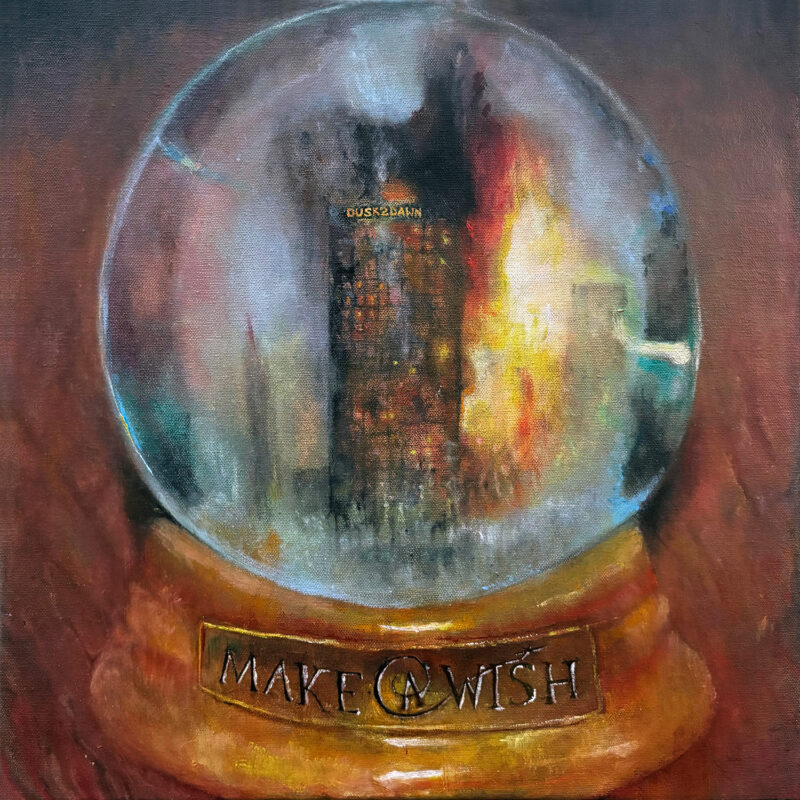
Australian witch house and dream pop duo dusk2dawn place that collision at the center of It Kills Me Every Time. The downtempo lament is the second single from their debut album, Make A Wish, due September 11, 2026, through DERO Arcade. It follows Psalm 23, the record’s first official single, released in July.
The recording opens in a distant hum that could be a roadway heard through concrete, then sinks into a deeper metallic drone. Synthesizers spread outward in broad, gauzy layers, carrying something of Blade Runner’s nocturnal grandeur through the haze of shoegaze and dreampop. A slow, shuffling drumbeat gives the track its narcotized gait. Jack Mannix sings with a dull, depleted sorrow, his voice seemingly drawn from a heart where hope has been reduced to residue. Finn Parker keeps widening the arrangement behind him, laying sheet after sheet of synth across the rhythm until the music reaches the desolate scale of The Cure’s slowest pieces on Disintegration and Wish.
Written around manipulation, betrayal, boredom, possession, and dependency, It Kills Me Every Time dwells inside an attachment where harm has repeated so often that it begins to feel like the governing law. The measured tempo gives every phrase room to sink in, while the massed keyboards turn sorrow into something physical, pressing against the vocal from all sides.
The accompanying video extends that condition into a catalogue of amateur fireworks disasters. Grainy found footage shows driveways, parking lots, wet plazas, and crowded public displays briefly transformed by fountains and rockets that veer sideways, topple, or burst at ground level. People scatter as white flashes burn out the camera sensor; cars and houses disappear behind red smoke; one doomed attempt gives way to another. Edited by Parker from clips sourced by Mannix, the film finds a grimly apt image for the song’s damaged intimacy: people remain close to something designed to explode because they still want the promised beauty.
“We often work with found footage for our videos, previously we have used footage of an exotic dancer in a masonic lodge, or a montage of controlled building demolitions. I like the way that these visuals provide an emotional metaphor for the music and create a somewhat hypnotic and disturbing viewing experience, with the aesthetics of lost media and youtube rabbit holes. For this video the firework accident footage seemed fitting as it was this document of people creating these dangerous and beautiful displays of explosives, and an attempt at one thing that goes wrong and creates another. The lengths and risks people will endure for a spectacle”
Watch the video for It Kills Me Every Time below:
dusk2dawn brings Finn Parker of Eternal Dust together with Jack Mannix of Circle Pit. The two first met as teenagers within Sydney’s post-punk scene and briefly played in a band alongside future members of Low Life and Exek. Parker began dusk2dawn as a solo outlet for the witch house- and gabber-informed instrumentals he was making while active in Eternal Dust, inviting Mannix to join as vocalist and lyricist in late 2022. Early demos followed during a brief period when they shared an apartment in Kings Cross and were released through Mannix’s DERO Arcade. A handful of sold-out appearances in Sydney and Melbourne accompanied the pair’s work on what would become Make A Wish.
Across the album, dusk2dawn move from the punk and industrial pressure of opening track Angel Face into dream pop and witch house ballads such as soul2keep, Heaven Is Only In Hell, and Gateway. Psalm 23, the title track, and Behind The Mask draw the record toward darker gothic forms. Its subjects remain equally severe, moving among suffering, grief, sublimation, transcendence, decay, mutation, and possession.
Of his approach to the lyrics, Mannix says:
“I try to make my lyrics for this project as obtuse and simple as possible, to create a screen that the listener can easily project their own experiences and interpretations onto. I want to cast a spell that is at once loaded and universal – the real meaning buried in the simplest possible terms.”
Make A Wish was recorded and mixed by Finn Parker and Eduardo Bianchino, then mastered by Wayne Sunderland at Suture Mastering. The album arrives September 11 through DERO Arcade.
Listen to It Kills Me Every Time below and pre-order the album here.
Revisit Psalm 23, the first official single from Make A Wish, below:
If there’s one thing AM radio programmers hated in the 1960s and ’70s, it was songs with long endings. Mostly, these songs never made it onto the AM radio dial. If they did, they were often edited. However, with the advent of the album-oriented format on the FM dial, epitomized by stations like New York’s WNEW in the seventies, song length didn’t matter. People loved album-oriented rock on the radio, and many classics received the airplay they deserved. The extended ending satisfied the audience’s appetite for cinematic, adventurous music in rock and roll. Progressive music started this trend, but it