Our Top 10 ZZ Top songs list looks back at all the great songs the band has delivered through their 50-plus-year career. In classic rock history, there is a definite line between the thousands of bands that sound like each other and the ones that created their distinct sound that no one ever comes close to imitating. ZZ Top is simply one of those bands that created their own sound. The band’s first record, appropriately entitled ZZ Top’s First Album, was released in 1971. Since then, the band has released fourteen more studio albums, with its most recent, La Futura,
Frank Beard, the drummer who helmed the kit in ZZ Top for 56 years, has died. Beard was in hospice care when he died Monday at his ranch in Richmond, Texas with his family at his side, a rep confirmed to the Associated Press. He was 77.
ZZ Top founding drummer Frank Beard has died at the age of 77, following a series of health battles. The news was confirmed in a post shared on ZZ Top’s website and social media platforms.
“Today, Elwood and I lost a great friend and collaborator, and the world lost one of the most naturally innovative drummers and a great and true son of Texas,” writes guitar Billy Gibbons. “His signature backbeat was key to keeping ZZ on top. The band of which he was part for six decades is going to keep on keeping on as he had wished.”
The news comes just two weeks after ZZ Top pulled a show at the Hollywood Bowl citing “insurmountable obstacles”, before the band continued their live schedule with drummer Michael Monahan filling in for Beard. In 2025, Beard stepped away from another ZZ Top tour to address health issues.
Beard was born in Frankston, Texas, in 1949, and paid his dues in a series of local outfits in the 1960s, before a bizarre stint touring in a fake version of British rockers The Zombies. In May 1969, he joined Gibbons in The Moving Sidewalks, before bassist Dusty Hill was recruited to complete one of rock’s most enduring lineups.
Beard’s precise, almost metronomic groove served as ZZ Top’s heartbeat for early classics like La Grange, Tush, and Cheap Sunglasses, before MTV thrust the trio into global superstardom during the Eliminator era. Across hits like Gimme All Your Lovin’, Sharp Dressed Man and Legs, it was Beard’s driving beat that underpinned the band’s newfound, synth-powered slickness.
“We found out we could make it sound like a flat tyre going down a muddy road,” Beard told Classic Rock.
ZZ Top will resume their current The Big One! tour this weekend with two dates at Austin City Limits, TX. Shows in Salt Lake City and Colorado Springs have been cancelled.
The cause of Beard’s death has not been confirmed, although it is understood that the drummer died in hospice care at his Top 40 Ranch in Richmond, Texas. ZZ Top bassist Dusty Hill died in 2021.
On the morning of August 17, 1991, Kurt Cobain, Chris Novoselic and Dave Grohl congregated at GMT Studios in Culver City, California to shoot a video for Smells Like Teen Spirit, the song they’d earmarked to be the first single from their band Nirvana’s major label debut album Nevermind. Loosely inspired by two of Cobain’s favourite films, the Ramones’ Rock And Roll High School and cult teen rebellion flick Over The Edge, the concept of the video would see the Aberdeen, Washington trio lip-syncing in front of an anarchic ‘pep rally from Hell’. Nirvana’s frontman had sketched out every single shot for the video in advance.
“I saw this movie Over The Edge,” Cobain told Melody Maker in 1993. “I remember leaving that theatre and almost everyone who was in there came running out screaming their heads off and breaking windows and vandalising and wanting to get high. It totally affected them and influenced them. It may not have been the intention of the person who made the movie, and it is a great movie, but that’s what happened.”
With his meticulously plotted storyboard for the Smells Like Teen Spirit video, Cobain hoped to provoke the same level of mayhem in every city in America.
Extras for the shoot had been recruited two days earlier via flyers given out outside a Nirvana show at the Roxy in Los Angeles.
‘Nirvana needs YOU to be appear in their upcoming music video, Smells Like Teen Spirit,’ it read. ‘You should be 18 to 25 years old and adapt a high school personna [sic], ie, preppy, punk, nerd, jock…Be prepared to stay for several hours! Come support Nirvana and have a great time!’
Geffen chose Samuel Bayer, a recent graduate from New York’s School Of Visual Arts, to direct the shoot. It was his first gig in the music industry, a fact that soon became obvious to Nirvana drummer Dave Grohl, himself a video virgin.
“The director had a loud bullhorn thing,” Grohl recalled to Newsweek in 1999, “and he was trying to explain the concept to the crowd, and saying, ‘Okay now, in the first verse you’re supposed to look bored and complacent and unhappy. Just sit in your seats and tap your foot and look, you know, distraught, whatever.’ And then by the end of the song, they’re supposed to be tearing the place to shreds.
“When they got to the first chorus, the crowd was completely out of control, and the director was screaming at the top of his lungs for everyone to fucking calm down and be cool, or they’ll get kicked out. So it was pretty hilarious actually, seeing this man trying to control these children who just wanted to destroy.”
As the shoot dragged on, tensions on the soundstage mounted. Kurt Cobain had made no secret of his desire to direct the video himself, and as he swallowed mouthfuls of Jim Beam whiskey between takes, his mood got uglier, his frustration more tangible. At the end of the evening, sensing that his mounting irritation was being mirrored among Nirvana fans watching the shoot, Cobain encouraged the extras to come down from the bleachers to thrash around his band as if they were at a real punk rock show.
Future Fear Factory frontman Burton C. Bell was one of the extras.
“Hearing the song over and over became infectious,” he recalled. “The director lost control of the crowd and chaos ensued.”
“The band was egging them on because they didn’t like making the video either,” Bayer told Rolling Stone in 2010. “I was exhausted at the end of the day. I’m like, ‘Okay, you guy want to destroy the set? Go, destroy the set.’ And the kids come down off the bleachers, and it’s under my lighting, and I’m like, Oh my God, this is the most beautiful thing I’ve ever seen! I was like, God is on my side. And that riot became the last minute of the video.”
In the edit suite, Cobain reasserted his independence by changing the ending of Bayer’s cut of the video. Against the director’s wishes, he inserted a closing sequence of his own face leering into the camera in close-up. It was a masterstroke.
Throughout the video Cobain had come across as every inch the brooding, agitated misfit, his fine features masked by his lank blonde hair. But here, at the video’s violent, riotous denouement, the mischievous expression on his handsome face offered an invitation to the dance, his eyes screaming ‘JOIN US!’ On September 30, 1991, less than a week after the release of Nevermind, MTV introduced the Smells Like Teen Spirit video as a ‘World Premiere’ on its flagship ‘alternative’ show 120 Minutes. in the US Two weeks later, the video was moved into the channel’s ‘Buzz Bin’ slot, intended to showcase new talent.
“My band Kyuss was on tour,” recalled Queens Of the Stone Age frontman Josh Homme, “and I remember seeing the video on MTV at 3am in a hotel room. I was saying,Man, this is so good, everyone should be into this music but they’re not going to be, it’s not going to get played because it’s too good. About a week later I realised how wrong I was…”
“The video was probably the key element in that song becoming a hit,” Dave Grohl once told me. “People heard the song on the radio and they thought, ‘This is great’, but when kids saw the video on MTV they thought, ‘This is cool. These guys are kinda ugly and they’re tearing up their fucking high school’. And then with the video came more people and the clubs got bigger and bigger.
“The only indication that our world was turning upside down would be when you’d get to the venue. You’d show up to a 500 capacity gig and there were 500 extra people there. We were still in our little bubble and it didn’t seem like anything unusual was happening until we’d get to the gig, and it was fucking chaos. And we started to notice there were normal people here. We were like, ‘What are they doing here? That guy looks like a jock, what the fuck is he doing here?’ And it was like Oh, maybe that video thing is attracting some… riff-raff.”
ZZ Top frontman Billy Gibbons shared sad news that their drummer Frank Lee Beard has passed way at the age of 77. Frank was in the band since the very beginning. Following Frank’s passing, ZZ Top has canceled its upcoming shows in Salt Lake City and Colorado Springs. The band will resume its current ‘The Big One!’ tour this weekend with two dates in at Austin City Limits, one of Frank’s favorite venues and in a city that had been something of a second home for him. Read more…
In wake of their upcoming LP release Sternensegler, Germans Schandmaul have revealed a video for another new track in preview titled “Nosferatu”. Read more…
Sticking to one’s guns and adapting with changing times might seem mutually exclusive concepts, but both have existed at varying points within Arizona-based power/thrash metal trailblazers Flotsam And Jetsam’s more than 40 years in the game. Though likely still remembered by the unfamiliar as the band Jason Newsted co-founded before joining Metallica’s ranks, this long-running steel beast of a fold has proven a more prolific quantity that weathered the shifting musical tides of the 90s and beyond with a level of tenacity comparable to Overkill, albeit while taking several substantial stylistic left turns in the process.
Following the 2014 re-recording of their iconic late 80s sophomore smash No Place For Disgrace, this fold has since planted their collective flag on a sound that married their explosive marriage of speed and old school melodic splendor with a forceful modern thrash metal edge, and Rats In The Temple continues this trend with a more concentrated kinetic charge.
Much like their sea monster mascot Flotzilla, this is a band that has seen a substantial outward metamorphosis since their formative years, yet underneath the supercharged exterior continually provided by Jacob Hansen’s post-production wizardry since 2019’s The End Of Chaos, the same old school spirit endures. The twin guitar assault of co-founder Michael Gilbert and Steven Conley frequently resembles the classic dueling quality pioneered by Tipton & Downing, married to a biting, thrash-infused riffing approach that bridges the gap between Metal Church and Testament. Throw into the mix a bombastic drum display out of Ken Mary that fires on all cylinders from start to finish and a rock-solid bass performance out of Bill Bodily to give the creature depth, not to mention a few cinematic keyboards here and there, and vocalist Eric A.K.’s weathered and gravely yet still high-flying shouts ride in with a veritable tidal wave of sonic fury.
As has been the general rule for their current approach, Flotsam and Jetsam opts for a mode of impact-based mayhem with an eye for concision and brevity. Chaotic anthems with a blatant earworm bent like opener “Harvesting The Hate”, the frenetic thrash entry “The Ghost Behind The Door” and the equally ferocious and catchy title entry “Rats In The Temple” begin on a Hollywood-like note with orchestrated intros before unleashing a torrent of breakneck riffs and wild, shred happy solos with all the virtuosic trimmings from the rhythm section and Eric’s raging voice, all before the 5 minute mark.
Similarly swift and to-the-point bangers like “Absolution” and “The Edge Of Nowhere” forgo the cinematic elements and lay down the metallic law in even smaller doses, the former drawing heavily from the Bay Area school of aggression while the latter comes with a more mystical angle when not plugging away like a steroid-infused cousin of Judas Priest. Other meaty entries like “Damnation” and “Blame The Knife” take a more well-rounded approach and trade frenzied thrash with intermittent mid-paced respites, all the while eschewing any sense of subtlety between the technically charged guitars and Eric’s furious vocal hooks.
Few and far between are the moments where this album showcases any deviations from the otherwise constants of relentless speed and uncompromising heaviness. Barring a brief bell toll and spooky atmosphere in the opening moments of “Last Rites” and a few droning keyboards in the background of “First On The Spike”, the rapid-fire assault continues unabated until the end of the album draws near. The first signs of a move to a less thrash-infused sound rear their heads on the more mid-paced and measured metal anthem “A Taste For War”, coming off closer to something Accept might have offered up recently. Combined with the Iron Maiden-infused part-time thrasher “Her Blood Your Pain” and the shuffling old school inspired romp “Anthem For The Broken”, the closing moments of this album seem to veer away from the explosive Bay Area trappings for something closer to a more classic heavy metal sounding, topped off with a punchy yet also atmospherically haunting closer “Going Down That Way”.
Rats In The Temple definitely sounds like a far cry from the beloved old school power/thrash 1986 debut Doomsday For The Deceiver, let alone the various stylistic shifts that would follow once the 80s gave way to the 90s groove metal craze and beyond. But behind the refined and compressed modern presentation and a voice that has evolved gruffer and deeper with 40 years of punishment on the road and in the studio, it’s an album that’s born out of the same spirit of playing too fast and too loud with zero apologies.
It’s about on par with its immediate predecessors, I Am The Weapon and Blood In The Water in terms of general quality, but those already familiar with Flotsam And Jetsam’s recent output will note a harder and meaner edge along for the ride. It’s aggressive enough to instigate the same degree of mayhem in the mosh pit as any Bay Area staple, catchy enough to encourage a few sing-along moments, and just the right amount of fiery goodness for anyone frequenting the metal temple that isn’t interloping vermin.
Release Date: August 28th, 2026 Record Label: Napalm Records Genre: Thrash Metal
“It’s a man’s world,” Joni Mitchell told interviewer Elio Iannacci in 2014. “Men wrote most of the songs for women and they were mostly tales of seduction. I wrote my own songs. That ended that.”
Arguably the most influential female singer-songwriter of our time, Joni Mitchell not only redefined women’s roles in rock and pop, but she also set the standard for others to follow.
Her poetic lyrics are the equal of Bob Dylan or Leonard Cohen in their prime. On a musical level, she blossomed from a coffee-house folkie into a roving experimentalist, weaving sophisticated song cycles from jazz, blues, pop and world music. And then there’s her voice, a soprano supple enough to trace the agonies and rhapsodies of human emotion, and most everything in between.
Mitchell’s interest in the arts developed during her teenage years in Saskatoon, Canada, where she began to paint and write poetry. A Pete Seeger songbook introduced her to the possibilities of guitar, leading to an open-tuning style. Having married, given birth, divorced and moved to the US, her reputation as a gifted songwriter grew apace.
She signed to Reprise Records and cut her 1968 debut album, Song To A Seagull. The real lift-off moment came two years later when third album Ladies Of The Canyon – which included the epochal Woodstock and her first hit single, Big Yellow Taxi – became an international success.
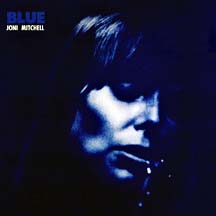
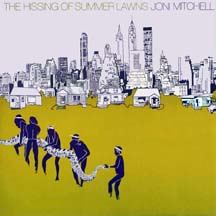
Mitchell’s golden years spanned the 70s. In a run of impeccable studio albums, she brought a candour and complexity to her work that ranged from the stark autobiography of Blue and the funky exoticism of The Hissing Of Summer Lawns to the spacious Hejira and the free-flowing jazz textures of Don Juan’s Reckless Daughter.
Such high standards took a dip during the following decade, as Mitchell grappled with electronica and the demands of new technology. The 90s saw a resurgence, and she released a handful of well-received albums before announcing her retirement in 2002. She returned to the studio for 2007’s Shine, after which she disappeared again.
Sadly, in 2015 she suffered a brain aneurysm. Her rehabilitation has been steady. And while it’s unlikely that we’ll ever hear new music from Joni Mitchell again, there’s still so much to savour, including an emotional return to the stage at the Newport Folk Festival in 2022 in the company of Brandi Carlile, Wynonna Judd, Marcus Mumford and more. The set was released as a live album, Joni Mitchell at Newport, the following year.
Sudden fame and celebrity didn’t sit well with Mitchell, who chose to escape by taking a year off and mooching around Europe. Her sojourn on the island of Crete helped restore her creative appetite, and she discovered the Appalachian dulcimer and wrote the first batch of intensely personal, emotionally transparent songs that would make up Blue.
The writing is raw and direct, the spare arrangements heightening the lyrical content. My Old Man details her failed relationship with Graham Nash, while All I Want is one of three tunes aimed at another recent partner, James Taylor. Faultless and revelatory, Blue is the ultimate break-up album.
Anyone who still thought of Mitchell as a boho folkie will have had their preconceptions dashed by this, her seventh album. Experimental and semi-symphonic, it finds her digging deep into jazz, borrowing elements from musique concrète and pre-empting the explosion of world music.
This is best illustrated on the stunning The Jungle Line, which is an exotic mini masterpiece. At the album’s heart lies Mitchell’s withering contempt for the superficiality of ‘respectable’ society, as documented on The Boho Dance and the title track, which features James Taylor on acoustic guitar.
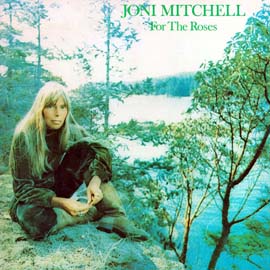
Tasked with following up the extended confessional of Blue, Mitchell responded with the more impressionistic For The Roses, which saw her shift towards more narrative song structures. The arrangements are subtle and deceptively intricate, fleshed out by strings.
Asylum Records boss David Geffen set Mitchell the challenge of writing a hit single, setting in motion the unashamedly commercial You Turn Me On, I’m A Radio. The song did indeed do the business on the charts, bringing Mitchell her first US Top 30 placing. Elsewhere, the title track lays bare her discomfort with her new-found fame.
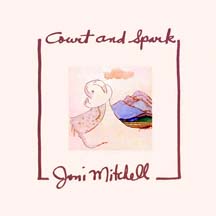
Mitchell’s sixth album reflected her burgeoning fascination with jazz, roping in Tom Scott and LA Express as her backing band and, in the process, broadening her musical palette. Cue woodwinds, reeds and trumpets as she and a raft of other helpers create an intoxicating blend of sun-blushed sophisti-pop.
The relatively carefree music belies the nature of her often troubled lyrics, which range from rigorous self-examination to deep meditations on celebrity, romantic love and what it means to be free. Help Me gave Mitchell her first (and only) US Top 10 hit, and she truly excels on Free Man In Paris and Down To You.
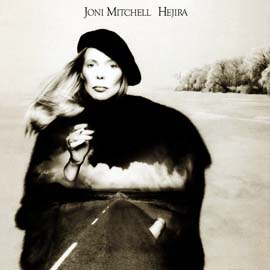
Named after the prophet Muhammad’s journey of exile from Mecca to Medina, Hejira references Mitchell’s own crosscountry road trip that followed the end of her relationship with drummer John Guerin. The songs find her caught between a thirst for independence and a desire for companionship, by turns philosophical, resigned and hopeful.
This sense of restlessness informs the songs on the record, which fold jazz, folk, poetry and almost-pop into a graceful whole. Jaco Pastorius’s fretless bass runs are a perfect fit for Mitchell’s pared-back arrangements and swooping soprano, heard to stirring effect on Coyote and Amelia.
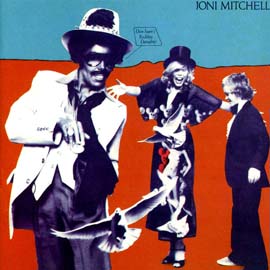
Generally dismissed by critics on release, this sprawling double album of fusionist jazz continues to polarise fans. Detractors claim that’s it’s overlong and unfocused, but it’s actually a joyous survey of music’s transportive powers, Mitchell untethering herself from expectations and flying far and free.
Some of it is deliciously abstract, while bongos, cowbell and coffee cans add to the invigorating sense of release. On a lyrical level, fun-time Joni hits a peak on the title track and the irrepressible Talk To Me: ‘I didn’t know I drank such a lot, till I pissed a tequila anaconda the full length of the parking lot.’
Mitchell didn’t appear at Woodstock, but her distanced vantage point, watching it on TV, didn’t prevent her from writing the definitive song about the festival and, by extension, the 60s counterculture movement.
Woodstock’s parent album finds her chronicling other matters too, from the contradictions of fame (For Free) to environmental havoc (Big Yellow Taxi) to the loss of innocence in the transition to adulthood (The Circle Game, written in response to Neil Young’s Sugar Mountain). Horns and strings add fresh texture to her favoured acoustic guitar and piano, but it’s her nuanced, fluting voice that most impresses.
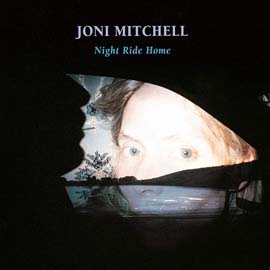
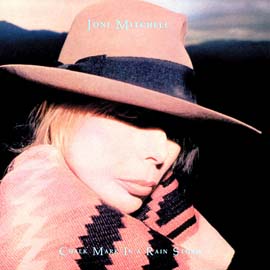
The less than enthusiastic response to Chalk Mark In A Rain Storm seemed to sting Mitchell into a new phase of creativity with its follow-up, the intimate feel of which drew a direct line to the early-70s albums that had made her reputation.
Exuding a satisfied warmth, Night Ride Home is nevertheless pitted with vitriol. The Windfall (Everything For Nothing) is a scathing rebuke to a former housemaid, while Slouching Towards Bethlehem is a commentary on American involvement in the Middle East. The exquisite Come In From The Cold, meanwhile, reflects on the rapturous joys of young love as seen from middle age.
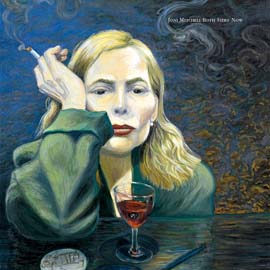
Described by co-producer Larry Klein as “a programmatic suite documenting a relationship from initial flirtation through optimistic consummation…”, this jazz-rooted covers album shifted attention from Mitchell’s songwriting to the expressive majesty of her voice. There’s a lived-in huskiness to her singing that lends her choices the full weight of emotional experience.
The London Symphony Orchestra ramp up the drama, on pre-war standards such as Stormy Weather to torch songs made famous by Lena Horne, Etta James, Nat King Cole and Ella Fitzgerald. Mitchell even breathes new meaning into 1971’s A Case Of You and the evergreen title track.
Even avid Joniphiles would admit that the 80s was a patchy decade for her, be it the synth-laden Dog Eat Dog or the concession to mainstream pop that was Wild Things Run Fast. But her artistic nadir came at the very end of the decade.
Chalk Mark feels like the bland yuppification of all that Mitchell holds dear, her usual creative instincts quashed by starry collaborations with Peter Gabriel, Tom Petty and, as unlikely as it may seem, Billy Idol. The Reoccurring Dream bolts together samples from TV commercials in a way that feels redundant rather than topical, while the protest songs – Lakota, Cool Water – suffer a similar fate.