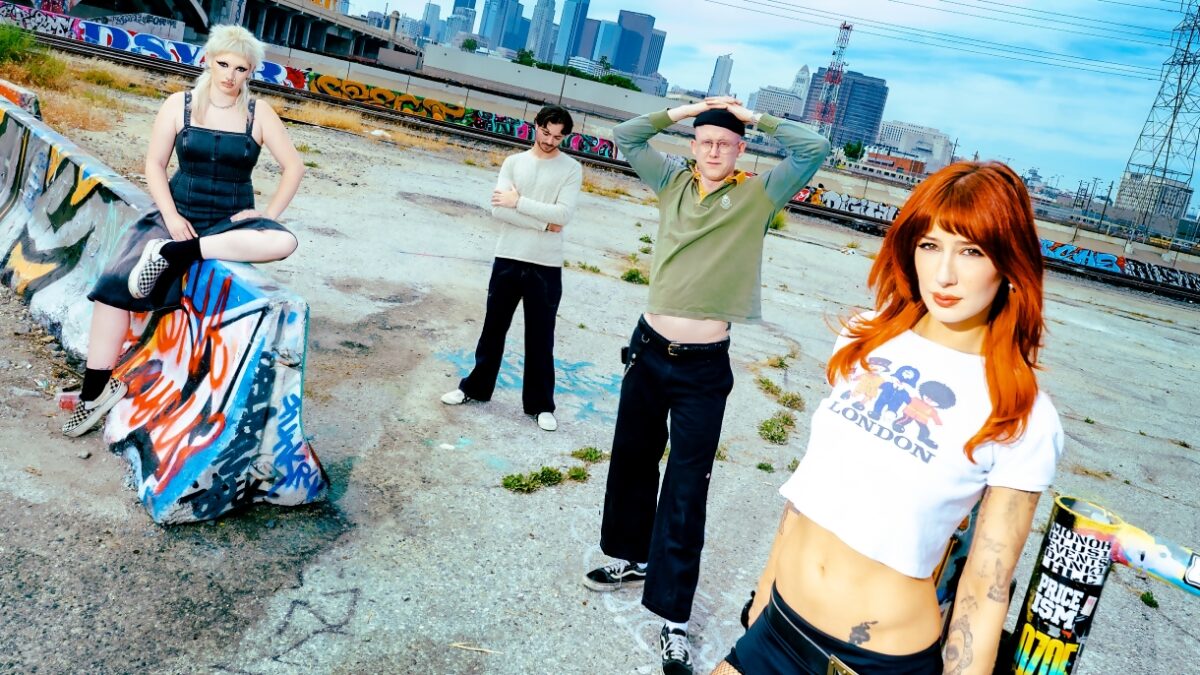
The roots of Truck Violence’s post-punk rage stretch thousands of kilometers from Montreal to the west, deep beneath the frozen tundra, to a small hamlet in central Canada named after the Lac la Biche that attracted fur traders and early pioneers. Vocalist Karsyn Henderson and guitarist Paul Lecours are pioneers in their own right, first meeting as middle school kids living on the periphery of a physical and emotional state that could be cold and unforgiving. On their second album, The weathervane is my body, the band sonically represents these perpetually frigid lands of despair. The sludgy, folk-tinged tracks illustrate a slow, slab-like movement of time, the forging of a valley through the movement of glaciers, the cold eye of a French immigrant sighting a wolf through the barrel of a shotgun.
Florida’s swamps and bogs inspired the sweaty, nihilistic death metal of Morbid Angel and Deicide, and Norway’s deepened, wind-eroded fjords drove kids to the darkened regions of cerebral forests, hiding behind the black and white corpse paint of black metal. Likewise, if you found yourself in the middle of nowhere in North America, it may as well be amongst the bogs and fens where Lecours and Henderson grew up. A small village a few hundred kilometers north of Edmonton, the Canadian hamlet was an auspicious place to come to age as a teenager. Couple this with being exposed to Slipknot at the perfect age of thirteen and your dad’s old Celtic Frost albums, in a community that didn’t offer much more than fishing for walleye off the banks of a lake, and you’d find yourself in some deep, dark, lonely places.
It’s in these lonely places, however, that partnerships are often formed. Couple this relationship with an unforgiving climate, a basement with some instruments, laptops and the Internet, and five or six hours to spare a day, and you may find that this kind of physical isolation can result in a cacophony that resonates well beyond the boreal forests of central Canada.
Henderson and Lecours joined me from the dorm room of an agricultural college in Denmark as they prepared to perform on stage at the Roskilde festival. Over the course of an hour, we talked about the origins of the band and the birth of Truck Violence lore; the trials and tribulations of touring by train in Europe; and how no matter what you do, you can’t escape the past.
…
…
How’s the tour going?
Karsyn Henderson (vocals): It’s been pretty crazy, and the shows have been sick. We had no idea what to expect. Our bookers, or whoever, were like, “It’s going to be tough, but it’ll be manageable.” But then every day of travel was agony. We had twelve bags for four people: double guitars, double bass, snare, cymbals, duffel bags, guitar heads, pedal boards, everything. We’re coming in and out of these quaint European trains, hauling ass and raising hell, trying to stuff bags into different crevices and find seats and shit.
At one point we had some bags accidentally near a fire extinguisher, and the cops came onto the train and literally stopped it until we moved our stuff.
Paul Lecours (guitar): Yeah, they don’t fuck around on trains here.
Karsyn Henderson: They really don’t. And then undercover cops came and checked our passports afterward. We clearly stuck out like sore thumbs on this chill train from wherever to wherever.
We also had this weird thing when we were in Bristol. Our drummer’s passport got stolen by a homeless guy, straight out of his bag. They found the homeless guy outside, and either he was too fucked up, or he was just fucking with us, because he was like, “No, I think it’s behind a dumpster somewhere.”
So for three hours everyone was just looking behind dumpsters, and…
Paul Lecours: Eventually, we actually found it stashed behind a dumpster at the venue. We gave him ten pounds to lead us around. We found it, and we went to Outbreak on two hours of sleep.
So that was fun.
Karsyn Henderson: But the actual shows have been fantastic.
Is this your first tour of Europe? Did you do one for the first album as well?
Karsyn Henderson: We didn’t do a tour for Violence, but a year after Violence came out, once it started getting picked up in the press a bit more, we could actually string dates together in Europe. We came out twice.
But I think this is our first real tour, if you know what I mean, where we’re actually playing to people who know the music a bit more, so it’s a completely different experience. Trying to win over an audience of people who just happened to wander into the room versus people who actually want to see the band is a completely different experience.
You’re a relatively young band. How old were you two when you met? Did you ever expect the music you’d be making would one day give you this kind of “rock and roll” experience?
Paul Lecours: We met when we were thirteen.
Karsyn Henderson: He moved from Ontario to Alberta, and it was a big deal at the time because our class was so small. We were only seven kids, or so. So when a new kid joins a seven-person class, it’s like, “holy shit, the world has just expanded!”
But no, we never thought it would happen. Honestly, when we were teenagers and swinging for the trees, and wanting to move to Montreal, we set a benchmark to reconvene on the issue in five years and see how we were doing. We figured if we could get a hundred people to listen to us, or get a hundred people into a bar in Montreal to see us play, that would be a sign we should keep going.
Obviously, we’ve surpassed those expectations. We’ve gone around the moon a couple of times compared to that. So no, I didn’t expect this at all.
Everything is kind of magical and a bit silly sometimes, particularly when it’s contextualized from where we came from in Alberta. The first shows we played were at a French cultural center, to what was essentially a bunch of grandparents of the kids who went to our school. I put on corpse paint and tight skinny jeans when we were thirteen, and we played to a drum track. It was just Paul and me and another guitarist on stage, playing original music.
Paul Lecours: Super loud, you know what I mean? So from that to this, the gap is enormous and obvious.
What is it about those extreme edges of music that attracted a kid out in Alberta?
Karsyn Henderson: I really didn’t fit in a lot when I was a young kid. Especially because I went to school farther away from all the other kids, and my family life was really unstable. My parents were divorced, and my dad was pretty fucked up when I was a kid. That was atypical, and in the town I grew up in, those family bonds are really important for blending in with other kids. I had friends whose parents wouldn’t let them come see me because they found out about my family situation. So I needed to find a new way to feel like I belonged, and also let out some of that archetypal angst you start getting when you feel alienated or disaffected.
My friend showed me Slipknot when I was a kid, which is the perfect band for that feeling at that age. My dad listened to heavy music, too. He gave me a Celtic Frost record when I was younger. Anyway, I went down that whole rabbit hole and started listening to progressively heavier and heavier music, and I really wanted to start a band.
Then Paul came along. He knew some rock and roll, and we were like, “Okay, rock and roll, but we’re going to show you some metal.” And we got him into it.
Paul Lecours: Yeah, before I moved there I was listening to ZZ Top and AC/DC. When I did a school visit before joining, a teacher mentioned there were a couple of kids there who were interested in metal. So I started googling metal songs and found Avenged Sevenfold or something like that, and I got morphed into it. I forced myself to listen to metal to actually like it. It took a while, but eventually I did.
You occupy a niche that not a lot of other bands are in. How did that sound develop, from when you left Alberta for Montreal? Was it deliberate, or just the combination of you four guys coming together?
Karsyn Henderson: A lot of the ambition began in Alberta, I’d say, because we had fuck-all to do, and Paul and I were basically each other’s only friend. I think we developed a really strong bond early on. We were playing in my basement, or wherever we could, five hours a day, five days a week, as much as possible. We were super experimental too. We had the internet, but we didn’t have anyone else around us experimenting with music in any way, so we kind of learned to do that together. We recorded samples of birds and water and waves, plugging things in through our car, bringing overheads to random places, or going out into the woods.
We developed a strong desire to be ambitious, to reach for the unreachable, because we were so obsessed with being technically and conceptually perfect. When we started our first death metal band, we wanted to be, for whatever reason, an indie death metal band.
We wanted the harshness of death metal combined with the emotional register we thought indie would lend us, which was probably overly ambitious for 16-year-olds. But we really wanted to do it, and we practiced so hard to be able to, and wrote so much music, and that desire never died. So when we get to Truck Violence now, it’s like we’re repeating that synthesis, just with more noise rock, hardcore, and folk. We’ve fine-tuned the subject matter.
What you’re saying about going out and doing these field recordings in Alberta connects to the use of folk instruments in your music, along with an awareness of time. In terms of how the songs come together on Weathervane, what’s that process like? Can you put me in that space?
Karsyn Henderson: Yeah, it’s all in the space. All the poetry I write is written beforehand. I write poetry compulsively, so I have a backlog of poems ready at any time. And luckily for me, Paul and I have such a strong connection that whenever he’s writing a guitar riff, it often already coincides with what I’m writing lyrically, and the images and feelings created by the sound can work together, even though they’re obviously different mediums.
The bass and guitar take the forefront in the beginning, and then we compose songs as a group, testing things out and going from part to part in a linear direction. We don’t usually come in with pre-prescribed song structures. It’s all very loose. Then Paul does the production. All the layers you hear, whether that’s the slide guitar, the banjo, the backing vocals, is done after the fact. Paul mixed, mastered, and recorded the entire album, so his hand in the production side of things is a heavy one, to say the least.
Do you enjoy that process as much as writing the songs?
Paul Lecours: Yeah, I love adding things to music. Honestly, it’s a love-hate relationship. I like mixing and mastering it, but when you’re listening to your songs over and over, you just hate it, and it takes at least a year before you can hear the song again, instead of just the mistakes you think are there.
But I love it. It’s so fun to mess around with mics, record stuff, get cool sounds, put it in a DAW. For a lot of the guitar leads, and some of the acoustic stuff, the whole band will do it, but for a lot of the guitar leads, it’s just me in my room, laying down lead after lead. But it’s really fun. I like doing it.
I’d never do it for anyone else, though. I’d hate to mix for another band, but for my own band, it’s good.
Would you ever consider an outside producer?
Paul Lecours: I like doing it myself. But as for someone completely random, it would bring a very different dynamic to the music. Maybe it would be cool, but it’s not something I’ve really thought about, to be honest. It would be such a massive switch-up.
Karsyn Henderson: Everything we’ve ever done has been Paul recording and handling that side of things, the grind work, basically. Paul is a fucking grinder. It’s insane. He handles all the tech stuff, too.
We played Roadburn this year, and we were super nervous. It was the biggest show we’d ever played, and the bass jack broke on stage during our first set. Paul straight-up took out a soldering iron and resoldered the bass jack on stage, live. We thought we’d have to cancel the show, and Jonathan from the Flenser had just signed us. We were meeting him for the first time, and he was backstage watching us.
I looked at him and thought, “We’re making the worst first impression ever: getting on stage at the biggest show we’ve ever played, and we’re just going to cancel it because we don’t have the gear ready to go.”
But Paul fucking soldered it on stage, and they gave us the go-ahead to play the full set. I think that’s a really representative moment of how Paul can just put his nose to the ground, get to work, and do all the dirty shit all the time.
I’m really fascinated by how heavy music, in particular, is connected to place. There’s a lot of lore connected to Truck Violence and your connection to the middle of nowhere in Alberta. Is this something you consciously connect to?
Karsyn Henderson: I mean, to some extent it has to be, right? You can’t escape your context. There’s an element of fortune involved in where you come from, and thus what subject matter is available to you. So, is my music entirely about Alberta? No, of course not. But it is a massive cultural influence on the way I think about things, or the way I observe things. These eyes I’m seeing with are informed by feelings and concepts I probably inherited from where I’m from, now more intangible and subconscious. So yeah, it’s inescapable, but it isn’t the whole of it, if you know what I mean.
I think the previous album was more centered on ingesting and metabolizing what it meant to come from that place, because we were so young, and I was still coming to terms with where I was from. You think they’re basic things, but you return to the basics constantly. That album was very obviously about that.
Weathervane is a lot more conceptual, and I think it touches on things that are both outside and inside of Alberta, because when we’re talking about the body, which is what the album centers around, my idea of what a body is will be heavily informed by what a body was when I grew up, of course. And the prescriptions I make are often the ones I’m most familiar with.
Of course, you can’t escape your context at all, but it’s not the whole of it.
Context is everything, for sure. I’ll let you head over to the venue so you can kick some ass. Hopefully, you won’t have to solder the bass again.
Karsyn Henderson: Hopefully.
…
The weathervane is my body is available now via The Flenser.