And you don’t even have to worry about tipping your bartender.
The post Watch Pro-Shot Footage Of Glassjaw’s 2026 Long Beach, CA ‘Vans Warped Tour’ Set appeared first on Theprp.com.
And you don’t even have to worry about tipping your bartender.
The post Watch Pro-Shot Footage Of Glassjaw’s 2026 Long Beach, CA ‘Vans Warped Tour’ Set appeared first on Theprp.com.
This week’s “Dark Wave” featured music by Dead Can Dance, Danielle Dax, Bauhaus, Alien Sex Fiend, Cocteau Twins, Nitzer Ebb, Rozz Williams, Magazine and more.
The post Playlist: Sirius XM’s “Dark Wave” — hosted by Matt Sebastian (7/26/26) appeared first on Slicing Up Eyeballs.
With an expanded edition of Hawkwind’s epochal self-titled debut album just released, Prog takes a look at the band’s first year, from playing blues in the back of pubs to forging a revolutionary space rock sound.
As would be the case throughout their career, Hawkwind were heading in a radically different direction from just about every other band in Britain as the 1970s dawned. In The Court Of The Crimson King had recently set the standard for bands of a progressive persuasion, while the first two Led Zeppelin albums had mapped out the hard rock road that many others would travel.
But for Hawkwind, the experimental imperative of the psychedelic era was still their guiding force, long after it had supposedly fallen out of fashion. From their origins as a community project based out of west London’s Ladbroke Grove, Hawkwind would rapidly mutate to become the key band of the countercultural underground, playing a sound that combined minimal riffs, hypnotic bass lines and pounding rhythms, psychedelia retooled for a new decade.
Their self-titled debut album was a milestone in their development as both an anti-establishment institution and an intuitively avant-garde jam band. From the very start, Dave Brock intended that the band was going to be different. He recalls that his previous group – the Famous Cure – had already nailed down one half of the equation, playing “freak-out music with long solos and weird noises, relentless drumming and bass thundering on.” But he was becoming interested in the possibilities of electronic music.
“I had a tape machine with a lot of old Stockhausen stuff on it,” he says. “We used to make tape loops, four or five feet long, running around the toilet door handle, and then we used to play on top of them.” “We” refers to him and Mick Slattery, also ex-Famous Cure and the new group’s lead guitarist. Next, a rhythm section was recruited: John Harrison on bass, who somewhat incongruously had previously played with the Joe Loss Orchestra, and Terry Ollis on drums, just 17 years old but very keen.
Rehearsals began in the summer of 1969, with extended improvisations around blues standards such as Howlin’ Wolf’s Spoonful. There were sporadic gigs, such as a show at Chiswick Town Hall and a private party at the famous Eel Pie Island Hotel, but Ollis recalls the nameless band mainly “playing in pubs, doing a couple of tracks at the end of somebody else’s gig, wherever we could, really.”
The band started to evolve into a more experimental unit with the addition of Nik Turner. Originally hired as their van driver, Turner became a member when it was discovered he had a rudimentary talent on the sax. He’d recently returned from Berlin, where he’d had a life-changing conversation with Tangerine Dream’s Edgar Froese. The late Turner recalled: “He said, ‘Look, you don’t have to be technical to express yourself. You’ve got to express yourself with what you’ve got and what you are.’ And I thought, ‘I’d like to do that in a rock band.’ Free-jazz in a rock’n’roll band – that’s how I saw Hawkwind when I started playing with them.”
The band’s fortunes changed almost overnight when they performed at Notting Hill’s All Saints Church Hall on August 29, 1969. The story is mythologised as the band – announced as ‘Group X’ – gatecrashing a gig headlined by High Tide and convincing Clearwater promoter Doug Smith to let them play a 15-minute slot. But Brock has more recently stated that their appearance was prearranged. What isn’t disputed is the impression they made on underground tastemaker John Peel, who happened to be in attendance.
Enjoying the band’s clangorous, propulsive improvisation based loosely around The Byrds’ Eight Miles High (or John Coltrane’s India, depending on who you speak to), Peel advised Smith to “get involved”, and it wasn’t long before the group – rechristened Hawkwind Zoo – became the latest addition to the Clearwater roster.
Now playing regularly around London, they went into EMI Studios in Abbey Road to record a demo. In contrast to the intense, sometimes chaotic music of their live shows, they decided to showcase their more melodic and accessible side to potential labels. Since the dissolution of the Famous Cure, Brock’s main source of income had been as a busker on the streets of Notting Hill and London’s West End, and the demo’s lead track was one of his kerbside numbers, a rousing folk-blues called Hurry On Sundown.
The other tracks reflected two of the band’s key influences: the rollicking Kiss Of The Velvet Whip was The Velvet Underground’s Venus In Furs via the Middle Earth club, while a faithful cover of Pink Floyd’s Cymbaline was a tip of the hat to the band’s most obvious forebears.
But it was as a live band that Hawkwind generated the most interest, particularly as Brock’s vision of playing rock music with electronics had been realised with the arrival of Richard Michael Davies, aka DikMik. Previously their roadie, he’d been given an ‘audio generator’ – actually an oscillator used for testing radio kits – which he experimented with via a Watkins Copicat echo unit and various pedals. The unearthly electronic howls, shrieks and whispers he wrangled from this basic set-up complemented the band’s brainstorming psychedelia perfectly.
We’re like a magnet with the power to repel or attract. We all realise this is a new level of communication
“That’s space rock, isn’t it?” says Brock. “Listen to what DikMik’s doing on his audio generator – he’s playing it like a theremin. What he was doing was quite innovative, though it’s always been glossed over.”
DikMik was pivotal to the growing perception of Hawkwind as an ‘electronic music group,’ with the extreme tonalities he produced sometimes having peculiar effects on the audience. “I was trying to turn people on, to blow their minds,” he said. “I understood what sound could actually do in terms of how ultrasonics affect the brain and subsonics affect the body. Especially if people were drunk down the front of the stage, you could use subsonics to make them physically sick if you wanted to – which I think I achieved a couple of times on purpose!”
Brock was also fascinated by the trance-inducing power of the music Hawkwind were now making, as he told Sounds at the time: “We’re like a magnet with the power to repel or attract. I think we can all sense the force and realise this is a new level of communication.”
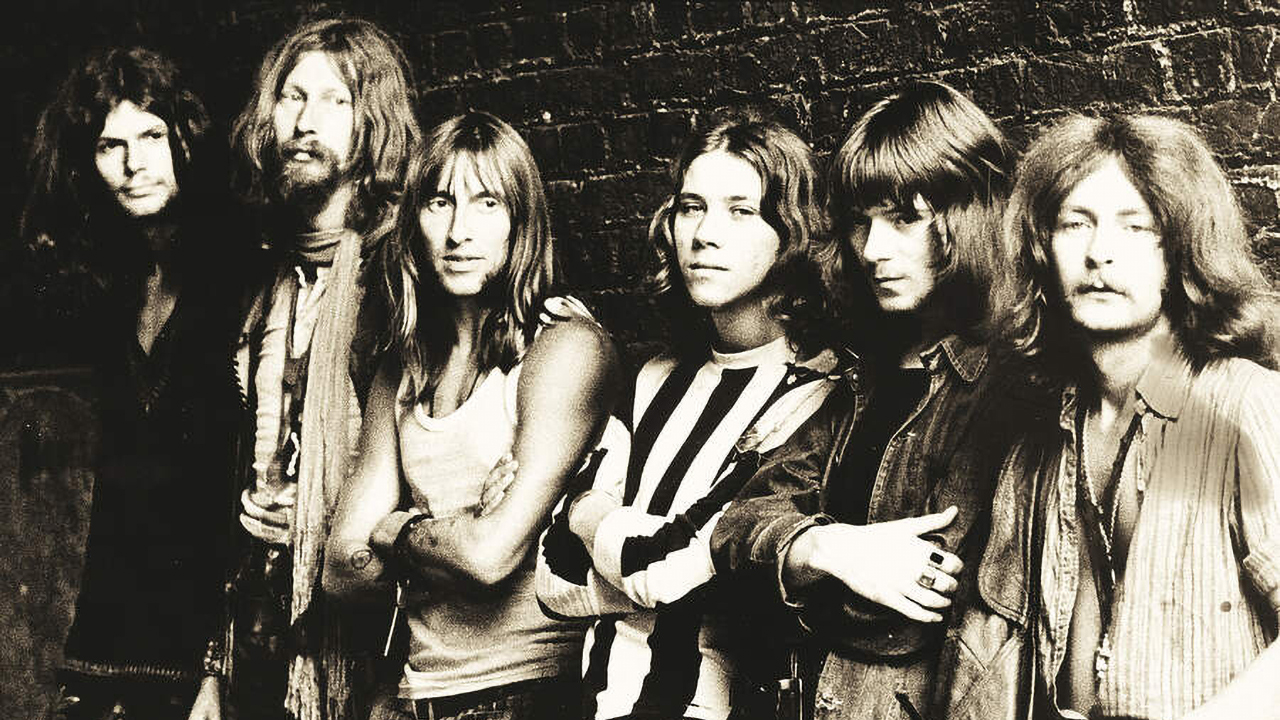
Inevitably, the regular ingestion of hallucinogenic substances also played a significant role in shaping the early band’s sound. Turner – who at the time claimed to take LSD every day – told Music Now: “Our music is derived from all the trips we’ve ever had. In the music somewhere there’s horror, beauty, paranoia, ecstasy, even randiness; every sort of human mood. So like a trip, our music is difficult to relate to with words. You can’t really put us in a bag.”
Having signed to Liberty Records in January 1970, putting the Hawkwind sound into a bag was exactly what was attempted the following month in Trident Studios as they began recording their debut LP. Luckily they had a sympathetic producer in ex-Pretty Things guitarist Dick Taylor, who’d even played live with the band a few times as a temporary replacement for Mick Slattery when he’d hit the hippie trail to India.
The essential thing was that each song had its structure – even when they went into quite strange places, it was always ordered chaos
With talented teenager Huw Lloyd-Langton recruited as their new lead player, some of the band’s more ‘conventional’ songs were laid down relatively quickly. These included the two tracks that would bookend the album – Hurry On Sundown and the more acidic Mirror Of Illusion – plus a gutsy, driving version of You Know You’re Only Dreaming, which didn’t make the final cut (but appear on the expanded edition).
However, it became apparent that such an approach wasn’t going to work for the majority of their set, which was a mostly vocal-free suite of spiky riffs, clattering rhythms, fierce soloing and moody atmospherics. The solution was to simply set the band up in the studio and press record. Speaking to Melody Maker, Turner said: “We tried double tracking llaying down separate parts, but it was so sterile that we ended up just playing it live; doing two or three takes of each number and picking the best, with a little polish added here and there.”
Beginning with the spooky ambience of The Reason Is?, the suite progresses through the hard jamming Be Yourself and nightmarish Paranoia before climaxing with the crazed voyage into inner space of Seeing It As You Really Are. As Dick Taylor told Hawkwind biographer Ian Abrahams: “What was quite amazing was that each piece had such an individual character. When I heard them I thought, ‘How do they do all this?’ But the essential thing was that each song had its structure – even when they went into quite strange places, it was always ordered chaos.”
Released on August 14, 1970 in a garishly trippy gatefold sleeve, Hawkwind didn’t exactly set the charts on fire, but received positive reviews. Melody Maker called their electronic sound “interesting and exciting” and the album “tremendous,” while Music Now reckoned that “the whole thing is so beautifully integrated that the fact one title has ended and another begun ceases to matter.” John Peel even described it as “optimistic, uplifting music” in Disc And Music Echo.
But it was the band’s appearance at the Isle Of Wight Festival two weeks later that cemented their reputation as leading lights of the UK underground. Wildly oversubscribed, with 50,000 paying audience members augmented by another half-million hippies, heads and freaks camped outside the perimeter fence, Hawkwind played for free in front of and inside an inflatable tent called Canvas City; five days of lysergic jamming together with fellow travellers the Pink Fairies. Turner painted himself silver and wandered around the site, his picture turning up in many of the articles written by the national press about this new youth phenomenon.
We regarded ourselves as being on the other side, an anti-establishment band. That’s what we’ve always been
A few weeks later, Hawkwind’s first John Peel/BBC session was broadcast, that version of Hurry On Sundown featuring some fiery fretwork from Lloyd-Langton – alas, the young guitarist had already left the band after suffering an acid-induced meltdown at the Isle Of Wight. With the decision taken not to replace him, Hawkwind’s sound changed again, becoming darker and more spacey. This was evident in their second BBC session in November 1970, which yielded the astonishing improvisation We Do It and signposted the way to the future.
By striking against the tide, Hawkwind had created a unique role for themselves, both as sonic explorers and countercultural figureheads. As Brock sums up: “We were a people’s band. We used to regard ourselves as being on the other side, an anti-establishment band, and that’s what we’ve always been, really.”
The expanded edition of Hawkwind is on sale now.
A New Zealand show by local stars Devilskin has been marred by what one eyewitness graphically describes as “a huge mess of shit, just completely spread all in the mosh pit.”
The show, which took place at the University of Otago’s Union Hall on Saturday, was the second date of Devilskin’s current tour, a celebration of the 10th anniversary of the band’s Be Like The River album, which topped the NZ charts in late 2016.
According to the local newspaper, the Otago Daily Times, the incident started when a middle-aged concertgoer “shook a log” from their trousers during Devilskin’s set.
“It was huge, like, massive,” says the eyewitness, who prefers to remain anonymous. “I haven’t seen one that big before.
“There was a lot of jumping. And then eventually someone must have looked down and noticed that there was just a huge mess of shit, just completely spread all in the mosh pit, all over the floor.
“It’s on people’s feet. People are wearing skirts and shit is up their legs and stuff, and then one girl went bleh – just vomited on the shit – and then everyone else starts vomiting.
“There was one lady with vomit in her hair, shit on her legs, and just crying, crying, crying.”
“It was like a scene from a B-grade horror movie,” Doug Stewart, bassist from opening band Pieces Of Molly, tells Metal Hammer. “This strong aroma wafted over the audience; the crowd parted like Moses parting the Brown Sea.
“Word quickly spread through the crowd as everyone realised what it was. It was at that point I started to see people throw up on the pit deuce. The other boys were in the green room, and that’s when I decided to make a quick exit myself to take advantage of said green room and free beers.”
According to the ODT, the loose-bowelled culprit was tracked down by local authorities but not charged with any offence. Devilskin’s tour continues, while Pieces Of Molly’s new single Alligator is out now.
Jul 31: Tauranga Mercury Baypark Stadium Lounge, New Zealand
Aug 01: Hamilton BNZ Theatre, New Zealand
Aug 07: Palmerston North Fly Palmy Arena, New Zealand
Aug 08: Hastings Toitoi Opera House, New Zealand
Sep 25: Auckland Spark Arena, New Zealand
Oct 24: Wellington Brewtown, New Zealand
Aug 15: Christchurch A Rolling Stone, New Zealand
Aug 21: Auckland The Mothership, New Zealand
Aug 22: Wellington Valhalla, New Zealand

The post Summer 2026 (a playlist) appeared first on Still in Rock.

There’s been several concert recordings from Bob Marley and THE WAILERS issued over the years, starting from the now-classic “Live!” and “Babylon By Bus” that saw the light of day while the great Jamaican was still with us, and each … Continue reading
The post Bob Marley’s Hammersmith Shows From 1976 Up For Release appeared first on DMME.net.
American boyhood can resemble a long induction into somebody else’s war. Strength is measured by the ability to make others submit; tenderness is seen as a liability; and young men learn to police one another before an employer, institution, or army ever needs to intervene. On “Victory in Death,” avant-garde darkwave project Mellow Code follows those instructions toward their brutal conclusion, confronting a model of masculinity designed to turn human beings into obedient bodies molded into the perfect vessels for capitalist greed and imperial power.
Led by Josh McVety and Oliver Michael German, Mellow Code opens the track with deep, processional drums and a funereal mass of synthesizers. Buzzing, bit-crushed electronics churn across the upper register while shuddering samples keep the arrangement under strain. McVety’s resonant vocal booms from a distance, suspended somewhere between lament and military command.
The track draws upon the physical machinery of early industrial music, but feels colder than EBM and graver than conventional darkwave. The body here is already bleeding out on the battlefield, with the genre’s flag lowered to half-mast. Repeated orders to “force it down” and “fall in line” turn masculinity into drill practice, while “just be a man” becomes both a taunt and a test whose only reward is further obedience. Even the title’s promised victory requires a form of self-erasure.
Mellow Code explains:
“Victory in death is a song evoking the feeling of growing up the way American culture targets boys. Preparation to be used as bodies for capital and imperialism. Fortify yourself little kid and don’t show weakness, that would be feminine or gay. Perpetuated in a cycle of abuse, boys police each other and the most conservative minded lash out at the perceived threats to that sense of “natural order”. Advertisements use the essence of porn and evoke rugged individualism to sell things but also that idea. The manosphere is only the newest mutant to spawn from this toxic path. These things feel inevitable at times but it’s not. Community and human contact is essential to humans, as is creating art. Sports are the most acceptable forms of community that also allow for some structured contact for young men. That’s why growing up as a soft art boy or boy adjacent can be hard. But if you’re lucky you find the other-ed and make art that speaks to rebellion against status quo gender existentialist bull shit. Maybe help some realize they also feel trapped by those structures.”
Shot in the high desert, the accompanying video turns that critique into an unruly nocturnal workshop. Around a campfire, a gang dressed in leather, mesh, workwear, and smeared makeup saws, drills, sands, and paints pieces of wood into oversized mallets, spears, and toy-like projectiles. Those scenes are intercut with McVety, sporting a yellow mullet and delivering the song from the cold white interior of a van, a knife resting in his hand.
Soon, a red-lit pickup carries the crew across the scrub with an enormous handmade slingshot mounted to its bed. Their target is a brightly painted wooden male dummy, equal parts carnival attraction, military mascot, and childhood invention. The friends bombard it with their homemade arsenal before closing in with clubs and axes, collectively demolishing the figure that has been built to represent inherited ideas of manhood. Orange firelight, hard headlights, flying sparks, and icy interior lighting give the desert escapade the character of a pirate raid organized by art-school outcasts.
For McVety, the production returned to the reckless ingenuity of childhood while placing that freedom in the hands of his closest creative community:
“This video was an absolute labor of love that was entirely done with and by my community of artist friends. I wanted to recapture what it felt like to be a kid when me and my freak friends would make weapons and contraptions and forts inspired by whatever movie we had just seen and often Jack Ass. Whatever felt Rad as Hell then still holds true. We built weapons and made a truck into a giant slingshot. I made a wooden dummy and my friends painted it. It was a party in the desert with the people closest to me.”
The video was photographed and co-directed by Adrian Stucker of Melankolia, with Daniel Maggio serving as co-director and editor. It stars Josh McVety, Eli Gray, Matt Hanson, Miranda Sharp, and Eric Runner, with color by Grady Colors.
Watch the video for “Victory in Death” below:
On creating the video for Victory in Death, Adrian Stucker discusses the film’s high-desert production and the internal conflict represented by its handmade weaponry:
“Serving as both Co-Director and Director of Photography for Mellow Code’s “Victory in Death,” I had the opportunity to craft a fantastically fun and highly conceptual visual narrative. The creative direction tied together the rebellious, youthful energy of The Lost Boys with the rugged, weathered aesthetic of desert-faring pirates.
Shooting out in the high desert always presents its own unique environmental and logistical challenges, but the cinematic payout is consistently worth the effort. To ground the raw aesthetic of the environment, I frequently utilized a hard, single lighting source, carving out striking, high-contrast imagery against the barren landscape. Drawing directly from Mellow Code’s actual thematic focus on fabricating custom instruments and devices, we wove that maker-centric vibe deeply into the video. The narrative visually documents the meticulous process of crafting tools from other tools, which are eventually forged into weapons. However, the story intentionally subverts the traditional use of these weapons. Instead of directing this arsenal outward at enemies, the weapons are turned inward for a deeply personal fight.
The core of the video captures Mellow Code on a mission to confront and metaphorically slaughter his own preconceived notions of masculinity. It is a visual exploration of dismantling internal barriers, illustrating that the most important battles are often fought within ourselves, ultimately making room to replace those outdated notions with the strength and love of the surrounding community.”
For Maggio, the concept also provided an opportunity to place McVety’s skills as a carpenter and fabricator directly before the camera:
“I love working with Josh. Not only does he make this wonderful, dark, hypnotic music, but he is also a master builder. He’s a brilliant carpenter who can create pretty much anything he designs. The opening shot of FACE IT (the last video we did together) is a handmade illuminated pentagram. He seemed to have made it in his spare time. I was blown away by the detail and its functionality. What can’t this guy do? For the second video, I was curious how far we could push his talents as a craftsman. He runs a shop in Alhambra and naturally works with an extremely talented, fashionable, and hardworking team. Every handmade object featured in the music video was created by the on-camera talent. You can tell they are all friends who share a professional working relationship. One of the highlights was the slingshot mounted to the top of the pickup truck. Our first launch was unsuccessful, and my fondest memory of the shoot was watching 4 cross-faded engineers troubleshoot this thing. I hope it’s as much fun to watch as it was to shoot.”
Listen to “Victory in Death” below, and order the single here.
Mellow Code is an avant-garde darkwave project led by Josh McVety and Oliver Michael German. Mechanical rhythms, new-wave vocals, EBM, house, and bright FM synthesis converge with samples gathered from the group’s fabrication workshop. The recent album Object Reality, along with tracks such as “Ich stehe im Blut” and “Face It,” develops an industrial club language in which handmade devices function as instruments, images, and extensions of the music itself.
Follow Mellow Code:

The post LA Darkwave Project Mellow Code Rebels Against the Machinery of Toxic Masculinity in Video for “Victory in Death” appeared first on Post-Punk.com.