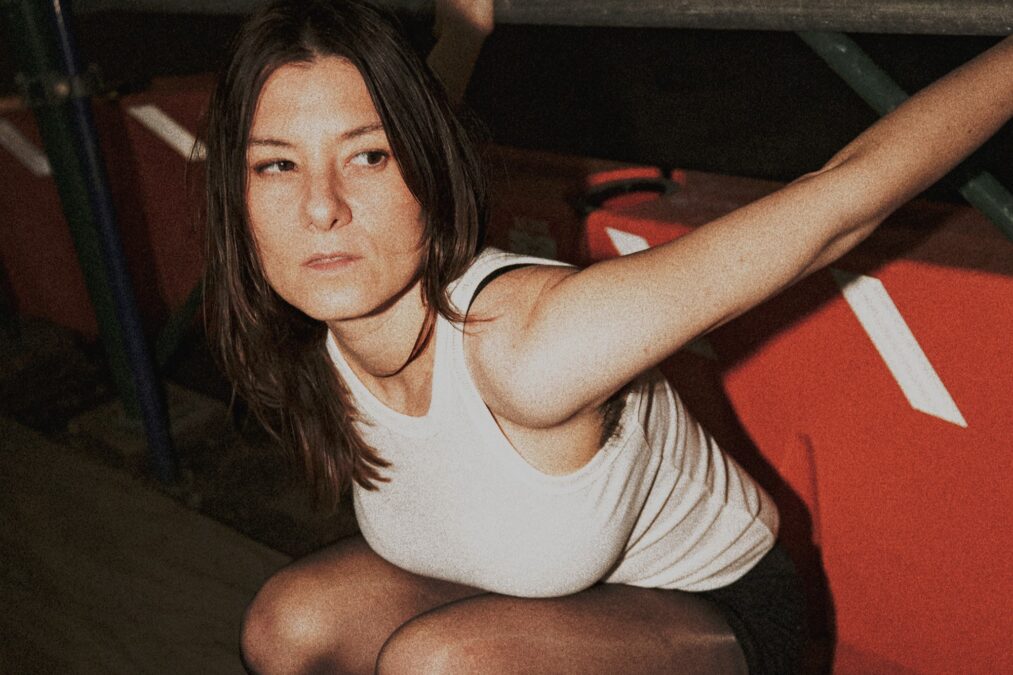
Since forming in New York City in 2013, Castrator have confronted misogyny, violence against women, and political repression through unforgiving death metal. Drummer and co-founder Carolina Perez has been there from the beginning alongside bassist Robin Mazen. Their 2022 debut, Defiled in Oblivion, was followed three years later by Coronation of the Grotesque, a record Perez describes as the band’s strongest work to date.
Born in Colombia, Perez started drumming at 14. She moved to New York as a teenager, where she immersed herself in the city’s metal scene. Years later, returning to her hometown of Medellín to perform with Castrator became one of the most significant experiences of her career. “I couldn’t believe that it happened,” she recalls. “That was a dream come true, for sure.”
Perez spoke with us about Castrator’s beginnings, feminism and politics in death metal, remaining DIY, life on the road, and how touring helped inform Coronation of the Grotesque. She also discusses the physical demands of extreme drumming, seeing more women and non-binary fans in metal crowds, and where Castrator go from here.
…
…
Can you discuss the band, its formation, the members, and what each of you contribute?
Castrator started in New York back in 2013. I used to play in another band called Hypoxia. We were based out of New York, partially Queens and Brooklyn, and then we played a show with Derkéta, which is the band that Robin played in. Robin’s the bass player for Castrator. So we played a show together, and then after the show, we got along and then we were like, “Hey, it’d be cool to start a female death metal band.”
Then we started recruiting, and we’ve been through a few lineup changes, but Robin and I have been the solid original members. It was really hard to find guitar players. That was the hardest challenge for the band. There’s a lot of guitar players out there, but there’s not a lot of real shredders.
What each member contributes to the band—their own talents and their own individual flavor. Most of the writing is done by Robin and me, because since the beginning, we’re the core of what we wanted to play and express with this band. But everyone’s very talented. Clarissa (Badini) is awesome. She’s got a very powerful voice and stage presence. And then Sarah (Loerlein), the newest member, is a really good guitar player as well.
You started drumming at 14 in Colombia. What was the first record that made you think, “I have to do that”?
I don’t think I can pinpoint a particular record. It’s more like a style of music, just metal. There were a lot of different punk bands, too, back at that time, where I was like, “you know, it looks like fun to play that way!” If I had to pinpoint it to a record, it would probably be, well, I wasn’t really listening to records, so that would be a lie. I was just listening to whatever was on the radio because I didn’t have a record player. I was very poor. So, it was more the metal and punk that I listened to on the radio that inspired me.
Your brother was/is a guitarist, right? Did that influence or shape your interest in music?
Yeah, definitely. We both started at the same time, and we started playing around with just a hand drum and him on the guitar and just being silly kids. Then before we knew it, we had instruments, and then we started jamming to covers. I think we tried playing Korn, Deftones, and Rancid. A lot of punk songs that were playing on the radio, stuff like that.
Castrator has turned the tables on the misogynistic tropes of ’90s death metal. Do you still find pushback, or have you noticed the scene becoming more welcoming to your perspective in 2026?
I think there’s always going to be pushback, but I think now that we’re a more established band and touring more and people see that we actually do this, we’re not in it for the trend or anything. This is something that we’ve been doing for a long time. We get some respect in that sense.
I feel like if we were younger, we wouldn’t get the respect that we’re getting now, you know what I’m saying? Because I just see it. When younger girls want to start, guys immediately reject it for some reason. It’s weird.
How did you decide on such a bold name?
We knew we wanted to play death metal, and we were looking for a name that was a statement and also was aggressive and would make a statement, too. We were thinking something that’s in your face, like Dying Fetus or Cannibal Corpse or stuff like that. We had a few suggestions, but Castrator was the one that we were like, “Oh, hell yeah!”
You’ve brought up real-world horror in your music, like the tragic killing of Mahsa Amini. Do you feel a responsibility to use your music as a platform to amplify these stories?
Yes. Also, things like that make an impact on me, and music is my way of expressing myself, so I’m always going to write about what’s bothering me or what’s causing this rage in me, which is why I play music, just to have this outlet. So, yes, it’s very important to use music as not only an outlet, but to amplify the message that needs to be heard.
But I feel like most people in the metal community don’t really want to listen to music for that reason, if you catch my drift. They just want to listen for entertainment purposes. There are very, very few people who actually listen for the actual message, unfortunately.
Is there a specific creative shorthand or energy that exists within all-female bands that you haven’t found in mixed-gender bands?
It’s going to be a very different dynamic. I think people are people. I think the most important thing about being in a band of any genre is taking your instrument and your craft seriously above anything. There’s always going to be differences of opinions or no one’s always in a good mood all the time, but as long as you can prioritize the band and the music, you’re always going to respect each other. Respect is everything.
So, yeah, the dynamic is very different, but musically speaking, it’s gotta be the same with either. It’s gotta be the same level of commitment and respect.
How do you protect your wrists and ankles at those BPMs?
I just have to keep them strong, so I gotta do a lot of practicing and strengthening of my important muscles to be able to keep up with that kind of drumming.
Being a drummer, and now that I’m over 40, forget it. I’ve been through it all. Carpal tunnel, tennis elbow, fractures, you name it. All kinds of shots/injections.
How does it feel to see more young women and nonbinary people in the front row of your shows today compared to 10 years ago?
I love it! It’s the best. It’s the best reward. It reassures me that I’m doing the right thing. It makes me feel like I spent my time well, because I remember that was not the case for me when I was younger, and it just feels good to be able to see this in the whole metal community.
How would you respond to people who think feminism or politics don’t belong in music, especially metal?
Everyone’s entitled to their opinion, but like I said, there are a lot of people who listen to music just for the entertainment of it. They don’t want to be involved in any sort of—they want to use music as an escape. They don’t want to face reality. But then there are a lot of people that don’t feel that way and actually want to use music as their outlet and their medium for raging and expressing themselves.
So I respect everybody, but I think it’s important to have both, actually, because the music industry wouldn’t be what it is if everyone was trying to relay a message through music.
…
…
You and Robin are the primary lyricists for the band. How does a song usually start between you two?
It depends. The way we work is, we do all the music first, and then we start brainstorming ideas that we think are strong suitors for the songs. Then we start building the lyrics together. There have been a few exceptions where we bring a whole idea or all the lyrics together. But for the most part, we work on them to suit the actual song.
You’ve been with Dark Descent Records since your debut album, Defiled in Oblivion. How did you connect with them? Do you feel you’re able to maintain full creative control working with them?
A really good friend of ours recommended that we talk to Matt Calvert from Dark Descent, and he said, “Send over whatever you have, I’ll give it a spin.” He liked what he heard, so he signed us. It’s been great. We 100% have creative control. I mean, we got signed for what we write and what we play, so we’ll never compromise the band no matter what.
You handle much of the band’s social media and video editing. Do you feel that being a multimedia artist is now a requirement for modern musicians?
100%. I really admire bands that don’t need to be on social media to be successful, because most bands have to be constantly staying active on social media to stay relevant, and it’s kind of upsetting. It’s annoying because most of us as musicians don’t want to be spending time doing that.
But also, most bands cannot afford a social media person or video editor. Forget it. This stuff is so expensive. So, you’ve got to become one.
I really enjoy video producing and video editing, but it is extremely time-consuming. It’s hard to manage my time, especially lately, because I work full-time, I do full-time school, and then touring and practicing. I don’t even know how I do it.
But when I was not in school, I was definitely spending most of my time doing a lot of video editing, and I’ve learned a lot just by going online and reading and trial by error. A lot of trial by error, especially with recording equipment for drums and microphones and interfaces and all that stuff. I didn’t go to school for any of that, but I got to learn on my own to be able to put something decent out there.
Now that the 2025 album has had time to breathe and you’re touring, which song has become one of your favorites to perform live?
I love playing “Deviant Miscreant.” It’s my favorite. It’s so much fun to play that song live. But I also love playing “Covenant of Deceit.” That song is very heavy, too. It’s hard because they’re all my babies. I love playing those songs live because there’s a very strong connection to each one of them. But yeah, “Deviant Miscreant” is definitely a good contender.
You did a tour supporting Obituary. Robin has a history with them?
Robin is a very successful tour manager. That’s what she does for a living. She also lives in Tampa, and she’s from back in the day. She’s an OG. She’s as relevant as George “Corpsegrinder” and all those guys because she’s been there from the beginning. She was there for all the early practices of all the legendary albums. She’s a living legend.
So all those guys know her and respect her and work with her, and she tours with them all the time, tour manages. So they actually gave her and Erik, who plays in Intoxicated, the opportunity to work together for us to come on the tour as well. And Intoxicated, too. Erik is the guitar tech for Obituary, and Robin’s the tour manager. The tour was amazing. Those guys are so cool.
Have there been any tracks that have been more challenging to translate from the studio to the stage?
With the previous album, definitely. With Defiled in Oblivion, for sure, because “Voices of Evirato,” that album, we tried to get really amazing guitar players to do guest solos on our album. But that song specifically had a super long solo from Moyses Kolesne from Krisiun, and it was a super long solo and kind of impossible to do.
So for us to play that song live, it would sound so weird without that solo. We don’t really play it live because, yeah, the girls could do it, and now we can try again, but it was a challenge for us to even try to play that live.
The other songs are pretty good, though. We definitely kept that in mind for this record, to not do something like that.
Looking back, what have been some of the most significant interactions or moments that you’ve had during this musical journey?
It’s hard because when I’m on tour, everything is kind of a blur because you’re always so tired and so focused at the same time. It’s work, work, work. I don’t really get time to hang out.
But significantly speaking, travelling to Medellín, going back to Colombia to play that huge festival, was cathartic for me because that was my hometown. That was definitely very significant for my drumming career, and to be able to go there with Castrator, I couldn’t believe that it happened. That was a dream come true, for sure! Full loop.
You know what? Now that I think about it, one of the other most significant moments of my drumming career was when we toured with Cattle Decapitation and we played in Tampa. It was the Orpheum. It was an outdoor venue.
When I got off stage, Paul Mazurkiewicz and Steve Asheim were right in the very front. They saw my whole set. They’re my heroes! I was freaking out! I couldn’t believe that was happening.
What’s one of the most important things that you’ve learned as a DIY band?
Tolerance. A lot of tolerance. The most important thing that we learned is that it’s very hard. It’s really, really hard to be a DIY band, but it is very rewarding, and every decision you make regarding sacrificing to go on the road is totally worth it. Just being able to work with like-minded people and badass ladies is great! It’s amazing.
Coronation of the Grotesque has been hailed as a leap forward. What shifted the energy compared to your debut, Defiled in Oblivion?
Coronation of the Grotesque is our second album, so we definitely learned a lot from our debut. When we toured with Cattle Decap, that was with Defiled in Oblivion, and just being on stage and playing every night and seeing what the crowd connects with more and what you feed off more from the energy from the crowd. Being on the road really is what made us better, to know what we wanted to write for the next album.
Are you still in other bands?
Yeah. I play guitar and sing for another band, Untoward. That’s with my boyfriend and my really good friend. And I do independent work. I recently recorded an album called “Mamakilla” with Ava Mendoza and Gabby Fluke in Brooklyn. We went to the Old Can Factory with Martin Bisi and we recorded. It was amazing.
I just always play whatever I can. If an offer comes my way and it sounds interesting, I’ll take it. I’m not exclusive to Castrator.
Even though geography has separated you at times, Castrator started and grew in New York City. How important is the city to the band’s identity and to you as a drummer?
Yes, Castrator was founded in New York City. Our first show was in Saint Vitus, a legendary metal bar. I actually played a lot of shows in New York, and I was there for a long time. I moved here to Ohio during the pandemic, and I’m still here. But I go to New York all the time. It’s home, definitely.
I arrived in New York when I was a teenager, and the New York metal scene is what shaped my playing as a drummer. Also, New York is a melting pot, and it’s also a melting pot for metal, as happened with Castrator, because it’s where we met and were formed.
I was at every show possible. During my 20s and early 30s, I was very, very present in the metal scene in New York.
What’s one underrated aspect of being in an all-female death metal band that people might not realize?
The underrated aspect of being in an all-female band is that nobody is gross (laughs). Nobody is farting. Nobody is doing gross things. I’m not saying all men are gross, but most men are gross, and it’s really refreshing to be with other girls where everyone cleans up after themselves. It’s just nice.
What’s next for Castrator?
Next, we’re going to obviously start writing our next album. We already have a bunch of ideas and riffs and stuff, so we just have to get together and start working on the new album.
Also, we want to tour more on this album, so hopefully we will have more tours towards the end of the year. We have some shows during the summer, fall and winter, but we definitely want to tour more.
…
Coronation of the Grotesque is available now.


STREAM THE METAL BREAKDOWN DAILY NOW: