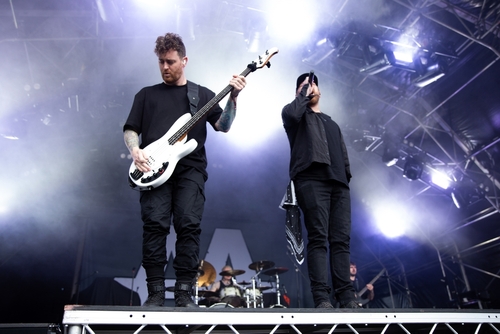
Some concerts are memorable because of the music. Others because of the atmosphere. Tuesday August 5, 2026, at Stir Cove in Council Bluffs offered both, as 311 returned to their hometown region to headline the “So Glad You Made It Tour” before a packed crowd.
Mother Nature couldn’t have scripted a better Wednesday evening. A cool breeze drifted across the Missouri River and temperatures settled into the perfect range.
ROME Ramirez got things rolling with a set that honored his years fronting Sublime with Rome while confidently standing on his own. Mixing familiar favorites with his signature laid-back charisma, he eased the crowd into the night with a coolness that was only matched by the glorious weather. We got what we needed from the band, a starter who grabbed our attention and gave us 5 solid innings.
Australia’s Ocean Alley followed with a hypnotic performance that proved why they’ve become one of the most respected rising bands in the genre. Their blend of psychedelic rock, reggae rhythms, and surf-inspired sound translated beautifully to the live stage. Their cover of Players, “Baby Come Back”, might have been the song of the night. The band’s musicianship was flawless, and their atmospheric jams won over the fans. They kept the momentum going as middle relievers and as we wound down to the final bands, they maintained our interest and has us eager to see the shows outcome.
By the time Dirty Heads took the stage, the energy had shifted into high gear. The California veterans delivered a nonstop party filled with singalongs, that included a Joe Walsh cover of “Life’s Been Good.” There was nothing but positive vibes as hit after hit filled the outdoor venue. Their chemistry with the audience was undeniable, turning Stir Cove into one giant summer celebration as hundreds sang every word back to the band. The stage filled up with talent when Rome came back out to join Dirty Heads for “Lay Me Down”. The band finished with “Medusa” and like the lyrics say, it hit us “right in the kisser” A superb band that much like an 8th inning pitcher, set the show up perfectly for the closer.
For Omaha natives 311, this wasn’t just another stop on the tour, it felt like a family reunion. From the opening notes, the band’s connection with the crowd was unbreakable. Fans who have followed the group for decades sang every lyric as if they were performing alongside them, creating one massive chorus that must have echoed across the river into downtown Omaha. The band’s signature mix of rock, reggae, funk, and rap remains as fresh and energetic as ever. Classics like, “All Mixed Up,” “Beautiful Disaster,” and “Come Original” ignited wave after wave of cheers, while newer material blended seamlessly into the set. Nick Hexum’s smooth vocals, SA Martinez’s infectious charisma, Tim Mahoney’s unmistakable guitar work, P-Nut’s thunderous bass lines, and Chad Sexton’s powerhouse drumming reminded everyone why 311 has remained one of alternative rock’s most enduring live bands for more than three decades. What made the performance especially meaningful was the hometown pride flowing in both directions. Every mention of Omaha drew deafening applause, and every familiar riff seemed to carry a little extra emotion. If there was lesson to be learned it was this, coming home never goes out of style. 311 closed out the show in a professional, no-nonsense manner and left no doubt why they were the ones chosen to end it. I only wish we had extra innings.
Madonna’s “Danceteria,” from her new album “Confessions II,” is packed with self-referential nostalgia, in both the dance floor production and the name-drop lyricism. Our critic Jon Caramanica explores how Madonna uses her own history as a creative engine for hope.
The 25th anniversary edition of Bloodstock Open Air Festival kicked off this week and tonight organisers announced Mercyful Fate, Electric Callboy and Motionless In White as main stage headliners for next year’s 26th year of the event.
With Lamb of God, Saxon, Slaughter To Prevail and Judas Priest headlining at Catton Park in Derbyshire, England, this weekend, fans who had just watched Municipal Waste’s set on Friday were told who will be the big hitters on the Ronnie James Dio Main Stage in 2027.
In a statement announcing the 2027 lineup, Friday’s headliners Mercyful Fate say: “Mercyful Fate is honoured and looking extremely forward to playing Bloodstock again. Last time was awesome, and this time with a brand new album out, finally!”
Saturday’s main draw Electric Callboy will be headlining the festival for the first time. The German electro-metal party-starters are cover stars of the new issue of Metal Hammer magazine which is available with an exclusive cover and special art print.
On being confirmed as Sunday headliners for 2027, Motionless In White frontman Chris Motionless says: “We were told that we are one of the most requested bands to perform at your legendary festival, so it is with great honour to announce that we are answering the call and will be seeing you next year for our first ever European festival headlining show, and only UK show of 2027! Thank you so much! Let the countdown begin.”
The Sophie Lancaster stage in 2027 will be headlined by Madball, Gaerea, Kanonenfieber and Dethklok.
THE EXILES have released the music video for the track ‘Soul Woman’ from their album ‘Turning Time”, available now on Bad Reputation Records.
“This is a song I had completely forgotten about and ‘rediscovered’ on the master tapes when they were kindly sent to me by Tom Whalley. Hearing it again after 20 years, I immediately felt it was a great track and was determined to take it from the demo it was—just scratch guitar, vocal, drums, and bass—and turn it into a fully produced song.
The opening always reminded me of ‘Black Dog’ by Led Zeppelin, so I really wanted to build on that feel by adding more guitar layers and Hammond to do it justice. I ended up adding around three additional guitar tracks, including slide and a more ‘jangly’ 335 part for the Jimmy Page-style breakdown before the slide solo kicks in.
I actually like the looseness—very Zeppelin—of the breakdown and middle section, as it plays nicely against the bigger, more traditional chorus. I also added backing vocals, and Jeff’s Hammond playing really brings the whole track together and finishes it off perfectly.“
The digital album will be available on August 7th on all digital platforms. It can be pre-ordered now on Bandcamp a https://theexilesuk.bandcamp.com/
‘Turning Time’ track list:
01. Turning Time
02. Rainmaker
03. Soul Woman
04. Tearing Up A Storm
05. Ain’t No Fool
06. Travelling Blues
07. Friend
08. Feminine Side
09. Richmond Castle Walk
10. Woman Let It Shine
11. Mission Bell
12. Soul Has No Home
13. I’m The One
14. High Old Times
15. Carry You Home
Tracks 1, 4
Vocal – Paul Rafferty
All Guitars – Sean Manning
Harmonica – Sean Manning
Bass – Frank Linx
Drums – Myron Grombacher
Keys – Jeff Jacobs
Tracks 3, 5, 6, 7, 8, 9, 10, 11, 12, 13
Vocal – Paul Rafferty
All Guitars – Sean Manning
Bass – Paul Andrew Stanley
Drums – Terry Mascall
Keys – Jeff Jacobs
Drums – Alex Gerst (“Ain’t No Fool”)
Harmonica – John Peyton (“T. Blues”)
Tracks 14, 15
Vocal – Paul Rafferty
All Guitars & Bass – Sean Manning
Drums – Dave Salinas
Keys – Richard Baker & Jeff Jacobs
Track 2
Vocal – Paul Rafferty
All Guitars – Sean Manning
Bass – Paul Andrew Stanley
Drums – Greg D’Angelo
Keys – Jeff Jacobs
Tracks 1 and 4 originally recorded by Neil Giraldo at Soul Kitchen in Malibu, CA. Additional guitar and keyboard tracks recorded by Alex Gerst ant Empire Sound in Dallas, TX.
Tracks 3, 5–13 originally recorded by Ricky & Eddie Delana at Sunset Sound, Hollywood, CA, and Cornerstone Recording, Chatsworth, CA. Additional guitar and keyboard tracks recorded by Alex Gerst at Empire Sound in Dallas, TX.
Tracks 14 and 15 originally recorded by Roger Sommers at Royaltone Studios, North Hollywood, CA. Additional guitar and keyboard tracks recorded by Alex Gerst at Empire Sound in Dallas, TX.
Track 2 originally recorded by Greg D’Angelo at D’Angelo Studios, Studio City, CA. Additional guitar and keyboard tracks recorded by Alex Gerst at Empire Sound in Dallas, TX.
This song opens with a beautiful guitar riff that showcases a certain compositional sophistication. As the entire band joins in, the atmosphere transports listeners back in time. The blend of funk, blues, and jazz creates an engaging mix. This combination captivates the audience and evokes nostalgia. The choice of a tune at 432Hz adds an interesting dimension to the track. Many legends surround this specific frequency, often deemed healing. In this case, listening to the song not only uplifts the spirit but resonates on a deeper level.
The melody and positive energy work together to leave listeners feeling genuinely better. It’s remarkable how this piece connects with the body, creating a transformation from within. The band clearly enjoys playing together. Their synergy is evident and contributes to an incredible chemistry that elevates this piece. The song flows with a sly rhythm that captures attention uniquely.
The musicianship displayed is fantastic. Each member contributes in a way that makes the music playful and fun, allowing the audience to enjoy the experience fully. Every note is filled with joy and passion. This enthusiasm adds to the infectious quality of the song. It’s easy to get lost in the groove, making it hard to resist moving along with the beat.
We Got A Song – Sound and Atmosphere
Listeners are treated to a vibrant musical journey. There are moments of intensity followed by softer parts that emphasize the harmony. This ebb and flow keep the listener engaged without overwhelming them. The production quality enhances the overall listening experience, ensuring clarity without losing the organic feel of the instrumentation.
The rhythm section lays a solid foundation for the other instruments to build upon. The basslines are groovy and infectious. They anchor the melody and drive the song forward. Drumming patterns are crisp and enhance the overall energy. This rhythmic backbone allows the lead instruments to shine even brighter.
We Got A Song – Performance and Production
Another standout feature of the song is its arrangement. The progression feels organic, rather than forced. It allows the listener to fully immerse themselves in the experience. Some moments feel spontaneous and alive, highlighting the band’s improvisational skills.
The song’s structure supports an engaging auditory journey. The repeat segments give the audience a chance to connect emotionally. The balance of familiarity and innovation ensures it resonates with diverse listeners. This combination is essential in creating music that stands the test of time.
Ultimately, “We Got A Song” is a celebration of musicality and connection. It’s impossible not to appreciate the chemistry among the band members. Their joy and spirit shine bright, drawing listeners in and encouraging them to participate. The raw energy and talent displayed serve as a reminder of the magic found in collaboration.
“We Got A Song” by G – BRO is a sublime piece. It successfully merges different musical styles with a modern touch. The emotional depth, combined with playful compositions, makes it an enjoyable experience for all. This track is not just music; it’s an invitation to feel and enjoy life. I highly recommend this song to everyone looking for a joyful escape.
Every Mercyful Fate studio album ranked worst to best — all seven records, spanning 1983’s Melissa to 1999’s 9. The Danish band formed in Copenhagen in 1981 around vocalist King Diamond and guitarist Hank Shermann, who remain its two constants. Their catalogue splits cleanly in half: two albums before a 1985 breakup, five after a 1993 reunion, and nothing since. The album most people name as their best is not the one at the top of this list. We’re counting down from 7 to 1.
There is a decent argument that no band has ever been more influential per album released.
Mercyful Fate made two records in the early eighties. Two. And out of those two came the blueprint for a genre that didn’t have a name yet — the corpsepaint, the occult theology treated as text rather than costume, the falsetto, the twin-guitar harmonies borrowed from Judas Priest and pointed somewhere considerably darker.
Metallica covered them. Every second-wave black metal band in Norway owned the records. Slipknot’s Clown has talked about them. And King Diamond is still out there at seventy, in the paint, doing the voice.
Then they broke up in 1985, came back eight years later, made five more albums, and stopped again.
Seven records total. Here they are, worst to best — and the famous one doesn’t win.
7. Into the Unknown (1996)
Lineup: King Diamond, Hank Shermann, Michael Denner, Sharlee D’Angelo, Bjarne T. Holm
Every band has one, and this is theirs.
Into the Unknown is the third album of the reunion era and the point where the momentum ran out. The songs are longer, the tempos slower, and the sense of menace that defined everything before it gets replaced by something closer to mid-paced hard rock with occasional occult decoration.
“The Uninvited Guest” is decent. “Fifteen Men (And a Bottle of Rum)” is a genuinely odd inclusion that some fans love and most quietly skip. The title track goes on considerably longer than its ideas do.
The core problem is that it sounds tentative. Where In the Shadows had something to prove and Time had confidence, this one sounds like a band who weren’t sure what the next move was and made an album anyway.
Bjarne T. Holm’s first record with them, and he’s fine — the drumming isn’t the issue. The writing is.
Not unlistenable. Just the one you’d never hand anybody.
Key tracks: “The Uninvited Guest,” “Listen to the Bell”
6. 9 (1999)
Lineup: King Diamond, Hank Shermann, Mike Wead, Sharlee D’Angelo, Bjarne T. Holm
The last one, and it goes out swinging even if it doesn’t quite connect.
9 was a deliberate correction. King Diamond described it at the time as much more direct and aggressive, musically and lyrically, than the records immediately before it — and that’s accurate. The songs are shorter, the riffs are blunter, and the sprawl of Into the Unknown is gone entirely.
The problem is that directness costs them the thing they were best at. Mercyful Fate’s greatest weapon was always the way a song could turn three times before it finished — a passage in “Satan’s Fall” or “The Oath” that arrives from nowhere and changes the room. 9 mostly plays it straight.
“Sold My Soul” and “Burn in Hell” work. The record moves. But it’s a good heavy metal album by a band who once made unclassifiable ones.
Nobody knew it was the final Mercyful Fate album at the time, and twenty-seven years later there still hasn’t been another. That gives it a weight it probably didn’t earn on release.
Key tracks: “Sold My Soul,” “Burn in Hell,” “Insane”
5. Dead Again (1998)
Lineup: King Diamond, Hank Shermann, Mike Wead, Sharlee D’Angelo, Bjarne T. Holm
The last album with real fight in it.
Dead Again is where Michael Denner’s departure gets absorbed. Mike Wead came in on guitar, and rather than trying to replicate Denner’s phrasing he pushed the band somewhere heavier and more modern. It works better than it had any right to.
It’s also long — over seventy minutes across a double album, which is more Mercyful Fate than most people need in one sitting. Trim it to fifty and it climbs this list.
But the highs are real. “Since Forever” is one of the best things they made after 1984. “The Night” builds properly. “Banshee” has the theatrical menace the reunion records kept reaching for.
This is the one reunion album that sounds like the band actually wanted to make it rather than needing to.
Key tracks: “Since Forever,” “The Night,” “Banshee”
4. In the Shadows (1993)
Lineup: King Diamond, Hank Shermann, Michael Denner, Timi Hansen, plus a returning rhythm section
The comeback, and it had absolutely no business working.
Eight years after the split, four-fifths of the classic lineup reconvened — Diamond, Shermann, Denner and Timi Hansen, with Kim Ruzz the one who didn’t return. Reunion albums from bands that important are almost always embarrassing.
This one isn’t. In the Shadows picks up so close to where Don’t Break The Oath left off that it’s genuinely disorienting. “Egypt” opens it with the same theatrical build they’d been using a decade earlier. “The Old Oak” stretches past eight minutes without sagging. “Is That You, Melissa” reaches directly back to the debut and mostly gets away with it.
There’s a famous footnote too: Lars Ulrich plays drums on “Return of the Vampire… 1993.” Metallica had covered Mercyful Fate on Garage Inc., and this was the debt going the other way.
Why isn’t it higher? Because it’s a very good imitation of the two albums above it rather than a new statement. It proved they still could. It didn’t prove they still needed to.
Key tracks: “Egypt,” “The Old Oak,” “Is That You, Melissa”
3. Time (1994)
Lineup: King Diamond, Hank Shermann, Michael Denner, Sharlee D’Angelo, plus new drums
The most underrated album in the catalogue, and the best thing the reunion produced.
Where In the Shadows was a band checking they could still do it, Time is a band deciding what to do next. Sharlee D’Angelo’s first record on bass gives it a different pulse, and the songwriting is looser and stranger than anything since 1984.
“Nightmare Be Thy Name” is a proper opener. “The Mad Arab” is one of the finest things Shermann and Denner ever wrote together — a genuine progressive metal composition wearing an occult hat. “Castillo del Mortes” closes the record with real ambition.
It also has the reunion era’s best production. The guitars are separated properly, King Diamond’s layered vocals sit where they should, and the whole thing breathes.
If you’ve written off everything after 1984 on principle — and plenty of people have — this is the album that will make you reconsider.
Key tracks: “The Mad Arab,” “Nightmare Be Thy Name,” “Castillo del Mortes”
2. Melissa (1983)
Lineup: King Diamond, Hank Shermann, Michael Denner, Timi Hansen, Kim Ruzz
One of the most important debut albums in the history of heavy metal, and it’s still only number two.
Released October 30, 1983 on Roadrunner, Melissa arrived into a scene that had no framework for it. Judas Priest and Iron Maiden had built the guitar language. Venom had supplied the imagery. Nobody had put them together with a classically trained falsetto, an actual occult narrative, and songwriting this ambitious.
“Evil” is the calling card and deserves to be. “Curse of the Pharaohs” is relentless. “Into the Coven” got the album banned from several shops. And “Satan’s Fall” — eleven minutes, four distinct movements, an eighteen-year-old’s idea of what a metal epic could be, executed by musicians good enough to pull it off.
Shermann and Denner’s twin-guitar interplay across this record is the thing everyone under-credits. King Diamond takes the attention, but the reason these songs survived forty years is the guitar writing.
Metallica later folded chunks of this album into their Mercyful Fate medley on Garage Inc. Every second-wave Norwegian black metal band owned it. Its fingerprints are on more records than almost any album of its decade.
It is a monumental debut. And the band got better one year later.
Key tracks: “Evil,” “Satan’s Fall,” “Curse of the Pharaohs”
1. Don’t Break The Oath (1984)
Lineup: King Diamond, Hank Shermann, Michael Denner, Timi Hansen, Kim Ruzz
Here’s the argument.
Melissa is the more famous album, the more shocking arrival, and the one people name first. Don’t Break The Oath is the better record, and it isn’t especially close once you sit with both.
Recorded in May 1984 at Easy Sound Recording in Copenhagen with producer Henrik Lund, it does everything the debut does with a year more experience and considerably more control. The production is cleaner without being tamer. The arrangements are more sophisticated. And the songs are simply stronger, top to bottom.
Look at the opening run. “A Dangerous Meeting” — which started life as a demo called “Death Kiss” — is the most efficient thing they ever wrote. “Nightmare” follows it with six minutes of genuine dread. “Desecration of Souls” is vicious. Then “The Oath” arrives, seven and a half minutes of ritual and build, and it is arguably the definitive Mercyful Fate song.
And it doesn’t fade. “Gypsy” is a two-minute punch. “Come to the Sabbath” closes the record with the best chorus in the catalogue. There is no weak track. On Melissa there are one or two.
The critical record agrees, for whatever that’s worth. Album of the Year has it at 90 against Melissa‘s 80. The Collector’s Guide To Heavy Metal gave it a straight 10 out of 10. Metal Blade’s own copy, describing a different album fifteen years later, called Don’t Break The Oath monumental — the band’s own label uses it as the yardstick.
Then it was over. The band split in April 1985 over musical direction, Shermann wanting a more commercial approach, and King Diamond went solo. Two albums, twenty-two months apart, and the whole story.
Whatever came after — and some of it is genuinely good — this is the summit.
Key tracks: “A Dangerous Meeting,” “The Oath,” “Come to the Sabbath”
The Full Ranking
Don’t Break The Oath (1984)
Melissa (1983)
Time (1994)
In the Shadows (1993)
Dead Again (1998)
9 (1999)
Into the Unknown (1996)
A note on what’s not here: the 1982 self-titled Mercyful Fate release is an EP, and both The Beginning (1987) and Return of the Vampire (1992) are compilations of early demos and radio sessions. All three are worth hearing — the EP especially — but none is a studio album, so none belongs in this ranking.
What Happens Next
There has been no Mercyful Fate album since 1999, but there is one in progress.
Whether album eight can trouble this top two is another question entirely. But at seventy, in the paint, still doing the voice, King Diamond has earned the benefit of the doubt. Our thirteen King Diamond facts covers plenty the headlines skip.
Best Mercyful Fate album: Don’t Break The Oath (1984) — stronger top to bottom than the more famous debut, with no weak track
Most important: Melissa (1983), one of the foundational records of extreme metal
Most underrated: Time (1994), the best album of the reunion era and the one worth revisiting
Weakest: Into the Unknown (1996), where the reunion momentum ran out
Total: seven studio albums — two before the 1985 split, five after the 1993 reunion
The constants: vocalist King Diamond and guitarist Hank Shermann, who founded the band in Copenhagen in 1981
Famous footnote: Lars Ulrich plays drums on “Return of the Vampire… 1993” from In the Shadows
Still to come: an eighth album has been in progress since 2022 and remains unreleased
FAQ
What is Mercyful Fate’s best album?
Don’t Break The Oath (1984). It’s the stronger record top to bottom — better produced, more sophisticated arrangements, and no weak track across its ten songs. Melissa is the more famous and more historically important debut, but Oath is where every element of the band peaked at once.
How many albums have Mercyful Fate released?
Seven studio albums: Melissa (1983), Don’t Break The Oath (1984), In the Shadows (1993), Time (1994), Into the Unknown (1996), Dead Again (1998) and 9 (1999). The 1982 self-titled release is an EP, and The Beginning and Return of the Vampire are compilations.
Why did Mercyful Fate break up?
The band split in April 1985 over musical direction, with guitarist Hank Shermann wanting a more commercial approach. King Diamond went on to a successful solo career, and the band did not reunite until 1993.
Who is in Mercyful Fate?
King Diamond on vocals and Hank Shermann on guitar are the two constants, having founded the band in 1981. The current lineup also includes Mike Wead on guitar, Bjarne T. Holm on drums and Becky Baldwin on bass, who joined permanently in 2024.
Are Mercyful Fate making a new album?
Yes, though it has been in progress for years. They debuted a new song, “The Jackal Of Salzburg,” live in 2022, and the album was described as being in the demoing process in early 2025. No release date has been announced. It would be their first since 1999’s 9.
Two albums that built a genre, five more that mostly justified the reunion, and one famous debut that we’ve put at number two. Come and tell us we’re wrong about Don’t Break The Oath — the comments are right there.
Want more? The Loaded Radio stream runs hard rock and metal twenty-four hours a day — grab the free Loaded Radio app on Apple iOS and Google Play, or listen right here.
In 2019 David Gilmour made the shock announcement that he’d decided to sell 123 of his guitars at auction, many of them legendary among Pink Floyd fans. The move led to all kinds of speculation about his future. He’d eventually raise $21.5m (about £16.6m) for the ClientEarth charity in a record-breaking event; but before it took place, he talked – and played – through some of the unique lots with Prog, and offered some hope for those who feared he might be retiring.
“I’ve no intention of going and doing a Pink Floyd record or a Pink Floyd tour again.” Words from the mouth of David Gilmour that won’t come as a massive surprise to fans, but are still likely to be met by a sinking of many hearts in Progland. Earlier in 2019, the guitarist also announced he was selling around 120 of his own guitars to raise money for charity, a collection that includes the legendary Black Strat that was used on all Floyd albums from 1970 to the mid-80s, and again at the Live 8 reunion; the equally legendary 0001 Strat; and Gilmour’s 1955 Les Paul Goldtop that was used on both The Walland A Momentary Lapse Of Reason.
One can understand a certain frisson of fear creeping through the Floyd/Gilmour fanbase. What on earth is going on, Mr Gilmour? Does selling so many guitars equate to an announcement of retirement for a man whose guitar tone has coloured the lives of millions of music fans the world over?
Christies, the auction house reselling the Gilmour collection, said his guitar solos were “both lyrical and layered with color, and immediately identifiable to critics and pop music fans as readily as the brushstrokes of Monet’s water lilies are to art historians.” For many (Prog’s editor, for example), the solo in Comfortably Numb remains the finest moment of the finest song on the finest album ever.
“There’s a purpose to what’s going on here,” Gilmour says. “We’re selling the guitars – it’ll do good. I could do without one or two guitars here and there; one or two guitars that I use less. I think, ‘Just do it. Get it done.’ If I find that I need something, I’ll hunt down the person that bought it and buy it back, or I’ll buy another one that’s almost identical. The second option’s much more likely.”
Gilmour is, of course, no stranger to grandiose charitable gestures. In 2003 he sold his £3.6 million house in London’s Little Venice to Earl Spencer, brother of the late Princess Diana, and gave the proceeds to the homeless charity Crisis, for whom he acts as a vice president. He once donated £25,000 to the Save The Rhino foundation at the behest of Douglas Adams, in return for the author’s invention of album title The Division Bell.
And yet there’s something inherently more personal about a guitar collection: instruments through which this mercurial musician has coloured some of the rock world’s most memorable moments – moments of personal triumph even, in the ongoing battle for the heart of Pink Floyd. Even if Gilmour’s words hint at a continuation of making music, there seems something horribly definite about selling so many of the things that connect him to music lovers the world over.
“These are instruments that have served me very well,” he says. “They have given me music, I’ve loved them, but now it’s time for them to go off and be part of someone else’s musical life. I’m hoping they’ll inspire music in other people. And selling them will hopefully give a fair bit of cash to a number of charities which are in deep need of that cash right at this moment.”
Let’s start with the Black Strat. How old is this instrument?
The Black Strat – my main tool of the trade for the last… God knows how long. I believe it was made in 1969 and I bought it at Manny’s in 48th Street New York in 1970. And it’s been on most Pink Floyd recordings from then up into the 80s, when I put it out to pasture for a while. But then I brought it back again and it’s still the guitar I play more than any other.
Manny’s was fantastic; a brilliant shop. The guy who ran it was called Henry, not Manny. He was a great guy; he would troop off to a back room and dig out a guitar and say, ‘Try this!’ We mostly got new guitars from Manny’s; he had the pick of the crop.
The four notes at the beginning of Shine On You Crazy Diamond popped out of this very guitar… It’s definitely earned its keep
Have you always been that person in the shop gazing out across the various instruments, unable to stop yourself getting another one?
Quite a bit, yes. In Cambridge when I was a teenager and there was no way I could afford a Fender of any sort, there was a music shop called Ken Stevens; I used to spend a lot of time in it. It was a miniature shop – one of those ones where it was only half the width of a usual shopfront, probably only seven or eight foot wide. But there were guitars all the way down both sides, and there was a Stratocaster hanging in there for years, which we sometimes persuaded the guy in the shop to let us touch and play a tune or two on. But I could never afford it.
When you’re in a music shop, when you’re testing out a guitar, what do you play? People will go into guitar shops and test guitars by playing your stuff!
I haven’t been into a guitar shop for quite a while – it’s not the way it works any more. My people talk to their people and the guitars come and you play them and put them back in the box and send them away. There are places in England where they have a range of beautiful old guitars that you can go and see and play and buy. One is an acoustic place I’m going to go to quite soon, with a bit of luck, in Kent.
(Image credit: Getty Images)
The first Floyd material the Black Strat appeared on is Meddle – the album many see as the template for the Floyd that would come after that point. So this guitar comes in at the same time. Did it feel like that?
It didn’t feel like that guitar had created that change, no; that would be being a little sparing of the truth. But it became my main guitar, the one I used pretty much on everything, unless there was a reason to want a different sound. So that’s definitely on Meddle, it’s on Dark Side Of The Moon, Comfortably Numb. The four notes at the beginning of Shine On You Crazy Diamond popped out of this very guitar [he plays a short part on it], because it was there and in my hands! What can you say? It’s definitely earned its keep.
If you look at the composite bits it’s probably only worth a couple of grand, but it’s got this status that you’re now using for a good cause. You wouldn’t call it a particularly iconic historical instrument, would you – apart from your association?
I have a duality about my teenage lust to have a Fender Stratocaster, and then having one and thinking, ‘It’s a tool of my trade… get another one’
No, it’s a 1969 Fender Stratocaster, of which thousands and thousands were made. The actual lump of wood that the body is made out of wasn’t always the same type of wood – some are made of alder, some are made of other things. Sometimes you get a bit of wood that’s really light, sometimes you get a bit of wood that’s really heavy. They’re all different. If you pick one up without plugging it in and play it and it feels and sounds great, then it’s gonna sound great amplified, too. This one happened to be in the right place at the right time.
When you retired it, it hung on the wall of the Hard Rock Café in Dallas. Of course, it’s nice that people can see it – but did it grate you a bit thinking, “It’s not being played?”
I have a duality about it, about my affection for it, my teenage lust to have a Fender Stratocaster, and then having one and thinking, “Well you know, it’s a tool of my trade; it’s just a guitar. Get another one, what’s the difference?” And I did get the red one, which has EMG pickups on it, which are battery-powered – it doesn’t react to all the gear, hums and buzzes. Throughout our early time touring, one of the biggest problems was hums and buzzes that the guitar picked up, single coil particularly.
That’s why humbucker pickups are called humbuckers, because they buck that hum. Single coils pick up everything. You’re constantly moving the guitar around two inches, pointing it this way and having to play whole songs that are pointing a certain angle, because if you’re doing it three inches that way, this hum would come up.
Every time you turn on an effects pedal that hum is magnified by 20. And with all those light rigs and stuff that we toured with, it was a constant battle. Our guys would be there in the daytime setting up the gear and they would spend hours trying to pinpoint everything that could make a hum or a buzz and get rid of it, but it was a nightmare. Getting these different electronic pickups got rid of all that in a second, so it made touring life for them and for me much easier.
They were very nervous; they were going to have to mix Hendrix’s sound. I did some mixing stuff in those days and they said, ‘Help! Help!’ so I did.
Did you ever have that Spinal Tap moment where you picked up a local radio station or something?
Yeah! And taxis – people asking for a taxi, they’d come straight through the guitar.
There’s a mythology around a strap that you’ve used on that guitar, more recently on your last tour. Is the myth true?
The myth? Well, my lovely wife Polly Samson bought me, as a present, a Jimi Hendrix strap, that you can see. The strap that he’s wearing at a lot of his later shows, at the Isle Of Wight in 1970 – which I helped mix the sound for. Not a lot of people know that. From the side of the stage on WEM Audiomasters with Charlie Watkins.
What do you recall from that gig?
I went down and I was camping in a tent, just being a punter, and I went backstage where our main roadie, Peter Watts, was trying to deal with all the mayhem with Charlie Watkins of WEM. They were very nervous; they were going to have to mix Hendrix’s sound. I did some mixing stuff in those days and they said, ‘Help! Help!’ so I did.
Did you chat to Hendrix much?
Not then. I had met him previous to that, once. I didn’t know him.
(Image credit: Getty Images)
Let’s talk about the acoustics next – we’ll do the Martins. You’ve always had a love for acoustic music, for folk music and early blues. Was the love for acoustic guitars there before you fell in love with electric guitars?
Most people are going to start off on an acoustic guitar. I started off on a nylon-strung acoustic and then graduated to an archtop guitar with F-holes. My background in music is very, very mixed, very broad; I’m a Jack of all trades. I loved acoustic music, I loved folk music, I loved acoustic blues music. Lead Belly was a favourite of mine. Lead Belly had a 12-string; I had a 12-string when I was a teenager, about 19, for a while.
I’ve racked my memory to try and remember what happened to the guitars I had at that time. In some cases I can only imagine that, when I wanted to get another guitar, I had to sell that one to raise the funds. Anyway, I had a 12-string back then and I did very much like Lead Belly’s playing. And a guy called Erik Darling I was very keen on who played 12-string – I had a bit of stuff from him.
One of the musicians my brother’s band at the time – a temporary musician, very temporary in this case – had half-inched the guitars. We got most of them back
So, the two Martins… I bought one from a friend in England. Dunno why he wanted to sell it, but I wanted a 12-string and I didn’t have one at that time so I got this one. Sounds nice! [He plays the start of Wish You Were Here]. So that fell out of this guitar in the control room of Number 3 at Abbey Road in ’75. The people around me picked up on it, and so evolved Wish You Were Here.
There’s a bit of mythology around various cables being taken out of studios and run into cars, and run back again and put through car radios. What’s the start of that track, the sound of that guitar?
The track was supposed to be imitating the sound of a car radio, music being played coming out of a radio, supposedly into someone’s bed sitting room; and the guy in the room joins in and starts playing those melody lines over the top. We did actually run a microphone out into my car in the car park at the front of Abbey Road. I just twiddled with the dial. We recorded some stuff of twiddling with the dial and the changing of stations and used a bit of it on Wish You Were Here.
(Image credit: Getty Images)
These strange things happen – it’s the weirdest synchronicity that you get, those strange voices saying weird things and then moving to a different bit. We did it again on The Wall album, exactly the same thing (‘Surprise surprise surprise’). You know you’re gonna get something fantastic. Nowadays, of course, you press a button to change channels between stations. I don’t think it would quite work these days, but in those days you just turned the thing and it gradually went from one into the next one.
Is it true that that guitar was stolen but then later returned to you?
Yeah. I lived out in the countryside somewhere and I had a little studio room. My brother had a band and he was in there rehearsing quite a bit, and these guitars were in that studio room. It was locked and everything; and one night it got broken into and some guitars went. It turned out to be one of the musicians who was in my brother’s band at the time – a temporary musician, very temporary in this case – had half-inched them.
I hope someone who genuinely wants to play them and maybe create something with them is going to buy them. But I don’t really believe that’s going to happen
They were put into a studio in Surrey, owned by Nigel Gray. He recognised the guitar and called us. He said, “I’ve got a sneaking suspicion there are some guitars here that might not belong to the person who brought them here.” We got most of them back. There were a couple that I never got back, one of which was a three-pickup black Les Paul with humbuckers on it, which I’d loved after seeing it on the cover of a Smokey Robinson and The Miracles record. And a Gibson Les Paul TV model, a little blond thing with double cutaways, that I didn’t get back either.
Who do you think is going to buy these guitars?
I hope someone who genuinely wants to play them and have some fun with them and maybe create something with them is going to buy them. But I don’t really believe that’s going to happen. They should be looked after; they should be played and passed on at the appropriate moment – which is now for me.
Have you had many people enquiring? You know, friends or fellow collectors going, “Could you…? How much…?”
I’ve told people about the instruments, but I haven’t had people enquiring with a view to buying them, really. The sort of people I know aren’t going to be the ones who want to buy these things.
What guitar are we going to end with?
This is a white Fender Stratocaster, made in 1954 with sort of gold bits on it. It had gold tuning pegs, but they don’t seem to be on it any more. Gold scratch plate, gold plate on the back with 0001 on it; I’ve had it since 1978. It was made by a friend of Leo Fender’s called Rex Gallion. He was the guy who suggested the scalloping out of the Stratocaster body and the shaping of it so that it would better fit someone’s frame as they were playing it.
I don’t know what his frame was like – maybe a bit like mine. It was a very good idea. Leo Fender gave him this guitar in around ’54, ’55. It’s a very, very beautiful instrument – but he was a Gibson man, it turns out, and so he didn’t really play it very much at all and eventually sold it, I believe, in order to buy a tape recorder. It was then in the window of a store somewhere in California and it was bought by a guy to give to his son for Christmas when he was 12. The years went by, mysterious things happened; and in ’78, I got it. And here it is. It is actually as good a Strat as I’ve ever played. Beautiful.
For me, there has been no real improvement in the making of the electric guitar since this was made in 1954. I would be as happy to play this electric guitar as any other electric guitar, out of all the other ones I’ve looked at and been asked to try over the years. How do you improve on perfection?
Do they have names?
Pardon?
Have you given them names, your guitars?
No.
Because it’s reasonably common for musicians to name, be it a Lucille or whatever.
I’ve never quite done that.
Why not?
Tools of the trade, mate! I guess I have a different form of romanticism.
Has anyone ever tried to steal that one? Does it travel under lock and key? Does it get its own plane seat?
Well, it doesn’t really travel. It moves from this studio to a studio in another house or something; not great distances. It usually just gets chucked in the boot of the car. There’s no massive security around it, no more than any other guitar. I’m lucky – it hasn’t been filched yet.
(Image credit: Getty Images)
Do you ever lend these guitars to anyone? Does anyone ever go, “Do you think we could borrow 0001?”
I don’t know if I’ve lent the 0001 guitar out. I’ve lent all sorts of other guitars out to friends. They give them back.
I sense there is a dichotomy here… How are you going to feel when you’re in the auction house and you see these instruments in front of you and you see the money being bid?
Obviously there’s going to be a dual feeling from a little bit of loss but a huge sense of relief, in that I don’t have to think about what’s going to happen to them in the future. I’ve had my time with them. I’m finding new friends now and they can move on, and they’ll do an enormous amount of good. I don’t think it’s something I’m going to have to struggle with in a major way. I don’t think I’m going to have to see my shrink for weeks and months and years to deal with this.
Finally, what’s next aside from this auction? Are your eyes set on a new musical horizon?
I’m seeing if I get my appetite back to start recording a proper album and doing all the stuff that goes with it
I write bits of music. I work. I haven’t done much lately. Other things in my life are tidying up a little bit, one might say, at the moment. Clear space is coming up to me. I’ll be getting into this studio we’re sitting in at the moment and listening to the hundreds of little bits of demos that I’ve got, and developing them; seeing where they go and seeing if I get my appetite back to start recording a proper album and doing all the stuff that goes with it.
Entering into that, for me, is about a four-year project – the writing, the refining, the recording. The marketing of an album and doing a tour, preparing for rehearsals, getting the musicians, all that shit, takes a lot of time. I usually find at the end that it’s taken me about four years to do the whole thing, so it’s a commitment which I have as yet to make. But we’ll probably get there.
During the auction at Christies in New York, the Martin acoustic, with an expected sale price of $20,000, went for $1,095,000; the white Strat, expected at $150,000, went for $1,815,000; and the Black Strat, also expected to raise $150,000, became a record-setting transaction at $3,975,000.
Following a week of building fan speculation and the excitement that followed as Koe Wetzel officially announced his reunion with Ella Langley on new radio single “Jaded,” the aching duet is available everywhere now. Marking the pair’s first collaboration since Gold-certified “That’s Why We Fight,” the song arrives as another bold chapter in Wetzel’s critically acclaimed The Night Champion era.
“Ella’s been one of my favorite people to write and sing with for a long time,” says Wetzel. “We recorded ‘That’s Why We Fight’ early on in both of our careers, and getting back in a room together was something we talked about every time we saw each other. When she sings, you believe it and I’m excited we could get this one out there to the fans.”
“Koe and I have known each other and been friends for a long time,” adds Langley. “He was one of the first artists I ever got to collaborate with and one of the first I went out on the road with back in 2022. Getting to write and record another song together is special.”
Co-written by Wetzel, Langley, Jordan Schmidt and ERNEST, “Jaded” continues the creative momentum of The Night Champion, which led VICE to proclaim, “Koe Wetzel is making music you think no one makes anymore…It is—from front to back—Southern-fried alt rock steeped in whiskey and served with a side of grunge posture.” Standout album track “Nowhere Fast” was also recently named by The New Yorker’s Kelefa Sanneh as one of the three best songs of 2026 so far, alongside a new release from Ariana Grande and viral Cuban hit “Dichavate.”
The release also arrives alongside a new Rolling Stone feature chronicling the making of The Night Champion and the evolution of Wetzel’s career as well as his creative partnership with producer Gabe Simon.
“Jaded” continues the creative momentum of the June release, which Wetzel quickly followed with five additional songs written and recorded alongside the album’s original 11 tracks, showcasing the fearless songwriting, hard-earned perspective and genre-bending approach that have earned him a devoted fanbase across the globe.
With The Night Champion World Tour underway now, fans across the U.S., Canada and Australia have a front-row seat to Wetzel’s latest chapter, with a setlist packed with new music alongside fan favorites spanning his catalog. Shane Smith & The Saints, Ole 60, Wyatt Flores, Corey Kent, Wade Bowen, Bayker Blankenship, Kolby Cooper and Logan Jahnke join as support across varying dates.
For more information and to purchase tickets to all upcoming shows