On Friday, stormy weather forced the cancellation of Lil Uzi Vert’s Lollapalooza set. “Due to weather issues, Lil Uzi Vert will no longer be performing,” the festival shared on Instagram. It was shaping up to be a major performance, especially as it coincided with the rapper’s 31st birthday.
Frolic Talks Legacies of Cybernetica , Bay Area Thrash, Hectic Records and More on The Zach Moonshine Show
San Francisco Bay Area thrash metal outfit Frolic joined The Zach Moonshine Show on Metal Devastation Radio for an in-depth conversation about their acclaimed new album, Legacies of Cybernetica , their journey as one of the Bay Area’s most exciting modern thrash bands, and what the future holds.
Released through Hectic Records , Legacies of Cybernetica has been turning heads across the metal underground, earning praise for its razor-sharp musicianship, progressive songwriting, and seamless blend of classic Bay Area aggression with modern technical precision. During the interview, the band expressed their gratitude for the overwhelmingly positive response.
“We’re incredibly proud of it… we were excited and glad to finally be able to share this with folks.”
Following the album’s July release, Frolic celebrated with a pair of CD release shows before hitting the road to continue building momentum behind the record.
The conversation explored the creative process behind Legacies of Cybernetica , with the band discussing how they balance honoring the legendary Bay Area thrash legacy while refusing to become a nostalgia act. Rather than trying to imitate the past, Frolic embraces a wide range of influences that naturally shape their sound.
“We are as individuals, have our own influences… and we’re gonna sound how we sound.”
The band also spoke about working with Hectic Records , whose support helped bring the album to fans on vinyl, CD, cassette, and digital platforms, giving metalheads multiple ways to experience the release.
One of the interview’s most memorable moments came when Frolic discussed receiving recognition from Banger TV’s Metal Monthly , where Legacies of Cybernetica was highlighted as one of the standout releases of the month. For the band, it was a surreal milestone.
“I’ve been watching Banger for like 10 years… The fact that it got pushed all the way to the monthly video… I was screaming and shaking. I was so happy.”
Throughout the interview, it was clear that Frolic is focused on writing the best music possible rather than chasing trends. Their dedication to musicianship, songwriting, and authenticity has positioned them as one of the strongest new voices carrying the Bay Area thrash tradition into the future.
If you missed the live broadcast, be sure to check out the full interview and hear the band discuss the making of Legacies of Cybernetica , their influences, life on the road, working with Hectic Records, the current state of thrash metal, and what’s next for Frolic.
Listen and support the bands keeping metal alive!
Full Track List:
Battle Of the Bands Top Six Winners:
1 – Trivan – Dark Malicious Desire – (1,786,990 votes) 2 – Soul Of Sheol – Paradise Is Not For Us – (74,794 votes) 3 – Rage of Justice – Digital Prison – (18,968 votes) 4 – Heidbekka – Völva – (9,970 votes) 5 – K Gizzle – Viral – (6,666 votes) 6 – Virya – Technophobia – Live from FLSS 2026 – (6,031 votes)
The Zach Moonshine Intro
7 – Ozzy Osbourne – Sweet Leaf 8 – Iommi – World Alone (Single) 9 – SHERI MOON ZOMBIE – I Love My Robot 10 – Clusterfux – American Gestapo 11 – Blood Druid – Cowards 12 – Violence System – Kingdom 13 – Larcenia Roe – Sandy Cheeks
Frolic – Interview featuring Legacies of Cybernetica/Where the Spiders Sleep
14 – Megaton Communion – DisBelief 15 – MAUSOLENT – Stench of Death 16 – Stone Wielder – Nihilist 17 – JOHN FLY – LET IT GO 18 – Diamond Rain – I Need Love 19 – AS-33 – Lay With You 20 – GAME MISCONDUCT – Fullspeed Zamboni Massacre 21 – Death of the Heron – Demon Inside 22 – Maris Anguis – Tombs of Kaelis 23 – The Red Mountain – When The Hammer Drops/Cosmic Guns/N.I.B. 24 – Beyond Defiance – Cry 25 – Jonestown – Jonestown 26 – NetherDred – Necrodancer 27 – Sight of Theia – Children of the Uplift 28 – Post Death Soundtrack – Eve of Disaster (Explicit Lyrics)
The interview clips are also available on YouTube, Spotify, Apple etc.
Super massive shout out and thanks to the 369,935 metal maniacs from around the world that tuned in to the live broadcast Friday night!
Check out the band on YouTube and subscribe:
Album: Legacies of Cybernetica Artist: Frolic Release Date: July 3, 2026 Genre: Technical Melodic Thrash Metal Label: Hectic Records For Fans Of: Kreator, Exodus, Revocation, The Black Dahlia Murder
In keeping with its tradition, Wacken Open Air used the final days of this year’s edition to announce the first wave of bands for the 2027 event. Read more…
Sleeping in a Dress is the fourth full-length album from long-running Baltimore-based band PLRLS. And while I’m loathe to reach into my bag of cliches in just the second sentence of a review, I believe the phrase “breath of fresh air” sums up this record nicely. The world needs more music like this. This band combines creativity, quirkiness, a spirit of fun, and infectious hooks in a way that’s classically new wave-ish yet genuinely contemporary. I hear elements of post-punk, power pop, punk rock, and indie rock all coming together as if the music gods had deemed it. The challenge of being inspired by later ’70s/early ’80s new wave yet creating music that sounds like 2026 is a formidable one, yet PLRLS pull off that very thing in impressive fashion. Each of the ten songs on Sleeping in a Dress is completely different from the others, yet there’s clearly a vibe that ties it all together. If you like earworm pop songs that are kind of weird but also super endearing and sure to make you want to dance like a maniac, this album and band are for you. These folks sound like they had so much fun in both writing and recording this material. And the quality of the songs is maintained all the way to the final track. Very often, the term “post-punk” brings to mind dreary, emotionally-detached music. Well, PLRLS are the opposite of that. The moment I knew this album was special was when I tried to play it in the background while I was working and quickly found myself too distracted to work. Some music just refuses to live in the background. New wave is alive and well!
“Orgies used to get hosted regularly on this boat,” Annouli Papadimitriou explains, dishing out mugs of herbal tea.
As the Hawxx frontwoman wanders through her London narrowboat, squeezing past her two bandmates who are setting up our picnic of sandwiches and vegan Victoria sponge cake, it wobbles back and forth. The delicate movement ironically emphasises what she’s just said – one can only imagine how precarious those nights of debauchery must have been. As she pauses to regain her footing, she adds an important detail: “It was the previous couple that lived here that had the orgies… not me.”
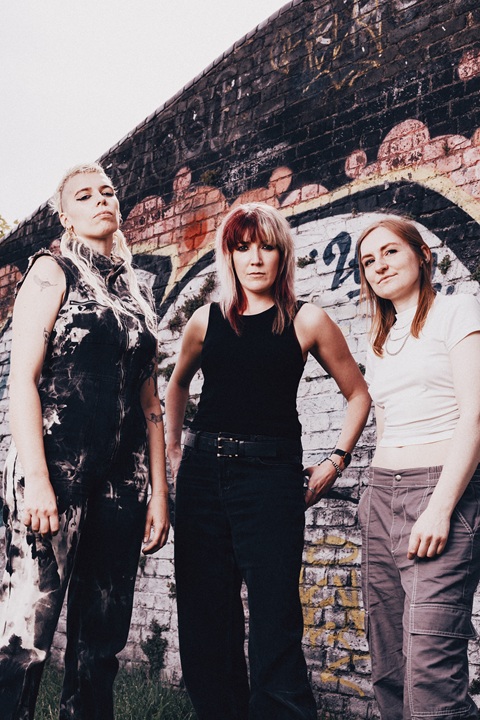
For eight years, Hawxx have exorcised blistering rage through punk-infused protest anthems. Driven by a chunky, dual-axe sound, Greek harmonies and urgent screams, second album The World Splits Open is a galvanising howl of political, ecological and cultural outrage.
Today, however, as we nurse our teas, the vibe is disarmingly relaxed. The sun sparkles off hanging trinkets, and a warm breeze wafts a Palestinian flag hanging in the doorway.
We want people who feel marginalised to bring their rage and have a safe space to get it all out.
Annouli Papadimitriou
Despite coming from different corners of the globe – Annouli is Greek, guitarist Hannah Staphnill is Welsh and drummer Jess Dann is English – Hawxx come across like sisters. They formed over a mutual sense that every other member was “fucking cool”. Their first connection came when Hannah worked at London’s Alaska Studios, and would always book Annouli in to practise in the room next door to her.
“She just looked so interesting, I wanted to listen in,” Hannah laughs.
Later, Annouli met Jess when they were both enlisted to perform in a drastically underpaid late-night covers band. While blood does not unify them, their shared values do.
“This isn’t some ‘rebel without a cause’ scenario,” Annouli explains. “Our music is heavy because we’re directing all our power into breaking down walls. Then we can rebuild a new world. We want people who feel marginalised to bring their rage and have a safe space to get it all out.”
People might look at Hawxx and see a group of hellbent, angry ladies – but that would be a fundamental misunderstanding of who they are. While the wrath is there, it stems from a place of love – both of humanity and the natural world. Annouli overflows with affection when she discusses her Greek heritage, keen to grab and show off her bouzouki – a long-necked lute – and talk about the sea-worshipping chants on the track Sacred Water.
“I would say I’m spiritual when it comes to nature and how connected we all are to one another,” Annouli explains.
She feels a particular affinity with birds – a love shown through her ever-expanding collection of feathers, as well as her side-hustle of saving injured pigeons. Jess dreamily echoes the sentiment, reflecting on how the natural world is “our teacher” – just because the soil or an animal can’t speak, that doesn’t mean it isn’t experiencing the world as much as any other living thing.
I used to lie to her and say I was going out clubbing when I was actually at all-night prayer meetings
Annouli Papadimitriou
Their song We Are Nature “mourns how the natural world is being poisoned” by pollution and how corporations mow down natural habitats to build infrastructure, while Feral Mother sees Annouli reflecting on how sleeping rough for weeks in the local marshlands in a bid to find her lost cat, Moses, forced her to connect with nature on a visceral level. Elsewhere, Arm The Animals campaigns against mass industrial farming.
“I feel like consuming those products is just absorbing that suffering,” Annouli says. “I read an essay that pointed out how veganism is essentially a feminist cause, because of how much the dairy industry mirrors female suffering – it’s essentially the animal equivalent of abuse and taking children away from their mothers.”
Meanwhile, the song Bind is about feeling controlled by religion, while Me Her And The Birds is a queer tale of women having sex in the woods, revelling in their liberation from Christian disapproval. Annouli and Jess used to attend church, with Annouli noting she wound up in an abusive Christian cult as her form of “teenage rebellion”.
“My mum was laughing about it the other day, because I used to lie to her and say I was going out clubbing when I was actually at all-night prayer meetings,” the singer explains. “She’d joke that I could have been a punk, but I became a Christian. When I got out of the cult, I exposed them. They called me the woman that was sent by Satan to destroy them.”
Hawxx also get overtly political. Opener Resistance Is Justified is about the ongoing Palestinian conflict, and centres on Annouli’s friend, Jordan Devlin. In August 2024, Jordan and five others from protest group Palestine Action raided an arms factory in Filton, Bristol, alleging the company who operate it – a UK subsidiary of Israeli company Elbit Systems – was manufacturing weapons for the Israeli army (something it has strongly denied).
Twenty-four people were arrested in relation to the break-in, and some were jailed for up to 18 months while they awaited trial. At trials in February and May of this year, Jordan was acquitted of aggravated burglary and criminal damage, and found not guilty of violent disorder. Four of the activists were convicted of criminal damage, and will be sentenced in June.
“I ended up singing Resistance Is Justified outside the courthouse during the Filton 24 trial,” Annouli says. “Protest is what our music is made for, you know?”
In an unprecedented move for a criminal damage case, the judge ruled that the offences had a “terrorist connection” for sentencing purposes. Independently, the government also proscribed Palestine Action as a terrorist group in July 2025. This means that the UK government and the judge are effectively treating the act of protest as an act of terrorism.
‘How dare you call me a terrorist, when you provide war criminals with weapons of mass destruction?’ Jordan’s sister proclaims on the track.
Ultimately, The World Splits Open aims to radicalise you – or, at the very least, make you give a fuck about something.
“Our music is about building resilience and resistance in ourselves, on our streets, in our communities,” Annouli explains. “We need to work together to get through what is happening in the world right now.”
As we polish off the last of the cake, we chat about the album’s triumphant closer, Be The Whore. It represents the band’s core motivation – encouraging people to stand up for what they believe in, even if someone tries to silence them.
“Religious texts are afraid of a whore, because she’s uncontrollable – and that’s pure power,” Annouli insists. “While the whore is condemned, she is also totally liberated. We want our community to be the whore in life. Tear down the walls of corporations, resist the rules. Be the whore that says ‘fuck you’ to your leaders. Because the whore is untouchable, and she always has been.”
The World Splits Open is out now. Hawxx UK tour starts on October 8.
If you love Atheist and always hoped they would release music less subtle than Piece of Time, you’re in for a fucking treat. Inscribed’s debut Upon the Twisted Throne bursts at the seams with oodles of noodles and rippin’ death thrash, and its trappings are olde and raw, evoking aesthetics from a time long before this Miami sound machine was conceived. What Inscribed lacks in restraint, though, they counterbalance with white-knuckle enthusiasm as they barrel through nine bite-sized, bass-fraught knots of labyrinthine compositions. 2026 has witnessed a slew of exciting thrash and thrash-adjacent platters already, but when all is said and done, will Inscribed sit Upon the Twisted Throne and claim the crown?
Though I consider Inscribed’s debut to be more thrash than death, Upon the Twisted Throne skirts many of thrash’s conventions. First, the band inhabits an interesting arena where the trademark palm mutes and chugs withdraw to make room for Inscribed’s guitar ‘n’ bass bonanza. Besides Atheist, Evie Austin’s ebullient bass recalls Cannibal Corpse’s Alex Webster and ex-Death, ex-Sadus bassist Steve Digiorgio’s frenzied fretwork, awhirl with ever-shifting moods and grooves. On guitar, Mario Alvarez occasionally röars into a Voivodian dimension via erratic riffing (“Demolition Zone”) and everything-but-the-kitchen-sink anarchy (“Time Still Passes”),1 while elsewhere he leans into Nocturnus-tinged eruptions and flurries (“On the Stage of Death,” “Evasive Mind”). Lucas Moore, the third leg of Inscribed’s tenacious tripod, pulls double duty on drums and vocals, sounding a dead ringer for Destruction’s Schmier with his sufficiently nasty growls while supplying a gnarly drum performance to boot. All told, the sheer aural audacity that Inscribed showcases is dazzling, and regardless of the influences they conjure, the end result downright sizzles.
Inscribed’s performances delight across Upon the Twisted Throne, where no one lets off the gas for thirty-four minutes straight. Austin’s low-end machinations struck me hardest my first time through Throne, where she plucks, pops, and punches with an insatiable lust for MOAR. Her style solidly inhabits lead bass territory, effectively sharing duties with Alvarez, and together their tandem begets a heady brew. The opening salvo of “Inquisition for Hatred,” “Machinery of War,” and “Demolition Zone” wallops with unconventional structures and protean songwriting that never settles in one place before Upon the Twisted Throne twirls you in another direction. And really, the album does this its entire way through, never content to lock in on a melody or riff before jumping to another. In this way, Upon the Twisted Throne reminds me of Megadeth’s debut, where Inscribed packs in an album’s worth of seeds and ideas into each track. On one hand, this approach makes for listening that quakes with possibilities and rewards repeated spins, but it also erodes the memorability of individual riffs and songs.
Inscribed covers an immense swath of notes in just over half an hour, cementing Upon the Twisted Throne as a vibrant debut. The production is raw yet clear, allowing listeners to pick out guitars, bass, drums, and vocals at any given moment. This is fantastic news given Inscribed wrote an album that oozes fun and intricacies worth exploring again and again. And though sometimes ‘fun’ can be code for silly, there’s nothing unserious about Upon the Twisted Throne. That said, there is an opportunity to hone the songwriting and give individual tracks more distinct identities, as Inscribed’s pure exuberance can make it difficult to latch onto specific passages. Still, the album is crafted with such blatant love for inspirations that the music becomes obscenely contagious.
Upon the Twisted Throne quickly wormed its way into my ever-expanding 2026 thrash cache, where my favorite genre-specific releases get abused when I want to bang my head with a cold one (or two) in tow. Given the runway ahead of these precocious metalheads and how well they’ve coalesced in so short a time, Inscribed has potential written all over them. I’ve greatly enjoyed my time with these Florida folks, and if you’ve got the fortitude for a quick sesh of fiery death thrash, I highly recommend you pop a squat Uponthe Twisted Throne.
I’ve noticed, and I am sure you have too: the sheer amount of music that’s out there and available to listen to these days is vast, overwhelming, and growing exponentially. But leave it to Vista Blue to remind us that that’s not necessarily a bad thing. On its new single “So Much Music!”, the band reflects on this world we now live in. There really is so much music out there that no one could ever keep up with everything. We will all die without hearing hundreds of records we may have loved. You’ve got new bands and artists popping up every day. You’ve got reissues of old stuff you love and old stuff you may have never heard but would like to hear. Heck, The Glow Bots broke up in ’98 while recording “Genie in the Amp,” and their label just released the unmastered tracks on Bandcamp. But you know what? It’s all OK!
This song manages to poke fun at the deluge of music that’s literally at our fingertips yet still frame it in an ultimately positive light. And the cover art is a tribute to all of you out there who love music too much to ever worry about there being too much of it. You can say that the worst thing about music today is that anyone can release a song. But isn’t that also the best thing about music today? Aren’t we better off without corporate suits dictating which music the world gets to hear? That would be like allowing one franchise to dominate Major League Baseball (oh, wait). Sure, with all the options people have for “consuming content,” it’s harder for bands to get anyone to listen or care. But still, you eventually find your niche and connect with your people. “So Much Music!” is a vintage Vista Blue song. It’s upbeat pop-punk that mixes humor with a genuine spirit of love for music. In a way, it’s like a sequel to “Somebody’s Favorite Band.” You’ve got a lot of things going on in life and may never actually check out that new Chromadome EP. But someone out there knows every song by heart.
On the virtual B-side, the faster, punkier “She Only Listens To Blue” is another love letter to music geekery. It’s a simple concept, as it’s about a girl who believes that the blue album is the only good Weezer record. I could probably start a war if I stated an opinion on this topic, so I’ll just say a lot of you will have your own strong opinions one way or another. And isn’t that the sort of thing that makes it so much fun to be a rock nerd? You may know someone who only listens to blue. You may be that person. But you probably don’t have to travel far to find someone who is willing to die on the hill of Hurley having a couple of good songs. I like that the narrator in the song is a good sport about all of this. If two people with very different opinions about Weezer can maintain a functioning relationship, there has to be hope for this world.
I know what you’re thinking: What’s Vista Blue doing releasing music on any day other than Friday? Well, you know there’s so much music out there. Sundays are lighter traffic for new releases. And now you’ve got all week to find four minutes to listen to this gem of a single. Hey, all you bands out there putting music into the world: I salute you!
Our Top 10 Otis Redding Songs list looks back at the career of one of the greatest singers of all time. While many R&B and soul singers became best known for either uptempo numbers or ballads, Otis Redding could dominate both. He could rock and swing with tremendous force, then make a listener feel every ounce of pain in one of his slow, wounded performances. It is impossible not to wonder what Redding might have accomplished if his life had not been cut short in a plane crash in 1967. He had already created an extraordinary body of work and
40 blues bands ascended upon Omaha, Nebraska, for In the Market For Blues on August 1, put on by the Blues Society of Omaha. The all-day festival was held across 10 venues in downtown Omaha.
The headliner of the festival was Texas Headhunters, the trio consisting of Jesse Dayton, Ian Moore, and Johnny Moeller.
Performances captured by Blues Rock Review included the Texas Headhunters, Artur Menezes, Mathias Lattin, and the Omaha/Kansas City Kings of the Blues.









 If you love Atheist and always hoped they would release music less subtle than Piece of Time, you’re in for a fucking treat. Inscribed’s debut Upon the Twisted Throne bursts at the seams with oodles of noodles and rippin’ death thrash, and its trappings are olde and raw, evoking aesthetics from a time long before this Miami sound machine was conceived. What Inscribed lacks in restraint, though, they counterbalance with white-knuckle enthusiasm as they barrel through nine bite-sized, bass-fraught knots of labyrinthine compositions. 2026 has witnessed a slew of exciting thrash and thrash-adjacent platters already, but when all is said and done, will Inscribed sit Upon the Twisted Throne and claim the crown?
.jpg)
