They spent some time together as part of a The Whosoevers event.
The post Fieldy & Head From Korn Hung Out Together Last Night appeared first on Theprp.com.
They spent some time together as part of a The Whosoevers event.
The post Fieldy & Head From Korn Hung Out Together Last Night appeared first on Theprp.com.
R.I.P..
The post GWAR Co-Founder Chuck Varga Has Passed Away appeared first on Theprp.com.
In February 2001, I was 22 years old, and six months into a new job working for a weekly British music magazine, when I was commissioned for my very first overseas assignment, to interview Dropkick Murphys in Boston. I’ve been told more than once that what transpired on my trip to the celtic punk band’s home turf is a story that the Dropkicks still like to share.
The trip got off to a rocky start – I got into Boston from London in the early evening, but was held at the airport for two hours because immigration considered my short trip suspicious. I was questioned aggressively and only free to go once I’d dropped the Dropkick Murphys name. (“I love that band!” yelled the guy who’d been grilling me.) When I finally got to the hotel, I was thoroughly exhausted, but when then-bassist, now-vocalist Ken Casey called my room and asked me to go for a drink, it seemed like a good opportunity to get some colour for the story.
Thirty minutes later, half the band pulled up to the hotel in Ken’s mini-van and whisked me off to an Irish bar. (I know it was an Irish bar because every human in there had either an Irish flag or a shamrock tattooed on them, and everyone was drinking Guinness.) But the band members were quiet and awkward, to the point where I wondered why they had even asked me there in the first place.
After 20 minutes of stilted conversation, vocalist Al Barr asked me if I’d like to go outside and smoke some weed with him. Desperate for the awkwardness to subside, I accepted the invitation. Once down the nearest alley, Al put some weed in a small pipe, and smoking commenced. Approximately three seconds later, a voice boomed down on us from a loudspeaker: “HANDS ON THE WALL! HANDS ON THE WALL!” A Boston Police Department van had us cornered.
“Shiiiiiiiit…” Al muttered.
So here we are. Side by side. Getting frisked against a graffiti-covered wall, in an area of Boston I don’t even know the name of yet. The cops treat us like we are complete idiots. They empty our pockets and go through my bag. When they find my Dictaphone, one cop asks, “Wha’s this fo-ah?”
“I’m a journalist,” I replied.
The sneering laughter that follows prompts instant waves of anxiety telling me that I won’t be sent anywhere to interview anyone ever again.
After a thorough 20 minute shakedown, the police confiscated Al’s weed and threw his pipe onto the roof of a neighbouring warehouse. They told us that they were surveilling the bar we had been in because of a gang shooting that had occurred there a week ago. They didn’t trust us not to blab to other patrons, so they insisted we leave the area immediately, or risk being taken to jail for the night. We returned to the bar, swiftly retrieved the rest of the band under the watchful eyes of the cops, and got the hell out.
We soon found a new bar, obviously. This one was more relaxed, and the band and I started to actually have a genuinely good time. They were jovial and chatty now, and we all had a good laugh about the bust earlier. An hour in, I was feeling boozy and having a great time. Until two cops walked into the bar…
These weren’t the same cops we’d dealt with earlier, but they approached me sternly, and asked me to confirm my name. I did so and asked what this was about. They told me to come outside with them. I grabbed Ken, in a panic, and begged him to come with me. He frowned, visibly concerned, and obliged.
The cops pushed us into the back of their patrol car. Then we drove. We drove around in circles for 25 minutes. The cops were gigantic Boston cop stereotypes. At one point, one of them actually said, “Sweethaaaaart, we can do this the hahd way, or the easy way. Just tell us where you got tha drugs.”
I just kept repeating the same thing over and over: “I’m a journalist. I’m following the band for a story. I had zero drugs on me. I just got into the country tonight.”
They weren’t listening.
“You wanna spend tha night in ah cell? Do ya? Just tell us where ya got tha drugs.”
This was a nightmare. Ken was completely and utterly silent. Eventually, the cops turned down a dark alley, pulled in and parked. They were silent for a minute or so. I panicked.
“If you want me to pay a fine, I’ll just pay a fine. I just don’t understand what’s going on right now.”
Ken turned to face me. Then, swiftly, he pulled out a camera, took a photo of my stressed face and burst out laughing. So did the cops.
Ken, shit-eating grin on his face, went about explaining what just happened. Dropkick Murphys had just released third album, Sing Loud, Sing Proud, and on the week prior my trip, a colleague at the magazine had given it a poor review, lambasting it in his trademark sarcastic manner. Incensed, the band decided then and there that they were going to get the journalist interviewing them in Boston, thrown in jail for the night, as revenge. The way Ken told it, they were fully prepared to exact this revenge – until they met me and realised I was both a nice human, and a fan. The reason they were quiet in the first bar was because they were all having second thoughts.
Then Al and I got into genuine trouble with the cops and they decided it was too good a set up to waste. They called a couple of friends on the force when I was in the bathroom at the second bar, and told them to come arrest me. The band liked me enough to not have my ass thrown in jail overnight, but not enough to refrain from pulling such a great prank. The next day, during the photoshoot, they left me alone in the minivan, parked illegally in a tow-away zone.
“If you hear sirens… just go with it,” someone said. “You should be used to that by now.”
Bastards.
Quavo’s new Pharrell-produced album QRÖMELIFE arrives next week. On Friday (Sept. 25), the Migos member announced the tracklist, which features guests like Tyler, The Creator, Justin Timberlake, Future, A$AP Rocky, Yung Miami, and more.
The post Quavo Announces <em>QRÖMELIFE</em> Tracklist With Tyler, The Creator, Justin Timberlake, Future, & More appeared first on Stereogum.
Long before horror cinema existed, Edgar Allan Poe was already exploring many of the fears that would later define the genre. His stories rarely relied on monsters, elaborate mythology, or graphic violence. Instead, Poe turned inward, examining guilt, obsession, paranoia, grief, and psychological collapse. The greatest horrors in his fiction often emerged from the human mind itself.
This approach transformed Gothic literature and helped create a blueprint that filmmakers continue using today. From psychological thrillers to supernatural horror, traces of Poe’s imagination appear throughout modern cinema, shaping how fear is visualized and experienced on screen.
Although few contemporary films directly adapt his stories, countless directors continue drawing upon his themes, narrative techniques, and understanding of psychological terror.

One of Poe’s most significant contributions to horror was his decision to shift fear away from external threats and toward the inner world of the mind.
Earlier Gothic fiction frequently focused on haunted castles, villains, supernatural events, and dramatic confrontations. Poe certainly employed Gothic settings, but his deepest interest lay elsewhere. He wanted to understand what happened when fear, guilt, obsession, or grief took control of human consciousness.
Stories such as The Tell-Tale Heart, The Black Cat, and The Fall of the House of Usher present characters whose greatest enemies are often themselves. Their terror emerges not from physical danger alone but from psychological instability.
This innovation would become one of the defining characteristics of modern horror cinema. Many of today’s most unsettling films focus less on monsters and more on fractured identities, unreliable perceptions, and emotional collapse.
In this sense, Poe helped establish the foundations of psychological horror more than a century before the genre fully developed on screen.
Cinema introduced a challenge that literature did not face. Filmmakers needed to transform internal psychological experiences into visual form.
Poe’s stories provided a valuable model because they frequently blur the line between objective reality and subjective perception. Readers experience events through narrators whose sanity is often questionable, creating uncertainty about what is actually occurring.
Modern horror films frequently employ similar strategies.
Robert Eggers’ The Lighthouse traps its characters inside an increasingly unstable reality where hallucination, obsession, and isolation become impossible to separate. Darren Aronofsky’s Black Swan follows a protagonist whose pursuit of perfection gradually destroys her sense of self.
Neither film directly adapts Poe, yet both rely upon a technique that he helped popularize: allowing audiences to experience psychological disintegration from the inside.
The horror emerges because viewers can no longer trust what they see, much like readers navigating Poe’s most famous narrators.
Another reason Poe remains influential is his ability to create uncertainty.
Many horror stories present clear threats. Poe often preferred ambiguity. His narratives frequently leave readers questioning whether supernatural events are real or whether they originate within disturbed minds.
This uncertainty closely resembles what Sigmund Freud later described as the uncanny: the unsettling feeling that emerges when something familiar suddenly becomes strange.
“The uncanny is that class of the terrifying which leads back to something long known to us, once very familiar.”
— Sigmund Freud, The Uncanny
Poe repeatedly explored this territory. Familiar homes become threatening. Ordinary sounds become sources of terror. Everyday reality begins to feel unstable.
Modern horror cinema continues relying upon this technique. Films often generate fear not by revealing monsters immediately but by disrupting the audience’s sense of certainty. The unknown becomes more frightening than anything fully explained.
This psychological strategy remains one of Poe’s most important gifts to the genre.
The influence of Poe can be traced through many of cinema’s most important directors, including Alfred Hitchcock.
Hitchcock openly acknowledged Poe’s importance, once describing him as a major influence on the development of suspense and psychological storytelling. Both artists shared a fascination with obsession, guilt, identity, and unreliable perception.
This connection is particularly visible in Vertigo. Like many Poe protagonists, Scottie Ferguson becomes consumed by an obsession he cannot control. His fixation gradually distorts reality, transforming love into psychological imprisonment.
The film’s dreamlike atmosphere, emotional instability, and exploration of fractured identity closely resemble the psychological landscapes Poe created in stories such as The Tell-Tale Heart and The Fall of the House of Usher.
Hitchcock also understood a lesson Poe had mastered decades earlier: suspense becomes most effective when audiences fear what might happen rather than what is already visible. By emphasizing anticipation, uncertainty, and psychological vulnerability, both artists transformed fear into an intensely personal experience.
The influence of Edgar Allan Poe extends far beyond direct adaptations of his stories.
Many contemporary horror films continue exploring themes that Poe helped establish nearly two centuries ago. Psychological instability, grief, obsession, guilt, and the gradual collapse of reality remain central elements within modern horror.
Films such as The Babadook and Hereditary demonstrate this connection particularly well. Both focus on emotional trauma and psychological suffering rather than conventional monsters. Their horror emerges from the inability of characters to escape grief, memory, and emotional wounds.
This approach closely resembles Poe’s fiction. In stories such as The Raven and The Fall of the House of Usher, emotional pain becomes inseparable from the horror itself. Fear does not arrive from outside. It grows from within.
Modern filmmakers continue returning to this model because it creates a more intimate and lasting form of terror. Audiences may never encounter ghosts or supernatural entities, but they understand grief, anxiety, obsession, and loss.
Among horror writers, few comparisons are more revealing than Edgar Allan Poe and H. P. Lovecraft.
Both shaped the evolution of horror, yet they approached fear from fundamentally different directions.
Poe focused on the mind. His stories examine psychological collapse, guilt, obsession, and emotional instability. Horror emerges from the internal world of the individual.
Lovecraft shifted attention outward. His fiction presents an indifferent universe filled with incomprehensible forces that dwarf humanity. The terror comes not from personal guilt but from cosmic insignificance.
Modern horror cinema continues drawing from both traditions. Films such as Hereditary, Black Swan, and The Lighthouse reflect Poe’s psychological approach, while productions such as Color Out of Space and Annihilation explore themes more closely aligned with Lovecraftian cosmic horror.
Together, these two writers helped establish the dominant forms of fear that continue defining the genre today.
While many filmmakers have absorbed Poe’s influence indirectly, Roger Corman brought his stories directly to the screen.
During the 1960s, Corman produced a series of films inspired by Poe’s work, many starring Vincent Price. These adaptations introduced new generations of audiences to Poe’s Gothic imagination while helping establish the visual language of modern horror cinema.
Films such as House of Usher (1960), The Pit and the Pendulum (1961), and The Masque of the Red Death (1964) emphasized decaying architecture, vivid color palettes, psychological tension, and atmospheric dread.
Although Corman often expanded or altered Poe’s original narratives, he preserved their essential spirit. His films understood that Poe’s true subject was not simply death or the supernatural, but the emotional and psychological forces hidden beneath the surface of human behavior.
The success of these productions helped cement Poe’s place within cinematic horror history.
Poe’s impact extends beyond narrative themes. He also helped shape the visual and emotional atmosphere associated with horror.
His stories are filled with crumbling mansions, dark corridors, oppressive interiors, storms, shadows, mirrors, and decaying landscapes. These images became central components of Gothic visual culture.
Filmmakers repeatedly draw upon this aesthetic tradition because it provides an immediate sense of mystery and unease. The visual worlds of Gothic cinema often feel like direct descendants of Poe’s imagination.
The influence can be seen in everything from classic horror films to contemporary productions. Atmospheric lighting, architectural symbolism, and isolated settings continue serving as powerful tools for creating psychological tension.
Poe understood that environments could reflect emotional states. Modern horror cinema continues applying that lesson, turning houses, rooms, and landscapes into extensions of the characters who inhabit them.
Few writers have influenced horror cinema as profoundly as Edgar Allan Poe.
Long before filmmakers explored psychological terror on screen, Poe was examining obsession, guilt, grief, paranoia, and the fragile boundary between reality and imagination. His stories demonstrated that the most disturbing horrors often emerge not from monsters but from the human mind itself.
This insight continues shaping modern horror. From Hitchcock’s suspense films to contemporary works such as Hereditary, The Lighthouse, and The Babadook, filmmakers repeatedly return to themes that Poe helped establish: unreliable perception, emotional collapse, psychological isolation, and the fear of losing control.
Technologies change and cinematic styles evolve, yet the anxieties that fascinated Poe remain remarkably familiar. People still struggle with grief, guilt, obsession, loneliness, and uncertainty. These universal experiences allow his work to transcend both time and medium.
Poe’s lasting influence comes from his understanding that horror is ultimately psychological. By transforming inner fears into compelling narratives, he created a blueprint that continues guiding horror cinema nearly two centuries later.
If Poe’s Influence on Modern Horror Cinema speaks to your fascination with Gothic literature, psychological horror, and the darker side of imagination, explore the Edgar Allan Poets store. Our designs celebrate Poe, noir culture, classic horror, and the timeless beauty of the Gothic tradition.

Poe helped establish many of the themes and techniques that define modern horror, including psychological terror, unreliable narration, obsession, guilt, and the exploration of madness.
Films such as The Lighthouse, Black Swan, Hereditary, and The Babadook reflect Poe’s fascination with psychological instability, grief, obsession, and emotional collapse.
While Hitchcock rarely adapted Poe directly, both artists explored similar themes, including obsession, unreliable perception, psychological tension, and suspense built through uncertainty.
Roger Corman directed a series of influential Poe-inspired films during the 1960s, helping introduce Poe’s Gothic imagination to modern movie audiences through visually rich adaptations starring Vincent Price.
Poe explored universal fears such as grief, guilt, madness, isolation, and uncertainty. These themes remain central to horror storytelling, allowing filmmakers to reinterpret his ideas for new generations.
The post Poe’s Influence on Modern Horror Cinema appeared first on Edgar Allan Poets – Noir Rock Band.
Crack The Skye established US prog metallers Mastodon on many prog fan’s radars. When it came to a follow-up there were bigger riffs and choruses, but it still beat with a prog heart, as the band told Prog when we sat down to talk about The Hunter in 2011.
Unlike its namesake, Atlanta progressive titans Mastodon have sidestepped extinction through the clever notion of adaption. In an industry and a market that cries out for new ideas and reinvention, they continue to surviv and thrive with The Hunter. “It’s not in our nature to say we’re going to write songs that are different to anything we’ve ever done, because that puts pressure on us.” sasy bassist Troy Sanders. “But thankfully it comes naturally. I love change – we embrace the unknown.” His words resonate not just with his bandmates, but with the swathe of fans they’ve amassed.
When their previous album, Crack The Skye, came out, people sat up and listened. Here was a band, traditionally regarded as metal, releasing a masterpiece in heavy prog. It became not only a landmark record for metal fans, but an enthralling concept album for proggers with a penchant for metallic elements.
For their fifth album, they could easily have knocked out Crack The Skye II and no one would have batted an eyelid. But sticking to their ethos, they have surprised again. The Hunter is the most melodic record the Georgia-rooted four-piece have created to date, to the extent that it contains a plethora of – saints above! – sing-a-long choruses. Gone are the heaps of thick, oppressive, acerbic riffs borne out of their mutual admiration for post-punk and sludge metal. Here instead are groovy basslines, acrobatic drumming, sensitive riffs, vast, spatial, shimmery effects and gentle psychedelic vibes.
“Once we decided to shed the idea of having another concept album, I feel like it breathed fresh energy back into the band,” says Sanders. “And that’s what lent itself to songs coming together rather quickly.”
Drummer Brann Dailor adds: “We thought how cool would it be to abandon the Mastodon comfort zone and do something completely different.” While very melodic in many points throughout the record, The Hunter is also more urgent and riff-laden than Crack The Skye. “It’s a knee-jerk reaction to spending two years touring Crack The Skye, which was so proggy and layered,” Dailor explains. “We wanted to let loose from that. The songs are probably the most instinctual we’ve ever put together – where we’ve worked the least on fine-tuning and tailoring every little piece.”
Knowing that they’d be booked up all summer with festival appearances, it was ‘now or never’ to get the songs laid down. “Our music is like milk,” Dailor says. “If we’d let it sit while we go to Europe it would have spoiled a little bit.” They split their time between Los Angeles and Atlanta over six weeks – a remarkably short period in any band’s books, let alone one whose records are crammed with labyrinthine riffs and melodies.
Continuing their trend of doing things differently, they roped in producer Mike Elizondo, known for his work with hip hop artists such as Eminem. Their choice of cover art saw another departure. Instead of Paul Romano – responsible for their first four covers – they went with AJ Fosik, who created of the vibrant yet terrifying mythical beast sculpture that defines The Hunter. “We don’t know him, but I saw his work years ago and always had him in the back of my mind in case we used a different artist,” says Dailor. “And, yeah, Romano was disappointed, but I think he understands.”
Sanders summarises the hiring of Fosik in the context of this project as a whole: “Every aspect of the album changed – new producer, new artist. We want the artwork to come from someone who is incredibly passionate and talented and we want people to realise it isn’t just a picture of a mythological creature – this is an epic wood sculpture that took complete dedication.”
It‘s been mentioned that album title refers to guitarist Brent Hinds’ brother, who died last year while on a hunting trip. But Dailor and Sanders stress that The Hunter is in no way a concept piece, nor is the lyrical content directly connected to their bandmate’s sibling. “Ultimately it’s a collection; each song has a story of its own,” says Sanders.
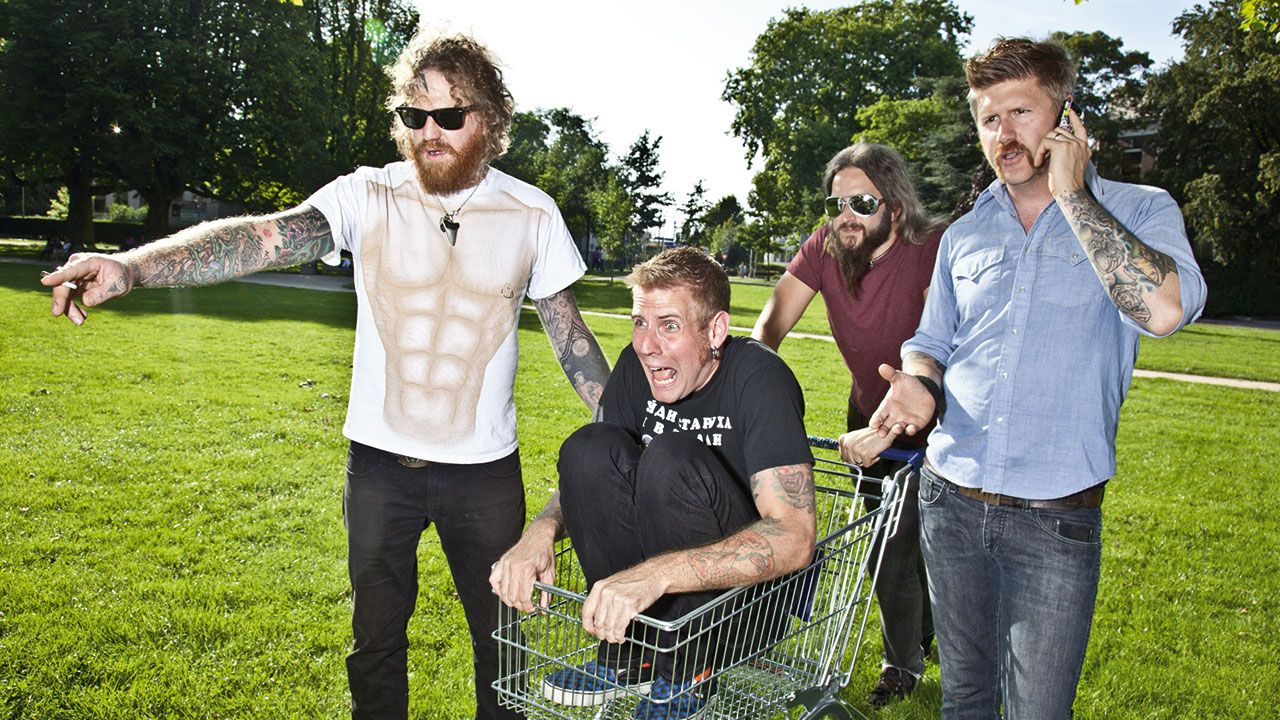
It becomes apparent that Hinds’ loss is not the only traumatic experience to affect the band. Behind every rock’n’roll lifestyle there are loved ones who get left by the wayside; and while Dailor won’t discuess his own personal life, you sense there’s a family that deeply misses him. “We are constantly disappointing the people that we care about the most with being gone so often,” he says. “So a lot of the themes on the record kind of have to deal with the people we’re closest to. Some of it’s almost like an apology to those people.”
Sanders confirms: “We touch on loss, we touch on grief, we touch on triumphant moments – it’s all over the place. And then we’ll think about how an octopus feels. We’ll go from very deep, sorrowful subjects to talking about the Swamp Thing’s baby.”
When I was introduced to Pink Floyd they frightened me. King Crimson irritate me to this day because they’re so good
Troy Sanders
“Or being a baby!” Dailor adds. “The Thickening is about being in a crib and wanting to be picked up and nursed. Then there’s Stargasm, which isn’t exactly about having sex in space, but it’s about having the best sex you’ve ever had with someone you really connect with and you go up into space. Blasteroid is like a playground song where you’re bouncing off the walls and the lyrics are: ‘If you’re sad and need to cry then turn around and go outside.’ It’s like a little kid wrote it.”
Although the title Bedazzled Fingernails is a cheeky nod to Hinds’ playful fretwork, the lyrical content is a reference to the fact that his entire family are born under the Chinese sign of the Ox. Dailor explores a further emotional topic in All The Heavy Lifting: “I had a movie playing in my head, of my wife and I in the woods running around and me saving her, and then some of the lyrics are about a bad situation I had back home. I was sitting behind my drums feeling numb and stressed out at not knowing what to do, and I heard in my head: ‘Just close your eyes and pretend everything’s fine’.”
This lyrical refrain is one of the catchiest moments on The Hunter, and also the first of its songs they recorded. Asked whether they can see their fans joining in, Sanders seem eager: “That, we hope, is the song that all our friends will be able to sing along with. I’m excited about that!”
Like their previous albums, The Hunter touches on both old and recent influences. There are moments that echo Radiohead’s OK Computer, Pink Floyd’s spatial awareness or the atmospheric grandeur of Muse, while heavier songs hark back to their sludge roots. Had Mastodon stuck with the style exemplified in early albums like Remission they could have ended up playing the type of music we traditionally class as stoner or desert rock, with a weighty Sabbath influence. Yet the band’s love for prog has spurred them on to create something far more complex.
“The old Genesis stuff is probably some of my favourite music ever created,” Dailor says. “Gabriel-era Genesis, too. But even when he left there were records that still embraced their proggier side.”
Sanders explains: “I remember very well when I was introduced to Pink Floyd – they frightened me! And King Crimson irritate me to this day because they’re so damn good. Recently touring with Mars Volta and Tool, I love that specialness they embrace with this thinking man’s music.”
On top of their genre-defining sound, iconic artwork and incendiary live shows, it’s sometimes forgotten that here’s a band who have stuck together since their inception more in 1999, overcoming deaths of loved ones (Dailor’s sister took her own life aged 14), drug abuse and a near-fatal altercation involving Hinds. That’s a vast achievement in itself.
Sanders admits: “I never thought it would last. It’s rare that any relationship can last this long – much less with three grown men that I’m ‘married’ to.”