Since 2015, Swedish band Metalite have been adding their own blend of melodic metal and sci-fi themes to the genre. Of the original lineup, only guitarist Edwin Premberg remains, while Robert Majd—also known to many from Nighthawk—has been part of the band for a decade. Erica Ohlsson took over vocal duties in 2019, and she… Continue Reading →
According to the Guinness Book of Records, the world’s most foremost authority on verifying facts and achievements, Napalm Death hold the record for the shortest recorded song.
In the time it takes light to travel from the Earth to the Moon or a Zoomer to lose their attention span while watching online ads, the Birmingham grindcore pioneers recorded their shortest song in 1986. It has a running length of just 1.316 seconds.
You Suffer appears on the first half of the band’s 1987 debut Scum. We say first half, because two-thirds of the band who wrote and recorded the first 12 songs – guitarist Justin Broadrick and bassist/vocalist Nicholas ‘Nik Napalm’ Bullen – left to pursue other musical interests and university studies before a brand new line-up joined drummer Mick Harris to complete a further 16 songs for the album’s second half.
The first half of Scum was mostly written in the Broadrick’s teenage bedroom in Shard End, Birmingham, where he lived with his mother and step-father. Partly inspired by Oregon crossover thrashers Wehrmacht’s own cough-and-you’ll-miss-it-song, titled E!, Bullen added his lyrics – four words: ‘You suffer, but why?’ – before the trio entered Rich Bitch Studios in Birmingham’s Selly Oak in August, 1986.
“I was a barely functioning 15-or-16-year-old during my time in Napalm Death,” Broadrick told Metal Hammer. “Everyone else in the band was two years older, but what I could do prolifically was write music and create songs. I was writing the majority of the music, and Nic was writing pretty much all the lyrics.”
“You Suffer was largely a comedy thing, a one-second song,” Bullentold Decibel magazine in their book, Precious Metal: Decibel Presents the Stories Behind 25 Extreme Metal Masterpieces. “It’s ridiculous, but it was hilarious. We played that song in front of 30 local kids, like, every weekend. We played that song 30 times. It was a laugh.”
Sometimes the laughter was directed at the teenage band, rather than with them. But gradually, people began to embrace the Napalm Death’s relentlessly chaotic take on metal and punk.
“People would often come to laugh at us because we were like a kid band who played super-fast,” Broadrick told Skinny Puppy‘s cEvin Key on his podcast. “We were like a laughing stock, you know, but eventually we weren’t – people started taking this quite seriously. We saw people flocking to this sound. I remember thinking, ‘What the fuck is happening here?'”
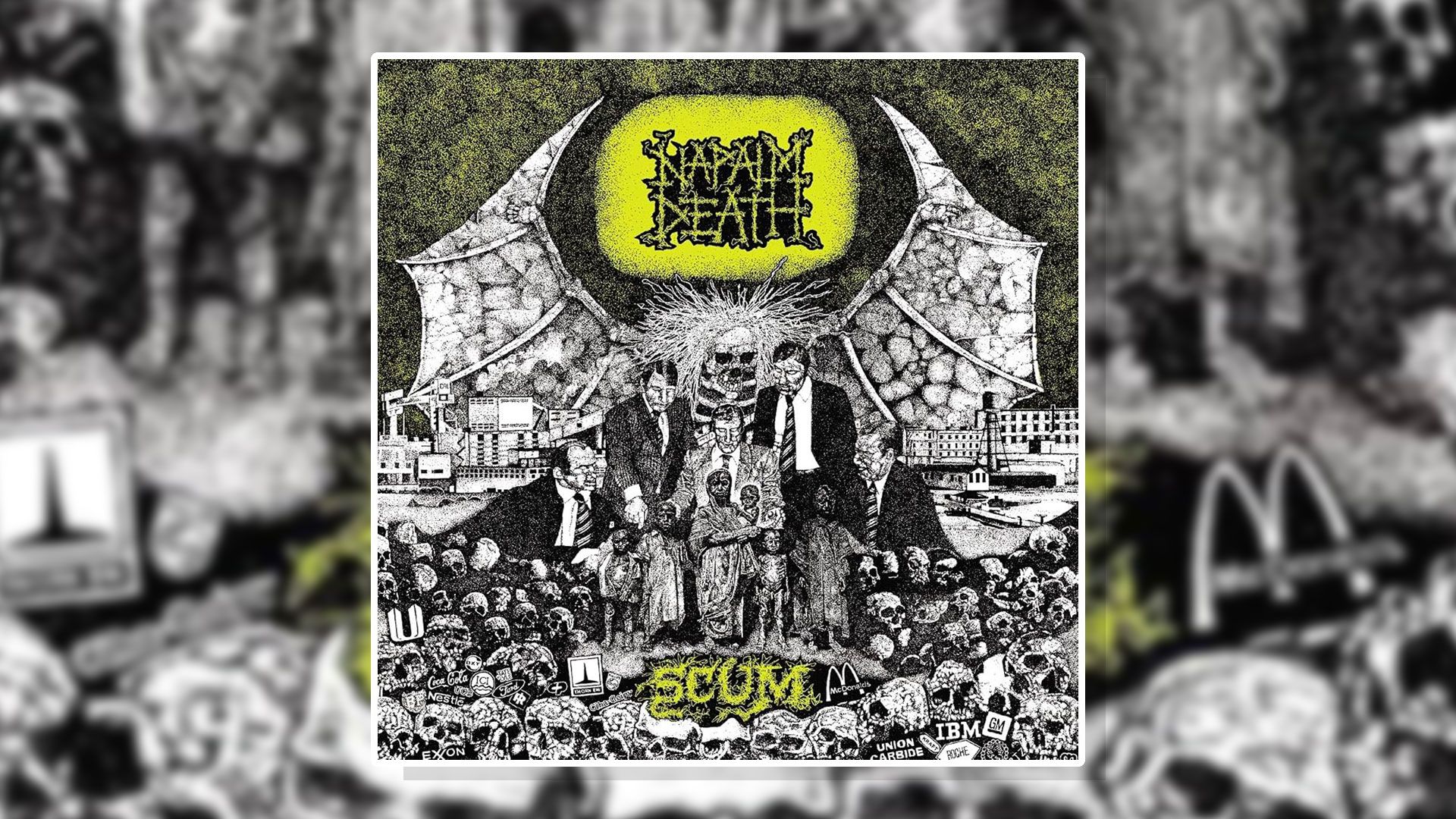
The cover art of Napalm Death’s debut album Scum, released in 1987 (Image credit: Earache Records)
By the time Scum was released in the summer of 1987, the band’s line-up had solidified to feature Lee Dorrian on vocals, Bill Steer on guitar, Shane Embury on bass, and Harris on drums. The four-piece were invited by John Peel to record the first of several Maida Vale sessions for his BBC Radio 1 show, and the late DJ would later play You Suffer a handful of times during a single show.
“There was a period when we had thrash band after thrash band after thrash band coming in to do Maida Vale sessions,” said Peel. “These bands played pretty hard, full-on music, and they’d been in a tour van for the last two weeks, and you’d walk into their studio and you’d know they’d been working hard, if you know what I mean. Napalm Death was an extraordinary session because the songs were so short. When a song only lasts two seconds you can hardly say to the band, ‘Can you play that again, please, I think a guitar was out of tune.”
During this session, which was broadcast on September 22, 1987, the band performed a slightly longer version of the song, titled You Suffer (Part II).
“There is a bit of a novelty,” said Harris. “Let’s do the shortest, fastest thing you can do. And yeah, there are notes there. People think we just go, ‘Blllp,’ and that’s it. And I believe there’s, like, four notes or something. There’s a lyric, ‘You suffer, but why?’ And it’s played quick, fast and sharp and as tight as we could. We had a bit of reverb on there. It probably made it longer.”
In 1989, the song was given away as a free seven-inch single as part of Earache’s scene-defining Grindcrusher compilation. Backed by the Electro Hippies’ micro-ballad Mega-Armageddon Death Part 3, it became the shortest single ever released, a feat recognised by Guinness Book of Records.
“We didn’t ask for it,” Harris told Decibel. “It just got put in there. We were told, ‘You’ve made the Guinness book of World Records.’ And we were like, ‘Nah, get out of here,’ and yes, there it is. It’s sort of funny, isn’t it? A bit of achievement, I guess.”
When a song only lasts two seconds you can hardly say to the band, ‘Can you play that again please, I think a guitar was out of tune.’
John Peel
Unbelievably, the song was brought to national attention two decades after its release, when current Napalm Death vocalist Mark ‘Barney’ Greenway guested on Labour MP Ed Miliband’s BBC Radio 2 show.
The MP, sitting in for presenter Jeremy Vine, invited Greenway into the studio to talk about the band’s upcoming appearance at the Glastonbury Festival. During the segment, the former Labour leader was given a lesson on how to become a grindcore vocalist.
“I’m going to now take my career into my hands if it’s not already gone down the pan and you’re going to try and help me to sort of do a bit of this extreme metal,” said Miliband, before failing as quickly as the song itself.
The MP did not immediately respond to a request for comment.
“If you thought you were a bluesman, hearing the Red Devils would send you back to the woodshed in double-quick time. Listening to that record, King King, would yank anybody’s chains. I had a CD made up of just two of the tracks on a loop – Mr Highway Man and Automatic. It was on constant rotation in my car wherever I went” – Billy Gibbons, ZZ Top
When Rick Rubin left New York and headed west in 1988, he severed ties with Def Jam, the record label he’d co-founded and through which he’d launched the Beastie Boys, Slayer and Run DMC. A music freak with an instinctive knack for picking out maverick spirits, Rubin set up base in a gothic-looking mansion house in Hollywood and from there rolled out his second record company, Def American.
This feature originally appeared in Classic Rock 195, published in April 2014.
Cast in his own renegade image, it became a home for such disparate bands as the Black Crowes, Danzig and the Red Devils.
The Red Devils were Def American’s shooting comet. Signed to the label in 1991, they were the archetypal Rubin band – five greasers who roughed up the blues, they blazed a brief but brilliant trajectory. They made just one album, and backed both Mick Jagger and Johnny Cash, before crashing and burning.
Their end was sordid and senseless, a wretched mess compounded by the tawdry death of their frontman, Lester Butler, at the age of 38. Butler was mourned by fellow musicians as a great lost bluesman. Yet even in death he continued to stir ill will. The Devils’ former bassist, Jonny Ray Bartel, was initially reluctant to contribute to this article for fear that it would canonise Butler.
“My personal history with Lester ended up being really bad,” he said. “He became the worst friend and the most horrible guy you could imagine. I’ve had to work hard on forgiveness towards him.”
The Red Devils grew up out of The Blasters, a hot rod of a band who became a fixture on LA’s vibrant punk and rockabilly scene in the early 1980s. Their drummer, Bill Bateman, looking like he’d walked out of a Sun Records session three decades earlier, and commanding a wicked bare-boned groove, put together a blues-playing side group in 1986.
Initially called The Stumblebums and then the Blue Shadows, after a Blasters song, it was a loose collection of local musicians and jamming buddies. One of the guys who began sitting in with Bateman was Lester Butler, a surf bum who blew a mean harmonica.
Even then, Butler had a reputation for raising hell. He once told a journalist: “Remember in the seventies when they said cocaine wasn’t that addictive? I was a good argument against that bullshit.”
Butler was eight when he first picked up a harmonica, and was guesting with local pickup groups by the time he was a teenager. His earliest influences were America’s great bluesmen – such iconic figures as Muddy Waters, Howlin’ Wolf and Little Walter.
“I can still picture Les, a skinny surfer boy with long blond hair, riding his skateboard around town while playing his harmonica,” recalls Butler’s sister, Ginny Tura. “I remember him playing Whammer Jammer by the J Geils Band. A crowd used to gather around him in the parking lot where we all hung out. He loved music, surfing, skateboarding, bike riding and smoking pot.”
In early ’88, the owner of the King King, a poky dive bar in West Hollywood that had once been a Chinese restaurant, asked Bill Bateman to put together a full-time group to headline a weekly Blue Monday gig. Their nightly fee would be $200 a man.
Retaining the Blue Shadows name, Bateman co-opted his roommate, Jonny Ray Bartel, a rake-thin rockabilly nut, into the band along with Butler. Jonny Ray’s elder brother, Dave Lee Bartel, joined later on rhythm guitar, supporting an ever-shifting assortment of hotshot lead players.
The Blue Shadows were already whipping up a storm at the King King by the time the elder Bartel enlisted. Each Monday night, a crowd would line up around the block to catch the band tearing through a set of blues covers on the tiny 12-by-15-foot stage. The Blue Shadows brought out Hollywood’s hipsters and beautiful people – wannabe stars and starlets and leggy models. In early 90, Bruce Willis, then still in the first flush of his Die Hard fame, began showing up and sitting in with the band.
“Bruce Willis is the only guy that could possibly play Lester in a movie,” Bill Bateman says today. “Lester used to take him out on the street and show him how to play harmonica. He was on the team.”
In Willis’s wake, a coterie of musicians trooped along to the King King: Angus and Malcolm Young of AC/DC, the Red Hot Chili Peppers and the Black Crowes all crammed into the club’s red fake-leather booths; Brian May of Queen and ZZ Top’s Billy Gibbons both got up to trade licks with the Blue Shadows.
One night, Billy Gibbons calls me out of the blue. He’s heard about this piece from Jonny Ray Bartel and wants to reminisce.
“Oh man, they were quite an outfit to be reckoned with,” Gibbons says, chuckling. “I was running hard at the time with one of the ZZ Top dancing girls – they called her the Alley Cat because she was always crawling about. She lived close by the King King, and I became a regular there on a Monday night. And who should I make friends with in those days but Rick Rubin. He was hanging out and took an interest in the band.”
By Jonny Ray Bartel’s estimate, Rubin came by the King King at least 60 times to scope out the Shadows. “I loved their raw blues power,” Rubin says today. “They were edgy, rocking and grooving. It was a fun vibe seeing them every week. I have great memories of that time.”
In early 1991, Rubin decided to sign the band to Def American. He had two provisos before doing so: that they get a permanent guitarist, and they change their name.
Through the blues grapevine the band heard of a whizz-kid guitarist from Denton, Texas, named Paul Size, a fresh-faced 19-year-old who played like a veteran from the wrong side of the tracks. Size drove to LA in his pick-up truck to audition, got the job and then moved in with Butler.
The Bartels had first played together in a high-school rockabilly band called the Red Devils. Spotting an old button badge of theirs one day, Rubin told them the name would sell more records than the Blue Shadows and to revive it. The producer also decided that a studio recording wouldn’t do his new pet band justice, so instead he set about taping them live over three consecutive Mondays at the King King.
The resulting record, also titled King King, and featuring pianist Gene ‘Fingers’ Taylor, was released in July 92. It collected together blues staples such as Willie Dixon’s She’s Dangerous and Chester Burnett’s Mr Highway Man alongside a handful of self-penned tracks.
It was hot, blue and righteous: Paul Size shooting sparks off the rhythm section’s laconic shuffle; Butler blowing up a storm and singing as though there were a hellhound on his trail. It was also entirely at odds with the musical temperature of the time – Guns N’Roses, Metallica and Nirvana were the reigning behemoths.
Rick Rubin was also then working on Mick Jagger’s third solo album, Wandering Spirit. He’d brought the Rolling Stones singer down to the King King to see his latest charges, and in May ’92 he got the two parties together at Ocean Way Recording in Hollywood for a now-legendary 13-hour session.
Jagger and the Red Devils cut 13 tracks that day, scorching covers of vintage blues tracks and all but one of them still officially unreleased.
“We got a late-night phone call from Rubin and were told to show up at the studio at 9am the next day,” recalls Jonny Ray Bartel. “Mick came in and played the original recording by Howlin’ Wolf or Muddy Waters or whoever, and we’d jam along to it through headphones. On the third runthrough, Mick would sing and we’d tape it. It was that quick and raw.”
“That session is incredible,” says Rubin. “You’d have to ask Mick why he never chose to release it.”
Flush from working with Jagger and with critical acclaim for their own record, the Red Devils set off on their first tour, criss-crossing America as the opening act for the Allman Brothers band, ZZ Top and Los Lobos.
It didn’t take long for cracks to appear. Let loose, the band ran wild – their singer wilder than anyone else.
“We were rowdy guys,” says Bill Bateman, cackling. “We went out for 120 days straight and there were all kinds of illegal things going on – drugs, fights, hookers, cops, jail, you name it. One of us was bound to end up dead. Lester had actually clinically died four times in previous years. On one occasion he woke up in the morgue with a sheet over his head. It was his opinion that he led a charmed life.”
Three months into the tour the band were in tatters. Dave Lee Bartel walked out after a show in Dallas, claiming Butler was paid double what the others got. They limped through the rest of the tour with a friend of Paul Size filling in and bad blood in the air.
“It got to the point where Lester was doing crack at every town we went through,” says Jonny Ray Bartel. “He’d stay up all night and listen to the board tapes of the gig we’d just done, and then go scream at Bill, the best musician in the band, telling him he was dragging. He basically just turned into this psycho drug addict who was never happy.”
Butler’s sister, Ginny, disputes this image of her brother. “Les had occasional lapses with drugs and alcohol, but for the majority of his professional life he was sober,” she insists. “The stress of being together with the band twenty-four-seven while touring was just too much for him. He was always a perfectionist with his music and he noticed when anything was off.”
When Butler returned to LA, he told Rubin he wanted to work with different musicians. Rubin humoured him by holding a series of open auditions, but then informed Butler he was only interested in the original Red Devils.
The patched-up band, with Dave Lee Bartel on board, toured Europe through the spring and summer of 1993, hitting a peak on an early afternoon slot at the Pink Pop festival in Holland (above). Pink Pop was the Red Devils’ valediction.
Then Paul Size quit, fleeing back to Texas, exhausted by sharing an apartment with Butler for two years. Rubin gathered the remaining members for one last great session at Ocean Way, backing Johnny Cash.
“He was a proper gentleman,” recalls Jonny Ray Bartel, “but the tracks sounded better with just him and his guitar, and that’s how Rubin put them out.”
It would be the last thing they did for Rubin. Soon after, they were dropped from Def American. They ghosted through a final European trek in 1994 and then split, beset by rancour and bitterness.
“Lester stole a bunch of money off us and wiped the band out,” claims Bartel. “We were broke and having to sleep on our fans’ couches. It was strictly his greed that took us out – that and drugs.”
“Lester had got back on the shit and he was a rookie,” says Bateman. “It was his first band, and he didn’t realise how hard it was to get five guys together that play that well. He tried to undermine it and it blew up in his face.”
Lester Butler onstage in 1997 (Image credit: Frans Schellekens / Getty Images)
Emerging from the carnage of the Red Devils, Bill Bateman returned to The Blasters, and the other three musicians to day jobs and part-time gigs. Lester Butler passed through short-lived groups and low-paid engagements in LA before gathering together a new band he called 13.
Mining the same blues seam as the Devils, they released a decent self-titled album in 1997 and had some success touring Europe.
“Lester’s reputation was a mess in LA. He’d done a lot of sub-par gigs and shown up in bad shape too many times,” says Alex Schulz, a seasoned blues guitarist who threw in his lot with 13. “For me, that band was a big step down in terms of business from what I’d been doing, but it was worth it to try and build this guy back up. When he was in good shape, Lester had some kind of magic. But he had big troubles in his personal life.”
13 bagged high-profile slots at blues festivals in Belgium and Holland in early May 1998. The shows were a success, but Butler was battling his demons, falling off the wagon after a stint in rehab. On the flight home, he told Schulz he’d hook up with a girl he’d just started seeing and buy an eight-ball of cocaine.
“He had five thousand dollars burning a hole in his pocket, and what he did was stay up for five days straight,” says Schulz. “I didn’t have the sense that he meant for it to end the way it did, but at other times he was pretty fatalistic. I think he felt there was a destiny he was living out – that he was going to go out that way.”
On the evening of May 8, 1998, Butler pitched up at Bill Bateman’s house in Hollywood. He was with another girl from the fast crowd he’d been running with.
“He’d been smoking rock, snorting coke, taking downers and drinking rum, so he was high,” remembers Bateman. “The two of them were sat in my living room and Lester was begging her for an injection of heroin, rather than snorting it like he had been.”
Bateman says he then left the house to go score his own heroin. He’d recently been convicted on a drink-driving charge, so was on foot and gone for more than an hour. When he returned, he says, Butler was still nagging the girl to shoot him up again.
“Eventually she did and he OD’d,” Bateman continues. “I was high myself by then and wasn’t paying them much mind.”
We may never know exactly what happened, as accounts differ, and by his own admission Bateman was worse for wear. Bateman recounts that the girl’s boyfriend came over, panicked, took Lester’s cocaine and shot it up through the veins in his hand.
“They had the idea that this would bring him back, and it killed him. They took him in his van to their house and he died there. After he’d been dead for eight hours they dropped him off at my place again, and I took him to the hospital. Then the cops turned up.”
Ginny Tura challenges Bateman’s account of her brother’s last hours and also the notion that he’d careered out of control. “Lester was sober for many years, and this relapse was fatal because his tolerance was low,” she maintains. “Bill did not make the emergency call when Les first passed out, and allowed two drug addicts to go off with his body. In my opinion he should have also done jail time.”
On the surface, the Red Devils’ legacy doesn’t amount to much – a solitary album and some celebrity fans. Yet King King has retained its power, and their influence lingers in America and especially Europe, where Lester Butler tribute acts continue to operate.
“The Red Devils is kind of a repeat of the thing people said about the Velvet Underground,” says JJ Perry, a South Dakota journalist and musician who runs nofightin. com, an online site dedicated to the band. “Their record didn’t sell, but it made a massive impression. Everyone I knew that heard it went out and formed a band.”
On November 12, 2013 Ginny Tura went out to dinner with her brother’s long-term girlfriend, Lori Peralta. It would have been Lester Butler’s 54th birthday.
“The Lester I knew and loved was extraordinarily witty, highly intelligent and charismatic,” says Tura. “He loved people and was constantly surrounded by friends and family. He could blow out birthday candles from across the room; we’d say he had harmonica lungs. Which of course he did.”
The men who shared the Red Devils’ short, crazy ride have a different recall of Lester Butler.
“He was a notorious addict,” says Jonny Ray Bartel. “And when you start messing around with heroin and coke, it’s a safe bet your heart and lungs are going to flip you out eventually. It didn’t shock me and I don’t remember a big emotional thing. I was just kind of numb.”
“Lester was an idiot, but I wish he wouldn’t have died,” concludes Bill Bateman. “I’ve searched the whole planet over and there isn’t anybody out there like him. Lester was the wildest one.”
This feature originally appeared in Classic Rock 195, published in April 2014.
Postscript: In May 2017 Bill Bateman, Jonny Ray Bartel, Paul Size, and Mike Flanigin, alongside Dutch blues singer and harmonica player Pieter “Big Pete” Van Der Pluijm, reformed The Red Devils for a series of shows in the Netherlands, before joining ZZ Top as support act on the European leg of their Tonnage Tour. A live album, Return of the Red Devils, followed.
Swiss cinematic metal band Illumishade have released their new single “The River.” The track is available now across all streaming platforms and on Bandcamp, and the group hosted a live YouTube premiere to celebrate the launch directly with their audience.
Thematically, “The River” explores concepts of division, belonging, and holding onto hope for reconciliation. The release marks a notable milestone for the band from Zurich, as they recently transitioned back to operating as a fully independent act after completing extensive tours across Europe and North America.
Swedish heavy metal band Scarblade have released a lyric video for their new single “Blind.” The song is the latest track to be taken from their upcoming album, Guardians of Time, which is scheduled for release on October 30 through Wormholedeath.
The lyrics for the new track focus on the importance of chasing dreams and staying aware of personal goals. Founded in 2015 by vocalist Alicke Kostopoulou, the band from Gothenburg is gearing up for this next release to follow up on their 2016 debut record The Cosmic Wrath.
Greek alternative groove metal band TELMA have announced a major lineup change, introducing Savvina Batsi on vocal duties and Giannis Paparseniou on guitar. The group chose to introduce the new members through music rather than a standard statement, releasing two vocal cover videos on YouTube.
The two videos feature Batsi performing tracks from different eras of the band’s discography. The first track is taken from their 2021 debut album Eternal, while the second is the title track from their 2025 release Awakening. These videos give fans an early look at the new vocal direction as the band prepares for upcoming live performances and future releases.
 Blood Of Angels talk to HEAVY about Les Angst ov Thanatou.