Stella Lefty is an American singer-songwriter from Winnetka, Illinois, whose music has moved from intimate singer-songwriter pop into a country-pop sound built around conversational lyrics, acoustic textures, and melodic hooks. Born Stella Lefkofsky in 2002, she began playing guitar as a child and later studied at Tulane University while developing her own songs. Her earliest formally released material appeared in 2022 and 2023, including “from me to you – demo,” “stay,” “back to ohio,” and “we were young.” Lefty’s catalog began expanding more quickly with “Kiss Me” in 2024 and the 2025 EP Tragic, Really. That six-song release included “Cynic,”
Pete Byrne, frontman for the hit-making English new wave band Naked Eyes, has died. A post on the band’s website today reveals that Byrne “died peacefully in Los Angeles, California, on Monday, September 14, after a brief illness.” He was 74.
Where’s the joy in this all?
Where’s the light in the dark
My hands hide my tears, I feel so lost
This first day of Fall
There is something especially lonely about being miserable on a day for which everyone else has already chosen your mood. A birthday comes with instructions: answer the messages, accept the affection, make a wish. For Los Angeles post-punk duo DECEITS, The First Day of Fall opens up the awful distance between that public celebration and a private wish to disappear. The calendar, as ever, has failed to consult the person concerned.
Following our premiere of the single, the song returns with a video directed by Shutter Visual, whose credits include work with Twin Tribes and Blood Club. Its tightly framed performance brings the song’s distress into uncomfortable proximity, with vocalist and multi-instrumentalist Kevin Moreno and drummer Francisco Saenz caught inside a room that seems to grow smaller as the performance intensifies.
Moreno wrote the song on a despondent morning the day before his birthday. Faced with an occasion supposedly reserved for happiness, he found himself confronting the desire not to exist at all. That unhappy collision gives the lyrics their particular ache: another year becomes something to account for, while the prospect of celebration makes an already difficult feeling harder to explain. Autumn provides an apt setting for such thoughts, its gradual retreat from summer matching the impulse to withdraw from everyone wishing you well.
The arrangement gives those thoughts a restless physical form. A commanding bassline and forceful drums drive through the song, while reverberant guitars spread outward over gothic synthesizers. There is punk urgency in the rhythm section and a wounded romanticism in the melody, each pulling at the other. Moreno’s singing follows the same uneasy course, moving from a softer, intimate register into high, strained cries as the music gathers force. The spacious production leaves room around his voice without taking any pressure off it.
Shutter Visual builds the clip around that pressure. Blue-green light washes across the musicians, with hanging guitars, amplifiers, and the white grid beneath their feet giving the performance space a stark, enclosed character. Close-ups of picking hands and struck cymbals keep returning us to the effort involved in playing, while wider shots catch Moreno bending over his guitar and throwing his head back. Saenz’s drumming supplies a firm center as the camera moves between the two.
Elsewhere, Moreno faces the lens with dark makeup trailing beneath his eyes, his pale shirt and decorative collar giving way to black stage clothes in other shots. He grips the microphone, raises his hands to his face, and sings with an increasingly exposed intensity. Blurred movement, doubled faces, and fractured views interrupt the more straightforward performance footage, making his expressions difficult to hold in focus. The visual instability suits a song about feeling estranged from the very life everyone else is congratulating you on having.
Near the end, the camera settles on white roses and scattered petals across the gridded floor. Against the room’s severe geometry, the flowers look painfully vulnerable, their associations with affection and celebration left in disarray. It is a fitting image for the song’s birthday premise, and Shutter Visual lets the performance carry the desperation that drove Moreno to write it. The most affecting moments come when his gestures seem to outrun his composure, giving visible shape to what the lyrics struggle to contain.
Watch the video for The First Day of Fall below:
Since forming in Los Angeles in 2021, Moreno and Saenz have channeled their shared love of the Spanish-language music of their upbringing into a particularly expressive strain of post-punk. Its rhythms, romantic feeling, and emotional directness inform a sound that gives gothic reserve very little room to get comfortable. The First Day of Fall draws on that openness, bringing a difficult private experience into a form that other people can recognize and share.
The First Day of Fall is out now, with the demo version also included on the Bandcamp release. Listen below and order the single here.
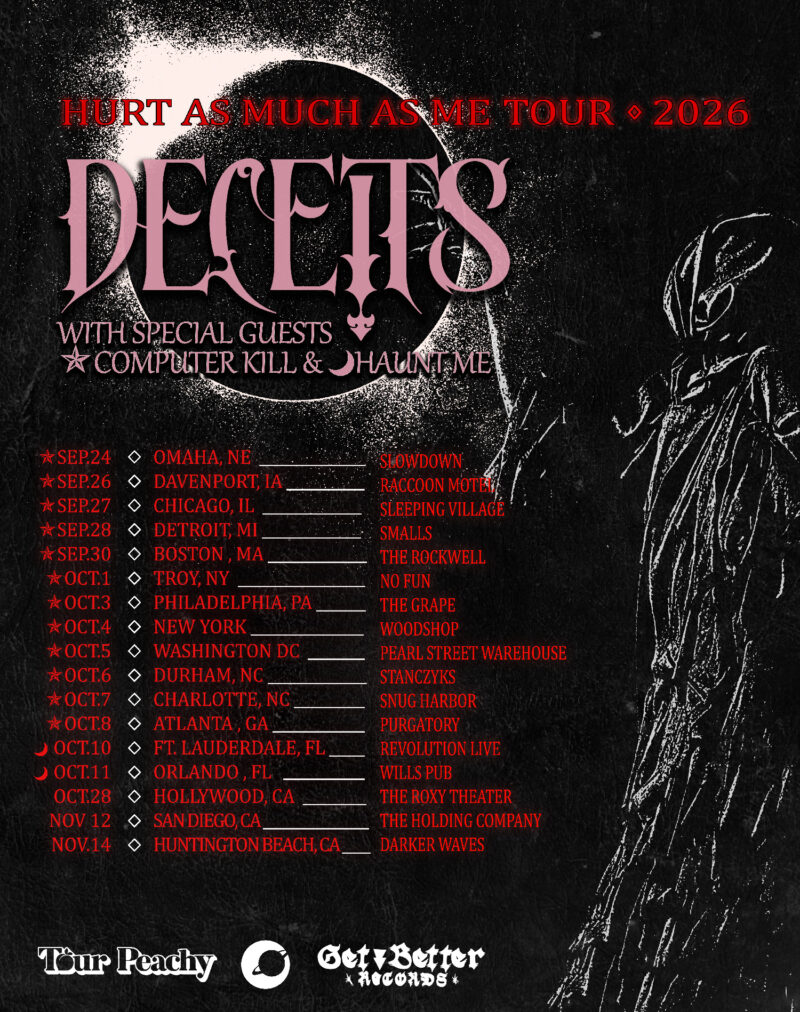
DECEITS continue their Hurt As Much As Me Tour through the United States, followed by an appearance at BLOODFLOWERS — Japan Goth & Post Punk Festival in Tokyo and dates in New Zealand and Australia. Get tickets here.
US dates — 2026:
September 24 — Omaha, NE — Slowdown*
September 26 — Davenport, IA — Raccoon Motel*
September 27 — Chicago, IL — Sleeping Village*
September 28 — Hamtramck, MI — Small’s*
September 30 — Somerville, MA — The Rockwell*
October 1 — Troy, NY — No Fun*
October 3 — Philadelphia, PA — The Grape Room*
October 4 — Brooklyn, NY — The Wood Shop*
October 5 — Washington, DC — Pearl Street Warehouse*
October 6 — Durham, NC — Stanczyks*
October 7 — Charlotte, NC — Snug Harbor*
October 8 — Atlanta, GA — Purgatory at The Masquerade*
October 10 — Fort Lauderdale, FL — Revolution Live†
Alice In Chains have released six studio albums, three EPs and a live record that sold two million copies, and almost every ranking you’ll find quietly ignores half of that. This is all nine of the releases that matter, ranked worst to best, counting up from nine to one. It includes Sap, it includes Jar of Flies, and it includes MTV Unplugged, because you cannot tell the story of this band and leave out a number one EP and the most-watched performance they ever gave. The album at the top will not shock anybody. The one at number two is where people start shouting.
How This Is Ranked
One question: how good is the record, and how much of it still works now?
That’s it. Not sales, not what it meant at the time, not whether Layne Staley was on it. Those things come into the argument as evidence, never as the verdict. A four-track EP from 1992 outranks a full studio album from 2018 on this list, and I’ll defend that when we get there.
Two notes on scope. The EPs are in because Jar of Flies went to number one on the Billboard 200 and leaving it out to protect a tidy list of six would be cowardice. MTV Unplugged is in because it’s a real release with a chart position and a certification, and it’s also the last great performance of that lineup. Live albums are judged against studio albums here, and that costs it.
The band formed in Seattle in 1987 — Layne Staley, Jerry Cantrell, Mike Starr and Sean Kinney. Mike Inez replaced Starr on bass in January 1993. Staley died on 5 April 2002, aged 34. William DuVall joined as co-vocalist and rhythm guitarist in 2006 and has now been in the band longer than Staley was.
The Full Alice In Chains Discography
Look at the chart column and then look at the certifications, because they tell two completely different stories. The Devil Put Dinosaurs Here debuted at No. 2 and has never been certified. Facelift peaked at 42 and went three times platinum. In the nineties an album climbed. Now it arrives, and whether anybody keeps it is a separate question entirely.
Seven years on from the last one, recorded partly in Seattle for the first time since Dirt, and it should have been an event.
It isn’t a bad record. That’s the problem. ‘The One You Know’ and the title track are perfectly good Alice In Chains songs, DuVall and Cantrell’s harmonies are as locked-in as they’ve ever been, and the guitar tone is enormous. Then it finishes and almost none of it stays with you.
This is the only Alice In Chains record where you can hear the band operating rather than reaching. It peaked at 12, which is the lowest chart placing of their post-2009 run, and it’s the one nobody brings up.
8. The Devil Put Dinosaurs Here (2013)
Sixty-seven minutes. Twelve songs. It debuted at No. 2, which is the highest chart position of the entire DuVall era, and it’s about twenty minutes too long.
There’s a genuinely great album buried in here. ‘Stone’ is one of the heaviest things they’ve recorded with either singer. ‘Hollow’ works. ‘Voices’ is the best pop song Cantrell has written this century. But the sequencing lets the middle sag, and the back half asks for a level of patience the songs don’t earn.
Cut four tracks and this is top five. As released, it’s the record that proved the reunion had stamina and not much editing.
7. Sap (1992)
Four songs, twenty-two minutes, recorded almost by accident between the first two albums after Sean Kinney dreamt the band made an acoustic EP.
‘Brother’ and ‘Got Me Wrong’ are the reason people still talk about it, and ‘Got Me Wrong’ had a second life years later when it turned up in Clerks. Chris Cornell sings on it. Mark Arm sings on it. Ann Wilson of Heart sings on it. For a throwaway it has an absurd guest list.
It sits at seven because it’s slight by design and it’s over before it starts. It also did something more important than its length suggests — it told everybody that this band could go quiet without going soft, which set up the record two places up from here.
It peaked at 134 and went Gold anyway, on four songs.
6. MTV Unplugged (1996)
10 April 1996, the Brooklyn Academy of Music, and the only time Alice In Chains ever played as a five-piece.
They hadn’t played live in two and a half years. Staley is visibly unwell and the performance is extraordinary anyway — ‘Nutshell’ from this show is the version everybody means when they say ‘Nutshell’, and ‘Down in a Hole’ has never sounded better than it does here. It went to No. 3 and twice platinum.
So why sixth? Because it’s a live record of songs that already exist, and ranking it above the albums that produced them would be sentiment rather than judgement. It’s the best possible document of a band at the end of something. It isn’t new music, and that’s what this list is measuring.
If you only ever watch one thing about this band, watch this.
5. Black Gives Way to Blue (2009)
Nobody thought this would work. I certainly didn’t.
Fourteen years after the last album and seven after Staley’s death, Alice In Chains came back with a singer nobody had heard of and made a record that sounds like Alice In Chains rather than like four men doing an impression of themselves. That’s the hardest trick in music and they managed it on the first attempt.
William DuVall was smart enough not to try to be Layne, and Cantrell’s harmonies did the rest — those vocals were always the sound, more than either individual voice. ‘Check My Brain’ is a genuinely strange hit single. ‘Your Decision’ is beautiful. And the title track, with Elton John on piano, is a goodbye to Staley that earns every second of itself without ever getting maudlin.
Gold, No. 5, and the reason there was a band at all after 2009.
4. Facelift (1990)
The debut, and the one that gets underrated because of what came next.
‘Man in the Box’ is on it, and that song did more to move heavy music out of the eighties than most albums managed — the wah-drenched vocal, the riff that doesn’t resolve, the whole thing sounding like nothing on radio at the time. ‘We Die Young’, ‘Bleed the Freak’ and ‘Love, Hate, Love’ are all still in the live set for a reason.
What holds it at four is that it’s a band still half-dressed in what it was. There’s hair metal residue in the production and a couple of tracks that sound like a different group. You can hear them deciding what they’re going to be.
It peaked at 42 and took until 1993 to go platinum. It’s now certified three times over, which is the sound of an album that was right before anybody realised.
The self-titled one. The three-legged dog. The record made by a band that was falling apart while it was making it.
It went straight to No. 1 and it is the bleakest, slowest, most airless thing they ever put on tape. ‘Grind’ opens it with Cantrell answering the rumours directly. ‘Heaven Beside You’ is the closest Alice In Chains got to a standard. ‘Sludge Factory’ and ‘Frogs’ are genuinely difficult listening and they’re supposed to be.
It gets marked down against the two above it because the atmosphere occasionally does the work the songs should be doing, and there are stretches where it drifts. But it is the most honest record in the catalogue and the one that has aged the strangest — it sounded oppressive in 1995 and it sounds like a document now.
They played four shows to support it, then Unplugged, then nothing.
2. Jar Of Flies (1994)
Here’s the argument, and I know exactly how it’s going to go down.
Jar of Flies was recorded in a week. Seven songs, about half an hour. Columbia put it out as a stopgap EP and it became the first EP in history to debut at No. 1 on the Billboard 200. It’s since gone four times platinum, which is more than the self-titled album and more than Facelift.
More importantly, it’s perfect. There is not one wasted bar on it. ‘No Excuses’ is the closest this band ever came to a song that swings, and it went to No. 1 on Mainstream Rock without sanding a single edge off them. ‘I Stay Away’ brings in strings and somehow doesn’t sound ridiculous. ‘Don’t Follow’ hands the first half to Cantrell on an acoustic before Staley walks in and takes it somewhere else entirely. And ‘Nutshell’ is four minutes of Layne Staley telling you exactly where he is, which is very hard to listen to now.
A seven-track EP made in seven days sits at number two on a list with five studio albums under it, and the reason is simple: nothing on it is filler, and every full-length in this catalogue has some.
Dirt is the record where every part of this band arrived at once — Cantrell’s riffs at their heaviest and most inventive, Staley at the absolute peak of what he could do, and a rhythm section that makes the whole thing lurch rather than drive. It’s thirteen songs and six of them are about addiction, and the band never once flinches or moralises about it.
‘Them Bones’ opens it in seven-eight time with a scream, which is a preposterous way to start a record that went five times platinum. Then ‘Rooster’ — Cantrell writing about his father in Vietnam, and the most emotionally direct thing in the catalogue. Then ‘Down in a Hole’, ‘Angry Chair’ and ‘Would?’. The run from ‘Junkhead’ through ‘Dirt’ to ‘God Smack’ is the bleakest twelve minutes in mainstream rock and it never feels like a pose.
It only reached No. 6. It has outsold everything else they’ve ever done, going five times platinum, and it’s the album people reach for when they want to explain what the early nineties actually sounded like underneath the flannel. Mammoth WVH covering ‘Them Bones’ three decades later tells you how far that reach goes.
It’s the best Alice In Chains album, it’s one of the best albums of the nineties full stop, and there’s no interesting contrarian position to take on it.
Which Alice In Chains Album Is The Heaviest?
Two answers, because it depends what you mean.
By riff, it’s Dirt. ‘Them Bones’, ‘Angry Chair’ and ‘God Smack’ are the heaviest things Cantrell has written, and the guitar tone on that record is thicker than anything before or since. If you want the album that hits hardest, this is it.
By feel, it’s the self-titled 1995 album. It’s slower, murkier and considerably more unpleasant to sit through — ‘Sludge Factory’ and ‘Frogs’ do something to a room that Dirt doesn’t. It’s less heavy and more oppressive, and for a lot of people that’s worse in the best way.
Third place goes to ‘Stone’ from The Devil Put Dinosaurs Here, which is heavier than anything in the DuVall era and doesn’t get talked about enough.
What’s Not On This List
We Die Young (1990) — a three-track promo EP that came out just before Facelift, and all of it turns up on the album. Not enough of a standalone release to rank.
Live (2000) and Live Facelift (2016) — both archival, neither essential, and ranking three live albums on a nine-entry list would be absurd.
No compilations. Music Bank, Nothing Safe and the rest are collections of songs already ranked here.
The Full Ranking
Dirt (1992)
Jar of Flies (1994)
Alice in Chains (1995)
Facelift (1990)
Black Gives Way to Blue (2009)
MTV Unplugged (1996)
Sap (1992)
The Devil Put Dinosaurs Here (2013)
Rainier Fog (2018)
Studio albums only, for anyone who wants that version: Dirt, Alice in Chains, Facelift, Black Gives Way to Blue, The Devil Put Dinosaurs Here, Rainier Fog.
Where They Stand Now
Alice In Chains have made three albums with William DuVall and he has now been in the band for twenty years, which is longer than Layne Staley managed. That fact makes people uncomfortable and it shouldn’t. Cantrell has been careful about it from the start, and the reason the reunion worked where so many don’t is that nobody pretended a replacement had happened.
Alice In Chains just keep quietly turning up. They’re one of the defining bands of that decade, and the reason isn’t nostalgia — it’s that Dirt and Jar of Flies still sound like they were made yesterday by people who meant it.
Dirt, released in 1992. It’s their highest-selling record at five times platinum, it peaked at No. 6 on the Billboard 200, and it’s the album where Layne Staley’s vocals and Jerry Cantrell’s riff writing both hit their peak at the same time. Jar of Flies, an EP, ranks second here.
How many albums do Alice In Chains have?
Six studio albums: Facelift (1990), Dirt (1992), Alice in Chains (1995), Black Gives Way to Blue (2009), The Devil Put Dinosaurs Here (2013) and Rainier Fog (2018). They’ve also released three EPs — We Die Young, Sap and Jar of Flies — and the MTV Unplugged live album.
What is the worst Alice In Chains album?
Rainier Fog, released in 2018. It’s well played and well produced, but it’s the only Alice In Chains record that doesn’t leave anything behind once it finishes. It’s also their lowest-charting album since the 2009 reunion, peaking at No. 12.
Is Jar of Flies an album or an EP?
It’s an EP, seven tracks and roughly half an hour long, released in January 1994. It became the first EP in history to debut at No. 1 on the Billboard 200 and has since been certified four times platinum, outselling several of the band’s full-length albums.
Which Alice In Chains album is the heaviest?
Dirt has the heaviest riffs and the thickest guitar tone, particularly ‘Them Bones’, ‘Angry Chair’ and ‘God Smack’. The 1995 self-titled album is the more oppressive listen — slower, murkier and harder to sit through, especially ‘Sludge Factory’ and ‘Frogs’.
Nine records, and I’ve put a seven-track EP above three studio albums. Come and tell me I’m wrong — and tell me where Jar of Flies really belongs. Follow Loaded Radio for daily rock and metal news.
Roughly 40 years to the day that Sweden’s hard rock powerhouse Europe took the world by storm with their breakout 3rd studio album The Final Countdown, said quintet is still most often associated with the arena-oriented excess of the mid-1980s. Granted, it’s rare for a northern European upstart to crack the Billboard Top 10 in the United States, but there is definitely something to be said for the fact that this band has been doing far more than living in the past since reuniting in 2003.
Far from being a band content to stand still and continually employ the same stylistic template, the musicians that brought blaring synthesizers and space travel to the days of big hair and bigger melodies have seamlessly adapted to the era of modern rock and progressed onward to new horizons. Now 12 albums deep into their career, Europe presents arguably the most potent blend of old and new via 2026’s Come This Madness, their first LP in nearly a decade.
Relative to the dark and heavy pivot that was 2004’s Start From The Dark and the assorted elements of progressive, alternative, and blues-driven 70s rock that followed, Europe has arguably found itself closer than ever to its mid-80s AOR glory days. Much of this owes to an expanded role played by keyboardist Mic Michaeli, who has brought back some of the spacey synthesizer elements into the equation to complement the Hammond organ and symphonic elements that have been more his staple over the past several albums.
Combined with a still heavy and bluesy riff assault out of John Norum and a punchy, gritty, and loose-flowing display out of bassist John Leven and drummer Ian Haugland, a strong synchronicity emerges that effectively balances a wide array of bygone and recent influences. Joey Tempest’s soaring tenor, though possessed of a slightly deeper tone relative to the days of “Rock The Night” and “Superstitious”, has lost none of its signature thunder and boldly leads the sonic onslaught to its various destinations.
Things begin on a highly cinematic note, featuring a pristine symphonic prelude to set the stage. In short order, a busy bass intro ushers in a hard-edge rocking groove with a brilliant blend of dank bluesy swagger and smooth 80s atmosphere that is “One On One”, effectively nailing a boisterous vibe normally associated with the classic 70s era of Boston and Journey with a modern twist.
Nipping right on its heels is a similarly styled but more up-tempo banger in “The Cult Of Ignorance” that matches fancy synthesizer work almost akin to something Stratovarius might dream up with an AC/DC meets Led Zeppelin-inspired guitar display out of John Norum. Rounding out the trifecta of early album brilliance is the more Deep Purple-tinged title entry “Come This Madness”, which still comes chock full of enough spacey keyboards and blustering chorus hooks to blur the lines between the mid-80s and the mid-2020s. Taken alongside enthralling numbers later on the album like “Takin’ It Back” and the closing hurrah “Nothing Can Follow This” that tread the same middle ground between recapturing The Final Countdown and pressing forward, this is where Come This Madness really shines.
Nevertheless, the moments where Europe opts to place greater emphasis on their eclectic post-2003 accomplishments, the results are no less triumphant. The charming power ballad “This Time Of Year” sees Michaeli painting a melancholic atmosphere with a straight piano and strings blend, giving Joey Tempest the needed room to let his vocal performance shine with a more minimal presentation from the rest of the arrangement.
Heavier modern rocking entries like “In A Different World” and the alternative-oriented groove machine “The Angels Must Have Flown” are where Norum’s six-string chops really shine, the former seeing him brilliantly channeling the stylings of Ritchie Blackmore, while the latter matches a similarly bluesy lead display with the darkest riff work present on the entire album.
The charming minute-and-a-half piano ballad “In The Absence Of Grace” finds Tempest serving up extra bright vocals despite/because of the more exposed context, but insofar as the entire band shining as a cohesive unit, the mini-epic rocker with a lofty atmospheric backdrop and some progressive trappings “Scandinavian Eyes” takes the cake and immediately demands seconds.
For longtime fans of this Swedish rock original, the fact that their post-reunion output has now exceeded their original 80s run must be nothing short of surreal, but it definitely reveals a quintet of musicians that are more dedicated to the craft than they are interested in simply chasing trends or becoming a glorified tribute act that only plays the oldies.
Come This Madness is an album that underscores such a commitment, regularly crossing boundaries that would have been unheard of during the early days of MTV, all the while coming away with a collection of standalone anthems that work on every level. It never feels wholly like a feat of nostalgia, yet one can’t help but hear some mighty echoes of what rock was before the rise of grunge all over it.
If nothing else, key entries on here will blend in more easily with Europe’s pre-1992 material in a live setting, and hopefully it’ll be less than 9 years before the world gets to see where Europe goes next.
Release Date: September 25th, 2026 Record Label: Silver Lining Music Genre: Hard Rock